Explore top 10 tips to secure your open-source projects now. Read More
×



Server Security data privacy automation
data privacy automation Every system admin has lived through the same Monday morning ritual. A queue of forty tickets, half of them password resets, permission errors, or disk space warnings that any experienced technician could resolve in under two minutes. The other half require actual judgment. For years, automation promised that software would eventually sort the two apart on its own. That promise is now being tested in production Linux environments. . Early results are reshaping how IT teams think about tier-1...
 Jul 17, 2026

Privacydata collection automation
data collection automation You're running a web scraping project to collect pricing data from e-commerce sites. You set up a pool of datacenter proxies, launch your scripts, and within minutes — banned . CAPTCHAs everywhere. Your data pipeline stops before it really begins. . It's a frustrating scenario that plays out daily in ad verification, market research, and multi-account management. The website doesn't know you're doing legitimate research or monitoring. It just sees traffic coming from IP ranges it recognizes as...
Jul 17, 2026

Security Trends security advisory social engineering
security advisory social engineering Business Email Compromise used to be a numbers game — mass-blasted emails, broken English, an obvious "URGENT WIRE TRANSFER" subject line. That era is over. Generative AI has turned BEC into a tailored, low-noise operation that mimics writing style, voice, and even video presence. This piece looks at what's actually changed under the hood, what defenders are testing in response, and why so many organizations are still structurally unprepared for it. . The Infrastructure Problem Nobody Wants to...
Jul 17, 2026
Security Trends cybersecurity Linux documentation
cybersecurity Linux documentation Linux operating systems have gained prominence due to their stability, adaptability, and excellent security options. In the case of developing documentation, designing cybersecurity dashboards, or educational material, visuals are of vital importance when it comes to making things clear. The use of icons allows one to understand the message regarding alerts, authorization, encryption, authentication, or the state of the system just by looking at the visual cue without having to read long...
Jul 17, 2026
Security Vulnerabilities security advisory linux distribution
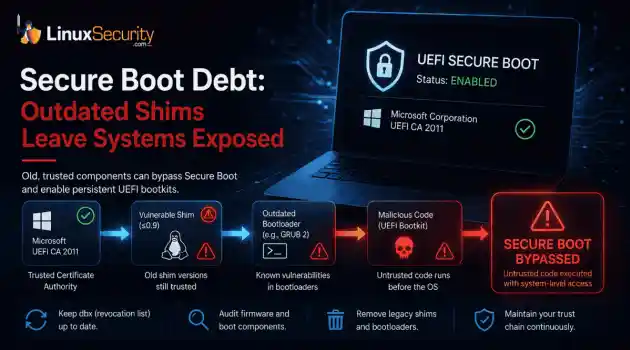
security advisory linux distribution ESET researchers identified 11 old and forgotten Linux UEFI shim bootloaders at versions 0.9 and below that can be used to bypass UEFI Secure Boot on any UEFI-based machine that trusts Microsoft’s Microsoft Corporation UEFI CA 2011 third-party certificate authority, regardless of the installed operating system (OS). Reported shims can be exploited to execute untrusted code during system boot, enabling attackers to deploy malicious UEFI bootkits even on systems with UEFI Secure Boot enabled.....
Jul 16, 2026
 Refine news
X Clear Filters
Get the latest News and Insights
Get the latest Linux and open source security news straight to your inbox.
Community Poll
Is continuous patching actually viable?
Loading...
Explore Latest Linux Security news
We found 69 articles for you...
78
 fedoradebianubuntu
In-depth Security Comparisons: Debian, Fedora, and Ubuntu Distributions
As a Linux security admin, choosing the right distribution is a crucial decision that will immensely impact your administration workflow. Debian, Fedora, and Ubuntu are three popular Linux distros that offer unique security features and characteristics. Fedora is like a cutting-edge scientist, constantly innovating with built-in tools like SELinux and delivering rapid security updates. . On the other hand, Debian is the reliable guardian, known for its stability and extensive testing, albeit with slightly slower adoption of new technologies. Then there’s Ubuntu, the user-friendly diplomat, offering a balance between usability and security with features like AppArmor and timely, albeit less frequent, updates compared to Fedora. In this article, I'll dive into the nitty-gritty of these distributions' security landscapes. I'll explore how each handles default configurations, manages updates, and what kind of community support you can expect. I’ll also highlight some pain points — because no distribution is without flaws — and provide practical insights to help you decide which distro best fits your security needs. Whether you're an SELinux wizard, a Debian stability fan, or an AppArmor enthusiast, understanding these differences can make a notable difference in your day-to-day operations. An In-Depth Security Analysis of Debian Debian is a rock-solid choice for many Linux admins, primarily due to its stability and well-maintained security features. One thing that makes Debian stand out is its predictable and stable release cycle. Each stable release gets around five years of security updates, so you can count on your systems staying secure over time without any surprises. The Debian Security Team is on the ball, too. They issue security advisories and updates promptly, and their dedicated security repository ( security.debian.org ) ensures you can get these patches easily and quickly. Also, Debian's default installation is pretty lean and secure right off the bat. It avoids runningunnecessary services, which helps keep the attack surface small. And if you're looking to beef up security further, Debian supports AppArmor , which lets you confine applications to tight security policies. Debian’s participation in the Reproducible Builds project is a big plus, assuring that the binaries you're running are genuine and haven't been tampered with. Another thing I appreciate about Debian is its strong security community. These folks are passionate and extremely collaborative, consistently working on identifying and fixing vulnerabilities. And let's not forget the Debian Security Tracker, which keeps everything transparent—you can check the status of vulnerabilities and the rollout of patches anytime. However, no system is perfect. One gripe some admins have with Debian is its SELinux support. While it supports AppArmor, SELinux , which offers more granular control, isn’t as polished or user-friendly. This might be a sticking point if you come from a Fedora or CentOS background. Also, while Debian does a good job with security patches, it’s conservative. This means you might not get some updates as fast as you would on a rolling-release distro like Arch Linux. Kernel hardening is another area that could use a bit more love. Debian’s default kernel is secure but not as aggressively hardened as in some security-focused distributions like Qubes OS or Kali Linux . If you want those features, you’ll likely dive into manual configurations. Lastly, the commitment to stability sometimes means you're dealing with older versions of packages. This can be a double-edged sword; while you get well-tested software, you might miss out on newer security features found in the latest versions. Debian’s security framework offers an outstanding balance of stability and security, making it a dependable choice for many scenarios, especially on servers. But as with any distribution, knowing its strengths and weaknesses will help you maximize it for your specific use case. Fedora'sProactive Security Approach: Strengths & Challenges Fedora Linux stands out in the Linux ecosystem due to its solid focus on security. As a Linux admin, you'll appreciate that Fedora integrates cutting-edge technologies with a strong emphasis on keeping systems secure. One of its hallmark features is SELinux, which is baked right into the system to enforce strict access controls—imagine sleeping at night knowing that even if a service gets compromised, it's locked down tighter than Fort Knox! Plus, the Fedora team is on the ball with security patches and updates, pushing them out with a sense of urgency that keeps you ahead of potential threats. It’s also handy that Fedora comes with essential security tools, like firewalld , making it easy to hit the ground running. And let’s not underestimate the power of community; Fedora’s security community is teeming with experts whose contributions often improve not only Fedora but the entire Linux landscape. When setting up a new system, you’ll notice that Fedora promotes security best practices from the start, with default settings prioritizing the highest level of safety. On the flip side, some users find SELinux a bit of a beast to tame. Its complexity can be intimidating, especially for those just dipping their toes into Fedora's waters, sometimes leading them to disable it, precisely what you don't want. Also, given how up-to-the-minute everything is, all these frequent updates can be a bit resource-hungry, which might make you think twice if you're managing systems that aren't exactly brimming with hardware prowess. In essence, Fedora’s proactive security stance and robust community support make it a solid choice for any security-savvy admin. Still, it’s wise to brush up on your SELinux skills to make the most of Fedora's offerings. Ubuntu's Comprehensive Security Features: Benefits & Areas for Improvement Ubuntu is well-regarded for its strong security measures, making it a go-to Linux distribution for many users seekingrobust cybersecurity features. One of the main characteristics that stands out is its design philosophy, which prioritizes ease of use and accessibility, helping even those with a minimal technical background configure secure systems. Ubuntu provides regular security updates and patches faster than many other distributions. This proactive approach enables administrators to address vulnerabilities rapidly, reducing exposure to potential threats. Another unique aspect of Ubuntu is its default installation, which is configured with security in mind. By default, it includes a firewall called UFW (Uncomplicated Firewall) , making it easier to implement basic firewall settings without delving into complex configurations. Moreover, Ubuntu integrates with AppArmor, a security module that restricts the capabilities of programs to fortify your system against potential threats. The security community supporting Ubuntu is active and dedicated, frequently sharing best practices and guidelines for improving system security. Resources like Ubuntu Security Notices and Launchpad are vital for staying informed on recent threats and security patches. Ubuntu’s Security Team ensures that security vulnerabilities are closely monitored and promptly addressed. Despite these strong points, there are areas where Ubuntu could enhance its security offerings. For example, while AppArmor provides good protection, some users feel that the SELinux support isn’t as comprehensive as it could be, limiting users accustomed to the more granular policy controls found in SELinux. Although UFW simplifies firewall management, it does not offer the same depth of features as more advanced firewall solutions. Ubuntu's user-friendly security features, reliable update mechanisms, and supportive community make it a solid choice for many. However, there is always room for improvement, especially in broadening the capabilities of built-in security tools to match those in more specialized security distributions. Our FinalThoughts: Choosing the Right Linux Distribution for Optimal Security Choosing the right Linux distribution can significantly impact your security posture. Debian's focus on stability and extensive testing procedures makes it an excellent choice for those prioritizing a time-tested, reliable environment. Fedora's rapid update cycle and cutting-edge security features, such as SELinux, cater to those who need the latest advancements and are willing to manage a more dynamic system. With its balanced approach, Ubuntu provides an accessible yet secure platform, leveraging features like AppArmor to offer protection with ease of use. Your choice should reflect your specific security needs and operational priorities. Whether you prefer Debian's stability, Fedora's innovation, or Ubuntu's balanced approach, understanding what each distribution offers can help you make the right decision. With this knowledge, you can tailor your security strategy to match the unique characteristics of your chosen distro, ensuring robust protection for your systems. . Evaluate Linux distributions like Debian, Fedora, and Ubuntu by considering their unique security strengths and weaknesses to find the best fit for your needs. Debian Security, Fedora Features, Ubuntu Administration. . Brittany Day
 Mar 26, 2025
•
Mar 26, 2025
• Vendors/Products
79
Debianlinux distributionapplication managementFree10: A Debian-Focused OS for Windows 10 Users Prioritizing Security
If you're a security-conscious Linux admin or a Windows 10 user considering a switch to Linux, you might be surprised to learn about Free10 . This Linux distribution offers significant security benefits while boasting a familiar Windows-like interface. . With a solid Debian foundation, Free10 makes switching easier while providing security benefits - not to mention no need to navigate around a new interface and risk introducing potential security risks! One of the key advantages of Free10 is its customization capabilities to meet your security needs. KDE Plasma-based customization options help meet admins' specific needs, from full-featured setups to interfaces that minimize the attack surface. Furthermore, with Flatpak support available within Free10, you can run applications in isolated environments, further increasing security by restricting their access to system resources. Let's take a closer look at the features that make Free10 user-friendly and robust enough to meet high-security standards and provide a viable Windows 10 alternative for admins looking to transition to Linux. A Familiar Interface with Strong Security Underpinnings Free10 makes transitioning to a new operating system less daunting by providing an interface similar to Windows 10, helping reduce learning curves for those familiar with its use. Its desktop layout, start menu, and overall design philosophy offer familiarity, reducing errors that could compromise security as users adjust to a different system. Debian, renowned for its stability and security, lies beneath this familiar Windows-like shell. Debian's strict package management and regular security updates allow Free10 users to take advantage of all the latest patches without needing to navigate a complex update process, making this environment suitable for newcomers and veteran Linux admins looking for an accessible yet secure system. Desktop Customization for Enhanced Security Free10 stands out among competing OSes because of its flexible desktopenvironment customization features. Users can select from a selection of desktop environments based on KDE Plasma , including full-featured, basic, and minimal setups. Customization does more than satisfy aesthetic preferences; it has significant security implications. Opting for a minimal desktop setup can be especially beneficial to users who prioritize security over all else. A minimal desktop features fewer programs and services running by default, reducing its attack surface and making the system more secure. Furthermore, customizing Linux admin environments to focus on security while offering a usable environment is another helpful approach, ensuring all daily tasks can be performed smoothly. Switching between desktop profiles is especially valuable for administrators overseeing multiple systems or users with differing security needs, such as handling sensitive data in an environment with a minimal setup. On the other hand, development environments might need full-featured desktops equipped with additional applications and services. KDE Discover and Flatpak: Secure Application Management Free10 uses KDE Discover to assist users in discovering and installing applications with minimal hassle, making KDE updates easily available. Hence, users always have access to the latest features and security patches. This approach ensures users can always benefit from accessing new features or patches without delay. One of the more surprising features of Free10 is its support for Flatpak , an innovative packaging format designed to increase application security. Although Free10 doesn't have this support by default, it can be easily accomplished in KDE Discover by opening its settings and clicking "Add Flathub." Flatpak applications run within isolated environments known as sandboxes, which greatly increase security by restricting access to system resources and user data. This is particularly helpful when installing proprietary or third-party applications that pose risks of system-wide issues oraccessing sensitive data. Linux admins will appreciate KDE Discover and Flatpak's sandboxing features, allowing them to monitor applications easily while protecting against security vulnerabilities. Free10 is an attractive option for tech-savvy users who require secure systems and those looking for simpler operating environments with better protections against vulnerabilities. Stability and Regular Updates OS security extends beyond inherent features and hinges upon regular and stable updates . Debian was chosen as the foundation for Free10 because of its proven record for stability, with rigorous testing processes before updates are released. This ensures each update provides improved security and is reliable enough to reduce system crashes or other issues that might compromise it. Free10 takes its inspiration from Debian by providing users with regular and secure updates that keep their systems safe from new threats and ensure users can rely on up-to-date security patches to defend against newer ones. Users can trust that Free10 will always remain up-to-date regarding its defenses against threats as time progresses. With this foundation, they know their system remains protected against persistent and emerging attacks. User and Admin-Friendly Environment Transitioning to a new operating system can be daunting for non-tech-savvy users or those deeply invested in the Windows ecosystem. Free10's design, which mimics that of Windows 10, dramatically lowers the barrier to entry for these users. They don't need to learn unfamiliar workflows or navigation methods, which could cause frustration or compromise security. Linux administrators will benefit from this user-friendly environment in that less time is spent training and supporting end-users. Instead, they can devote more of their attention to configuring and maintaining security on the system. It also empowers end-users to manage basic tasks themselves without incurring unnecessary security risks through unfamiliarity. Community andSupport Free10 benefits from having access to one of the largest and most active Linux communities - Debian . This community contributes regular updates and security patches while providing administrators with plenty of resources they can draw upon when troubleshooting and aiming to increase security on their system. Free10 users also benefit from forums, documentation, and support channels where they can pose their queries, share experiences with fellow users and developers, and get advice from other Free10 users and developers alike. This collaborative environment fosters continuous improvement while keeping an eye on security measures. Our Final Thoughts on Transitioning to Free10 Free10 provides an attractive alternative for security-conscious Linux administrators and Windows 10 users looking to switch over. Featuring a familiar Windows-like interface, robust Debian-based security, customizable desktop environments, and application management support via KDE Discover and Flatpak, Free10 is a safe yet practical choice. Free10 provides everything necessary to secure multiple systems with differing security needs or create a user-friendly yet secure environment for personal use, making it the ideal solution for maintaining high standards without compromising usability. Its familiarity, customization, and strong security foundations make Free10 an attractive alternative to Windows while offering secure workflow capabilities. You can easily download and install Free10 for free. Have you given Free10 a try? We'd love to hear what you think @lnxsec ! . Free10's Debian framework simplifies the switch from macOS, offering enhanced safety and an interface that feels like home.. Free10 Linux, Debian security, KDE Plasma customization, secure Linux alternative, Linux distribution features. . Brittany Day
Feb 25, 2025
•
Security Projects

79
 security advisorysecurity featureslive patching
Linux Kernel 6.14: Enhanced Security and Networking Features Explained
With the release of Linux kernel 6.14 , admins and Linux users have many new features and enhancements to look forward to - especially in the realm of security! This version improves defenses against well-known vulnerabilities like Spectre and Meltdown, integrates advanced security modules, and offers robust live patching capabilities. The support for new hardware means you can take advantage of the latest security enhancements built into modern CPUs and devices, making systems faster and more secure. . Beyond these improvements, updates to networking protocols and firewall configurations ensure your network defenses are tighter than ever. Data integrity and confidentiality have reached new heights with filesystem improvements focused on better encryption and secure deletions. As Linux security admins, it is crucial that we familiarize ourselves with these updates, test them in controlled environments, and revise our security policies to leverage these advancements effectively. The 6.14 kernel isn't just an upgrade—it’s a toolkit to future-proof the security of your systems. Let's examine some of the key updates and advancements you can expect in Linux kernel 6.14 and how they will improve the security of your systems. Enhanced Security Features One of the most significant areas of improvement in Linux kernel 6.14 is its enhanced security features. Kernel developers have continued to refine their mitigations for hardware vulnerabilities such as Spectre and Meltdown . These vulnerabilities, which exploit speculative execution in processors, have been a significant concern in the industry. With each kernel release, security measures become more sophisticated, providing a crucial layer of defense. Additionally, Linux 6.14 brings improvements in existing security modules. For instance, systems using AppArmor and SELinux , frameworks designed for enhanced access control, will benefit from more granular control over system access and behavior. These updates allow administrators to fine-tunesecurity policies further, making it even harder for malicious activities to go unnoticed or unchallenged. Support for Modern Hardware Another significant advantage is up-to-date hardware support. As new generations of processors and devices come equipped with advanced security features, having a kernel that supports these advancements is vital. The 6.14 kernel’s compatibility with the latest hardware ensures that these built-in security features are utilized, offering enhanced protection mechanisms not available in older hardware. For instance, new CPUs often come with improved hardware-based isolation techniques and better performance counters, aiding in detecting anomalies and potential intrusions. Embracing these advancements means that not only can you maximize performance, but you also secure your system more effectively against emerging threats. Filesystem and Storage Improvements Filesystem improvements are typically a highlight of new Linux kernel releases, and version 6.14 is no different. File systems like ext4, Btrfs, and XFS have seen enhancements that improve data integrity and security . Improved encryption support makes it harder for unauthorized users to access sensitive data, while features such as secure file deletions ensure that deleted data cannot be quickly recovered. Btrfs, for example, continues to evolve with better balance operations and more efficient storage utilization, which is crucial for maintaining data consistency and availability. Whether you're managing small-scale deployments or extensive storage solutions, these improvements mean your data is readily accessible to authorized users and protected against unauthorized access or corruption. Networking Enhancements Network security is paramount in today's interconnected digital environment, and Linux kernel 6.14 brings several enhancements in this area. The updated network stack supports new cryptographic algorithms, making encrypted communications more robust against decryption attempts. Improvedsupport for VPN protocols means that data transmitted across potentially unsecured networks remains private and secure. Firewalls have received special attention as well. Integrating with nftables or iptables improves efficiency, making your firewall rules more effective without compromising performance. Enhanced configurations and support for new security options ensure you can better defend against network-level attacks, reducing the attack surface and making it harder for adversaries to exploit vulnerabilities. Patch Management and Live Kernel Patching One critical task for any Linux admin is keeping systems patched with the latest security fixes. Linux kernel 6.14 enhances support for live patching, a feature that allows you to apply security patches without rebooting the system. This capability, supported by tools like Kpatch and KGraft , is vital for maintaining uptime and security. In environments where availability is critical, live patching ensures that security patches are applied promptly, minimizing the window of vulnerability while avoiding the disruptions caused by reboots. This means you can maintain a higher level of security without sacrificing the performance and availability of your services. Linux Kernel Lockdown Enhancements Linux Kernel Lockdown is a feature that restricts certain types of actions even from privileged users, preventing potential inadvertent or deliberate tampering with the core parts of the system. Kernel version 6.14 includes strengthened lockdown modes, providing multiple levels of lockdown that can be tailored to the security needs of your environment. These lockdown modes are particularly useful in high-security environments where it’s vital to ensure that even administrative accounts can’t perform actions that might compromise the system’s integrity. By enabling and configuring these enhanced lockdown features, you can create a more secure and resilient system that is better protected against internal and external threats. Actionable Considerations for Linux Admins With these advancements, Linux security admins should take a proactive approach to integrating the new features of the 6.14 kernel. Begin by planning for testing and deployment. Carefully test the latest kernel in a staging environment to identify and resolve compatibility issues, especially with third-party software and custom drivers. Review and update your security policies to take advantage of the new features. If enhanced encryption support is available, ensure it's configured correctly. Revising firewall and network security settings to include new protocol support and cryptographic algorithms can further harden your defense. Stay informed about new vulnerabilities and patches. A critical part of a security admin’s role is staying abreast of emerging security issues. Regular updates from Linux newsletters and security advisories are vital for maintaining a robust security posture. Our Final Thoughts on the Linux Kernel 6.14 Release The release of Linux kernel 6.14 brings enhancements and new features that significantly improve security. From better hardware support to enhanced filesystem and network security, this kernel version ensures we have the tools to protect our systems against current and emerging threats. By thoroughly testing and integrating these updates, staying informed about new patches, and continually refining security policies, we can leverage the full potential of the 6.14 kernel to create a secure, resilient, and future-proof computing environment. . The release of Linux Kernel 6.14 introduces significant improvements in security measures, network capabilities, and filesystem functionality aimed at enhancing overall protection.. Linux kernel updates, security enhancements, Linux administration, system security. . Brittany Day
Feb 03, 2025
•
Security Projects
215
 security featuresdata recoverydesktop environments
Spiral Linux: Data Recovery Features and Security Benefits
Spiral Linux is a Debian-based distribution that offers a range of desktop environments, making it stand out from other Linux distributions. In addition, it comes with a unique tool called SnapperGUI , which simplifies the process of creating operating system snapshots. These snapshots serve as a data recovery solution, allowing users to revert to a previously working state easily. . While Spiral Linux may not provide as many bells and whistles as other distributions, it offers a solid foundation, numerous desktop options, and a powerful data recovery tool that sets it apart. What Sets Spiral Linux Apart From Other Distros Regarding Security? A main feature of Spiral Linux is SnapperGUI. This tool simplifies the creation of snapshots, allowing users to easily revert to a previous state if anything goes wrong. The importance of data recovery must not be overlooked and frustration can be avoided by having readily available snapshots. This is possible with Spiral Linux, making it an excellent choice for users prioritizing security and reliability. Moreover, long-term implications must be considered. While Spiral Linux provides a reliable backup option, the lack of scheduled snapshots raises concerns. Users must remember to manually take snapshots, which may be cumbersome for those who prefer automated solutions. This limitation leads to the question of whether Spiral Linux should consider incorporating scheduled snapshots to enhance its usability. The impact of Spiral Linux on security practitioners is significant. With most tasks being performed within a web browser, the distro provides the opportunity to switch to an exponentially more secure and flexible operating system. Security-conscious users will find the reliability and data recovery capabilities of Spiral Linux appealing, as it provides a safety net for protecting sensitive information. Our Final Thoughts on Spiral Linux Spiral Linux stands out among its competitors with its wide range of desktop environments and powerful datarecovery tool, SnapperGUI. While it may not offer the same level of customization as other distributions, its solid foundation and emphasis on security make it a reliable choice for security-conscious practitioners. You can download Spiral Linux here. . Spiral Linux provides a solid foundation with security features and data recovery solutions like SnapperGUI for users.. spiral, linux, debian-based, distribution, offers, range, desktop, environments, making. . Brittany Day
May 08, 2024
•
Desktop Security
78
 Ubuntusecurity featurescommunity support
Linux Mint vs Ubuntu: Security Features Comparison for Admins
Linux Mint and Ubuntu are two popular Linux distributions that have gained a reputation for prioritizing system safety. It is crucial for Linux administrators, infosec professionals, and internet security enthusiasts to understand the security measures implemented by these distributions. Let's examine the security features and enhancements available to Ubuntu and Linux Mint users to help you determine if one of these distros could be a good fit for your priorities and requirements. . How Do Linux Mint & Ubuntu Security Measures Compare? Both Ubuntu and Linux Mint aim to provide a reliable and secure computing environment. Linux Mint, known for its intuitive design, employs a multi-layered kernel security technique, along with a vigilant Update Manager ensuring software packages are up to date. Additionally, Linux Mint offers a well-balanced firewall that enables users to adjust rules and maintain security while providing a smooth experience. Ubuntu, on the other hand, utilizes AppArmor to restrict programs and minimize security breaches. This access control architecture strengthens security by lowering the attack surface and mitigating vulnerabilities . Ubuntu also implements Secure Boot, which ensures that only authorized bootloaders and kernels are launched during the starting procedure. This feature significantly reduces the risk of boot-time attacks, enhancing system security. The update policies of Linux Mint and Ubuntu are a key differentiator between the two. Linux Mint provides fewer updates, offering a solid foundation and a careful approach, which may appeal to users seeking a stable environment. However, this approach may not always include the latest security updates. On the contrary, Ubuntu prioritizes frequent system updates to ensure users promptly receive the latest patches. Linux courses can guide enthusiasts in selecting the approach that aligns with their security philosophy. Both Linux Mint and Ubuntu benefit from active and watchful communities, which contribute toregular security audits and bug fixes. This community-based strategy enhances the overall security posture of these distributions, establishing trust and reassuring users of a safe computing experience. An important consideration is the balance between security and usability. Linux Mint's focus on providing a smooth, out-of-the-box experience might be beneficial for beginners or users who prefer simplicity. However, this could potentially result in a trade-off with system security. Balancing user convenience with robust security measures is an ongoing challenge for both Linux Mint and Ubuntu. Final Thoughts on Ubuntu vs. Linux Mint Security Security practitioners, Linux admins, infosec professionals, and internet security enthusiasts can rely on Linux Mint and Ubuntu's commitment to system safety. However, it is essential to critically evaluate the security features and understand the implications they have in real-world scenarios. Ongoing investigation and collaboration within the Linux community are necessary to keep pace with evolving threats. Striking the right balance between usability and security remains an ongoing challenge for both distributions. By staying informed and actively participating in the Linux ecosystem, security practitioners can make sound decisions to ensure a dependable and safe computing experience. . Fedora and OpenSUSE both aim to provide cutting-edge Linux experiences but stand apart in package management and release frequency strategies.. Linux Mint Security, Ubuntu Protection, System Safety Measures, Infosec Insights, Community Contributions. . LinuxSecurity.com Team
Jan 22, 2024
•
Vendors/Products
81
 web securityopen sourcesecurity features
Discover LibreWolf: Enhanced Privacy Over Firefox for Safe Browsing
Privacy and security are top concerns for many internet users today. With data breaches, tracking, and surveillance threats seemingly everywhere online, finding a web browser that truly protects your information is critical. . This article examines LibreWolf , a rising privacy-focused browser built on Firefox that aims to give users control, security, and peace of mind each time they go online. For sysadmins, infosec professionals, and open source enthusiasts who value privacy, understanding LibreWolf's protections and how it stacks up to other alternatives like Firefox can be useful in determining the best browsing experience. By stripping away potential privacy risks, enabling security by default, and putting user control first, LibreWolf makes a compelling case as a go-to browser for those who desire freedom and safety online. This article details how LibreWolf accomplishes this through its features, configurations, and community philosophies. For readers looking to take control of their web browsing data and activity, LibreWolf presents a promising option worth consideration. What Is LibreWolf? LibreWolf is a fork of the popular open-source Firefox browser created by the privacy-focused community at wolvic.org. The LibreWolf project began in 2020 with the goal of creating an enhanced version of Firefox that better protects user privacy and blocks online trackers by default. LibreWolf is based on Firefox but configured with stricter privacy defaults right out of the box. The developers have tweaked hundreds of settings and preferences to optimize LibreWolf for privacy protection over convenience or compatibility. For example, it ships with total cookie protection enabled, blocks fingerprinting scripts, and disables telemetry/data collection. While Firefox focuses on balancing privacy, usability, and compatibility, LibreWolf puts privacy first, even if it impacts website functionality. The developers believe that with the rise of online tracking, a hardened browser is needed to give users morecontrol over their data. LibreWolf caters to privacy-conscious individuals like security experts, activists, journalists, and those concerned about their digital footprint. LibreWolf's Privacy Features LibreWolf was created to provide a stronger privacy browser than even Firefox, and it includes some key protections built-in by default. For example, LibreWolf automatically enables protections against fingerprinting, which prevents websites and ad companies from gathering info about your browser settings to track you across the internet. This includes default protection from canvas, font, and WebGL fingerprinting. LibreWolf also includes "Total Cookie Protection" turned on, which isolates cookies to the specific website that created them to prevent tracking. No third-party cookies are allowed to develop cross-site tracking profiles. Additionally, LibreWolf has extremely strict tracking protection enabled for all windows that block a wide array of known trackers, analytics scripts, pixels, cookies, cryptominers, and more. Only content deemed essential for sites to function properly is allowed through. This gives you private browsing-like tracking protection always without having to open a private window. Beyond that, LibreWolf disables telemetry and data collection, meaning none of your browsing data is sent back to Mozilla or anywhere else. It also disables Pocket by default, Mozilla's built-in article recommendation system that can monitor your browsing to suggest content. How Does LibreWolf Compare to Firefox? LibreWolf is based on Firefox but takes privacy and security to the next level. While Firefox has some enhanced privacy features compared to other major browsers like Chrome, LibreWolf goes much further. Some key differences in privacy protections include: LibreWolf blocks over 3000 trackers and ads by default compared to a couple hundred blocked in Firefox. This prevents far more user data collection and tracking. Fingerprinting protections are stricter in LibreWolf,making it much harder for sites to identify and track users. Firefox allows some crypto miners and social media trackers, while LibreWolf blocks these. LibreWolf enables encrypted SNI by default to prevent ISPs from seeing what websites you visit. Firefox does not. The privacy-focused search engine DuckDuckGo is set as the default in LibreWolf rather than Google for Firefox. So, in summary, LibreWolf takes Firefox's enhanced privacy and cranks it up significantly more through stricter defaults, block lists, and anti-tracking protections. For those prioritizing privacy, LibreWolf keeps users far better protected versus Firefox's more modest privacy benefits. Additional Privacy Extensions Out of the box, LibreWolf comes with strong privacy protections, but users can further enhance their privacy by installing additional extensions. Two of the most popular and effective options are NoScript and Privacy Badger. NoScript is designed to block malicious scripts and cross-site tracking on websites. It prevents JavaScript, Java, Flash, and other plugins from running unless explicitly authorized by the user. This protects against many drive-by download attacks and tracking methods. NoScript takes a default-deny approach, so users must whitelist the domains and scripts they trust on each site. This provides excellent protection, albeit with more hands-on management required. Privacy Badger was created by the Electronic Frontier Foundation (EFF). It utilizes heuristic analysis to detect and block user tracking, advertisements, and other objectionable content. The extension "learns" over time to identify and block invisible trackers without any configuration required by the user. Privacy Badger only blocks domains that appear to track the user across multiple sites based on its algorithms. This makes it less strict than extensions like NoScript but also easier to use. By combining the embedded protections in LibreWolf with stringent extensions like NoScript and Privacy Badger, userscan browse the web with confidence that their privacy is strongly guarded. The extensions complement LibreWolf's built-in features, providing customizable layers of added privacy. Security Benefits LibreWolf aims to provide robust security protections right out of the box. It blocks known malicious sites, shields you from phishing attempts, prevents fingerprinting, and more. Some key security features include: Blocks are known malware sites through disconnect.me's list of over 5000 tracking and malicious domains. This helps protect users from accidentally visiting dangerous sites that distribute malware. Enforces HTTPS Everywhere by default to ensure connections are encrypted wherever possible. Unencrypted HTTP sites are increasingly being used for malware attacks and surveillance. Disables WebRTC by default to prevent IP address leakage that could allow sites to gather information about your location and connection details. Shutting this potential data leak down improves privacy. Includes privacy-focused configurations for permissions to limit how much access websites have to things like your location, camera, microphone, and more. This reduces the surface area for potential misuse. It ships with several privacy extensions preinstalled, like Cookie AutoDelete, to purge tracking cookies automatically after each browsing session. Limiting cookies reduces how much sites can monitor your online activity and build profiles. Overall, LibreWolf aims to limit any unnecessary exposure through malicious sites, unsecured connections, tracking technologies, and excessive permissions. The browser tries to be secure and privacy-preserving right out of the box without any tricky configuration needed. For users who want enhanced protection beyond Firefox with less effort, it delivers. Performance and Customization LibreWolf aims to provide a balance between privacy, security, and performance. Regarding speed, LibreWolf leverages the performance optimizations present in Firefoxwhile limiting some convenience features that can impact speed. Overall, benchmarks show LibreWolf's performance is on par or slightly faster than Firefox in most scenarios. Memory usage is also comparable to Firefox. LibreWolf's hardened security does require some additional background processes that can increase RAM usage slightly, but overall it remains lightweight. Those wanting to maximize performance can tweak LibreWolf's configuration for lower memory usage. One of LibreWolf's advantages is extensive customization options inherited from Firefox. Users can customize the interface, change default search engines, modify toolbars, and install additional add-ons. LibreWolf makes it easy to mold the browser to suit your specific needs and preferences. The customization options strike a balance between usability and privacy. Overall, LibreWolf delivers solid performance while still providing hardened privacy protections. Users who value both privacy and speed will find that LibreWolf meets their needs. The open-source project leverages Firefox's optimizations and provides ample customization options suited for power users. Downsides and Limitations LibreWolf lacks full compatibility with some websites and web apps compared to the more mainstream Firefox browser. This is partly due to LibreWolf's hardened privacy and security defaults that can break certain sites. LibreWolf also has a much smaller user base and contributor community than Firefox. This means individual users may need to troubleshoot issues themselves without as much support available. While LibreWolf strives for maximum privacy, there are still some weaknesses that privacy-focused users should be aware of. LibreWolf doesn't provide protection against browser fingerprinting, unlike Tor Browser, which uses fingerprinting resistance techniques. LibreWolf still relies on central authorities for TLS certificates rather than using certificate pinning. So there's room for improvement regarding anti-tracking and traffic analysis protections. Overall, LibreWolf prioritizes user privacy at the expense of convenience and compatibility in some cases. For those wanting a hardened browser optimized for privacy over everything else, LibreWolf is a great option. But more casual users may prefer sticking with Firefox for greater app support and less hassle while still getting solid privacy protections. Who Should Use LibreWolf? LibreWolf is a great option for users who prioritize privacy and security in their web browsing. However, it does require some sacrifices in convenience compared to mainstream browsers like Chrome or even Firefox. LibreWolf removes a lot of questionable default settings present in Firefox in order to enhance user privacy. This means some websites or web apps may not work properly out of the box. Configuring site permissions and toggling certain protections on and off will likely be required for full functionality on some sites. In general, LibreWolf is ideal for technically inclined users who understand the privacy tradeoffs and are willing to tweak settings to get websites to work properly. Casual users who just want things to work seamlessly without any configuration may find LibreWolf frustrating at times. LibreWolf also receives updates less frequently than Firefox, so it may occasionally fall behind in supporting the latest web technologies and standards. For users who depend on always having the most up-to-date browsing experience for development or testing purposes, this could be a drawback. Overall, LibreWolf best suits privacy-focused power users who are technically skilled enough to handle the occasional hassle of configuring site permissions or toggling protections off. It offers unmatched protection against trackers and fingerprinting for those willing to work through any minor usability challenges that arise. Our Final Thoughts on Using LibreWolf for Secure & Private Browsing The niche LibreWolf browser offers an admirable commitment to user privacy and security. Based on Firefox but with tighteneddefaults, it blocks tracking by default while permitting flexibility via user configuration. Though not for everyone, LibreWolf caters to the minority of users concerned foremost with enhanced privacy. By enabling privacy protections by default that users would otherwise need to configure manually, LibreWolf makes private browsing more accessible. Its preconfigured settings raise the bar for out-of-the-box privacy while allowing power users to customize further as desired. While the more limited configuration options and lack of full Firefox add-on support may frustrate some, this tradeoff boosts privacy and security. Ultimately, LibreWolf succeeds in its mission to deliver a no-nonsense, privacy-focused browsing experience. While more research is needed, its independent security audits and a fundamental commitment to user privacy set LibreWolf apart. For users who prioritize privacy above all else, LibreWolf presents a compelling choice as an alternative to Firefox. . This article examines LibreWolf, a rising privacy-focused browser built on Firefox that aims to give. privacy, security, concerns, internet, users, today, breaches, tracking. . LinuxSecurity.com Team
Jan 04, 2024
•
Privacy
215
 security advisorysecurity featuresperformance enhancement
Nitrux 3.2.1 SE: Comprehensive Overview on Security and Performance
Nitrux is a Linux distribution that builds its root directory using Debian rootfs as a starting point. It aims to provide a secure, user-friendly desktop experience. The project recently announced the release of Nitrux 3.2.1 SE, the latest version of their operating system. This release brings updated software packages, UI enhancements, and a continued focus on security. . The goal of Nitrux is to offer Linux users a polished alternative to mainstream distributions like Ubuntu and Linux Mint. It uses a customized KDE Plasma desktop and focuses on delivering a refined aesthetic paired with robust functionality. Nitrux is a distro geared toward exceptional security and privacy. Security Features Right out of the box, Nitrux takes steps to increase the security posture for sysadmins and enthusiasts. AppArmor and Firejail sandboxing are both enabled by default, restricting what system processes are allowed to access and execute. This aids in protecting against malicious attacks should a service become compromised. Multiple security protocols are also switched on that are frequently disabled in other distros. This includes enabling the IPV6 firewall, activating the Uncomplicated Firewall , enabling password encryption, and more. While distro-hoppers will need to adjust their muscle memory, the extra protocols undoubtedly provide more layered security. For admins managing remote servers or enthusiasts running personal machines, the security precautions lower the attack surface. Sysadmins unfamiliar with hardening Linux can rest easier knowing Nitrux bakes in protections upfront. The developers clearly approached the distro with security in mind from day one. System Enhancements One of the highlighted new features in Nitrux 3.2.1 SE is the improved system enhancements that make setup and usage easier for users. A major change is the switch to the Calamares system installer. Calamares offers a more polished and user-friendly experience than the previous Ubiquity installer. The installationprocess has been streamlined, with options presented in a clear and organized manner. Everything from disk partitioning to user creation can be completed through an intuitive wizard. Another handy addition is the automatic hardware configuration tool. Upon first booting into the installed system, a setup wizard automatically detects and configures hardware like graphics drivers, touchpads, printers, etc. This eliminates the need to manually install additional drivers and tweak settings to get devices working properly. For Linux beginners and those less comfortable editing config files, having their hardware auto-configured out of the box makes Nitrux more accessible. Overall, these system enhancements lower the barrier to getting started with Nitrux and improve the quality of life for daily usage. Desktop Options One of the standout features of Nitrux is the polished and configurable KDE Plasma desktop environment that comes by default. The KDE Plasma desktop provides a sleek and modern user experience with plenty of customization options to suit different preferences. From themes to widgets to panel layouts, users can tweak the desktop to their liking. Beyond the default KDE Plasma desktop, Nitrux also offers other desktop environment options like Xfce and Gnome. For users who prefer something lighter than KDE Plasma, Xfce provides a lean and fast desktop experience. And for those who want an alternative modern desktop, Gnome offers its own unique take on the Linux desktop. The availability of different desktop environments is a big plus for Nitrux, allowing users to choose the option that best fits their needs and style. Switching between desktop environments is easy in Nitrux as well. Users can select their preferred desktop from the display manager at login. The ability to hop between KDE, Xfce, and Gnome gives users flexibility and choice. Overall, the polished default KDE Plasma desktop combined with the additional DE options make Nitrux a great distro for those who want a customizable andvisually appealing Linux desktop experience. Software Selection Nitrux provides a thoughtful selection of preinstalled applications for common productivity tasks and multimedia needs. The distro comes with LibreOffice for office tasks, allowing users to easily create documents, spreadsheets, and presentations without needing additional software. For internet browsing, Nitrux includes both Firefox and Falkon browsers, giving users a choice between Firefox's widespread support and Falkon's speed and customizability. Media needs are covered through apps like Celluloid Media Player, Drawing drawing software, and Nomacs Image Viewer. This curated selection means users have software ready for their basic needs without hunting down additional apps after installation. Beyond the preinstalled selection, Nitrux leverages AppImage support for adding other applications easily. AppImages allow apps to run on any Linux distro without dependencies or compatibility issues. This gives Nitrux users access to a wide range of additional software that can be quickly installed and run regardless of what's included by default. The thoughtful defaults plus AppImage support make it easy to have the right software for any task. For those interested in running Android applications, Nitrux includes a tool called Waydroid. Waydroid uses a container-based approach to run a complete Android system on your Linux device. It should be noted that Waydroid will not work in X11 but only in a Wayland session. Performance When it comes to performance, Nitrux stands out. The distribution focuses greatly on optimizing and streamlining key components for speed. A big boost comes from the custom kernel, which is configured specifically for desktop usage scenarios. The kernel omits any unnecessary drivers or modules that won't be utilized, helping reduce overhead. Benchmarks show Nitrux outperforming many other popular distributions. Tests indicate Nitrux has lower boot times compared to the likes of Ubuntu, elementary OS,and Fedora. Application launch speeds are also snappy. The OS utilizes less RAM overall as well, freeing up resources. These gains come from aggressive compiler optimizations and stripping down components to only the essentials needed for a fast desktop experience. Even on lower-spec hardware, Nitrux provides a responsive and fluid user experience. The developers have prioritized performance tuning at the core system level so users can enjoy speedy performance even on old or budget hardware. When it comes to benchmarks, Nitrux excels. It tops the charts for desktop performance against major competitors like Ubuntu, Mint, Manjaro, and more. The specialized kernel configuration pays off. Nitrux doesn't just benchmark well either - the real-world usage reflects the numbers. It simply feels fast to use day to day thanks to the performance optimizations. Hardware Support Nitrux 3.2.1 offers exceptional hardware support, making it an excellent choice for a wide variety of systems. During testing, it was found to work seamlessly with Intel, AMD, and ARM processors (downloads are x86_64 only). The Nitrux team has put significant effort into ensuring compatibility with the latest hardware on the market. It automatically configures settings for components like touchpads, webcams, printers, and scanners. This makes the installation process smooth and hassle-free. Specific hardware known to work flawlessly with Nitrux includes: Intel Core i3, i5, i7, and Xeon processors AMD Ryzen, Threadripper, and EPYC processors Nvidia GeForce and Quadro graphics cards AMD Radeon graphics cards WiFi adapters from Intel, Realtek, Broadcom, and more Printers from HP, Canon, Epson, Brother, and other major brands So if you're building a new PC or upgrading components, you can feel confident Nitrux will work with your hardware. Its automatic detection and configuration of devices make setup easy for even complex systems. With Nitrux, you can use the latest technology without compromising Linuxcompatibility and stability. Ease of Use Nitrux emphasizes ease of use and convenience for the end user. The installer and initial setup process are designed to be user-friendly, allowing even Linux beginners to get up and running quickly. The desktop environment and interface out of the box provide an intuitive experience. The default settings require little configuration while still providing a polished look and feel. Everything is aimed at allowing users to get to work right away instead of spending time tweaking the system. The software preinstalled on Nitrux covers the most common use cases, reducing the need to hunt down additional applications after installation. It comes ready for web browsing, office tasks, media playback, and more. The curated software selection reduces clutter and confusion for newcomers. Overall, Nitrux focuses on delivering a hassle-free experience from the first boot. The developers have tailored the distro for simplicity without sacrificing functionality. Both experienced Linux users and those trying it for the first time will appreciate the attention paid to usability. Our Final Thoughts on Nitrux 3.2.1 SE Nitrux offers a secure and user-friendly Linux distro that appeals to both new and experienced Linux users. Some of the key benefits highlighted in this article include: Enhanced security features like AppArmor profiles for system services and encrypted /tmp and /var/tmp directories by default. This provides extra protection against malware and exploits. System improvements like using the latest Linux kernel , Wayland display server and KDE Plasma desktop. These updates bring better hardware support, performance optimizations, and a polished desktop experience. A refined software selection with curated apps for productivity, creativity, and system tools. The Nitrux AppImage service also provides easy one-click installs. Resource-efficient performance thanks to a lightweight base, optimization focus, and the efficientNX Desktop. Systems, both old and new, can benefit. Broad hardware compatibility, including for NVidia and AMD graphics cards. Open-source drivers are used where possible for greater stability. Nitrux is recommended for Linux users who prioritize an elegant, user-friendly system that doesn't sacrifice security or customization options. It's beginner-friendly but also has the configurability advanced users expect. For those seeking a polished Linux desktop powered by the latest technologies, Nitrux is worth considering. Are you using Nitrux to power your Linux desktop? How has your experience been? Connect with us on X @lnxsec and let's discuss! Special thanks to @Fabio_Lolix for a few corrections on this article. . The goal of Nitrux is to offer Linux users a polished alternative to mainstream distributions like U. nitrux, linux, distribution, builds, directory, using, debian, rootfs, starting. . Brittany Day
Jan 02, 2024
•
Desktop Security
215
security featuresopen source technologykde plasmaExplore The Kubuntu Focus Ir14: A Secure Linux Laptop For KDE Plasma
The latest Kabuntu laptop marries security-first hardware with its Linux-based operating system. Here are three features in particular that stand out. . Kubuntu Focus focuses on laptops that run the Kubuntu operating system. For those that aren't aware, Kubuntu is an official spin of Ubuntu that uses the KDE Plasma desktop in place of GNOME. KDE Plasma offers many of the same elements most users are accustomed to (panel, system tray, desktop menu, clickable desktop icons, etc). It's similar to the Windows desktop UI, only with more flexibility and customization. And given how elegant KDE Plasma is, one would expect a laptop to power that desktop to be equally so. What Kubuntu Focus is set to offer is exactly that. . The Pop!_OS Ultra highlights a machine tailored for GNOME, prioritizing stability and exceptional efficiency as its foundation.. Kubuntu Laptop, KDE Plasma, Linux Hardware, Security Features. . Brittany Day
Apr 20, 2023
•
Desktop Security

Get the latest News and Insights
Get the latest Linux and open source security news straight to your inbox.
Community Poll
Is continuous patching actually viable?
Search Topics
Powered By

Linux Security - Your source for Top Linux News, Advisories, HOWTOs and Feature Releases
QUICK LINKS
subscribe to newsletters!
Like staying secure? So do we.
Sign up for updates, tips, and alerts!