Explore top 10 tips to secure your open-source projects now. Read More
×



Server Security data privacy automation
data privacy automation Every system admin has lived through the same Monday morning ritual. A queue of forty tickets, half of them password resets, permission errors, or disk space warnings that any experienced technician could resolve in under two minutes. The other half require actual judgment. For years, automation promised that software would eventually sort the two apart on its own. That promise is now being tested in production Linux environments. . Early results are reshaping how IT teams think about tier-1...
 Jul 17, 2026

Privacydata collection automation
data collection automation You're running a web scraping project to collect pricing data from e-commerce sites. You set up a pool of datacenter proxies, launch your scripts, and within minutes — banned . CAPTCHAs everywhere. Your data pipeline stops before it really begins. . It's a frustrating scenario that plays out daily in ad verification, market research, and multi-account management. The website doesn't know you're doing legitimate research or monitoring. It just sees traffic coming from IP ranges it recognizes as...
Jul 17, 2026

Security Trends security advisory social engineering
security advisory social engineering Business Email Compromise used to be a numbers game — mass-blasted emails, broken English, an obvious "URGENT WIRE TRANSFER" subject line. That era is over. Generative AI has turned BEC into a tailored, low-noise operation that mimics writing style, voice, and even video presence. This piece looks at what's actually changed under the hood, what defenders are testing in response, and why so many organizations are still structurally unprepared for it. . The Infrastructure Problem Nobody Wants to...
Jul 17, 2026
Security Trends cybersecurity Linux documentation
cybersecurity Linux documentation Linux operating systems have gained prominence due to their stability, adaptability, and excellent security options. In the case of developing documentation, designing cybersecurity dashboards, or educational material, visuals are of vital importance when it comes to making things clear. The use of icons allows one to understand the message regarding alerts, authorization, encryption, authentication, or the state of the system just by looking at the visual cue without having to read long...
Jul 17, 2026
Security Vulnerabilities security advisory linux distribution
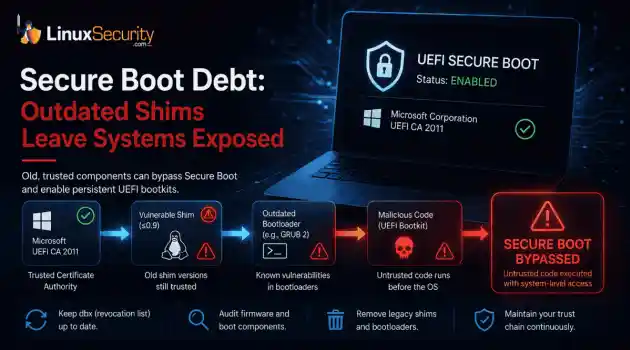
security advisory linux distribution ESET researchers identified 11 old and forgotten Linux UEFI shim bootloaders at versions 0.9 and below that can be used to bypass UEFI Secure Boot on any UEFI-based machine that trusts Microsoft’s Microsoft Corporation UEFI CA 2011 third-party certificate authority, regardless of the installed operating system (OS). Reported shims can be exploited to execute untrusted code during system boot, enabling attackers to deploy malicious UEFI bootkits even on systems with UEFI Secure Boot enabled.....
Jul 16, 2026
 Refine news
X Clear Filters
Get the latest News and Insights
Get the latest Linux and open source security news straight to your inbox.
Community Poll
Is continuous patching actually viable?
Loading...
Explore Latest Linux Security news
We found 3 articles for you...
209
 incident responseopen-sourcelinux
Enhancing Linux Security with Threat Intelligence Platforms
Cyber threats move faster than teams can track them. Exploits surface, get patched, and come back wearing new code. Staying secure now means reading the landscape before it shifts. Every day, thousands of new indicators roll in — from open-source feeds, sensors, honeypots, and shared research. Nobody can keep up manually. . That’s why most mature shops rely on a threat intelligence platform. It pulls data from everywhere, cleans it, correlates it, and gives it shape. Instead of triaging blind alerts, teams start to see what matters. They move from guessing to knowing. For Linux environments, this shift has been overdue. Visibility across open-source infrastructure used to trail behind Windows or commercial stacks. Now, with integrated feeds and sandbox engines tied to systems like VMRay, Linux security teams get the same depth of insight — who’s probing them, what’s changing, and where the next risk sits. What Makes a Useful Threat Intelligence Platform A TIP works like the nervous system for security operations. It gathers raw data — domains, hashes, logs, packet traces — from every possible source. Then it normalizes that mess into something analysts can read. To speed up detection and investigation, many security teams rely on Security Information and Event Management (SIEM) to centralize telemetry and surface suspicious patterns across systems. A solid one does three things well: Aggregation: collects data from internal tools, commercial sources, and community feeds. Correlation: connects malware to infrastructure, infrastructure to attackers, and attackers to campaigns. Automation: pushes intelligence out to the controls that can act on it. Many teams now blend commercial feeds with open-source threat intelligence tools . They pull from MISP, VirusTotal, and internal telemetry, then send it all through their TIP. The payoff is cleaner data and faster triage. Analysts spend less time proving what’s noise and more time tracing realattacks. Threat Intelligence Platforms Commonly Used in Linux Security Most Linux security teams mix tools instead of betting on one platform. What matters isn’t the brand — it’s how the data flows, how clean it stays, and how fast it connects back into your controls. The following are common in production environments. Each does the job a bit differently. MISP (Malware Information Sharing Platform) An open-source project that’s been around for years, MISP powers a lot of community and government sharing hubs. It helps teams tag, correlate, and exchange indicators using open formats. Not point-and-click simple, but solid once automated through scripts or APIs. Anomali ThreatStream Anomali’s ThreatStream platform handles aggregation at enterprise scale. It pulls hundreds of feeds, normalizes the data, and pushes it into SIEMs or SOAR systems. Common in bigger SOCs that need volume and reliability more than customization. Recorded Future Teams use Recorded Future when they care more about context than raw indicators. It tracks open-web chatter, dark-web listings, and exploit trends, then maps them to known actors or CVEs. The intel helps Linux defenders spot patterns before they turn into active campaigns. ThreatConnect With ThreatConnect, the focus is on tying intelligence to workflow. It lets analysts pivot from a suspicious IP straight into playbooks or ticketing systems. Takes time to tune, but cuts down on console switching once it’s set up. VMRay Analyzer + Threat Intelligence VMRay centers on sandboxing. It detonates binaries and scripts, then feeds behavioral data back into your threat intelligence stack. That’s useful for Linux teams validating new samples or spotting evasive payloads that signatures miss. None of these platforms is a silver bullet. They’re building blocks. Pick the one that fits how your Linux environment handles automation, visibility, and data ownership. The goal isn’t collecting more intel — it’s making sense of what youalready have. From Reactive to Proactive Defense Most SOCs still live in reaction mode. Alerts hit, someone pivots through logs, and the cycle repeats. A mature threat intelligence platform breaks that loop. Once you start mapping known adversary infrastructure, new activity stops looking random. Patterns show up — IP reuse, compiler strings, payload types. When cybersecurity threat intelligence shows a Linux kernel exploit gaining traction on GitHub, defenders can patch early and tighten policies before it lands. That’s the step from defense to prevention. VMRay helps by feeding in behavior analysis from its sandbox engine — clean, high-confidence intelligence that’s ready to act on. Each new data point improves the next decision. The same loop tracks emerging Linux exploits and eBPF malware . Feeds evolve, models learn, and teams adjust before the next wave hits. The Role of Automation in Incident Response Manual work still kills time. Analysts spend hours copying IoCs between consoles or confirming what’s already known. That lag gives attackers room to move. Inside modern platforms, incident response automation closes that gap. When the TIP confirms a malicious domain or IP, it pushes the data straight into firewalls, endpoint agents, or Linux server rulesets. The entire cycle happens in seconds. Organizations that require continuous monitoring often supplement threat intelligence workflows with dedicated 24/7 Threat Detection & Response capabilities , ensuring that suspicious activity is investigated and contained even when internal security teams are unavailable. To cut response time and reduce manual overhead, Security Orchestration, Automation and Response (SOAR) can connect alerts, enrichment, and remediation into a much faster operational workflow. A simple chain looks like this: A phishing domain shows up in several feeds. The TIP matches it to known C2 infrastructure. SOAR or firewall automation adds it to block lists and flags any systemsthat talked to it. Analysts don’t touch a thing until it matters. That space gives them time for actual analysis — connecting behavior to campaigns, not cutting and pasting alerts. Threat Hunting and Linux Visibility Automation handles speed. Hunting handles depth. Security teams running Linux often dig through logs and kernel events, looking for subtle traces — rogue modules, privilege jumps, odd process trees. A threat intelligence platform ties that activity to a broader context. Say an analyst finds an unusual binary. The TIP checks it against sandboxes, known hashes, and attacker campaigns. It could link to an eBPF loader or a command-and-control host seen last week. That connection gives the hunt direction. Each cycle feeds the next. Data from hunts improves detection logic. Intelligence from the platform shapes what to look for. Over time, the system and the analysts start teaching each other. That’s how Linux security matures — less reaction, more understanding of how attackers actually move. Context, Attribution, and the Power of Integration When an incident hits, the question isn’t just what happened? It’s who did it, how, and what else ties in? A good threat intelligence platform maps those links — IPs, binaries, command servers, infrastructure. For Linux shops, that context matters. It helps trace a malicious script back to its origin or link a local infection to a global campaign. If a kernel exploit appears in logs, the platform can indicate whether it matches a known actor’s toolkit or a fresh zero-day still under study. That’s the bridge between alert and action. It’s where incident response turns from cleaning up to learning. Building a Threat Intelligence Culture Tools don’t fix security. People do — when they share what they learn. Building a culture around threat intelligence means turning analysis into a habit. Linux teams usually lead that naturally. Open-source work teaches collaboration. The same idea applies here.Analysts feed sightings back into the platform, operations tune the playbooks, and engineers build automation hooks. It becomes routine — a constant cycle of detection, validation, and feedback. Over time, the company shifts from consuming threat data to contributing it. Sharing indicators with peers and information-sharing centers keeps everyone sharper. That’s when Linux security becomes more than patching and scanning — it becomes part of a broader defense network. Final Analysis Threat intelligence isn’t a luxury anymore. The scale of Linux-focused attacks shows how quickly old defenses fall behind. Platforms like VMRay and others provide teams with a way to stay current by collecting, refining, and acting on data before the next exploit hits. Combined with automation, open-source collaboration, and disciplined process, a TIP gives back something most SOCs rarely have: time to think. That’s where better decisions start. . Cyber threats evolve rapidly; a threat intelligence platform helps Linux security teams anticipate and respond effectively.. threat intelligence Linux security, incident response automation, open source security tools, cybersecurity platform, proactive defense. . MaK Ulac
 Oct 23, 2025
•
Oct 23, 2025
• Security Trends
79
 open sourceidentity managementaccess management
Janssen Project: New Cloud-Native Identity Management From Linux Foundation
The Linux Foundation has announced a new, secure cloud-native identity and access management software platform - the Janssen Project . . Every time we use an online pay service, manage our finances online, or enter our credit-card information, we're demonstrating our good faith. Now, one organization wants to help us feel even more secure. Today (Dec. 8), the Linux Foundation announced a cloud-native identity and access management software platform that prioritizes security and performance, the Janssen Project, which is based on the Gluu server and features signing and encryption functionalities. The integrity of our connections online is conveyed via identity software, from our devices to a complex web of backend services. Despite assurances and encouragement on this use, which we grow increasingly dependent on, digital identity remains a challenge and is at the very crux of delivering truly trustworthy online security. . Protect your digital exchanges using the innovative cloud-based identity verification system developed by the Linux Foundation.. Cloud-Native Identity Management, Security Solutions, Open Source Software. . LinuxSecurity.com Team
Dec 09, 2020
•
Security Projects

78
 threat detectionsecurity platformpolicy enforcement
Stackrox Kubernetes Security Platform 2.5 Enhancements for DevOps
The new Kubernetes Security Platform comes with enhanced capabilities for DevOps and security teams to protect their container and Kubernetes environments. Get the details: . StackRox, the security for holders and Kubernetes company, declared the general accessibility of form 2.5 of the StackRox Kubernetes Security Platform. The new form incorporates upgraded arrangement and runtime controls that empower organizations to flawlessly authorize security controls to improve use cases, including threat detection, network segmentation, configuration management, and vulnerability management. These security controls further reinforce StackRox’s position as the main Kubernetes-native container security stage that uses specific Kubernetes abilities for policy enforcement. With StackRox, companies can progressively embrace a “security as code” model and guarantee that security is worked into the framework versus bolted on. The link for this article located at Toolbox is no longer available. . Uncover the newest features in StackRox's Kubernetes Security Platform 2.5 designed for advanced container safeguarding.. Kubernetes Security, DevOps Tools, Container Protection, StackRox Platform. . LinuxSecurity.com Team
Sep 04, 2019
•
Vendors/Products
72
 network securitysecurity platformIPS
Sourcefire Universal Network Security Platform: Next-Gen Threat Adaptation
Sourcefire is moving into the firewall business, bringing its experience in intrusion prevention systems (IPS) such as Snort to offer a more context-aware platform that can better adapt to modern security threats than traditional firewalls, according to the firm.. Set to ship before the end of 2011, the Sourcefire Universal Network Security Platform blends next-generation firewall capabilities with the firm's existing IPS.. Set to ship before the end of 2011, the Sourcefire Universal Network Security Platform blends next-g. sourcefire, moving, firewall, business, bringing, experience, intrusion, prevention. . Dave Wreski
Dec 05, 2011
•
Firewalls
82
secure computingsecurity platformEthos OSEthos OS Development With NSF Funding: A Secure Computing Initiative
Windows, Mac OS and even Linux don't quite cut it when it comes to security in the eyes of University of Illinois at Chicago researchers, who are building an operating system from scratch designed to safeguard computers and applications. . The researchers have now been awarded a $1.15 million grant from the National Science Foundation to build the Ethos OS in an attempt to foil botnets and other security threats. Ethos has been in the works for a few years, with the idea emerging from a 2006 panel on botnets. "Today's computer operating systems are thoroughly penetrated and unfixable," says Jon Solworth, associate professor of computer science at the University of Illinois at Chicago, in a statement. "Every year we spend more and more on the problem, but every year the problem gets worse because we're working at the edges instead of at the heart of the problem." Solworth is working with colleague Daniel Bernstein, research professor of computer science and a cryptography expert, whose job is to try cracking the Ethos OS, which runs on virtual machines. The idea is to build an OS that can free up application developers to focus on their apps, not security. [All of article] . The researchers have now been awarded a $1.15 million grant from the National Science Foundation to . windows, linux, don't, quite, comes, security, universit. . Anthony Pell
Apr 12, 2010
•
Government
82
open-sourcelinuxinformation assuranceGovernment Explores Secure Open Source for Remote Work Initiatives
The Cabinet Office's Central Sponsor for Information Assurance, which co-ordinates information security projects across government, is investigating applications based around a highly secure open source operating system. The proof-of-concept systems being developed by the CSIA will use security enhanced Linux to support remote working and web services. Ministers were prompted to disclose details of the work following parliamentary questions tabled by Lord Harris of Haringey about the CSIA's activities in evaluating the security of open source software. . Responding on behalf of the Government, Lord Bassam said the unit was also sponsoring work at CESG, the Government's information assurance facility at GCHQ. "Among a range of IA capabilities being investigated is the future 'trusted computing platform'," he added The link for this article located at eGov Monitor is no longer available. . The Cabinet Office explores secure open source to boost remote work through innovative applications and trusted computing.. Open Source Security, Trusted Computing, Remote Work Solutions. . Benjamin D. Thomas
Jun 24, 2005
•
Government
78
open source softwareemail securitysecurity platformGuardian Digital Launches Next-Gen Email Security Suite
Guardian Digital, Inc., the premier open source security company, today announced the availability of the next generation Guardian Digital Secure Mail Suite, the industry's most secure and cost-effective email platform. Capable of managing all email functions within an . . . . Guardian Digital, Inc., the premier open source security company, today announced the availability of the next generation Guardian Digital Secure Mail Suite, the industry's most secure and cost-effective email platform. Capable of managing all email functions within an organization, Secure Mail Suite is designed to meet the needs of small businesses, enterprise level companies, and service providers looking to secure and manage corporate email operations. The suite increases employee productivity by simplifying management and drastically reducing junk mail, virus, and Internet threats. Secure Mail Suite is currently available with Guardian Digital's EnGarde Secure Linux v1.5, the newest version of the company's award winning secure Linux server operating system. The link for this article located at Guardian Digital.com is no longer available. . Veritas Technologies unveils its advanced Data Shield Platform to enhance data protection, compliance, and operational efficiency for organizations.. Email Security, Guardian Digital, Secure Mail Suite. . LinuxSecurity.com Team
Jun 18, 2003
•
Vendors/Products
78
enterprise securitynetwork intrusion detectionmonitoring suiteSecureNet PRO v3.0.7 Release: Enhanced Network Monitoring Features
Version 3.0.7 of the SecureNet PRO Network Intrusion Detection and Monitoring suite is now available! SecureNet PRO is an enterprise-scalable security platform offering advanced custom protocol decoding, real-time monitoring and intrusion response features not found in other product offerings. . Version 3.0.7 of the SecureNet PRO Network Intrusion Detection and Monitoring suite is now available! SecureNet PRO is an enterprise-scalable security platform offering advanced custom protocol decoding, real-time monitoring and intrusion response features not found in other product offerings. The link for this article located at LinuxPR is no longer available. . Version 4.1.2 of GuardNet ELITE platform boosts threat detection and cybersecurity defense functionalities.. Network Intrusion Detection, SecureNet PRO, Real-Time Monitoring. . LinuxSecurity.com Team
Jun 08, 2000
•
Vendors/Products

Get the latest News and Insights
Get the latest Linux and open source security news straight to your inbox.
Community Poll
Is continuous patching actually viable?
Search Topics
Powered By

Linux Security - Your source for Top Linux News, Advisories, HOWTOs and Feature Releases
QUICK LINKS
subscribe to newsletters!
Like staying secure? So do we.
Sign up for updates, tips, and alerts!