Explore top 10 tips to secure your open-source projects now. Read More
×



Server Security data privacy automation
data privacy automation Every system admin has lived through the same Monday morning ritual. A queue of forty tickets, half of them password resets, permission errors, or disk space warnings that any experienced technician could resolve in under two minutes. The other half require actual judgment. For years, automation promised that software would eventually sort the two apart on its own. That promise is now being tested in production Linux environments. . Early results are reshaping how IT teams think about tier-1...
 Jul 17, 2026

Privacydata collection automation
data collection automation You're running a web scraping project to collect pricing data from e-commerce sites. You set up a pool of datacenter proxies, launch your scripts, and within minutes — banned . CAPTCHAs everywhere. Your data pipeline stops before it really begins. . It's a frustrating scenario that plays out daily in ad verification, market research, and multi-account management. The website doesn't know you're doing legitimate research or monitoring. It just sees traffic coming from IP ranges it recognizes as...
Jul 17, 2026

Security Trends security advisory social engineering
security advisory social engineering Business Email Compromise used to be a numbers game — mass-blasted emails, broken English, an obvious "URGENT WIRE TRANSFER" subject line. That era is over. Generative AI has turned BEC into a tailored, low-noise operation that mimics writing style, voice, and even video presence. This piece looks at what's actually changed under the hood, what defenders are testing in response, and why so many organizations are still structurally unprepared for it. . The Infrastructure Problem Nobody Wants to...
Jul 17, 2026

Security Trends cybersecurity Linux documentation
cybersecurity Linux documentation Linux operating systems have gained prominence due to their stability, adaptability, and excellent security options. In the case of developing documentation, designing cybersecurity dashboards, or educational material, visuals are of vital importance when it comes to making things clear. The use of icons allows one to understand the message regarding alerts, authorization, encryption, authentication, or the state of the system just by looking at the visual cue without having to read long...
Jul 17, 2026
Security Vulnerabilities security advisory linux distribution
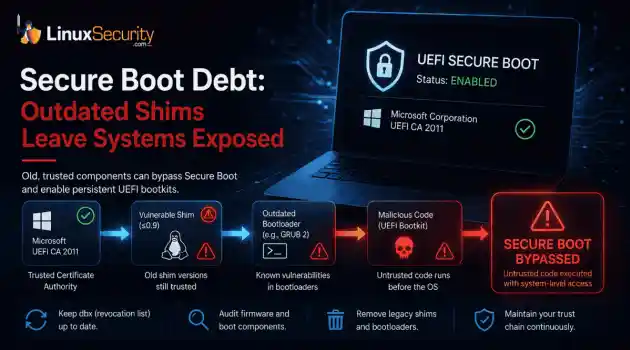
security advisory linux distribution ESET researchers identified 11 old and forgotten Linux UEFI shim bootloaders at versions 0.9 and below that can be used to bypass UEFI Secure Boot on any UEFI-based machine that trusts Microsoft’s Microsoft Corporation UEFI CA 2011 third-party certificate authority, regardless of the installed operating system (OS). Reported shims can be exploited to execute untrusted code during system boot, enabling attackers to deploy malicious UEFI bootkits even on systems with UEFI Secure Boot enabled.....
Jul 16, 2026
 Refine news
X Clear Filters
Get the latest News and Insights
Get the latest Linux and open source security news straight to your inbox.
Community Poll
Is continuous patching actually viable?
Loading...
Explore Latest Linux Security news
We found 218 articles for you...
77
 security practicesprocess managementfile permissions
Boost Linux Security Through Clear and Readable Coding Practices
There is a certain culture in Linux spaces that rewards cleverness. Tight one-liners, dense pipelines, scripts that do a lot in very few characters, and to be fair, that kind of fluency is powerful when everything behaves the way you expect. . But clever code has a cost. It compresses meaning, and when something drifts even slightly, you’re left untangling your own logic, stepping through commands that no longer explain themselves, trying to rebuild intent from something that used to feel obvious. That gap is where mistakes tend to sit. Not loud failures, just small things that get missed because understanding takes longer than it should. Readable code takes the opposite approach. It expands meaning upfront with clear names, explicit steps, and structure that holds up over time, which matters more when you’re revisiting something under pressure and need to trust what you’re looking at without second-guessing it. Make Privilege Changes Impossible to Miss On Linux, privilege levels change the impact of everything. Moving from a normal user to root, or adding a capability , shifts what your code can do immediately. If that transition is buried, it’s easy to lose track of where control actually changes. Group those actions, name them clearly, and keep them easy to scan, because later you’re not trying to relearn the code, you’re checking where elevated access happens and whether it still makes sense. Syscalls Deserve Attention A lot of real behavior sits in system calls . open, execve, clone, small differences in flags or parameters can change outcomes in ways that aren’t obvious at a glance. When those details are packed tightly, they’re easy to skip over. Breaking them out and leaving just enough context makes it easier to confirm later that files are handled safely and nothing unexpected is happening in the background. Make File Permissions Speak for Themselves Permissions are easy to get wrong when they’re hard to read. Seeing raw valuesscattered through code doesn’t give you much without stopping to interpret each one. Defining clear constants and keeping that logic in one place changes that. You’re no longer decoding numbers; you’re reading intent, and that makes it faster to confirm that sensitive files stay restricted and temporary ones don’t linger longer than they should. Keep Process and IPC Boundaries Clear Linux systems rely on processes talking to each other. Pipes, sockets, shared memory, signals, it’s all normal, but it also means data is constantly crossing boundaries. If those paths aren’t clear, you end up tracing them manually when something goes wrong. Keeping them defined and named with a purpose makes it easier to follow how data moves without having to reconstruct it each time. Match Your Code to Linux Security Features Linux gives you tools like seccomp , namespaces, and security modules. They shape what your application is allowed to do, whether you make that visible or not. Pulling that logic into clear sections helps. When someone reviews the code, they can quickly see what’s restricted and what isn’t, instead of piecing it together from scattered checks. Take a Moment Before Running Linux Commands Copying commands from forums or running scripts from online sources is part of the workflow. It’s also where things go wrong, especially when commands run with elevated privileges and trust gets extended too quickly. If a script is hard to read, it’s easier for something unintended to slip through. Clear structure creates a pause, just enough to see what’s happening before execution, which is a practical part of staying aware of social engineering during day-to-day work, not something abstract. Treat commands as something to inspect, not just run. That habit seems small, but it’s often what keeps a quick fix from turning into a longer cleanup later. . Readable code enhances Linux system security through clearer logic, controlled privileges, and robust processcommunication.. Linux Security Practices, Readable Code Importance, Code Clarity Linux, Process Management Linux. . MaK Ulac
 Apr 21, 2026
•
Apr 21, 2026
• Server Security
76
 security practicesoperational efficiencysecurity integration
OpenInfra Foundation Joins Linux Foundation: Enhancing Open-source Security
Exciting news has just reached the open-source community: OpenStack , now known as OpenInfra Foundation , is joining forces with the Linux Foundation . This significant move promises greater collaboration and operational efficiency throughout the community. . Linux security admins now have new opportunities to leverage advanced security practices supported by the extensive resources of the Linux Foundation, with improved integration and compliance with global security standards. In addition, this partnership underscores the significance of secure infrastructure in supporting cutting-edge technologies like AI . By aligning these two powerful organizations, their combined expertise and governance should strengthen security protocols further, making collaborative efforts more robust and streamlined. Let's examine the significance of this partnership and its potential benefits for open-source security/ Strengthening Open-source Collaboration The open-source community thrives on cooperation, as evidenced by the recent merger between OpenInfra Foundation (formerly OpenStack) and the Linux Foundation. By joining forces, these two powerhouses aim to amp up their impact in areas critical for modern infrastructure; not simply pooling resources but creating synergies that strengthen robustness, security, scalability, and longevity of open-source projects. This is particularly beneficial for Linux security administrators hoping this alliance will bring new methodologies and tools to make their tasks more efficient and effective. OpenInfra's decision to collaborate with the Linux Foundation is wise. Although its governance will remain unchanged, collaboration unlocks unrivaled expertise and resources within both organizations. Thanks to their long history of nurturing innovative projects, this relationship provides fertile ground for OpenInfra to expand and improve initiatives, providing security admins access to improved tools and practices without disrupting current governance structures. Enhancing Security Practices One of the main benefits of this merger is its potential to strengthen security practices across both organizations' projects. The Linux Foundation has an impressive record of creating and enforcing security standards that should now extend into OpenInfra's tools and frameworks. This cross-pollination should lead to more resilient and secure open-source infrastructures. As Linux security administrators, integration means having more structured and well-maintained security protocols. The Linux Foundation's Core Infrastructure Initiative and Open Source Security Foundation aim to identify and mitigate vulnerabilities early. With more deeply embedded OpenInfra projects providing a stronger basis on which to build secure environments, fewer vulnerabilities will slip through cracks. Operational Efficiency and Governance Aligning with the Linux Foundation offers another great advantage in terms of operational efficiency. The organization boasts a well-tested governance model, which helps projects run smoothly and scale. OpenInfra's adherence to this model will mean adopting best practices in project management that streamline development cycles and lead to faster implementation of security features. We security administrators will benefit from this governance model in two ways. Integration of new features and updates should become simpler within your systems. More predictable release cycles and documentation will reduce the overhead of keeping systems secure and up-to-date , potentially decreasing the patching frenzy that typically follows less structured release cycles. Supporting Cutting-edge Technologies Ensuring a secure foundational infrastructure is necessary at the forefront of cutting-edge technologies. With their complex computational demands, Artificial Intelligence (AI) and Machine Learning (ML) necessitate a secure yet scalable infrastructure. OpenInfra and the Linux Foundation's partnership strives to support this by making sure open-source toolsused for AI/ML are not only robust but also safe. AI applications often involve sensitive data that requires stringent security measures to safeguard against breaches. As OpenInfra projects align closer with Linux Foundation's standards, these security measures for such applications will strengthen AI/ML solutions providers' confidence that their infrastructure's security can meet these requirements head-on. Better Integration with Global Security Standards The Linux Foundation's dedication to upholding global security standards is another hallmark of its collaboration. Projects under its umbrella are known for complying with these standards, making regulatory requirements easier for organizations to meet. With OpenInfra now part of this ecosystem, organizations can expect improved alignment with international security regulations such as GDPR and HIPAA. Linux security administrators working in regulated industries know firsthand that assuring compliance is often time-consuming. Thanks to increased adherence to security protocols and standards introduced by this merger, this process will become streamlined, reducing administrative burden and mitigating risk from noncompliance penalties. Leveraging Expertise and Resources One key advantage of joining forces is access to available expertise and resources. The Linux Foundation houses numerous projects and working groups specializing in technology and security, which OpenInfra projects can now leverage by joining forces. For us admins, this means having access to an expansive community of security experts who can offer insights and assistance with specific security challenges. Leveraging collective knowledge through forums, working groups, or direct collaboration can significantly boost your capabilities and security strategies, creating an ecosystem designed for continuous learning and improvement that keeps you at the forefront of security practices. Final Thoughts & Looking Ahead OpenInfra's integration into the Linux Foundationmarks an exciting step forward for open-source projects, especially those focused on security. Collaboration, robust security practices, operational efficiency, and compliance with global standards will likely all improve over time, setting new benchmarks for creating and maintaining these projects. This merger marks an exciting time in our community as the OpenInfra Foundation and Linux Foundation join forces to advance infrastructure security and efficiency. Stay engaged, stay secure, and embrace what this game-changing collaboration will offer! . Linux cybersecurity professionals can now benefit from improved protective strategies, resulting from a partnership with the Linux Foundation.. OpenInfra, Linux Foundation, Open Source Security, Security Practices, Compliance Standards. . Brittany Day
Mar 13, 2025
•
Organizations/Events

76
risk managementsecurity practicessecurity measuresOpenSSF: Security Baseline Initiative Enhances Open-Source Protection
Open Source Security Foundation (OpenSSF) recently unveiled its Security Baseline initiative to assist Linux security admins and developers in incorporating essential security measures into open-source projects. This set of guidelines, available on February 25, offers three tiers of practices explicitly tailored for project maturity levels, ensuring open-source software provides consistent and dependable protection from day one. . Understanding and following these guidelines means taking proactive measures against vulnerabilities while strengthening user trust in projects. Operating at version 20250225, the OSPS Baseline outlines basic security for open-source projects, serving as a practical guide for developers and project maintainers. This initiative encourages security awareness within communities so everyone can collaborate to refine and improve practices. Adding this guideline into your workflow can make the open-source ecosystem safer while aligning yourself with broader community efforts to remain vigilant against security threats. Let's take a closer look at this initiative, its significance, and practical measures you can take to adhere to these guidelines while overcoming implementation challenges. Understanding the Security Baseline Initiative On February 25, OpenSSF introduced its Security Baseline initiative, providing an organized framework for securing open-source projects according to their level of maturity. Since open-source software development involves collaborative efforts without central oversight, maintaining consistent standards can be challenging. Thankfully, the Security Baseline offers three guidelines that ensure basic security fundamentals are always met. This design makes this initiative particularly advantageous for diverse projects ranging from fledgling developments to mature software offerings. Why Tiered Guidelines Matter Security in software development cannot be addressed with one-size-fits-all solutions. Projects vary significantly incomplexity, size, and sensitivity - therefore, security frameworks and solutions must reflect this diversity. The Security Baseline's tiered guidelines were specifically tailored to this reality to enable projects at various stages of maturity to adopt appropriate security practices at different points during their journeys. This scalability ensures burgeoning projects start with manageable security goals while adding more sophisticated measures as they expand. As a result, it supports projects as they develop, facilitating sustained security improvement over their lifecycles. Building Trust in Open-Source Software One of the main objectives of the Security Baseline is to build trust in open-source software by assuring its security is comparable with proprietary solutions. Security breaches and vulnerabilities can erode trust in an open-source project and prompt users to seek alternatives. By adhering to OpenSSF guidelines, developers can demonstrate their dedication to user and stakeholder security and position projects favorably in trust-driven ecosystems. Engaging the Linux Security Community in This Initiative Linux security admins will play an instrumental role in adopting and implementing the OpenSSF Security Baseline. As security leaders within their projects, these individuals are in an ideal position to advocate for and integrate this set of guidelines into existing workflows, thus leading initiatives prioritizing security from their inception and creating an atmosphere that values proactive risk management practices. The Security Baseline allows Linux admins to interact with and engage with the broader security community. With its active maintenance and open-source nature, there is room for collaboration and contribution - and community members are encouraged to provide feedback, suggest improvements, and refine the guidelines in response to emerging security threats or advancements in technology. A Practical Guide to Implementation Implementing the Security Baseline within aproject begins with understanding the project's security needs and maturity level. This includes a current security posture assessment, gap analysis, and selecting appropriate tier levels from guidelines to address those gaps. Newer projects might focus on security measures like secure coding practices or vulnerability scanning . In contrast, more mature ones could focus more heavily on advanced threat modeling and incident response plans. Open-source initiatives provide greater flexibility when applying these guidelines, enabling administrative teams to tailor practices according to their operational environment. By carefully considering each tier, projects can create an adaptive security strategy that scales with their growth while responding quickly to changing risks. Overcoming Common Challenges Adopting new security guidelines can be challenging for projects with limited resources or stretched teams. One key solution lies in education and awareness: ensuring all contributors understand why security is necessary and how it can be incorporated into their work without disrupting the workflow. Collaboration is another vital asset. Networking with other projects and developers who have successfully applied the guidelines can provide invaluable practical insight and experiences to guide your efforts. This community-centric approach to open-source development fosters increased collective security through shared knowledge. Our Final Thoughts: Understanding The Path Forward As the open-source community expands, its security challenges will also grow. To meet this need, the OpenSSF Security Baseline initiative was formed. By adopting its guidelines, we Linux security admins and developers can increase our projects' security while protecting ourselves from emerging threats and building trust between ourselves and users. The journey towards comprehensive open-source security is complex yet rewarding. Initiatives like Security Baseline are helping the open-source community meet challengeshead-on while making sure open-source software remains an enduring platform for innovation now and in the future. Have you adopted the OpenSSF Security Baseline guidelines in your open-source development workflow? Let us know on X @lnxsec ! . Bolster the resilience of open-source applications by implementing multi-level protocols from the OpenSSF framework, aimed at reducing vulnerabilities and fostering confidence.. OpenSSF, security practices, open-source guidelines, risk management, Linux admin. . Brittany Day
Feb 27, 2025
•
Organizations/Events
83
cyber threatssecurity practicesnetwork monitoringSalt Typhoon Threat: Credential Management and Network Defense Strategies
Recent reports have revealed a sophisticated intrusion campaign conducted by Salt Typhoon, targeting major U.S. telecommunications providers. To safeguard against this emerging threat, Linux admins must understand Salt Typhoon's malicious methods: using stolen credentials, living-off-the-land techniques, and consistently changing network configurations to avoid detection while expanding access. . These tactics stress the importance of rigorous credential management practices, such as disabling unnecessary utilities and conducting regular configuration audits to protect networks against Salt Typhoon. Let's examine Salt Typhoon's attack methods in greater depth and discuss practical detection and prevention measures you can implement to safeguard your Linux environment. Credential Use and Expansion The Salt Typhoon group's recent increase in cyber intrusion activity has been a cause of alarm among the cybersecurity community and U.S. telecommunications providers. This threat actor excels at using valid stolen credentials to gain entry to key network infrastructure, further expanding their reach by gathering more credentials from network configurations. Doing so helps solidify their hold on networks once an initial breach occurs, making extrication increasingly difficult. To prevent credential management abuse and to mitigate this particular threat, it is vitally important that security admins engage in reliable credential management practices. This includes creating and using strong, unique passwords across users and systems, as well as updating them regularly and adding multi-factor authentication whenever feasible to add another layer of protection. Furthermore, consistent and proactive monitoring for unauthorized access attempts is imperative. Monitoring access logs and setting alerts can quickly identify and isolate potential breaches before they escalate further. Living-off-the-Land (LOTL) Techniques Salt Typhoon stands out by using living-off-the-land (LOTL) techniques toexploit existing legitimate tools and utilities within compromised networks, such as command line utilities, network management tools, or scripting environments already present on these systems. By doing this, they can minimize their footprint while remaining undetected by traditional detection mechanisms, allowing them to conduct malicious activities without raising immediate red flags. Administrators can counter these tactics by regularly reviewing and updating their network configurations, with an eye toward disabling unnecessary tools or services that could be exploited. Understanding which tools should run on each network device and then disabling or removing those that are unnecessary is key. Regular audits of system configurations and real-time monitoring will assist administrators in detecting and preventing LOTL techniques used in campaigns like Salt Typhoon. Infrastructure Pivoting and Persistence One of the hallmarks of the Salt Typhoon campaign is its persistent movement through compromised infrastructure. Once inside a network, an attacker meticulously modifies configurations and creates multiple access points to maintain control for extended periods. This technique allows the attackers to operate undetected, continuously siphoning data or planning new exploits. Implementing stringent network segmentation measures is key to mitigating persistent threats. like Salt Typhoon. breaking up a large network into separate and isolated segments, security teams can limit an attacker's lateral movement. Conducting thorough configuration audits regularly is also necessary. These audits should identify any unauthorized changes that might signal an attacker's presence on your network. Monitoring devices for sudden configuration changes can detect malicious activities quickly and respond swiftly to these activities. Recommendations for Detection and Prevention Protecting network infrastructure against sophisticated threat actors like Salt Typhoon requires an aggressive and comprehensiveapproach. Our recommendations for detection and prevention include robust configuration management, enhanced monitoring, and in-depth traffic analysis, as these are designed to detect early signs of compromise and stop attackers from reaching their goals. Robust Configuration Management and Auditing Security teams should undertake network device configuration audits regularly. They should check for unapproved changes such as AAA (Authentication, Authorization, and Accounting) configurations, loopback IP addresses, or newly created local accounts that could serve as targets for attackers looking to penetrate networks further. Adopting the principle of least privilege is also an integral security practice. Only users who need access to critical network devices should have it, minimizing opportunities for compromised accounts to be exploited by threat actors. Strong password policies and widespread multifactor authentication measures will significantly increase threat actors' difficulty in gaining and maintaining access. Enhanced Monitoring and Logging Effective detection relies on closely monitoring the syslog and AAA logs for any unusual activities or configuration changes that could indicate potential attacks and log changes. Modifying bash_history, auth.log, lastlog, wtmp, or btmp could indicate an attacker's attempt to cover up their tracks. Integrity logging across all network devices is vitally important. Automated systems can detect log tampering or gaps in logging data - often signs of malicious activity - while regularly checking for non-empty or unusually large.bash_history files may reveal evidence of illicit scripts being run. Network Traffic Analysis Establishing visibility of network traffic is essential to identifying and mitigating network threats. Utilizing tools like NetFlow for traffic analysis, port scanning, and monitoring for unusual volumetric changes are all helpful in pinpointing suspicious network activities. Profiling network devices to detect any changes,such as new ports opening, closing, or traffic patterns, could give early indications of breaches in security systems. Implementing stringent Access Control Lists (ACLs) is crucial to restricting unauthorized access and movement within a network, with regular monitoring for violations helping identify security gaps and address them quickly. Network segmentation helps contain threats more effectively by compartmentalizing potentially compromised sections into separate segments. Patching known vulnerabilities is also key to maintaining an effective security posture against threats like Salt Typhoon. Our Final Thoughts on Mitigating Salt Typhoon's Threat to Your Linux Environment Salt Typhoon's tactics demonstrate the necessity of adopting an integrated network security approach. From advanced credential management and disabling unneeded tools to network segmentation and ongoing configuration audits, Linux security administrators possess several strategies to prevent sophisticated intrusions from taking hold. By prioritizing such actions and cultivating a culture dedicated to security, network defenders can gain the upper hand against even persistent and skilled threat actors. Ultimately, vigilance, continuous improvement, and proactive mitigation are key in protecting critical network infrastructures from stealthy cyber threats like Salt Typhoon. . To combat threats like Salt Typhoon effectively, organizations should implement strong credential management, robust activity monitoring, and proper network segmentation to enhance security.. Cyber Intrusion Detection, Credential Management Techniques, Network Security Practices, Salt Typhoon Threat, LOtl Mitigation Techniques. . Brittany Day
Feb 24, 2025
•
Hacks/Cracks
209
security practicessocial engineeringopen sourceOpenSSF & OpenJS Warning: Social Engineering Risks Affecting OSS Security
As the backbone of much of the world's technological infrastructure, the open-source community prides itself on transparency, collaboration, and innovation . However, these strengths can also present vulnerabilities, as seen with the notorious XZ Utils backdoor. . Recently, social engineering attacks targeting open-source projects have emerged as a significant threat. The Open Source Security Foundation (OpenSSF) and OpenJS Foundation have issued alerts highlighting attempts to manipulate project maintainers into granting unauthorized access or introducing malicious code. These incidents underscore the need for heightened awareness and robust defenses among Linux admins, developers, and open-source project maintainers. Let's examine these recent warnings and actionable strategies you can implement to combat this concerning trend. Understanding The Nature of Social Engineering Attacks Social engineering attacks exploit the human element of security, relying on deceit and manipulation rather than technical exploits. Attackers typically pose as legitimate contributors or community members, using friendly and persuasive tactics to build trust over time. The ultimate goal is often to gain maintainer status or convince existing maintainers to accept harmful changes. This method can be particularly effective in open-source environments where collaboration and trust are foundational. Recognizing Suspicious Activity To combat these threats, we must be able to recognize the patterns of social engineering attacks. Persistent, friendly engagement from relatively unknown contributors aiming for high-level access should raise red flags. Additionally, endorsements from unfamiliar accounts or networks can signal coordinated deception efforts. Pay close attention to pull requests (PRs) containing obfuscated code or binaries that lack transparency. Such changes can be vehicles for introducing malicious payloads. Security admins must remain vigilant for deviations from standard build and deploymentpractices that could compromise security. If a contributor creates a false sense of urgency, pushing for expedited reviews or immediate changes, take a step back and scrutinize their motives. Strengthening Authentication and Access Controls Strong authentication methods are one of the best ways to safeguard against attacks. Two-factor or multifactor authentication (MFA) can add another layer of protection, making it much harder for attackers to gain unauthorized access. Password managers provide additional security and ensure passwords are strong, unique, and not reused across services. Administrators should store recovery codes safely offsite to regain control if their accounts become compromised. Ensuring Code Integrity The review and merging of code can be critical points of vulnerability. Enabling branch protections and insisting on signed commits can help maintain the integrity of a codebase. Code reviews are required from a second developer before merging, even for changes proposed by maintainers. This additional step can catch potentially harmful alterations before they’re integrated into the project. It’s also essential to enforce readability requirements for new code. Obfuscated code or binaries hidden within a pull request can introduce significant security risks. By ensuring all changes are human-readable, maintainers can better understand the logic and purpose behind each modification, making it easier to spot malicious intent. Periodic Reviews and Minimal Permissions Administrative practices also play a crucial role in defending against social engineering attacks. Regularly review the list of committers and maintainers to verify their ongoing involvement and legitimate status within a project. Removing inactive or unnecessary accounts can reduce the risk of hijacking dormant accounts. Limiting npm publish rights and other critical permissions to trusted individuals can further minimize risk. Ensuring that only a small, trusted group can make significant changesreduces the number of potential entry points for attackers. This principle of least privilege is a fundamental aspect of a security posture. Establishing and Following Security Policies A clear and comprehensive security policy is a cornerstone of protecting open-source projects. This policy should include protocols for coordinated disclosure, providing a transparent process for reporting and addressing vulnerabilities. By establishing these guidelines, maintainers can ensure that any discovered issues are handled systematically and securely. It's also imperative to align with industry standards for security best practices. Resources like the OpenSSF Guides provide valuable insights and frameworks to help maintainers enhance their security posture. Regularly updating and reviewing these policies ensures they remain relevant and effective in the face of evolving threats. Leveraging External Support No project is an island; the broader open-source community offers resources and support. Foundations like The Linux Foundation and OpenJS Foundation can provide valuable assistance and technical resources. These organizations can offer guidance and security reviews and help coordinate responses to security incidents. Alpha-Omega and Sovereign Tech Fund provide financial and technical support tailored explicitly toward strengthening the security of open-source projects. Participating projects gain access to funding and expertise by joining these programs, significantly boosting their defensive capacities. Fostering Vigilance To guard against social engineering attacks, open-source communities should create an atmosphere of vigilance. Communication channels must remain open between maintainers and contributors while encouraging transparency among contributors. Creating an atmosphere where maintainers and contributors feel comfortable reporting suspicious activities can help detect and mitigate threats early. Training and awareness programs also play a vital role in keepingprojects secure. Informing maintainers and contributors about social engineering attacks, their signature tactics, and how to recognize them can significantly bolster project defenses. Regular security training sessions consider these risks and prepare everyone involved if suspicious activities emerge. Our Final Thoughts on These Warnings Open-source communities' collaborative nature is their greatest strength and weakness, creating opportunities and risks. As social engineering attacks become more sophisticated, Linux security admins must take proactive measures to safeguard their projects against takeover attempts by recognizing suspicious activity, strengthening authentication and access controls , assuring code integrity, and enlisting external support to decrease takeover risk. Through vigilance, transparency, and community collaboration, the integrity and security of open-source projects can be maintained to ensure they continue to flourish and innovate over time. The joint alert from OpenSSF and OpenJS Foundation is an essential reminder that while the collaborative spirit of open-source projects is invaluable, their security must also be protected with robust measures and proactive approaches. By adopting these best practices, Linux security admins can ensure their projects remain safe from current and emerging digital threats. What measures are you taking to secure your open-source projects? Reach out to us @lnxsec and let us know! . Manipulation tactics target community-driven software; implement effective measures to strengthen defenses and resilience.. Open Source Security, Social Engineering Threats, Security Practices, Code Integrity, Community Collaboration. . Brittany Day
Jan 15, 2025
•
Security Trends
209
 security practicesopen source softwaredata management
Open Source Strategies for Enhanced Security in Digital Operations
Digital transformation, powered by the principles of open-source security , is vital for businesses looking to excel in today's technology-driven landscape. Customers, employees, and partners demand easily accessible, seamless digital experiences that integrate securely with their daily lives. By adopting open-source digital strategies, companies improve operations, foster stronger relationships, and fortify their cybersecurity posture. . Many organizations still need to rely on outdated, manual processes and face challenges in securely organizing and sharing crucial information. The reliance on legacy systems poses significant risks, including vulnerabilities, cyberattacks, and data breaches. With modern, secure software solutions to streamline and protect activities, businesses can meet rising expectations or maintain a competitive edge against more agile, security-conscious competitors. Fortunately, adopting open-source security measures presents many digital opportunities for companies to enhance their security and achieve their transformation objectives. This guide will delve into five key ways digital software, underpinned by open-source security principles, can revolutionize operations across your organization, ensuring efficiency, innovation, and robust security in the digital era. Automate Manual and Repetitive Tasks with Open- Source Tools Many businesses still need to work on manual, paper-based processes that are time-consuming and prone to errors. Digital solutions allow you to automate repetitive tasks that consume employees' time. For instance, accounting software can automatically reconcile invoices and receipts. CRM systems can automate tasks like lead follow-ups, and workflow automation tools can digitize multi-step processes routing functions to the appropriate teams or individuals. Automation frees employees' time to focus on more strategic work by eliminating mundane, repetitive jobs and standardizing best practices. It also reduces the risk of humanerror. You'll see speed, accuracy, and compliance improvements when digitizing manual tasks. As digital solutions can automate repetitive tasks, open-source tools like Ansible, Jenkins, or GitLab can automate software development processes, server configurations, and deployment tasks. These tools can streamline operations on a Linux server, reducing the time and effort needed for manual intervention. Enhance Customer Experiences with Open Source CRMs Today's customers expect flawless, convenient digital experiences comparable to those of leading brands. Software applications can transform how customers interact with and perceive your business. For example, e-commerce offers a personalized virtual storefront that is available 24/7. Customers can browse, learn about products, and purchase without calling or visiting in person. Automated communication through email and text marketing helps nurture relationships. Responsive customer service management (CSM) systems provide customer support agents with a 360-degree view of inquiries, orders, and past interactions, enabling quick issue resolution and consistently meeting or exceeding customer expectations. Overall, engaging digital platforms enhances brand loyalty and advocacy. Positive interactions create opportunities to promote additional products or services in the future. Delighting customers remains the ultimate long-term growth strategy. Utilize open-source CRM (Customer Relationship Management) systems such as SuiteCRM or Odoo, which can be hosted on Linux servers. These systems allow businesses to automate customer follow-ups and track customer interactions, similar to proprietary CRM systems, but with the advantages of customization and flexibility that open-source solutions offer. Centralize and Organize Critical Data One of the primary challenges in today's business landscape is managing vast quantities of critical data effectively and securely. Without proper measures to protect it from becoming vulnerableor scattered across platforms, security breaches or data loss could occur, leaving companies vulnerable. Integrating open-source software for data management centralizes all this critical information and adds an extra layer of protection inherent within an open-source ecosystem. Open-source customer relationship management (CRM) systems and document management solutions demonstrate how businesses can securely centralize data. An open-source CRM enables organizations to safely house all customer interactions, orders, support cases, and more in one safe location, with secure access controls and encryption ensuring sensitive customer information remains accessible only by authorized personnel. Open-source document management systems also offer secure environments for storing, sharing, and tracking documents. These platforms feature automated backup, version control, and fine-grained permissions—essential features that keep records intact and confidential. Furthermore, open-source systems enable businesses to customize security features according to organizational needs. Centralizing data with open-source solutions provides businesses with additional transparency and collaborative security advantages inherent to the open-source model. As anyone can review code, vulnerabilities are more likely to be discovered and remedied swiftly by the community; additionally, such transparency encourages trust among stakeholders who can assess whether security measures in place meet expectations. Additionally, open-source business intelligence and analytics tools can transform centralized data into actionable insights. These tools offer advanced security and protection features to ensure robust yet secure decision-making processes. Improve Communication and Collaboration Clear communication and collaboration are crucial in today's business environment, especially in distributed work. Digital collaboration tools keep all teams and stakeholders connected to their work, regardless of location. These toolsenable group chats, file sharing, comments, and video meetings within designated channels. For example, project management software allows you to centralize task assignments, monitor progress, document processes, and provide real-time feedback. Through transparent discussions, online collaboration fosters better decision-making, leading to more productive outcomes with fewer obstacles. When digital communication is prioritized, remote or hybrid workers align closely with overall business goals and priorities. Gain Deeper Business Insights Actionable business intelligence relies on synthesizing large amounts of data. Digital analytics tools aggregate vital metrics and performance indicators, revealing patterns and trends that are difficult to identify with manual reporting. For instance, analytics dashboards in marketing automation or e-commerce platforms track campaign performance, product views, and sales conversions, providing insights into what drives leads and revenue. Data-driven insights guide more effective marketing strategies and resource allocation over time. Similarly, finance or production management tools deliver operational KPIs and predictive forecasts, enabling you to identify issues before they impact goals. With in-depth analytics, you can better understand what drives your business and set more achievable expectations. Enhancing Security with Linux and Open-Source Software Security is not simply necessary in today's digital business environment; it forms the cornerstone of trust between a company and its customers, employees, and partners. Linux and open-source software offer unique benefits to companies seeking to enhance their digital security posture. From collaborative open-source development projects that promote security features built into Linux OS to collaborative open-source development that fosters more robust levels of digital protection, this combination can help businesses attain increased digital safety levels. Utilizing Linux to EnableSecure Operations Linux is widely known for its security features, making it an excellent option for hosting critical applications and managing sensitive data. Here's how Linux contributes to creating a safe digital environment: 1. Robust User Permission Management: Linux boasts an advanced user permission system, ensuring only authorized individuals can access files and applications. This protects against malicious access or data breach risks that might otherwise occur. 2. Security-Enhanced Linux (SELinux) and AppArmor are powerful Linux kernel security modules that add an extra layer of protection, with mandatory access control policies that limit program capabilities through per-program profiles. 3. Regular Security Updates: With Linux's robust community and rapid patching times for security vulnerabilities, businesses should stay current on these updates to stay safe against emerging threats. By staying abreast of them and adhering to them regularly, businesses can stay protected against current or emerging risks. Open Source Security Tools and Practices Open-source software provides businesses access to many security tools they can customize and integrate into their digital infrastructure for more excellent protection. Here are a few ways open source can enhance security: 1. Customizable Security Solutions: Open-source security tools can be adapted and customized to fit a business's unique requirements, giving them greater flexibility than proprietary tools in designing security practices that closely match operational needs and threat models. 2. Transparency and Community Review: Open source software can significantly benefit from scrutiny from an international community of contributors who quickly identify security flaws. With their collective efforts, contributors swiftly rectify vulnerabilities, resulting in more secure software. This continuous improvement cycle can ultimately result in the development of safer software products. 3. Innovative Security Tools: The open source ecosystem offers many innovative security tools, such as fail2ban (intrusion prevention software), OpenVPN (secure VPN tunneling), and ClamAV (antivirus engine), to bolster an organization's security posture. Implementing Open Source Security in Real-World Situations Imagine a business seeking to protect customer data and internal communications by using OpenVPN for remote access, significantly reducing the risks of data interception. Incorporating ClamAV into email servers for scanning attachments and downloads is an antimalware measure; failing this, fail2ban can also help prevent brute force attacks by banning IPs showing signs of malign activity. These open-source tools on a Linux infrastructure provide a robust security framework to safeguard against various cyber attacks and risks while meeting specific business needs and emerging risks. Integrating Linux and open-source software into a business's digital transformation strategy offers improved efficiency and innovation and enhanced security measures to protect digital assets while building trust among stakeholders in today's digital landscape. Keep Learning About Transforming Your Business Using Open Source Tools In summary, well-chosen digital solutions have the power to transform your business and optimize operations in various ways. CRM, ERP, marketing automation, and other software tools enable companies to streamline workflows, centralize important data, improve collaboration, and gain invaluable insights—all of which drive increased productivity and reduced costs. Regularly evaluating emerging solutions ensures your business continuously evolves its technological capabilities, keeping pace with rapid market shifts. While innovation is crucial to long-term success, digital tools open numerous doors for innovation across functions. Ultimately, operational transformation leads to optimized efficiency, cost savings, and growth. . Elevate your online processes by utilizing free-to-use resourcesand methodologies to promote improved protection and creativity within your organization.. Open Source Security, Digital Business Operations, Automation Tools, Data Management Solutions, Customer Experience Innovations. . Brittany Day
Aug 23, 2024
•
Security Trends
83
security practicesthreat analysismalwareNoodle RAT Threat Analysis: Strategies For Linux Security
A new backdoor, "Noodle RAT" has caused widespread alarm across the cybersecurity landscape. Research highlights this previously undisclosed malware used by Chinese-speaking groups engaged in cybercrime and espionage activities. . This article seeks to provide a thorough understanding of this threat for Linux administrators who wish to better protect themselves against Noodle RAT and similar attacks. We'll focus specifically on the Linux variant of this cross-platform malware and how it infects targeted systems. Understanding Noodle RAT Since 2022, Noodle RAT has been under scrutiny due to targeted attacks in the Asia-Pacific region. At first, it was thought to be part of existing malware such as Gh0st RAT or Rekoobe, but intensive research revealed it as being brand new. The malware, available on Windows and Linux, has been employed by Chinese-speaking groups for espionage and cybercrime activities, demonstrating its widespread impact. Noodle RAT typically exhibits capabilities such as downloading/uploading files/running additional in-memory modules, and acting as TCP proxy on infected computers, underscoring its widespread usage among target systems. The Linux Version of Noodle RAT: How Does It Infect Targeted Systems? Linux.NOODLERAT stands out from its Windows counterpart through its design and capabilities, which have been widely employed for financial gain and espionage purposes by various groups for their ends. Employed for different motivations, including financial gains or spying operations, its design features include reverse shell functionality, file download/upload features, scheduling execution of scheduled processes, and SOCKS tunneling capabilities. After infiltrating public-facing applications, the backdoor copies itself to an identified location before performing process name spoofing and connecting back with its C&C server per predefined settings, making its design unique from its Windows counterpart regarding design vs. capabilities. Practical Advice for ProtectingAgainst Noodle RAT and Similar Threats With cyber threats evolving almost daily, Linux administrators must take proactive measures to ward off threats like Noodle RAT. Here are several practical steps you can take to reinforce the security posture of your systems: Implement Comprehensive Access Controls: Comprehensive access controls and user permissions can significantly limit unauthorized access and help stop the installation and execution of malicious payloads. Prioritize Regular System Updates and Patch Management: Timely installation of software updates and security patches can address known vulnerabilities exploited by backdoors like Noodle RAT. Implement Strong Authentication Measures: Establishing multifactor authentication and enforcing robust password policies are great strategies for protecting against any unauthorized access attempts. Utilize Network Segmentation: Dividing the network into distinct zones according to traffic patterns and user roles can help contain malware spread and limit its impact in case of breach. Implement Intrusion Detection and Prevention Systems: Installing and configuring effective intrusion detection and prevention systems is one way to detect and respond quickly to attempted infiltration by Noodle RAT or similar threats. Utilize Behavior-Based Monitoring: Behavior-based monitoring tools can enable administrators to detect suspicious and potentially malicious behaviors that indicate backdoor activities. Regular Security Audits and Penetration Testing: Conducting periodic security audits and penetration tests is one way to identify vulnerabilities before threat actors exploit them. User Education and Awareness Programs: Raising users' awareness of the potential dangers of social engineering tactics and phishing attacks can significantly lower the odds of successful backdoor installations. Our Final Thoughts on Noodle RAT & Preventing Attacks Noodle RAT's rise as an emerging backdoor threatunderscores the necessity of strong cybersecurity measures for Linux systems. By understanding its functionality and employing proactive security practices to strengthen defenses against this malicious malware, administrators can better protect themselves and reduce the risks from falling victim. As the cyber threat landscape changes rapidly, remaining vigilant and proactive when protecting essential infrastructure and sensitive data against emerging threats like Noodle RAT is imperative for maintaining and securing its integrity and safety. . Gain insights on Noodle RAT's impact on Linux systems and strategies to enhance security against this new backdoor threat.. backdoor, noodle, rat', caused, widespread, alarm, across, cybersecurity, landscape, researc. . Dave Wreski
Jun 11, 2024
•
Hacks/Cracks
209
 intrusion detectionsecurity practicesattack prevention
Mitigation Techniques For Espionage Threats On Linux Systems
Cybersecurity is an ever-evolving environment, with threat actors continually finding new methods of breaching systems and stealing sensitive information. Recent research has shed light on the sophisticated operations of threat groups and botnets that have successfully penetrated Linux server domains, creating significant risks to organizations globally. . Let's examine this concerning trend and the mitigation strategies you should implement to secure your systems and sensitive data. Security Researchers Are Witnessing Increased Espionage on Linux Platforms Security researchers have historically prioritized APT attacks targeting Windows platforms over those targeting Linux servers; however, scientific research sectors utilize Linux servers extensively as they host valuable and sensitive data that must remain protected at all costs. Threat actors have taken note and have started targeting these servers instead for malicious purposes. Recent research identified UTG-Q-008, an active threat group that targets Linux systems for espionage. Through comprehensive tracking efforts, it was confirmed that this malevolent group utilizes a massive botnet network to engage in its activities against research and education institutions. Notably, up to 70% of its infrastructure includes springboard servers—each activity using different sets. Its prolonged operations reveal the significant resources and expertise invested in such campaigns. Unveiling Botnet Threats in Linux Server Domains One of the more alarming trends observed in recent espionage activities targeting Linux servers has been the increased involvement of botnets. These malicious networks provide threat actors with virtually unrestricted resources, enabling them to carry out large-scale operations successfully. Using new springboard servers for each attack activity poses unique challenges to traditional defense mechanisms based on Indicators of Compromise (IoC) intelligence systems. Threat groups such as UTG-Q-008 utilize techniqueslike scanning and brute-forcing to gain unauthorized access to Linux servers. By employing distributed SYN scans and brute-force attempts, attackers can identify and compromise vulnerable systems through sophisticated exploitation techniques. Botnets' involvement in spy activities underscores the ever-evolving nature of cyber threats and the necessity of strong defense strategies against these attacks. Practical Recommendations for Mitigating Espionage Threats on Linux Systems With increasing threats aimed at Linux systems, administrators must strengthen the security posture of their systems to mitigate threats posed by threat actors and increase defenses against any potential espionage activities. Here are some practical recommendations designed to bolster your defenses: Implement Strong Authentication Mechanisms: For added protection from brute-force attacks on Linux servers, require complex and unique credentials for user accounts to secure them with complex credentials that prevent unauthorised access through brute-force methods. Maintain Regular Patch Management: Install software updates and security patches as quickly as possible to address known vulnerabilities that threat actors could exploit to compromise Linux systems. Network Segmentation and Access Controls: Establish robust network segmentation measures and strong access controls to prevent unauthorized access to sensitive systems and information. Monitoring and Intrusion Detection: Deploy advanced monitoring tools and intrusion detection systems to monitor for suspicious activities, unauthorized access attempts, or network traffic anomalies that might indicate suspicious activities or unusual traffic flow patterns. Enhance Incident Response Planning: Create effective incident response plans to swiftly address security incidents, limit breaches' impact, and restore compromised systems' integrity. Security Awareness Training: Provide users and administrators with training on cybersecurity bestpractices, social engineering threats, and the importance of remaining vigilant against potential attacks. Linux administrators who take a proactive and multi-layered approach to cybersecurity can protect their servers against potential espionage threats and ensure the integrity of data hosted on Linux servers. Our Final Thoughts on the Rise in Linux Espionage Threats Recent research findings demonstrate the increased espionage threats targeting Linux systems and underscore their need to prioritize cybersecurity measures and strengthen defenses against cyber threats. By understanding the methodologies employed by threat groups and botnets targeting Linux server domains, organizations can equip themselves with the knowledge and tools necessary to defend against sophisticated espionage activities and protect valuable assets from malicious actors. . Uncover the escalating risks posed by espionage activities aimed at Linux platforms and identify robust tactics to fortify your security measures.. Linux Espionage Threats, Botnet Attacks, Cybersecurity Alert, Protect Linux Systems. . Brittany Day
Jun 05, 2024
•
Security Trends

Get the latest News and Insights
Get the latest Linux and open source security news straight to your inbox.
Community Poll
Is continuous patching actually viable?
Search Topics
Powered By

Linux Security - Your source for Top Linux News, Advisories, HOWTOs and Feature Releases
QUICK LINKS
subscribe to newsletters!
Like staying secure? So do we.
Sign up for updates, tips, and alerts!