Explore top 10 tips to secure your open-source projects now. Read More
×



Server Security data privacy automation
data privacy automation Every system admin has lived through the same Monday morning ritual. A queue of forty tickets, half of them password resets, permission errors, or disk space warnings that any experienced technician could resolve in under two minutes. The other half require actual judgment. For years, automation promised that software would eventually sort the two apart on its own. That promise is now being tested in production Linux environments. . Early results are reshaping how IT teams think about tier-1...
 Jul 17, 2026

Privacydata collection automation
data collection automation You're running a web scraping project to collect pricing data from e-commerce sites. You set up a pool of datacenter proxies, launch your scripts, and within minutes — banned . CAPTCHAs everywhere. Your data pipeline stops before it really begins. . It's a frustrating scenario that plays out daily in ad verification, market research, and multi-account management. The website doesn't know you're doing legitimate research or monitoring. It just sees traffic coming from IP ranges it recognizes as...
Jul 17, 2026

Security Trends security advisory social engineering
security advisory social engineering Business Email Compromise used to be a numbers game — mass-blasted emails, broken English, an obvious "URGENT WIRE TRANSFER" subject line. That era is over. Generative AI has turned BEC into a tailored, low-noise operation that mimics writing style, voice, and even video presence. This piece looks at what's actually changed under the hood, what defenders are testing in response, and why so many organizations are still structurally unprepared for it. . The Infrastructure Problem Nobody Wants to...
Jul 17, 2026
Security Trends cybersecurity Linux documentation
cybersecurity Linux documentation Linux operating systems have gained prominence due to their stability, adaptability, and excellent security options. In the case of developing documentation, designing cybersecurity dashboards, or educational material, visuals are of vital importance when it comes to making things clear. The use of icons allows one to understand the message regarding alerts, authorization, encryption, authentication, or the state of the system just by looking at the visual cue without having to read long...
Jul 17, 2026
Security Vulnerabilities security advisory linux distribution
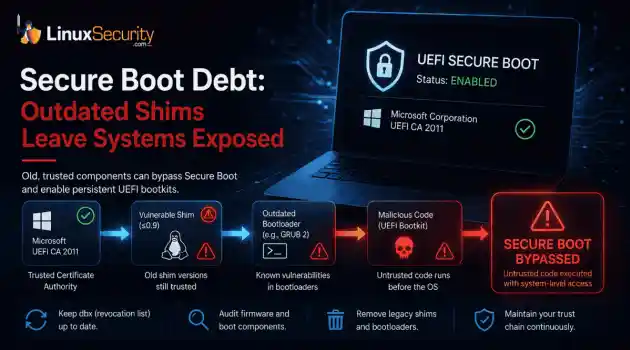
security advisory linux distribution ESET researchers identified 11 old and forgotten Linux UEFI shim bootloaders at versions 0.9 and below that can be used to bypass UEFI Secure Boot on any UEFI-based machine that trusts Microsoft’s Microsoft Corporation UEFI CA 2011 third-party certificate authority, regardless of the installed operating system (OS). Reported shims can be exploited to execute untrusted code during system boot, enabling attackers to deploy malicious UEFI bootkits even on systems with UEFI Secure Boot enabled.....
Jul 16, 2026
 Refine news
X Clear Filters
Get the latest News and Insights
Get the latest Linux and open source security news straight to your inbox.
Community Poll
Is continuous patching actually viable?
Trending News
Loading...
Explore Latest Linux Security news
We found 14 articles for you...
77
 patch managementsecurity protocolsemail security
Zero Trust for Email: Implementing Advanced Protections on Linux
Email threats have long outgrown spamming and obvious phishing. Attackers now exploit trust itself. They impersonate internal users, hijack legitimate threads, and abuse misconfigured configurations. Defenses like perimeter filtering or static rules are not adequate any longer. A Zero Trust model redefines the issue by eliminating implicit trust at all phases of email processing. This shift is especially important in modern Linux mail environments where services are often modular, network-exposed, and heavily dependent on correct configuration across multiple components. . Redefining Trust at the Protocol Level On Linux mail servers, Zero Trust starts with the rigid implementation of authentication protocols. Correctly configured SPF, DKIM, and DMARC make sure that any incoming message is authenticated against policy at the domain level before being accepted. However, implementation alone is not enough. The policy needs to be set to enforcement mode as opposed to passive monitoring, and logs should be checked on a regular basis to detect anomalies. In practical deployments, this means moving DMARC policies toward “quarantine” or “reject” rather than “none.” This ensures that spoofed messages are actively blocked instead of only observed. Outbound validation is equally important. Preventing unauthorized messages from leaving your infrastructure protects both your reputation and your users. This two-fold verification makes a closed circle where trust has to be created on both sides. This includes restricting SMTP submission to authenticated sessions only and preventing unauthenticated relaying, which is a common misconfiguration in exposed mail servers. Hardening the Mail Stack A Zero Trust approach requires a hardened foundation. Mail transfer agents such as Postfix and mail delivery agents like Dovecot should be configured with minimal exposure. Turn off unneeded services, use TLS in all connections and limit access with firewall rules and network segmentation.Additional hardening should include: Disabling legacy authentication mechanisms Enforcing modern TLS versions Restricting administrative interfaces to trusted internal networks or VPN-only access The principles presented in the Linux hardening guide will reinforce this further by minimizing the attack surface and implementing stringent access controls. Combined with regular patching and long-term Linux support, systems are resilient to known vulnerabilities and new threats. Applying system-level hardening practices such as least privilege access, secure file permissions for mail configurations, etc., prevents the underlying operating system from becoming the weakest link in the mail security chain. Zero Trust Email Architecture Design Considerations A Zero Trust email system on Linux should be designed as a layered architecture rather than a single server handling all responsibilities. Separating roles such as mail transfer, authentication, filtering, and storage reduces blast radius and improves fault isolation. For example, Postfix can handle SMTP routing while a separate filtering layer processes content before delivery to Dovecot. This segmentation ensures that even if one component is compromised, the entire mail flow is not immediately exposed. Continuous Verification Over Static Rules Zero Trust is not a one-time configuration; it is an ongoing process of validation. Email content should be scanned dynamically using multiple layers, including: Heuristic analysis Reputation checks Sandboxing for suspicious attachments These layers are often chained together in mail pipelines so that each message is evaluated at multiple stages rather than relying on a single pass filter. Open-source security tools are essential in this regard. Adaptive filtering can be installed in Linux environments with solutions like: SpamAssassin ClamAV Rspamd These tools must be regularly tuned according to the threat intelligence instead of the defaultsettings. Static defenses fade away, whereas systems that are constantly updated remain effective. For example, rule sets should be updated based on live threat feeds, and scoring thresholds should be adjusted to reduce false negatives in high-risk environments. Identity and Access Controls Matter Compromised credentials remain a leading cause of email-based attacks. This risk is mitigated by enforcing strong authentication systems like multi-factor authentication on all mail users. In Linux, email services can be integrated with a centralized identity management system to enable a stricter access policy. Integration with PAM-based authentication or centralized directory services allows consistent enforcement of authentication policies across all mail-related services. Service accounts and administrative access should also be under least privilege principles. Restricting the number of people configuring or accessing the mail system curtails the possibility of misuse or escalation. Administrative SSH access and mail configuration privileges should be separated, ensuring that operational accounts cannot directly modify mail routing or authentication rules. Monitoring, Logging, and Response A Zero Trust model requires visibility. Full logging of SMTP transactions, authentication attempts, and system modifications can help quickly identify anomalies. Logs need to be proactively analyzed and not stored. Centralized log aggregation using syslog pipelines or SIEM-style tooling improves correlation between authentication events, mail delivery patterns, and system changes. Automated alert systems are capable of detecting abnormal patterns, including outbound mail spikes or failed logins. Organizations can swiftly transition to containment when a clear incident response plan combines with detection. When integrated properly, these systems can automatically throttle or block suspicious accounts based on behavioral thresholds, reducing response time during active attacks. Organizations operatinginternet-facing mail infrastructure should also consider DDoS protection solutions that can detect and mitigate large-scale traffic floods targeting SMTP gateways, authentication services, and other externally exposed communication systems before availability is disrupted. Endnote Organizations implementing a Zero Trust approach to email will be in a more favorable position to protect their systems as attackers continue to improve their methods. They do not respond to the threat when it manifests, but create a space where trust is constantly tested and never presumed. . Implement Zero Trust in Linux email systems by reinforcing security through authentication protocols and layered architecture.. Linux Email Security, Zero Trust Model, Threat Mitigation, Email Protocols, Security Architecture. . MaK Ulac
 Apr 17, 2026
•
Apr 17, 2026
• Server Security
81
 security advisorytwo-factor authenticationsecurity protocols
Ring Security Notice: Required Two-Factor Authentication for Your Safety
After customer complaints of account hacks, Ring is making two-factor authentication mandatory and is considering allowing users to opt out of sharing their data with third-party companies. . In response tohighly publicized complaintsfrom customers about their Ring cameras being hacked, the Amazon-owned company announced new security protocols on Tuesday that will make their products more secure for customers. Ring is now making two-factor authentication mandatory for all users when they log into their accounts. Each time a customer logs in, the company will send a code through an email or phone number associated with the account. The six-digit code -- which many consumers have become familiar with through other websites -- will add an extra layer of security to Ring accounts, making it harder for hackers to gain control of the account and its devices. The link for this article located at Security Today is no longer available. . In response to customer concerns over recent hacking incidents, Ring enhances safety measures by implementing compulsory two-step verification.. Ring Security Protocols, Two-Factor Authentication, Account Security, Data Privacy. . LinuxSecurity.com Team
Feb 24, 2020
•
Privacy

67
 security protocolskey generationcryptography research
Analysis Reveals Weak Key Generation in SSL Protocols Identified
Analysis Cryptography researchers have discovered flaws in the key generation that underpins the security of important cryptography protocols, including SSL.. Two teams of researchers working on the problem have identified the same weak key-generation problems. However, the two teams differ in their assessment of how widespread the problem is The link for this article located at The Register UK is no longer available. . Numerous groups of scientists discovered a vulnerability in the random number generation techniques used in various encryption systems.. Cryptography Flaws, Key Security, Weak Key Generation. . LinuxSecurity.com Team
Feb 16, 2012
•
Cryptography
67
data protectionencryptionsecurity protocolsEffective Encryption Methods to Safeguard Sensitive Information
Here's the perfect plan to solve all those pesky security problems. Confidentiality and data leakage, secure backups, individual privacy, data integrity, identity and access management - all can be dealt with in some way by encryption. So why don't we all just use it then, and be done?. Of course encryption is out there, embedded in various technologies The link for this article located at The Register UK is no longer available. . Of course encryption is out there, embedded in various technologies The link for this article locate. here's, perfect, solve, those, pesky, security, problems, confidentiality, leakage. . LinuxSecurity.com Team
Jun 07, 2010
•
Cryptography
74
security protocolsserver protectionsshSSH Attacks Spike: Enhance Passwords And Security Measures
Thanks to the end-of-term for many colleges and some K12 schools, brute-force attacks against SSH servers surged sharply this past weekend, according to the SANS Internet Storm Center. The sudden jump in SSH attacks merits a re-examination of how such servers should be properly secured. Jim Owens and Jeanna Matthews of the Department of Computer Science at Clarkson University have published a paper on the methods that such attacks frequently employ and on the best ways to defeat them. Brute-force attacks gets a lot of attention in the press but do we really need to study it? Yes, with botnet and more powerful computers it makes brute-force attacks more affective. However, if users use strong passwords then the likely hood that they will be hacked by this type of attack goes down drastically. . The link for this article located at arstechnica.com is no longer available. . The link for this article located at arstechnica.com is no longer available.. thanks, end-of-term, colleges, schools, brute-force, attacks, against. . Bill Locke
May 16, 2008
•
Network Security
77
security advisoryrisk managementsecurity protocolsCrucial Steps to Ensure Security in Linux Operating Systems
There's no dearth of Linux distributions to choose from. With so many to choose from, one might think it's as easy as picking up the Linux kernel, throwing in a few applications, setting up respositories, making ISOs and you've got a shiny new Linux distro. Well, there's more to a Linux distro than assembling applications and making sure everything works. A lot of time and effort, at least for major distros, is spent on making the distribution secure and getting updates out in a timely fashion. To start with, all major distributions have security teams that collaborate with the main release team to ensure no vulnerable packages make their way into the final release. For example, Chris Gianelloni, release engineering strategic lead of Gentoo says that the release engineering team works with Gentoo's security team and individual architecture teams to make sure Gentoo doesn't have security vulnerabilities when Gentoo is released. . The link for this article located at Linux.com is no longer available. . The link for this article located at Linux.com is no longer available.. choose, there's, dearth, linux, distributions, might. . LinuxSecurity.com Team
Dec 08, 2006
•
Server Security
77
authenticationsecurity protocolsmixed network managementEffective Security Management for Mixed Linux and Windows Networks
Directory services play a critical role in ensuring computer networks are properly secured and efficiently managed. While Linux machines running in Microsoft Windows networks can interoperate with Active Directory, configuration is complicated - especially for administrators lacking Linux expertise. Managing authentication between Windows and Linux systems just got easier. Linux systems, as shipped, include support for Kerberos, LDAP and other security/authentication protocols, but don't typically come ready to perform single-sign on Linux by buying specialized, proprietary software. It is possible to partially implement Active Directory-based single sign-on on Linux systems without any additional software. . The link for this article located at Newsforge.com is no longer available. . Investigate optimized administration for hybrid Windows/Linux environments along with robust security protocols and directory frameworks.. Mixed Network Management, Directory Services, Linux Authentication, Security Protocols, Windows Integration. . LinuxSecurity.com Team
Oct 04, 2006
•
Server Security
67
security protocolscrypto applicationsencryption techniquesExplore Godzilla Crypto Tutorial: 509 Slides on Encryption Techniques
This page contains my godzilla crypto tutorial, totalling 509 slides in 8 parts, of which the first 7 are the tutorial itself and the 8th is extra material which covers crypto politics. Part 8 isn't officially part of the technical tutorial itself. The tutorial is done at a reasonably high level, there are about two dozen books which cover things like DES encryption done at the bit-flipping level so I haven't bothered going down to this level. Instead I cover encryption protocols, weaknesses, applications, and other crypto security-related information. Since the slides are accompanying material for a proper tutorial, there's a lot of extra context which isn't available just by reading the slides. Bear in mind that some of the claims and comments on the slides need to be taken in the context of the full tutorial. Accompanying the slides are about 150 images, unfortunately I can't make these available for copyright reasons. . The tutorial is formatted so that two slides fit one page, which means you'll burn out about 260 pages of paper printing them all out (half that if you print double-sided). To view the tutorial you'll need a copy of the free Adobe Acrobat Reader software. Note that most of the diagrams (and there are quite a few of them) will look a lot better on paper than on screen. The gv viewer (a replacement for ghostview) displays the slides better than the Acrobat Reader, especially with antialiasing enabled. The output was generated from Powerpoint slides, unfortunately Powerpoint converts the text colours of embedded tables into a very hard-to-read light grey, ignoring the actual text colouring set for the table. There doesn't appear to be any way to fix this problem. The link for this article located at Peter Gutman is no longer available. . The tutorial is formatted so that two slides fit one page, which means you'll burn out about 260 pag. godzilla, crypto, tutorial, totalling, slides, parts, which, first. . LinuxSecurity.com Team
Jul 20, 2006
•
Cryptography

Get the latest News and Insights
Get the latest Linux and open source security news straight to your inbox.
Community Poll
Is continuous patching actually viable?
Trending News
Search Topics
Powered By

Linux Security - Your source for Top Linux News, Advisories, HOWTOs and Feature Releases
QUICK LINKS
subscribe to newsletters!
Like staying secure? So do we.
Sign up for updates, tips, and alerts!