Explore top 10 tips to secure your open-source projects now. Read More
×



Server Security data privacy automation
data privacy automation Every system admin has lived through the same Monday morning ritual. A queue of forty tickets, half of them password resets, permission errors, or disk space warnings that any experienced technician could resolve in under two minutes. The other half require actual judgment. For years, automation promised that software would eventually sort the two apart on its own. That promise is now being tested in production Linux environments. . Early results are reshaping how IT teams think about tier-1...
 Jul 17, 2026

Privacydata collection automation
data collection automation You're running a web scraping project to collect pricing data from e-commerce sites. You set up a pool of datacenter proxies, launch your scripts, and within minutes — banned . CAPTCHAs everywhere. Your data pipeline stops before it really begins. . It's a frustrating scenario that plays out daily in ad verification, market research, and multi-account management. The website doesn't know you're doing legitimate research or monitoring. It just sees traffic coming from IP ranges it recognizes as...
Jul 17, 2026

Security Trends security advisory social engineering
security advisory social engineering Business Email Compromise used to be a numbers game — mass-blasted emails, broken English, an obvious "URGENT WIRE TRANSFER" subject line. That era is over. Generative AI has turned BEC into a tailored, low-noise operation that mimics writing style, voice, and even video presence. This piece looks at what's actually changed under the hood, what defenders are testing in response, and why so many organizations are still structurally unprepared for it. . The Infrastructure Problem Nobody Wants to...
Jul 17, 2026

Security Trends cybersecurity Linux documentation
cybersecurity Linux documentation Linux operating systems have gained prominence due to their stability, adaptability, and excellent security options. In the case of developing documentation, designing cybersecurity dashboards, or educational material, visuals are of vital importance when it comes to making things clear. The use of icons allows one to understand the message regarding alerts, authorization, encryption, authentication, or the state of the system just by looking at the visual cue without having to read long...
Jul 17, 2026
Security Vulnerabilities security advisory linux distribution
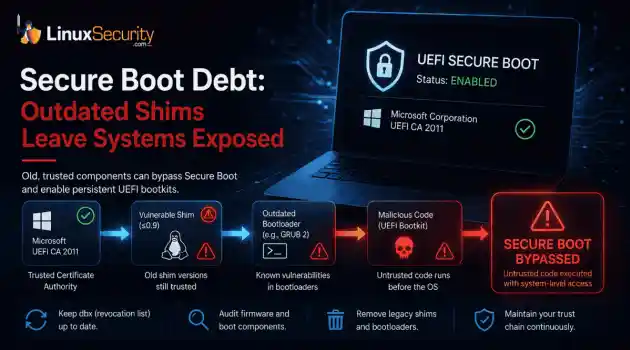
security advisory linux distribution ESET researchers identified 11 old and forgotten Linux UEFI shim bootloaders at versions 0.9 and below that can be used to bypass UEFI Secure Boot on any UEFI-based machine that trusts Microsoft’s Microsoft Corporation UEFI CA 2011 third-party certificate authority, regardless of the installed operating system (OS). Reported shims can be exploited to execute untrusted code during system boot, enabling attackers to deploy malicious UEFI bootkits even on systems with UEFI Secure Boot enabled.....
Jul 16, 2026
 Refine news
X Clear Filters
Get the latest News and Insights
Get the latest Linux and open source security news straight to your inbox.
Community Poll
Is continuous patching actually viable?
Loading...
Explore Latest Linux Security news
We found 207 articles for you...
210
 open-sourcedependency managementsecurity threat
Malicious Go Modules: Securing Your Linux Build Pipeline
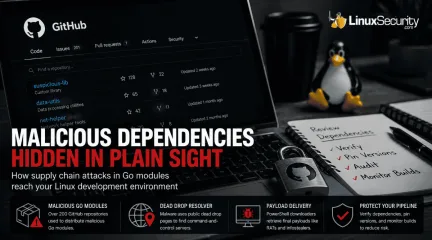
Every Linux developer who works with Go has run the same workflow a thousand times. You find a library that solves your problem, you see a decent star count on GitHub, and you run go get. It is frictionless and efficient. Lately, however, it is becoming one of the most effective ways for an attacker to get code running on your build servers. The recent "Operation Muck and Load" campaign is a perfect example of why this workflow is risky. Researchers uncovered over 200 GitHub repositories distributing malicious Go modules . These were not exploiting a vulnerability in the Go compiler or a bug in a specific package. They were exploiting the assumption that anything hosted on GitHub deserves the benefit of the doubt. . How Attackers Turn GitHub Into a Delivery Platform The attack starts long before any malware is downloaded. Attackers first publish a Go module that looks like something you would genuinely use. The repository has a believable name, a polished README, and enough commit history to suggest an active project. Much of that activity is manufactured through commit farming, giving the impression that multiple developers have been maintaining the code over time. Once a developer imports the module, the real attack begins. Hidden inside the package is obfuscated code that launches PowerShell rather than simply performing its advertised function. Instead of connecting directly to a command-and-control server—which would be easy for security teams to block via firewall rules—the script first checks a public "dead drop" page that stores the current server location. This technique, classified by MITRE as a Dead Drop Resolver , lets the attackers change infrastructure whenever they want without modifying the malware itself. Only after resolving that address does the downloader retrieve the final payload, such as a Remote Access Trojan. Supply chain attacks are difficult to detect because nothing initially looks broken. The build succeeds, the application runs, and developers move on.By the time suspicious behavior appears, the malicious dependency may already be embedded across multiple projects. Why Your Linux Build Pipeline Is at Risk It is easy to look at a Windows-based RAT and assume your Linux servers are safe. Do not be that confident. Shared Infrastructure: If your CI/CD runner is configured to compile artifacts for both Linux and Windows, that runner is now compromised. Trusting the Proxy: Many developers rely on the default GOPROXY . While this protects you from repositories disappearing, it does not verify that the code within those modules is benign. Developer Workstations: Most of us use Linux as our primary workstation. If you import a malicious module, your local GOPATH is exposed, and any environment variables or credentials cached on your machine are fair game. Auditing and Verifying Your Dependencies Go provides several tools to help you keep an eye on your dependencies. If you are not using them, you are flying blind. 1. Start with go mod verify The go mod verify command checks that the dependencies in your local cache have not been modified since they were downloaded. If a local file has been tampered with, this command will immediately flag it. 2. Inspect with go list Before you add a module, see what it’s actually pulling in. Use go list -m all to get a full tree of your project's dependencies. If you are importing a simple logging tool and it suddenly pulls in 50 sub-dependencies you’ve never heard of, that is a massive red flag. 3. Manage your Proxy In enterprise environments, do not just rely on public proxies. Consider using an internal GOPROXY or an artifact repository that caches and scans modules. This gives you a single choke point where you can enforce security policies and conduct vulnerability scans before code ever reaches your build pipeline. 4. Leverage Build-Time Monitoring If your build process is suddenly reaching out to the internet to fetch "resolver" content from randompublic websites, your security team needs to know. Monitor your CI/CD runners for unexpected outbound network traffic during the go build phase. Legitimate builds should talk to known proxies or git servers, not random public dead drops. Don't Let Your Build Process Be Your Weak Link Go's module ecosystem is not broken, but blind trust is. The repositories in Operation Muck and Load did not exploit a flaw in the language; they exploited the assumption that anything hosted on GitHub deserves the benefit of the doubt. Before adding a new dependency, spend a minute looking at who maintains it, how the project history has evolved, and what your build process is actually downloading. Verify your hashes, pin your versions, and keep an eye on your outbound traffic. That is often enough to avoid becoming the next victim of a supply chain attack. . Learn how to secure your Linux build pipeline from malicious Go modules exploiting trust in GitHub repos.. Go modules security, Linux build risks, dependency management, supply chain threats. . MaK Ulac
 Jul 10, 2026
•
Jul 10, 2026
• Security Vulnerabilities
83
 malware protectionsecurity threatLinux development
Mitigating Typosquatting Threats in Linux: Strategies for Developers
Recent discoveries by Socket have exposed an elaborate typosquatting campaign targeting Linux and macOS developers through similar-sounding names for Go packages. This strategy dupes developers into downloading malicious packages that install malware loaders silently onto systems, potentially endangering entire networks. . As admins and developers, we must understand its mechanics to implement effective protection strategies against this threat. Proactively mitigating risk requires rigorous package name verification, integrity checks, and real-time scanning tools to detect suspicious activity. Furthermore, being mindful of obfuscation tactics used by these packages can prevent malware from sneaking through unseen. To help you understand and prepare for this threat, let's examine its mechanics and discuss practical measures you can implement to safeguard your Linux environment and open-source projects against it. Understanding This New Typosquatting Threat Socket recently unveiled an intriguing typosquatting campaign to target Linux and macOS developers by exploiting similar-sounding names for Go packages. This strategy deceives them into downloading malicious packages that silently install malware loaders, potentially compromising entire systems and leaving security administrators vulnerable. Let's examine the mechanics of typosquatting so you can implement effective protection strategies against this threat. The Mechanics of Typosquatting Typosquatting is a deceptive practice in which malicious actors create packages with names that closely resemble popular and legitimate software packages to take advantage of typographical errors made by developers when downloading said packages. For instance, if an intended gopackage downloader typed "gopackge, " they could import an infected version unwittingly. These malicious packages are often distributed through widely used repositories, making them appear legitimate at first glance. Once imported, however, they can install hiddenmalware loaders that execute harmful payloads without the developer's knowledge, leading to data breaches, system compromises, and unauthorised access to sensitive information. Vigilance in Package Name Verification One of the easiest and most effective strategies against typosquatting is meticulous package name verification. Developers should double-check each package they import for typographical errors. While simple, this practice can drastically lower risks associated with typosquatting. Deploying package managers that support checksum verification can add another layer of protection by verifying downloaded packages against their original version without any unauthorized modifications - something especially vital when working with open-source software. Implementing Integrity Checks Integrity checks provide another important defense mechanism against malware installation . They ensure that installed software matches an expected cryptographic hash value and has not been modified since being published. Linux security administrators should enforce the use of package managers like Node.js npm or Python pip , which support integrity verification with checksums or digital signatures across development environments. By doing so, even if a developer accidentally downloads an infected package by mistake, integrity checks will fail and prevent its installation. The Challenge of Obfuscated Payloads Malicious packages often use deceptive tactics to conceal their true intention, making it harder to detect and analyze them. Such techniques could include minified code, encrypted payloads or complex scripts which execute additional downloads. Recognizing and mitigating obfuscated payloads is key. Security administrators should implement advanced scanning tools and methods to detect obfuscated code. This can help analyze package behavior to detect suspicious activities such as remote server communication or unauthorized system changes. Regular code audits are another invaluable way ofdetecting obfuscation. By thoroughly scouring their codebases, security teams can catch any strange or unfamiliar code that has passed initial inspection. Encouraging developers to document and peer-review code changes further assists this process and creates a culture of transparency and vigilance in their organizations. Fostering a Culture of Vigilance and Sharing Developing a culture of vigilance among developers is paramount to protecting against typosquatting and similar threats. Security is everyone's responsibility, so encouraging developers to stay alert for suspicious activities and report suspicious ones can dramatically strengthen overall security. One effective approach is to implement regular security training sessions. These can educate developers about common threats such as typosquatting, demonstrate how to identify suspicious packages, and emphasize best practices for secure coding . Furthermore, setting up clear channels for reporting any security concerns quickly ensures that any discovered threats can be promptly dealt with. Sharing threat intelligence within a community is also crucial. Organizations can strengthen their defenses by discussing threats openly and exchanging relevant indicators of compromise (IOCs). Proactive Measures and Continuous Monitoring Proactive measures and continuous monitoring are key components of an effective security strategy for Linux administrators. Admins and developers should implement comprehensive monitoring solutions that detect unusual behavior in real time, alerting security teams of potential breaches for rapid response and mitigation efforts. Automation tools can also play a crucial role in maintaining security. Automated vulnerability scanning can quickly identify outdated or vulnerable packages that could be exploited. Adopting the principle of least privilege can also lessen the damage from any potential compromise by restricting access rights and permissions as needed. Our Final Thoughts on Mitigating This RecentLinux Security Threat Recent typosquatting campaigns against Linux and macOS developers underscore the need for strong security practices within development environments. By understanding typosquatting's mechanisms, conducting thorough package verification checks, and recognizing obfuscated payloads, Linux security administrators and developers can significantly decrease risk. Adopting a proactive, community-driven security approach can further boost defenses. Regular training sessions, continuous monitoring, and threat intelligence sharing play key roles in creating an effective security plan. As threat actors adapt and evolve, remaining vigilant and informed is our best defense against typosquatting and other malicious campaigns. . Address the emerging typosquatting risks threatening Linux and macOS programmers through robust safety protocols.. Typosquatting Threat, Linux Security, Malware Protection, Package Verification, Code Obfuscation. . Brittany Day
Mar 11, 2025
•
Hacks/Cracks

210
 DoS issuesecurity threatsecurity measure
Addressing RCE and DoS Threats: Strategies for Linux Security
Linux is a powerful operating system that forms the backbone of numerous servers, workstations, kiosks, and embedded devices worldwide. It accounts for approximately 3.08% of all operating systems in use globally. Given its critical role in infrastructure and technology, ensuring the security of Linux environments is paramount. However, the reality is challenging; over the past five years, more than 1,050 cybersecurity vulnerabilities have been identified in the Linux kernel. . In this article, we’ll focus on the types of Linux vulnerabilities you should be familiar with, such as KSMBD file server module vulnerability , their implications, and effective mitigation strategies. Understanding Linux Vulnerabilities In cybersecurity, a vulnerability refers to a weakness in an asset, process, or software that a threat actor can exploit. Vulnerabilities increase the risk of adverse outcomes, including data breaches, system downtime, and loss of sensitive information. Understanding these vulnerabilities is crucial for organizations aiming to secure their Linux environments against growing cyber threats. Common Types of Linux Vulnerabilities As one of the world's most widely used operating systems, Linux underpins many critical systems, from web servers and data centers to embedded devices and cloud infrastructure. Its versatility and open-source nature make it popular among businesses and developers. However, with its growing prominence comes an increasing risk of cyber threats targeting Linux environments. The security of Linux systems is paramount to protect sensitive data and maintain operational integrity, ensure compliance with regulatory requirements, and safeguard organizational reputation. Here are some of the types of security vulnerabilities you should know: Denial of Service (DoS) Vulnerabilities Denial of Service (DoS) vulnerabilities are attacks that aim to render services unavailable to legitimate users. This is typically accomplished by overwhelming targetsystems with excessive traffic or exploiting weaknesses that cause crashes. For example, a DoS attack may prevent customers from accessing a banking application, resulting in significant disruption and potential financial loss. DoS attacks can be categorized based on their execution method. Common forms include: Ping of Death: Sending malformed packets to crash a target system. Buffer Overflow: Exploiting a program's memory allocation errors to execute arbitrary code. SYN Flood: Initiating multiple TCP connection requests without completing them, consuming server resources. Remote Code Execution (RCE) Vulnerabilities Remote Code Execution (RCE) vulnerabilities are among the most severe security issues. They allow attackers to run malicious code on a target system from a distance. Such vulnerabilities can lead to full-scale breaches, enabling attackers to take complete control of web servers and other critical infrastructure. The consequences of RCE can be devastating, including unauthorized access to sensitive data and the potential for widespread disruption. Historical Context of Linux Vulnerabilities According to the Linux Foundation’s Linux Kernel History Report published in 2020 , the Linux kernel has found applications in various sectors, including medical devices, autonomous vehicles, and aerospace technologies. The report highlights the annual increase in contributions to the Linux kernel, with over ten commits per hour on average. This robust development ecosystem is essential for continuous improvement, but it also means that vulnerabilities can emerge as new features are integrated. Analyzing Prominent Vulnerabilities Recent telemetry analysis reveals several vulnerabilities that have been significantly exploited. Among them, the following Common Vulnerabilities and Exposures (CVEs) stand out: CVE-2021-44228 : Known as the Apache Log4j vulnerability, this critical flaw has a severity score of 10 in the Common Vulnerability Scoring System(CVSS). CVE-2017-12611 and CVE-2018-11776 : Vulnerabilities associated with Apache Struts that have been widely exploited. CVE-2018-15473 : An OpenSSH vulnerability that impacts all Linux and Unix platforms. Strategies for Mitigating Linux Vulnerabilities Organizations must adopt proactive and comprehensive strategies to combat the ever-evolving landscape of Linux vulnerabilities. Effective mitigation starts with understanding the potential threats you face and implementing robust security measures, such as those we will discuss below. Vulnerability Prevention and Reduction Implementing effective vulnerability prevention strategies is crucial. This includes minimizing the attack surface by only installing necessary software and services. A minimal installation approach ensures that only essential processes are running, reducing potential entry points for attackers. Enable kernel hardening options such as stack canaries, ASLR (Address Space Layout Randomization) , and control flow integrity to further fortify the kernel against both known and unknown security threats. Conduct regular system audits and employ intrusion detection systems (IDS) to promptly identify and respond to suspicious activities. Code Auditing and Development Practices Incorporating rigorous code auditing practices for software development organizations can significantly reduce the likelihood of introducing vulnerabilities. Code auditing tools, such as linting utilities, can help identify potential issues early in development. Developers should be encouraged to use established security libraries and frameworks that minimize common coding pitfalls. Firewalls and Traffic Filtering Network security can be improved through effective traffic filtering mechanisms. Configuring local firewalls to only allow necessary services can drastically reduce threat exposure. While firewalls provide an initial layer of defense, they should be complemented with web application firewalls (WAFs) to filter and monitorHTTP traffic to web applications, further protecting against application-layer attacks. Regular Patch Management Maintaining an up-to-date Linux environment is critical for mitigating vulnerabilities. Regular patch management ensures that known security flaws are addressed promptly. Organizations should establish a routine for monitoring updates and deploying patches, particularly for critical components like the Linux kernel and frequently used applications. Comprehensive Security Audits Conducting comprehensive security audits regularly helps organizations identify potential vulnerabilities within their systems. These audits can include network scanning, penetration testing, and configuration reviews. Engaging with external cybersecurity experts can provide valuable insights into existing vulnerabilities and help develop tailored remediation strategies. Employee Training and Awareness Human error remains one of the leading causes of security breaches. Educating employees about the importance of cybersecurity, recognizing phishing attempts, and adhering to best practices can significantly mitigate risks associated with social engineering attacks. Implementation Of Mitigation Strategies As organizations increasingly rely on Linux systems for their critical operations, the importance of robust security measures cannot be overstated. With the growing number of cyber threats explicitly targeting Linux environments, implementing effective mitigation strategies is essential. The rationale behind minimal installations is straightforward: the fewer applications and services running on a system, the fewer vulnerabilities can be exploited. For instance, a server configured to run only the necessary web services without additional software minimizes exposure to threats inherent in unneeded applications. This approach enhances security and improves system performance as resources are allocated more efficiently. Our Final Thoughts on Combating Linux Vulnerabilities Thedigital ecosystem is constantly shifting, driven by technological advancements, user behavior changes, and the increasing complexity of IT environments. Cyber threats have become more sophisticated, with attackers employing various tactics that exploit operating systems, applications, and network infrastructure vulnerabilities. As a foundational technology for many organizations, Linux is not immune to these threats. As cybercriminals develop new techniques to breach defenses, the importance of staying informed about these evolving threats cannot be overstated. Continuous education and adaptation remain vital in safeguarding Linux systems against emerging vulnerabilities. . Linux, widely used in server settings, has vulnerabilities that must be addressed. Key categories include kernel bugs, package management flaws, configuration issues, and more. Linux vulnerabilities, mitigation techniques, RCE threats, DoS attacks, security practices. . Brittany Day
Oct 07, 2024
•
Security Vulnerabilities
83
 malwarecybersecuritysecurity threat
Gomir Linux Backdoor Threat Analysis: Kimsuky APT Insights and Defense
The Kimsuky APT group, reportedly linked to North Korea's Reconnaissance General Bureau (RGB), has been identified deploying a Linux version of its GoBear backdoor called Gomir. The Gomir backdoor is structurally similar to GoBear, leading to concerns within the cybersecurity community. The overlapping code between malware variants raises questions regarding the extent of the threat and the potential implications for targeted organizations. Let's explore the significance of this discovery and its implications for the Linux community so you are better prepared to protect against Gomir and other Linux malware variants. . How Does Gomir Work & What Are Its Implications for Linux Admins? In technical terms, Gomir, the Linux backdoor, supports several commands, enabling its operators to carry out file operations, initiate a reverse proxy, pause command-and-control communications, execute shell commands, and terminate its own process. The existence of these capabilities demands robust security protocols within Linux systems , including monitoring and controlling command executions to prevent the misuse of these privileges by threat actors. Security researchers initially documented GoBear in connection with a campaign involving malware known as Troll Stealer, suggesting that these activities are part of a larger, coordinated effort by the Kimsuky APT group to infiltrate organizations in South Korea. Moreover, the distribution of the malware through trojanized security programs downloaded from a South Korean construction-related association's website is noteworthy. This points to the pressing need for organizations to meticulously assess the integrity of the software they download and use. Using rogue installers for Wizvera VeraPort to deliver Troll Stealer further emphasizes the need for improved supply chain security measures to prevent the spread of malicious software. This includes modernizing processes, reviewing and updating permissions throughout the supply chain, and verifying code beforedeploying it. The broader implication of this report is the emerging pattern of software installation packages and updates being exploited as favored infection vectors for espionage activities. Recognizing this trend is essential for security practitioners and underscores the urgency of ensuring the authenticity and security of software updates and installation packages. Our Final Thoughts on Gomir The emergence of Gomir and the tactics employed by the Kimsuky APT group in targeting South Korean organizations demonstrate the need for enhanced vigilance and proactive security measures. Linux admins should take note of these developments and evaluate their security postures to mitigate the risk such advanced persistent threat groups pose to their systems. . Gomir, a concerning malware variant, poses threats to Linux security. Understanding its tactics is vital for enhancing system defenses against such intrusions. Linux Backdoor,Kimsuky APT,Security Threats,Malware Defense,Linux Security. . Brittany Day
May 30, 2024
•
Hacks/Cracks
210
 security advisorycriticalcritical threat
Util-Linux Advisory: CVE-2024-28085 Critical Wall Command Exploit
A critical vulnerability has been found in the wall command of the util-linux package that poses a severe security threat to Linux systems. This vulnerability, known as WallEscape and tracked as CVE-2024-28085 , has been present in every package version for the past 11 years. . It allows an attacker to exploit escape control characters to create a fake SUDO prompt on other users' terminals, ultimately tricking them into revealing their sensitive information, such as administrator passwords. The vulnerability can be exploited under certain conditions, mainly when the "mesg" utility is active and the wall command has setgid permissions. What Are the Implications of this Issue? How Can I Mitigate My Risk? This longstanding vulnerability in Linux systems poses potential risks, as attackers with access to multi-user Linux servers can leverage it to deceive unsuspecting users. This vulnerability has remained undiscovered and unpatched for over a decade, raising questions about the effectiveness of security auditing processes in open-source software developmen t. One exploitation scenario involves a fake SUDO prompt being created for the Gnome terminal, tricking users into entering their passwords. This prompts us to consider the wide-ranging implications of this vulnerability. Does this mean similar vulnerabilities may exist in other commonly used Linux utilities and commands? Are there additional attack vectors that could exploit similar flaws in terminal emulators? These questions highlight the broader security implications that necessitate further examination. This vulnerability serves as a wake-up call for Linux admins, infosec professionals, and sysadmins to prioritize patching vulnerabilities promptly . The fact that the exploitation of WallEscape requires local access limits its severity to some extent. However, in multi-user environments like organizational servers, the risk is heightened. System administrators are advised to upgrade to linux-utils v2.40 or implement mitigations byremoving setgid permissions from the wall command or disabling the message broadcast functionality using the 'mesg' command. In terms of long-term consequences, this issue highlights the need for continuous security monitoring and regular updates in the Linux ecosystem. The discovery of this decade-old vulnerability reveals the importance of comprehensive security audits and continuous testing to uncover hidden weaknesses that might have been overlooked. Additionally, it highlights the significance of collaboration within the open-source community to ensure timely vulnerability identification and patching. Our Final Thoughts on This Linux 'wall' Bug This article aims to shed light on a critical vulnerability in Linux systems and raise important questions about the overall security landscape of open-source software. It is an urgent reminder for Linux admins and security practitioners to prioritize vulnerability patching and continuous security monitoring. By addressing the long-standing vulnerability and emphasizing the need for r obust security practices , admins can mitigate risk and improve Linux system security. . An alarming vulnerability has been identified within the wall command, enabling deceptive SUDO prompts to mislead individuals into disclosing their passwords.. Util-Linux, Wall Command, Critical Advisory, SUDO Exploits. . Anthony Pell
Mar 29, 2024
•
Security Vulnerabilities
83
 cybercrimeopen sourcesecurity threat
Malvertising Threat on Linux: Protecting Against Fake PuTTY Attacks
A malvertising campaign has been discovered that deploys a fake PuTTY client to deliver the Rhadamanthys stealer, a dangerous malware . The attackers exploit the trust placed in PuTTY as a widely used SSH and Telnet client by presenting a counterfeit website through malicious ads that appear at the top of Google search results. Let's examine this significant security threat targeting Linux admins more deeply, emphasizing the need for heightened vigilance and robust Linux security measures. . A Closer Look at This Malicious Campaign Malware loaders have assumed a central role in the cybercriminal ecosystem. These loaders infiltrate machines and deploy additional payloads while evading detection. The loader used in this campaign is particularly noteworthy for its use of the Go programming language and an innovative technique to deploy the Rhadamanthys stealer. This emphasizes the need for Linux admins and security practitioners to stay updated on emerging attack techniques and constantly improve their defense mechanisms to counter such threats. It is critical to highlight how unsuspecting users are directed to a domain controlled by the attackers, masquerading as PuTTY's homepage. From there, a two-step redirection process leads to downloading a malicious PuTTY executable. This executable initiates the downloading of the Rhadamanthys stealer, which, once executed, poses a significant threat by stealing sensitive information from the compromised system. What Are the Implications of This Threat? How Can I Secure My Systems? The implications of this malvertising campaign are severe for Linux administrators and the broader cybersecurity community. The attackers' ability to exploit the trust in widely used tools like PuTTY highlights the need for constant vigilance and scrutiny of sources. It prompts questions about the potential for similar attacks targeting other open-source software that forms the backbone of various operating systems. The use of the Go programming language for theloader is notable as it indicates cybercriminals' evolving sophistication. This poses a challenge for security practitioners who must stay updated on the latest programming languages and techniques attackers employ. Moreover, this threat raises concerns about the long-term consequences of such attacks. As malware and cybercrime evolve and adapt, security practitioners must remain proactive and agile in defending against emerging threats. This includes implementing robust monitoring and detection systems, regularly updating software and firmware, and educating users and administrators about the risks posed by malicious campaigns. The impact on Linux administrators and infosec professionals is profound. They are at the forefront of defending against such attacks and must be aware of the latest techniques employed by cybercriminals. This discovery serves as a reminder that even seemingly legitimate tools and websites can be compromised, underscoring the importance of scrutinizing domain names and sources. Our Final Thoughts on Securing Linux Systems Against Malvertising Campaigns This article highlights the evolving tactics employed by cybercriminals to exploit trust and infiltrate systems. Linux admins, infosec professionals, and sysadmins must stay informed, adapt their defenses, and emphasize the importance of user education to protect against these threats. The consequences of these attacks are far-reaching, making constant vigilance and proactive defense strategies vital to safeguarding critical systems and data. Stay safe out there, Linux admins! . A recent malvertising campaign exploiting PuTTY highlights the risks of popular software. Users should be vigilant, verify downloads, and strengthen security practices. Linux Security, Cybercrime Alert, Malware Defense, Open Source Threats, User Education. . Dave Wreski
Mar 25, 2024
•
Hacks/Cracks
77
network monitoringmalwaresecurity threatBifrost Malware Targets Linux Servers With Deceptive Techniques
A new variant of Bifrost, a remote access Trojan (RAT), has been observed attacking Linux servers. The new variant, dubbed Bifrose, employs a deceptive domain name to evade detection. . Security researchers have stated, "The latest version of Bifrost reaches out to a command and control (C2) domain with a deceptive name, download.vmfare[.]com, which appears similar to a legitimate VMware domain." This is significant because it shows that attackers are getting more sophisticated in using socially engineered techniques to trick users. The use of this domain made domain name system (DNS) monitoring and blocking more difficult. To avoid detection, the malware also uses misleading domain names such as C2 instead of IP addresses. Why Is this Malware So Dangerous? The fact that stripped binaries were used indicates that the attackers employed this tactic to hinder analysis. This makes reverse engineering more difficult and time-consuming for security professionals. Additionally, it is concerning that researchers discovered that a malicious IP address hosts an ARM version of Bifrost, suggesting that attackers are attempting to increase the area of attack. These developments pose profound implications for Linux admins, infosec professionals, sysadmins, and internet security enthusiasts. These security practitioners must stay informed and prepared to defend against these types of attacks. They must be increasingly vigilant with system updates, network monitoring , staying up-to-date with the latest security patches , and access controls. It is important to be proactive in securing networks and systems against cyber threats. Our Final Thoughts on Bifrose Malware The new Bifrost malware targeting Linux servers employs enhanced deceptive tactics to infect systems and steal confidential information. The malware can bypass traditional security measures using typosquatting techniques, making it harder for even experienced security teams to detect and mitigate. With the rise of newly developedmalware using this deception, we must remain vigilant with our defensive measures. It is crucial for Linux admins, infosec professionals, internet security enthusiasts, and system administrators worldwide to actively look for and eliminate such malware to safeguard sensitive information and maintain the integrity of computer systems. . The latest iteration of Bifrost employs cunning strategies to avoid being spotted, specifically aiming at Linux systems, heightening the potential for security vulnerabilities.. Bifrost Malware, Linux Server Security, Remote Access Trojan. . Dave Wreski
Mar 02, 2024
•
Server Security
67
 high severityransomwaresecurity threat
Abyss Locker Ransomware Targets Linux And Windows Systems: High Threat
A ransomware variant dubbed "Abyss Locker" has been observed targeting Microsoft Windows and Linux platforms. The Abyss Locker ransomware is believed to be based on the HelloKitty ransomware source code. It steals and encrypts victims' files, demanding ransom for decryption and preventing the release of stolen data. The ransomware's severity level is classified as high, showcasing the urgency of addressing this issue. . Intriguing Points & Security Implications Abyss Locker was first detected in July 2023, but its origins may date even further. This raises questions about the potential evolution of ransomware and the continuous importance of staying ahead of emerging threats. Another interesting aspect is the attack method of ransomware. The Windows version of Abyss Locker performs several actions to ensure successful encryption, such as deleting Volume Shadow Copies and system backups. On the Linux side, it attempts to shut down running VMware ESXi systems before encrypting files. This intricate approach reveals the attackers' sophistication and highlights the need for robust security measures. The ransomware avoids encrypting specific file extensions and directories to maintain system operability and enable victim-attacker communication for ransom negotiation. This indicates that the attackers are focused on maximizing their chances of receiving payment, leaving room for speculation about their motives and potential future enhancements to their tactics. The Abyss Locker ransomware presents a significant challenge for security practitioners. Its ability to target Windows and Linux platforms demonstrates the necessity for a comprehensive and multi-layered security strategy. Linux admins, in particular, must be attentive to the risks associated with VMware ESXi systems, as the ransomware specifically targets this environment. As security practitioners, it is essential to ask critical questions: How can we enhance our detection and prevention mechanisms to identify emergingransomware variants like Abyss Locker? Are our backup and recovery processes robust enough to mitigate the impact of ransomware attacks? What steps can be taken to counteract ransomware developers' sophisticated tactics, such as the multiple evasion techniques employed by Abyss Locker? Long-term consequences must also be considered. The successful targeting of both Windows and Linux platforms indicates a potential shift in ransomware strategies, revealing the adaptability and resourcefulness of cybercriminals. This calls for ongoing vigilance and the continuous development of proactive security measures. Our Final Thoughts on Abyss Locker The Abyss Locker ransomware represents a clear and present danger to Windows and Linux users. Its sophisticated attack methods, ability to encrypt files, and ransom demand raise serious concerns for security practitioners. By analyzing the implications and asking critical questions, security professionals can better understand this threat and take proactive measures to protect their systems. The long-term consequences of this ransomware highlight the need for ongoing adaptation and improvement in security practices. As we face the evolving landscape of cybersecurity, it is vital to stay informed , remain vigilant, and develop robust defenses against ransomware attacks. . Phantom Gate malware targets both Mac and Windows platforms, employing complex strategies for maximum damage. Remain vigilant.. Abyss Locker Ransomware, Linux Security Threat, Windows Cyber Attacks, Ransomware Defense Strategies. . Brittany Day
Mar 02, 2024
•
Cryptography

Get the latest News and Insights
Get the latest Linux and open source security news straight to your inbox.
Community Poll
Is continuous patching actually viable?
Search Topics
Powered By

Linux Security - Your source for Top Linux News, Advisories, HOWTOs and Feature Releases
QUICK LINKS
subscribe to newsletters!
Like staying secure? So do we.
Sign up for updates, tips, and alerts!