Explore top 10 tips to secure your open-source projects now. Read More
×



Server Security data privacy automation
data privacy automation Every system admin has lived through the same Monday morning ritual. A queue of forty tickets, half of them password resets, permission errors, or disk space warnings that any experienced technician could resolve in under two minutes. The other half require actual judgment. For years, automation promised that software would eventually sort the two apart on its own. That promise is now being tested in production Linux environments. . Early results are reshaping how IT teams think about tier-1...
 Jul 17, 2026

Privacydata collection automation
data collection automation You're running a web scraping project to collect pricing data from e-commerce sites. You set up a pool of datacenter proxies, launch your scripts, and within minutes — banned . CAPTCHAs everywhere. Your data pipeline stops before it really begins. . It's a frustrating scenario that plays out daily in ad verification, market research, and multi-account management. The website doesn't know you're doing legitimate research or monitoring. It just sees traffic coming from IP ranges it recognizes as...
Jul 17, 2026

Security Trends security advisory social engineering
security advisory social engineering Business Email Compromise used to be a numbers game — mass-blasted emails, broken English, an obvious "URGENT WIRE TRANSFER" subject line. That era is over. Generative AI has turned BEC into a tailored, low-noise operation that mimics writing style, voice, and even video presence. This piece looks at what's actually changed under the hood, what defenders are testing in response, and why so many organizations are still structurally unprepared for it. . The Infrastructure Problem Nobody Wants to...
Jul 17, 2026

Security Trends cybersecurity Linux documentation
cybersecurity Linux documentation Linux operating systems have gained prominence due to their stability, adaptability, and excellent security options. In the case of developing documentation, designing cybersecurity dashboards, or educational material, visuals are of vital importance when it comes to making things clear. The use of icons allows one to understand the message regarding alerts, authorization, encryption, authentication, or the state of the system just by looking at the visual cue without having to read long...
Jul 17, 2026
Security Vulnerabilities security advisory linux distribution
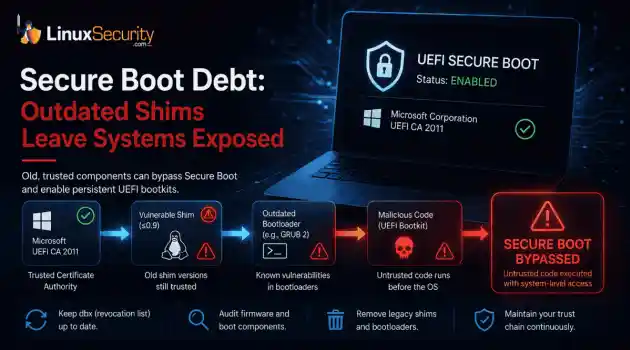
security advisory linux distribution ESET researchers identified 11 old and forgotten Linux UEFI shim bootloaders at versions 0.9 and below that can be used to bypass UEFI Secure Boot on any UEFI-based machine that trusts Microsoft’s Microsoft Corporation UEFI CA 2011 third-party certificate authority, regardless of the installed operating system (OS). Reported shims can be exploited to execute untrusted code during system boot, enabling attackers to deploy malicious UEFI bootkits even on systems with UEFI Secure Boot enabled.....
Jul 16, 2026
 Refine news
X Clear Filters
Get the latest News and Insights
Get the latest Linux and open source security news straight to your inbox.
Community Poll
Is continuous patching actually viable?
Loading...
Explore Latest Linux Security news
We found 9 articles for you...
67
 data breachransomwarecyber threat
Cylance Ransomware Targets Linux And Windows Users: Security Alert
A new strain of Cylance Ransomware has been discovered, which has already claimed several victims. Researchers noticed it early Friday morning, and further probing revealed that it is targeting Linux and Windows devices . . As of now, insufficient information is available about Cylance Ransomware, indicating that it is a relatively recent emergence. The ransom note received by victims was published by Unit 42 which contains the attackers’ email addresses, but surprisingly not the ransom amount. Here is the content of the ransom note: “All your files are encrypted, and currently unusable, but you need to follow our instructions. Otherwise, you can’t return your data (never. It’s just a business. We absolutely do not care about you and your deals, except getting benefits. If we do not do our work and liabilities – nobody will cooperate with us. It’s not in our interests.” “To check the ability of returning files, we decrypt one file for free. That is our guarantee. If you will not cooperate with our service – for us, it does not matter. But you will lose time and data, cause just we have the private key. time is more valuable than money.” It is believed that the amount will be disclosed to the victim when they contact the attacker. The attackers have warned against any attempt to restore or change the files, as it would destroy the private key, which means the data will be lost forever. . Uncover the latest Cylance Malicious Software aimed at Linux and Windows, affecting numerous targets, while specific information remains scarce.. Cylance Ransomware, Linux Malware, Windows Security Threat, Cyber Attack. . LinuxSecurity.com Team
 Apr 05, 2023
•
Apr 05, 2023
• Cryptography
79
 system hardeningsecurity warningboot time
Linux 6.1 Default Configuration Warns On W+X Mappings At Boot
A change queued up as part of the "x86/mm" TIP changes expected to land for Linux 6.1 will now have the default kernel configuration warn at kernel boot time around any W+X mappings that pose a security risk. . Going back to 2015 has been the "CONFIG_DEBUG_WX" kernel option to warn of mappings at kernel boot time that are set to writable and executable, since they pose a security risk. The intention of this "debug" option is to warn of W+X mappings left by the kernel after applying NX. Any mappings will be dumped to the kernel log for uncovering potential kernel problems. CONFIG_DEBUG_WX has been happily working on Linux kernel releases for the past seven years albeit not part of the x86/x86_64 default kernel configuration. But with this week's TIP x86/mm changes of material queuing ahead of the Linux 6.1 merge window, CONFIG_DEBUG_WX would be enabled by default. The link for this article located at Phoronix is no longer available. . The latest iteration of the Linux 6.1 kernel introduces notifications for W+X memory mappings during initialization, bolstering security protocols against potential threats.. Linux Kernel, Boot Security, Code Execution Risk. . LinuxSecurity.com Team
Sep 11, 2022
•
Security Projects

83
 malware threatcybersecuritycyber attack
FBI Alert: Sony Megahack Malware Risks Impacting US Businesses
The FBI has warned US businesses to maintain a heightened state of alert following a high profile cyber attack on Sony Pictures Entertainment last week. . The malicious software outlined in the alert bears the hallmarks of the malware that affected Sony. Reuters reports that the five-page, confidential "flash" warning was issued by the FBI on Monday. The link for this article located at The Register UK is no longer available. . The CIA warns American firms about the recent Target data breach and associated cyber risks they should be aware of.. Sony Hack, Malware Threats, FBI Warning, Cybersecurity, Business Security. . LinuxSecurity.com Team
Dec 02, 2014
•
Hacks/Cracks
83
security advisorymalwarehacking toolsWarning: Anonymous-OS 0.1 Highly Risky With Possible Malware
Warnings have been issued to internet users who have downloaded an operating system purportedly created by members of the Anonymous hacker group. . Anonymous-OS 0.1, which comes with a number of hacking tools, has been downloaded by tens of thousands of people but security experts have warned the software could be riddled with viruses. The 'official' Anonymous group has distanced itself from the software and claimed on Twitter it is 'wrapped in trojans'. The creators of the operating system, which is based on a version of the open-source operating system Linux, have denied the presence of viruses and said it was created for 'checking the security of web pages'. The link for this article located at Metro is no longer available. . Cybersecurity analysts caution individuals regarding the dangers associated with Ghost-OS 1.0, rife with possible viruses and illicit software.. Anonymous-OS, Security Warning, Hacking Tools, Linux Distribution, Malware Detection. . LinuxSecurity.com Team
Mar 16, 2012
•
Hacks/Cracks
82
cyber attackcyber threatsecurity warningGates Issues Warning: Huge Cyber Threats To U.S. Infrastructure
Officials from the Departments of Defense (DoD) and Homeland Security (DHS) this week warned that the prospect of a cyber attack remains imminent even as their agencies continue to monitor threats to U.S. critical infrastructure. . Speaking at The Wall Street Journal's CEO Council, Secretary of Defense Robert M. Gates said the future threat of a cyber attack is "huge," while there is a "considerable current threat." "That's just the reality we all face," he said according to a transcript of his comments. The link for this article located at Information Week is no longer available. . During a dialogue at the World Economic Forum, Security Chief Lee cautions about massive digital risks facing America's foundational systems.. Cybersecurity, Threat Assessment, Critical Infrastructure, Cyber Warfare, Defense Security. . Alex
Nov 19, 2010
•
Government
83
rootkitmalicious codevirus attackStorm Worm Email Attacks Spike: 60 Times More Threats Detected
The largest proliferation of email virus attacks in more than a year is likely to have occurred last Thursday, according to security company Postini. Postini said two variations of the Storm Worm virus, which originally spread across the internet in January, have quickly driven global virus levels 60 times higher than their daily average. Email users should be on alert for messages with "love"-related subject lines and an executable attachment that would contain a Trojan virus, as well as messages with "Worm Alert!" subject lines that contained a dot-zip file full of malicious code. . According to warning notices from Postini - as well as VeriSign, which has also been following the threat - clicking on the executable file in one of the new Storm Worm emails installs a rootkit with anti-security measures that mask the malicious software's presence from virus scans and shut down security programs that may be running. The virus then taps into a private peer-to-peer network where it can download new updates and upload personal information from the compromised computer. Additionally, the virus scans the machine's hard drive to locate email addresses to which it can replicate itself. The link for this article located at Silicon is no longer available. . According to warning notices from Postini - as well as VeriSign, which has also been following the t. largest, proliferation, email, virus, attacks, likely, occurred. . LinuxSecurity.com Team
Apr 16, 2007
•
Hacks/Cracks
83
user privacyhacking toolnetwork scanningNmap Security Alert: FBI Subpoenas Target User Download Information
The author of the popular freeware hacking tool Nmap warned users this week that FBI agents are increasingly seeking access to information from the server logs of his download site, insecure.org. . "I may be forced by law to comply with legal, properly served subpoenas," wrote "Fyodor," the 27-year-old Silicon Valley coder responsible for the port scanning tool, in a mailing list message. "At the same time, I'll try to fight anything too broad... Protecting your privacy is important to me, but Nmap users should be savvy enough to know that all of your network activity leave traces." Probably the most widely-used freeware hacking tool, Nmap is a sophisticated port scanner that sends packets to a machine, or a network of machines, in an attempt to discern what services are running and to make an educated guess about the operating system. An Nmap port scan is a common prelude to an intrusion attempt, and the tool is popular both with security professionals performing penetration tests, and genuine intruders with mischief in their hearts. The link for this article located at Kevin Poulsen is no longer available. . 'I may be forced by law to comply with legal, properly served subpoenas,' wrote 'Fyodor,' the 27-yea. author, popular, freeware, hacking, warned, users, agents. . LinuxSecurity.com Team
Dec 01, 2004
•
Hacks/Cracks
74
network flawinformation securitywireless technologyBrisbane University Students Discover Major Wireless Network Flaw
Three Brisbane university students have discovered a major flaw in wireless network technology that means hackers can bring down critical infrastructure in as little as five seconds. . . .. Three Brisbane university students have discovered a major flaw in wireless network technology that means hackers can bring down critical infrastructure in as little as five seconds. The finding, which is likely to have worldwide ramifications - was identified by the Queensland University of Technology's Information Security Research Centre. Wireless technology is booming in popularity because it allows for access to the Internet without the need for cables and it is also used in some countries - but not Australia - to control infrastructure such as railways and electricity. Associate Professor Mark Looi, the deputy head of QUT's School of Software Engineering and Data Communications, said the discovery should send a warning to government and industry worldwide. "Any organisation that continues to use the standard wireless technology (IEEE 802.11b) to operate critical infrastructure could be considered negligent," Professor Looi said. "This wireless technology should not be used for any critical applications, as the results could potentially be very serious." The link for this article located at TheCourierMail is no longer available. The link for this article located at TheCourierMail is no longer available. The link for this article located at TheCourierMail is no longer available. . Melbourne researchers uncover a significant vulnerability in cellular networks, threatening essential systems and international safety.. Brisbane Students, Wireless Technology, Security Threats, Network Vulnerability. . Anthony Pell
May 14, 2004
•
Network Security

Get the latest News and Insights
Get the latest Linux and open source security news straight to your inbox.
Community Poll
Is continuous patching actually viable?
Search Topics
Powered By

Linux Security - Your source for Top Linux News, Advisories, HOWTOs and Feature Releases
QUICK LINKS
subscribe to newsletters!
Like staying secure? So do we.
Sign up for updates, tips, and alerts!