Explore top 10 tips to secure your open-source projects now. Read More
×



Server Security data privacy automation
data privacy automation Every system admin has lived through the same Monday morning ritual. A queue of forty tickets, half of them password resets, permission errors, or disk space warnings that any experienced technician could resolve in under two minutes. The other half require actual judgment. For years, automation promised that software would eventually sort the two apart on its own. That promise is now being tested in production Linux environments. . Early results are reshaping how IT teams think about tier-1...
 Jul 17, 2026

Privacydata collection automation
data collection automation You're running a web scraping project to collect pricing data from e-commerce sites. You set up a pool of datacenter proxies, launch your scripts, and within minutes — banned . CAPTCHAs everywhere. Your data pipeline stops before it really begins. . It's a frustrating scenario that plays out daily in ad verification, market research, and multi-account management. The website doesn't know you're doing legitimate research or monitoring. It just sees traffic coming from IP ranges it recognizes as...
Jul 17, 2026

Security Trends security advisory social engineering
security advisory social engineering Business Email Compromise used to be a numbers game — mass-blasted emails, broken English, an obvious "URGENT WIRE TRANSFER" subject line. That era is over. Generative AI has turned BEC into a tailored, low-noise operation that mimics writing style, voice, and even video presence. This piece looks at what's actually changed under the hood, what defenders are testing in response, and why so many organizations are still structurally unprepared for it. . The Infrastructure Problem Nobody Wants to...
Jul 17, 2026

Security Trends cybersecurity Linux documentation
cybersecurity Linux documentation Linux operating systems have gained prominence due to their stability, adaptability, and excellent security options. In the case of developing documentation, designing cybersecurity dashboards, or educational material, visuals are of vital importance when it comes to making things clear. The use of icons allows one to understand the message regarding alerts, authorization, encryption, authentication, or the state of the system just by looking at the visual cue without having to read long...
Jul 17, 2026
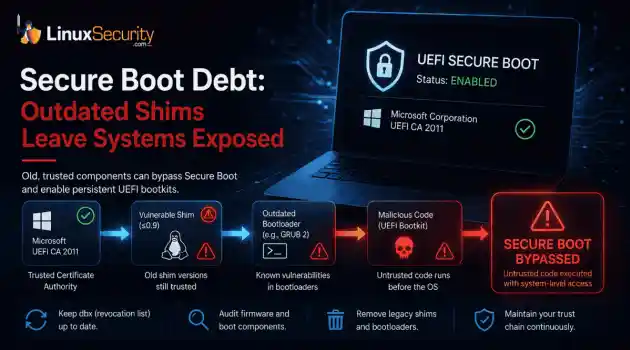
Security Vulnerabilities security advisory linux distribution
security advisory linux distribution ESET researchers identified 11 old and forgotten Linux UEFI shim bootloaders at versions 0.9 and below that can be used to bypass UEFI Secure Boot on any UEFI-based machine that trusts Microsoft’s Microsoft Corporation UEFI CA 2011 third-party certificate authority, regardless of the installed operating system (OS). Reported shims can be exploited to execute untrusted code during system boot, enabling attackers to deploy malicious UEFI bootkits even on systems with UEFI Secure Boot enabled.....
Jul 16, 2026
 Refine news
X Clear Filters
Get the latest News and Insights
Get the latest Linux and open source security news straight to your inbox.
Community Poll
Is continuous patching actually viable?
Loading...
Explore Latest Linux Security news
We found 22 articles for you...
210
 security advisorycriticalIntel
Intel: Branch Authority Exploitation Severe Threat CVE-2024-45333
In modern computing, the line dividing speed from security is razor-thin. Performance innovations have helped processors handle billions of instructions per second, but these optimizations often come with cracks in their armor. This couldn’t be more apparent following the discovery of the Branch Privilege Injection flaw , a vulnerability impacting Intel processors and tracked as CVE-2024-45332 . For us admins, the implications are serious, with the potential for sensitive data leaks, cross-domain attacks, and undermined kernel protections. . This isn’t just another entry in the long list of hardware vulnerabilities. Branch Privilege Injection represents a fundamental breakdown in the defenses Intel processors have relied upon to protect against Spectre-BTI attacks—a type of side-channel attack that most admins thought had been contained years ago. Let’s unpack this newly discovered flaw, how it works, and why Linux environments are potentially at risk. Understanding The Flaw: What Is Branch Privilege Injection? To understand Branch Privilege Injection, you must first consider how modern CPUs handle branch predictions. When a program executes, processors often “guess” the next execution path to improve performance. These guesses aren’t arbitrary but are based on historical program behavior and stored in the branch predictor component. For years, hardware and operating system mitigations have refined how processors handle these predictions, ensuring that guesses made in one security domain (say, user space) don’t leak into another, like kernel space. But Branch Privilege Injection exploits something overlooked for years: race conditions in branch predictor updates. Here’s the problem in simpler terms. When processors switch between privilege levels—like moving from a user process to kernel code—the branch predictor should be sanitized, ensuring that predictions from one domain don’t affect another. Mitigations like IBPB (Indirect Branch Prediction Barrier) weresupposed to handle this, clearing branch predictor states during transitions. However, processors don’t update all aspects of the branch predictor instantaneously. Updates run asynchronously, often with a slight delay. This delay, which Intel designed consciously to optimize performance, introduces a vulnerability. During privilege switches, branch predictors remain briefly susceptible to manipulation. An attacker can exploit this window to insert malicious inputs into the branch predictor, undermining even the most robust mitigations like enhanced Indirect Branch Restricted Speculation (eIBRS). Through this exploitation, attackers can access arbitrary memory and read sensitive data stored outside their privilege domain—a breach that should not be possible under normal operation. Whether it’s accessing kernel data or extracting sensitive information from virtual machines, this flaw opens up alarming possibilities for exploitation. Why We Need to Care About This Issue Linux systems are at particular risk, not because of any failings in the OS itself, but because of how widespread Intel processors are in the server landscape. This vulnerabilities doesn’t discriminate—if you’re using Intel hardware, your machines likely harbor this flaw. And it’s not limited to specific workloads. The vulnerability penetrates hardware-level protections, whether you’re managing virtual machines, containers, or bare-metal systems. In proof-of-concept research, Branch Privilege Injection was successfully exploited on a Linux system running Ubuntu 24.04. This discovery is especially concerning because every standard Spectre mitigation was enabled. The attack wasn’t some edge case; it targeted a default configuration on retail-grade Intel hardware. This flaw introduces risks to administrators managing sensitive infrastructure like web servers, databases, and virtualized environments. Because branch predictor manipulations can bypass privilege boundaries, attackers could theoretically jump betweencontainers or virtual machines. What might have been isolated workloads now face the threat of cross-domain attacks. But there’s an even bigger concern. Spectre vulnerabilities typically fall under the “side-channel” attack umbrella—a category that banks on minute timing differences and speculative execution behavior. However, Branch Privilege Injection operates with striking reliability, exploiting the predictable latency of branch predictor updates. This consistency allows attackers to leak memory at speeds of up to 5.6 KiB/s, putting practical exploitation within reach of real-world adversaries. Am I Affected? Branch Privilege Injection primarily impacts Intel processors, specifically those built from the Ninth Generation (Coffee Lake Refresh) onward. Processors based on older architectures, such as Kaby Lake, may exhibit some weaknesses but have not been definitively confirmed as fully vulnerable. Current research points directly to Intel’s design decisions regarding asynchronous branch predictor updates—a design choice not shared by AMD or ARM processors. This makes Intel users uniquely exposed. You might be managing a fleet of servers using something as recent as Ice Lake or Raptor Lake chips. Or maybe you’re running older-generation systems on Coffee Lake, assuming they’re “good enough” for your environment. If you're using Intel processors that fall into this vulnerable range, this flaw applies to your systems, regardless of the workload or application layer above the hardware. And it doesn’t stop with Linux. While Branch Privilege Injection was explored specifically on Linux systems, the vulnerability lies at the hardware level. It impacts any operating system running on affected Intel processors, which means Windows, macOS, and other OS environments are just as susceptible. This universality should concern anyone responsible for infrastructure security. Whether you’re dealing with bare-metal Linux servers or mixed operating systems running virtualizationsolutions, this flaw can compromise your security. How Can I Protect Against This Flaw? Knowing there’s a vulnerability impacting your systems doesn’t mean you’re helpless. Since this flaw was disclosed, Intel and the broader security community have been hard at work, and mitigations are already starting to surface. However, these mitigations come with trade-offs, particularly in performance. First and foremost, you should prioritize firmware updates. Intel has released microcode updates to address the issue, pushing BIOS and UEFI firmware fixes. These updates patch the asynchronous branch predictor flows that enable Branch Privilege Injection, ensuring mitigation tools like IBPB and eIBRS function as intended. Applying this microcode may introduce performance penalties ranging from roughly 1.6% to 2.7%, depending on your processor generation. Next, update your Linux kernel. When vulnerabilities like this surface, kernel developers waste no time integrating software-level mitigations. Patching your systems with the latest kernel updates from your Linux distribution ensures that defense-in-depth mechanisms kick in. Even if your hardware remains vulnerable, kernel patches can add additional barriers, limiting what attackers can access and exploit. Lastly, stay informed about emerging mitigations. Intel has signaled that further work is being done to improve security while reducing performance impacts. Future Linux kernel versions and microcode updates may refine or enhance protections. Follow your distribution’s release notes closely, particularly those targeting Spectre-related vulnerabilities. Facing the Real Risks As a Linux administrator, you must deal with the ugly truth: the hardware you rely on may not be as secure as you thought. Branch Privilege Injection rewrites the trust model we’ve built around modern CPUs. For years, mitigations like IBPB and eIBRS were deployed as silver bullets to combat speculative execution vulnerabilities. They were supposed to separatesecurity domains, ensuring attackers couldn’t tunnel their way out of sandboxes or virtual machines. Now, those defenses are circumvented. And while firmware updates and kernel patches are critical responses, there’s a deeper lesson here: side-channel attacks are evolving and aren’t going away anytime soon. The architectural complexity of modern processors is fertile ground for new vulnerabilities, and every discovery leaves us playing catch-up. What’s particularly troubling about Branch Privilege Injection is that it chips away at assumptions we took for granted. Security mitigations designed to protect against a well-known vulnerability are effectively subverted, turning yesterday’s solution into today’s liability. That should make every admin pause and rethink their approach to infrastructure security. Our Final Thoughts on Staying Ahead of This Threat Looking forward, Linux admins need more than just software updates. Mitigating side-channel attacks demands proactive, holistic strategies. Architectures vulnerable to speculative execution flaws are in widespread use and won’t disappear overnight. But staying ahead means more than rolling out patches. Consider using hardware built with more robust defenses—AMD processors or ARM-based alternatives may minimize exposure to similar flaws. As more research emerges, stay open to the possibility of rearchitecting workloads that are particularly sensitive to these types of vulnerabilities. Branch Privilege Injection is more than a one-off problem—a sign of the times. Hardware weaknesses will continue to surface, often undermining trusted mitigations. As custodians of complex infrastructures, admins must adapt and respond to this vulnerability and whatever comes next. The stakes are high, and the race to secure computing environments is unending. . Branch Privilege Injection in Intel processors poses serious risks, affecting sensitive data and undermining kernel protections.. Intel Processors, Branch Privilege Injection, SecurityThreats. . Brittany Day
 May 14, 2025
•
May 14, 2025
• Security Vulnerabilities
209
 automationsensitive datadata compliance
Mastering Test Data Management: Strategies for Compliance and Quality
Test data management is the technique of providing modern teams with restricted data access throughout the Software Development Lifecycle (SDLC). By giving fast access to fresh, relevant data downstream for code development, automated tests, debugging, and validation, modern Test Data Management solutions help organizations increase application development speed, code quality, data compliance , and sustainability initiatives. . To support agile development and automated testing, test data management entails synchronizing numerous data sources from production, versioning copies, sensitive data discovery, compliance masking data, and multicolor dissemination of test data. This article will examine how Linux admins and organizations can securely manage confidential data through proper and secure test data management. Managing confidential data As part of test data management operations, a test data management solution assists CIO and CISO teams in administering security controls like as data masking, authorization, authentication, fine-grained data access management, and audit logs in downstream environments. This enables organizations to swiftly comply with compliance and data privacy standards when delivering test data while also minimizing data friction for AppDev and software test teams. What Is The Current State of Test Data Management Tools? Data from tests is required. For software testing early in the SDLC, modern DevOps teams require high-quality test data based on real-world production data sources. This enables development teams to bring high-quality applications to market at a faster and more competitive rate. Information for DevOps Despite the fact that many organizations have implemented agile software development and DevOps approaches, there has been a lack of investment in test data management technologies, which has hampered innovation. Boost DevOps Initiatives Modern DevOps teams are concerned with increasing system availability, decreasing time-to-market, andminimizing costs. By dramatically enhancing compliant data access across the SDLC, test data management enables organizations to accelerate important initiatives such as DevOps and cloud. Software development speed, code quality, data compliance, and sustainability initiatives all benefit from test data management. Common Test Data Issues Application development teams want quick, dependable test data but are limited by the speed, quality, security, and cost of transporting data to environments during the software development lifecycle (SDLC). The most typical issues that organizations encounter when it comes to managing test data are listed below. Provisioning test environments is a time-consuming, manual, and high-touch operation. Most IT organizations use a request-fulfillment approach, which means that developers' and testers' requests are queued behind others. Because creating test data requires substantial time and effort, provisioning new data for an environment might take days if not weeks. The time it takes to turn around a new environment is frequently exactly proportional to the number of people involved in the process. In most cases, four or more administrators are engaged in setting up and provisioning data for a non-production environment. This procedure not only strains operations staff but also causes time drains throughout test cycles, reducing the speed of application delivery. High-quality data is lacking in development teams. Development teams frequently lack access to purpose-fit test results. A developer, for example, may want a data set at a given moment in time, depending on the release version being tested. However, due to the intricacy of refreshing an environment, one is frequently compelled to operate with a stale copy of data. This can lead to lost productivity as a result of time spent resolving data-related issues, as well as an increase in the likelihood of data-related faults leaking into production. Data masking complicates release cycles. Data maskingis necessary for many applications, such as those that process credit card numbers, patient records, or other sensitive information, to ensure regulatory compliance and safeguard against data breaches. According to the Ponemon Institute, the average cost of a data breach (including cleanup, customer churn, and other losses) is $3.92 million. Masking sensitive data, on the other hand, frequently adds operational overhead; an end-to-end masking procedure may take an entire week due to the difficulty of ensuring referential integrity across various tables and databases. Storage prices are constantly rising. This causes IT organizations to make several redundant copies of test data, resulting in inefficient storage use. Operations teams must manage test data availability across many teams, apps, and release versions in order to meet concurrent needs within the constraints of storage capacity. As a result, development teams frequently compete for restricted, shared environments, causing essential application projects to be serialized. Common Test Data Types In the SDLC, there are four popular methods for creating test data for application development and testing teams. Data on Production: Real-world data from production systems provides the most comprehensive test coverage, but it can generate friction in the absence of contemporary DevOps TDM tooling because of security controls around sensitive data. Subsets of Data: Subsets of test data can enhance static test performance while saving money on computation, storage, and software licensing. Subsets, on the other hand, do not provide adequate test coverage for system integration testing. Because it is still a direct duplicate of production values, subsets inherently omit test cases and contain sensitive data. Masked Data: Production data obfuscation by masking techniques enables teams to exploit current data in a compliant manner in order to swiftly offer test data that fulfills regulatory criteria such as PCI, HIPAA, and GDPR.Masking removes all data from production, uses algorithms to identify sensitive data, obfuscates PII and sensitive fields, and retains just relevant data for testing. This allows for the provisioning of realistic values in test data without generating hazardous levels of risk. Synthetic Data Generation: Synthetic data Generation has no personally identifiable information or sensitive information by definition. As a result, synthetic data generation is an intriguing option for the early development of new features or model exploration of test data sets. Synthetic data generation often entails mathematically generating values or picking list items to meet a statistical distribution using algorithms. While synthetic data can aid in developing first-unit tests, it cannot substitute comprehensive data sets required throughout the testing process. Realistic production data includes valuable test cases that are required to validate the program early and frequently in order to shift left issues in the SDLC. Test Data Management Best Practices A holistic strategy should aim to improve test data management in the following areas: Data delivery: shortening the time it takes to deliver test data to a development or testing team. Data quality: satisfying high-fidelity test data criteria Data security: reducing security risks without sacrificing speed Infrastructure expenses: decreasing the costs of testing data storage and archiving. Data Transmission: Copying real data from production environments for development or testing is a time-consuming, labor-intensive procedure that generally lags demand. Modern organizations require optimized, repeatable data delivery methods that include the following: Automation: In most cases, modern DevOps toolchains contain technology for automating build processes, infrastructure delivery, and testing. Organizations, on the other hand, frequently lack equivalent technologies for producing test data at the samelevel of automation. A streamlined method to test data management reduces manual operations such as target database initialization, configuration stages, and validation checks, resulting in a low-touch approach for new ephemeral data settings. Integration of toolsets: A modern approach to test data management should integrate technologies for data versioning, data masking, data subletting, and synthetic data synthesis. To truly enable automated declarative workflows for both infrastructure and data, technologies must have open APIs or direct interfaces. Self-service: Rather than relying on IT ticketing systems, a modern approach to test data management harnesses automation to allow users to furnish test data on demand. Not only should self-service features include test data distribution, but also versioning, bookmarking, and sharing. Individuals should be their own test data manager, utilizing capabilities like bookmarking, refreshing, rewinding, archiving, and sharing without relying on Data Administrators or contacting IT Operations teams. Data Accuracy IT Operations teams must balance needs on three essential dimensions when creating test data, such as masked production data or synthetic datasets. TEST Data Expiration Date Operations teams are frequently unable to meet ticketed demand because of the time and effort necessary to prepare test data. As a result, data in non-production environments frequently grows stale, affecting test quality and resulting in costly, late-stage failures. A TDM approach should seek to decrease the time it takes to refresh an environment, allowing access to the most recent test data. TEST Data Dimensions In order to reduce storage footprints, developers may explore employing data subsets in order to enhance agility. However, subsets cannot meet all functional testing needs, resulting in missing test cases and transferring issues around the SDLC, raising overall project expenses. A modern TDM system should strive to reduce the number of unmonitoredcopies of test data across environments, allow for the sharing of common data blocks across similar copies (saving on storage), and reduce manual processes with improved workflow automation to reduce operational expenses. Data Security Masking tools have arisen as a dependable and practical means of shielding actual data from production by replacing sensitive data fields indefinitely with fictional but plausible data values. Masking ensures regulatory compliance in test settings by totally eliminating the danger of data breaches . Organizations should consider the following requirements to make masking possible and effective: Full solution Many organizations fail to appropriately mask test data because they lack a comprehensive solution that includes out-of-the-box capability for discovering sensitive data and auditing the trail of masked data. Furthermore, a successful approach should consistently hide testing data while retaining referential integrity across many heterogeneous sources. There is no requirement for development knowledge. Lightweight masking tools that may be set up without scripting or specialized development experience should be sought after by organizations. Tools with rapid, predetermined masking algorithms, for example, can drastically minimize the complexity and resource requirements that prevent masking from being used consistently. Masking and distribution are combined. Because of the difficulties in transmitting data downstream, only roughly one out of every four organizations uses masking techniques. Masking operations should be strongly connected with data delivery to overcome this. Organizations will benefit from a method that allows them to disguise data in a safe zone before quickly distributing compliant data to non-production environments such as remote data centers or public clouds. Costs of Infrastructure TDM teams must develop a toolset that maximizes the efficient use of infrastructure resources in light of the fast proliferation of test data.A TDM toolbox should, in particular, meet the following requirements: Data aggregation: Organisations frequently keep non-production environments where 90% of the data is redundant. A TDM strategy should strive to consolidate storage and reduce costs by exchanging common data across environments, including those used for development, reporting, production support, and other use cases. Archiving of data: A TDM method should make it possible to manage test data libraries by optimizing storage and enabling quick retrieval. Data libraries should be automatically version-controlled in the same manner that code versioning tools like Git exist. Reduced Contention: Due to contention in shared software testing environments during working hours, most IT organizations serialize data access. Environments are frequently underutilized during the testing process since systems are left running when not in use due to the time required to load a fresh environment with configurations and test data. A modern TDM strategy should allow for the ephemeral usage of instantaneously available data from any point in time. Environments for Ephemeral Data: Using their test data management tools, users should be able to bookmark data, tear down infrastructure environments, and reinstall a new data environment supplied by a bookmark in minutes. This removes shared resource contention during peak times, allows for resource freeing during off-peak hours, and allows for parallelizing discrete data sandbox environments. An optimized TDM strategy can remove congestion while increasing resource utilization by up to 50%. The Modern Method of Test Data Management Organizations may improve how teams handle and consume suitable test data by implementing a contemporary DevOps TDM approach. IT operations can hide and transmit data 100 times faster while taking up ten times the space. What is the end result? More projects can be done in less time with fewer resources. Release cycles and time-to-market are beingshortened: It takes 3.5 days to refresh an environment versus 10 minutes using self-service. Higher quality and lower costs: 15% vs. 0% data-related faults. Data privacy and regulatory compliance were ensured: data was safeguarded in non-production environments. Have questions about getting started with TDM? Connect with us on X @lnxsec - we're here to help! Stay safe out there, Linux security enthusiasts! . Implement robust data stewardship practices to enhance regulatory adherence, elevate quality benchmarks, and accelerate software delivery cycles, all while safeguarding sensitive information.. Test Data Management, Agile Development, Data Compliance, Data Masking, DevOps Strategies. . scottjohnny288 Scott
Jan 08, 2024
•
Security Trends

83
 security advisorymalwaresensitive data
NSA and FBI Security Advisory on Drovorub Malware Exploiting Linux
The NSA and FBI warn that a new Linux malware variant - dubbed Drovorub - is being used by APT 28 to compromise networks, execute malicious commands and steal sensitive data. . The FBI and NSA have issued a joint report warning that Russian state hackers are using a previously unknown piece of Linux malware to stealthily infiltrate sensitive networks, steal confidential information, and execute malicious commands. In a report that’s unusual for the depth of technical detail from a government agency, officials said the Drovorub malware is a full-featured tool kit that was has gone undetected until recently. The malware connects to command and control servers operated by a hacking group that works for the GRU, Russia’s military intelligence agency that has been tied to more than a decade of brazen and advanced campaigns, many of which have inflicted serious damage to national security. “Information in this Cybersecurity Advisory is being disclosed publicly to assist National Security System owners and the public to counter the capabilities of the GRU, an organization which continues to threaten the United States and U.S. allies as part of its rogue behavior, including their interference in the 2016 US Presidential Election as described in the 2017 Intelligence Community Assessment, Assessing Russian Activities and Intentions in Recent US Elections (Office of the Director of National Intelligence, 2017),” officials from the agencies wrote. . Recent Linux-based malware called Drovorub poses significant risks to networks and national security, according to alerts issued by the FBI and NSA.. Drovorub Malware, APT 28 Threat, NSA Warning, Linux Security Risks. . LinuxSecurity.com Team
Aug 14, 2020
•
Hacks/Cracks
83
 data breachsensitive datacybersecurity threat
BBC: Major Data Leak On Russian Intelligence's Tor De-Anonymization
Have you heard that hackers havestolen a massive trove of sensitive data and defaced the website of SyTech, a major contractor working for Russian intelligence agency FSB (Federal Security Service)? BBC Russia, which reported the breach, said âitâs possible that this is the largest data leak in the history of the work of Russian special services on the Internet.â The documents included descriptions of dozens of internal projects the company was working on, including ones on de-anonymization of users of the Tor browser and researching the vulnerability of torrents. . The link for this article located at The Next Web is no longer available. . Major security incident disclosed concerning Russian cyber operations targeting Tor anonymity mechanisms and weaknesses in torrent protocols.. Tor De-Anonymization,Russian Intelligence,Data Breach,Cybersecurity Threats. . LinuxSecurity.com Team
Jul 22, 2019
•
Hacks/Cracks
83
 risk managementdata breachincident response
Key Steps To Take Post Data Breach To Reduce Potential Risks
It happened again. Another major web service lost control of its database, and now you’re scrambling to stay ahead of the bad guys.. As much as we hate them, data breaches are here to stay. The good news is they don’t have to elicit full-blown panic no matter how sensitive the pilfered data might be. There are usually some very simple steps you can take to minimize your exposure to the potential threat. The link for this article located at PCWorld is no longer available. . Cybersecurity breaches pose an ongoing danger. Discover actionable strategies to mitigate risks and reduce vulnerability following an event.. Data Breach Management, Risk Mitigation Plans, Incident Response Strategy, Threat Assessment. . LinuxSecurity.com Team
May 03, 2018
•
Hacks/Cracks
81
data breachinformation theftcyber threatInvestigating OPM Data Breach: Serious Threats And Security Flaws
The hackers who breached the US Office of Personnel Management accessed a second set of even more highly sensitive data, it was widely reported Friday, in revelations that make the breach one of the biggest thefts of data on federal workers. . Investigators probing the compromise have "a high degree of confidence that OPM systems containing information related to the background investigations of current, former, and prospective federal government employees, and those for whom a federal background investigation was conducted, may have been exfiltrated," Samuel Schumach, a spokesman for the personnel agency, said in a statement to Bloomberg News Friday.. Investigators probing the compromise have 'a high degree of confidence that OPM systems containing i. hackers, breached, office, personnel, management, accessed, second. . LinuxSecurity.com Team
Jun 15, 2015
•
Privacy
83
application securityopen source toolsensitive dataGitrob: Application Security Tool for GitHub Data Detection
Free online code repositories such as GitHub provide a valuable collaboration service for enterprise developers. But it. An application security specialist from Berlin has developed a tool he hopes can keep companies a step ahead. Gitrob is an open source intelligence command-line tool that mines GitHub for files belonging to an organization and runs them against pre-determined patterns looking for potentially sensitive information that isn The link for this article located at ThreatPost is no longer available. . An application security specialist from Berlin has developed a tool he hopes can keep companies a st. online, repositories, github, provide, valuable, collaboration, service, enterprise. . LinuxSecurity.com Team
Jan 15, 2015
•
Hacks/Cracks
83
security advisorysecurity issuesensitive dataiOS 6.1: Security Advisory on Passcode Bypass and User Data Threat
Researchers are having a fun time with iOS 6.1 passcode locks this month, with Vulnerability Lab having discovered a second version of a vulnerability that lets a hacker slip past a lock screen to access a user's contact list, voicemails and more.. The first vulnerability, which popped up on YouTube earlier in the month, entailed this laundry list of steps, brought to us courtesy of Naked Security's Paul Ducklin: The link for this article located at Sophos is no longer available. . The first vulnerability, which popped up on YouTube earlier in the month, entailed this laundry list. researchers, having, passcode, locks, month, vulnerability. . LinuxSecurity.com Team
Feb 27, 2013
•
Hacks/Cracks

Get the latest News and Insights
Get the latest Linux and open source security news straight to your inbox.
Community Poll
Is continuous patching actually viable?
Search Topics
Powered By

Linux Security - Your source for Top Linux News, Advisories, HOWTOs and Feature Releases
QUICK LINKS
subscribe to newsletters!
Like staying secure? So do we.
Sign up for updates, tips, and alerts!