Explore top 10 tips to secure your open-source projects now. Read More
×



Server Security data privacy automation
data privacy automation Every system admin has lived through the same Monday morning ritual. A queue of forty tickets, half of them password resets, permission errors, or disk space warnings that any experienced technician could resolve in under two minutes. The other half require actual judgment. For years, automation promised that software would eventually sort the two apart on its own. That promise is now being tested in production Linux environments. . Early results are reshaping how IT teams think about tier-1...
 Jul 17, 2026

Privacydata collection automation
data collection automation You're running a web scraping project to collect pricing data from e-commerce sites. You set up a pool of datacenter proxies, launch your scripts, and within minutes — banned . CAPTCHAs everywhere. Your data pipeline stops before it really begins. . It's a frustrating scenario that plays out daily in ad verification, market research, and multi-account management. The website doesn't know you're doing legitimate research or monitoring. It just sees traffic coming from IP ranges it recognizes as...
Jul 17, 2026

Security Trends security advisory social engineering
security advisory social engineering Business Email Compromise used to be a numbers game — mass-blasted emails, broken English, an obvious "URGENT WIRE TRANSFER" subject line. That era is over. Generative AI has turned BEC into a tailored, low-noise operation that mimics writing style, voice, and even video presence. This piece looks at what's actually changed under the hood, what defenders are testing in response, and why so many organizations are still structurally unprepared for it. . The Infrastructure Problem Nobody Wants to...
Jul 17, 2026

Security Trends cybersecurity Linux documentation
cybersecurity Linux documentation Linux operating systems have gained prominence due to their stability, adaptability, and excellent security options. In the case of developing documentation, designing cybersecurity dashboards, or educational material, visuals are of vital importance when it comes to making things clear. The use of icons allows one to understand the message regarding alerts, authorization, encryption, authentication, or the state of the system just by looking at the visual cue without having to read long...
Jul 17, 2026
Security Vulnerabilities security advisory linux distribution
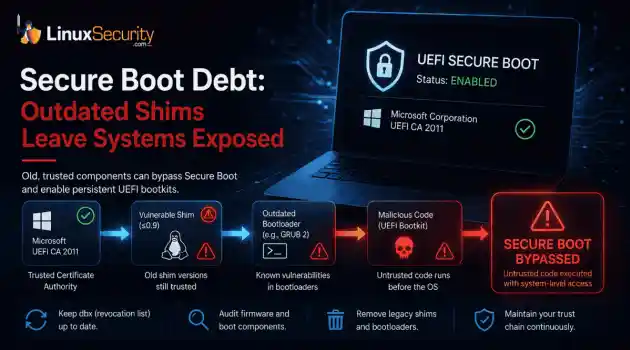
security advisory linux distribution ESET researchers identified 11 old and forgotten Linux UEFI shim bootloaders at versions 0.9 and below that can be used to bypass UEFI Secure Boot on any UEFI-based machine that trusts Microsoft’s Microsoft Corporation UEFI CA 2011 third-party certificate authority, regardless of the installed operating system (OS). Reported shims can be exploited to execute untrusted code during system boot, enabling attackers to deploy malicious UEFI bootkits even on systems with UEFI Secure Boot enabled.....
Jul 16, 2026
 Refine news
X Clear Filters
Get the latest News and Insights
Get the latest Linux and open source security news straight to your inbox.
Community Poll
Is continuous patching actually viable?
Loading...
Explore Latest Linux Security news
We found 53 articles for you...
76
 security enhancementsystem administrationlong-term support
SUSE 15 Support Extended and AI Improvements Highlighted at SUSECON25
SUSECON25 recently took place in Orlando, showcasing SUSE's significant strides toward integrating Artificial Intelligence (AI) throughout its product line. With enhanced workflows and observability tools designed to streamline operations and increase efficiency, SUSE promises more intelligent system administration platforms that facilitate quicker detection and resolution of potential security issues. . SUSE has also pledged extended support for their current offerings, with Service Pack 7 for SLES 15 receiving updates until 2037 and SLES 16 planned to be released later this year. This ensures administrators can plan long-term without feeling pressure to upgrade frequently. Combined with enhanced Multi-Linux Support and its upgraded Multi-Linux Manager 5.1 offering Role Based Access Control (RBAC) capabilities and seamless migration features, these upgrades make managing diverse Linux environments securely and efficiently a snap! These changes go beyond incremental enhancements; they will become essential tools in helping strengthen security and management practices across various Linux distributions. In this article, I'll explore three key developments from this event: improved AI integration, extended support for long-term stability, and enhanced multi-Linux support. Embracing AI for Smarter System Management We Linux security administrators benefit greatly from AI integration. Traditional manual processes can now be automated using AI-powered observability tools that identify anomalies or potential security threats and enable quicker responses and mitigation efforts. By harnessing this intelligence, admins can focus on strategic tasks rather than routine monitoring and troubleshooting - thus increasing productivity while strengthening overall security posture. SUSE's expanded AI Library provides invaluable resources for customizing and optimizing AI features according to individual security needs. From automating patch management and threat detection to compliance monitoringand more, SUSE's toolkit offers ample foundation to build. Long-Term Support for Peace of Mind SUSE's announcements at SUSECON25 showcase their dedication to innovation and long-term support. Its AI integration efforts, extended support for SLES 15, the upcoming release of SLES 16, and improvements to multi-Linux management all indicate a significant effort to make Linux security administration simpler, safer, and more manageable. Admins will benefit from these developments both immediately and over the long term. AI capabilities promise to transform how systems are monitored and managed, and extended support and releases guarantee stability and reliability. Additionally, multi-Linux support with better RBAC features and seamless migrations helps address some practical difficulties of managing diverse environments. As 2025 unfolds, SUSE is positioning itself to lead in providing the tools and support necessary for successfully managing change. SUSECON25 underscored the importance of staying aware and taking advantage of innovations, which are vital to maintaining secure systems now and in the future. Smoother Management with Improved Multi-Linux Support Maintaining uniform security and performance across various Linux distributions can be an arduous and time-consuming endeavor. SUSECON25's expanded Multi-Linux Support sought to address this by simplifying this task and offering an uncomplicated management experience for those overseeing them. Multi-Linux Manager 5.1 features several upgrades designed to simplify life for Linux security administrators, particularly regarding Role-Based Access Control (RBAC). RBAC gives administrators more granular control of user permissions and access rights so only authorized personnel can make system modifications without risk of unauthorized access or security breaches. Notable upgrades also include migration capabilities for major and minor versions of Linux, offering administrators tools that make transitioning between versions as seamless aspossible without disrupting workflow or jeopardizing security. This is especially useful in organizations using multiple distributions that must comply with strict security standards. Integrating Third-Party Tools for Enhanced Security SUSE recognizes the value of interoperability and flexibility, so Multi-Linux Manager 5.1 now includes greater integration with third-party tools. This allows admins to seamlessly integrate their preferred tools or applications into SUSE environments without altering them significantly. This flexibility goes beyond mere convenience; it also promotes stronger security infrastructures. Administrators can use various tools to conduct in-depth vulnerability assessments , monitor network traffic for suspicious activity, or enforce policies across systems. By consolidating all these resources into one management platform like SUSE Linux Enterprise Server 11, security admins have all the resources they need when conducting assessments or enforcing policies across systems. The Road Ahead SUSE's announcements at SUSECON25 showcase their dedication to innovation and long-term support. SUSE's AI integration, extended support for SLES 15, the upcoming release of SLES 16, and improvements to multi-Linux management all indicate its commitment to making Linux security administration simpler, safer, and manageable in the future. Administrators will benefit from these developments both immediately and over the long term. AI capabilities promise to transform how systems are monitored and managed; extended support and releases guarantee stability and reliability; and multi-Linux support with better RBAC features and seamless migrations helps address some of the practical difficulties of managing diverse environments. SUSE is positioning itself to lead in providing the tools and support necessary for successfully managing change. Staying informed and taking advantage of these innovations are vital to maintaining secure systems in the future. Did you attend SUSECON25? We'd loveto hear about your experience @lnxsec ! . SUSECON25 showcased significant advancements in Linux admin tools, leveraging AI for optimized management, support, and streamlined operations for enterprises. SUSECON25, AI Solutions, Linux Management, Security Tools, Multi-Linux Support. . Brittany Day
 Mar 18, 2025
•
Mar 18, 2025
• Organizations/Events
77
 data protectionsystem administrationscalability
Benefits of Cloud Linux for E-Commerce: Security and Scalability Insights
Online stores are an essential part of the modern economy. Their stability, speed, and security directly affect a business's success. However, owners of online stores often have questions about the appropriate operating system. This is understandable, as they want modern solutions and high-quality service. . Among the many options, cloud Linux can be called the ideal solution. This operating system provides many advantages, especially for those working with e-commerce . If you want a suitable alternative, dedicated server hosting will be your faithful assistant. Many modern services offer access to safe and reliable equipment, enabling you to transform your business and succeed digitally. Benefits of Using Cloud Linux for Online Stores Cloud Linux has many advantages. It can make online store management more controlled and increase efficiency while strengthening eCommerce Security Stability and Fault Tolerance : Cloud technologies ensure continuous system operation, which is critical for sites with high loads. Powerful Protection : Cloud Linux provides strong security against external threats like viruses or hacking attempts . Scalability : It allows you to quickly scale your project as traffic grows without affecting the system's stability. Data Optimization : Cloud Linux is designed to handle large amounts of data efficiently, improving request processing speed and site loading time. Resource Management : Easily control the server's memory, processor, and other capabilities to distribute resources effectively. Such features are how the operating system Cloud Linux has many advantages. They are essential for the successful operation and growth of your business. Flexibility and Scalability in Cloud Linux An online store must function effectively so customers can comfortably use its offers. When pages load quickly, visitors do not have to wait long. As a result, they are happy and will visit the site repeatedly. If you want youronline store to operate exactly like this, you must worry about fast scalability and adaptability to changing market conditions. Cloud Linux perfectly copes with this task, offering high flexibility. You can add or remove resources quickly, and this is very important. This way, it’s possible to maintain your online store at the required level of performance. You will not be afraid of seasonal fluctuations in traffic. This is an excellent option for small businesses since, as they grow, you can easily switch to more powerful servers. Compare two scaling options: a physical server and a regional platform. If adding computing power becomes more difficult as the volume increases in the first case, you can do so in the cloud without unnecessary costs and complications. Advantages of Cloud Linux Scalability: Ability to increase server capacity at any time Resource customization depending on business needs Minimization of equipment costs Reduction of time for implementing new functions Capability to work with large volumes of data The privilege of Cloud Linux is that, despite the increased traffic, the system continues to work effectively at the required speed without failures or overloads. Thus, online store owners can be confident in the reliability of their platform even during peak loads. Ease of Management and Security The most critical aspects for online store owners are ease of management and high security. Cloud Linux offers flexible administration options and robust data protection tools. The system actively uses isolation and attack defense technologies to ensure the security of business and customer data. Cloud Linux can help improve security and ease of management in the following ways: Isolation of accounts and processes to prevent attacks Automatic updates and patches to avoid vulnerabilities Protection against DDoS attacks Reliable management of passwords and access rights Integration with anti-fraud systems to protect payments The Cloud Linux safe system provides more security guarantees than traditional solutions. Such features are essential for online stores, which often face fraud or data leakage threats. To use it, you need to set the proper settings. Save Your Budget with Cloud Linux Many online store owners are looking for savings. Traditional servers require significant investments in equipment, labor costs, and regular maintenance. However, Cloud Linux saves a lot on IT infrastructure and support personnel. The cloud technology platform works on a subscription model. You can more flexibly control your expenses by paying only for the features you use. Savings are available in the following methods: There’s no need for significant investments in physical equipment Reduced energy and maintenance costs Flexibility in choosing tariff plans Optimization of resource use No need for constant support The right approach to using Cloud Linux in an online store will allow you to save money greatly. This is excellent news because you can direct the saved budget to business development, marketing, improving customer service, and other areas. Final Thoughts Cloud Linux is the preferred solution for online retailers. The solution has a lot of strengths, including excellent security, required performance, flexibility, and scalability. The system has a particular appeal for companies because it is economical and easy to use. By leveraging Cloud Linux, businesses can ensure seamless operations even during peak traffic periods while maintaining robust security and cost-efficiency. The ability to scale resources efficiently provides online store owners with long-term stability and adaptability to market changes. You need to correctly select the host of your business. Investigate the options and find the best offer that will optimize the operation and maximize the returns. . Among the many options, cloud Linux can be called the ideal solution. This operating system provides. online, stores,essential, modern, economy, their, stability, speed, security. . MaK Ulac
Feb 26, 2025
•
Server Security

212
 malware threatsystem administrationcloud security
TeamTNT Docker Assault: Mitigating Risks with Effective Security Strategies
TeamTNT has recently emerged at the forefront of the ever-evolving threat landscape by devising novel exploits assaulting Docker clusters. Their Docker Gatling Gun campaign has targeted 16 million IP addresses worldwide and attacked Docker clusters globally. . To help you understand and prepare for this emerging threat, I'll investigate its nature, attack flow, impact, and targets, providing system administrators with actionable insights to protect against this campaign and other Linux container security threats. Understanding This Docker Security Threat TeamTNT, widely recognized in the hacking community, has made headlines again by engaging in an unprecedented attack against cloud-native infrastructures. By exploiting exposed Docker daemons, this group systematically deploys Sliver malware, a multi-faceted cyber worm, and crypto miners through compromised servers and Docker Hub to perpetuate their spread while renting out computational resources to third parties for direct crypto mining operations. Their devious yet malevolent campaign uses native cloud capabilities by employing Docker Swarm E xpansion capabilities while using Docker Hub to distribute Sliver malware. Decoding the Attack Flow TeamTNT Gutling Gun Attack Flow (source: aquasec) TeamTNT's campaign showcases an intricately planned attack flow, with the following key components observed over seven years: External and Local Lateral Movement: Malware infections can be quickly deployed within an organization's network by employing tools like Masscan and ZGrab to deploy them quickly on related servers within its environment. Local network probing also plays a vital role in spreading infections quickly across servers within it. Resource Hijacking: This aspect primarily centers on crypto miner deployment and, more surprisingly, the sale of compromised infrastructure for computational resource stripping purposes, relieving mining operations, and maintaining operations independently. Commandand Control (C2): By employing Sliver malware as a significant barrier against counterintelligence efforts, TeamTNT has upped their game by potentially adding Tsunami functionality into their strategy. Cloud Tool Exploitation: Docker Hub has been used for malware storage and distribution, while Sliver provided command and control (C2) and exploit capability. Initial attacks involve exploiting Docker daemons on specific ports, laying the foundation for an advanced "Docker Gatling Gun" script which scans for vulnerable instances to create an extensive target range and, upon success, deploys an Alpine Linux image with malicious commands from TeamTNT's Docker Hub account. Sliver Malware Explodes to New Heights TeamTNT has swapped its previously utilized backdoor utility Tsunami for more subtle Sliver malware. This open-source tool enables dynamic C2 operations across various protocols while remaining undetectable due to its per-binary asymmetric encryption keys explicitly compiled for each binary encryption key used. TeamTNT can utilize Sliver malware to direct commands, execute payloads, and introduce in-memory execution capabilities. Through its exploits, TeamTNT poses a severe threat to cloud-native landscapes. This group's attacks silently spread across cloud infrastructures by seizing Docker clusters. Using Docker Swarm extends its reach and ensures persistent presence as crypto miners sap computational resources from victims, showing its devastating potential. Who Is at Risk? Its Docker cluster operators with exposed daemons are primary targets in this campaign. This can encompass businesses and organizations using cloud services or open-source cloud software—especially those operating operational baselines and open-source entities in the cloud environment. However, due to indications of potential future Kubernetes cluster exploitations, the net at risk can expand further; virtually any organization using containerized environments without taking stringent security precautionsis also at risk. Practical Strategies to Help Sysadmins Reduce Risk Protecting Docker clusters against such malignant threats requires a proactive and multi-layered approach including the following best practices: Port Security: For best practice, ensure that Docker daemon ports (2375, 2376, 4243, and 4244) do not expose themselves directly to the public internet. Instead, bind them directly to localhost or utilize VPN technology to access Docker environments. Secure Docker API endpoints: Set up mutual TLS authentication and implement encrypted communication for data protection while in transit. Monitor and Analyze Network Traffic: Regularly monitor for unusual network activity patterns that could indicate an attack script or illegal Docker images being pulled from registries. Maintain Docker and its Dependencies Regularly: To protect against vulnerabilities that attackers could exploit, it is recommended that Docker and all its dependencies be regularly updated and patched for optimal performance and to reduce vulnerabilities that malware could exploit. Access Controls: To limit the number of users who can push or pull images from Docker registries and environments, role-based access control (RBAC) should be applied. Secure Container Images: Before deployment, always utilize reliable base images and scan for vulnerabilities before rejecting those that do not pass security checks. Limit Resource Usage: Set restrictions on Docker containers to minimize potential gains from crypto miner deployment while monitoring for abnormal resource consumption patterns. Incident Response Plan: Develop an incident response plan so you can take quick, decisive action if your system becomes compromised. For example, you could isolate infected containers and servers and conduct a full forensic investigation. Backup and Recovery: Keep backup copies of crucial data and system configurations on hand to ensure fast recovery in case of security incidents. Education and Training: Provide all team members with training on this form of attack and ensure all operators use container operations judiciously while adhering to best practices for Docker security. Identity Threat Detection and Response (ITDR) What is ITDR? Have you thought about some of the ways we can block these types of attacks? Identity Threat Detection and Response (ITDR) is all about keeping a close eye on who is accessing your systems and ensuring they're supposed to be there. Imagine it as a vigilant security team dedicated to tracking user activities and catching any suspicious behavior that might indicate someone is trying to gain unauthorized access. With ITDR, you'll have tools that continuously monitor what users are doing, look for unusual patterns that could signal a threat, and enforce strong security measures like multi-factor authentication to make sure only the right people get in. If something fishy does happen, ITDR systems can jump into action automatically, alerting your team and taking steps to minimize any potential damage. In short, ITDR helps keep your digital environment safe by focusing intensely on the security of user identities. Check out ModSecurity for Apache. It's a bit complicated to use, but it's an open source web application firewall (WAF) that can also be configured to monitor and respond to potential identity threats happening through web applications. It includes real-time monitoring and logging of HTTP traffic, a rule-based detection system, and the ability to block suspicious activities and mitigate attacks against Apache. Our Final Thoughts on Combating This Container Security Threat Administrators can take proactive measures against TeamTNT and other threat actors by employing these measures, strengthening their cloud environments against any unauthorized exploitation and potential malware campaigns. Security is an ongoing priority for us admins, particularly given cloud technologies' increasing role in business operations and threatactors like TeamTNT becoming ever more sophisticated. Therefore, administrators must remain vigilant and implement robust measures to safeguard against potential breaches. . Grasp the implications of TeamTNT's latest attacks on Docker environments and explore strategies to safeguard your infrastructures from this advancing danger.. TeamTNT Malware, Docker Security Threat, Container Exploitation, Cloud Infrastructure Safety, Cybersecurity Practices. . Anthony Pell
Oct 29, 2024
•
Cloud Security
215
 security advisorysystem administrationsystem security
EndeavorOS Gemini: Arch Linux Desktop with Basic Security Features
EndeavorOS Gemini is a captivating and charming desktop operating system based on Arch Linux. The new release includes a kernel upgrade, 3D graphics libraries, an updated Welcome app, and enough polish to make users feel like they're using something special. We must commend this release on its user-friendliness, beauty, security, stability, and reliability. . Let's highlight the features that make EndeavorOS Gemini stand out from other operating systems. By the end of this article, you'll want to give it a try! What Sets EndeavorOS Gemini Apart from Other OSes? EndeavorOS boasts several features that set it apart from other OSes. One key differentiator of EndeavorOS Gemini is how the Welcome app simplifies updating the Arch-based distribution. Another interesting feature is the inclusion of the Firewall Applet, which allows users to easily enable the shields and notifications. This puts system security front and center in a way anyone can use. As security professionals, the EndeavorOS Gemini operating system has several implications and long-term consequences. While it may be beautiful and user-friendly, the challenge with any open-source operating system is to ensure comprehensive security. Linux, especially Arch, has a reputation for being a secure operating system . However, the operating system is only as secure as how it is configured. The system administrator is responsible for installing additional security measures to enhance security features like the Firewall Applet in EndeavorOS. For practical advice on improving Linux system security, explore this LinuxSecurity must-read article. EndeavorOS Gemini with KDE Plasma provides plenty of configurations and eye candy, but it is worth noting that not all of the applications that might be needed for productivity or entertainment come with the OS. The Welcome app makes locating and installing the necessary applications easy; however, ensuring their security is also the system administrator's responsibility. Our Final Thoughtson EndeavorOS Gemini EndeavorOS Gemini is an outstanding desktop operating system with all the security, stability, and reliability of a rocket ship ready to take users to the moon and back. It provides a great opportunity for users to explore an alternative to more commercial operating systems such as Windows and Mac OS. However, in security practitioners' hands, EndeavorOS Gemini requires proper configuration and additional security measures to facilitate comprehensive security. You can download EndeavorOS Gemini here. . EndeavourOS Gemini merges robust security with user-friendly features, delivering an accessible Arch Linux experience equipped with seamless updates and customizable options. EndeavorOS, Arch Linux, Desktop Security, User Friendly, KDE Plasma. . Brittany Day
Jun 03, 2024
•
Desktop Security
79
 security advisorydebiansecurity
Debian 12 Overview: Balancing Security, Stability, and Innovation
The latest release of Debian , one of the oldest and most trusted distributions within the Linux ecosystem, redefines security, stability, and innovation in open-source OSes. As security practitioners and Linux administrators, we always seek stable and innovative operating systems that can meet our needs while keeping our systems secure. . What Makes Debian 12 an Exceptionally Secure and Stable Open-Source OS? Debian's commitment to stability over frivolous updates appeals to those who value reliability without sacrificing software freshness. This highlights Debian's reputation for providing a rock-solid base for desktop and server environments. It raises the question of how Debian manages to strike the balance between stability and innovation and whether this approach could have long-term consequences for the open-source community. The improved security protocols in Debian 12 should be highlighted, making it a preferred choice for organizations prioritizing safety. Debian 12 also brings updated software repositories, ensuring users have access to the latest and most efficient versions of their favorite tools. This is particularly important for infosec professionals and system administrators who rely on cutting-edge software for their security practices. Debian's influence on the broader open-source community has been significant, as other popular distributions like Ubuntu and Linux Mint build upon Debian's foundation. This raises the question of how Debian's updates shape the direction of Linux development. Does Debian's emphasis on stability hinder the adoption of newer technologies in other distributions? Or does it set an example of how to balance stability and innovation? Debian's impact on various industries, from cloud computing and IoT to AI and big data analytics, is also noteworthy. As security practitioners, it is crucial to consider the implications of Debian's stability and reliability in these rapidly evolving fields. How does Debian support and drive advancements inthese technologies? And how can security practitioners leverage Debian's robustness to secure these areas better? Our Final Thoughts on Debian 12 Debian 12 brings a combination of stability and innovation to the open-source operating system realm. The OS offers security practitioners a comprehensive, secure, and stable environment that can meet the demands of modern computing. As we explore and consider migrating to Debian 12, it is essential to look beyond the surface and evaluate how it fits into our specific security needs and long-term objectives. . Explore the ways Ubuntu 22 optimizes performance and reliability, offering essential features for professionals in the tech ecosystem.. Debian 12, Open Source Security, Linux Stability, System Administration, OS Innovation. . Anthony Pell
May 01, 2024
•
Security Projects
76
 patch managementsystem administrationsecurity updates
Efficient Linux Patching at Hyperscale by Meta for Admins
It's no secret that Linux is the most popular operating system in the world. It's also no secret that it's a very secure OS, but many things can go wrong. It's hard to keep up with all the patches and vulnerabilities, especially when you must patch tens of thousands of servers without downtime. But Meta has a system for doing so! . Meta's system of patching Linux at hyperscale makes it possible to apply patches to your entire collection of packages at once rather than just one at a time. This means that if someone finds a vulnerability in one package (say, OpenSSH), you can patch all of your packages and be done with it—no need to worry about whether or not any other packages might be affected by this vulnerability because they'll already be patched by the time you install it! This will make life so much easier for sysadmins everywhere, who will now have more time to focus on security issues rather than worrying about whether or not they've applied all their latest patches. I found the article linked below very helpful in understanding Meta's efficient approach to Linux patching, and I thought you would as well. Check it out! . Meta's approach to enhancing Linux on a broad scale streamlines the update implementation process across numerous servers effortlessly.. Linux Patching, Hyperscale Security, Efficient Updates. . Brittany Day
Dec 02, 2023
•
Organizations/Events
79
 system administrationLinux toolscloud management
Mastering Key Linux Tools For ITOps: A Guide For Engineers
Which Linux tools are the most important for IT operations work? That depends on exactly which type of ITOps work you're talking about, of course. . ITOps teams that manage cloud-based microservices workloads need to master a somewhat different set of Linux tools from those who work with on-premises monolithic applications, for instance. Still, in general, there are a core set of Linux tools that every IT operations engineer should know. Here's a look at the top eight such tools. Some are tried-and-true utilities that have been around for decades. Others are newer, but are growing increasingly important to IT operations work. . IT Operations personnel should become proficient with Linux utilities to manage diverse tasks, encompassing both cloud-based and local software.. Linux Tools, ITOps Best Practices, Microservices Management, On-Premises Operations, Tool Mastery. . LinuxSecurity.com Team
Dec 07, 2022
•
Security Projects
78
 system administrationcomparisonDocker
Docker Vs. Podman: Evaluate Security Benefits And Management Features
Are you using Docker for container management? If so, you may want to reconsider. Docker and Podman offer similar capabilities when it comes to managing containers, but Docker's security vulnerabilities could make Podman more appealing for certain system administrators. . Docker has become the de facto standard for many IT administrators and does have the lion's share of developer interest today. Yet, Podman offers admins some security advantages over basic Docker due to its ability to run as a nonprivileged user and without a daemon. Docker and Podman both offer many of the same features, such as their support for Open Container Initiative's (OCI) runtime and image specifications, as well as their ability to map commands to create and manage containers. Yet, there are several differences between Docker and Podman, including security concerns and reliance on daemon programs. . Container orchestration has evolved, with Docker and Podman leading the way; explore their distinct functionalities and security benefits.. Container Management, Docker Features, Podman Security, Daemonless Containers. . LinuxSecurity.com Team
Sep 02, 2020
•
Vendors/Products

Get the latest News and Insights
Get the latest Linux and open source security news straight to your inbox.
Community Poll
Is continuous patching actually viable?
Search Topics
Powered By

Linux Security - Your source for Top Linux News, Advisories, HOWTOs and Feature Releases
QUICK LINKS
subscribe to newsletters!
Like staying secure? So do we.
Sign up for updates, tips, and alerts!