Explore top 10 tips to secure your open-source projects now. Read More
×



Server Security data privacy automation
data privacy automation Every system admin has lived through the same Monday morning ritual. A queue of forty tickets, half of them password resets, permission errors, or disk space warnings that any experienced technician could resolve in under two minutes. The other half require actual judgment. For years, automation promised that software would eventually sort the two apart on its own. That promise is now being tested in production Linux environments. . Early results are reshaping how IT teams think about tier-1...
 Jul 17, 2026

Privacydata collection automation
data collection automation You're running a web scraping project to collect pricing data from e-commerce sites. You set up a pool of datacenter proxies, launch your scripts, and within minutes — banned . CAPTCHAs everywhere. Your data pipeline stops before it really begins. . It's a frustrating scenario that plays out daily in ad verification, market research, and multi-account management. The website doesn't know you're doing legitimate research or monitoring. It just sees traffic coming from IP ranges it recognizes as...
Jul 17, 2026

Security Trends security advisory social engineering
security advisory social engineering Business Email Compromise used to be a numbers game — mass-blasted emails, broken English, an obvious "URGENT WIRE TRANSFER" subject line. That era is over. Generative AI has turned BEC into a tailored, low-noise operation that mimics writing style, voice, and even video presence. This piece looks at what's actually changed under the hood, what defenders are testing in response, and why so many organizations are still structurally unprepared for it. . The Infrastructure Problem Nobody Wants to...
Jul 17, 2026

Security Trends cybersecurity Linux documentation
cybersecurity Linux documentation Linux operating systems have gained prominence due to their stability, adaptability, and excellent security options. In the case of developing documentation, designing cybersecurity dashboards, or educational material, visuals are of vital importance when it comes to making things clear. The use of icons allows one to understand the message regarding alerts, authorization, encryption, authentication, or the state of the system just by looking at the visual cue without having to read long...
Jul 17, 2026
Security Vulnerabilities security advisory linux distribution
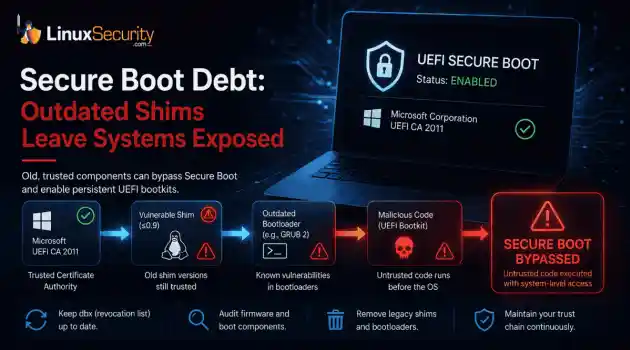
security advisory linux distribution ESET researchers identified 11 old and forgotten Linux UEFI shim bootloaders at versions 0.9 and below that can be used to bypass UEFI Secure Boot on any UEFI-based machine that trusts Microsoft’s Microsoft Corporation UEFI CA 2011 third-party certificate authority, regardless of the installed operating system (OS). Reported shims can be exploited to execute untrusted code during system boot, enabling attackers to deploy malicious UEFI bootkits even on systems with UEFI Secure Boot enabled.....
Jul 16, 2026
 Refine news
X Clear Filters
Get the latest News and Insights
Get the latest Linux and open source security news straight to your inbox.
Community Poll
Is continuous patching actually viable?
Loading...
Explore Latest Linux Security news
We found 77 articles for you...
210
 security advisorycriticalprivilege escalation
RHEL: Critical Privilege Escalation Flaw in open-vm-tools CVE-2025-41244
Red Hat confirmed a privilege escalation flaw in open-vm-tools (CVE-2025-41244), the utility that keeps Linux guests talking to VMware hosts. It handles the small things — time sync, clipboard sharing, system events — the background work that makes virtual machines feel seamless. Most systems run it by default, and most admins forget it’s even there once the guest comes online. . That’s exactly what makes this vulnerability matter. The service runs with broad privileges inside the guest while maintaining a direct communication path to the host. When that link breaks, it doesn’t just cause sync errors or logging noise — it erodes one of the key trust boundaries in virtualization. The guest isn’t supposed to influence the host, but open-vm-tools sits in the middle with just enough authority to make that separation less certain. The issue doesn’t stem from the kernel, but it reaches the same depth of exposure. Environments built on RHEL, CentOS Stream, and similar distributions all inherit the same weak point. For linux security teams, that’s the real story here: the tools that make virtual machines convenient are the same ones that can quietly undermine isolation when something goes wrong. The problem isn’t that open-vm-tools exists — it’s that it’s trusted. And when trust extends across layers, the impact of one small bug extends with it. Technical Summary: What Went Wrong in open-vm-tools Inside most virtualized Linux environments, open-vm-tools runs with elevated privileges. It’s the bridge that links a guest to its VMware host — syncing time, clipboard data, and system events behind the scenes. It’s supposed to make management easier. In security terms, it sits at one of the riskiest points in the stack: between the user space and the hypervisor. CVE-2025-41244 exposes what happens when that trust layer breaks. The flaw stems from improper validation in guest–host communication , where input can slip past expected checks. With the right conditions, alocal attacker can trigger code execution as root. It’s not remote, but it turns a standard user session inside a Linux guest into full system control — something that defeats basic Linux privilege escalation defenses by abusing a trusted integration tool. The issue affects RHEL 8.x and 9.x families and derivative distributions that share the same package base. Red Hat has shipped updated builds through the following advisories: RHSA-2025:17509 , RHSA-2025:17510 , RHSA-2025:17511 , and RHSA-2025:17512 . The greater concern is how long vulnerable builds persist. Outdated open-vm-tools packages often live inside base images, automation templates, and snapshots used across data centers and clouds. Every clone replicates the same exposure. The result isn’t a single misconfiguration — it’s a repeating weakness multiplied across virtual environments. For defenders focused on Linux security, this is where patching meets architecture. Kernel hardening doesn’t help if the attack path runs through a trusted service. When that service lives at the intersection of guest and host, privilege boundaries become fragile by design. Why Guest Tools Matter in Linux Security Guest utilities like open-vm-tools are part of every virtual Linux system, yet they rarely get the same scrutiny as the kernel or core packages they interact with. They manage clipboard sync, shutdown signals, and time drift — quiet, routine operations that depend on trust between guest and host. That trust is what makes them valuable, and what makes them risky when it fails. Shared Trust Boundary Every virtualized Linux environment operates on a shared trust boundary. open-vm-tools handles privileged coordination between systems, moving commands and data that shape how the guest behaves inside the host. When that trust is broken, privilege boundaries weaken. A process inside the guest can use that same channel to move laterally, establish persistence across snapshots, or tamper with host-level operations that should beisolated. The Virtualization Amplifier Virtualization doesn’t just replicate workloads — it replicates vulnerabilities. A single outdated open-vm-tools package baked into a golden image or orchestration template becomes a Linux virtualization security problem at scale. Each deployment of that image spreads the same flaw across potentially hundreds of systems. When automation pipelines reuse old builds, exposure multiplies faster than most patching workflows can keep up. Visibility Challenge The hardest issue to fix is the one no one monitors. open-vm-tools often sits outside patch automation because it’s seen as an infrastructure dependency, not an application package. It won’t always appear in vulnerability baselines or patch dashboards, leaving a quiet gap in Linux system security updates. Closing that gap means treating integration tools like any other privileged software: monitored, version-controlled, and verified. Guest utilities hold the keys to the boundary between virtual and physical systems. When that line blurs, Linux security isn’t about patching the kernel; it’s about defending the trust model that virtualization depends on. It starts with knowing which hosts carry the vulnerable builds, which templates still deploy them, and how to patch without breaking automation. That’s where the work shifts from awareness to control — and where Linux defenders earn back the trust that open-vm-tools was meant to uphold. How to Patch and Secure open-vm-tools Against Privilege Escalation In Linux virtualization, small background services often hold the most critical privileges. open-vm-tools is one of them — a package that syncs guest and host activity, but also runs with enough authority to become a liability when left unpatched. Addressing the recent privilege escalation flaw means treating it as a core part of your Linux security workflow, not just another package update. Immediate Remediation Patch first, verify second. Update the package through yoursystem’s manager: sudo dnf update open-vm-tools Restart the service to load the patched build: systemctl restart vmtoolsd Confirm the update and version with: rpm -q open-vm-tools vmware-toolbox-cmd -v Validation and Automation After patching, verify your versions against Red Hat’s security advisory for CVE-2025-41244 . That confirmation step is what separates patched systems from assumed ones. Integrate open-vm-tools into your configuration management process — whether that’s Ansible, Puppet, or Chef — to ensure updates are consistent across all environments. Refresh base images and container templates so you’re not redeploying outdated code in new builds. Then, run targeted vulnerability scans to confirm the patched version appears everywhere it should. Defense-in-Depth Patching removes the immediate risk, but lasting protection comes from hardening. Enforce least privilege for guest utilities and disable unnecessary host–guest channels. Apply SELinux or AppArmor confinement to contain potential abuse if the service is ever compromised again. Privilege escalation flaws like this one will resurface. Kernel hardening, strict access control, and consistent update automation ensure they don’t spread when they do. Strong Linux security depends on visibility, not reaction. Guest utilities like open-vm-tools operate beneath most monitoring tools, yet they bridge every virtual boundary. Keeping them patched isn’t just maintenance — it’s defending the trust model that virtualization relies on. Lessons for Linux Virtualization Hardening The open-vm-tools flaw underscores a familiar truth in Linux security: the biggest risks often come from the smallest components. Guest utilities, daemons, and system connectors rarely draw attention, yet they shape the trust boundary between virtual and physical infrastructure. When one fails, the exposure isn’t theoretical — it runs through every instance, image, and orchestration pipeline that depends onit. Operational best practices: Treat guest-integration tools as part of the core patch cycle, not as background utilities. Audit golden images and deployment templates to make sure outdated packages aren’t redeployed automatically. Pair patch automation with verification — updates that don’t propagate are no better than none at all. The strategic takeaway is broader. Linux security doesn’t stop at the kernel. It depends on maintaining discipline across every privileged process that links systems together. Virtualization only works when that trust remains intact, and keeping it intact means watching the pieces that most people forget about. . Patch open-vm-tools for critical privilege escalation issues affecting RHEL systems to ensure security and integrity.. open-vm-tools security update, RHEL privilege escalation, Linux virtualization risk, patching open-vm-tools. . MaK Ulac
 Oct 09, 2025
•
Oct 09, 2025
• Security Vulnerabilities
83
 threatmalwaredata theft
Protect Your Linux Servers from Nood RAT Malware Threats
The Nood RAT malware is a new threat to Linux servers worldwide. Security researchers say Nood RAT is designed to steal sensitive information from targeted servers. This article warns Linux admins and infosec professionals of the risks posed by the malware and how to prevent such cyberattacks. . How Does Nood RAT Malware Threaten Linux Servers? Nood RAT is a variant of the Gh0st RAT malware. Gh0st RAT for Windows is well-known and has been circulating for over a decade; however, this is one of the first Gh0st RAT strains to target Linux systems. Like its Windows counterpart, Nood RAT is a backdoor malware that can perform malicious operations such as downloading harmful files, stealing internal system files, and executing commands. Nood RAT has an encryption function that can evade network packet identification, which can be concerning for Linux admins and infosec professionals tasked with detecting and preventing such attacks. Additionally, the malware can receive commands from its threat actors and execute various harmful operations, putting sensitive data at risk of theft. Nood RAT can also impersonate itself as an authentic program and that threat actors can choose the malware's fake process name during its development phase. This makes detection more challenging, and it's a task that requires vigilance on the part of an organization's security team. The Chinese C. Rufus Security Team is the developer of Gh0st RAT and that its source code is available to the public. As a result, hackers have been using it in their attacks. In the case of Nood RAT, threat actors exploit the codes to create malware variations, putting Linux servers worldwide at risk of data theft. How Can I Protect Against Nood RAT? There are various measures that security practitioners can take to protect against Nood RAT. Investing in an Endpoint Detection and Response (EDR) solution that provides threat hunting and incident response capabilities can help detect and prevent malware attacks like Nood RAT. Linuxusers must keep their systems updated with the latest security patches and examine their environment configuration to avoid such security concerns. It is essential to remain vigilant in the fight against cyber threats. Our Final Thoughts on Nood RAT: What Can We Learn? Nood RAT is a new threat to Linux servers, and its implications are severe. This article warns Linux admins, infosec professionals, and security practitioners that such attacks are becoming more frequent. However, by being vigilant, staying informed , and investing in the right security solutions, we can stay ahead of cybercriminals and protect critical data from being stolen or compromised. . Nood RAT aims at Linux systems, introducing significant dangers. Remain updated to safeguard confidential information against digital attacks.. Nood RAT, Linux Malware, Cybersecurity Threats, Data Protection, Endpoint Security. . Brittany Day
Mar 04, 2024
•
Hacks/Cracks

210
 security advisorymoderatecross-site scripting
Joomla: 5.0.3/4.4.3 Moderate: RCE Risk from Critical XSS Bug
A critical security vulnerability has been found in the popular Joomla open-source content management system that has left millions of websites open to the risk of remote code execution (RCE) due to multiple cross-site scripting (XSS) bugs. The vulnerability is linked to a fundamental flaw in Joomla's core filter component and is tracked as CVE-2024-21726 . . What Is the Impact of This Bug? How Can I Mitigate My Risk? Joomla's advisory labels the vulnerability as "moderate" but emphasizes the potential impact attackers can have by exploiting XSS bugs to inject malicious scripts into legitimate websites. These scripts can then be used to steal sensitive data, redirect visitors to malicious sites, or distribute malware . With Joomla powering around 2% of all websites and many deployments accessible to the public, this vulnerability poses a significant risk to website owners and users. This issue highlights the importance of prompt patching and updates . The issue has been addressed in Joomla versions 5.0.3/4.4.3, released immediately after the discovery of the vulnerability. We emphasize the urgency for Joomla users to update their systems to the patched versions to protect their websites from potential attacks. We also urge security practitioners, Linux admins, infosec professionals, and sysadmins to stay vigilant and proactive in monitoring and addressing vulnerabilities in widely used platforms like Joomla. This vulnerability prompts admins and users to question the effectiveness of Joomla's content filtering mechanisms and raises concerns about how attackers can leverage XSS bugs to compromise websites and data integrity. Security practitioners can better safeguard their networks and data from potential cyber threats by keeping abreast of such vulnerabilities and hardening their systems through timely updates and patches. As the threat landscape evolves, security practitioners must adapt their strategies to combat emerging threats and protect their systems from exploitation. OurFinal Thoughts on the Implications of This Flaw This issue serves as a timely reminder of the ever-present security risks in the digital landscape and the importance of proactive security measures to mitigate these risks. By staying informed, vigilant, and proactive, security practitioners can enhance their organization's security posture and safeguard against potential threats and vulnerabilities. . Joomla's severe XSS vulnerability jeopardizes countless users to RCE threats; please update promptly to safeguard infrastructures and avert breaches.. Joomla Security Update, RCE Threat, XSS Vulnerability, Cybersecurity Awareness, Website Security. . Brittany Day
Feb 22, 2024
•
Security Vulnerabilities
79
 security advisoryDebianthreat
Debian 10 EOL: Security Gaps and Compliance Risks Ahead
Debian 10, known as “Buster,” was first released on July 6, 2019, and has earned the reputation of being a reliable Linux distribution for individuals and businesses alike. However, the security support for this version of Debian is ending, with Debian 10 reaching its End of Life (EOL) on June 30, 2023. . The end of support for Debian 10 poses significant security concerns for those who fail to upgrade to Debian 11. Without security updates , vulnerabilities found after the end of life will remain unpatched, making systems more susceptible to attacks and compromise. As security threats evolve, using an outdated operating system is increasingly dangerous, potentially leading to data breaches and jeopardizing system integrity. Complying with industry standards and regulations is crucial for organizations, and compliance frameworks often mandate the use of systems with the latest patches applied to ensure data security and protect consumers. Failing to comply due to using an outdated OS may result in legal penalties and severe reputational harm. To mitigate the security risks of Debian 10 EOL, it is crucial to upgrade to Debian 11 (Bullseye), which is supported until June 30, 2026. You can also upgrade to the latest release, Debian 12 (Bookworm). Both versions offer the latest security bug fixes and improved features, contributing to a secure and compliant Linux environment. Stay up-to-date on the latest Linux security advisories, information, and insights required to secure your systems by subscribing to our weekly newsletters. Have additional questions about upgrading your Debian systems? Connect with us on X @lnxsec - we're here to help! Stay safe out there, fellow Debian users! . The cessation of updates for Debian 10 brings serious security vulnerabilities for users who neglect to migrate to a current release.. Debian End Of Life, Security Risks, Compliance Frameworks, Upgrade Issues. . LinuxSecurity.com Team
Dec 29, 2023
•
Security Projects
83
 threatmalwarerootkit
Krasue RAT: Remote Access Trojan Targeting Linux in Telecoms
Let me fill you in on a stealthy threat to Linux systems that has flown under the radar for nearly three years! A remote access trojan dubbed "Krasue" has been silently infiltrating Linux systems like yours, primarily targeting telecommunications companies since 2021. . It operates through a sophisticated rootkit including seven variants, each drawing its foundation from different open-source projects. This tricky technique allows the malware to adapt to different Linux kernel versions, making this malware highly difficult to detect and remove. Security researchers have said that the primary objective of the Krasue RAT is to maintain access to the host system. Krasue’s deployment strategy is unknown; possible approaches include credential brute-force assaults, exploiting vulnerabilities, or disguising distribution through unreliable sources that pretend to be trustworthy packages or binaries. So what can you do to stay safe against threats like Krasue? Ensure you have applied the latest patches released by your distro(s) to fix known vulnerabilities that malicious actors could exploit, and subscribe to our newsletters to stay updated on the latest security news, trends, and advisories impacting you. It's a dangerous digital world these days - stay informed and proactive to remain ahead of cybercriminals! . An advanced malware named Krasue targets Linux, exploiting vulnerabilities for remote access. Stay alert and secure!. Krasue RAT, Linux Intrusion, Cybersecurity Threats, Stealthy Malware. . LinuxSecurity.com Team
Dec 21, 2023
•
Hacks/Cracks
82
threatmalwaregovernmentAPT36 Threatens Indian Government Agencies with Custom Malware
APT36 is a highly sophisticated APT (Advanced Persistent Threat) group known for conducting targeted espionage in South Asia and is strongly linked to Pakistan. . While this APT group is known for targeting the following Indian sectors: Government Defense Education Since 2013, this APT group has been active, and to conduct cyber espionage, it uses the following methods:- Credential harvesting Malware distribution Here below, we have mentioned the resources used by APT36:- Custom-built remote administration tools targeting Windows Lightweight Python-compiled cyber espionage tools serving specific purposes targeting Windows and Linux Weaponized open-source C2 frameworks like Mythic Trojanized installers of Indian government applications like KAVACH multi-factor authentication Trojanized Android apps Credential phishing sites targeting Indian government officials Zscaler analysts dubbed the Windows backdoor used by APT36 ‘ElizaRAT,’ because of unique strings in observed C2 commands. The link for this article located at CyberSecurity News is no longer available. . APT36 utilizes tailored malicious software targeting Indian governmental divisions such as education and defense, representing significant risks.. APT36,CyberEspionage,GovernmentMalware,EducationSecurity,DefenseAttacks. . Brittany Day
Sep 16, 2023
•
Government
209
threatmalwaresecurity strategyRecognizing Linux Malware Risks And Detection Strategies
Although Linux offers security advantages, users must remain vigilant against various forms of malware and cyberattacks. . Linux is often praised for its enhanced security compared to other operating systems. Nevertheless, IT professionals must never assume that Linux is immune to threats. Due to widespread adoption in critical infrastructure, Linux has drawn the attention of advanced persistent threat (APT) groups aiming to breach its security. Additionally, Linux finds use in various IoT devices. One of the largest cyberattacks in history involved the “Mirai” malware , which exploited vulnerabilities in devices running Linux. In this article, we will explore characteristics of Linux malware, examine malware distribution methods, and learn how to thwart attacks. . Delve into the landscape of malware aiming at Linux systems, and identify proactive methodologies to bolster defenses and prevent cyber intrusions.. Linux Malware Threats, Cybersecurity Strategies, Malware Prevention Techniques. . Brittany Day
Aug 21, 2023
•
Security Trends
210
 security advisoryupdateprivilege escalation
Ubuntu Critical Advisory: Kernel Update for Privilege Escalation Risks
Two new Linux kernel privilege escalation flaws have been discovered in the OverlayFS module in Ubuntu, which affect nearly 40% of Ubuntu users (CVE-2023-2640 and CVE-2023-32629). Modifications to the OverlayFS module introduced by the Linux kernel project in 2019 and 2022 conflicted with Ubuntu’s earlier changes, and Ubuntu's adoption of the new code introduced these two vulnerabilities. . The researchers who discovered these vulnerabilities have stated, “Both vulnerabilities are unique to Ubuntu kernels since they stemmed from Ubuntu’s individual changes to the OverlayFS module. Weaponized exploits for these vulnerabilities are already publicly available given old exploits for past OverlayFS vulnerabilities work out of the box without any changes.” These issues can allow an unprivileged local user to gain elevated privileges on impacted systems. Important updates for the kernel that mitigate these severe vulnerabilities are now available for Ubuntu users. We strongly recommend that all impacted users apply these updates immediately to protect against privilege escalation attacks leading to system compromise. To stay on top of essential updates released by the open-source programs and applications you use, register as a LinuxSecurity user , subscribe to our Linux Advisory Watch newsletter, and customize your advisories for your distro(s). This will enable you to stay up-to-date on the latest, most significant issues impacting the security of your systems. Follow @LS_Advisories on Twitter for real-time updates on advisories for your distro(s) . . Crucial patches released for Ubuntu systems to address emerging security vulnerabilities in the OverlayFS component.. Ubuntu Kernel Flaws, Privilege Escalation, OverlayFS Issues. . Brittany Day
Aug 03, 2023
•
Security Vulnerabilities

Get the latest News and Insights
Get the latest Linux and open source security news straight to your inbox.
Community Poll
Is continuous patching actually viable?
Search Topics
Powered By

Linux Security - Your source for Top Linux News, Advisories, HOWTOs and Feature Releases
QUICK LINKS
subscribe to newsletters!
Like staying secure? So do we.
Sign up for updates, tips, and alerts!