Explore top 10 tips to secure your open-source projects now. Read More
×



Server Security data privacy automation
data privacy automation Every system admin has lived through the same Monday morning ritual. A queue of forty tickets, half of them password resets, permission errors, or disk space warnings that any experienced technician could resolve in under two minutes. The other half require actual judgment. For years, automation promised that software would eventually sort the two apart on its own. That promise is now being tested in production Linux environments. . Early results are reshaping how IT teams think about tier-1...
 Jul 17, 2026

Privacydata collection automation
data collection automation You're running a web scraping project to collect pricing data from e-commerce sites. You set up a pool of datacenter proxies, launch your scripts, and within minutes — banned . CAPTCHAs everywhere. Your data pipeline stops before it really begins. . It's a frustrating scenario that plays out daily in ad verification, market research, and multi-account management. The website doesn't know you're doing legitimate research or monitoring. It just sees traffic coming from IP ranges it recognizes as...
Jul 17, 2026

Security Trends security advisory social engineering
security advisory social engineering Business Email Compromise used to be a numbers game — mass-blasted emails, broken English, an obvious "URGENT WIRE TRANSFER" subject line. That era is over. Generative AI has turned BEC into a tailored, low-noise operation that mimics writing style, voice, and even video presence. This piece looks at what's actually changed under the hood, what defenders are testing in response, and why so many organizations are still structurally unprepared for it. . The Infrastructure Problem Nobody Wants to...
Jul 17, 2026

Security Trends cybersecurity Linux documentation
cybersecurity Linux documentation Linux operating systems have gained prominence due to their stability, adaptability, and excellent security options. In the case of developing documentation, designing cybersecurity dashboards, or educational material, visuals are of vital importance when it comes to making things clear. The use of icons allows one to understand the message regarding alerts, authorization, encryption, authentication, or the state of the system just by looking at the visual cue without having to read long...
Jul 17, 2026
Security Vulnerabilities security advisory linux distribution
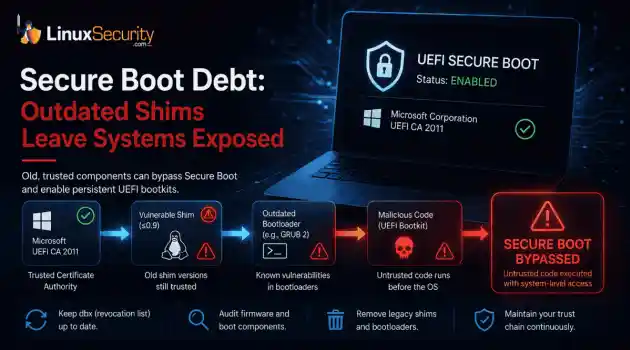
security advisory linux distribution ESET researchers identified 11 old and forgotten Linux UEFI shim bootloaders at versions 0.9 and below that can be used to bypass UEFI Secure Boot on any UEFI-based machine that trusts Microsoft’s Microsoft Corporation UEFI CA 2011 third-party certificate authority, regardless of the installed operating system (OS). Reported shims can be exploited to execute untrusted code during system boot, enabling attackers to deploy malicious UEFI bootkits even on systems with UEFI Secure Boot enabled.....
Jul 16, 2026
 Refine news
X Clear Filters
Get the latest News and Insights
Get the latest Linux and open source security news straight to your inbox.
Community Poll
Is continuous patching actually viable?
Loading...
Explore Latest Linux Security news
We found 86 articles for you...
209
 threat analysisLinux securityincident response
Threat Analysis and Cyber Intelligence in Linux Security
Over the last decade, the volume of cyber threats has grown, but their shape has changed even more. Attacks no longer sit neatly inside a few predictable categories. Espionage, ransomware, and phishing bleed into each other, turning up in organizations of every size. . Threat analysis matters because most attacks do not begin with a clear signal. They unfold gradually, blending into routine activity until the pattern becomes obvious, usually after damage has already occurred. You start to notice the shift when incidents stop looking isolated. One campaign bleeds into another. Infrastructure gets reused. Techniques repeat, but the timing changes. Defenses built around static assumptions tend to fail quietly. By the time a new tactic is obvious, it has usually already worked somewhere else. Why Threat Analysis Matters for Linux Users This tends to show up first in Linux-heavy environments where systems have been stable for a long time. A service that has not been touched in months starts accepting unexpected connections. A patch is delayed because nothing appears broken. A small configuration change is made to solve a short-term problem and is never revisited. Nothing looks like an incident on its own. Each change makes sense in isolation. Threat analysis is what connects those details. It gives teams a way to see when routine activity starts forming a pattern. Without that perspective, most attacks are only understood after the fact, once logs are reviewed and timelines are reconstructed. By then, the question is no longer how to prevent it, but how far it has gone. How Security Is Strengthened by Threat Intelligence in Organizations Threat intelligence becomes valuable when it adds context. Not as a feed of indicators, but as a way to understand what activity actually means. This is where threat intelligence protecting enterprise networks helps teams distinguish routine system activity from access patterns and behavior that warrant investigation. Threatintelligence is not just a list of malicious IP addresses. It reflects: Who the attackers are. What motivates them? Which techniques do they reuse across campaigns? Organizations use that context to decide which risks matter now, not which ones look impressive on paper. The Federal Trade Commission has repeatedly pointed to actionable threat intelligence as a practical way to improve security posture. Many organizations supplement internal threat intelligence efforts with external Cybersecurity Services that provide additional visibility into emerging threats, attacker tactics, and incident response strategies. Combining internal analysis with specialized expertise can help security teams identify risks earlier and improve overall defensive readiness. On Linux systems, this context often explains activity that would otherwise look routine, including: Repeated SSH access attempts tied to known tooling Malware variants adapted for common distributions Vulnerabilities that appear theoretical until exploitation begins Collaboration and Information Sharing Threat analysis rarely happens in isolation. Most meaningful findings come from shared work, whether through industry groups, research communities, or government agencies. CISA’s public alerts and analysis are one example, but they are far from the only source. Patterns emerge faster when information moves: One organization spots a technique Another confirms it under different conditions A third sees the same infrastructure reused weeks later That shared visibility fills gaps no single team can cover on its own, especially when campaigns span regions and jurisdictions. Tools and Methods Employed in Risk Assessment Threat data comes from many places. Malware sandboxes, honeypots, analytical platforms, and monitoring systems all contribute pieces of the picture. NIST outlines many of these practices as part of its guidance on detection and response. In Linux environments, much ofthat signal originates from: System and authentication logs Audit records tied to privilege changes Network telemetry collected over time On their own, these records rarely stand out. Correlated, they begin to show patterns that were easy to miss in isolation. Automation helps surface those relationships, but it does not replace judgment. Machine learning can highlight anomalies across large datasets. Honeypots, by contrast, reveal attacker behavior directly by design. Both serve different purposes, and both age differently. Threat Research for Proactive Defense The real value of threat research shows up before an incident fully unfolds. Patterns repeat. Techniques resurface. Once that becomes clear, defenses can be adjusted ahead of time. Proactive research supports: Earlier detection through updated rules and signatures Faster triage when activity deviates from baseline Policy decisions around access and authentication Treating incidents as isolated events rarely works. The same weaknesses tend to reappear under slightly different conditions. Training and Awareness Through Threat Research Threat research also shapes how teams are trained. Real incidents carry more weight than abstract scenarios. Case studies grounded in current activity tend to stick longer than generic examples. The SANS Institute regularly highlights the role of current threat trends in professional education. In practice, this shows up as: More realistic phishing simulations Red team exercises based on recent campaigns Faster recognition of early warning signs Prepared staff do not eliminate risk. They reduce surprise. The Growing Cyber Threats Affecting Security Programs As technology changes, so do attack paths. Cloud platforms, connected devices, and automation tools expand the surface that defenders have to account for. The same technologies that improve efficiency also create new opportunities for abuse. Threat researchers now spend more timeexamining how emerging systems are misused rather than how they were intended to work. That work does not stop. Attackers adapt quickly, especially when experimentation becomes cheap. Organizations that invest in ongoing research tend to notice those shifts earlier, not because they predict the future, but because they recognize familiar patterns when they resurface. Threat Research as Part of Incident Response Threat analysis sits near the beginning of most incident response workflows. Before containment decisions are made, teams need to understand how the activity started and where it can spread. For Linux fleets, that analysis often includes: authentication activity across hosts privilege escalation and role changes persistence mechanisms that survive restarts lateral movement patterns between systems Together, these signals explain how an incident unfolded. Response efforts typically involve coordination across technical teams, legal, operations, and external partners. Over time, those responses influence how systems are hardened and how future incidents are handled. The Role of Automation in Threat Research Automation becomes unavoidable as data volumes increase. No team can manually review everything generated by modern environments. Automated collection and analysis allow analysts to focus on interpretation rather than triage. When paired with machine learning, automation helps: Surface patterns earlier Reduce response latency Prioritize investigation paths It narrows the field. It does not decide the outcome. FAQ: Threat Analysis and Threat Research What is threat research in cybersecurity? Threat research focuses on understanding attacker behavior, techniques, and vulnerabilities so organizations can respond based on evidence rather than assumptions. Why is threat research important to businesses? It helps teams recognize emerging risks earlier and reduce the impact of attacks that would otherwise go unnoticed. How doorganizations use threat research? They apply it to detection strategies, training programs, and incident response planning. Conclusion: Why Threat Analysis Remains Essential Threat analysis remains central to modern security because attackers rarely stop at the first attempt. They probe, adjust, and return. Continuous research shapes how defenses evolve, how incidents are investigated, and how future risks are assessed. As threats become more adaptive, the ability to observe, analyze, and adjust becomes just as important as any individual control. . Explore why threat analysis is critical for Linux security, helping teams understand complex attack patterns and enhance defenses.. Threat Analysis, Cyber Intelligence, Risk Assessment, Incident Response, Linux Security. . MaK Ulac
 Jan 13, 2026
•
Jan 13, 2026
• Security Trends
83
 data protectionthreat analysisincident response
Combatting BlackLock Ransomware: Strategies for Linux Security Admins
Since its discovery in March 2024, BlackLock (also known as El Dorado or Eldorado) has quickly established itself as a serious threat within the ransomware-as-a-service ecosystem. Linux security admins face an adversary capable of targeting Linux environments alongside Windows and VMWare ESXi systems. Its custom malware poses an additional danger with its double extortion strategy involving data encryption and theft to coerce victims into paying ransom. . Linux administrators seeking to defend against BlackLock must keep systems updated, implement reliable backups, and increase endpoint security. Understanding BlackLock's infrastructure and tactics - such as sophisticated data leak sites or recruitment via cybercriminal forums - is also key. By being aware of their techniques and evolution, we can better safeguard environments against this rapidly growing threat. Let's take a closer look at BlackLock ransomware, its defining tactics and techniques, and practical measures you can take to secure your Linux environment against this advanced threat. The Rising Threat of BlackLock BlackLock’s ascent in the ransomware world has been nothing short of alarming. By Q4 of 2024, activity linked to BlackLock had surged by an astounding 1,425%, marking it as a threat that cannot be ignored. This exponential growth is due to its widespread campaigns and sophisticated ransomware attack approach. Unlike many ransomware groups that rely on off-the-shelf malware, BlackLock invests in developing custom malware tailored for maximum impact. This bespoke approach allows them to fine-tune their attacks to specific vulnerabilities, enhancing their success rate. Understanding BlackLock's Double Extortion Tactic BlackLock stands out for employing an advanced double extortion tactic. Traditional ransomware attacks primarily threaten victims with data encryption: attackers encrypt victim's data and demand payment in exchange for decryption keys. However, Blacklock takes this a step further by not onlyencrypting but also exfiltrating data. BlackLock victims risk their data being released publicly or sold if they fail to comply with ransom demands made by attackers. BlackLock uses this tactic to exert double pressure on victims. Data leaks can devastate businesses, as they threaten reputational harm, legal liability, and client trust issues - increasing the chance that victims pay the ransom and making this approach very lucrative for BlackLock. Practical Advice for Protecting Linux Environments Given BlackLock’s specific targeting of Linux systems, Linux security admins must adopt proactive and comprehensive defense strategies. Ensuring all systems are routinely updated with the latest security patches is a crucial first step. Outdated software often has unpatched vulnerabilities that attackers can exploit, so staying current is imperative. Beyond updates, admins should focus on implementing robust backup solutions . Having regular and isolated backups can mitigate the impact of ransomware by ensuring that critical data can be restored without succumbing to ransom demands. However, it is essential to test these backups regularly to ensure they function correctly when needed. Enhancing Endpoint Security Enhancing endpoint security is another essential aspect of combatting BlackLock. Implementing advanced endpoint protection solutions with real-time threat detection and response features can assist in quickly detecting and neutralizing ransomware before it causes irreparable harm to systems and data. As BlackLock often deploys customized malware, behavior-based detection mechanisms will prove particularly effective in mitigating risk. Reducing administrative privileges can limit the extent of an attack, providing users with only those permissions required for their roles. Using multi-factor authentication (MFA) on critical systems can further lower risk. This helps admins prevent ransomware from spreading across networks. Understanding BlackLock's Infrastructure Anessential aspect of combatting BlackLock involves understanding its infrastructure and evasion techniques. With secure communication mechanisms, BlackLock uses sophisticated data-leak websites that are well-protected against takedown attempts. Awareness of their operations and regularly checking known threat actor forums can provide valuable insights into upcoming threats or ongoing campaigns that BlackLock may undertake. BlackLock's recruitment on cybercrime forums indicates a well-planned and expanding operation. It also provides security professionals with early warning of new tools and techniques that collaborators might employ and provides critical intelligence gathering to anticipate attacks. The Importance of Incident Response Planning Even with the most stringent precautions in place, breaches may still occur. Therefore, having a comprehensive incident response plan in place is crucial - one that outlines specific steps for detecting, containing, and eliminating ransomware from your network, along with protocols for communicating with stakeholders and law enforcement officials in case an attack does occur. Regular incident response drills can help ensure that teams are prepared to act swiftly and effectively should a ransomware attack occur. Such drills help identify any gaps or flaws in their response plans and allow them to fine-tune processes and procedures. Our Final Thoughts on Staying Vigilant in the Face of This RaaS Threat BlackLock's rapid ascension as a significant ransomware threat reinforces the necessity of vigilance and preparation to combat attacks like these. By understanding BlackLock's tactics, techniques, and infrastructure, we can better defend our environments against potential attacks. Staying up-to-date with ransomware developments, regularly updating and backing up systems , strengthening endpoint security, and having an incident response plan are essential components of an effective defense strategy. In the face of sophisticated adversaries like BlackLock,taking a proactive and informed approach is the only effective means of protecting sensitive data while upholding your Linux system's safety and integrity. . System administrators need to remain informed and bolster device safety measures to tackle BlackLock ransomware with efficiency.. Linux Ransomware Protection, BlackLock Threat, Endpoint Security Strategies. . Brittany Day
Feb 20, 2025
•
Hacks/Cracks

83
 threat analysiscybersecurityransomware
Cicada3301 Ransomware Analysis and Protection Techniques for Linux
Recent advancements by cybersecurity researchers have shed additional light on Cicada3301, an emerging and formidable ransomware-as-a-service (RaaS) threat. Thanks to an analysis conducted by Group-IB researchers who gained access to its affiliate panel on the dark web, a deeper understanding of Cicada3301's operations, targets, and potential effects on the cyber threat landscape has been achieved, enabling businesses to prepare themselves for this emerging risk more effectively. . To help you understand the latest insights on this threat and how to mitigate the risk of an attack, I'll explain how Cicada3301 ransomware works, who it targets, and measures admins and organizations can take to secure their critical systems and data. Let's begin by examining the RaaS model, which is becoming increasingly popular among ransomware developers, including those behind the Cicada3301 ransomware. Ransomware-as-a-Service (RaaS): An Overview Before diving deeper into Cicada3301, it's essential to understand RaaS as a business model ransomware developers use. RaaS is a method for leasing malicious software to affiliates, who execute attacks against targets while sharing proceeds with original developers. This concept has helped democratize cybercrime by making participation more accessible even to those with limited technical skills, contributing significantly to an explosion in ransomware attacks worldwide. What Is Cicada3301 Ransomware & How Does It Operate? Cicada3301 first became of interest to cybersecurity experts in June 2024. Its source code is similar to BlackCat ransomware , which has since become dormant. What makes this threat unique, though, is its cross-platform capability—written in Rust to target multiple operating systems such as Windows, multiple Linux distributions, ESXi virtualization hosts, NAS storages, and various versions of PowerPC processors. Cicada3301 ransomware operates similarly to other forms of ransomware by encrypting files on infected systems but with additionalmalicious steps taken before encryption. For example, this ransomware shuts down virtual machines, inhibits system recovery processes, terminates suspicious processes and services, and deletes shadow copies—making recovery more difficult without paying the ransom. Furthermore, it inflicts maximum damage by encrypting network shares, further compounding victim frustration. Cicada3301's affiliate program stands out as one of its hallmarks. To recruit affiliates, the group advertised on the RAMP cybercrime forum using the Tox messaging service. It provided affiliates access to an affiliate panel offering extensive features that allowed them to manage their operations efficiently. These features included Dashboard, News, Companies, Chat Companies, Chat Support, Account, and FAQ sections. Who Does Cicada3301 Target? Cicada3301 is particularly dangerous because it targets all operating systems without discrimination. So far, it has compromised at least 30 organizations from critical sectors across the USA and the UK. No sector seems immune. Victims include essential industries, such as aerospace or power generation. Exfiltrating data before encryption further heightens victim pressure while adding an extra level of extortion, threatening financial loss as well as reputational harm. Cicada3301's sophistication lies not just in its technical prowess but also in its operational setup. For instance, its affiliate panel was designed to be user-friendly so that even inexperienced cybercriminals could execute targeted and high-impact attacks without technical training. Researchers Nikolay Kichatov and Sharmine Low also disclosed that professional-grade tools utilized by this group include ChaCha20 encryption technology, which makes the ransomware resistant to decryption attempts. The group's ability to exfiltrate data before encryption and shut down virtual machines amplifies its impact, prompting individuals and companies to be aware of potential financial ransom demands and any collateral damage, dataleakage, or operational disruption due to an attack. Practical Protection Advice for Mitigating the Cicada3301 Ransomware Threat Admins must focus on several critical areas to protect themselves against ransomware and other cybersecurity threats. First and foremost is the importance of implementing robust backup and recovery solutions . Regularly scheduled copies should be stored offline or isolated to mitigate risks posed by shadow copy deletions and network s hare encryptions. Multi-layered network security solutions are also critical to an effective ransomware protection strategy. Advanced threat detection systems for tracking suspicious behavior, firewalls, intrusion detection/prevention systems (IDS/IPS), and up-to-date endpoint protection are essential. Network segmentation and adherence to the principle of least privilege are also crucial measures for ransomware containment and damage limitation. Segmenting helps manage spread while least-privilege models limit user and application access only as necessary, mitigating the damage of potential breaches. Furthermore, patch management is integral as regular updates to systems and software can protect them against ransomware that exploits known vulnerabilities. User education also plays an essential part in protecting against ransomware infections. Employees should be educated about phishing threats and other entry points for ransomware attacks, creating a culture of cybersecurity awareness where vigilance is the norm. Monitoring dark web activity with threat intelligence services provides early warning about emerging threats or any possible targeting of specific sectors. Implementing strong authentication measures, such as multi-factor authentication (MFA) , across critical systems is an excellent way to prevent unauthorized access even if login credentials become compromised. Additionally, having an incident response plan should never be taken for granted. Drills should be held regularly so that all parties involved understand their rolein case a ransomware attack arises and can act swiftly to minimize damage. Our Final Thoughts on Navigating RaaS Threats to Linux Systems Cicada3301's operations reveal a new standard for ransomware attacks, employing advanced tools and professional-grade operational sophistication. As these attacks increasingly target critical sectors, proactive and comprehensive security measures become ever more necessary in protecting organizations against ransomware's ever-evolving mechanisms and techniques. . Cicada3301 ransomware is infamous for its advanced encryption targeting businesses and individuals. Here are key insights and strategies to defend against evolving threats.. Cicada3301 Ransomware, Ransomware Protection, Cybersecurity Insights. . Anthony Pell
Oct 18, 2024
•
Hacks/Cracks
83
 security practicesthreat analysismalware
Noodle RAT Threat Analysis: Strategies For Linux Security
A new backdoor, "Noodle RAT" has caused widespread alarm across the cybersecurity landscape. Research highlights this previously undisclosed malware used by Chinese-speaking groups engaged in cybercrime and espionage activities. . This article seeks to provide a thorough understanding of this threat for Linux administrators who wish to better protect themselves against Noodle RAT and similar attacks. We'll focus specifically on the Linux variant of this cross-platform malware and how it infects targeted systems. Understanding Noodle RAT Since 2022, Noodle RAT has been under scrutiny due to targeted attacks in the Asia-Pacific region. At first, it was thought to be part of existing malware such as Gh0st RAT or Rekoobe, but intensive research revealed it as being brand new. The malware, available on Windows and Linux, has been employed by Chinese-speaking groups for espionage and cybercrime activities, demonstrating its widespread impact. Noodle RAT typically exhibits capabilities such as downloading/uploading files/running additional in-memory modules, and acting as TCP proxy on infected computers, underscoring its widespread usage among target systems. The Linux Version of Noodle RAT: How Does It Infect Targeted Systems? Linux.NOODLERAT stands out from its Windows counterpart through its design and capabilities, which have been widely employed for financial gain and espionage purposes by various groups for their ends. Employed for different motivations, including financial gains or spying operations, its design features include reverse shell functionality, file download/upload features, scheduling execution of scheduled processes, and SOCKS tunneling capabilities. After infiltrating public-facing applications, the backdoor copies itself to an identified location before performing process name spoofing and connecting back with its C&C server per predefined settings, making its design unique from its Windows counterpart regarding design vs. capabilities. Practical Advice for ProtectingAgainst Noodle RAT and Similar Threats With cyber threats evolving almost daily, Linux administrators must take proactive measures to ward off threats like Noodle RAT. Here are several practical steps you can take to reinforce the security posture of your systems: Implement Comprehensive Access Controls: Comprehensive access controls and user permissions can significantly limit unauthorized access and help stop the installation and execution of malicious payloads. Prioritize Regular System Updates and Patch Management: Timely installation of software updates and security patches can address known vulnerabilities exploited by backdoors like Noodle RAT. Implement Strong Authentication Measures: Establishing multifactor authentication and enforcing robust password policies are great strategies for protecting against any unauthorized access attempts. Utilize Network Segmentation: Dividing the network into distinct zones according to traffic patterns and user roles can help contain malware spread and limit its impact in case of breach. Implement Intrusion Detection and Prevention Systems: Installing and configuring effective intrusion detection and prevention systems is one way to detect and respond quickly to attempted infiltration by Noodle RAT or similar threats. Utilize Behavior-Based Monitoring: Behavior-based monitoring tools can enable administrators to detect suspicious and potentially malicious behaviors that indicate backdoor activities. Regular Security Audits and Penetration Testing: Conducting periodic security audits and penetration tests is one way to identify vulnerabilities before threat actors exploit them. User Education and Awareness Programs: Raising users' awareness of the potential dangers of social engineering tactics and phishing attacks can significantly lower the odds of successful backdoor installations. Our Final Thoughts on Noodle RAT & Preventing Attacks Noodle RAT's rise as an emerging backdoor threatunderscores the necessity of strong cybersecurity measures for Linux systems. By understanding its functionality and employing proactive security practices to strengthen defenses against this malicious malware, administrators can better protect themselves and reduce the risks from falling victim. As the cyber threat landscape changes rapidly, remaining vigilant and proactive when protecting essential infrastructure and sensitive data against emerging threats like Noodle RAT is imperative for maintaining and securing its integrity and safety. . Gain insights on Noodle RAT's impact on Linux systems and strategies to enhance security against this new backdoor threat.. backdoor, noodle, rat', caused, widespread, alarm, across, cybersecurity, landscape, researc. . Dave Wreski
Jun 11, 2024
•
Hacks/Cracks
210
 threat analysismalwareopen source
XZ Utils Backdoor Incident: Lessons and Implications for Linux Security
The alarming discovery of a backdoor in the xz data compression library , which had the potential to compromise Linux systems, has dominated recent security news. While the backdoor did not make its way into production Linux distributions, the incident raises crucial questions about open-source security and the need for vigilance in the face of emerging threats. . How Was This Backdoor Introduced? What Were the Motives Behind It? A Microsoft software engineer, Andres Freund, detected the slow performance of the SSH remote security code in the Debian Linux beta. This discovery led Freund to investigate and identify that Jia Tan, the chief programmer and maintainer of the xz library , had inserted a backdoor to enable attackers to gain control over Linux systems. This incident is notable because, until now, malware has not been successfully concealed within Linux code. Linux managed to evade a potentially catastrophic situation thanks to its open-source nature . Mark Atwood, Amazon's open-source program office principal engineer, highlights that the attack failed precisely because the code was open and accessible to scrutiny. In contrast, closed-source components often present challenges in detecting and mitigating covert attacks. The motives behind the backdoor are unknown, but we can speculate the possibility of crypto miners attempting to infiltrate high-powered Linux systems to capitalize on the surging value of cryptocurrencies. While the exact identity of the attacker remains unknown, their extensive efforts to compromise the xz project in 2021 and push the infected program into Linux distributions are evident. What Are the Implications of This Backdoor? What Can the Community Learn from This Issue? This issue raises critical questions about the security implications of open-source software and the Linux community's underlying responsibility to ensure its code's safety. It underscores the importance of continuous code review, especially within the open-source supply chain , toidentify and address vulnerabilities promptly. The incident with the xz backdoor serves as a wake-up call for Linux admins, infosec professionals, internet security enthusiasts, and sysadmins. The potential consequences of such an attack could have been catastrophic, compromising individual systems and entire infrastructures. It highlights the need for a proactive approach to security and the constant evolution of defensive measures to match emerging threats. This incident also sheds light on the possibility of additional open-source malware programs that have yet to be discovered. This raises questions about the overall security posture of the Linux ecosystem and the measures put in place to detect and prevent future attacks. It prompts security practitioners to reflect on the current defenses and collaborate on strengthening the entire open-source supply chain against persistent threats. Our Final Thought on the XZ Utils Linux Backdoor The close call that Linux encountered with the xz backdoor incident highlights the critical need for continuous code review and an engaged security community. It underscores the importance of maintaining a disciplined and vigilant approach to open-source security rather than relying solely on the assumption that open-source code is inherently secure. Security practitioners, Linux admins, infosec professionals, internet security enthusiasts, and sysadmins play a crucial role in upholding the security and integrity of open-source software. This incident serves as a reminder to stay alert , actively contribute to code review efforts, and collaborate with the broader community to safeguard against potential threats that may have long-term consequences. . The xz utils backdoor incident has highlighted vulnerabilities in open-source software, stressing the need for rigorous code audits, secure supply chains, and a security-first mindset. xz Utils, Open Source Threats, Backdoor Security, Linux Risks. . Brittany Day
Apr 21, 2024
•
Security Vulnerabilities
78
 threat analysismalwarebotnet
Redis Under Threat: P2Pinfect Worm Malware Targets Data Storage Tool
An unknown group of hackers is using a novel strain of malware to attack publicly accessible deployments of Redis — a popular data storage tool used by major companies like Amazon, Hulu and Tinder. . Researchers from Cado Security Labs explained that what stood out most was the fact that the malware appears to be a worm — a subset of malware that can propagate or self-replicate from one computer to another without human activation after breaching a system. The researchers said they recently encountered the malware, which they labeled “P2Pinfect,” and were alarmed at its ability to self-propagate and spread itself to other vulnerable Redis deployments. The report does not name specific victims of the malware, and Cado Security said it is unclear what the botnet's purpose is. The hacking campaign was initially analyzed by Palo Alto’s Unit 42 in a report on July 19, which found the malware exploiting CVE-2022-0543 to take over Redis applications and add them to a botnet — a group of computers that have been infected in a way that allows a hacker to control them all. . A troubling novel worm-like virus exploiting MySQL setups presents significant threats throughout systems.. Redis Botnet, Worm Malware, Cyberattack Prevention, Data Security, P2Pinfect Threat. . LinuxSecurity.com Team
Aug 01, 2023
•
Vendors/Products
209
 threat analysiscyberattackOSINT
TeapotHacker: Rockstar Games and Uber Data Breaches Analysis
For bad actors, the more intelligence they have on their target, the better. Attackers typically gather intelligence by scraping data readily available from public sources, called open source intelligence (OSINT). . On September 19, 2022, an 18-year-old cyberattacker known as “teapotuberhacker” (aka TeaPot) allegedly breached the Slack messages of game developer Rockstar Games. Using this access, they pilfered over 90 videos of the upcoming Grand Theft Auto VI game. They then posted those videos on the fan website GTAForums.com. Gamers got an unsanctioned sneak peek of game footage, characters, plot points and other critical details. It was a game developer’s worst nightmare. In addition, the malicious actor claimed responsibility for a similar security breach affecting ride-sharing company Uber just a week prior. According to reports , they infiltrated the company’s Slack by tricking an employee into granting them access. Then, they spammed the employees with multi-factor authentication (MFA) push notifications until they gained access to internal systems, where they could browse the source code. . Explore the methods used by 'datawhizbandit' to infiltrate Cybercore and TechSavvy through open-source intelligence and two-factor authentication loopholes in notable cybersecurity incidents.. TeapotHacker, Rockstar, Uber, Cybersecurity Insights, OSINT Analysis. . Brittany Day
Jan 24, 2023
•
Security Trends
83
 threat analysismalwarecybersecurity
Tycoon Ransomware Affects Linux And Windows Systems In Targeted Attacks
Have you heard about the dangerous new ransomware strain dubbed "Tycoon" that is targeting Linux and Windows systems across a number of industries? . The malware, given the name Tycoon by the researchers at BlackBerry Research and Intelligence Team in partnership with KPMG’s UK Cyber Response Services that discovered it, is operating what appear to be highly targeted attacks at SMBs in the software and education industries. The ransomware is even more dangerous as it does not just affect one family of devices, but both Windows and Linux, which are widely used across the targeted industries. . The DarkMatter malware exploits vulnerabilities in both Linux and Windows operating systems, creating serious risks for small to medium-sized businesses across various sectors.. Tycoon Ransomware, Linux Threats, Windows Malware. . LinuxSecurity.com Team
Jun 08, 2020
•
Hacks/Cracks

Get the latest News and Insights
Get the latest Linux and open source security news straight to your inbox.
Community Poll
Is continuous patching actually viable?
Search Topics
Powered By

Linux Security - Your source for Top Linux News, Advisories, HOWTOs and Feature Releases
QUICK LINKS
subscribe to newsletters!
Like staying secure? So do we.
Sign up for updates, tips, and alerts!