Explore top 10 tips to secure your open-source projects now. Read More
×



Server Security data privacy automation
data privacy automation Every system admin has lived through the same Monday morning ritual. A queue of forty tickets, half of them password resets, permission errors, or disk space warnings that any experienced technician could resolve in under two minutes. The other half require actual judgment. For years, automation promised that software would eventually sort the two apart on its own. That promise is now being tested in production Linux environments. . Early results are reshaping how IT teams think about tier-1...
 Jul 17, 2026

Privacydata collection automation
data collection automation You're running a web scraping project to collect pricing data from e-commerce sites. You set up a pool of datacenter proxies, launch your scripts, and within minutes — banned . CAPTCHAs everywhere. Your data pipeline stops before it really begins. . It's a frustrating scenario that plays out daily in ad verification, market research, and multi-account management. The website doesn't know you're doing legitimate research or monitoring. It just sees traffic coming from IP ranges it recognizes as...
Jul 17, 2026

Security Trends security advisory social engineering
security advisory social engineering Business Email Compromise used to be a numbers game — mass-blasted emails, broken English, an obvious "URGENT WIRE TRANSFER" subject line. That era is over. Generative AI has turned BEC into a tailored, low-noise operation that mimics writing style, voice, and even video presence. This piece looks at what's actually changed under the hood, what defenders are testing in response, and why so many organizations are still structurally unprepared for it. . The Infrastructure Problem Nobody Wants to...
Jul 17, 2026

Security Trends cybersecurity Linux documentation
cybersecurity Linux documentation Linux operating systems have gained prominence due to their stability, adaptability, and excellent security options. In the case of developing documentation, designing cybersecurity dashboards, or educational material, visuals are of vital importance when it comes to making things clear. The use of icons allows one to understand the message regarding alerts, authorization, encryption, authentication, or the state of the system just by looking at the visual cue without having to read long...
Jul 17, 2026
Security Vulnerabilities security advisory linux distribution
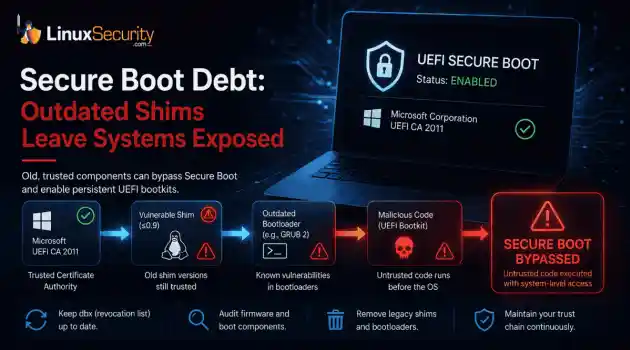
security advisory linux distribution ESET researchers identified 11 old and forgotten Linux UEFI shim bootloaders at versions 0.9 and below that can be used to bypass UEFI Secure Boot on any UEFI-based machine that trusts Microsoft’s Microsoft Corporation UEFI CA 2011 third-party certificate authority, regardless of the installed operating system (OS). Reported shims can be exploited to execute untrusted code during system boot, enabling attackers to deploy malicious UEFI bootkits even on systems with UEFI Secure Boot enabled.....
Jul 16, 2026
 Refine news
X Clear Filters
Get the latest News and Insights
Get the latest Linux and open source security news straight to your inbox.
Community Poll
Is continuous patching actually viable?
Loading...
Explore Latest Linux Security news
We found 84 articles for you...
81
 security advisoryupdateaccessibility
Tails 6.14.1: Major Updates for Tor Browser and Security Improvements
As Linux security admins, staying on top of the latest privacy and security advances is paramount. The recent Tails 6.14.1 release brings several crucial updates that you simply cannot afford to overlook! . With this release, the confinement technology for Tor Browser has seen significant enhancements, offering you an added layer of protection against potential security breaches while ensuring that vital functionalities, such as access to any folder within your Home folder or Persistent Storage, remain intact. Additionally, accessibility improvements within Tor Browser make it more user-friendly without compromising security. Additionally, this release includes key updates to essential components like the Tor Browser, now upgraded to version 14.0.9, and the Tor client updated to version 0.4.8.16, ensuring that the latest security patches are in place. Stability and usability fixes, such as resolving the Welcome Screen freeze issue and enhancing visibility in Kleopatra, make this a robust update for any security-focused Linux admin. Let's dive into the details and discover how Tails 6.14.1 can fortify your online defenses while maintaining seamless operational efficiency. Enhanced Confinement Technology for Tor Browser Tails 6.14.1 stands out with its enhanced confinement technology for the privacy-focused Tor Browser . As a Linux admin, you know Tor's value in providing online protection and anonymity. This update fortifies Tor against potential vulnerabilities, preventing the access of sensitive data unwittingly by hackers or untrustworthy sources. It isolates browser processes so any exploit affecting Tor can stay within its limited scope and reduce risk across your entire system. While using Tor Browser to browse anonymously online, you can now securely access files anywhere within your Home Directory or Persistent Storage without fear of browser vulnerabilities compromising them. Tails' combined strength of increased security and sustained usability is an impressive advance, makingit an attractive solution for Linux administrators looking to protect their systems against sophisticated cyber threats. Updates to Essential Components Keeping software components up to date is fundamental to maintaining robust system security. Tails 6.14.1 addresses this by updating critical components to their latest versions. The Tor Browser has been updated to version 14.0.9, and the Tor client has been upgraded to version 0.4.8.16. These updates are not just about introducing new features; they are vital for patching security vulnerabilities that could otherwise be exploited. Running outdated software can leave your system vulnerable. With Tails 6.14.1, you incorporate the most recent security patches and improvements into your toolbox. This proactive approach to security management is crucial in an environment where threats advance rapidly, and staying updated is often the first line of defense. Improved Usability and Accessibility Tails 6.14.1 takes important strides toward making secure systems usable and accessible, including making Tor Browser more user-friendly for people with visual impairments by including large text and adjustable cursor size settings. Further, restore, minimize and maximize buttons improve the user experience, making managing windows and multitasking simpler than before. These improvements are critical, as they ensure the security features don't compromise usability. As a Linux administrator, you understand this principle all too well—difficult systems tend to be less likely to be adopted and may lead to compliance issues . By making Tails 6.14.1 accessible and user-friendly, developers have created something easier for daily operations. Stability and Usability Fixes Tails 6.14.1 features major updates and upgrades and contains many essential fixes to increase its stability and usability. One notable improvement includes fixing an annoying Welcome Screen freeze issue after unlocking Persistent Storage. This change provides users with uninterruptedaccess to their files, streamlining workflow and saving valuable time. One notable fix involves improved border visibility of the Kleopatra window on white backgrounds. While these changes may seem minor at first, they significantly contribute to improving user experience by decreasing eye strain and making interactions with the system more pleasant. Furthermore, an error that occurred while closing the upgrade check from the About Tails screen has also been resolved for smoother update processes and better reliability. Our Final Thoughts on the Tails 6.14.1 Release The Tails 6.14.1 release represents a substantial upgrade that Linux security administrators should embrace with open arms. Tor Browser's enhanced confinement technology protects systems more effectively against exploits while permitting seamless access to necessary files. Up-to-date components like the Tor browser and client are crucial to staying ahead of security vulnerabilities by ensuring the latest patches and improvements are applied as they emerge. Focusing on accessibility balances security and usability, creating an enjoyable user experience without compromising security measures. Stability fixes address common problems to improve the overall experience, making Tails 6.14.1 an indispensable addition to any Linux administrator's security toolbox. Tails 6.14.1 represents an essential update for those prioritizing online security and privacy . By adopting it, users can ensure higher levels of protection without hindering efficiency or productivity during operations. You can find instructions on installing or upgrading to Tails 6.14.1 on the official Tails OS website. Have you tested it out? Let us know what you think of these updates and fixes @lnxsec! . Fortify your defenses using Tails 6.14.1; recent enhancements in Tor Browser amplify usability and safeguard measures substantially.. Tails security, Tor Browser update, Linux privacy, user-friendly security, Linux admin tools. . Brittany Day
 Apr 04, 2025
•
Apr 04, 2025
• Privacy
79
 security advisoryupdatesecurity patch
Wine 10.0 Released: Security Updates and Performance Enhancements
With the recent release of Wine 10.0 , we now have an updated and powerful tool for running Windows applications on our Linux systems. This new version features over 6,000 improvements designed to improve performance, compatibility, and the overall user experience. . Key enhancements in Wine 10.0 include critical security patches and performance boosts that can fortify your infrastructure against vulnerabilities. However, new features and significant changes always have the potential to introduce new attack vectors. Thorough testing and validation are paramount before transitioning to this new version. Reviewing the official release notes and engaging with the Wine community will provide vital insights, ensuring you can deploy this update confidently while maintaining a vigilant stance on security. In this article, I'll delve into the key aspects of Wine 10.0, exploring how it can be integrated effectively while ensuring that security remains uncompromised. Understanding The Significance of Wine 10.0 Wine is a compatibility layer enabling users to run Windows apps on non-Windows platforms like Linux. Wine 10.0 marks an important milestone, bringing over 6,000 improvements and the fruits of years of development efforts, providing users with a more capable platform. This year's iteration strives to ensure applications run more smoothly while simultaneously creating an improved user experience that's seamless and consistent across platforms. Enhanced Security Measures One of the most crucial aspects of any software update is the introduction of new security measures and patches. With Wine 10.0, security admins should be on the lookout for these critical updates. Although specifics will vary, general improvements can be expected in areas like handling system calls, memory management, and application sandboxing. These updates are designed to patch vulnerabilities that, if left unaddressed, could potentially be exploited by malicious actors. Therefore, promptly applying these patchesand understanding their impact is essential for maintaining a secure working environment. Conducting a thorough review of the official release notes will help you identify and prioritize these critical security aspects. Performance and Compatibility Improvements Beyond security, Wine 10.0 brings significant performance enhancements. These improvements are particularly important for resource-intensive applications that have previously experienced sluggish performance on Linux. With a more optimized compatibility layer, applications are likely to run more efficiently, making them more responsive and reducing system strain. Compatibility updates mean that a broader range of Windows applications can function better on Linux. This benefits administrators and end-users relying on specific Windows applications for daily tasks. It's a step towards reducing the friction often associated with cross-platform compatibility, enabling smoother and more reliable operation of these applications. Thorough Testing and Validation With such a substantial update, it's crucial not to rush into deployment. Testing and validation are indispensable steps in your deployment strategy. Start by setting up a controlled testing environment where you can run all necessary Windows applications under Wine 10.0. Monitor their behavior and performance closely compared to the previous version to catch any anomalies or issues early on. During this phase, focus also on assessing any security implications. Look out for new permission requests or changes in how applications access system resources. Ensuring that these changes do not inadvertently create security holes is vital. After thorough testing and validation, you should begin rolling out Wine 10.0 to your production environment. Monitoring and Post-Deployment Practices Even after a successful deployment, your job isn't over. Ongoing monitoring is crucial to ensure that no unexpected issues arise. Keep an eye on system logs and application behavior to detect anyanomalies quickly. Tools that can help automate this monitoring can be particularly useful, alerting you to issues before they escalate. Post-deployment, it's also wise to continue engaging with the Wine community and staying up to date with any additional patches or updates that might be released. As with any significant software deployment, being vigilant and proactive is key to maintaining a secure and efficient environment. Documentation and Training While technical updates and community engagement are important, don’t overlook the value of thorough documentation and training. Make sure that all security protocols and changes associated with the Wine 10.0 update are well-documented. This ensures that everyone on your team is on the same page and understands how to maintain the security and efficiency of your applications. Additionally, training sessions for your team can be beneficial, particularly if the update introduces new features or changes workflow processes. Equip your team with the knowledge they need to leverage the new capabilities of Wine 10.0 fully, while also maintaining the security protocols necessary to protect your environment. Our Final Thoughts on Wine 10.0's Impact on Windows App Security & Performance on Linux Adopting Wine 10.0 is an invaluable opportunity to improve the performance, compatibility, and security of Windows applications running on Linux. By carefully testing and validating this new release while engaging with its community and ensuring proper post-deployment monitoring as well as comprehensive documentation and training to facilitate its secure introduction, you can ensure a successful transition process. Remember that successful deployment involves more than simply installing updates; it must also involve understanding their effect on your overall security posture. You can freely download Wine 10.0 here. We'd love to hear what you think of these updates @lnxsec! . Wine 10.0 introduces vital security enhancements and improvedefficiency for Windows programs running on Linux environments.. Windows App Security, Linux Performance, Wine Enhancements, System Compatibility, Linux Security. . Brittany Day
Jan 23, 2025
•
Security Projects

210
 security advisoryupdatecritical
Linux Kernel Netfilter Vulnerability: CVE-2024-26925 Critical DoS Threat
A critical vulnerability was discovered in the Linux kernel's netfilter subsystem, specifically within the nf_tables component, posing potential risks to systems worldwide. The vulnerability, CVE-2024-26925 , arises from improperly releasing a mutex within the garbage collection (GC) sequence of nf_tables. It could potentially lead to race conditions and compromise the stability and security of the Linux kernel. . What Is the Impact of This Vulnerability on Linux Security? The technical details of the vulnerability and its impact on the Linux kernel's security should be highlighted. During the critical section, the commit mutex must not be released between nft_gc_seq_begin() and nft_gc_seq_end. The async GC worker could collect expired objects and get the released commit lock within the same GC sequence if this occurs. The implications of this kernel flaw are severe for systems utilizing the nf_tables for network packet filtering. Thus, admins and users should apply the latest updates to safeguard their systems. This proactive patching underscores the Linux community's commitment to security and stability and the importance of staying updated and informed on Linux security patches and best practices. For Linux admins, infosec professionals, internet security enthusiasts, and sysadmins, this vulnerability could have substantial long-term consequences for their systems and networks. It raises questions about the overall security of the Linux kernel and prompts critical analysis of the patching process and its effectiveness. However, the implications of this vulnerability extend beyond the immediate need for patching, elevating the importance of understanding and addressing potential weaknesses in open source and Linux security . This article aims to ensure that users are aware of their risks and equipped to take necessary actions to mitigate potential threats. Our Final Thoughts on This Critical Kernel Bug The critical vulnerability identified in the Linux kernel's netfiltersubsystem underscores the ongoing challenges in maintaining robust security measures for open-source software. The implications of this vulnerability on systems worldwide necessitate a heightened focus on proactive security measures, patching, and ongoing monitoring to ensure the resilience of Linux environments. This article aims to provide valuable insights and takeaways for the global community of Linux admins, infosec professionals, internet security enthusiasts, and sysadmins by emphasizing the impact of this flaw on security practitioners and offering actionable mitigation recommendations. . This critical weakness in the Linux kernel presents considerable dangers, requiring immediate response from system administrators and cybersecurity personnel.. Linux Kernel, Netfilter, Critical Risk, DoS, Security Update. . Brittany Day
Apr 30, 2024
•
Security Vulnerabilities
83
 security advisoryupdatephishing
Israel: Phishing Alerts for F5 Updates - Data Wipers Target Linux Users
Alright, folks, let me fill you in. Fake security updates have been causing real-world havoc ! The Israel National Cyber Directorate (INCD) alerts about phishing emails pretending to be F5 BIG-IP security updates, and guess what? These emails unleash Windows and Linux data wipers. Troubling, right? . Israeli organizations have been under fire recently, with an uptick in data theft and data-wiping attacks since October. Fueling this storm, the INCD discovered a malicious data wiper, "BiBi Wiper," which puts your Linux and Windows devices in its crosshairs. But it doesn’t stop there! The phishing emails link to a so-called F5 BIG-IP update, which, when launched, unleashes data wipers. Crafty, eh? The Linux and Windows versions will communicate with a Telegram channel to provide information about the compromised device, including status updates. So, what are the implications of these attacks? The threat isn't merely local, so we must ask how such tactics might evolve and impact global cybersecurity. While vendors are naturally the first line to maintain custom updates, where does that leave the end-users, particularly in open-source and Linux communities? Long-term, how can awareness and robust security strategies mitigate these risks? At LinuxSecurity, we've long been preaching that awareness and a defense-in-depth approach to securing your Linux systems are critical in mitigating risk. Remember, mates, only trust updates from original vendors or your Linux distro(s) and only download files from email if they come from a trusted and confirmed source. Stay safe out there, you savvy tech folks! . Cyber threats escalate for Israeli enterprises as harmful phishing campaigns aim at both Linux and Windows platforms.. Data Wiper Threats, Phishing Attacks, Linux Security Updates, Cybersecurity Awareness, Threat Intelligence. . LinuxSecurity.com Team
Dec 21, 2023
•
Hacks/Cracks
79
 updatenotificationlinux
New Systemd Patch: Blue Screen of Death for Linux Errors
The Linux Blue Screen of Death is a new feature that gives users a taste of the dreaded Windows feature. . Linux, the open-source operating system, has long been considered an alternative to Windows. In fact, many have ditched Windows and switched to Linux because they believe it's more secure. But now with the Linux Blue Screen of Death (BSoD), they can experience what it's like to use Windows. The BSoD is a new type of error message that pops up in place of the traditional yellow warning icon on your screen—and it's just as annoying as you'd expect! The BSoD was created by developers who wanted to make sure users were aware of their mistakes without being too rude about them, so they came up with this "friendly" way to tell them something wasn't working right. Now when users try out commands that don't work properly or accidentally delete an important file, they get a friendly pop-up asking them whether they want to continue or reboot their machine. You can imagine how frustrating this could be for someone who doesn't know how to fix things themselves! While some might argue that this feature should be removed from Linux altogether, others believe it will actually help people learn more about computers by making mistakes. I personally believe the latter. What do you think? Reach out to me on X at @lnxsec and let me know! Here's an article that I found helpful in understanding this new feature, and I thought you would enjoy it. Check it out at the link below! . An exciting update to systemd introduces a vibrant Error Display in Linux, mimicking a popular Windows feature for enhanced user-friendliness.. Linux Systemd, User Experience, Error Handling, Blue Screen of Death. . LinuxSecurity.com Team
Dec 08, 2023
•
Security Projects
210
 security advisoryupdatedebian
Debian: DSA-5472-1 Critical: JOSE for C/C++ DoS and Info Exposure
It was discovered that JOSE for C/C++ AES GCM decryption routine incorrectly uses the Tag length from the actual Authentication Tag provided in the JWE ( CVE-2023-37464 ). This severe vulnerability is simple to exploit and threatens the integrity of impacted systems. . An attacker could use this to cause a denial of service (system crash) or to expose sensitive information. Updates for JOSE for C/C++ that mitigate this dangerous bug have been released. We strongly recommend that all impacted users apply the updates released by Debian , Debian LTS , Oracle , RedHat , Rocky Linux , and Ubuntu as soon as possible to safeguard their sensitive data and protect against potential security issues. To stay on top of essential updates released by the open-source programs and applications you use, register as a LinuxSecurity user , subscribe to our Linux Advisory Watch newsletter, and customize your advisories for your distro(s). This will enable you to stay up-to-date on the latest, most significant issues impacting the security of your systems. Follow @LS_Advisories on Twitter for real-time updates on advisories for your distro(s) . . Malicious users may exploit the JOSE vulnerability in C/C++ apps, risking denial of service and confidential data leaks. It's essential to apply updates promptly. DoS Cybersecurity, JOSE C/C++ Update, Info Disclosure Alert, System Integrity Risk. . Brittany Day
Sep 07, 2023
•
Security Vulnerabilities
210
 security advisoryupdatecritical
Fedora & Ubuntu Advisory: ClamAV DoS Threat and Update Required
It was discovered that ClamAV incorrectly handled parsing HFS+ files ( CVE-2023-20197 ). This bug is easy to exploit and poses a severe threat to the availability of impacted systems. . A remote attacker could use this issue to cause ClamAV to crash, resulting in a denial of service (DoS). Important updates for ClamAV have been released that mitigate this severe flaw. We urge all impacted users to apply the updates issued by Fedora and Ubuntu as soon as possible to protect the availability of their critical systems. To stay on top of essential updates released by the open-source programs and applications you use, register as a LinuxSecurity user , subscribe to our Linux Advisory Watch newsletter, and customize your advisories for your distro(s). This will enable you to stay up-to-date on the latest, most significant issues impacting the security of your systems. Follow @LS_Advisories on Twitter for real-time updates on advisories for your distro(s) . . Critical vulnerability found in ClamAV raises significant DoS threat, necessitating immediate updates for Fedora and Ubuntu users.. ClamAV Update, DoS Threat, Fedora Security, Ubuntu Security, Critical Patches. . Brittany Day
Aug 31, 2023
•
Security Vulnerabilities
210
security advisoryupdateprivilege escalationUbuntu Critical Advisory: Kernel Update for Privilege Escalation Risks
Two new Linux kernel privilege escalation flaws have been discovered in the OverlayFS module in Ubuntu, which affect nearly 40% of Ubuntu users (CVE-2023-2640 and CVE-2023-32629). Modifications to the OverlayFS module introduced by the Linux kernel project in 2019 and 2022 conflicted with Ubuntu’s earlier changes, and Ubuntu's adoption of the new code introduced these two vulnerabilities. . The researchers who discovered these vulnerabilities have stated, “Both vulnerabilities are unique to Ubuntu kernels since they stemmed from Ubuntu’s individual changes to the OverlayFS module. Weaponized exploits for these vulnerabilities are already publicly available given old exploits for past OverlayFS vulnerabilities work out of the box without any changes.” These issues can allow an unprivileged local user to gain elevated privileges on impacted systems. Important updates for the kernel that mitigate these severe vulnerabilities are now available for Ubuntu users. We strongly recommend that all impacted users apply these updates immediately to protect against privilege escalation attacks leading to system compromise. To stay on top of essential updates released by the open-source programs and applications you use, register as a LinuxSecurity user , subscribe to our Linux Advisory Watch newsletter, and customize your advisories for your distro(s). This will enable you to stay up-to-date on the latest, most significant issues impacting the security of your systems. Follow @LS_Advisories on Twitter for real-time updates on advisories for your distro(s) . . Crucial patches released for Ubuntu systems to address emerging security vulnerabilities in the OverlayFS component.. Ubuntu Kernel Flaws, Privilege Escalation, OverlayFS Issues. . Brittany Day
Aug 03, 2023
•
Security Vulnerabilities

Get the latest News and Insights
Get the latest Linux and open source security news straight to your inbox.
Community Poll
Is continuous patching actually viable?
Search Topics
Powered By

Linux Security - Your source for Top Linux News, Advisories, HOWTOs and Feature Releases
QUICK LINKS
subscribe to newsletters!
Like staying secure? So do we.
Sign up for updates, tips, and alerts!