Explore top 10 tips to secure your open-source projects now. Read More
×



Server Security data privacy automation
data privacy automation Every system admin has lived through the same Monday morning ritual. A queue of forty tickets, half of them password resets, permission errors, or disk space warnings that any experienced technician could resolve in under two minutes. The other half require actual judgment. For years, automation promised that software would eventually sort the two apart on its own. That promise is now being tested in production Linux environments. . Early results are reshaping how IT teams think about tier-1...
 Jul 17, 2026

Privacydata collection automation
data collection automation You're running a web scraping project to collect pricing data from e-commerce sites. You set up a pool of datacenter proxies, launch your scripts, and within minutes — banned . CAPTCHAs everywhere. Your data pipeline stops before it really begins. . It's a frustrating scenario that plays out daily in ad verification, market research, and multi-account management. The website doesn't know you're doing legitimate research or monitoring. It just sees traffic coming from IP ranges it recognizes as...
Jul 17, 2026

Security Trends security advisory social engineering
security advisory social engineering Business Email Compromise used to be a numbers game — mass-blasted emails, broken English, an obvious "URGENT WIRE TRANSFER" subject line. That era is over. Generative AI has turned BEC into a tailored, low-noise operation that mimics writing style, voice, and even video presence. This piece looks at what's actually changed under the hood, what defenders are testing in response, and why so many organizations are still structurally unprepared for it. . The Infrastructure Problem Nobody Wants to...
Jul 17, 2026
Security Trends cybersecurity Linux documentation
cybersecurity Linux documentation Linux operating systems have gained prominence due to their stability, adaptability, and excellent security options. In the case of developing documentation, designing cybersecurity dashboards, or educational material, visuals are of vital importance when it comes to making things clear. The use of icons allows one to understand the message regarding alerts, authorization, encryption, authentication, or the state of the system just by looking at the visual cue without having to read long...
Jul 17, 2026
Security Vulnerabilities security advisory linux distribution
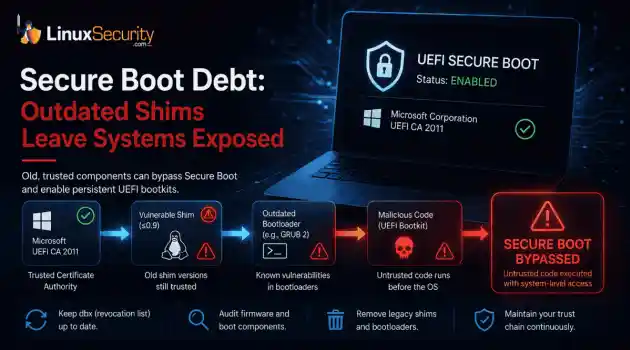
security advisory linux distribution ESET researchers identified 11 old and forgotten Linux UEFI shim bootloaders at versions 0.9 and below that can be used to bypass UEFI Secure Boot on any UEFI-based machine that trusts Microsoft’s Microsoft Corporation UEFI CA 2011 third-party certificate authority, regardless of the installed operating system (OS). Reported shims can be exploited to execute untrusted code during system boot, enabling attackers to deploy malicious UEFI bootkits even on systems with UEFI Secure Boot enabled.....
Jul 16, 2026
 Refine news
X Clear Filters
Get the latest News and Insights
Get the latest Linux and open source security news straight to your inbox.
Community Poll
Is continuous patching actually viable?
Loading...
Explore Latest Linux Security news
We found 41 articles for you...
78
 linuxsystem securityvirtualization
Insights on Apple's macOS Container Tool for Linux Administrators
For years, macOS has been more of a bystander in the containerization world—a useful client tool for developers but rarely the platform of choice for running production-grade workloads. Docker Desktop filled that gap, albeit with a layer of abstraction devs tolerated rather than embraced. And now? Apple is stepping directly into the arena with its new container tooling , which integrates natively with macOS technologies. . If you're a Linux admin or someone responsible for system security, this warrants a deeper discussion. It’s not just another container runtime; it’s a marked departure from shared-kernel solutions like Docker or Podman, and that raises both opportunities and questions. With Apple's tool, you're not just running containers. Here, each container gets its own lightweight Linux virtual machine (VM), isolated and enforced via Apple’s Virtualization and Containerization frameworks. Sound familiar? That’s not unlike the shift we’ve seen in Kubernetes with Kata Containers or Firecracker VMs. Those who've worked with them will recognize the emphasis Apple is placing on isolation at the VM level. This architecture could resonate strongly with infosec professionals tired of hunting down shared-kernel vulnerabilities in Docker deployments. But before we dive into any assumptions, let’s walk through what Apple is laying on the table and where its limitations might trip you up. Why Does Native Integration with macOS Tools Matter? One of the most notable aspects of Apple’s tool is how deeply it integrates with macOS-specific technologies. Unlike Docker Desktop , which essentially layers a custom solution on top of macOS and macOS features like vmnet but never fully “belongs,” Apple’s tooling is purpose-built to plug directly into macOS components. It works with Keychain for secure credential storage, uses XPC for interprocess communication, and taps into Apple’s vmnet framework for networking. What does this mean in practice? Well, for starters, performancecould be leaner. By bypassing the abstraction layers that Docker Desktop and similar third-party solutions rely on, Apple’s Container tool potentially consumes fewer system resources while delivering better efficiency on supported hardware. This becomes even more relevant when paired with Apple Silicon chips, which are custom-optimized for virtualization. However, the native integration isn’t purely about speed or resources—it’s also a matter of security. With Keychain integration, secrets like access tokens or SSH keys are stored using macOS's well-vetted credential management systems. This adds a layer of trustworthiness you don't always see in container ecosystems. And since container communication leans on XPC—a mechanism that’s sandbox-aware and hardened against exploits—your interaction between processes just got exceptionally harder to tamper with. But as with any tightly integrated system, reliance on macOS-exclusive technologies could potentially lock you into the ecosystem. This is a compromise Linux admins rarely take lightly. Isolation via Lightweight VMs Isn’t Just a Buzzword Let’s talk isolation. Unlike Docker containers , which share the host OS kernel, Apple’s containers operate within independent Linux VMs. Every container essentially runs with the shield of its own kernel, which significantly minimizes the impact of kernel-level vulnerabilities or exploits being carried into other containers—or the host itself. From a security standpoint, this is a big deal. Consider your typical case scenario: if you’re running multiple containers on Docker and one gets compromised, you’re looking at shared-kernel risks and lateral movement between containers. Apple’s approach makes that level of exposure much harder to pull off. For infosec professionals deploying sensitive workflows or managing multi-tenant environments, this architecture could be the bulletproof vest you’ve been looking for. That said, lightweight VMs aren’t without their challenges in areal-world operational sense. Memory utilization, for instance, becomes a tricky thing with Apple's virtualized containers, as its Virtualization framework has incomplete support for dynamic memory allocation techniques like ballooning. If you’re running resource-heavy applications or expect memory demand to scale unpredictably, this could be a thorn in your deployment plans. Another interesting feature? Sidecar container support. These allow you to run auxiliary services—think logging agents, security monitoring tools, or reverse proxies—alongside your main container workload with similar levels of isolation. While the mechanics here mirror sidecars in Kubernetes, applying this effectively in Mac-specific workflows is going to require careful rethinking of architectures—especially if networking hiccups (more on that later) persist. OCI Compliance Keeps Doors Open—but Not Without Tradeoffs Apple isn’t looking to upend industry standards, and its Container tool adheres to Open Container Initiative (OCI) specifications. This means you can use popular container registries and workflows right out of the gate, whether you’re spinning up images pulled from Docker Hub, Harbor, or another compliant source. Kubernetes clusters and multi-platform development workflows should, in theory, play nicely with these containers so long as the rest of the toolchain supports OCI. However, the big unknown here is how Apple’s new containerization tool handles longstanding quirks and edge cases that often arise between container runtimes and registries. Sure, performance might improve when running native macOS workloads, but what’s the cost of compatibility when you run into mixed-node environments with workloads spanning macOS, Linux, or even Windows machines? Early signs of networking gaps—such as Apple’s current lack of full container-to-container communication support—point to potential friction, especially if your workloads rely on distributed microservices. Apple Silicon: PerformanceMeets Architecture Let’s carve out a moment for hardware. By now, anyone following Apple's hardware trajectory knows they’ve gone all-in on Apple Silicon’s M-series chips. These chips are highly optimized for virtualization workloads, so it shouldn’t surprise anyone that the Container tool was built with this in mind. Apple promises reduced overhead and higher resource efficiency compared to Docker Desktop, especially on M1 and M2 systems—and, in theory, that should hold true. Practically, if you’re running macOS Sequoia (macOS 15) on Intel-based hardware, the tool is still functional but diminished. Any devs planning for forward compatibility should note that macOS 26 “Tahoe” is explicitly where performance peaks are unlocked. This creates an interesting issue, particularly for IT teams supporting mixed environments. The cumulative security, performance, and efficiency Apple seems to push here only fully materialize with relatively modern hardware. Older Intel systems aren’t just slow—they’re effectively early adopters without full access to the promised features. Our Final Thoughts: What Apple Got Right—and What Needs Work Bringing it back together, Apple’s native integration with macOS for containerization is clearly meant to signal a shift: they’re formally building tools for developers and ops teams who’ve adapted Linux container workflows. The feature set leans toward addressing security and performance concerns; however, no system arrives without tradeoffs. Admins will want to carefully test the waters before rolling this tool into production environments. Auditing how it interacts with your current mix of Linux VMs, containerized deployments, and registries is critical. The reliance on macOS-specific frameworks like vmnet and Keychain, while enhancing security, means you’re carving out space in an ecosystem that doesn’t lend itself easily to multi-platform portability just yet. At its core, though, this tool signifies Apple’s intent to meetdevelopers where they are. Whether they can create a smooth path across a fragmented, containerized world remains to be seen. For now, cautious optimism seems reasonable—just make sure you read the fine print on networking limitations and memory restrictions before deploying anything you can’t afford to troubleshoot at scale. . If you're a Linux admin or someone responsible for system security, this warrants a deeper discussio. years, macos, bystander, containerization, world—a, useful, client. . Brittany Day
 Jun 11, 2025
•
Jun 11, 2025
• Vendors/Products
209
IT infrastructuresecurity strategyvirtualizationDual Boot or VM: Securely Transitioning to Linux Infrastructure
Given its potential security implications, switching from Windows to Linux can be intriguing and daunting for administrators . Instead of taking an abrupt leap and abandoning Windows altogether, creating an environment in which both operating systems coexist can make this transition process smoother and safer. . Taking this approach not only enhances testing capabilities but also provides protection from disruptive failures. Furthermore, this gradual migration approach enables critical services and workloads to be safely moved before a full switchover to Linux. Let's examine how dual booting or using virtualization software provides a balanced, secure route towards adding Linux into your IT infrastructure. Exploring the Dual Boot Advantage Establishing a dual boot system involves installing both Windows and Linux onto one machine, allowing users to boot into either system at startup. This provides organizations an effective means for testing security practices - acting as an ideal testing ground where Linux-specific security tools or patches may be trialed before expanding them across an entire network. Security administrators can use this setup to conduct vulnerability assessments without endangering their existing Windows setup. Testing updates or open-source security software in an isolated Linux environment provides peace of mind knowing any potential issues won't threaten critical Windows systems. Incorporating both operating systems simultaneously ensures greater operational continuity while mitigating risks associated with software compatibility issues. Virtual Machines: A Flexible Approach Virtual machines (VMs) offer administrators several benefits over dual booting methods. One such advantage is access to Linux as an application within Windows without needing to reboot their machine and use its security tools. Running a Linux virtual machine (VM) can greatly enhance security operations by providing real-time testing of security scenarios without impacting liveenvironments. Admins can test potential threats in virtualized Linux environments before exploiting vulnerabilities for real. This process enhances security measures and creates more robust response strategies. Virtual machines (VMs) enable admins to efficiently prioritize current tasks on Windows systems while exploring security frameworks or protocols in Linux on one machine, thus expanding their understanding and utilization of Linux's vast security features. Security: Mitigating Risks with a Dual Strategy One of the primary concerns when switching operating systems is security risks that might emerge. Using dual boot or virtualization technology can help minimize these risks significantly, especially since cyber threats have become far more sophisticated in recent years. Running two distinct OSes on one machine adds another layer of protection. Suppose one operating system becomes compromised due to malware or a security breach. In that case, its counterpart remains undamaged, providing admins a crucial advantage in responding to incidents without resorting to emergency restoring procedures. Admins can leverage Linux's robust security tools without completely cutting ties with all their Windows applications, maintaining operational flexibility and assurance that would otherwise be impossible with a single OS system. Gradual Learning Curve and Migration Transitioning from Windows to Linux can be a steep learning curve, particularly for those entrenched in a Windows-based environment. A phased approach via dual boot or VM allows IT professionals to acquaint themselves with Linux at their own pace, testing waters and developing competencies without immediate pressure. This comfort in learning fosters a deeper understanding of Linux’s capabilities, from superior security protocols to tweaking system configurations that enhance your security posture. Over time, as familiarity grows, critical services and workloads can be moved from Windows to Linux with confidence. Admins canensure that all security standards are rigorously tested and maintained during this gradual migration, reducing the potential for disruption and increasing the resilience of IT infrastructure. Enhancing Your Overall Security Strategy Both dual boot and VM solutions encourage a more comprehensive approach to strengthening an organization’s overall IT security strategy. By integrating Linux into their systems in a controlled and incremental fashion, security professionals can leverage the best aspects of each OS. Windows continues to provide familiarity and compatibility with established systems, while Linux offers unparalleled opportunities for innovation and enhanced security practices. Admins can monitor and adjust policies in real time, dynamically applying insights from the Linux environment into more extensive network-wide security plans. Switching effortlessly between systems facilitates continuous learning and adaptation, essential qualities for any security-conscious admin to develop. Our Final Thoughts on The Benefits of a Dual Boot or VM When Transitioning to Linux For IT security admins considering the leap to Linux, opting for a dual boot or VM offers a prudent, security-focused strategy. It promotes a balanced learning curve and encapsulates security benefits that aren't just theoretical but demonstrably practical in mitigating risks and maintaining business continuity. As organizations continue navigating the challenges of today's digital environment, such a transitional strategy ensures readiness and resilience, empowering security admins to deliver secure, reliable IT solutions. Ready to get started? Tom's Hardware offers an excellent guide on setting up a dual boot system . Canonical also offers a great guide on setting up a VM with VirtualBox. Have additional questions or concerns? Reach out to us on X @lnxsec - we're here to help! . Boost your testing potential and fortify security by transitioning to Linux via dual boot setups or virtual machines, whileexpertly minimizing associated risks.. Dual Boot, Virtualization, IT Security, Linux Transition. . Brittany Day
Feb 28, 2025
•
Security Trends

79
 network securitysecurity enhancementmemory management
Linux Kernel 6.13: Exciting Security Features for Admins this Holiday
As Linux admins and infosec professionals prepare for the holiday season, there's much cause for celebration this year! Linus Torvalds recently made headlines when he unveiled the initial release candidate of Linux Kernel 6.13 (6.13-rc1) on December 1, 2024. Its final version is due for a mid-to-late January 2025 release. This gives ample opportunity for testing, resource planning, and resource allocation during an otherwise slower season. . Not only was the merge window completed smoothly, ensuring stability during development, but this release also promises many security enhancements essential in protecting systems against increasingly sophisticated cyber threats and defend against vulnerabilities . In this article, I'll examine the significance of this exciting release and how it will gift you a stronger Linux security posture this holiday season! Favorable Timing One of the stand-out aspects of Linux Kernel 6.13 is its timing with the holiday season. Linus Torvalds noted its significance in his announcement to the Linux Kernel Mailing List , noting how this release cycle avoided year-end clashes that usually lead to hastened and subpar development processes. As such, developers could focus on stabilizing 6.13 without feeling pressure from holiday rushes during development cycles, creating a smoother trajectory for future development cycles. Torvalds recently mentioned the holiday break as another positive factor for future releases - an opportunity for relaxation among developers that might result in more focused releases with better refinement and focus. Release Candidate Availability Testing begins in full swing once the release candidate (6.13-rc1) arrives. This period allows developers and security professionals to identify and fix bugs, ensuring a robust release in the final version. In this phase, administrators and security professionals test it against their systems to prepare a seamless transition when the final version arrives. Development cycles that coincide withholidays offer extended testing and optimization windows, which should generally contribute to more stable and reliable releases. This mainly benefits security communities, allowing thorough evaluations of new security features or updates. Successful Merge Process Completing the merge window without significant issues is more evidence of Linux Kernel 6.13's smooth development process. A seamless merge process ensures overall stability and reliability for its final release and smooth integration of new features or updates. This cycle brings updates across multiple subsystems, from updates to Virtual File System (VFS), driver, architecture-specific improvements for ARM64, x86, and RISC-V architectures, as well as core kernel components like memory management and scheduling to memory updates that demonstrate its value in overall stability and performance of kernel. Torvalds noted more core VFS changes than usual during this cycle, underscoring their significance to overall kernel stability and performance. Security Enhancements We Linux admins view new kernel releases with great interest because of the security enhancements they often bring. Linux Kernel 6.13 includes several critical updates to increase resilience against vulnerabilities and attacks. Notable security enhancements in Linux Kernel 6.13 include: Improved Memory Management Proper management of available memory is central to system stability and security. Linux 6.13 updates have enhanced core memory components to maximize efficiency while mitigating any possible buffer overflow vulnerabilities or memory corruption vulnerabilities that might compromise them. These core memory components use more available space while decreasing security breach risks. Efficient Scheduling Updates to the kernel's scheduling mechanisms have proven instrumental in increasing system performance and security. Efficient scheduling ensures processes have equitable access to system resources while mitigating DoS attacks and improving overall systemresponsiveness. File System Security Linux Kernel 6.13 includes updates for several file systems, such as Btrfs, XFS, and F2FS, that strengthen security and reliability by protecting data integrity while restricting unauthorized access - an essential safeguard in keeping confidential files private and preventing breaches in data confidentiality. Network and Virtualization Security Additionally, this release features improvements to networking and virtualization (KVM) components. Network security enhancements help protect systems against network-based attacks, and updates to virtualization components ensure virtual environments remain isolated to avoid spreading attacks between virtual machines. Rust Support in the Kernel A particularly notable update in Linux 6.13 is the continued inclusion of the Rust programming language . Rust is widely known for its emphasis on safety and concurrency, making it an excellent language for writing secure kernel code. Updates such as Rust file abstractions and PID namespace bindings provide steps towards further embedding Rust into our Linux systems, potentially leading to safer systems in the future. Our Final Thoughts on the Security Improvements in Linux Kernel 6.13 The release of Linux Kernel 6.13 marks an exciting event in the Linux community this holiday season. Security improvements made possible through Linux Kernel 6.13 are paramount in protecting systems against emerging threats, with enhancements in memory management, scheduling, file system security, networking virtualization, and Rust support all providing greater resilience. As is always the case for Linux advancements, collaborative efforts within its community drive them, helping keep Linux at the cutting edge of operating system technology. With the release of Linux Kernel 6.13, the community continues its commitment to innovation and security and provides a critical update for administrators and infosec professionals. As always, be diligent and ensure your systems can use the newsecurity enhancements introduced with Linux Kernel 6.13. These updates are essential in maintaining a robust Linux infrastructure heading into 2025. What are you most excited about in this release? Reach out to us @lnxsec and let's chat about it! . Dive into Linux Kernel version 6.13, showcasing enhanced security features, sophisticated memory management, bolstered network protections, and the integration of Rust for safer programming.. Linux Kernel 6.13, security updates, Rust integration, network protection, kernel enhancements. . Brittany Day
Dec 02, 2024
•
Security Projects
79
 security impactupdatesimprovement
Linux 6.13: Intel TDX Enhancements and Security Considerations
Linux 6.13 features significant enhancements in Intel Trust Domain Extensions (TDX) code that aim to provide robust hardware-based security protections for virtual machines (VMs) on recent Xeon processors. As virtualization becomes an indispensable part of modern IT infrastructures, such advancements, as seen in Linux 6.13, are becoming more crucial. . In this article, I'll explore the security impact of these changes and why they will not be exposed by default. Overview of Intel Trust Domain Extensions (TDX) Intel TDX provides virtual machines with hardware-level isolation. This helps ensure that even if an underlying hypervisor is compromised, the integrity and confidentiality of any VMs hosted remain secure. Trust Domain Extensions use secure enclaves to create a Trusted Execution Environment for these VMs - protecting against potential attack vectors that might exploit hypervisor vulnerabilities. Critical Updates in Linux 6.13 Source: Phoronix Linux 6.13 features key improvements in managing Intel TDX functions more effectively. Updates primarily target improving interactions between TDX guests and virtual machine monitors by implementing new infrastructure for handling metadata. This change provides developers with more granular control. One of the key enhancements in this update is the capability of disabling runtime injection of #VE (Virtualization Exception) exceptions from virtual machines at runtime. Before now, control of #VE exception injections was handled via static switches. Any misconfiguration on the guest side could cause panic and downtime. However, runtime control features provide administrators more flexibility and finer control mechanisms to handle exceptions efficiently and ensure maximum stability and security for their systems. Linux 6.13 also introduces an enhancement that enables TDX guests to opt in to access topology CPUID leaves. Previously, accessing such information would trigger a #VE, disrupting VM performance and operationalinsights for workload management. With these changes, Linux 6.13 marks a significant step in optimizing and managing TDX functionalities, ensuring greater control, stability, and performance for virtualized environments. Examining the Security Implications of These Changes Linux 6.13's advancements significantly enhance Intel TDX security measures. By providing runtime control for #VE exception handling, the new kernel version minimizes disruptions and potential attack surfaces caused by misconfiguration or malicious use. Increased access to topology CPUID data without setting off exceptions also helps protect against unintended downtime and improve resource management. Runtime control features enhance security by enabling dynamic adjustment of #VE exceptions, providing more responsive and adaptive security management. Furthermore, permitting guests to access CPUID topology data without triggering #VEs ensures operational resilience and efficient resource allocation, making virtualization environments secure and performant. Constraints on Default Exposure Though their benefits are readily apparent, these enhancements will not appear by default. This is due to compatibility issues between Linux and other operating systems. Retaining "legacy behavior" for compatibility reasons recludes making these features default behaviors. The pull request explains: "For both cases, it would have been easiest to change the default behavior simply; however, certain 'other' OSes require keeping their legacy behavior. This statement implies a reference to Microsoft Windows but more broadly illustrates the considerations kernel developers must account for when developing software. If new behaviors were enabled automatically, they could cause compatibility issues that cause virtual machines running legacy or non-compliant operating systems to crash. Keeping compatibility intact ensures broad stability and usability but will require manual opt-in for environments ready to utilize these new features. Do youagree with these constraints? We'd love to hear your opinion! Connect with us @lnxsec , and let's have a discussion. Our Final Thoughts on the Significance of These Security Improvements Intel TDX advancements for Linux 6.13 represent an essential advance in secure virtualization. Improving exception management and data access protocols boosts the performance and security of systems employing Intel's latest Xeon processors. Compatibility requirements across various operating systems necessitate restrained default exposure to guarantee stability and broad applicability. While Linux 6.13's developments can significantly enhance virtualization security and efficiency, administrators must carefully weigh these features against compatibility concerns for broader virtual machines (VMs) deployments. As virtualization evolves, such incremental yet essential advances demonstrate how far open-source communities have come toward providing secure computing paradigms. . Intel TDX in Linux 6.13 significantly enhances virtualization security, but it requires careful configuration and management to prevent vulnerabilities. Intel TDX Enhancements, Linux Security Updates, Virtual Machine Protocols, Exception Management, Hardware Isolation. . Brittany Day
Nov 26, 2024
•
Security Projects
79
security advisoryvirtualizationkernel enhancementLinux 6.8 Kernel: KVM Enhancements Impacting Security Protocols
Notable virtualization changes and enhancements have been integrated into the Linux kernel 6.8 . Significant features include enhanced support for confidential VMs, software-protected VMs, and improvements for specific architectures like x86 and ARM. These changes offer intriguing possibilities for Linux admins, infosec professionals, Internet security enthusiasts, and sysadmins but also raise important considerations for security and long-term consequences. Let's have a look at these changes and their implications for the security of your Linux systems. . Notable Virtualization Changes in the Linux 6.8 Kernel The inclusion of the new KVM_SET_MEMORY_ATTRIBUTES ioctl in Linux 6.8 brings about improved support for confidential and secure VMs. The ability to specify per-page attributes for guest memory enables stronger isolation and protection for VMs utilizing technologies like AMD SEV-SNP, Intel TDX, and ARM pKVM. This feature is particularly relevant for security practitioners who deal with sensitive workloads and require robust mechanisms to ensure data confidentiality. Another intriguing feature mentioned in the article is the support for "software-protected VMs" on x86, which serves as a testing method for interfaces related to guest_memfd and page attributes. While this may not have immediate practical implications, it represents an effort to innovate and develop more secure mechanisms for VMs. Security practitioners should keep an eye on these advancements to ensure they align with their requirements and evaluate the potential impact on their security posture. The addition of Intel Linear Address Masking (LAM) support for KVM guests allows better control over guest access to memory, which can enhance security by ensuring that guests only have access to the appropriate memory regions. Linux admins and infosec professionals should consider the implications of these advancements and assess how they can leverage this feature to strengthen the security of their virtualized environments. Additionally, flush-by-ASID support now exists for nSVM, unconditionally on KVM. This change facilitates compatibility with the latest versions of VMware Workstation, a widely used virtualization platform. While this may seem like a minor improvement, compatibility with popular platforms is crucial for security practitioners to manage and secure their virtualized infrastructure effectively. Furthermore, the introduction of the "CONFIG_KVM_HYPERV" Kconfig option raises questions about the potential impact on KVM support for Microsoft Hyper-V emulation. This option provides flexibility to disable Microsoft Hyper-V emulation support at build time. It raises concerns for security practitioners relying on Hyper-V and KVM integration. They have to weigh the pros and cons of such a decision and assess if the trade-off is worth it regarding security, performance, and management. Our Final Thoughts on the Impact of Linux 6.8 Kernel Enhancements on Security In conclusion, the KVM changes in Linux 6.8 bring promising enhancements for virtualization and security. The improved support for confidential VMs, software-protected VMs, Intel LAM, and architectural-specific features like ARM64 LPA2 and LoongArch LSX/LAX SIMD CPU instructions provide opportunities for security practitioners to strengthen their virtualized environments. However, it is crucial to consider the long-term consequences and potential trade-offs associated with these changes. By staying informed and analyzing the implications of these advancements, Linux admins, infosec professionals, Internet security enthusiasts, and sysadmins can make informed decisions to enhance the security of their systems and stay ahead of emerging threats. We encourage you to stay up-to-date on the latest Linux security news, updates, and advisories by subscribing to our weekly newsletters. Stay informed and secure, fellow Linux users! . The Linux kernel 6.8 showcases major upgrades to KVM, enhancing memory management, strong security measures, and performancetools for virtual settings. Linux Kernel 6.8, KVM Features, Virtualization Security, Software Protection. . LinuxSecurity.com Team
Jan 14, 2024
•
Security Projects
79
 security practicessystem securityvirtualization
QEMU Enhancements: Secure Isolation in Linux Emulation Practices
QEMU plays a significant role in Linux system emulation by providing users with features like isolation of guest and host systems, device emulation security, memory management, and sandboxing. The article emphasizes QEMU's ability to "prevent potential security flaws or exploits in the guest system from affecting the host system" through its isolation feature, a crucial aspect for information security pros. . However, considering the movement towards containers and other efficient virtualization methods, one might ask if the level of isolation is enough and whether there's room for improvement. Unlike containers, which share the host OS kernel and can be compromised across all instances, QEMU "creates a full virtual machine with its kernel," providing a higher isolation level albeit with more resource consumption. QEMU's integration with security technologies like SELinux and AppArmor adds an extra layer of protection, but is it enough? Should security practitioners explore other ways to strengthen QEMU's defenses? Should we consider the trade-offs between the portability of containers and the isolation of QEMU-created virtual machines, especially as the landscape of system virtualization continuously evolves? In conclusion, QEMU has made important contributions to Linux system emulation security. Still, it's crucial to reflect on the emulator's long-term implications and potential improvements to protect virtual environments. Stay informed to stay secure , friends! . KVM is essential for boosting Windows safety by utilizing cutting-edge containment and virtualization techniques to safeguard systems.. QEMU, Linux Emulation Security, Virtual Machine Isolation, Device Emulation Techniques. . LinuxSecurity.com Team
Dec 22, 2023
•
Security Projects
212
 software deploymentvirtualizationcontainer management
Top 9 Docker Alternatives For Effective Container Management
Learn about nine great Docker alternatives for container management to consider using in your next project. . Containers are highly beneficial for software development, deployment, and management in a virtual environment. Docker is useful in the containerization process, but it's not the only platform around. If you're searching for some alternatives to Docker, look no further. This list showcases some feature-rich and efficient Docker alternatives to use in your next project. . Explore premier container orchestration platforms that rival Docker for your development tasks.. Container Management, Docker Alternatives, Virtual Deployment Solutions. . Brittany Day
Nov 09, 2021
•
Cloud Security
78
Linux distributionSUSE LinuxvirtualizationSUSE Linux Enterprise Micro 5.1 Hyper-Secure For Edge Computing
SUSE's latest SUSE Linux Enterprise Micro 5.1 release is ideal for those who need a lightweight and secure OS for their containerized and virtualized workloads. . Once upon a time, we got Linux distributions because they were the Swiss-Army Knives of operating systems. They came with every program you might ever need. You can still get those, of course. But, lately, businesses have been wanting lightweight, secure Linux distros for cloud and edge computing containers and virtual machines (VM)s. To meet that demand, the latest business-class Linux is SUSE 's new SUSE Linux Enterprise Micro 5.1 (SLE Micro). You can use SLE Micro as a single-node container host, Kubernetes cluster node, single-node KVM virtualization host, or, of course, in the public cloud. Since it's built to scale, you can also use it at the edge or to support edge deployments with mainframes. This makes it easier to move your workloads designs from monolithic to microservices at your own pace. . SUSE Linux Enterprise Micro 5.1 is tailored for robust, efficient tasks in edge computing and cloud settings.. SUSE Linux Enterprise, Edge Computing, Containerized Workloads, Virtualization. . LinuxSecurity.com Team
Oct 29, 2021
•
Vendors/Products

Get the latest News and Insights
Get the latest Linux and open source security news straight to your inbox.
Community Poll
Is continuous patching actually viable?
Search Topics
Powered By

Linux Security - Your source for Top Linux News, Advisories, HOWTOs and Feature Releases
QUICK LINKS
subscribe to newsletters!
Like staying secure? So do we.
Sign up for updates, tips, and alerts!