Explore top 10 tips to secure your open-source projects now. Read More
×



Server Security data privacy automation
data privacy automation Every system admin has lived through the same Monday morning ritual. A queue of forty tickets, half of them password resets, permission errors, or disk space warnings that any experienced technician could resolve in under two minutes. The other half require actual judgment. For years, automation promised that software would eventually sort the two apart on its own. That promise is now being tested in production Linux environments. . Early results are reshaping how IT teams think about tier-1...
 Jul 17, 2026

Privacydata collection automation
data collection automation You're running a web scraping project to collect pricing data from e-commerce sites. You set up a pool of datacenter proxies, launch your scripts, and within minutes — banned . CAPTCHAs everywhere. Your data pipeline stops before it really begins. . It's a frustrating scenario that plays out daily in ad verification, market research, and multi-account management. The website doesn't know you're doing legitimate research or monitoring. It just sees traffic coming from IP ranges it recognizes as...
Jul 17, 2026

Security Trends security advisory social engineering
security advisory social engineering Business Email Compromise used to be a numbers game — mass-blasted emails, broken English, an obvious "URGENT WIRE TRANSFER" subject line. That era is over. Generative AI has turned BEC into a tailored, low-noise operation that mimics writing style, voice, and even video presence. This piece looks at what's actually changed under the hood, what defenders are testing in response, and why so many organizations are still structurally unprepared for it. . The Infrastructure Problem Nobody Wants to...
Jul 17, 2026

Security Trends cybersecurity Linux documentation
cybersecurity Linux documentation Linux operating systems have gained prominence due to their stability, adaptability, and excellent security options. In the case of developing documentation, designing cybersecurity dashboards, or educational material, visuals are of vital importance when it comes to making things clear. The use of icons allows one to understand the message regarding alerts, authorization, encryption, authentication, or the state of the system just by looking at the visual cue without having to read long...
Jul 17, 2026
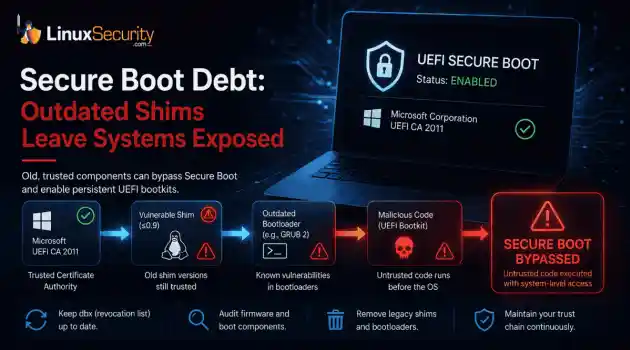
Security Vulnerabilities security advisory linux distribution
security advisory linux distribution ESET researchers identified 11 old and forgotten Linux UEFI shim bootloaders at versions 0.9 and below that can be used to bypass UEFI Secure Boot on any UEFI-based machine that trusts Microsoft’s Microsoft Corporation UEFI CA 2011 third-party certificate authority, regardless of the installed operating system (OS). Reported shims can be exploited to execute untrusted code during system boot, enabling attackers to deploy malicious UEFI bootkits even on systems with UEFI Secure Boot enabled.....
Jul 16, 2026
 Refine news
X Clear Filters
Get the latest News and Insights
Get the latest Linux and open source security news straight to your inbox.
Community Poll
Is continuous patching actually viable?
Loading...
Explore Latest Linux Security news
We found 109 articles for you...
210
 security advisorydenial of servicecritical
Linux: X.Org Critical Flaws Advisory CVE-2025-49176 to CVE-2025-49180
Let’s cut to the chase—if you’re running any system with X.Org X server or Xwayland versions prior to the latest patches , your setup may be dangerously exposed to vulnerabilities that stretch from data leaks to outright instability. These are not hypothetical problems or edge-case issues buried deep in some obscure configuration. We’re talking about flaws that impact core extensions many of you rely on every day, whether you’re maintaining workstations, servers, or production systems. . Several CVEs—five in total—have been identified, each tied to critical bugs introduced in various historical versions of X.Org and its components over the years. The scope of the affected systems is broad, covering decades of deployments, and while that may sound overwhelming, resolving these weaknesses boils down to understanding their nature, confirming you’re affected, and applying the appropriate fixes. Let’s dissect these vulnerabilities. CVE-2025-49176: Integer Overflow in Big Requests Extension The Big Requests extension—a feature present since X11R6.0—has been found to mishandle unusually large request sizes. Essentially, an attacker could craft a request that surpasses integer size limits during processing, bypassing safeguards intended to block them. This isn’t just sloppy error-handling; it opens the door to undefined behaviors that could affect system stability or be leveraged for further attacks. Imagine your guardrails on memory allocation disappearing mid-operation. That’s what happens here—the size validation slips up, and suddenly your server is operating outside the expected bounds. The fix? Patch to xorg-server-21.1.17 or xwayland-24.1.7, where this behavior has been corrected in commit 0885e0b2. CVE-2025-49177: Data Leak in XFIXES Extension The problem with XFixesSetClientDisconnectMode—the handler for a command used in the XFIXES extension—is how it mismatches request lengths. This flaw is subtle but dangerous; if a client sends a misaligned request,residual data from previous commands may be exposed. For workloads handling sensitive information or multi-user environments, this is a glaring issue. This vulnerability dates back to XWayland-22.0.99.1 (the release candidate for XWayland 22.1) and Xorg server 21.0.99.1, meaning systems built on these versions or older could be leaking data with every wrong-sized request. If confidentiality matters in your setup, patch immediately—look for commit ab02fb96 in the fixed versions. CVE-2025-49178: Unprocessed Client Requests Due to Leftover Bytes This one’s messy. The vulnerability stems from how shared buffers between clients are managed. Leftover bytes from one client request—bytes meant to be ignored—aren’t always purged correctly. Worse, these residual bytes could be consumed by an entirely different client’s request, causing hangs, glitches, and even denial-of-service scenarios. The root issue traces back to Xorg 1.10.0, but if you trace deployments across enterprise networks, you’ll probably find this older version still limping along on legacy setups. The fix in xorg-server-21.1.17 eliminates this cross-client interference ( commit d55c54ce ). If your systems rely on a mix of modern and legacy clients, this oversight is a ticking time bomb. CVE-2025-49179: Integer Overflow in X Record Extension The X Record Extension’s function RecordSanityCheckRegisterClients() has been exposed as vulnerable to yet another integer overflow. This mistake affects systems dating back to X11R6.1, allowing malicious actors to bypass request length checks. It’s a low-level vulnerability, yes, but handling malformed requests at this level can snowball into instability and exploits down the line. Patch to xorg-server-21.1.17 or xwayland-24.1.7, where fixes for this flaw have been committed ( see 2bde9ca4 ). CVE-2025-49180: Integer Overflow in RandR Extension The RandR extension was meant to better handle display properties, but in RRChangeProviderProperty(), there’s mishandling ofinteger overflow issues. These overflow errors could allow improper allocation of memory, risking anything from system instability to outright crashes. It first appeared in Xorg server 1.12.99.901, but its impact remains relevant for many active deployments. To mitigate, the bug has been patched in the latest versions of both Xorg-server and Xwayland. Notably, two separate commits— 3c3a4b76 and 0235121c —address this weakness. Which Systems Are At Risk? If you’re running anything predating xorg-server-21.1.17 or xwayland-24.1.7, you’re likely vulnerable to at least one (and possibly all) of these exploits. These flaws impact cornerstone X server functionality—extensions many of us assume are solidly built—and echo throughout organizations relying on aging deployments. Legacy systems, particularly those in heavily customized environments, are a high-risk category here. Considering the breadth of affected versions (some dating back decades), the responsibility falls on admins to evaluate their systems carefully. Whether you’ve rolled out custom distributions or are relying on once-stable deployments in critical infrastructure, these vulnerabilities demand immediate attention. What Can I Do to Mitigate Risk? If your systems are impacted by these flaws, there are several measures you can take to secure your data and mitigate risk: Apply the Fixes: First things first: upgrade your systems to xorg-server-21.1.17 and xwayland-24.1.7. This is non-negotiable. The patched releases address all five CVEs described above. Validate Your Changes: Take time to review the specific commits mentioned (e.g., 0885e0b2 , ab02fb96 ). Understanding what’s been fixed enables better long-term auditing for systems handling sensitive or mission-critical workloads. Monitor Vulnerability Reports: Follow the X.Org mailing list or GitLab repository. These platforms remain critical for staying plugged into emerging threats, particularly in open-source ecosystems where historicalflaws can lurk for years before discovery. Our Final Thoughts: Why This Matters for Security-Conscious Admins The open-source community’s strength lies in the transparency of its platforms, but transparency alone doesn’t guarantee security, especially when flaws trace their roots back decades. These vulnerabilities highlight the need for due diligence, especially in environments where legacy software plays a role. While upgrading and patching can feel like administrative tedium, ignoring these fixes risks systems that are unstable at best and actively exploitable at worst. Admins, take this as a wake-up call. For every fix deployed today, there’s a system out there still running the buggy version someone swore would “never need another update.” Let yours not be one of them! . Five critical CVEs in X.Org X Server and Xwayland require immediate upgrades to protect against severe data leaks.. X.Org security,Xwayland vulnerabilities,Linux patching,X server issues. . Brittany Day
 Jun 18, 2025
•
Jun 18, 2025
• Security Vulnerabilities
78
 security advisoryvulnerabilityRHEL
RHEL 10: Enhanced Security Features with Post-Quantum Crypto and AI Tools
Red Hat Enterprise Linux (RHEL) 10 isn’t just another update—it’s a serious step forward in the battle against security threats, both current and emerging. If you’ve been working in Linux for a while, you know the drill: new releases mean tweaks here and there, maybe a feature upgrade. But this? This is different. This version is gearing up for the future in ways that demand our attention, tackling issues like post-quantum cryptography and advanced container security head-on. It’s not just a response to today’s threats—it’s a preparation for tomorrow’s. . What makes RHEL 10 stand out is how it balances complexity with practicality. Security tools that once felt cumbersome are now streamlined into workflows and processes that make sense for active system admins. You’re not left wading through mysterious features; it’s clear what’s new and why it matters. From AI-powered management tools that adapt as you work to security enhancements designed to shield against quantum-level threats, everything is tuned to protect critical systems in the modern world. It doesn’t promise—it delivers. Let's take a closer look at the key updates and security improvements introduced in RHEL 10 and how they will help strengthen your security posture and optimize your workflows as an admin managing RHEL systems. Post-Quantum Cryptography Standards Protect Data & Ensure Compliance The advent of quantum computing poses significant challenges to traditional cryptographic methods. RHEL 10 introduces post-quantum cryptography standards recommended by the National Institute of Standards and Technology (NIST) to address this emerging threat. This approach incorporates quantum-resistant algorithms to safeguard against "harvest now, decrypt later" attacks. By integrating post-quantum signature schemes, RHEL 10 maintains the integrity and authenticity of software packages, systems, and TLS certificates. The impact of these measures is significant. By adopting these new standards, RHEL 10strengthens defenses against quantum-based decryption attacks on data that could have already been compromised. It also aligns with emerging regulatory requirements for advanced cryptographic standards, ensuring regulatory compliance for users. Red Hat Enterprise Linux Security Select Add-On Improves Vulnerability Management The Security Select Add-On is a significant addition to RHEL 10’s security arsenal. This feature allows admins to request fixes for up to 10 specific Common Vulnerabilities and Exposures (CVEs) per year. This ability to directly address critical vulnerabilities ensures administrators can target security fixes based on their unique environment needs. The impact is profound. Administrators can now manage vulnerabilities more flexibly and targeted, thus enhancing their system’s overall security posture. This add-on helps organizations prioritize and address more pressing security vulnerabilities efficiently. Enhanced Container Security RHEL 10 introduces a container-native approach to operating system image creation and management through its innovative image mode. This minimizes configuration drift by preventing unexpected patch deviations and maintaining operational consistency between application developers and IT ops teams. For administrators, this translates into stronger container security , improved standardization, and reduced security risks related to inconsistent configurations. Tighter control over container image integrity strengthens protection in hybrid and cloud-native environments. AI Integration to Boost Security Operations A notable feature in RHEL 10 is Lightspeed, an AI-powered Linux management tool. Built-in generative AI provides context-aware recommendations for troubleshooting and optimization, offering natural language assistance directly at the command line. The inclusion of Red Hat-specific expertise improves the management of complex environments. This integration is crucial in addressing Linux skills gaps and empoweringless experienced IT administrators with practical insights. It also improves workflow efficiency, resolving potential security issues and operational disruptions faster. Unified Management and Early Security Decisions RHEL 10 advances the concept of unified IT workflows through its container-native image mode, providing a single workflow for managing both the OS and applications. This approach helps administrators make key security-related decisions early in the lifecycle, with tools like the Red Hat Insights Image Builder offering tailored package recommendations that fit specific deployment needs. These features' proactive stance reduces the likelihood of misconfigurations leading to security vulnerabilities. Streamlining processes minimizes human error , improving overall system security. AI-Ready and Cloud-Native Security Features Recognizing the need for secure deployment of AI workloads, RHEL 10 introduces pre-tuned images optimized for major cloud platforms such as AWS, Google Cloud, and Azure. Additionally, it supports emerging architectures like RISC-V, providing developer previews for secure builds on these niche platforms. These pre-tested and validated solutions improve deployment security and scalability, particularly for AI workloads. Partner-validated hardware further supports this, increasing confidence in deploying RHEL 10 on advanced systems tailored for AI and other intensive computational tasks. How Do These Changes Impact My Security Posture & Administrative Workflows? Introducing these proactive features in RHEL 10 significantly boosts security resilience by reducing vulnerabilities associated with legacy and emerging technologies. Quantum-resilient cryptography integration ensures readiness for the next generation of cyber threats. Generative AI assistance simplifies administrative complexities and offers actionable insights, allowing security policies to be effectively implemented and monitored. Unified workflows for hybrid environments reduce frictionbetween security and operations teams, improving collaboration and compliance with security policies. Overall, RHEL 10 prepares administrators to handle evolving requirements with tools that align with regulatory compliance and advanced security best practices, whether the workloads are in the cloud, on-premises, or at the edge. Key Recommendations for Admins Adopting RHEL 10 RHEL 10's security enhancements offer great potential to its adopters. To take full advantage, adopters should prioritize early implementation of post-quantum cryptographic features to protect sensitive workloads against future threats and leverage AI tools like Lightspeed , which reduce troubleshooting. Unifying workflows using container-native image mode will minimize configuration drift, while exploring Security Select Add-On will help prioritize critical fixes. These strategies should help RHEL users maximize security when adopting RHEL 10. Our Final Thoughts on the Security Improvements Introduced in RHEL 10 RHEL 10 brings groundbreaking advancements in security, like post-quantum cryptography, AI-driven management tools, and container-native workflows. These features are designed to help admins strengthen their security posture while simplifying complex workflows. By embracing these new features, security-conscious admins can ensure their environments are robustly protected against evolving threats, maintain compliance with regulatory requirements, and significantly improve the efficiency of managing RHEL systems. This future-ready release is optimized for the challenges of hybrid cloud and AI-driven IT landscapes. It's not only prepared but proficient in tackling tomorrow’s security challenges today! . RHEL 10 boosts protection through sophisticated encryption methods, AI-powered functionalities, and improved container oversight for system administrators.. RHEL security enhancements, container security improvements, AI management Linux. . Brittany Day
May 21, 2025
•
Vendors/Products

210
security advisorycriticalvulnerabilityOracle Linux 2025: April Critical Security Update Advisory RHSA-2025:0011-1
If you're managing an Oracle Linux system, you're well aware that vigilance is essential for staying ahead of adversaries looking to exploit unpatched vulnerabilities. Thankfully, in its April 2025 Critical Patch Update (CPU), Oracle has fixed 48 vulnerabilities that, if left unaddressed, could leave our systems vulnerable to server infiltration, privilege escalation, and the exposure of sensitive network protocols, among other risks. . These vulnerabilities range in severity, including some with high CVSS scores that carry significant potential risks. From kernel-level bugs to third-party software flaws integrated into Oracle Linux, the update addresses complex attack vectors that require thoughtful and immediate mitigations. Let’s explore the implications of the bugs fixed in this update, the urgency of applying these patches, and how we can navigate the task efficiently to secure our systems against these dangerous flaws. Understanding the Scope of This Update Oracle's April update stands out from typical patch drops in that it assesses vulnerabilities across Oracle Linux's codebase and third-party dependencies. These areas are often overlooked but can be just as vulnerable to exploitation by attackers who use these weak points to infiltrate servers, escalate privileges, or execute code arbitrarily. Oracle has shown its dedication to staying ahead of potential threats by identifying and fixing 48 new issues. However, we admins still bear responsibility for acting swiftly and updating our systems to take advantage of these bug fixes. This CPU is essential due to its breadth. Some vulnerabilities patched this month affect core functionalities, representing potential threats to enterprise systems. These include kernel security flaws and exposed network protocols . We must prioritize applying these updates to maintain system integrity and close critical security gaps. Addressing Third-Party Integration Challenges Oracle Linux admins know the importance of monitoringvulnerabilities in third-party software, especially external libraries, and dependencies that integrate into the Oracle ecosystem. Many vulnerabilities identified through routine auditing processes may go undetected due to the inherent functionality and performance requirements of these integrated components, creating risks that may escape our notice. When reviewing third-party component fixes, we often encounter challenges, including assessing compatibility and testing the performance impact of patches. Admins should validate their deployments as part of proactive planning to mitigate friction and downtime during patch rollouts. Test environments are key tools in finding potential conflicts or disruptions during rollout. The Importance of Staying On Actively Supported Versions Oracle's April update highlights the importance of operating systems that remain under active support cycles. Unsupported Oracle Linux versions no longer receive security patches and updates, leaving critical vulnerabilities exposed to attackers. Organizations running legacy systems frequently cite compatibility or resource concerns as justification for postponing upgrades; however, these concerns pale in comparison to the risks posed by unsupported software. Admins should assess their environments proactively by identifying pathways to migrate workloads to supported versions of Oracle Linux. By doing this, we ensure that future patch updates apply seamlessly and remove potential blind spots in our security posture. Practical Tips for Applying the Patch Patching is more than just an IT task — it's part of an overall cybersecurity strategy and requires thoughtful preparation and consideration. Deploying an Oracle CPU often requires scheduling downtime windows for testing, identifying vulnerable assets, and then communicating with teams to ensure a smooth implementation. Administrators should review Oracle's release notes for this update to familiarize themselves with all identified vulnerabilities, theirseverity levels, and the components they affect. Complex or clustered environments often benefit from taking an incremental approach when patching systems. Begin by patching test environments first to assess system behavior and identify any compatibility issues, then roll out updates to critical production systems during their scheduled maintenance windows. Note that patches do not replace more extensive security measures. While CPUs help target specific vulnerabilities, administrators should prioritize defense-in-depth strategies, such as network segmentation, secure access controls, and regular audits, to maximize risk mitigation even when patches cannot be applied instantly. A well-rounded approach ensures that even in instances when patches cannot be deployed immediately, risks are minimized within your organization. LinuxSecurity has put together a helpful guide on how to update and upgrade your Linux distribution so you can benefit from the latest security fixes, such as these recent Oracle Linux patches. Examining The Road Ahead for Oracle Linux Security As we review and apply April's Critical Patch Update, we must keep the larger picture in mind when making decisions about system protection. Patching should never be considered a one-time event but an ongoing cycle of prevention. By staying alert when reviewing each CPU and system version and pairing fixes with deeper security strategies, we can ensure strong defenses against emerging threats. Oracle's April CPU highlights the complexity of modern Linux-based systems, including vulnerabilities, third-party integrations, unpatched systems, and the associated risks. We, admins tasked with safeguarding our organizations, must navigate these challenges while meeting operational demands. Applying patches isn't just fulfilling a checklist; it helps secure your environment against the latest risks to your systems and sensitive data! . Oracle Linux's April 2025 CPU addresses critical vulnerabilities, highlighting the importance ofswift patching for security integrity.. Oracle Linux April CPU, critical patch update, Linux vulnerabilities, patch management guidance. . Brittany Day
Apr 29, 2025
•
Security Vulnerabilities
210
security advisoryFedoracritical riskOpenSSH: Urgent Warning Regarding MitM and DoS Security Vulnerabilities
Qualys researchers have recently identified two significant vulnerabilities in OpenSSH that put Linux and FreeBSD systems at severe risk. These bugs enable man-in-the-middle (MitM) attacks and denial-of-service (DoS) attacks to compromise secure communications channels. . Now is the time to ensure your systems are bulletproof by understanding these vulnerabilities' implications, how they work, determining if your systems are vulnerable, and taking measures to secure infrastructures of all sizes - single servers or fleets! Here's everything you need to stay ahead of the game and address these vulnerabilities before adversaries can exploit them. Understanding these New OpenSSH Vulnerabilities Let's begin with a quick review of both vulnerabilities identified by Qualys. CVE-2025-26465 allows attackers to intercept and manipulate communications between OpenSSH clients and servers, potentially leading to attacks against either. By default, VerifyHostKeyDNS settings on FreeBSD systems were typically disabled permanently. However, from September 2013 until March 2023, they were temporarily enabled - creating an opportunity for attackers who can pose as legitimate servers while intercepting sensitive information like passwords and confidential files being transmitted back and forth between clients and servers. CVE-2025-26466 allows pre-authentication denial-of-service attacks by exploiting memory and CPU consumption asymmetry. An attacker could exploit this flaw to cause prolonged outages that impede administrators from performing maintenance on critical servers. This could lead to severe disruption where uptime and reliable access are crucial. Debian , Fedora, Gentoo, and Slackware have released important security advisory updates regarding available fixes for these flaws. Assessing Your Risk The first step in mitigating these risks is assessing your systems' vulnerability. Start by checking your OpenSSH version. You can quickly determine which version you’re runningwith the simple command ssh -V. This command will display your current OpenSSH version. If you’re not on version 9.9p2, updating as soon as possible is crucial. The patches released in this version address these recent vulnerabilities and safeguard your systems against potential exploitation. Next, review your SSH configuration files, typically located at /etc/ssh/ssh_config or /etc/ssh/sshd_config , to check the status of the VerifyHostKeyDNS option. You want to ensure this option is set to "no" unless you need it to be otherwise. Use the following command grep VerifyHostKeyDNS /etc/ssh/ssh_config to check this. If you see an output indicating that VerifyHostKeyDNS is set to "yes" or "ask", you should change it to "no" to mitigate the MitM vulnerability. Additionally, monitoring your system logs regularly can help you detect any unusual activity that might indicate an attempted or successful exploit of these vulnerabilities. Look closely at your logs for patterns or anomalies suggesting a compromised system. Enhancing Security Patching systems regularly is key in defending against OpenSSH bugs like these, but additional measures can help mitigate vulnerabilities and ensure robust system protection. One key principle in security is the principle of least privilege: ensure only users who need SSH access for their roles receive it! Having less access also decreases potential points of attack. Strong authentication methods are integral in offering optimal protection, including using key-based rather than password authentication (which tends to be less secure). Relying on SSH keys dramatically decreases the chance of unauthorized entry, while two-factor authentication (2FA) can add extra layers of defense against intrusions. Tools like Fail2Ban monitor log files to detect potential maliciousness, such as multiple failed login attempts. By automatically banning IPs associated with these attempted log-ins, an IDS like Fail2Ban can stop brute force attacks and any unauthorizedattempts at access. Regular updates and patch management are critical when using OpenSSH, mainly to ensure optimal functionality of its software, dependencies, and components. Staying current by patching every aspect of your system, including OpenSSH, reduces risks related to known vulnerabilities or exploitable flaws that could compromise its proper workings and ensures smooth operations. Network segmentation can further strengthen security. Limiting SSH access with appropriate firewall rules and using virtual private networks (VPNs) to connect sensitive servers create an even safer environment with additional encryption and authentication measures in place. Our Final Thoughts on Mitigating These Recent OpenSSH Bugs Recent vulnerabilities discovered in OpenSSH illustrate the necessity of staying vigilant to maintain secure systems. Beyond patching, strong authentication, minimal access privileges, intrusion detection, regular updates, network segmentation, and vigilant monitoring can protect your systems more effectively and guarantee their security while keeping operations running efficiently. Keep informed , remain protected, and prioritize security across every aspect of your system administration! . Address vulnerabilities from recent OpenSSH flaws impacting protected interactions; discover security upgrades today.. OpenSSH Issues, MitM Risks, DoS Strategies, Linux Protection, System Security. . Brittany Day
Feb 24, 2025
•
Security Vulnerabilities
210
security advisoryremote code executionvulnerabilityChrome 131: Urgent Advisory from CERT-In on Remote Exploit Risk
India's Computer Emergency Response Team (CERT-In) recently issued a high-risk advisory warning about Google Chrome vulnerabilities in versions prior to 131.0.6778.204 for Linux that could allow remote hackers to gain unauthorized access to impacted systems. As a Linux security admin, staying ahead of any threats that might compromise your systems is paramount. . These Chrome vulnerabilities present serious security threats, including remote code execution and potential data breaches that could allow unauthorized access and disruption. In this article, we'll examine critical details from this Chrome advisory, necessary mitigation steps, and the critical importance of staying updated for maximum protection. What Vulnerabilities Have Been Found in Google Chrome? A significant security vulnerability, CVE-2025-0291 , has been identified in Google Chrome, impacting users on multiple platforms, including Linux. This vulnerability arises from a type confusion issue within the V8 JavaScript engine, which could potentially allow malicious actors to execute arbitrary code on a victim’s system. Essentially, type confusion happens when the browser mistakenly accesses a resource using an incompatible type, leading to unexpected behaviors or even code execution. Mitre, a recognized authority in cybersecurity, explains that these types of vulnerabilities occur when there’s a mismatch in how data types are managed, leading to severe security flaws. In recognizing the severity of this issue, Google awarded $55,000 to Popax21 , the security researcher who brought this vulnerability to light. Thus, immediately updating Chrome to version 131 is crucial for protecting your systems against this threat. Understanding This CERT-In Chrome Advisory India's CERT-In acts as a national cybersecurity incident response agency. When they issue high-risk advisories, this signals immediate attention is warranted on threats they have identified. For example, their recent advisory regarding Google Chrome identifiedmultiple vulnerabilities that hackers could exploit to breach system integrity using the Chrome browser. They include: Type Confusion in V8. Out-of-bounds memory access in V8. Out-of-bounds write in V8 and Use after free in compositing. When Google Chrome, widely adopted due to its efficiency and cross-platform support, becomes a potential security risk, prompt action must be taken to mitigate exploits. An advisory is issued not simply as a call to update your browser but as a reminder to implement stronger cybersecurity practices to effectively defend against vulnerabilities like these. The Importance of Keeping Google Chrome Updated It is essential for all Chrome users to update Google Chrome to version 131.0.6778.264 right away to address the CVE-2025-0291 vulnerability. This update patches a critical security flaw that could otherwise be exploited to execute malicious code on your systems. To manually update Chrome, go to the Help section in your Chrome menu and select the About option. This will trigger an automatic security update. Don’t forget to restart your browser afterward to ensure the new security measures take effect. Given how serious this vulnerability is, it’s vital to handle the update process proactively instead of waiting for automatic updates. Taking immediate action reduces the risk of potential exploitation, which is why staying on top of security updates is a fundamental part of good cybersecurity practices. This step is not just a formality; it’s a necessary action to maintain the integrity and safety of your systems. Monitoring Security Advisories Staying up-to-date is key to effective cybersecurity management, and following advisories from CERT-In and other relevant bodies such as LinuxSecurity.com will keep you abreast of emerging threats and the best defenses against exploits. Such advisories provide invaluable insights into vulnerabilities' nature, impacts, and actions necessary for protection from exploitation. Security is anever-evolving field, with new vulnerabilities and threats emerging constantly, and staying current with advisories allows Linux admins to take proactive measures in securing their systems. Strengthening Browser Security Linux admins can take additional steps to strengthen browser security beyond simply updating the browser, such as adding security-focused extensions. Such extensions provide an added layer of protection by blocking malicious websites, tracking attempts, and protecting against phishing attempts - yet it's vitally important that they come from reliable sources, as malicious extensions could introduce additional vulnerabilities into your systems. Regular security audits and scans on systems running Chrome are other best practices that should be adhered to. Conducting security audits allows administrators to detect any potential vulnerabilities or misconfigurations that could be exploited. Such audits include checking for outdated software and available updates, verifying extensions installed via Chrome, and verifying browser security settings. By conducting regular security audits, Linux admins can identify potential threats early and address them effectively before they become significant threats. Educating Users A key cybersecurity strategy is cultivating a culture of awareness and responsiveness among users. Part of our role as Linux security admins should include informing our user base of the importance of browser updates and general security best practices. Training sessions and regular communications such as newsletters or emails can be practical training tools. Such efforts should focus on installing updates quickly, recognizing phishing attempts promptly, and reporting any suspicious activities to ensure an informed and engaged user base that helps strengthen the collective security posture of an organization. Implementing Layered Security Measures While updating Chrome and reviewing advisories are essential parts of comprehensive protection, developing abroader and multilayered strategy for comprehensive protection is equally as crucial. Layered security utilizes multiple defensive measures - like firewalls, IDS systems, and endpoint security solutions - to effectively guard systems and data against attacks. As well as technical measures, stringent access controls , and regular user permission reviews are essential steps toward mitigating the risk of unauthorized access. Ensuring users only have the minimum access necessary for performing their tasks helps eliminate potential attack vectors. Regular Backups and Incident Response Plans Even when all reasonable precautions have been taken to prevent security breaches, we must be prepared for any possible incidents that may arise. Regularly backing up critical data ensures that it can be restored without undue disruption in case of a breach. These backups should also be stored safely and periodically tested to verify their integrity and effectiveness. An incident response plan is of equal importance. A comprehensive incident response strategy allows Linux admins to respond swiftly and effectively in case of security breaches, including containment measures, communication protocols, and recovery procedures. Having such a plan, they can ensure a swift response that mitigates negative consequences. Future-Proofing Security Measures Cybersecurity is an evolving process that demands constant vigilance and adjustment. As new vulnerabilities emerge and attack methods advance, Linux administrators must remain proactive in adapting their security measures accordingly. Reevaluating security policies frequently, remaining informed of emerging threats, and taking advantage of advanced security technologies are all part of future-proofing defense strategies. Investment in ongoing training and development for security teams is paramount. By keeping abreast of new trends and technologies, Linux administrators can ensure that their security measures protect systems and data effectively. Our FinalThoughts on CERT-In's Recent Chrome Security Advisory CERT-In's high-risk advisory for Google Chrome users underscores the significance of practicing strong, proactive security strategies - such as keeping Google Chrome updated, keeping up-to-date on security alerts, and taking extra security precautions when managing risk. Linux admins can build a more assertive security posture within their organization by cultivating security awareness among users, conducting regular audits, and implementing robust incident response plans. Successful cybersecurity requires being aware, vigilant, informed, and ready for new challenges. By taking these proactive measures to protect against vulnerabilities, we can ensure a safer digital environment for ourselves and our users. . These Firefox exploits pose significant security risks, such as unauthorized system access and mandate prompt updates.. Google Chrome update, CERT-In advisory, browser security, remote code execution. . Brittany Day
Jan 08, 2025
•
Security Vulnerabilities
210
 security advisorycode executionarbitrary code execution
7-Zip 24.07 Update: Critical Security Flaw - Code Execution Threat
Compression utilities like 7-Zip have become essential tools for managing and storing data efficiently. Renowned for its high compression ratio and versatility, 7-Zip has earned millions of fans, from individual consumers to IT professionals around the globe. However, even trusted software can contain vulnerabilities. Recently, a security flaw was discovered within 7-Zip that may allow remote attackers to execute code through specially crafted archives containing malicious codes. . In this article, I'll examine this vulnerability and its impacts and guide you through updating to protect yourself by upgrading to the latest 7-Zip version to secure your systems. What Is 7-Zip? 7-Zip is an open-source file archiver widely recognized and utilized for its high compression ratio and support of various file formats such as ZIP, RAR, and ISO. Notably, its proprietary.7z format offers enhanced compression capabilities. 7-Zip has become indispensable to individuals worldwide, administrators, and software developers, who integrate it into various workflows and applications. Analyzing This Recent 7-Zip Vulnerability 7-Zip contains a critical security vulnerability, CVE-2024-11477 , that allows remote attackers to exploit Zstandard (Zstd) decompression implementation via specially crafted archives to execute arbitrary code remotely. The issue earned enough significance that CVSS gave it a score of 7.8, signaling its severity. At its core, 7-Zip's vulnerability lies in how it handles Zstandard decompression. More specifically, improper validation of user data may lead to an integer underflow before writing into memory - exploited by convincing users to open maliciously crafted archives. Attackers can exploit this weakness to execute arbitrary code within the context of their current processes. Vulnerable 7-Zip versions are susceptible to integer underflow when data provided to its decompression function isn't properly validated. This leads to an integer underflow and overwriting criticalmemory, allowing attackers to insert and execute code at will. Risk is compounded by exploiting this vulnerability, which requires relatively minimal technical knowledge. An attacker could easily create and distribute malicious archives via popular delivery like email attachments or file-sharing platforms. When someone interacts with someone using an exploited version of 7-Zip, the attacker could execute code with all access rights as the current user. Understanding the Impact of This Vulnerability CVE-2024-11477 can severely impact impacted systems, enabling attackers to run arbitrary code that could lead to further malicious activities. By exploiting this vulnerability, attackers could gain user access rights that allow them to operate with similar privileges as the currently logged-in user and access sensitive data or execute system commands. This includes accessing sensitive files and system commands in cases where an administrator-privileged user exists, resulting in complete system compromise. It affects all versions of 7-Zip before 24.07, so users running outdated versions are at risk. Steps should be taken immediately to secure systems by updating to the 24.07 version of 7-Zip for maximum system protection. Mitigation and Fixes Available to 7-Zip Users The 7-Zip development team has addressed this security flaw with version 24.07. As 7-Zip does not feature an automated update mechanism, users must download and install the latest version to stay protected. To update 7-Zip, download its latest version from its official website - version 24.07 or later is required - and follow its installation instructions to update your current installation. Finally, verify whether or not it has been installed by opening 7-Zip, checking its 'Help' menu, and verifying its version number. IT administrators and software developers should also monitor for suspicious activity within their networks and educate users about the risks of opening files from untrusted sources. Likewise, organizations shouldimplement policies limiting code execution from external sources to reduce potential vulnerabilities while conducting regular security audits on systems to identify and rectify vulnerabilities promptly. Security experts emphasize the significance of prompt patching as exploiting this vulnerability does not require complex technical knowledge. Though no known malware campaigns have targeted it yet, the risk remains significant, and mitigation measures should be prioritized. Both organizations and individuals should update systems regularly to stay protected against exploits that may impact their Linux environments. Our Final Thought on Addressing This Severe 7-Zip Flaw CVE-2024-11477 is an alarming reminder of the frequent vulnerabilities in widely used software such as 7-Zip. Improper validation within the Zstandard decompression algorithm underscores the vital need for rigorous testing and continuous monitoring for security flaws in software, making upgrading to version 24.07 of 7-Zip an absolute requirement to prevent potential arbitrary code execution attacks on systems. Users and organizations alike can lessen risks associated with cybersecurity vulnerabilities by following these steps and adopting a proactive approach to cyber safety. Keeping software updated, educating users on safe practices, and employing rigorous security measures combine to create a safer computing environment. Are you impacted by this flaw? Have you updated? Let us know on X @lnxsec ! . 7-Zip, a popular compression tool, has faced a serious vulnerability that could allow code execution, risking data breaches and system integrity. 7-Zip Vulnerabilities, Code Execution Risk, Software Updates, Cybersecurity Patches, Integer Underrun Exploit. . Brittany Day
Nov 25, 2024
•
Security Vulnerabilities
210
 security advisoryvulnerabilitycritical threat
Ubuntu 24.04 Postponed Release Due to XZ-Utils Critical Threat
The recent security issue with xz-utils has delayed the latest Ubuntu beta release and other major Linux distros. The delay follows the discovery of a critical vulnerability, CVE-2024-3094 , which has prompted developers to push back the release by a week to ensure the safety of the upcoming Ubuntu version, codenamed Noble Numbat. . The impact of this security concern is not limited to just one distribution. It affects a multitude of Linux distros and requires a significant response from their respective development teams to tackle the vulnerability effectively. How Has This Issue Impacted Linux Distro Releases? What Are the Repercussions of These Delays? A pseudonymous attacker introduced the vulnerability to XZ version 5.6.0 through 5.6.1. This underscores the extent of the vulnerability, indicating that it has remained unnoticed across successive versions. This revelation could undoubtedly impact system administrators and infosec professionals in understanding the depth and persistence of the security threat within their infrastructures. This vulnerability has delayed the upcoming official release of the Ubuntu 24.04 version. Initially scheduled for April 25, the final version launch might also face delays, as reflected by comments from a Mastodon survey where only a slim majority anticipated the release to be on time. This uncertainty could have broader implications for users and organizations relying on the timely deployment of the Ubuntu 24.04 release, prompting questions about contingency plans and the readiness of alternative security measures. Our Final Thoughts: What Are The Implications of Delays Due to This Flaw? In light of these issues and their potential long-term consequences, security practitioners and Linux administrators must urgently reevaluate their approach to vulnerability management. This includes proactive risk assessment regarding the immediate impact on the pending releases and the broader implications for ongoing system security. Furthermore, the emergenceof open-source vulnerability detection tools presents a glimmer of hope. These tools offer efficient surveillance and showcase the community's collaborative efforts to address these security issues promptly. . The newly discovered xz-utils flaw resulted in postponements for Ubuntu beta and various other distribution launches, underscoring essential security concerns.. xz-utils vulnerability, Ubuntu 24.04, Linux distro threats, system admin security. . Brittany Day
Apr 05, 2024
•
Security Vulnerabilities
78
 security advisoryvulnerabilitypatch management
CBL-Mariner Linux Security Advisory on Microsoft Patch Management
Microsoft's Security Update Guide, which chronicles Microsoft's patch releases each month, is getting two relatively new additions. . First off, the Security Update Guide will soon list common vulnerabilities and exposures (CVEs) for Microsoft''s CBL-Mariner Linux distribution, per a Friday announcement. CBL-Mariner is Microsoft''s Linux-based operating system that''s widely used with various Azure services. Specifically, CBL-Mariner is getting added to the "Security Update Guide (SUG) Common Vulnerability Reporting Framework." Publication will happen "beginning January 11, 2023." The coming CBL-Mariner vulnerability disclosures are expected to bulk up the amount of CVEs published by Microsoft, although the CVEs actually derive from various open source software projects. . The forthcoming update from Microsoft's Security Update Guide will elaborate on CBL-Mariner exposure findings, thereby improving the efficiency of patch management.. CBL-Mariner Linux, Microsoft Security Updates, Vulnerability Disclosure. . LinuxSecurity.com Team
Jan 15, 2023
•
Vendors/Products

Get the latest News and Insights
Get the latest Linux and open source security news straight to your inbox.
Community Poll
Is continuous patching actually viable?
Search Topics
Powered By

Linux Security - Your source for Top Linux News, Advisories, HOWTOs and Feature Releases
QUICK LINKS
subscribe to newsletters!
Like staying secure? So do we.
Sign up for updates, tips, and alerts!