Explore top 10 tips to secure your open-source projects now. Read More
×



Server Security data privacy automation
data privacy automation Every system admin has lived through the same Monday morning ritual. A queue of forty tickets, half of them password resets, permission errors, or disk space warnings that any experienced technician could resolve in under two minutes. The other half require actual judgment. For years, automation promised that software would eventually sort the two apart on its own. That promise is now being tested in production Linux environments. . Early results are reshaping how IT teams think about tier-1...
 Jul 17, 2026

Privacydata collection automation
data collection automation You're running a web scraping project to collect pricing data from e-commerce sites. You set up a pool of datacenter proxies, launch your scripts, and within minutes — banned . CAPTCHAs everywhere. Your data pipeline stops before it really begins. . It's a frustrating scenario that plays out daily in ad verification, market research, and multi-account management. The website doesn't know you're doing legitimate research or monitoring. It just sees traffic coming from IP ranges it recognizes as...
Jul 17, 2026

Security Trends security advisory social engineering
security advisory social engineering Business Email Compromise used to be a numbers game — mass-blasted emails, broken English, an obvious "URGENT WIRE TRANSFER" subject line. That era is over. Generative AI has turned BEC into a tailored, low-noise operation that mimics writing style, voice, and even video presence. This piece looks at what's actually changed under the hood, what defenders are testing in response, and why so many organizations are still structurally unprepared for it. . The Infrastructure Problem Nobody Wants to...
Jul 17, 2026

Security Trends cybersecurity Linux documentation
cybersecurity Linux documentation Linux operating systems have gained prominence due to their stability, adaptability, and excellent security options. In the case of developing documentation, designing cybersecurity dashboards, or educational material, visuals are of vital importance when it comes to making things clear. The use of icons allows one to understand the message regarding alerts, authorization, encryption, authentication, or the state of the system just by looking at the visual cue without having to read long...
Jul 17, 2026
Security Vulnerabilities security advisory linux distribution
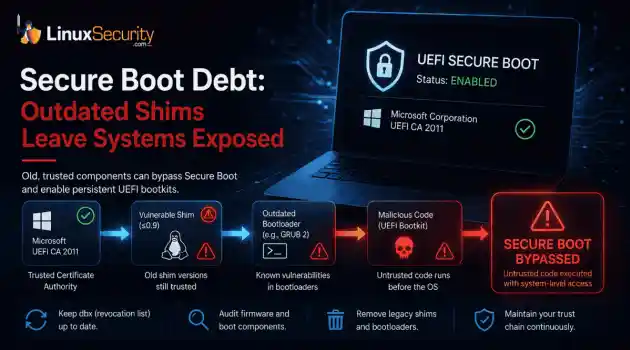
security advisory linux distribution ESET researchers identified 11 old and forgotten Linux UEFI shim bootloaders at versions 0.9 and below that can be used to bypass UEFI Secure Boot on any UEFI-based machine that trusts Microsoft’s Microsoft Corporation UEFI CA 2011 third-party certificate authority, regardless of the installed operating system (OS). Reported shims can be exploited to execute untrusted code during system boot, enabling attackers to deploy malicious UEFI bootkits even on systems with UEFI Secure Boot enabled.....
Jul 16, 2026
 Refine news
X Clear Filters
Get the latest News and Insights
Get the latest Linux and open source security news straight to your inbox.
Community Poll
Is continuous patching actually viable?
Loading...
Explore Latest Linux Security news
We found 89 articles for you...
210
 buffer overflowDoS attackweb application
Web Application Security: Understand Buffer Overflows and DoS Risks
In the current scenario, web applications are gaining momentum, and businesses and corporations are hosting several services. This increased utilization of web applications naturally raises the odds of having cybersecurity vulnerabilities. Grasping these Linux buffer overflow vulnerabilitie s is critical in your quest to protect sensitive information and maintain network integrity. . In this article, we’ll examine the basics of web application security vulnerabilities, their implications, and the strategies for mitigating associated risks. What are Web Application Security Vulnerabilities? Vulnerabilities in web applications refer to weaknesses in a system that a hacker would leverage to access unauthorized information, execute malicious code, install malware, or steal sensitive information. According to a report by CISA, about 85% of successful attacks employ known vulnerabilities. The vulnerabilities could be associated with defects in coding, poorly chosen configurations, or outdated software. Overcoming such network attacks is especially difficult for small businesses, corporations, and even end-users, who may struggle to simultaneously compete with several security attacks. Since security threats in wireless networks become a critical risk for every organization, an extended range of security knowledge becomes very important to prevent carelessness from becoming the root cause of application-layer vulnerabilities. A vulnerability scanner will typically scan your environment and compare the results with a vulnerability database or a list of known flaws. However, to properly understand the cyber threats and vulnerabilities you will likely be exposed to, it is crucial to begin with the basics. Buffer Overflow Vulnerability Basics One of the most famous classes of vulnerabilities is the buffer overflow. Knowing how to handle Linux buffer overflow vulnerabilities is critical to preventing buffer overflow attacks. An overflow occurs when a program writes more data to a bufferthan it is designed to hold or when a program attempts to put data beyond a buffer. This can corrupt the application and lead to the execution of malicious code that enables cybercriminals to gain unauthorized access to systems and networks. Buffer overflows have been well documented, yet they continue to cause misery for enterprises of all sizes. An attacker exploiting a web application's stack execution may be able to execute arbitrary code and take control of a machine. According to the OWASP Top Ten, buffer overflow vulnerability remains one of the more problematic concerns because it has a tremendous potential impact. Types of Buffer Overflow Vulnerabilities According to OWASP, there are two significant types of Linux buffer overflow vulnerabilities: Stack-Based Buffer Overflow: This includes an attacker sending malicious code to an application in the form of data, loading itself into a stack buffer. This operation overwrites other data on the stack and gives the attacker control. Heap-Based Buffer Overflow: This vulnerability generally attacks heap memory. It is based on flooding a program's memory space beyond its usage limits and overwriting the data in the heap to exploit certain programming peculiarities. Once this is performed, an attacker can adjust the software and thus gain unauthorized access. Denial of Service (DoS) Basics The other critical vulnerability within web applications is the DoS vulnerability, which stands for Denial of Service. The whole point of a DoS is to bring a machine or network down and thus render its services unavailable for legitimate users. An attacker generally sends vast amounts of traffic or a quantity of information that results in the crashing of the target; hence, legitimate users - employees or subscribers - cannot access the service. The FBI estimated that more than 70% of organizations have been victims of DoS at one time or another. Thankfully, DoS attacks can be remedied much faster than other attacks. Blocking or tracing DoSattacks is usually easier because a single device attacks a particular resource. Why Are These Basics So Essential? Understanding the basics of web application security vulnerabilities is essential, as these vulnerabilities form the foundation for attacks in network security—both well-known and obscure. Knowledge of these vulnerabilities equips you with an understanding of the threats you face. Understanding what web application security vulnerabilities exist, how they can be exploited through attacks, and the scenarios where an attacker would use the exploits organize your organization's preparation for whatever risks come its way. Best Practices for Vulnerability Management Best practices for securing your Linux environment against vulnerabilities and exploits include: Routine Vulnerability Scanning A vulnerability scanner will help you avoid security vulnerabilities in your apps. These scans automatically test your environment against a continuously updated database of known vulnerabilities, alerting and methodically allowing for mitigation before potential issues can be exploited. Several applications are well-regarded for performing routine vulnerability scanning on Linux systems, helping to ensure that potential security issues are identified and mitigated. OpenVAS (now called Greenbone Vulnerability Manager) is a comprehensive open-source tool for scanning and managing vulnerabilities, making it suitable for extensive security audits. Nessus, developed by Tenable, is another powerful and widely used vulnerability scanner that offers detailed reporting and high detection accuracy. Nikto is a straightforward yet effective web server scanner that hunts for known vulnerabilities, server configuration problems, and outdated software. Lynis is a robust security auditing tool for Unix-based systems focusing on hardening, compliance testing, and vulnerability detection. Lastly, ClamAV is a versatile open-source antivirus engine that can scan for various types ofvulnerabilities, including those related to email, files, and web content. Keep Software Up to Date Keep your software up to date. This means it will be kept secure, too. Most attacks happen via vulnerabilities known for some time, for which fixes have already been published. Keep your systems, libraries, and frameworks current to guard against vulnerabilities others know about. Several applications can help keep Linux software up to date, ensuring your system remains secure and efficient. Arch Linux and Manjaro Linux are popular due to their excellent package management systems, ensuring your servers always have access to the latest updates. For comprehensive patch management, tools highlighted by BleepingComputer include automated systems that seamlessly update your Linux operating system. APT (Advanced Package Tool) and Snap are are commonly used to manage updates on Ubuntu-based systems. Secure Coding Practices Developers should implement secure coding practices to avoid introducing vulnerabilities during development. This includes input validation, output sanitizing, and proper error handling to reduce and prevent buffer overflow and other vulnerabilities. For secure coding practices on Linux, several applications and resources stand out. The OWASP Secure Coding Practices Quick Reference Guide provides comprehensive guidelines for mitigating common software vulnerabilities and can be seamlessly integrated into the software development lifecycle. LinuxSecurity.com features articles and best practices for enhancing security in Linux web applications, focusing on defending against vulnerabilities like injection and cross-site scripting attacks. Another valuable resource is the OWASP Foundation , which provides extensive guidance on implementing a secure software development framework. Lastly, Snyk offers detailed insights into secure coding practices, making it easier for developers to write secure code from the ground up. Access Control Implementation Limit access tosensitive data and critical systems to prevent unauthorized access. Use role-based access to provide users with only the information and resources required to perform their roles. Security-Enhanced Linux (SELinux) and AppArmor provide mandatory access control (MAC) mechanisms to define what resources applications can access, enhancing system security. iptables is a powerful firewall tool that manages network traffic rules, which are crucial for controlling external and internal network access. TCP Wrappers offer host-based access control to monitor and filter incoming network requests, adding a layer of security to network services. PAM (Pluggable Authentication Modules) enables flexible authentication methods for programs, facilitating secure access control policies across different services. Regular Security Training Education in cybersecurity best practices is essential to reducing vulnerability risks. Regular training should be provided to update employees on new threats and prevention measures. For regular security training on Linux, Coursera offers comprehensive courses covering basic to advanced security concepts. Wiz provides essential best practices, including training on VPN solutions like OpenVPN and WireGuard for securing Linux systems. LinuxSecurity.com offers expert-recommended security practices for kernel hardening and filesystem protection. Coursera also has a course specifically for security experts, focusing on utilities, containers, networks, and firewalls. LinuxLinks provides a broad list of security applications and resources, assisting in training on various security tools and best practices. Our Final Thoughts on the Importance of Vulnerability Fundamentals The need for web applications to support business operations continues to grow. With this growth, knowledge of cybersecurity vulnerabilities becomes increasingly valuable. Securing your network from potential attacks by understanding some of the vulnerabilities that threaten Linux systems is essential to youand your organization. Learning the basics of different types of vulnerabilities, such as buffer overflows and DoS attacks, can prepare your organization to proactively fight these types of threats. . Understanding web application security is vital. Focus on buffer overflows and DoS attacks by validating inputs and using rate limiting to enhance safety. Web Application Security, Cybersecurity Basics, Buffer Overflow Threats, Vulnerability Management. . Brittany Day
 Oct 02, 2024
•
Oct 02, 2024
• Security Vulnerabilities
83
 security advisoryXSSweb application
PHPNuke Security Advisory: XSS And Path Disclosure Issues Report
PHPNuke seems to have a horrible security track record, but continues to be quite popular. No statement from the PHPNuke folks yet, but if you're using a rapid site development tool, don't forget to consider the security implications. "Cross site . . . . PHPNuke seems to have a horrible security track record, but continues to be quite popular. No statement from the PHPNuke folks yet, but if you're using a rapid site development tool, don't forget to consider the security implications. "Cross site scripting is a serious problem, (even if some people doesn't believe it), On this second round i'll show 8 new XSS vulnerabilities in PHP Nuke (most of them are also path disclosure vulns):" Date: 23 Apr 2002 09:50:48 +0200 From: "Replugge [ROD]" To:
Jul 26, 2023
•
Hacks/Cracks

210
 security advisorysecurity issuecritical
Zend Framework RCE Advisory for PHP Applications: Critical Security Patch
A high-risk RCE bug impacting PHP-based websites running a vulnerable version of the web-app creation tool Zend Framework and some Laminas Project releases has been discovered and disputed by Zend. Regardless of the dispute, Zend has issued a patch addressing this vulnerability which "provides type checking of the $streamName property before performing a cleanup operation (which results in an unlink() operation, which, previously, could have resulted in an implied call to an an object’s __toString() method) in the Laminas\Http\Response\Stream destructor". . Versions of the popular developer tool Zend Framework and its successor Laminas Project can be abused by an attacker to execute remote code on PHP-based websites, if they are running web-based applications that are vulnerable to attack. However, those that maintain Zend Framework emphasize that the conditions under which a web app can be abused first require the application author to write code that is “inherently insecure.” For that reason, the current maintainers of Zend Framework are contesting whether or not the vulnerability classification is correct. “We are contesting the vulnerability, and consider our patch a security tightening patch, and not a vulnerability patch,” said Matthew Weier O’Phinney, Zend product owner and principal engineer in an email-based interview with Threatpost. The link for this article located at ThreatPost is no longer available. . Critical vulnerability detected in Zend Framework and Laminas Project, demanding urgent updates to protect PHP applications.. remote Code Execution,Zend Framework,Laminas Project,PHP Security,Web Application Threat. . Brittany Day
Jan 06, 2021
•
Security Vulnerabilities
81
web applicationdata breachprivacy issueSingapore Airlines Account Incident Reveals Unintended Data Exposure
A Singapore Airlines (SIA) customer has reported an incident in which she was able to view someone else's personal data after successfully logging into the carrier's frequent flyer programme using her user ID and password. . The Krisflyer member logged into the carrier's website on Friday and noticed the site was laggier than usual. She opened a second page when the first appeared to have stalled and when both pages loaded up, she saw another user's personal details on one while the other contained a combination of that user's data and hers. The link for this article located at ZDNet is no longer available. . A data leak happened as a Qatar Airways passenger stumbled upon a different traveler's details during their attempt to access Privilege Club.. Singapore Airlines Incident, Data Exposure, Privacy Breach. . LinuxSecurity.com Team
Jan 05, 2019
•
Privacy
83
web applicationattack frequencycybersecurity statisticsDaily Attack Statistics: 50 Daily Attacks Target Websites and Apps
No matter how large or small, websites and web applications are under a constant barrage of attacks. Two new studies out today put a finer point on the numbers, showing just how frequently attacks hit the average website and how this constant pressure is yielding a huge number of compromised websites and web apps.. According to the Sitelock Website Security Insider Q1 2018 report, the average website today is attacked 50 times per day, with the vast majority of attacks coming through automated means. The study shows that 88% of traffic filtered by firewalls is from bad bots seeking to compromise sites. The link for this article located at DarkReading is no longer available. . According to the Sitelock Website Security Insider Q1 2018 report, the average website today is atta. matter, large, small, websites, applications, under, constant, barrage, attacks. . LinuxSecurity.com Team
Jun 20, 2018
•
Hacks/Cracks
72
security advisoryweb applicationSQL injectionDrupal 7.x Advisory Critical: SQL Injection and Firewall Bypass Risks
Late last year, CSO Online reported on a vulnerability in Drupal that could have left thousands of websites compromised. Last week, researchers examined the attack in more detail, measuring the time it would take to compromise a website completely.. On October 15, 2014, Drupal urged users to apply an update that fixed an SQL Injection vulnerability. Unfortunately, unless the patch was applied within a seven hour window, Drupal warned administrators that they should just assume installations in the Drupal 7.x branch before version 7.32 were already compromised. The link for this article located at CSO Online is no longer available. . On November 25, 2015, WordPress recommended that users implement a patch addressing a Cross-Site Scripting vulnerability.. Drupal Security, SQL Injection Threats, Web Application Security. . Alex
Mar 24, 2015
•
Firewalls
78
XSSweb applicationvulnerability assessmentFiring Range Tool: Test Web App Security Scanners Effectively
Google today released to open source tool called Firing Range, which is designed as a test bed for Web application security scanners that provides coverage for a wide variety of cross-site scripting (XSS) and other vulnerabilities on a massive scale. - See more at: . According to Google security engineer Claudio Criscione, 70 percent of the bugs in Google The link for this article located at ThreatPost is no longer available. . Microsoft unveils Code Lab, a community-driven platform designed for validating security tools against CSRF and additional exploit categories.. Web Application Security, Open Source Testing, XSS Testing, Vulnerability Assessment. . LinuxSecurity.com Team
Nov 21, 2014
•
Vendors/Products
83
security advisorySQL InjectioncriticalDrupal Critical Advisory: Assume Compromise for SQL Injection Threat
If your organization uses Drupal, you might have a serious problem on your hands. On October 15, Drupal urged users to apply an update that fixed a SQL Injection flaw. However, unless that patch was installed within seven hours, Drupal now says it's best to assume the website was completely compromised. . The SQL Injection vulnerability exists in an API used by Drupal, which is supposed to prevent SQL Injection. It was re-discovered by German security firm SektionEins in September, after a Drupal user hired them to check for vulnerabilities. The link for this article located at CSO Online is no longer available. . The SQL Injection vulnerability exists in an API used by Drupal, which is supposed to prevent SQL In. organization, drupal, might, serious, problem, hands, october. . LinuxSecurity.com Team
Oct 30, 2014
•
Hacks/Cracks

Get the latest News and Insights
Get the latest Linux and open source security news straight to your inbox.
Community Poll
Is continuous patching actually viable?
Search Topics
Powered By

Linux Security - Your source for Top Linux News, Advisories, HOWTOs and Feature Releases
QUICK LINKS
subscribe to newsletters!
Like staying secure? So do we.
Sign up for updates, tips, and alerts!