Explore top 10 tips to secure your open-source projects now. Read More
×



Server Security data privacy automation
data privacy automation Every system admin has lived through the same Monday morning ritual. A queue of forty tickets, half of them password resets, permission errors, or disk space warnings that any experienced technician could resolve in under two minutes. The other half require actual judgment. For years, automation promised that software would eventually sort the two apart on its own. That promise is now being tested in production Linux environments. . Early results are reshaping how IT teams think about tier-1...
 Jul 17, 2026

Privacydata collection automation
data collection automation You're running a web scraping project to collect pricing data from e-commerce sites. You set up a pool of datacenter proxies, launch your scripts, and within minutes — banned . CAPTCHAs everywhere. Your data pipeline stops before it really begins. . It's a frustrating scenario that plays out daily in ad verification, market research, and multi-account management. The website doesn't know you're doing legitimate research or monitoring. It just sees traffic coming from IP ranges it recognizes as...
Jul 17, 2026

Security Trends security advisory social engineering
security advisory social engineering Business Email Compromise used to be a numbers game — mass-blasted emails, broken English, an obvious "URGENT WIRE TRANSFER" subject line. That era is over. Generative AI has turned BEC into a tailored, low-noise operation that mimics writing style, voice, and even video presence. This piece looks at what's actually changed under the hood, what defenders are testing in response, and why so many organizations are still structurally unprepared for it. . The Infrastructure Problem Nobody Wants to...
Jul 17, 2026

Security Trends cybersecurity Linux documentation
cybersecurity Linux documentation Linux operating systems have gained prominence due to their stability, adaptability, and excellent security options. In the case of developing documentation, designing cybersecurity dashboards, or educational material, visuals are of vital importance when it comes to making things clear. The use of icons allows one to understand the message regarding alerts, authorization, encryption, authentication, or the state of the system just by looking at the visual cue without having to read long...
Jul 17, 2026
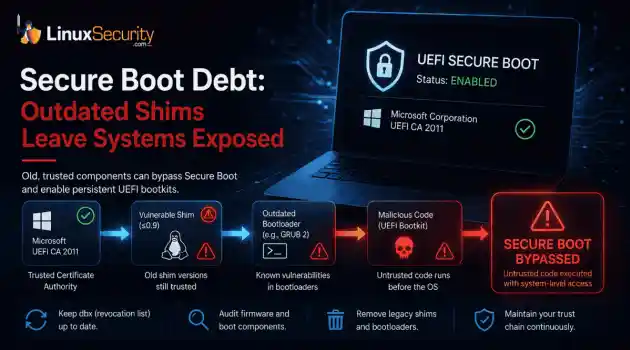
Security Vulnerabilities security advisory linux distribution
security advisory linux distribution ESET researchers identified 11 old and forgotten Linux UEFI shim bootloaders at versions 0.9 and below that can be used to bypass UEFI Secure Boot on any UEFI-based machine that trusts Microsoft’s Microsoft Corporation UEFI CA 2011 third-party certificate authority, regardless of the installed operating system (OS). Reported shims can be exploited to execute untrusted code during system boot, enabling attackers to deploy malicious UEFI bootkits even on systems with UEFI Secure Boot enabled.....
Jul 16, 2026
 Refine news
X Clear Filters
Get the latest News and Insights
Get the latest Linux and open source security news straight to your inbox.
Community Poll
Is continuous patching actually viable?
Trending News
Loading...
Explore Latest Linux Security news
We found 14 articles for you...
77
 security advisoryremote accessimportant
Windows XP Important UPnP Remote Access Security Risk 2001-0011
The latest Microsoft bug is a doozy. Why do these things keep cropping up? The federal government and technology industry want you to believe the threats to our networks are external, not internal, where someone must be held accountable when things go wrong. Thus, we hear the rhetoric about cyberterrorists, hackers, and the so-called 'Digital Pearl Harbor' - things you can't easily point fingers at and hold someone accountable for when bad things happen.. . . . The latest Microsoft bug is a doozy. Why do these things keep cropping up? The federal government and technology industry want you to believe the threats to our networks are external, not internal, where someone must be held accountable when things go wrong. Thus, we hear the rhetoric about cyberterrorists, hackers, and the so-called 'Digital Pearl Harbor' - things you can't easily point fingers at and hold someone accountable for when bad things happen. Richard Forno 20 December 2001: Essay #2001-15
 Apr 06, 2024
•
Apr 06, 2024
• Server Security
78
updatemicrosoftkernelWSL 0.50.2.0: Microsoft Updates Kernel And Introduces New Icon
Microsoft has released the latest preview version of Windows Subsystem for Linux, bringing with it a lengthy changelog, an updated kernel and a new icon. . With the launch of Windows Subsystem for Linux Pre-release 0.50.2.0, Microsoft has introduced a new icon (featuring, of course, a penguin), but there's far more to this release than just this visual update. The latest version fixes various WSL issues, updates the Linux kernel, and includes numerous other changes and additions. Continuing its embrace of Linux, Microsoft has used the latest version of WSL to make numerous changes to this increasingly invaluable tool. Key changes with this release include updating the tar used for importing and exporting WSL2 distributions, as well as adding new strings and parameters, while updating existing ones. . The newest version of WSL Pre-release 0.50.2.0 from Microsoft showcases a revamped logo along with significant kernel enhancements, boosting efficiency and user experience.. Windows Subsystem For Linux, WSL Update, Microsoft Linux Tool. . LinuxSecurity.com Team
Nov 17, 2021
•
Vendors/Products

78
 ubuntuwindowsuser experience
Linux Mint 20 Versus Ubuntu And Windows: An Admin's Insights
Wondering how Linux Mint compares to Ubuntu and Windows? Get an experienced admin's perspective in this article. . As a long term user of Microsoft Windows, Fedora, Ubuntu and Linux Mint, I have seen some of the more intricate tantrums a Windows or Linux operating system can throw. My first Mint 20 installation was in early April 2020, even before Mint 20 was released. I have had the unique opportunity to compare it with Microsoft Windows and Ubuntu 20 for day-to-day work and use, and have made some interesting discoveries. Read on to find out. . Explore Linux Mint 20, Ubuntu, and Windows through the insights of a seasoned administrator, highlighting their unique features, usability, and user needs. Linux Mint, Ubuntu Comparison, Admin Perspectives, Windows Insights. . LinuxSecurity.com Team
Mar 16, 2021
•
Vendors/Products
210
 remote accessmalicious codelinux
Three Malicious Npm Packages Open Shells On Linux And Windows Systems
Three malicious npm JavaScript packages have been found opening shells on Linux and Windows systems. According to npm staff: "Any computer that has this package installed or running should be considered fully compromised." . Three JavaScript packages have been removed from the npm portal on Thursday for containing malicious code. According to advisories from the npm security team, the three JavaScript libraries opened shells on the computers of developers who imported the packages into their projects. The shells, a technical term used by cyber-security researchers, allowed threat actors to connect remotely to the infected computer and execute malicious operations. The npm security team said the shells could work on both Windows and *nix operating systems, such as Linux, FreeBSD, OpenBSD, and others. . On Thursday, a trio of JavaScript packages was taken down from the npm repository due to the discovery of harmful shell access vulnerabilities.. Malicious Npm Packages, JavaScript Security Risks, Shell Exploits, Remote Access Threats. . Brittany Day
Oct 19, 2020
•
Security Vulnerabilities
78
security enhancementcyber defensewindowsMorphisec Enhances Windows Security with Unhackable Initiative
Due to its vulnerability to hacks and exploits, many of the Windows and Linux users describe Windows as a very unsafe operating system. However, one Israeli security organization is claiming to work towards to change the impression of Microsoft. The Isreali security organization, Morphisec is presently working on making a Windows version that The link for this article located at TechWorm is no longer available. . Cybersecurity company Morphisec from Israel is working on a flawless Windows system to bolster defenses against vulnerabilities and cyberattacks.. Windows Security, Cyber Defense, Morphisec Solution, Exploit Protection. . LinuxSecurity.com Team
Sep 07, 2015
•
Vendors/Products
74
security advisorycriticalexploitWindows Critical Patch: Immediate Action Required For Exploit Risk
Listen up, this one is serious. There is a critical vulnerability in many versions of Windows, which could be exploited to spread a worm automatically between vulnerable computers.. Microsoft has issued a patch, urging owners of vulnerable PCs to fix their computers as a matter of urgency. The link for this article located at Sophos is no longer available. . An urgent security flaw in macOS has surfaced across multiple iterations, leading Apple to release immediate updates. Take action now!. Windows Exploit Patch, Microsoft Security Risk, Critical Patch Urgency. . Anthony Pell
Mar 14, 2012
•
Network Security
83
malwarecyber threatwindowsTDL-4 Botnet: Persistent Cyber Threat to Millions of Windows PCs
A new and improved botnet that has infected 4.5 million Windows PCs is "practically indestructible," security researchers say.. TDL-4, the name for both the bot Trojan that infects machines and the ensuing collection of compromised computers, is "the most sophisticated threat today," reported Kaspersky Labs researcher Sergey Golovanov late last month. "[TDL-4] is practically indestructible," Golovanov said. The link for this article located at Network World is no longer available. . TDL-4, an advanced botnet, significantly threatens millions of Windows PCs with its remarkable resilience and persistence.. TDL-4 Botnet, Windows Malware, Botnet Security, Cyber Threats, Malware Analysis. . LinuxSecurity.com Team
Jul 18, 2011
•
Hacks/Cracks
82
security advisorysystem upgradewindowsNSA Advisory: Upgrade to Windows 7 or Vista for Enhanced Protection
Top US spooks are advising businesses to upgrade to Vista or Windows 7, claiming that other operating systems do not cut the mustard when it comes to security.. According to a best practices sheet which the National Security Agency sends out, both Windows 7 and Vista provide substantial security enhancements over earlier Windows workstation operating systems such as XP. Many of these security features are enabled by default and help prevent common attack vectors, it says. In addition, implementing the 64-bit mode of the OS on a 64-bit hardware platform substantially increases the effort of an adversary to attain a system or root compromise. For any Windows-based OS, verify that Windows Update is configured to provide updates automatically, the leaflet claims. The link for this article located at TechEye is no longer available. . The NSA recommends transitioning to Windows 7 or Vista to boost security, featuring robust defenses, timely updates, enhanced encryption, and better access controls. NSA Advisory, Windows Security, Business Best Practices. . Dave Wreski
May 02, 2011
•
Government

Get the latest News and Insights
Get the latest Linux and open source security news straight to your inbox.
Community Poll
Is continuous patching actually viable?
Trending News
Search Topics
Powered By

Linux Security - Your source for Top Linux News, Advisories, HOWTOs and Feature Releases
QUICK LINKS
subscribe to newsletters!
Like staying secure? So do we.
Sign up for updates, tips, and alerts!