Audit Linux privileges now to limit compromise, escalation, and system-wide damage. Review Linux Privileges×


How AI Is Shrinking Linux's Security Patch Window
 Jul 27, 2026
•
Jul 27, 2026
•
 MaK Ulac
4 - 7 min read

Topics Covered
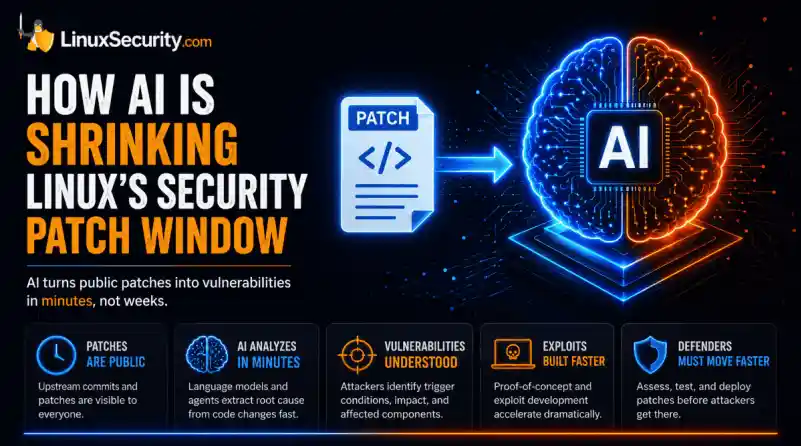
For decades, Linux defenders relied on a comfortable assumption: a public security patch did not imply an imminent vulnerability. While open-source openness made vulnerability fixes public to everyone on kernel.org or the Linux Kernel Mailing List (LKML), converting a raw commit into a weaponized exploit took a significant amount of manual effort. This delay, estimated in weeks or months, gave businesses enough time to assess exposure, organize testing windows, and push changes across production estates. Recent research suggests that this safety buffer is evaporating.
Rather than inventing new attack techniques, recent research suggests artificial intelligence is dramatically accelerating one attackers have relied on for decades: patch diffing. As language models and agentic systems automate the transition from a public fix to root-cause understanding, the operational rules of Linux patch management are rewriting themselves.
Linux Security Has Always Relied on a Hidden Time Advantage
Open-source development is built on radical visibility. From Git commits and stable branches to public CVE publications and vendor advisories, the mechanics of how Linux fixes bugs are laid bare for anyone to inspect.
Historically, this transparency acted as a double-edged sword. While it enabled peer review and rapid community hardening, it also allowed attackers to perform patch diffing—comparing the vulnerable code before a commit with the secured code after it—to reverse-engineer what went wrong.
The delay between a patch becoming public and a vulnerability becoming widely understood has never been guaranteed, but in practice, it often provided defenders valuable time. Organizations could evaluate advisories, test updates, and begin deployment before detailed exploit techniques became broadly available.
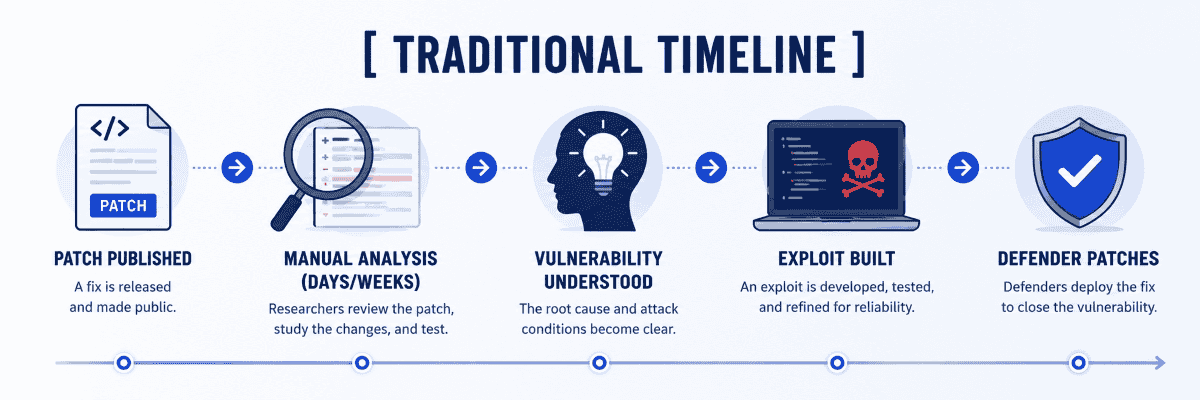
However, manual analysis created a natural friction. Reading a cryptic kernel diff, tracing execution paths across complex subsystems, and building a working proof-of-concept (PoC) required scarce, highly specialized human talent.
- Administrator Takeaway: Publishing a patch no longer means attackers need weeks of manual reverse-engineering to understand your exposure.
- Security Team Takeaway: Public code repositories and commit logs are now the earliest indicators of attacker interest, often preceding formal vendor advisories.
- CIO Takeaway: Patch velocity is no longer a routine maintenance metric; it is your primary defense against automated reconnaissance.
The underlying technique of patch diffing isn't new. What has changed is the velocity. AI compresses what used to take human analysts days or weeks of manual excavation into minutes.
AI Is Automating the Most Time-Consuming Part of Vulnerability Research
The true bottleneck in vulnerability research has never been writing an exploit—it is understanding the root cause.
Traditionally, the lifecycle looked linear and grueling: a patch drops, an analyst manually reverses the binary or source, maps out the execution path, identifies the logical flaw, builds a primitive PoC, and validates the exploit environment.
Recent research suggests AI-assisted systems can automate much of the early analysis that traditionally consumed the most researcher time, specifically across:
- Vulnerability analysis
- Reverse engineering
- Root-cause analysis
Recent research into AI-assisted patch analysis frameworks demonstrates that modern language models can ingest a public fixing commit and systematically reconstruct vulnerability parameters directly from the code changes. Independent industry analysis from firms like similarly confirms that LLM-powered patch diffing drastically reduces the cognitive effort required to turn a security advisory into actionable intelligence.
Make no mistake: these systems still require validation and human context. This is not cinematic autonomous hacking; it is ruthless operational acceleration.
Linux Kernel Research Shows AI Can Already Reproduce Real Vulnerabilities
Moving from user-space scripts to the Linux kernel represents the ultimate test of automated security analysis due to low-level memory layouts, architecture quirks, and massive subsystem complexity. Yet, empirical studies show that significant progress has been made.
Recent research suggests AI agents are now capable of completing portions of Linux kernel vulnerability reproduction that previously required experienced researchers. The K-Repro research project evaluated agentic AI systems against 100 real-world, exploitable Linux kernel vulnerabilities drawn directly from KernelCTF. Starting from public Linux kernel security patches and equipped with code-browsing, debugging, and virtual machine tooling, the AI agents ingested raw kernel security patches and autonomously navigated source trees, booted kernels, and generated functional PoCs in over half of the test cases.
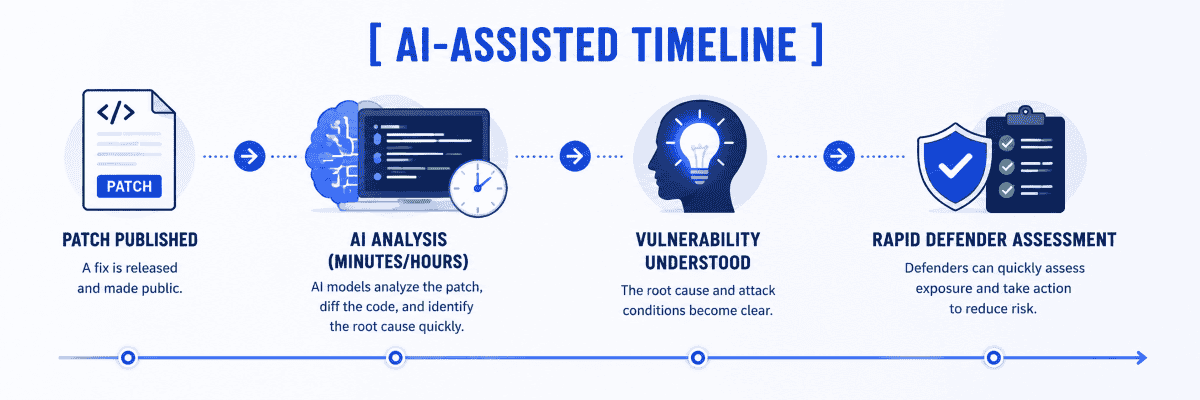
The takeaway from K-Repro isn't just a success metric; it is a profound shift in capability. AI systems are demonstrating the ability to analyze kernel behavior, navigate source trees, and generate working proof-of-concept candidates from public security patches.
Why This Changes Linux Patch Management
When vulnerability understanding drops from weeks to minutes, traditional IT maintenance schedules break down. Organizations relying on quarterly or even routine monthly patching cadences are increasingly exposed during the gap between public commit visibility and deployment.
|
Yesterday |
Today |
|
Patch analysis takes days or weeks of scarce human effort. |
AI performs initial code analysis and diffing within minutes. |
|
Vendor advisories dictate vulnerability prioritization. |
Upstream code commits and public diffs deserve immediate threat assessment. |
|
Reverse engineering is an expensive barrier to entry. |
AI lowers the technical barrier for threat actors analyzing N-day flaws. |
|
Patch windows are forgiving and wide. |
Patch windows shrink dynamically as automated tooling scales. |
Actionable Recommendations
- For Linux Administrators: Stop treating all updates as background maintenance. Track upstream kernel commits closely, subscribe to upstream security mailing lists instead of relying solely on downstream vendor advisories, maintain automated kernel testing pipelines, and ruthlessly prioritize your patch backlog for internet-facing systems.
- For Security Teams: Monitor exploit discussions, GitHub activity, and PoC repositories immediately following patch drops. Shift threat intelligence collection upstream toward developer commit streams.
- For CIOs and Leadership: Measure vulnerability response by patch latency—how fast your organization moves from commit to verification—rather than simple compliance checkboxes. Invest in test automation to compress deployment timelines.
AI Is Also Helping Defenders Understand Linux Patches Faster
Fortunately, the underlying technology is dual-use. The same capability that allows attackers to dissect patches faster enables defenders to scope their actual risk with unprecedented precision.
Research into automated tools demonstrates that static patch analysis can evaluate thousands of Linux kernel, FFmpeg, and PHP patches to automatically compute precise vulnerability impact conditions. Instead of panicking over a generic high-severity CVE, defenders can use AI-driven analysis to instantly determine whether their specific kernel configuration or compile-time options leave them exposed—preventing wasted emergency patching cycles on unaffected systems.
Similarly, academic frameworks highlight how automated agent analysis helps security teams validate whether software mitigations hold up against multi-stage exploits. AI is becoming a core engine for both sides of the digital fence—driving offensive speed while providing defenders automated triage and remediation validation.
Why Public Linux Development Is Still the Right Model
Given that automated tooling can parse and analyze patches faster than ever before, a natural question arises: should the open-source community rethink its radical transparency? Does public code visibility now present an unacceptable security liability?
The short answer is no. The transparency of Linux development remains open-source software's greatest security asset.
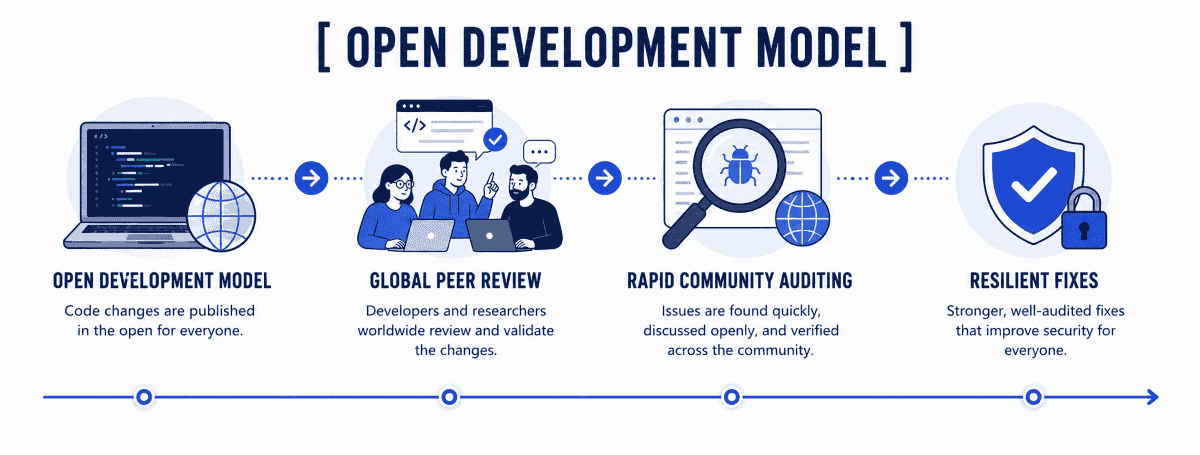
Security through obscurity has never worked for complex operating systems. Public collaboration ensures that:
- Vulnerabilities are exposed to thousands of global eyes rather than hidden in silos.
- Fixes undergo rigorous, multi-party peer review before reaching stable branches.
- Community auditing catches logic errors that internal teams routinely miss.
The security challenge is not that code is public; it is that defenders have historically relied on the slowness of manual analysis as a substitute for rapid response infrastructure. Open development accelerates the discovery and fixing of bugs. The emergence of AI-assisted patch analysis simply means that defenders must match that velocity in their operational deployment practices.
Preparing for a Future Where Patch Analysis Is Nearly Instant
Linux security has long depended on a practical delay between a patch becoming public and attackers fully understanding the vulnerability it fixed. The research suggests that AI is reducing that delay by accelerating patch analysis, vulnerability reproduction, and exploit research.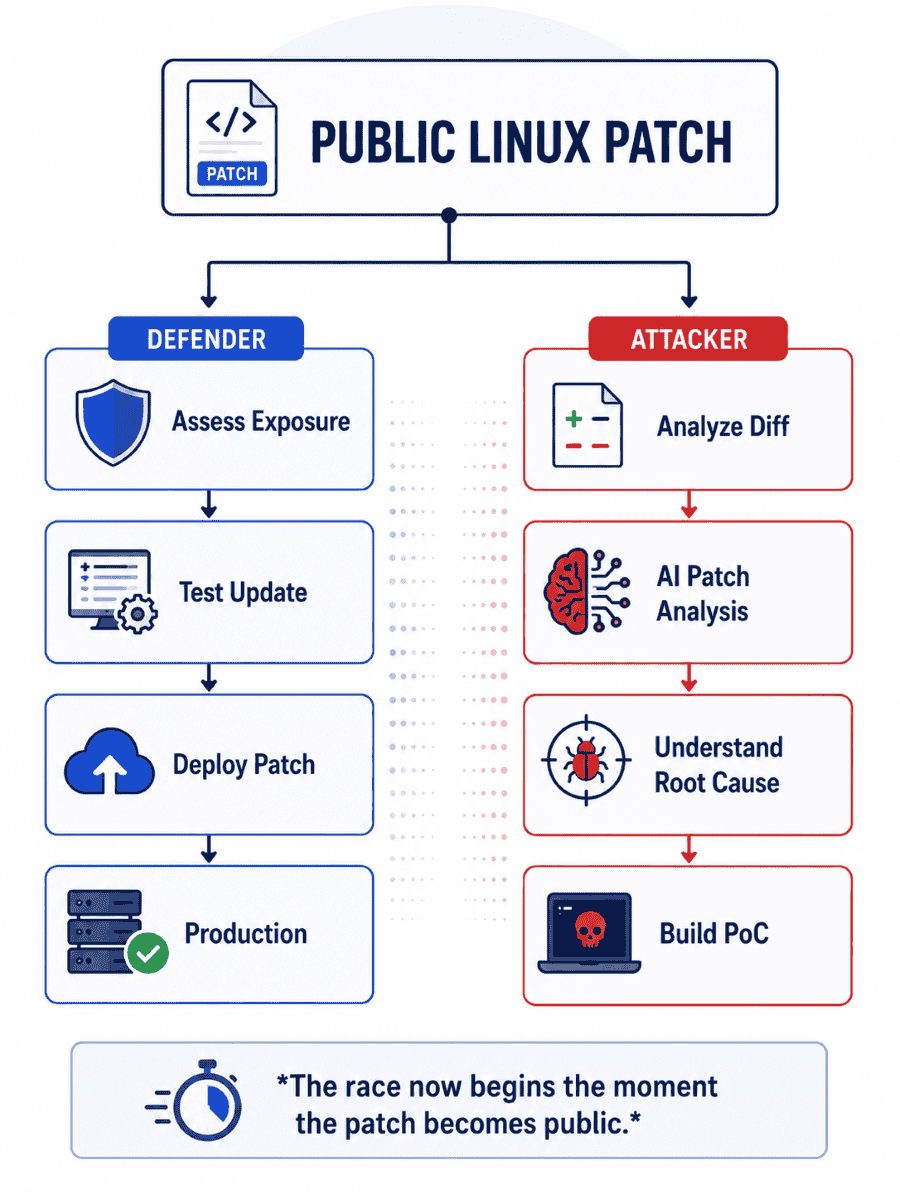
Whether organizations use AI themselves or not, the operational implication is the same: patch management can no longer assume yesterday's timelines. Organizations that shorten the time between public disclosure and production deployment will be better positioned to withstand a future where vulnerability analysis increasingly happens at machine speed.
 PREVIOUS
Powered By

Linux Security - Your source for Top Linux News, Advisories, HOWTOs and Feature Releases
QUICK LINKS
subscribe to newsletters!
Like staying secure? So do we.
Sign up for updates, tips, and alerts!