Explore top 10 tips to secure your open-source projects now. Read More
×


Ubuntu Dirty Frag Important Local Privilege Escalation Exploit
 May 08, 2026
•
May 08, 2026
•
 MaK Ulac
4 - 7 min read

Topics Covered
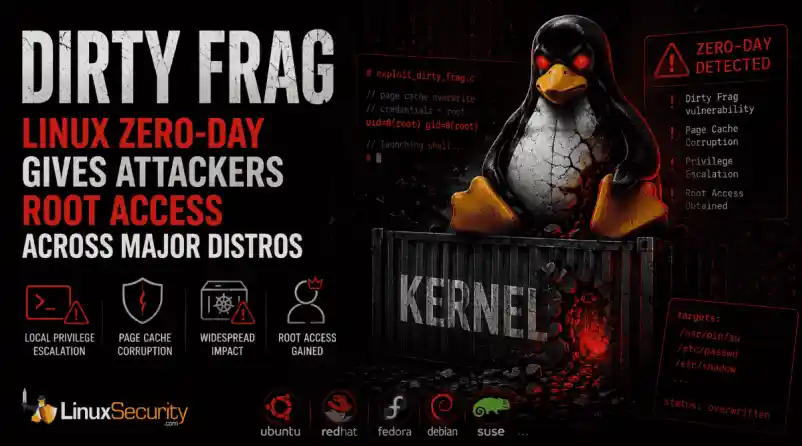
Just weeks after Linux defenders began responding to Copy Fail, researchers have disclosed another serious privilege escalation vulnerability that can deliver reliable root access on major distributions.
Known as Dirty Frag, the exploit abuses Linux page cache corruption to modify protected files directly in memory without relying on unstable race conditions or crash-prone exploitation methods.
Unlike race-condition exploits that rely on timing or unstable behavior, Dirty Frag succeeds consistently. No kernel panic is required. No memory corruption crash window needs to line up perfectly. According to researcher Hyunwoo Kim, the exploit chain works reliably enough to provide immediate root access across a wide range of environments.
At the time of disclosure, no CVE had been assigned, and no official patches were broadly available.
How the Dirty Frag Exploit Works
Dirty Frag is not a single vulnerability. It is a chained local privilege escalation attack built from two separate Linux kernel flaws:
xfrm-ESPPage-Cache WriteRxRPCPage-Cache Write
Both vulnerabilities abuse the Linux kernel’s handling of fragmented socket buffer structures (sk_buff) during in-place cryptographic operations.
At a high level, the exploit abuses Linux zero-copy networking behavior. Using splice() and related kernel interfaces, attackers can place references to page-cache-backed memory into fragmented socket buffers. Vulnerable cryptographic code paths then perform in-place operations directly against those fragments.
That allows protected memory pages to be modified even when the attacker only has read access to the underlying file.
In practice, attackers can:
- patch
/usr/bin/suwith shellcode - alter
/etc/passwd - bypass authentication
- launch a root shell
All from an otherwise unprivileged local context.
What makes Dirty Frag especially dangerous is that the exploit modifies files through the Linux page cache in memory rather than writing directly to disk. That breaks long-standing security assumptions around read-only file access and protected cached pages.
Why Security Researchers Are Comparing It to Dirty Pipe
Dirty Frag belongs to the same vulnerability class as:
- Dirty Pipe
- Dirty COW
- Copy Fail
All of them abuse unintended write behavior against cached pages in memory.
Dirty Pipe targeted pipe_buffer structures. Dirty Frag instead abuses the frag field inside Linux socket buffers. That difference matters because it opens another path to modifying supposedly protected memory pages during network and cryptographic processing.
The exploit effectively turns internal kernel crypto operations into arbitrary write primitives.
Two Exploit Paths Cover Each Other’s Weaknesses
One reason Dirty Frag is especially concerning is that the two exploit variants compensate for each other.
The ESP variant
The xfrm-ESP attack path provides a strong arbitrary write primitive, but typically requires: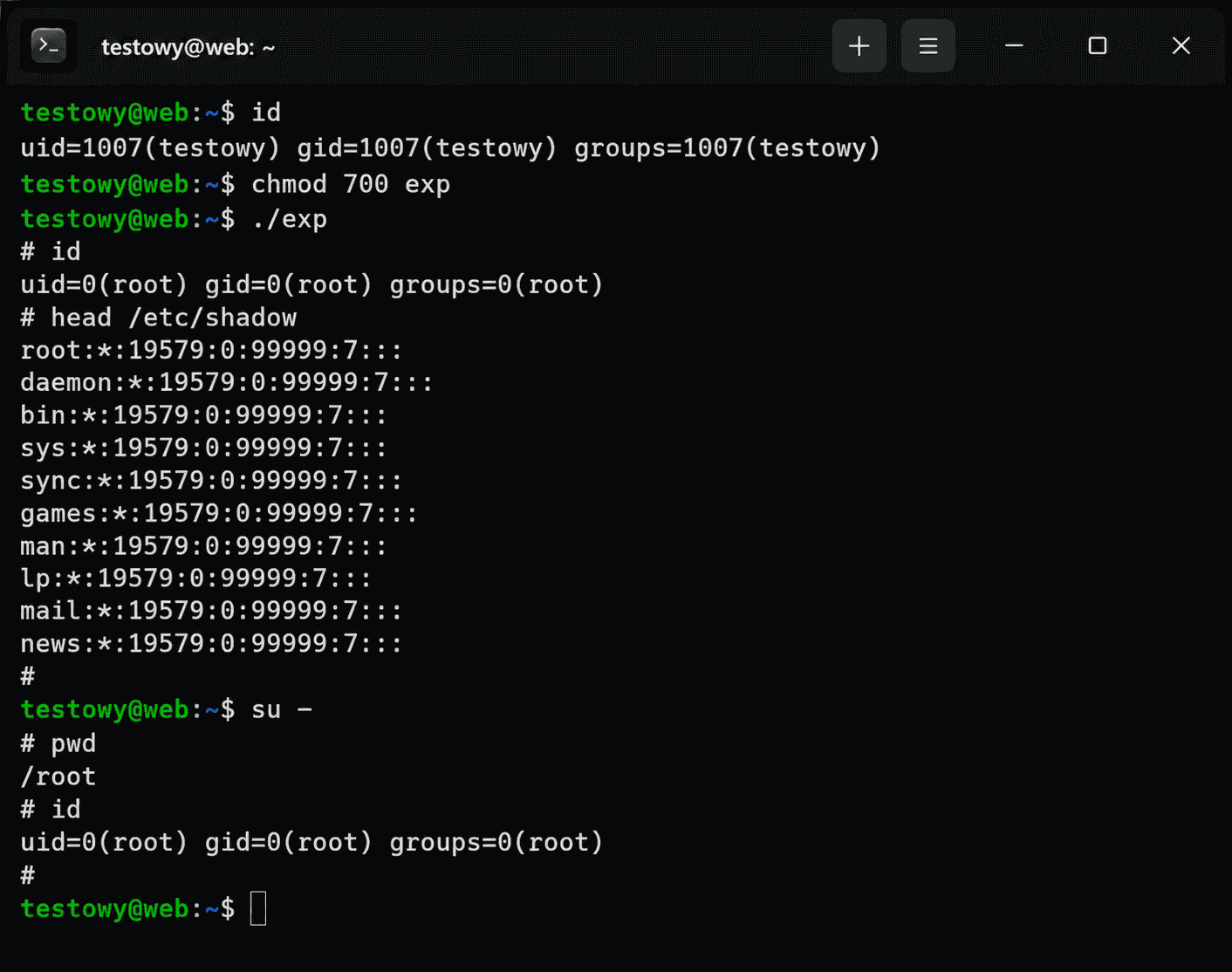
- user namespaces
CAP_NET_ADMINwithin a namespace
Some hardened environments restrict unprivileged namespace creation, which can block this path.
The RxRPC variant
The RxRPC attack path does not require namespace creation and can work entirely from unprivileged APIs. Instead of patching binaries directly, it manipulates /etc/passwd entries to bypass authentication.
Its limitation is module availability. Some distributions do not ship rxrpc.ko by default.
Together, they broaden exploitability
If one path is blocked by policy or configuration, the other may still succeed.
That flexibility is exactly why researchers are treating Dirty Frag as more than another isolated Linux kernel bug.
Why You Need To Take Dirty Frag Vuln Seriously
Several characteristics make Dirty Frag more dangerous than a typical Linux local privilege escalation vulnerability.
Reliable Exploitation Changes the Threat Model
Many Linux kernel privilege escalation exploits rely on race conditions, unstable timing windows, or behaviors that frequently crash systems during exploitation attempts.
Dirty Frag is different.
According to researcher Hyunwoo Kim, the exploit chain works reliably without requiring race conditions or precise timing. The attack also avoids the kernel instability commonly associated with memory corruption exploits, making successful privilege escalation far more practical for real-world attackers.
That reliability significantly lowers the barrier to weaponization.
Broad Linux Distribution Exposure Increases Risk
Researchers confirmed successful exploitation against multiple major Linux distributions, including:
- Ubuntu
- Red Hat Enterprise Linux
- CentOS Stream
- AlmaLinux
- Fedora
- openSUSE Tumbleweed
Because the affected functionality exists deep inside common Linux kernel networking and cryptographic subsystems, organizations may find it difficult to quickly determine exposure across large environments.
Shared infrastructure, CI/CD systems, developer platforms, and container-heavy deployments may face elevated risk.
Public Exploit Code Is Already Available
The coordinated disclosure process reportedly broke down after a third party publicly released exploit details ahead of schedule.
Once the embargo collapsed, researchers and maintainers released technical writeups and proof-of-concept exploit chains publicly.
As a result, attackers already have access to:
- detailed exploit documentation
- weaponized proof-of-concept code
- mitigation bypass techniques
- practical exploitation examples
before many organizations have production-ready patches available.
Temporary Mitigation Available
Until vendors release patches, researchers recommend disabling the affected modules where possible.
sh -c "printf 'install esp4 /bin/false\ninstall esp6 /bin/false\ninstall rxrpc /bin/false\n' > /etc/modprobe.d/dirtyfrag.conf; rmmod esp4 esp6 rxrpc 2>/dev/null; true"Be aware that this mitigation has an operational impact.
Disabling these modules may break:
IPsecVPN functionalityAFSdistributed file systems- services relying on
RxRPC
Some administrators have also noted that if the vulnerable modules are already loaded, a reboot may be necessary after unloading them to fully clear the affected page cache state.
SELinux May Reduce Exposure
Some early testing suggests that strict SELinux policies can interfere with exploitation.
Researchers discussing the flaw noted that SELinux Strict Policy configurations using user_t contexts appeared capable of blocking exploit execution paths associated with Dirty Frag and Copy Fail.
Kernel Hardening Still Matters
Dirty Frag is another reminder that SELinux, AppArmor, and other hardening layers can still help reduce zero-day impact even before patches arrive.
The Bigger Problem Facing Linux Security
Dirty Frag arrives only weeks after the Linux ecosystem began responding to Copy Fail, another actively exploited privilege escalation vulnerability.
CISA recently added Copy Fail to its Known Exploited Vulnerabilities catalog, warning federal agencies to patch affected systems quickly due to the risk of real-world exploitation.
Now, another exploit chain in the same vulnerability family has appeared before many defenders fully addressed the previous one. The trend is difficult to ignore. Researchers are increasingly finding ways to abuse:
- page cache interactions
splicebehavior- zero-copy networking
- in-place cryptographic operations
inside the Linux kernel.
The result is a growing class of high-impact privilege escalation vulnerabilities that can bypass traditional assumptions about file protections and memory isolation.
What Linux Administrators Should Do Right Now
Organizations running Linux servers should immediately: 
- Determine whether affected modules are loaded
- Restrict unprivileged user namespace creation where feasible
- Apply temporary mitigations if operationally possible
- Monitor vendor advisories closely
- Watch for unusual privilege escalation activity
- Harden
SELinuxorAppArmorpolicies where applicable - Prioritize patch deployment once fixes become available
Systems with shared-user access, developer workloads, CI/CD infrastructure, or container-heavy environments may face elevated risk.
Final Thoughts
Dirty Frag does not feel like an isolated kernel mistake. It looks more like another sign that attackers and researchers are getting better at abusing the same weak points inside Linux memory handling and page-cache behavior. Dirty COW exposed it years ago. Dirty Pipe reinforced it. Copy Fail pushed it further. Now Dirty Frag arrives with reliable exploitation, public proof-of-concept code, and multiple paths to root access before many defenders have even finished patching the last round of issues.
What stands out here is the consistency. No unstable race conditions. No complicated crash timing. Just predictable abuse of trusted kernel operations that were never expected to become write primitives. That changes the risk calculation for shared systems, developer infrastructure, container hosts, and anywhere unprivileged local access already exists.
The bigger problem is that these bugs keep surfacing in different forms while targeting the same underlying assumptions around memory isolation and protected file access. Defenders can patch this specific flaw once updates land, but the pattern itself is becoming harder to dismiss.
Stay Ahead of Linux Security Threats
Sign up for our newsletter for weekly analysis covering Linux kernel vulnerabilities, privilege escalation exploits, container security risks, and hardening strategies.
 PREVIOUS
 NEXT
NEXT

Powered By

Linux Security - Your source for Top Linux News, Advisories, HOWTOs and Feature Releases
QUICK LINKS
subscribe to newsletters!
Like staying secure? So do we.
Sign up for updates, tips, and alerts!