Explore top 10 tips to secure your open-source projects now. Read More
×


GitHub Actions Linux Self-Hosted Runners Security Risks 2025-30066
 May 15, 2026
•
May 15, 2026
•
 MaK Ulac
3 - 6 min read


Topics Covered
Self-hosted GitHub Actions runners give organizations far more flexibility than standard cloud-hosted runners. Teams can integrate internal infrastructure directly into CI/CD workflows, automate Kubernetes deployments, run custom tooling, and manage Linux-based build environments without relying entirely on external infrastructure.
That flexibility also creates a significant security risk. A compromised self-hosted GitHub Actions runner can hand attackers direct access to Kubernetes clusters, cloud credentials, package registries, and production deployment systems—often without exploiting a single Linux vulnerability.
Recent compromises, such as the poisoning of the tj-actions/changed-files Action and the Codecov supply chain breach, demonstrated how attackers increasingly target CI/CD automation. This is because the pipeline itself often provides privileged access to infrastructure and production environments already. Unlike ephemeral cloud runners, self-hosted Linux runners frequently persist long after workflows complete. In many environments, they already sit close to Kubernetes clusters, internal repositories, package publishing systems, and cloud administration tooling.
Why Self-Hosted GitHub Actions Runners Create Security Risks
Self-hosted runners often inherit broad operational access because they handle container builds, infrastructure deployment, cloud provisioning, and release automation simultaneously. That concentration of privileged access makes the runner itself a high-value target.
As workflows expanded, self-hosted runners gradually accumulated access to: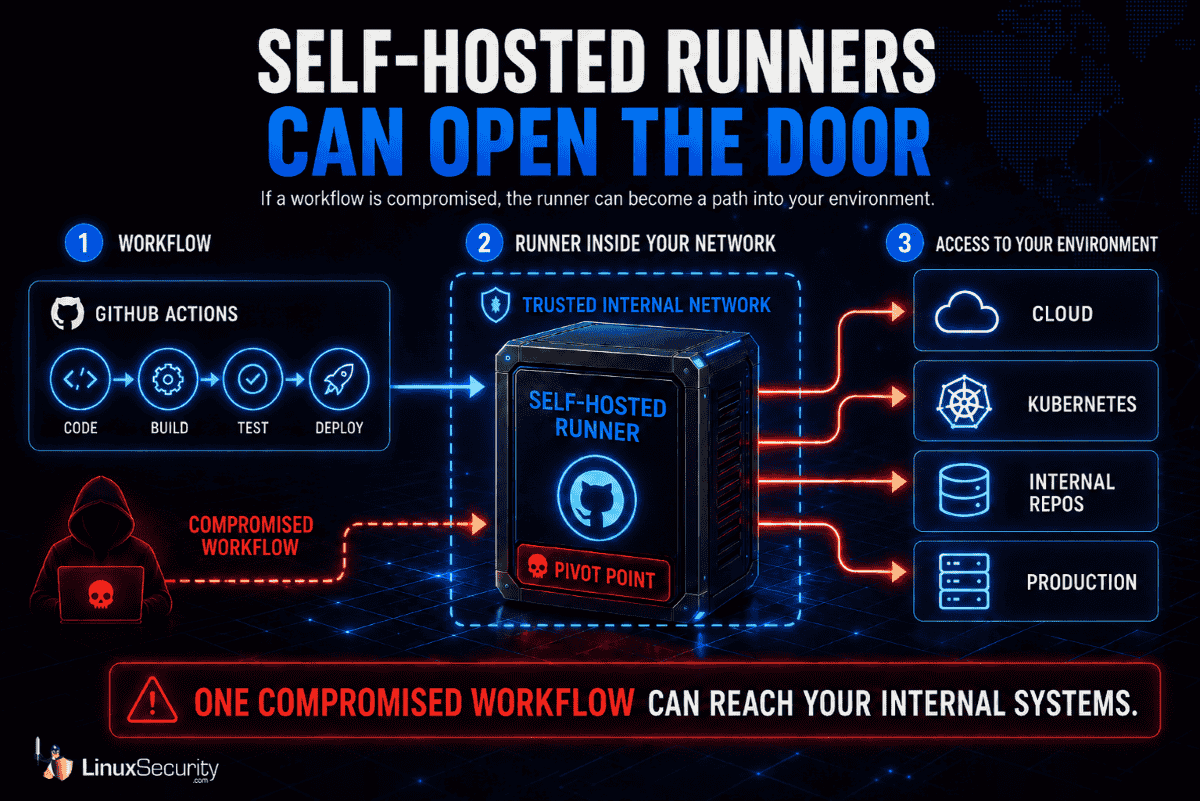
- cloud deployment credentials,
- Kubernetes environments,
- internal repositories,
- package publishing systems,
- infrastructure automation tooling,
- container registries,
- and production release pipelines.
The risk becomes larger when organizations place runners directly inside trusted internal networks or allow workflows to interact directly with production infrastructure. Once attackers compromise the workflow environment, the runner may become a pivot point for lateral movement deeper into the environment. Unlike traditional endpoint compromise, attackers frequently abuse legitimate CI/CD automation behavior rather than exploiting Linux directly. That operational normalcy makes malicious workflow activity much harder to detect.
How to Use Ephemeral GitHub Actions Runners on Linux
Persistent runners may retain credentials, temporary artifacts, shell histories, and environment variables long after workflows finish executing. That persistence creates additional opportunities for:
- credential theft,
- workflow persistence,
- artifact tampering,
- and lateral movement across infrastructure environments.
Ephemeral runners reduce that exposure window because the environment is destroyed automatically after each workflow completes. If you are running on standalone Linux hosts, you can enforce this by using the --ephemeral flag during the registration process:
./config.sh --url [https://github.com/OWNER/REPO](https://github.com/OWNER/REPO) --token YOUR_TOKEN --ephemeralMany organizations now deploy ephemeral Linux runners using the GitHub Actions Runner Controller (ARC) for Kubernetes. This allows organizations to isolate workflows using namespaces, network policies, and tightly scoped service accounts. The goal is to prevent attackers from inheriting leftover state between jobs.
How to Restrict Docker Socket Access on GitHub Actions Runners
Exposing the Docker socket (/var/run/docker.sock) inside GitHub Actions workflows effectively grants root-level control over the runner host. Many Linux CI/CD environments expose this socket so pipelines can build containers directly, but that configuration becomes dangerous during workflow compromise because attackers may use Docker socket access to escape container isolation, mount sensitive host directories, or deploy privileged containers.
Organizations should avoid exposing the Docker socket whenever possible. Safer alternatives include: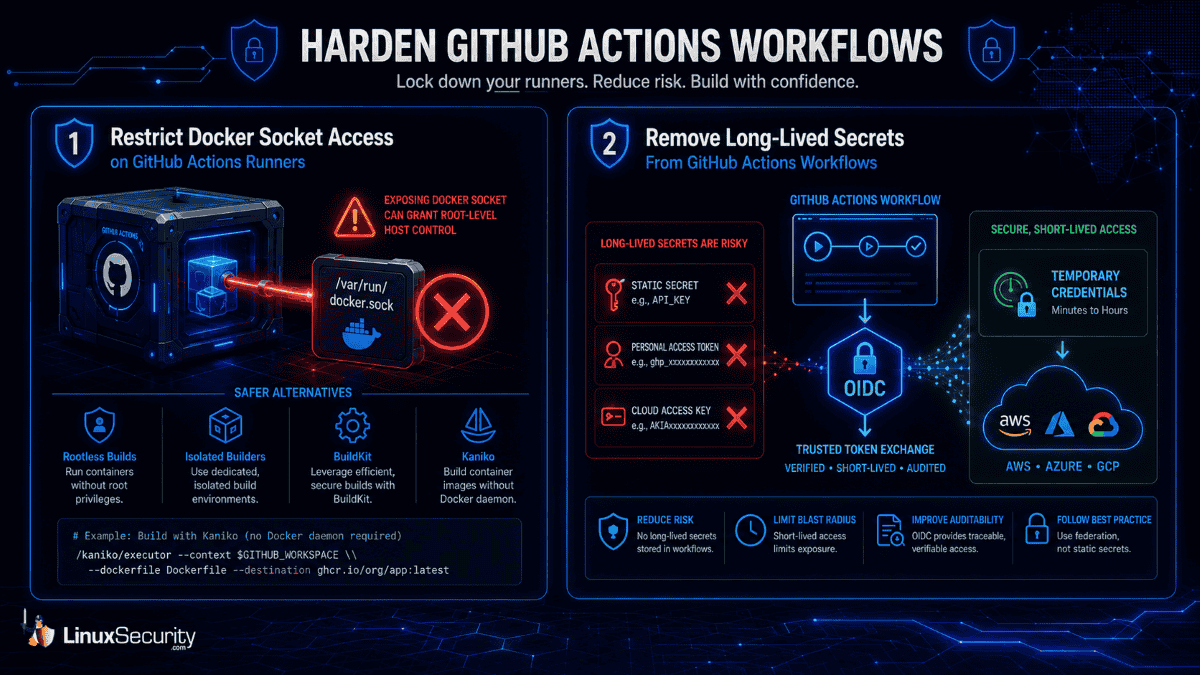
- rootless container builds,
- isolated build systems,
- BuildKit,
- or Kaniko.
A standard Kaniko implementation in a Kubernetes-based runner looks like this:
YAML
- name: Build with Kaniko
  image: gcr.io/kaniko-project/executor:latest
  args: ["--dockerfile=Dockerfile", "--destination=my-registry.com/image:latest"]
How to Remove Long-Lived Secrets From GitHub Actions Workflows
Long-lived credentials create unnecessary exposure. Many workflow compromises specifically target GitHub Personal Access Tokens or cloud access keys stored inside repositories. Once exposed, those credentials may continue functioning long after defenders discover the breach.
Organizations should replace static credentials with OIDC (OpenID Connect). OIDC allows workflows to request temporary cloud credentials dynamically during execution. Major cloud providers, including AWS, Azure, and Google Cloud, already support OIDC integration, which significantly reduces the operational value of stolen credentials.
A hardened OIDC configuration for AWS would look like this:
YAML
permissions:
  id-token: write
  contents: read
steps:
  - name: Configure AWS Credentials
    uses: aws-actions/configure-aws-credentials@v4>
    with:
      role-to-assume: arn:aws:iam::1234567890:role/my-github-role
      aws-region: us-east-1
How to Restrict GitHub Actions Workflow Permissions
Many GitHub Actions environments still run with broader repository permissions than workflows actually require. Overly permissive configurations, such as permissions: write-all, grant workflows unnecessary repository modification privileges.
A safer baseline starts with an empty permission set, explicitly granting only the permissions required for the workflow itself: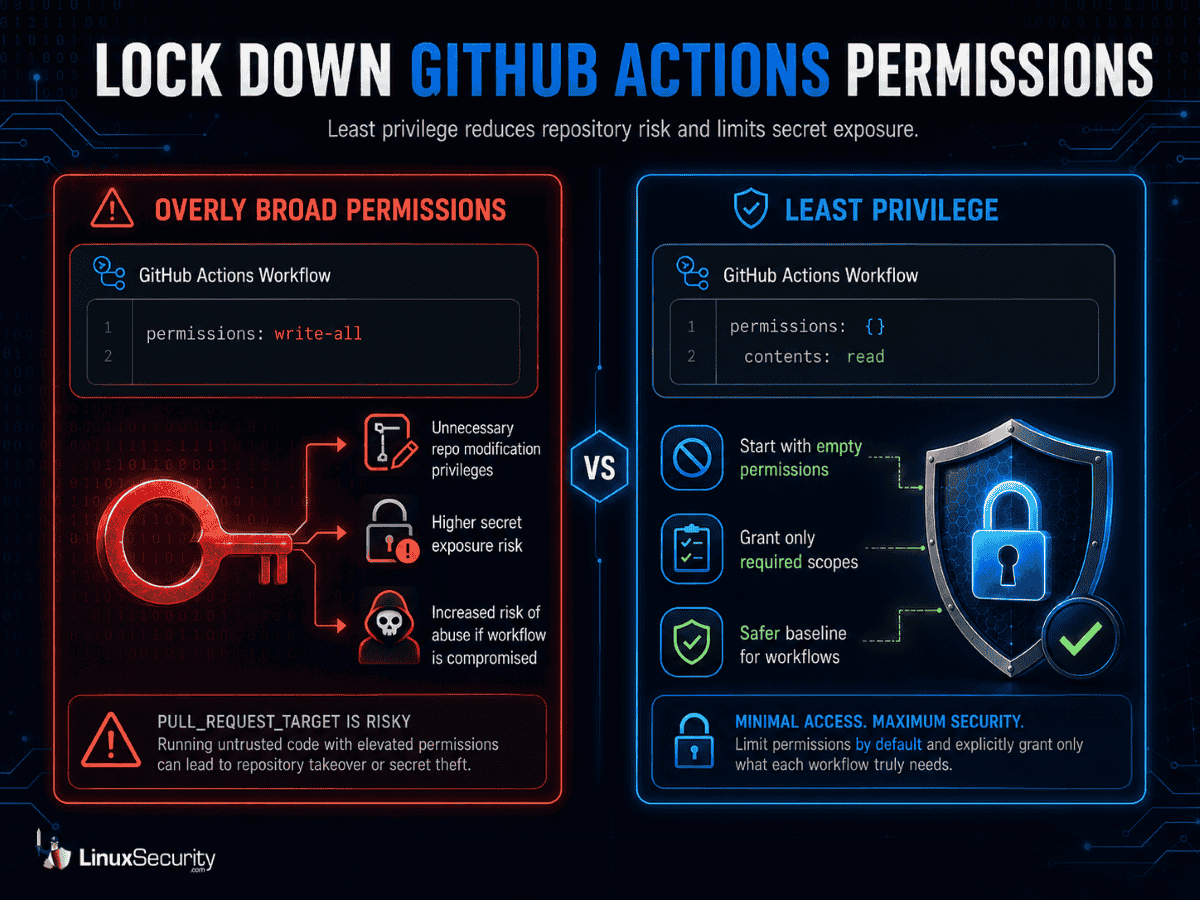
YAML
permissions: {}

# Grant only the specific scope required
permissions:
  contents: read
Security teams should also carefully review all workflows using the pull_request_target trigger. Because this trigger executes using the permissions of the target repository rather than the untrusted fork, attackers may abuse it to expose repository secrets.
How to Review GitHub Actions Workflow Changes Safely
Workflow files should be treated like infrastructure code. Modifications inside .github/workflows/ can directly affect deployment systems, cloud authentication, and runner execution behavior. Organizations should require mandatory pull request reviews and use CODEOWNERS protection to ensure security teams audit every change.
Plaintext
# .github/CODEOWNERS
.github/workflows/ @platform-security-team
In many environments, modifying a workflow effectively changes production infrastructure behavior. Security teams should monitor for unexpected workflow additions or unauthorized permission changes that could indicate a supply chain compromise in progress.
How to Restrict Outbound Traffic and Monitor Activity
Many CI/CD compromises rely on transmitting secrets to attacker-controlled infrastructure. Organizations should restrict unnecessary outbound traffic from runners using firewall rules, DNS filtering, or Kubernetes NetworkPolicies. For example, you can lock down a Kubernetes runner pod to only communicate with GitHub IP ranges:
YAML
apiVersion: networking.k8s.io/v1
kind: NetworkPolicy
metadata:
  name: runner-egress
spec:
  podSelector:
    matchLabels:
      app: github-runner
  egress:
  - to:
    - ipBlock:
        cidr: 140.82.112.0/20 # GitHub IP Range
Because attackers frequently operate using legitimate workflow credentials, detection often depends on identifying unusual operational behavior—such as unexpected curl execution or unauthorized cloud API activity.
GitHub Actions Runner Hardening Checklist
- Use ephemeral runners to prevent persistence between builds.
- Replace long-lived cloud credentials with short-lived OIDC tokens.
- Remove Docker socket exposure by using Kaniko or BuildKit.
- Isolate runners from production networks and Kubernetes control planes.
- Restrict outbound traffic to only essential GitHub and cloud endpoints.
- Enforce a "deny-all" permission baseline in every workflow YAML.
-
Require mandatory reviews for any modification to
.github/workflows/.
GitHub Actions workflows now sit directly inside the software supply chain. They build applications, publish packages, and deploy infrastructure across production systems every day. That operational position makes them extremely attractive targets. For Linux-heavy infrastructure running cloud-native workloads, the risk is significant because the pipeline is no longer just a support tool—it has become part of production itself.
Want more Linux security hardening guides like this? Subscribe to our newsletter for practical tutorials on Linux infrastructure, CI/CD security, cloud-native operations, and open-source security best practices.
 PREVIOUS

 NEXT
NEXT

Powered By

Linux Security - Your source for Top Linux News, Advisories, HOWTOs and Feature Releases
QUICK LINKS
subscribe to newsletters!
Like staying secure? So do we.
Sign up for updates, tips, and alerts!