Explore top 10 tips to secure your open-source projects now. Read More
×


Europe’s Open Source Strategy Takes Aim at Software Security’s Maintenance Problem
 Jun 19, 2026
•
Jun 19, 2026
•
 MaK Ulac
5 - 9 min read

Some of the software the world depends on most is maintained by people most users will never know by name. The project might be sitting inside Linux distributions, enterprise software, cloud platforms, and government systems without most users ever realizing it is there.
The problem is not difficult to find. Critical software components can end up supporting thousands of products and services while being maintained by small teams with limited resources. By the time a vulnerability, governance failure, or supply chain incident becomes visible, the software is often already embedded across environments that depend on it.
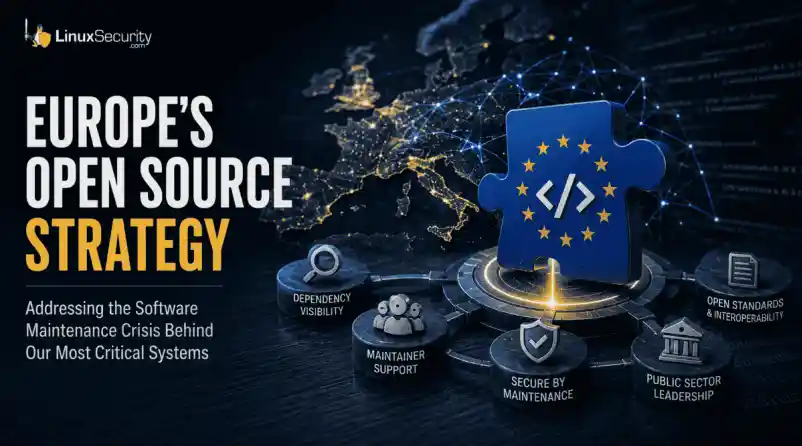
The European Commission's new Open-Source Strategy is an attempt to address that problem. The strategy focuses on long-term maintenance, critical dependency mapping, open standards, procurement, governance, and public-sector adoption. More importantly, it recognizes that open-source security often depends on project health long before a CVE appears.
What Europe’s Open Source Strategy Actually Proposes
The European Commission published the strategy in June 2026. It sits inside Europe’s wider push for technological sovereignty, where open source is being tied to cloud, AI, public-sector systems, and long-term control over software infrastructure.
The focus is practical:
- Adoption
- Governance
- Maintenance
- Skills
- Public-sector use
The strategy is not only looking at new software. It is looking at projects that are already inside systems, already pulled into packages, already supporting workloads that governments may not fully understand until a patch fails or a dependency shows up in an incident.
The main pieces are the Open Source Maintenance Instrument, critical dependency mapping, stronger Open Source Program Offices, open standards, interoperability, and procurement reform. Those are maintenance controls as much as policy ideas. They decide who can find the dependency, who owns support, who understands the upstream project, and whether public-sector buyers keep treating open source as free code with no operational tail.
That is the useful part of the strategy. It treats open source like something that keeps running after deployment. Code needs maintainers. Dependencies need visibility. Public systems need support paths before a vulnerability, abandoned package, or broken update turns into the reason everyone finally starts looking.
Why Maintenance Has Become a Security Problem
Open-source security problems do not always begin with vulnerable code. Sometimes the warning signs appear much earlier. A maintainer steps away. Reviews become less frequent. Issues sit unanswered. Releases slow down. The project is still being used, but fewer people are actively keeping it moving.
That can become a problem surprisingly quickly. Critical software is not always maintained by large teams with dedicated funding and formal processes. A package may end up inside Linux distributions, enterprise products, cloud platforms, and government systems, while a small group of maintainers handles most of the work. As adoption grows, the dependency footprint expands. The maintainer team often does not.
Consider these high-profile examples:
- Heartbleed: Exposed the risk inside a cryptographic library that much of the Internet already trusted.
- Log4Shell showed how a single open-source component could be embedded across thousands of environments, leaving organizations scrambling to find where it was running.
- The xz Backdoor: Shifted attention from the malicious code itself to maintainer trust, project stewardship, and how influence had been established inside a widely used project.
These incidents looked different, but they shared a common thread. The security issue became visible at the end of the story. The maintenance, governance, and dependency problems were already there.
Why Europe Is Linking Open Source to Digital Sovereignty
The strategy is also tied to Europe's broader push for digital sovereignty. That term can sound political, but much of the discussion comes down to technology dependencies. Governments, public institutions, and critical services increasingly rely on software, cloud platforms, and AI technologies that are controlled by a relatively small number of providers. For more context on these objectives, refer to the EU Open Source Strategy Fact Page.
Open source fits into that conversation because it changes some of those dependencies. Code can be inspected. Systems can be maintained without relying on a single vendor. Software can be replaced, modified, or supported by another provider if requirements change. None of those guarantees better security on their own, but they can give organizations more visibility and more control over the systems they depend on.
Open standards and interoperability appear throughout the strategy for similar reasons. Public-sector systems often remain in service for years. Sometimes decades. The ability to move data, replace components, or change providers becomes much more difficult when systems are tied to proprietary formats or vendor-specific technologies.
The security relevance is not really about politics. It is about understanding what is running, reducing unnecessary dependencies, and avoiding situations where critical systems become difficult to maintain because too much control sits outside the organization responsible for operating them. If the strategy leads to better-supported open-source projects and healthier software dependencies, the security benefits are fairly easy to see.
Critical Dependency Mapping Could Be the Most Important Security Piece
Organizations cannot protect dependencies they cannot identify. That sounds basic until a vulnerable package shows up three layers down in an application stack, and nobody knows which system pulled it in.
Linux systems are built from thousands of libraries, packages, tools, and upstream projects. Some are obvious. Others sit quietly under installers, containers, appliances, build systems, and managed services. They only become visible when a patch is needed or an advisory forces teams to trace the dependency path.
That is why critical dependency mapping matters. It gives governments and public institutions a way to see:
- Which projects are actually supporting their systems.
- Which ones need review.
- Which ones may need funding or maintenance support before they become the next emergency.
This also connects directly to SBOMs, vulnerability management, and software supply chain visibility. Inventory is no longer just asset management. It is part of knowing where exposure begins.
Can Procurement Fix What Volunteer Labor Cannot?
SUSE’s argument is that Europe does not have a supply problem. Open-source software already exists. The harder problem is demand that is scattered across agencies, vendors, contracts, and procurement rules that do not always reward maintenance or support.
Public-sector buying can change that. If governments require open standards, support pathways, and maintain open-source solutions, money starts moving toward the organizations and projects keeping the software alive. That creates pressure in the right place.
But procurement does not fix everything:
- A contract can support a vendor and still miss the upstream maintainer doing the real work.
- A public-sector requirement can increase adoption without improving review, governance, or release discipline.
- Buying open-source software is not the same as sustaining it.
The bet is that coordinated demand can make maintenance less accidental. That only works if the money reaches the projects and support structures that actually carry the load. Further economic context can be found in the European Commission 2021 Economic Impact Study and the research provided by Frank Nagle at Harvard Business School.
The Risks: Strategy Does Not Secure Code by Itself
Mapping dependencies is easier than maintaining them. A list can show where a project is used, but it does not review patches, handle releases, resolve maintainer burnout, or fix governance problems.
Funding has the same issue. It has to reach the projects that need it, not just the institutions best positioned to apply for it. Public-sector procurement is slow. Member states may adopt different standards, different timelines, and different definitions of what “critical” means.
There is also a simpler failure mode. Governments adopt more open source without building the maintenance path around it. The software footprint grows, but the support model does not. Risk moves around instead of going away.
The strategy has value only if it turns into operational support. Funding. Review. Governance. Maintainer help. Procurement rules that reward long-term support instead of treating open source as a cheaper line item. As the Open-Source Initiative (OSI) notes, the implementation details matter as much as the intent.
What Linux Users and Open Source Teams Should Watch
The first thing to watch is whether the Open Source Maintenance Instrument becomes real support or just another framework. The difference will show up in whether maintainers see funding, review help, staffing, infrastructure, or reduced workload.
The definition of “critical” also matters. If ENISA or other EU bodies define it too narrowly, important packages will be missed. If the definition is too broad, the process becomes paperwork, and nobody knows where to focus.
Procurement is another signal. Public-sector contracts may start requiring open standards, support paths, SBOMs, or clearer maintenance responsibilities. That would affect vendors, integrators, and Linux teams supporting government environments.
OSPOs are worth watching too. A program office without authority becomes documentation. A program office with budget, policy control, and technical staff can change how an institution selects software, tracks dependencies, and handles upstream relationships.
The useful question is simple. Do maintainers, vendors, and public-sector users get practical help from this, or do they get more forms to fill out?
Conclusion
Europe’s Open Source Strategy matters because it recognizes a hard truth. Software security is not only about finding vulnerabilities after they appear. It is also about keeping the projects underneath critical systems healthy enough that failure is less likely in the first place.
That means people. Funding. Governance. Dependency visibility. Review. Support paths that exist before a CVE, broken package, or supply chain incident forces everyone to care.
If Europe turns the strategy into real maintenance support, it could strengthen the open-source foundations Linux users already rely on. If not, it becomes another document that correctly identifies the problem without changing what happens when the next critical project starts to crack.
 PREVIOUS

 NEXT
NEXT



Powered By

Linux Security - Your source for Top Linux News, Advisories, HOWTOs and Feature Releases
QUICK LINKS
subscribe to newsletters!
Like staying secure? So do we.
Sign up for updates, tips, and alerts!