Explore top 10 tips to secure your open-source projects now. Read More
×


Linux Foundation Launches Akrites to Strengthen Software Supply Chain Security
 Jun 29, 2026
•
Jun 29, 2026
•
 MaK Ulac
4 - 7 min read
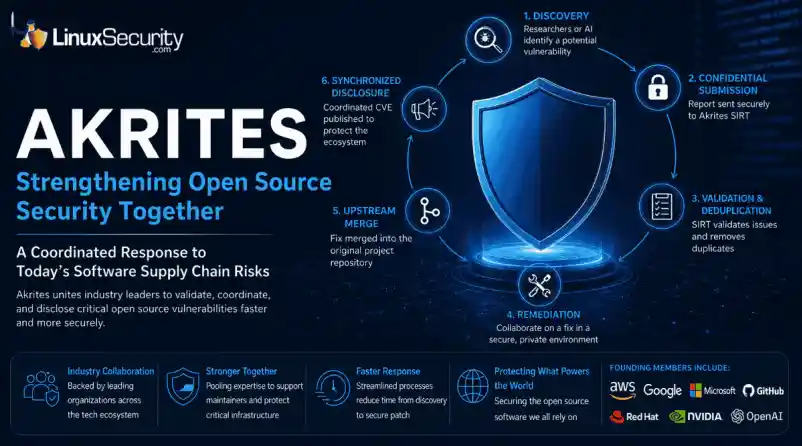

The Linux Foundation has officially launched Akrites, a coordinated industry initiative designed to improve how critical open source vulnerabilities are validated, coordinated, and disclosed before patches reach downstream users.
Backed by a diverse coalition—including AWS, Google, Microsoft/GitHub, Red Hat, NVIDIA, and OpenAI—Akrites establishes a shared Security Incident Response Team (SIRT) to streamline the validation, remediation, and disclosure of vulnerabilities in the foundational code that underpins the modern digital economy.
AI Is Changing Software Supply Chain Security
One detail in the Linux Foundation announcement stands out more than the launch itself. The organization isn't suggesting that open source projects suddenly need more vulnerability reports. They already receive plenty.
The problem is volume.
AI-assisted analysis has made it possible to review large codebases much faster than before. Researchers can identify suspicious patterns, compare projects, and generate vulnerability reports in a fraction of the time that manual analysis once required. That is good news for open-source security, but it has also exposed a weakness in the current response model.
Every report still has to be reviewed by a person.
Someone has to reproduce the issue, determine whether it affects supported releases, understand its severity, decide whether a CVE is appropriate, develop a patch, and move that fix through coordinated vulnerability disclosure before technical details become public. None of those tasks has become significantly easier simply because AI can produce findings more quickly.
According to Endor Labs, one of Akrites' founding members, fewer than 5% of recently validated open source vulnerabilities have been patched. Whether that percentage changes over time, it illustrates the same trend. Discovery is accelerating faster than remediation.
Why Existing Open Source Security Processes Are Under Pressure
The reality for many maintainers looks very different from how people imagine open-source security working.
A widely used library isn't necessarily maintained by a large engineering team. In many cases, it's a handful of contributors or even a single developer balancing maintenance with a full-time job. Now imagine that the project suddenly receives dozens of reports describing the same underlying issue. One submission comes from a commercial scanner. Another is generated by an AI coding assistant. A third arrives through a bug bounty program. None are identical, but all require investigation.
The difficult part isn't opening the email.
It's figuring out whether the report is accurate, whether the vulnerability can actually be reproduced, whether downstream users are affected, and how the issue should move through vulnerability disclosure without exposing organizations before a fix is available.
Akrites is intended to reduce that burden by acting as a shared Security Incident Response Team. Instead of every organization independently contacting maintainers, the initiative provides a coordinated process for validating reports, removing duplicates, and helping projects prepare fixes before disclosure begins.
Recent Incidents Showed Why Coordination Matters
Recent security incidents have demonstrated that identifying a vulnerability is often only the beginning.
Log4Shell became a global response effort almost overnight. The challenge wasn't limited to understanding the vulnerability itself. Linux distributions, software vendors, cloud providers, security teams, and enterprise administrators all had to coordinate patches, advisories, testing, and deployment under intense time pressure.
The XZ Utils backdoor exposed a different weakness. It showed how much critical infrastructure still depends on software maintained by very small teams. When one upstream project experiences a security problem, the consequences spread through Linux distributions, enterprise products, containers, cloud platforms, and countless applications built on top of that code.
Akrites would not have prevented either incident. The Linux Foundation isn't making that claim. Instead, the initiative attempts to strengthen the coordination that happens after a vulnerability is discovered and before it reaches the wider ecosystem.
What Akrites Means for Open-Source Security
Akrites represents a clear realization: open source security can no longer rely solely on the efforts of individual maintainers. Every critical project eventually hits the same wall: the software becomes indispensable long before the maintenance team has the resources to manage it.
One interesting aspect of this initiative isn't just the technology—it's the list of founding members. Organizations like Citi, JPMorgan Chase, Ericsson, and Cisco rarely launch joint initiatives unless they share a massive, systemic problem. In this case, they do. Modern infrastructure shares an enormous amount of upstream code, which means one overwhelmed maintainer is now a systemic risk for banks, power grids, and cloud providers alike.
What This Means for Linux Administrators
Linux administrators rarely work directly with upstream maintainers, yet they depend on them every day. Enterprise distributions such as Red Hat Enterprise Linux, Ubuntu, Debian, SUSE, AlmaLinux, and Rocky Linux package software only after upstream projects have investigated reports, developed patches, and coordinated disclosure. Improvements at the upstream level can ripple through the entire software supply chain, ultimately affecting how quickly organizations receive trusted updates. :
- Faster upstream patch coordination: Verified fixes land in your distribution’s repositories sooner because the "middle work" of validation and deduplication is handled upstream.
- More consistent security advisories: Standardized reports make it easier to track and prioritize updates across your fleet.
- Better support for widely used components: Akrites says it can serve as a "maintainer of last resort" for certain critical projects by helping coordinate remediation when active maintenance is no longer sufficient.
How Akrites Coordinates Vulnerability Response
The initiative formalizes the vulnerability disclosure lifecycle to ensure confidentiality and speed. Instead of maintainers fielding reports from hundreds of sources, they have one predictable partner.
- Discovery: A researcher or AI surfaces a potential flaw.
- Confidential Submission: The report is sent to the Akrites SIRT, not a public bug tracker.
- Validation & Deduplication: The SIRT verifies the issue and removes duplicates.
- Remediation: Maintainers and industry engineers collaborate on a fix in a secure environment.
- Upstream Merge: The fix is merged into the original project's repository.
- Synchronized Disclosure: A coordinated CVE is published to alert the ecosystem.
Akrites Won't Replace Vulnerability Management
It is vital to note that Akrites is an upstream coordination body, not an enterprise security product. Organizations still need robust internal programs, including vulnerability management processes, asset inventories, and monitoring tools to detect threats within their specific environments. Akrites improves the upstream coordination of security, but the responsibility for securing the downstream enterprise environment remains with the organization.
Akrites complements existing vulnerability management programs rather than replacing them. Organizations will still need scanners, patch management workflows, asset inventories, and software bills of materials (SBOMs) to identify affected systems and deploy updates. Akrites focuses on the upstream coordination that happens before those updates reach enterprise environments.
Conclusion
For years, the industry invested heavily in tools designed to identify software vulnerabilities faster. Akrites reflects a strategic recognition that discovery is no longer the limiting factor. As AI continues to accelerate vulnerability research, the challenge has become how quickly maintainers can validate reports, coordinate fixes, and deliver patches before attackers exploit them.
Whether Akrites succeeds will ultimately be measured not by the number of vulnerabilities it processes, but by whether it successfully shortens the time between discovery and remediation across the open source ecosystem. By professionalizing the "messy middle" of the response process, Akrites is attempting to build the operational infrastructure needed to keep our most critical software secure in an age of AI-accelerated threats.
Want more Linux security news, open source security analysis, and software supply chain insights? Subscribe to the LinuxSecurity Newsletter for the latest vulnerability disclosures, security advisories, threat analysis, and expert coverage of the technologies shaping the Linux ecosystem.
Related Reading
 PREVIOUS

 NEXT
NEXT



Powered By

Linux Security - Your source for Top Linux News, Advisories, HOWTOs and Feature Releases
QUICK LINKS
subscribe to newsletters!
Like staying secure? So do we.
Sign up for updates, tips, and alerts!