Audit Linux privileges now to limit compromise, escalation, and system-wide damage. Review Linux Privileges×


Why Linux Supply Chain Attacks Are Becoming a Nightmare for DevOps Teams
 May 06, 2026
•
May 06, 2026
•
 MaK Ulac
4 - 8 min read

Linux has long carried a reputation for resilience, bolstered by open-source reviews, hardened kernels, and transparent development pipelines. While that trust is well-founded, attackers have shifted their focus to a more vulnerable target: the surrounding software supply chain.
Instead of breaking Linux directly, malicious actors are poisoning the delivery pipeline. The shift is obvious when you look at the last few years of incidents. Compromised maintainers, malicious packages, dependency confusion, and poisoned updates frequently land on systems long before defenders realize the code has changed. While security teams are busy patching traditional vulnerabilities, attackers are quietly slipping through package managers and CI/CD workflows we assumed were trustworthy.
The XZ Utils backdoor fundamentally changed the tone of this conversation.
The XZ Backdoor: The Scenario Everyone Feared
In early 2024, attackers inserted a backdoor into XZ Utils, a compression library embedded across Linux distributions and SSH-related workflows. The malicious code targeted liblzma (a data compression library) and created a path to intercept SSH authentication under specific conditions. It was subtle, heavily obfuscated, and positioned deep enough in the stack that most environments would never notice it during routine reviews.
But the most dangerous part wasn’t the payload itself—it was how access was gained.
A contributor operating under the alias "Jia Tan" slowly built trust inside the project over months. The pattern started with normal, helpful commits, routine maintenance, and participation, before the poisoned update eventually landed. This long-game approach mirrors what’s happening across open-source ecosystems today: attackers are playing the long game rather than relying on smash-and-grab compromises.
The backdoor was ultimately caught by Microsoft engineer Andres Freund after he noticed strange CPU behavior in Debian test environments. If that anomaly had gone unnoticed for a few more release cycles, the blast radius would have been catastrophic.
The Pattern Didn't Stop with XZ
In March 2026, a supply chain attack hit Axios, one of the most widely used HTTP client libraries in the JavaScript ecosystem. Attackers got access to a maintainer’s npm account and quietly published two compromised versions, 1.14.1 and 0.30.4, before anyone caught it.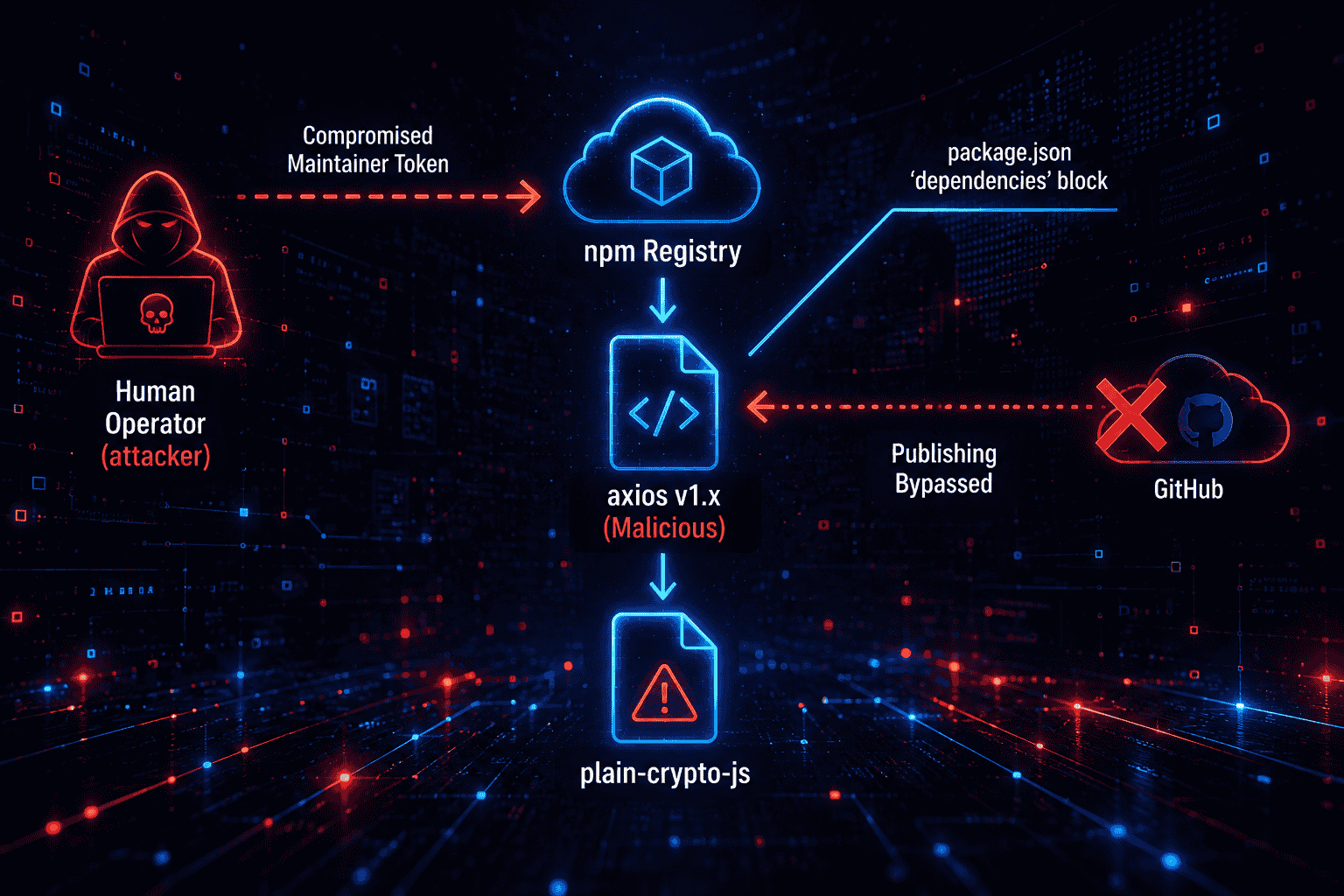
The Axios source code itself wasn’t altered. That part mattered. Instead, the attackers slipped a malicious dependency called plain-crypto-js into the release chain, which is a much easier place to hide when everyone’s focused on the main project diff and not the packages underneath it.
Once installed, npm automatically ran post-install scripts tied to the dependency. The code was heavily obfuscated and built to stay unnoticed long enough to deploy a remote access trojan across Linux, macOS, and Windows systems. Researchers later connected the infrastructure and forensic overlap to North Korean operators.
What unsettled a lot of security teams wasn’t the sophistication. It was the timing. The poisoned packages were live for only a few hours, but Axios pushes tens of millions of downloads every week, so developer workstations, CI runners, and production pipelines started pulling the update almost immediately without anyone stopping to inspect a routine dependency refresh.
That’s the part that supply chain attacks keep exposing now. Attackers do not always need to compromise the primary codebase anymore. A transitive dependency buried deep enough in the update path can move through trusted channels quietly, especially in environments where automated installs happen faster than meaningful review ever does.
Takeaway: Open-source trust models are incredibly vulnerable to patient attackers. To learn more about how organizations are improving software transparency, you can review the CISA Software Bill of Materials Guidance
Linux Repositories as Active Attack Surfaces
The problem extends far beyond Linux distributions themselves. Language ecosystems are hit constantly because developers install dependencies—third-party code modules used to speed up development—at scale with almost zero scrutiny.
- Go Modules: In 2025, researchers uncovered malicious Go modules (such as prototransform, go-mcp, and tlsproxy) that deployed destructive shell scripts to wipe Linux disks through /dev/sda. The payload didn't even attempt to extort the user via ransomware; it destroyed the systems outright.
- PyPI Packages: Packages frequently serve as delivery mechanisms for credential theft and remote access tooling. Some have abused Gmail SMTP infrastructure and WebSockets to blend exfiltration traffic into normal outbound communications, easily bypassing monitoring in smaller environments.
- Node.js Ecosystem: The event-stream compromise remains one of the clearest examples of this evolution. A maintainer handed project ownership to a new contributor who gradually introduced malicious code through a nested dependency targeting cryptocurrency wallets. npm audit failed to flag it because it wasn't tied to a known vulnerability at the time. You can read the original breakdown of the event-stream GitHub discussion to understand how social trust becomes an attack vector.
Why Traditional Dependency Scanning Falls Short
Many organizations treat tools like npm audit, Dependabot, or standard vulnerability scanners as a complete supply chain defense. They aren't.
These tools are great for identifying known vulnerable versions tied to published advisories and helping with patch management. However, they fail to reliably catch:
- Compromised maintainer accounts
- Typosquatted or malicious packages
- Obfuscated payloads
- Malicious post-install scripts
- Dependency confusion attacks
- Insider sabotage
- Runtime exfiltration behavior
The ua-parser-js compromise demonstrated this gap. Attackers hijacked the maintainer’s account and pushed malicious package versions that deployed cryptominers and credential-stealing malware. The window lasted only a few hours, but thousands of developer systems and CI pipelines pulled the update automatically before any advisory was published. Ecosystems are trying to improve trust validation, and you can see how in the npm Registry Signatures and Provenance documentation.
The Trap of Trust at Scale
Modern applications routinely pull hundreds or thousands of dependencies through transitive package chains (where one dependency relies on another). Most teams cannot realistically audit all of them manually, leading to the dangerous assumption that "popular" equals "safe."
Attackers know developers trust download counts, GitHub stars, and familiar names:
- Typosquatting: Campaigns exploit simple human errors. Packages like crossenv successfully harvested environment variables simply because someone missed a hyphen while trying to install cross-env.
- Dependency Confusion: In research by Alex Birsan, public packages using internal company names tricked package managers into pulling malicious versions from public registries rather than private ones. Giants like Apple, Microsoft, PayPal, and Tesla were impacted during testing. This attack chain works because the package resolution behavior itself is exploited. You can review the original Dependency Confusion Research to see how this vulnerability operates.
How to Reduce Supply Chain Risk
There is no single silver bullet. Because attackers target multiple parts of the pipeline simultaneously, teams need layered verification:
Lockfiles and Integrity Validation
Lockfiles (like package-lock.json or yarn.lock) pin exact dependency versions and verify integrity hashes. In production pipelines, use npm ci instead of npm install to enforce deterministic installs rather than recalculating dependency trees dynamically. It's a small change with a big security difference.
SBOMs and Dependency Visibility
 Software Bills of Materials (SBOMs) provide much-needed visibility into what is running inside applications. Tools like CycloneDX and Syft generate SBOMs for Linux systems and container images, helping teams quickly check whether suspicious components exist in their environments. To learn more about reproducible builds and software integrity frameworks, check out the SLSA Framework.
Provenance and Signed Builds
Projects like Sigstore modernize software provenance verification using cryptographic signing tied to CI/CD workflows, rather than relying on developer machines. This ensures we know where a package was built, which pipeline produced it, and if it was altered afterward. You can read the Sigstore project overview to learn more.
Restrict Install-Time Execution
 Many attacks abuse post-install scripts that inherit broad execution privileges. Using flags like npm install --ignore-scripts stops an entire category of malicious behavior. High-trust production pipelines should strictly limit unnecessary execution paths and isolate build runners to prevent lateral movement.
5 Things Linux Teams Should Do This Week
- Require MFA for package maintainers
- Pin dependency versions in production
- Disable unnecessary install scripts
- Generate SBOMs during builds
- Monitor dependency changes in CI pipelines
Open Source Security Relies on Human Processes
Some of the hardest problems in supply chain security aren't technical: maintainer burnout, poor account security, weak review pipelines, and underfunded projects maintaining critical infrastructure.
The colors.js and faker.js sabotage incident showed what happens when maintainers themselves become unpredictable risk factors. This wasn't an external intrusion; the maintainer intentionally broke downstream systems.
The industry is slowly responding by requiring MFA, improving provenance tooling, and adopting reproducible builds. But adoption is uneven outside of large enterprises, and that gap is where attackers continue to operate.
Treat Supply Chain Monitoring Like Endpoint Security
The old assumption that Linux repositories are inherently trustworthy no longer holds up under modern attack patterns. Defenders need visibility into dependency changes, unusual network behavior, build pipeline anomalies, and maintainer activity—not just CVEs.
Because most supply chain compromises don’t arrive as traditional exploits. They arrive as routine updates: quietly, usually signed, and almost always trusted.
If you’re tracking issues like this, Linux security newsletters are a great way to keep them on your radar.
 PREVIOUS

 NEXT
NEXT

Powered By

Linux Security - Your source for Top Linux News, Advisories, HOWTOs and Feature Releases
QUICK LINKS
subscribe to newsletters!
Like staying secure? So do we.
Sign up for updates, tips, and alerts!