Explore top 10 tips to secure your open-source projects now. Read More
×



Server Security data privacy automation
data privacy automation Every system admin has lived through the same Monday morning ritual. A queue of forty tickets, half of them password resets, permission errors, or disk space warnings that any experienced technician could resolve in under two minutes. The other half require actual judgment. For years, automation promised that software would eventually sort the two apart on its own. That promise is now being tested in production Linux environments. . Early results are reshaping how IT teams think about tier-1...
 Jul 17, 2026

Privacydata collection automation
data collection automation You're running a web scraping project to collect pricing data from e-commerce sites. You set up a pool of datacenter proxies, launch your scripts, and within minutes — banned . CAPTCHAs everywhere. Your data pipeline stops before it really begins. . It's a frustrating scenario that plays out daily in ad verification, market research, and multi-account management. The website doesn't know you're doing legitimate research or monitoring. It just sees traffic coming from IP ranges it recognizes as...
Jul 17, 2026

Security Trends security advisory social engineering
security advisory social engineering Business Email Compromise used to be a numbers game — mass-blasted emails, broken English, an obvious "URGENT WIRE TRANSFER" subject line. That era is over. Generative AI has turned BEC into a tailored, low-noise operation that mimics writing style, voice, and even video presence. This piece looks at what's actually changed under the hood, what defenders are testing in response, and why so many organizations are still structurally unprepared for it. . The Infrastructure Problem Nobody Wants to...
Jul 17, 2026
Security Trends cybersecurity Linux documentation
cybersecurity Linux documentation Linux operating systems have gained prominence due to their stability, adaptability, and excellent security options. In the case of developing documentation, designing cybersecurity dashboards, or educational material, visuals are of vital importance when it comes to making things clear. The use of icons allows one to understand the message regarding alerts, authorization, encryption, authentication, or the state of the system just by looking at the visual cue without having to read long...
Jul 17, 2026
Security Vulnerabilities security advisory linux distribution
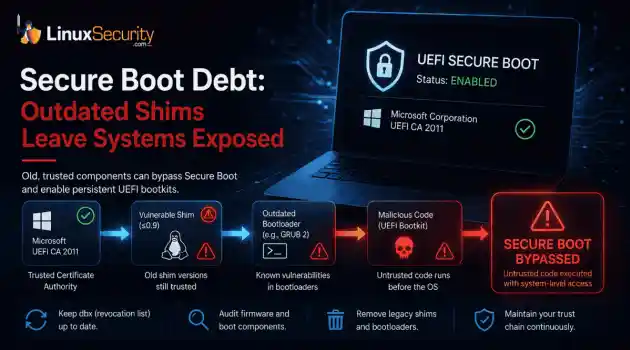
security advisory linux distribution ESET researchers identified 11 old and forgotten Linux UEFI shim bootloaders at versions 0.9 and below that can be used to bypass UEFI Secure Boot on any UEFI-based machine that trusts Microsoft’s Microsoft Corporation UEFI CA 2011 third-party certificate authority, regardless of the installed operating system (OS). Reported shims can be exploited to execute untrusted code during system boot, enabling attackers to deploy malicious UEFI bootkits even on systems with UEFI Secure Boot enabled.....
Jul 16, 2026
 Refine news
X Clear Filters
Get the latest News and Insights
Get the latest Linux and open source security news straight to your inbox.
Community Poll
Is continuous patching actually viable?
Loading...
Explore Latest Linux Security news
We found 1,607 articles for you...
82
 European Commissionpublic sectorsoftware maintenance
Europe’s Open Source Strategy Takes Aim at Software Security’s Maintenance Problem
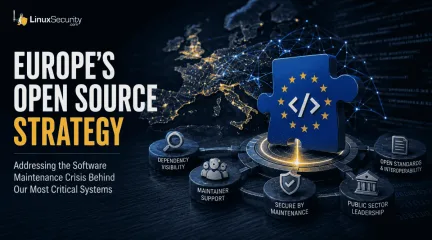
Some of the software the world depends on most is maintained by people most users will never know by name. The project might be sitting inside Linux distributions, enterprise software, cloud platforms, and government systems without most users ever realizing it is there. . The problem is not difficult to find. Critical software components can end up supporting thousands of products and services while being maintained by small teams with limited resources. By the time a vulnerability, governance failure, or supply chain incident becomes visible, the software is often already embedded across environments that depend on it. The European Commission's new Open-Source Strategy is an attempt to address that problem. The strategy focuses on long-term maintenance, critical dependency mapping, open standards, procurement, governance, and public-sector adoption. More importantly, it recognizes that open-source security often depends on project health long before a CVE appears. What Europe’s Open Source Strategy Actually Proposes The European Commission published the strategy in June 2026. It sits inside Europe’s wider push for technological sovereignty, where open source is being tied to cloud, AI, public-sector systems, and long-term control over software infrastructure. The focus is practical: Adoption Governance Maintenance Skills Public-sector use The strategy is not only looking at new software. It is looking at projects that are already inside systems, already pulled into packages, already supporting workloads that governments may not fully understand until a patch fails or a dependency shows up in an incident. The main pieces are the Open Source Maintenance Instrument, critical dependency mapping, stronger Open Source Program Offices, open standards, interoperability, and procurement reform. Those are maintenance controls as much as policy ideas. They decide who can find the dependency, who owns support, who understands the upstream project, and whetherpublic-sector buyers keep treating open source as free code with no operational tail. That is the useful part of the strategy. It treats open source like something that keeps running after deployment. Code needs maintainers. Dependencies need visibility. Public systems need support paths before a vulnerability, abandoned package, or broken update turns into the reason everyone finally starts looking. Why Maintenance Has Become a Security Problem Open-source security problems do not always begin with vulnerable code. Sometimes the warning signs appear much earlier. A maintainer steps away. Reviews become less frequent. Issues sit unanswered. Releases slow down. The project is still being used, but fewer people are actively keeping it moving. That can become a problem surprisingly quickly. Critical software is not always maintained by large teams with dedicated funding and formal processes. A package may end up inside Linux distributions, enterprise products, cloud platforms, and government systems, while a small group of maintainers handles most of the work. As adoption grows, the dependency footprint expands. The maintainer team often does not. Consider these high-profile examples: Heartbleed : Exposed the risk inside a cryptographic library that much of the Internet already trusted. Log4Shell showed how a single open-source component could be embedded across thousands of environments, leaving organizations scrambling to find where it was running. The xz Backdoor : Shifted attention from the malicious code itself to maintainer trust, project stewardship, and how influence had been established inside a widely used project. These incidents looked different, but they shared a common thread. The security issue became visible at the end of the story. The maintenance, governance, and dependency problems were already there. Why Europe Is Linking Open Source to Digital Sovereignty The strategy is also tied to Europe's broader push for digital sovereignty. That term can soundpolitical, but much of the discussion comes down to technology dependencies. Governments, public institutions, and critical services increasingly rely on software, cloud platforms, and AI technologies that are controlled by a relatively small number of providers. For more context on these objectives, refer to the EU Open Source Strategy Fact Page . Open source fits into that conversation because it changes some of those dependencies. Code can be inspected. Systems can be maintained without relying on a single vendor. Software can be replaced, modified, or supported by another provider if requirements change. None of those guarantees better security on their own, but they can give organizations more visibility and more control over the systems they depend on. Open standards and interoperability appear throughout the strategy for similar reasons. Public-sector systems often remain in service for years. Sometimes decades. The ability to move data, replace components, or change providers becomes much more difficult when systems are tied to proprietary formats or vendor-specific technologies. The security relevance is not really about politics. It is about understanding what is running, reducing unnecessary dependencies, and avoiding situations where critical systems become difficult to maintain because too much control sits outside the organization responsible for operating them. If the strategy leads to better-supported open-source projects and healthier software dependencies, the security benefits are fairly easy to see. Critical Dependency Mapping Could Be the Most Important Security Piece Organizations cannot protect dependencies they cannot identify. That sounds basic until a vulnerable package shows up three layers down in an application stack, and nobody knows which system pulled it in. Linux systems are built from thousands of libraries, packages, tools, and upstream projects. Some are obvious. Others sit quietly under installers, containers, appliances, build systems, and managedservices. They only become visible when a patch is needed or an advisory forces teams to trace the dependency path. That is why critical dependency mapping matters. It gives governments and public institutions a way to see: Which projects are actually supporting their systems. Which ones need review. Which ones may need funding or maintenance support before they become the next emergency. This also connects directly to SBOMs, vulnerability management, and software supply chain visibility. Inventory is no longer just asset management. It is part of knowing where exposure begins. Can Procurement Fix What Volunteer Labor Cannot? SUSE’s argument is that Europe does not have a supply problem. Open-source software already exists. The harder problem is demand that is scattered across agencies, vendors, contracts, and procurement rules that do not always reward maintenance or support. Public-sector buying can change that. If governments require open standards, support pathways, and maintain open-source solutions, money starts moving toward the organizations and projects keeping the software alive. That creates pressure in the right place. But procurement does not fix everything: A contract can support a vendor and still miss the upstream maintainer doing the real work. A public-sector requirement can increase adoption without improving review, governance, or release discipline. Buying open-source software is not the same as sustaining it. The bet is that coordinated demand can make maintenance less accidental. That only works if the money reaches the projects and support structures that actually carry the load. Further economic context can be found in the European Commission 2021 Economic Impact Stud y and the research provided by Frank Nagle at Harvard Business School . The Risks: Strategy Does Not Secure Code by Itself Mapping dependencies is easier than maintaining them. A list can show where a project is used, but it does not review patches, handlereleases, resolve maintainer burnout, or fix governance problems. Funding has the same issue. It has to reach the projects that need it, not just the institutions best positioned to apply for it. Public-sector procurement is slow. Member states may adopt different standards, different timelines, and different definitions of what “critical” means. There is also a simpler failure mode. Governments adopt more open source without building the maintenance path around it. The software footprint grows, but the support model does not. Risk moves around instead of going away. The strategy has value only if it turns into operational support. Funding. Review. Governance. Maintainer help. Procurement rules that reward long-term support instead of treating open source as a cheaper line item. As the Open-Source Initiative (OSI) notes , the implementation details matter as much as the intent. What Linux Users and Open Source Teams Should Watch The first thing to watch is whether the Open Source Maintenance Instrument becomes real support or just another framework. The difference will show up in whether maintainers see funding, review help, staffing, infrastructure, or reduced workload. The definition of “critical” also matters. If ENISA or other EU bodies define it too narrowly, important packages will be missed. If the definition is too broad, the process becomes paperwork, and nobody knows where to focus. Procurement is another signal. Public-sector contracts may start requiring open standards, support paths, SBOMs, or clearer maintenance responsibilities. That would affect vendors, integrators, and Linux teams supporting government environments. OSPOs are worth watching too. A program office without authority becomes documentation. A program office with budget, policy control, and technical staff can change how an institution selects software, tracks dependencies, and handles upstream relationships. The useful question is simple. Do maintainers, vendors, and public-sector users getpractical help from this, or do they get more forms to fill out? Conclusion Europe’s Open Source Strategy matters because it recognizes a hard truth. Software security is not only about finding vulnerabilities after they appear. It is also about keeping the projects underneath critical systems healthy enough that failure is less likely in the first place. That means people. Funding. Governance. Dependency visibility. Review. Support paths that exist before a CVE, broken package, or supply chain incident forces everyone to care. If Europe turns the strategy into real maintenance support, it could strengthen the open-source foundations Linux users already rely on. If not, it becomes another document that correctly identifies the problem without changing what happens when the next critical project starts to crack. . Europe's Open Source Strategy addresses software security maintenance, focusing on dependencies and governance for better safety.. Open Source, Software Maintenance, Security Governance, Dependency Mapping, Digital Sovereignty. . MaK Ulac
 Jun 19, 2026
•
Jun 19, 2026
• Government
82
 security advisoryincident responselinux
2027 Budget Cuts Impact Linux Security Data Quality and Coordination
When federal security budgets are cut, the data that stops hackers from breaking into your Linux servers begins to dry up. . Budget shifts usually feel like political noise rather than a technical risk. However, Linux security relies on a steady flow of data from government-funded programs. Most of this data flows downstream through trusted channels like distro advisories or built-in threat intelligence feeds. When funding for organizations like CISA is reduced, the quality of that data changes. We often assume that this visibility is a constant force, but it is actually a coordinated effort. If that coordination slows down, the dashboards we rely on every day become less reliable. Ultimately, this shift in cybersecurity policy directly impacts your technical defenses. How Linux Environments Depend on CISA Data Linux security isn’t a standalone process. It’s part of a larger network that shares information to keep systems running. Vulnerability Management Pipelines Most Linux patching starts with filtered data. Teams use the CISA Known Exploited Vulnerabilities (KEV) catalog to decide what to fix first. Major distributions like Red Hat and Ubuntu pull from these shared pools of context. When this data loses quality, your vulnerability management process becomes noisy. You still patch your systems, but you may not be hitting the most dangerous bugs first. Threat Telemetry and Indicators Detection tools in Linux rely on external data to find threats. This includes IP addresses, malicious domains, and MITRE ATT&CK mappings used to categorize hacker behavior. Most of us trust these feeds without thinking about where they come from. If the primary source of this data weakens, the rules in your security tools grow old. Attackers can move through your network because your tools are looking for yesterday’s threats. Critical Infrastructure Protection Linux runs the systems that manage our energy and water. These environments are hard to patch quickly because theycannot have downtime. They rely on "early warning" data to stay safe. Effective critical infrastructure protection depends on this signal; when it is delayed, the time a system stays exposed to a threat increases. Systemic Risks: The Degradation of Defense A reduction in central coordination causes security to degrade slowly rather than failing all at once. Slower Detection and Alert Fatigue: Security teams spend more time checking if an alert is real. Without strong background data to auto-verify threats, SIEM tuning becomes impossible, leading to rule drift and massive alert fatigue for analysts. Open-Source Security Gaps: Small teams depend on public advisories and Open Source Vulnerability (OSV) data. When funding for these sources is cut, open source security suffers because coverage gaps don't appear as errors—they appear as silent missed detections. Supply Chain Risk Management: Linux uses many shared libraries. Coordinated intelligence helps everyone react to a problem at the same time. Without it, supply chain risk management fails as different vendors move at different speeds, creating a synchronization problem that hackers easily exploit. The Distributed Security Problem: Coordination Without Authority Linux is decentralized by design. This is its greatest strength, but it creates a massive "implicit trust" problem. There is no single boss in charge of security who can force everyone to align. Instead, the ecosystem relies on a handful of groups to act as the connective tissue. CISA has filled this role by helping synchronize the response across thousands of independent developers and vendors. Without this influence, we lose our ability to move as one. Fragmentation increases, response times diverge, and the "shared defense" model starts to break down because no one is formally in charge of keeping the signal clean. Real-World Impact: The Anatomy of a Delay Imagine a new exploit targeting a core library like glibc . In a world with less centralcoordination, the timeline starts to fracture immediately. The Detection Gap: Initial reports are scattered across private forums. Without a central push, detection rules for your sensors lag by days. The Timeline Delay: One major Linux distro patches on Monday. Another waits until Friday to validate. Uneven Patch Rollout: Attackers don't need to break the whole internet. They just scan for the "pockets" of users on the slower update cycle. They operate inside that timeline gap—moving through your network while your team is still waiting for a "verified" alert that may never arrive. Recommended Actions for Linux Security Teams As shared defense signals weaken, we have to take more responsibility for our own visibility. Reduce Single-Source Dependence Do not treat one feed as the only source of truth. Use a mix of distribution advisories and community sources like GitHub Security Advisories . You want these sources to overlap so you don't miss anything. Harden Host Detection Shift your focus from lists of "bad" IPs to how a system actually behaves. Use tools like auditd or Falco to monitor for unusual process activity or privilege changes. Behavior patterns are much harder for hackers to change than an IP address. Improve Patch Prioritization Standard risk scores aren't enough anymore. Monitor for news of real-world usage of an exploit. You need to build an internal model of what matters most to your specific environment. Verify Package Integrity Check the signatures on the software you download. Monitor your dependency trees. Remember that third-party mirrors and repositories extend your risk boundary in ways you might not see every day. Build Internal Context Treat security data as a helpful input rather than the absolute truth. You have to analyze how a threat applies to your specific servers. We can no longer assume that someone else is filtering the data for us. Conclusion: TheShift to Self-Managed Visibility The risk of funding cuts isn't just about having fewer alerts. The real risk is that the alerts you do get are no longer accurate or timely. Visibility is moving from a shared resource to a self-managed task. Linux teams must be ready to own their analysis and verify the signals they rely on to stay safe. . Budget cuts may seem political, but they hinder Linux security teams' access to vital threat data and coordination.. CISA funding cuts, Linux security risks, data coordination, vulnerability management, incident response. . MaK Ulac
Apr 10, 2026
•
Government

82
 security advisorylinuxattack surface
Austria: Enhancing Military IT Security and Sovereignty with LibreOffice
Austria’s Armed Forces have confirmed a major shift in military IT: 16,000 systems have been migrated from Microsoft Office to LibreOffice on Linux desktops. Finalized in 2025, the rollout is one of Europe’s largest open-source deployments, carried out on a military scale. . Officials stressed this wasn’t a financial move. It was about resilience. By dropping Microsoft Office, long targeted through macro malware and phishing campaigns, Austria eliminated a key attack vector, reduced dependency on foreign vendors, and reinforced digital sovereignty. Microsoft Office is now restricted to special cases where legacy macros require it. Austria didn’t just adopt LibreOffice; it invested in it. Officials confirmed the Armed Forces contributed more than five man-years of upstream development during the transition. In other words, this isn’t just procurement — it’s participation in strengthening the ecosystem. For defense, that’s part of the strategy: tie sovereignty to open platforms, and secure them through Linux. Austria Makes Security the Priority Austria didn’t frame this migration as an IT refresh. Leaders were explicit: it was a security-first move designed to close vulnerabilities that Microsoft Office introduced into military operations. For years, Office macros and VBA were among the most exploited attack vectors in phishing and malware campaigns. Removing them from daily use wasn’t just an upgrade — it was shutting down an entire class of threats. But the migration went further than blocking macros. By building its defense desktop environment on Linux and LibreOffice, Austria established a foundation where patching is transparent , updates are controlled locally, and foreign telemetry is no longer embedded into sensitive workflows . In defense terms, that shift is about trust: trust in the code being run, trust in when and how it’s updated, and trust that national data won’t leak outside sovereign control. How Austria Strengthened Linux Security One ofthe most apparent advantages of Austria’s migration was the reduction of its attack surface . By removing Microsoft Office and its reliance on VBA macros, the Armed Forces shut down one of the most exploited vectors in modern cyberattacks. Pairing LibreOffice with Linux desktops further reduced exposure, leaving adversaries with far less to target. It also meant fewer zero-days to manage. Windows plus Office 365 remains one of the most attractive global targets for attackers, which forces constant firefighting with emergency patches. In contrast, Linux paired with LibreOffice presents a smaller footprint, giving Austria more predictable operations and fewer disruptions from critical vulnerabilities. Transparency in patching was another major gain. With Linux, Austria’s IT teams can audit code directly, review fixes, and decide when to apply them. Security is no longer tied to a vendor’s opaque release cycle, and defense IT staff regain visibility and control at every stage. Update management also shifted in Austria’s favor. Office 365 enforces cloud-driven pushes that often arrive without warning, a liability in defense environments. By contrast, Linux and LibreOffice allow updates to be scheduled and deployed locally, on the Armed Forces’ own terms. Finally, sovereignty became inseparable from security. By moving away from Office 365 telemetry and AI features such as Copilot, Austria ensured that sensitive defense data remains fully under its own control. The shift reinforced a core principle: resilience depends on maintaining independence at the platform level. For Austria’s defense planners, this was the real point: Linux security isn’t just about software choice. It’s about sovereignty, resilience, and control in an environment where IT decisions directly impact national defense. Europe’s Path to Linux Security in Defense Austria’s move capped a continent-wide trend where open source and Linux moved from local pilots to national and then defense adoption. Germany, 2023 – State Pilot : Schleswig-Holstein began migrating 30,000 PCs to LibreOffice with Linux desktops in scope. Security and sovereignty were cited as the drivers. Denmark, 2024 – National Plan : Denmark announced a phased transition away from Microsoft Office, explicitly calling it a “breaking dependency”. Linux desktops were included in agency roadmaps. EU, 2024–2025 – Institutional Backing : The European Union strengthened support for open source in its digital sovereignty and cybersecurity strategies through initiatives such as EU OS and EuroStack. Austria, 2025 – Military Execution : The Austrian military adopted LibreOffice across approximately 16,000 systems, part of one of Europe’s largest open-source deployments. However, the migration focused on office software rather than a full Linux rollout. By 2025, Linux security was no longer a peripheral IT project. It had become a pillar of Europe’s digital sovereignty agenda. U.S. Policy vs. Europe’s Linux Security Execution The United States has embraced open source through policy, but it has stopped short of following Europe into visible desktop migrations. Linux is entrenched in federal infrastructure, but not in user-facing platforms. 2016 – Federal Source Code Policy : Required reuse and transparency across agencies. Many tools were Linux-compatible. 2017 – GSA OSS Policy : Proved open source could scale at the agency level, with pipelines running on Linux. 2022 – DoD CIO Memo + FAQ : Called open source the “bedrock” of defense software, but framed it mainly in terms of Linux servers, hardened builds, and containers. 2023 – NSA & CISA Best Practices : Linked OSS security to critical infrastructure — most of it Linux-based — but again, not desktops. Across Europe, Linux is moving into defense operations, though deployments remain country-specific rather than continent-wide. The U.S. has a policy, but remains tied to Microsoft at the userlevel. NATO now faces coordination challenges where workflows must bridge Microsoft and LibreOffice stacks. Defense Lessons From Austria’s Migration Austria’s migration was not seamless, and the obstacles it encountered carry important lessons for any government seeking to reduce Microsoft dependency. One of the first challenges was macro compatibility. Many legacy defense files still relied on VBA-heavy documents, which forced Austria to create special permissions and workarounds to ensure operational continuity. Interoperability with NATO partners also surfaced as an issue. Since most allies continue to rely on Microsoft Office, exchanging documents and maintaining smooth collaboration introduces friction. This underscored how deeply Microsoft remains embedded in defense workflows across the alliance. Managing Linux desktops at scale brought its own set of difficulties. Patch and fork maintenance demanded disciplined cycles and close oversight to prevent security drift. Austria’s experience shows that without tight coordination, even Linux security can weaken over time. User retraining was another major hurdle. Soldiers and staff needed to adapt to new tools, and inadequate training could easily turn into a security risk. Mistakes made under pressure or unfamiliarity with workflows carry consequences in a defense setting that go beyond lost productivity. The takeaway: these aren’t reasons to avoid migration, but challenges that must be anticipated. Why Austria’s Move Redefines Linux Security Worldwide Austria’s decision carries implications far beyond its own armed forces. Within Europe, Austria’s adoption demonstrates how open-source software like LibreOffice can operate in demanding government and defense environments. What began as state-level pilots has matured into national strategies, with digital sovereignty now embedded directly into IT infrastructure. For the United States, the contrast is clear. Federal agencies have adopted strong open-source policies andrely heavily on Linux in backend systems, but desktops remain tied to Microsoft. This leaves the U.S. lagging behind allies who have taken the leap to full-stack Linux security. Differences in office suite adoption across European institutions highlight potential interoperability challenges, even as NATO relies on its own secure systems. For the global Linux community, Austria’s success is both validation and a warning. The rollout shows Linux meeting stringent military requirements. At the same time, experts note that high-profile deployments often increase visibility, which could attract adversary interest. Patching, auditing, and upstream collaboration become even more critical as Linux moves from infrastructure to the front lines of defense IT. What Comes Next The rollout underscores that open-source adoption in defense is no longer theoretical — it is running in production at scale, even if focused on productivity tools rather than full operating system migrations. For Europe, it signals a new era where digital sovereignty isn’t just policy language but IT infrastructure. For the United States, the challenge is clear: policy without execution leaves dependency intact. The world is watching whether other nations treat Linux security as strategic infrastructure or remain tethered to Microsoft. Austria has already chosen its path. For defense IT everywhere else, the clock is ticking, and the choice is between Microsoft dependency or Linux security as strategic infrastructure. . Austria's Armed Forces shift to LibreOffice on Linux for enhanced security and sovereignty in military IT.. Linux Security, LibreOffice Migration, Digital Sovereignty, Defense IT. . MaK Ulac
Oct 03, 2025
•
Government
82
Understanding Schleswig-Holstein's Bold Move to Open Source
For Linux admins and open-source advocates, the German state of Schleswig-Holstein is about to become a live case study. In just a few short months, the state government plans to ditch Microsoft entirely across its public sector, affecting 30,000 employees – civil servants, judges, and even the police force. . The ultimate goal? A complete migration to Linux-based systems and open-source software . It's a monumental shift, and as we unpack the technical and strategic considerations behind it, one thing becomes clear: this isn’t simply about cost-cutting or jumping on the Linux bandwagon. It’s about sovereignty. Data sovereignty, to be exact. This move embodies a trend happening across Europe, driven by concerns around control over sensitive data, geopolitical dependencies, and the desire to move away from proprietary software. But as promising as it sounds, transitions like this are complex, and for those of us working in IT, they offer plenty to think about—both in terms of technical opportunities and potential pitfalls. The Mechanics of the Migration: What’s Changing? From a systems administration perspective, Schleswig-Holstein’s migration is everything we expect from a major open-source overhaul. Key proprietary tools are being swapped out for well-known open-source alternatives. Think Microsoft Office being replaced with LibreOffice , Outlook with Thunderbird , and Exchange replaced by Open-Xchange . For cloud collaboration, Nextcloud is stepping in. And on the desktop, KDE Plasma will become the standard environment, running on distributions like Kubuntu, openSUSE Leap, or, potentially, SUSE Linux Enterprise Desktop. For Linux pros, this hits close to home. If you’ve worked on Linux migrations, you know how heavily these projects lean on interoperability and user retraining. LibreOffice, for example, is famously capable, but document compatibility with Microsoft Office formats can sometimes feel more like an art than a science. Will macros transfer over cleanly?How will shared legacy files behave? Now scale those concerns across tens of thousands of users – some of whom may barely know the difference between a PDF and a DOCX – and you start to understand the magnitude of this shift. What really makes this transition stand out, though, is not just its scope but its motivation. For Schleswig-Holstein, this isn’t just about seeing “Linux” boot up on 30,000 machines. It’s about regaining control over their digital infrastructure. Minister Dirk Schrödter, who’s leading the charge, made it clear that this is about protecting data sovereignty—ensuring sensitive information doesn’t wind up in the hands of third countries, whether because of foreign tech dependencies or lax jurisdictional safeguards. Security and Digital Sovereignty: A Driving Force From an infosec standpoint, this is where things get really interesting. The core of the argument against proprietary systems—and specifically U.S.-based tech firms like Microsoft—comes down to jurisdictional control. When software and cloud services process government or citizen data, who ultimately has access to that data? Where does it live? And what legal frameworks govern it? For European governments, the answer has too often been “somewhere in the U.S.,” which triggers valid concerns around frameworks like the CLOUD Act and the broader surveillance-friendly posture of U.S. law. By pivoting to open source and hosting services locally in Europe, Schleswig-Holstein is effectively locking down these vulnerabilities. Running Nextcloud on German soil eliminates the risk of data flowing outside the EU. LibreOffice and Thunderbird provide similar assurances, offering tools that process data without feeding telemetry back to a centralized, proprietary system. Of course, the geopolitics aren’t the only factor. Recent technological trends—like the dependency crises exposed by supply chain attacks—have underscored how over-reliance on large vendors like Microsoft creates systemic risks.These are lessons sharpened by increasing global tensions, including cyber risks stemming from the war in Ukraine. For IT professionals, these security concerns should resonate. Even if you’re managing smaller infrastructures, the threat models Schleswig-Holstein is addressing aren’t exclusive to European governments. If anything, their concerns highlight the vulnerabilities baked into systems worldwide—particularly ones that lean heavily on large, centralized vendors. What Do Linux Admins Need to Watch For? Let’s pivot to the practical side of things. What does this mean for Linux admins and open-source advocates watching from the sidelines? For one, it’s validation of the demand for Linux expertise. Moves like this remind us that the skills you’ve been cultivating—deploying KDE desktops, hardening Linux environments, or getting users (somewhat) comfortable with LibreOffice—are only gaining relevance. However, this isn’t all roses. If you’ve been around a while, you probably remember Munich’s “LiMux” project . Back in the 2000s, the city of Munich attempted a similarly ambitious migration to Linux, only to partially roll it back years later. Why? A handful of reasons, but one of the most consistent complaints was resistance from end-users. Poorly handled training left employees frustrated. Compatibility headaches slowed work. And while most of these issues weren’t unique to Linux, they became political ammunition for reversing course. Schleswig-Holstein needs to learn from those early lessons, and frankly, so do the rest of us. If you’re building or managing Linux systems at scale—especially in environments historically dominated by Microsoft—you have to nail the user experience. Investing in robust training programs and clear communication isn’t a luxury; it’s a necessity. The performance of the tech itself isn’t enough to carry a rollout like this. The human side of the equation matters just as much. Lastly, the success of this migration will dependheavily on access to long-term support. The open-source ecosystem is notorious for fragmentation—one distro’s star tool swiftly becomes obsolete when interest wanes or funding dries up. Schleswig-Holstein seems to recognize this, which is why they’re considering enterprise-grade tools like SUSE’s offerings. For admins watching this project unfold, it’s a reminder of the need to balance the flexibility of open-source tools with a reliable, well-supported foundation. A Broader European Shift to Open Source Schleswig-Holstein isn’t alone in this direction. Across Europe, there’s a clear movement toward reducing dependency on U.S.-based tech giants and opting for transparent, locally managed solutions. You’ve got Denmark ditching Microsoft in schools in favor of LibreOffice and Linux. You’ve got France’s Gendarmerie Nationale, which has steadily replaced Windows with “ GendBuntu ” on over 100,000 machines since the mid-2000s. And then there’s the European Union’s broader policy frameworks, often centered around “digital sovereignty” as a strategic goal. What’s happening here is about more than money or ideology. Governments are realizing that their reliance on foreign proprietary systems isn’t just expensive; it’s strategically risky. And that’s a realization that, in time, many enterprises and private organizations are likely to confront as well. Moving Forward: Lessons for the IT Community Schleswig-Holstein’s transition should interest anyone working in IT, whether you’re managing Linux desktops, supporting open-source collaboration tools, or simply keeping an eye on global cybersecurity trends. It’s both a case study and a cautionary tale. This migration shows what’s possible when an organization commits to Linux and open-source tools at scale—but it’s also a reminder of the complexity involved. The takeaway is straightforward: the demand for open-source expertise is growing, and so are the stakes. As organizations wrestle with questionsaround data sovereignty, security, and cost, the ability to deploy, support, and secure Linux ecosystems will only become more critical. At the same time, the human side of these systems—the usability, the training, the support—remains a challenge we can’t afford to underestimate. Schleswig-Holstein’s path won’t be frictionless, but it’s a step forward that’s worth paying attention to. Watching it unfold may just provide the insights you need for your next big migration—or at least the validation that you’ve been betting on the right tools all along. . A comprehensive migration to Linux and open-source in Schleswig-Holstein emphasizes data sovereignty and IT complexities.. linux, admins, open-source, advocates, german, state, schleswig-holstein, about, becom. . Brittany Day
Jun 17, 2025
•
Government
82
 security measuresopen sourcememory safety
Addressing Memory Safety: Government Guidance for Linux Administrators
Government agencies are drawing attention to an issue plaguing open-source communities: memory-unsafe languages. A study entitled " Exploring Memory Safety in Critical Open Source Projects ," led by prominent cybersecurity bodies, reveals some severe repercussions and implications that Linux administrators must carefully consider. . Let's examine these recent warnings, government agencies' recommendations for Linux admins, and additional measures admins should take to improve open-source security. Memory Safety: Understanding the Terrain Memory-unsafe languages include popular programming languages like C and C++, which permit developers to manipulate memory directly within a system. Although powerful, these entrust developers with the responsibility for proper memory management, which leaves room for human error that could cause security breaches. Memory-unsafe programming poses multiple risks, such as buffer overflows, dangling pointers, and use-after-free errors. Such vulnerabilities could allow malicious actors to gain unauthorized system control, potentially endangering vast networks and sensitive data. Examination of Government Agencies' Warnings About Mem ory Unsafe Languages A recent report released by government agencies sheds light on an entrenched problem. After conducting an exhaustive analysis of 172 open-source projects, the study discovered that 52% utilize memory-unsafe languages directly, and even those written using safe languages depend on others that use unsafe code. Among these projects are large ones with high proportions of unsafe code - often over 94%! Importantly, this report illuminates the problem's scope and emphasizes its downstream impacts on Linux administrators. Since open-source software (OSS) supports the Linux ecosystem, any vulnerabilities within OSS could result in systemic weaknesses within Linux environments. As system guardians, Linux administrators must remain wary of memory safety challenges. Since Linux is the basis for many serversystems, network operations, and embedded platforms—not to mention several critical sectors—a security-aware approach should always be employed when administering it. This is especially pertinent given its immense reach and breadth of usage across vital industries. Government Agencies' Recommendations on Addressing Memory Safety As a response to these findings, government agencies advocate a multifaceted strategy: Fostering Memory-Safe Languages: Agencies recommend adopting and investing in memory-safe languages such as Rust and Go, abstract memory management tools to reduce human error. Curating Migration Roadmaps: As part of their strategy, businesses should develop memory-safe roadmaps to oversee their migration from legacy codebases to safer frameworks, starting with critical software components. Open Source Software Security Initiatives: Agencies have launched initiatives to facilitate memory-safe practices within OSS communities. Linux administrators should heed this advice as a call to action: They must actively participate in and support initiatives that promote migration to memory-safe languages, establish security best practices and strengthen OSS security. Linux administrators play an essential role, incorporating the practices used in open-source projects into their systems environments and adapting them accordingly. Adopting new tools, updating software , and conducting regular vulnerability assessments are non-negotiable components of a robust security protocol. Given the increasing focus on critical infrastructure, the stakes are high. Yet memory-safe languages combined with the collaborative nature of open-source software communities offer hope of survival. What Additional Security Measures Should Admins Implement? Linux administrators must take into account several measures that will assist in running their administration successfully and securely: Audit Software Stacks: Evaluate your software stack for memory-unsafe languages andidentify viable alternatives where appropriate. Invest in Developer Training: Advocate and support developer training on memory-safe programming languages and practices for development teams. Engage With the Open Source Community: Engaging with and contributing to open-source projects can help reduce overall risk by addressing memory safety concerns. Our Final Thoughts on These Recent Warnings Government bodies have sent an unmistakable signal: Linux continues to play an essential role in today's digital infrastructure, and thus, addressing memory safety concerns is both sensible and critical for network integrity. With our increasing reliance on technology, the steps we take today to secure our systems have never been more essential. Linux administrators and the broader software community must seize this moment to enact best practices, introduce safer programming languages, and secure open-source software for years to come. . Let's examine these recent warnings, government agencies' recommendations for Linux admins, and addi. government, agencies, drawing, attention, plaguing, open-source, communities, memory-unsaf. . Brittany Day
Jun 27, 2024
•
Government
82
IT solutionsdata controlopen-source softwareSchleswig-Holstein Transitions To Open-Source for Enhanced Data Control
The German state, Schleswig-Holstein, has decided to move away from proprietary software, such as Windows and Office, to open-source alternatives , including Linux and LibreOffice . The move is motivated by the need to "ensure that their data is kept safe with us, and we must ensure that we are always in control of the IT solutions we use and that we can act independently as a state," as stated by Dirk Schrödter, the digitalization minister for Schleswig-Holstein. . What Are the Motives & Implications of This Decision? One interesting point to note is the reason behind the decision. It is not based on technical superiority but on the need to achieve "digital sovereignty," which means protecting citizens' data from foreign companies and enabling European tech companies to compete with their American and Chinese rivals. This raises some critical questions for infosec professionals and IT managers, such as how much control we have over our data and how we can ensure that it's not being used for nefarious purposes by third parties. Another intriguing point is the state's plan to replace Microsoft Office with LibreOffice, Windows with a yet-to-be-determined Linux desktop distro, and other Microsoft-specific programs with open-source equivalents. This indicates a growing trend towards open-source, cost-effective, secure solutions allowing seamless collaboration between different systems. However, this move away from proprietary software could have profound implications for businesses and governments that rely heavily on Microsoft's products. As Microsoft is trying to meet the EU's digital sovereignty requirements, some may argue that switching to open-source solutions is unnecessary and costly. It's also important to consider the impact on the workforce and how it would affect their productivity and user experience. This highlights the increasing importance of open-source solutions and their critical role in ensuring digital sovereignty for Linux admins and other sysadmins. It also reminds us ofthe importance of data ownership and control for individuals and organizations. Our Final Thoughts on the German State's Decision We support and commend the German state's decision to move away from proprietary software and towards open-source solutions. While this move is motivated by the need to achieve digital sovereignty and control over data, it raises crucial questions about the impact on businesses and the workforce. It reminds IT professionals of the importance of open-source solutions in ensuring data security and sovereignty and their critical role in modern IT infrastructures. . Schleswig-Holstein's shift to open-source software marks progress in data management, enhancing control, security, and cost efficiency while fostering local tech ecosystems. Schleswig-Holstein Germany, Open Source Software, Digital Sovereignty, Linux Transition, IT Solutions. . Brittany Day
Apr 05, 2024
•
Government
82
 cybersecuritysoftware developmentprogramming practices
White House ONCD Advocates Memory-Safe Programming Adoption
The Office of the National Cyber Director (ONCD) emphasizes the urgent need for developers to adopt memory-safe programming languages like Rust to minimize vulnerabilities in software. The ONCD's Back to the Building Blocks: A Path Toward Secure and Measurable Software" report is a strong recommendation rather than an executive order or law. . What Is ONCD's Recommendation for Secure Software Development? Memory-unsafe languages such as C and C++ have long been a staple in software development, but significant cybersecurity risks have also accompanied it. As Anjana Rajan, the ONCD Assistant National Cyber Director for Technology Security, points out, past catastrophic cyber incidents like the Morris worm and the Heartbleed vulnerability have often stemmed from memory safety vulnerabilities. The prevalence of security bugs in the C language is a significant issue. Almost 50% of reported vulnerabilities in the seven most widely used languages over the past decade were in C. While factors like its longevity and widespread use can contribute to this statistic, Kees "Case" Cook, a Google Linux kernel security engineer, notes that C's inherent weaknesses and undefined behaviors make it prone to security flaws. The growing endorsement of memory-safe languages like Rust by industry giants such as Microsoft further emphasizes the need for a fundamental shift in programming practices. Microsoft Azure's CTO Mark Russinovich advises developers to avoid using C or C++ and opt for Rust. This aligns with Microsoft's ongoing efforts to rewrite core libraries in Rust and integrate them into their products, like Microsoft 365. This has significant implications for the security community, as it signals a shift towards safer programming languages and the potential abandonment of traditional languages like C and C++. From the perspective of a Linux admin, infosec professional, internet security enthusiast, or sysadmin, ONCD's report highlights the immediate impact and long-term consequences of usingmemory-unsafe languages. The report prompts critical thinking and raises important questions regarding the security of existing codebases. It also serves as a call to action for these professionals to consider adopting memory-safe languages and implementing advanced diagnostics to improve software security. Our Final Thoughts on ONCD's Recommendation The recommendation from the White House's Office of the National Cyber Director to move towards memory-safe programming languages like Rust sheds light on the critical issue of software vulnerabilities. Making informed decisions in software development can help minimize cybersecurity risks. Industry leaders' growing endorsement of memory-safe languages and the potential long-term consequences for traditional languages like C and C++ should prompt a renewed focus on software security and adopting safer programming practices. What are your thoughts on ONCD's recommendation? Do you agree or disagree? Connect with us on X @lnxsec and let's have a discussion! . The ONCD's latest advisory highlights the need for a shift to memory-secure programming languages to combat cybersecurity threats in software engineering. Memory Safety, Secure Languages, Cybersecurity Recommendations. . Brittany Day
Mar 04, 2024
•
Government
82
 data securityencryptionprivacy law
ECHR Rules Against Backdoor Encryption And Data Surveillance Laws
The European Court of Human Rights (ECHR) has made a major decision , ruling that laws requiring weakened encryption and extensive data retention violate the European Convention on Human Rights. In a recent case involving Russia's demand for Telegram to provide encryption assistance, the Court stated that such legislation cannot be considered necessary in a democratic society. . This landmark ruling has significant implications for data surveillance legislation across Europe, including the proposed Chat Control and the UK government's Online Safety Act, which aim to weaken encryption for the purpose of scanning digital communications for illegal content. What Are the Security & Privacy Implications of This Decision? The ECHR's decision carries profound implications for security practitioners and privacy-conscious individuals. The ruling highlights the importance of encryption for maintaining privacy and security in a democratic society. It questions the legitimacy of governments' attempts to weaken encryption for the sake of law enforcement and surveillance, as it ultimately compromises the protection and privacy of all users. Weakened encryption could have significant security consequences. Ransomware attacks targeting operational technology (OT) systems, such as those used in power plants and water treatment facilities, may become more prevalent. While traditional ransomware attacks have primarily focused on financial gain, the prospect of ransomware specifically designed to disrupt critical infrastructure's operational capabilities poses a new and alarming threat. Criminal groups, as well as nation-state attackers, could exploit these vulnerabilities, potentially causing physical harm and societal chaos. These implications prompt critical questions about the long-term consequences of backdoored encryption. Will weakened encryption actually lead to improved security, or will it create more vulnerabilities for criminals to exploit? Moreover, will governments be able to maintain control overthe technology needed to exploit these backdoors, or are they unintentionally opening the door for hostile actors to wreak havoc? As security practitioners, we must consider the potential impact on our work and be mindful of the broader implications. The ECHR's ruling becomes a rallying point for privacy advocates and those who understand the importance of encryption in safeguarding individual freedoms. It empowers us to push back against intrusive surveillance measures and fight for strong encryption standards. Additionally, this ruling resonates beyond legal frameworks and poses broader challenges for international cooperation on data security and privacy. With varying approaches to encryption laws across different countries, achieving a harmonized approach becomes more complex. This fragmentation can lead to confusion and exploitation by malicious actors seeking refuge in countries with lax encryption regulations. Our Final Thoughts on The ECHR's Decision The ECHR's decision on backdoored encryption serves as a critical reminder of the significance of encryption in safeguarding our privacy and security. It challenges governments, security practitioners, and the technology industry to balance collective safety and individual rights. As security professionals, it is our responsibility to advocate for strong encryption, subvert unwarranted surveillance measures, and ensure the protection of our digital infrastructure and personal data. . This landmark ruling has significant implications for data surveillance legislation across Europe, i. european, court, human, rights, (echr), major, decision, ruling, requiring. . Brittany Day
Feb 16, 2024
•
Government

Get the latest News and Insights
Get the latest Linux and open source security news straight to your inbox.
Community Poll
Is continuous patching actually viable?
Search Topics
Powered By

Linux Security - Your source for Top Linux News, Advisories, HOWTOs and Feature Releases
QUICK LINKS
subscribe to newsletters!
Like staying secure? So do we.
Sign up for updates, tips, and alerts!