Explore top 10 tips to secure your open-source projects now. Read More
×



Server Security data privacy automation
data privacy automation Every system admin has lived through the same Monday morning ritual. A queue of forty tickets, half of them password resets, permission errors, or disk space warnings that any experienced technician could resolve in under two minutes. The other half require actual judgment. For years, automation promised that software would eventually sort the two apart on its own. That promise is now being tested in production Linux environments. . Early results are reshaping how IT teams think about tier-1...
 Jul 17, 2026

Privacydata collection automation
data collection automation You're running a web scraping project to collect pricing data from e-commerce sites. You set up a pool of datacenter proxies, launch your scripts, and within minutes — banned . CAPTCHAs everywhere. Your data pipeline stops before it really begins. . It's a frustrating scenario that plays out daily in ad verification, market research, and multi-account management. The website doesn't know you're doing legitimate research or monitoring. It just sees traffic coming from IP ranges it recognizes as...
Jul 17, 2026

Security Trends security advisory social engineering
security advisory social engineering Business Email Compromise used to be a numbers game — mass-blasted emails, broken English, an obvious "URGENT WIRE TRANSFER" subject line. That era is over. Generative AI has turned BEC into a tailored, low-noise operation that mimics writing style, voice, and even video presence. This piece looks at what's actually changed under the hood, what defenders are testing in response, and why so many organizations are still structurally unprepared for it. . The Infrastructure Problem Nobody Wants to...
Jul 17, 2026

Security Trends cybersecurity Linux documentation
cybersecurity Linux documentation Linux operating systems have gained prominence due to their stability, adaptability, and excellent security options. In the case of developing documentation, designing cybersecurity dashboards, or educational material, visuals are of vital importance when it comes to making things clear. The use of icons allows one to understand the message regarding alerts, authorization, encryption, authentication, or the state of the system just by looking at the visual cue without having to read long...
Jul 17, 2026
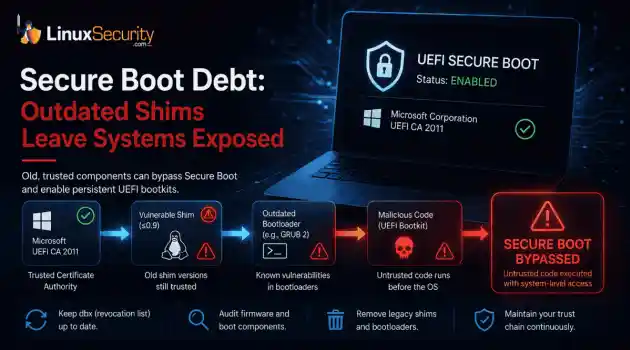
Security Vulnerabilities security advisory linux distribution
security advisory linux distribution ESET researchers identified 11 old and forgotten Linux UEFI shim bootloaders at versions 0.9 and below that can be used to bypass UEFI Secure Boot on any UEFI-based machine that trusts Microsoft’s Microsoft Corporation UEFI CA 2011 third-party certificate authority, regardless of the installed operating system (OS). Reported shims can be exploited to execute untrusted code during system boot, enabling attackers to deploy malicious UEFI bootkits even on systems with UEFI Secure Boot enabled.....
Jul 16, 2026
 Refine news
X Clear Filters
Get the latest News and Insights
Get the latest Linux and open source security news straight to your inbox.
Community Poll
Is continuous patching actually viable?
Trending News
Loading...
Explore Latest Linux Security news
We found -1 articles for you...
209
 security advisorycommunity collaborationvulnerability management
Navigating CVE Management in Linux Security: Embracing Community Control
As Linux security administrators, we're witnessing a pivotal shift in how open-source projects manage vulnerabilities. This transition is a result of new regulatory landscapes, such as the European Union Cyber Resilience Act, which mandates a more hands-on approach for open-source projects. These projects must now become their own CVE Naming Authorities (CNAs). . Gone are the days of relying solely on third-party vendors to assign and manage Common Vulnerabilities and Exposures (CVEs) . Instead, open-source communities must take the reins, ensuring a more accurate and direct handling of security vulnerabilities. Though introducing additional tasks, this change promises to reduce the issuance of unnecessary or erroneous CVEs, which have historically led to resource drain and, at times, complacency among security teams. For you, this shift brings a few key changes. Firstly, there will be increased administrative tasks related to security management, offering better accuracy and control over how vulnerabilities are handled. Projects will need efficient tools to automate the CVE process, just as the Linux kernel team has done with their public repository. Automation will help manage the high volume of vulnerabilities, allowing you to focus on resolution rather than tracking. Let's examine how this new approach not only aligns with regulatory requirements but also enhances the overall security framework of your open-source projects. Embracing the Responsibility of Managing CVEs Transitioning to managing CVEs internally means open-source projects are taking on a significant amount of responsibility. This can initially seem daunting, especially for smaller projects with limited resources. However, the outcome of this increased responsibility guarantees more precise vulnerability tracking. When projects manage their CVEs, they can tailor vulnerability identification to their specific needs and environments, reducing the noise from irrelevant or inaccurately assigned CVEs. Open-source projectsare inherently collaborative, a strength they can leverage in this new framework. By involving contributors in the CVE management process, teams can draw from a broader pool of expertise. This is not just about administrators or project leaders taking charge; it's about harnessing the collective power of the entire community. When everyone involved in a project understands their role in the new CVE management process, it leads to a more robust and dynamic approach to security. Enhancing Precision and Control The move to self-manage CVEs allows projects to exercise greater control over how vulnerabilities are reported and addressed. This addresses one of the major pain points of the previous system—misclassified or "bogus" CVEs issued by external parties. These issues often arise from a lack of understanding of a project's specific nuances. By becoming CNAs, projects can ensure that CVEs reflect actual security concerns and are not padded out with irrelevant issues. More accurate CVE management means vulnerabilities are handled more efficiently, from identification to resolution. This can significantly enhance a project’s security posture, reducing risk and building trust with users who rely on these open-source solutions. For us administrators, this means less time wasted sorting through irrelevant CVEs and more focus on resolving genuine vulnerabilities. Automation: A Necessary Tool With the increase in responsibility comes the need for tools to handle the workload. Automation is set to become indispensable in managing the CVE process. Take a cue from the Linux kernel team, which has implemented a public repository to disclose vulnerabilities. This approach streamlines vulnerability tracking and makes it easier for stakeholders to access, understand, and react to potential security issues. Automation tools can quickly generate CVE reports, reducing the manual effort required. They ensure that reports are consistent, timely, and accurate, allowing administrators to focus on criticalproblem-solving tasks rather than administrative overhead. Embracing automation also aids in compliance with new regulations , providing a clear audit trail of how vulnerabilities are identified and addressed. Building an Effective Reporting Infrastructure Establishing a standardized process for reporting and disclosing vulnerabilities is a crucial part of this transition. This involves setting up systems that can quickly disseminate information about CVEs to everyone who needs it, whether internal developers, external partners, or end-users. The process should be as transparent and accessible as possible, enabling a swift and effective response to security issues. Security teams can ensure no vulnerability slips through the cracks by developing a clear reporting infrastructure. This can involve creating detailed documentation and using universally understood formats, like JSON , for security vulnerability disclosures. It's also important to consider how feedback will be received and processed, ensuring that all parties agree and work towards a common goal. Projects that communicate their CVE handling processes effectively will stand out in the open-source community. When users and developers know how vulnerabilities are managed, their confidence in the project's security grows, leading to broader adoption and contribution. Leveraging Community Collaboration Open-source projects thrive on collaboration, which should be harnessed to manage security vulnerabilities effectively. Projects can benefit from varied expertise and creative problem-solving skills by involving a diverse group of contributors. This collective effort can lead to innovative approaches to vulnerability management that might not be possible in more siloed environments. Encouraging community involvement can be as simple as making vulnerability tracking tools and processes accessible and easy to use. Regular updates and clear guidelines on how contributors can help can also foster a sense of ownership and responsibilityamong community members. This collaborative approach enhances security and energizes the community, driving more contributions and improvements to the project. Our Final Thoughts: Moving Forward with Confidence Transitioning to a model where open-source projects manage their CVEs is a big change, but it has significant benefits. By taking control of vulnerability management, projects gain more accuracy, transparency, and efficiency. While the initial setup may require additional effort, the long-term advantages include a more robust security framework and increased trust from users and contributors. We, Linux security administrators, are at the forefront of this change, equipped to lead our projects toward a future where vulnerabilities are not just another checkbox but a focal point of innovation and collaboration. By embracing responsibility, implementing effective tools, fostering community engagement, and setting up streamlined processes, the challenge of CVE management becomes an opportunity to redefine and enhance security within open-source projects. This proactive approach ensures that open-source ecosystems remain secure, reliable, and ready to tackle the vulnerabilities of tomorrow. What are your thoughts on this shift? Let us know @lnxsec! . Community-driven initiatives implement CVE oversight to enhance precision and governance regarding security flaws, reinforcing defense and reliability.. Linux CVE Management, Open Source Security, Vulnerability Control, Community Collaboration, Automation Tools. . Brittany Day
 Apr 02, 2025
•
Apr 02, 2025
• Security Trends
209
 security practicesopen source softwaredata management
Open Source Strategies for Enhanced Security in Digital Operations
Digital transformation, powered by the principles of open-source security , is vital for businesses looking to excel in today's technology-driven landscape. Customers, employees, and partners demand easily accessible, seamless digital experiences that integrate securely with their daily lives. By adopting open-source digital strategies, companies improve operations, foster stronger relationships, and fortify their cybersecurity posture. . Many organizations still need to rely on outdated, manual processes and face challenges in securely organizing and sharing crucial information. The reliance on legacy systems poses significant risks, including vulnerabilities, cyberattacks, and data breaches. With modern, secure software solutions to streamline and protect activities, businesses can meet rising expectations or maintain a competitive edge against more agile, security-conscious competitors. Fortunately, adopting open-source security measures presents many digital opportunities for companies to enhance their security and achieve their transformation objectives. This guide will delve into five key ways digital software, underpinned by open-source security principles, can revolutionize operations across your organization, ensuring efficiency, innovation, and robust security in the digital era. Automate Manual and Repetitive Tasks with Open- Source Tools Many businesses still need to work on manual, paper-based processes that are time-consuming and prone to errors. Digital solutions allow you to automate repetitive tasks that consume employees' time. For instance, accounting software can automatically reconcile invoices and receipts. CRM systems can automate tasks like lead follow-ups, and workflow automation tools can digitize multi-step processes routing functions to the appropriate teams or individuals. Automation frees employees' time to focus on more strategic work by eliminating mundane, repetitive jobs and standardizing best practices. It also reduces the risk of humanerror. You'll see speed, accuracy, and compliance improvements when digitizing manual tasks. As digital solutions can automate repetitive tasks, open-source tools like Ansible, Jenkins, or GitLab can automate software development processes, server configurations, and deployment tasks. These tools can streamline operations on a Linux server, reducing the time and effort needed for manual intervention. Enhance Customer Experiences with Open Source CRMs Today's customers expect flawless, convenient digital experiences comparable to those of leading brands. Software applications can transform how customers interact with and perceive your business. For example, e-commerce offers a personalized virtual storefront that is available 24/7. Customers can browse, learn about products, and purchase without calling or visiting in person. Automated communication through email and text marketing helps nurture relationships. Responsive customer service management (CSM) systems provide customer support agents with a 360-degree view of inquiries, orders, and past interactions, enabling quick issue resolution and consistently meeting or exceeding customer expectations. Overall, engaging digital platforms enhances brand loyalty and advocacy. Positive interactions create opportunities to promote additional products or services in the future. Delighting customers remains the ultimate long-term growth strategy. Utilize open-source CRM (Customer Relationship Management) systems such as SuiteCRM or Odoo, which can be hosted on Linux servers. These systems allow businesses to automate customer follow-ups and track customer interactions, similar to proprietary CRM systems, but with the advantages of customization and flexibility that open-source solutions offer. Centralize and Organize Critical Data One of the primary challenges in today's business landscape is managing vast quantities of critical data effectively and securely. Without proper measures to protect it from becoming vulnerableor scattered across platforms, security breaches or data loss could occur, leaving companies vulnerable. Integrating open-source software for data management centralizes all this critical information and adds an extra layer of protection inherent within an open-source ecosystem. Open-source customer relationship management (CRM) systems and document management solutions demonstrate how businesses can securely centralize data. An open-source CRM enables organizations to safely house all customer interactions, orders, support cases, and more in one safe location, with secure access controls and encryption ensuring sensitive customer information remains accessible only by authorized personnel. Open-source document management systems also offer secure environments for storing, sharing, and tracking documents. These platforms feature automated backup, version control, and fine-grained permissions—essential features that keep records intact and confidential. Furthermore, open-source systems enable businesses to customize security features according to organizational needs. Centralizing data with open-source solutions provides businesses with additional transparency and collaborative security advantages inherent to the open-source model. As anyone can review code, vulnerabilities are more likely to be discovered and remedied swiftly by the community; additionally, such transparency encourages trust among stakeholders who can assess whether security measures in place meet expectations. Additionally, open-source business intelligence and analytics tools can transform centralized data into actionable insights. These tools offer advanced security and protection features to ensure robust yet secure decision-making processes. Improve Communication and Collaboration Clear communication and collaboration are crucial in today's business environment, especially in distributed work. Digital collaboration tools keep all teams and stakeholders connected to their work, regardless of location. These toolsenable group chats, file sharing, comments, and video meetings within designated channels. For example, project management software allows you to centralize task assignments, monitor progress, document processes, and provide real-time feedback. Through transparent discussions, online collaboration fosters better decision-making, leading to more productive outcomes with fewer obstacles. When digital communication is prioritized, remote or hybrid workers align closely with overall business goals and priorities. Gain Deeper Business Insights Actionable business intelligence relies on synthesizing large amounts of data. Digital analytics tools aggregate vital metrics and performance indicators, revealing patterns and trends that are difficult to identify with manual reporting. For instance, analytics dashboards in marketing automation or e-commerce platforms track campaign performance, product views, and sales conversions, providing insights into what drives leads and revenue. Data-driven insights guide more effective marketing strategies and resource allocation over time. Similarly, finance or production management tools deliver operational KPIs and predictive forecasts, enabling you to identify issues before they impact goals. With in-depth analytics, you can better understand what drives your business and set more achievable expectations. Enhancing Security with Linux and Open-Source Software Security is not simply necessary in today's digital business environment; it forms the cornerstone of trust between a company and its customers, employees, and partners. Linux and open-source software offer unique benefits to companies seeking to enhance their digital security posture. From collaborative open-source development projects that promote security features built into Linux OS to collaborative open-source development that fosters more robust levels of digital protection, this combination can help businesses attain increased digital safety levels. Utilizing Linux to EnableSecure Operations Linux is widely known for its security features, making it an excellent option for hosting critical applications and managing sensitive data. Here's how Linux contributes to creating a safe digital environment: 1. Robust User Permission Management: Linux boasts an advanced user permission system, ensuring only authorized individuals can access files and applications. This protects against malicious access or data breach risks that might otherwise occur. 2. Security-Enhanced Linux (SELinux) and AppArmor are powerful Linux kernel security modules that add an extra layer of protection, with mandatory access control policies that limit program capabilities through per-program profiles. 3. Regular Security Updates: With Linux's robust community and rapid patching times for security vulnerabilities, businesses should stay current on these updates to stay safe against emerging threats. By staying abreast of them and adhering to them regularly, businesses can stay protected against current or emerging risks. Open Source Security Tools and Practices Open-source software provides businesses access to many security tools they can customize and integrate into their digital infrastructure for more excellent protection. Here are a few ways open source can enhance security: 1. Customizable Security Solutions: Open-source security tools can be adapted and customized to fit a business's unique requirements, giving them greater flexibility than proprietary tools in designing security practices that closely match operational needs and threat models. 2. Transparency and Community Review: Open source software can significantly benefit from scrutiny from an international community of contributors who quickly identify security flaws. With their collective efforts, contributors swiftly rectify vulnerabilities, resulting in more secure software. This continuous improvement cycle can ultimately result in the development of safer software products. 3. Innovative Security Tools: The open source ecosystem offers many innovative security tools, such as fail2ban (intrusion prevention software), OpenVPN (secure VPN tunneling), and ClamAV (antivirus engine), to bolster an organization's security posture. Implementing Open Source Security in Real-World Situations Imagine a business seeking to protect customer data and internal communications by using OpenVPN for remote access, significantly reducing the risks of data interception. Incorporating ClamAV into email servers for scanning attachments and downloads is an antimalware measure; failing this, fail2ban can also help prevent brute force attacks by banning IPs showing signs of malign activity. These open-source tools on a Linux infrastructure provide a robust security framework to safeguard against various cyber attacks and risks while meeting specific business needs and emerging risks. Integrating Linux and open-source software into a business's digital transformation strategy offers improved efficiency and innovation and enhanced security measures to protect digital assets while building trust among stakeholders in today's digital landscape. Keep Learning About Transforming Your Business Using Open Source Tools In summary, well-chosen digital solutions have the power to transform your business and optimize operations in various ways. CRM, ERP, marketing automation, and other software tools enable companies to streamline workflows, centralize important data, improve collaboration, and gain invaluable insights—all of which drive increased productivity and reduced costs. Regularly evaluating emerging solutions ensures your business continuously evolves its technological capabilities, keeping pace with rapid market shifts. While innovation is crucial to long-term success, digital tools open numerous doors for innovation across functions. Ultimately, operational transformation leads to optimized efficiency, cost savings, and growth. . Elevate your online processes by utilizing free-to-use resourcesand methodologies to promote improved protection and creativity within your organization.. Open Source Security, Digital Business Operations, Automation Tools, Data Management Solutions, Customer Experience Innovations. . Brittany Day
Aug 23, 2024
•
Security Trends

76
 security practicessoftware developmentautomation tools
Exploring OpenSSF's Initiatives to Mitigate Log4j-Like Flaws
More critical flaws similar to Log4Shell found in open source are almost inevitable, but Open Source Security Foundation ’s (OpenSSF’s) goal is to make those incidents rare and continually make the attackers’ job harder, a Linux Foundation executive noted. . Founded in 2020, OpenSSF is a cross-industry organization hosted by the Linux Foundation that brings together individuals and companies including Cisco , GitHub, Google , and VMware , to develop better security tools and practices for open source application development without bias toward a specific ecosystem or vendor. The organization offers automation tools, educational materials, and courses and develops various projects and frameworks — including Supply Chain Levels for Software Artifacts (SLSA) , Secure Supply Chain Consumption Framework (S2C2F) , Software Bill of Materials (SBOM) Everywhere , and Alpha-Omega — to improve security for the open source community, David Wheeler, Director of open source supply chain security at Linux Foundation, told SDxCentral. “Certainly nobody wants another Log4j, [but] a major vulnerability in software that beats open source or closed source is probably inevitable,” he said. “So the goal is to make these kinds of problems rare. And so we are working towards that end.” Wheeler noted OpenSSF offers open source security courses that specifically educate students not to make the mistake that happened in Apache Log4j 2 Java library. “Unfortunately, LogShell was not, as far as anyone can tell, intentional maliciousness. It was an honest mistake, in part due to the complexity of code, and in part, frankly due to people who are doing the development not knowing how to do certain kinds of secure software development, and the tools that really support them either,” he said. . The Linux Foundation is focused on preventing vulnerabilities akin to Log4j by promoting robust security measures throughout open-source development ecosystems.. OpenSSF, Open SourceSecurity, Log4j Incident, Risk Management, Secure Development. . Brittany Day
Mar 13, 2023
•
Organizations/Events
74
 IT securityhacking techniquesethical hacking
Essential Programming Languages For Ethical Hacking In 2023
Ethical hacking is a proactive approach using the same techniques and programming languages as malicious hacking. Ethical hackers must stay current on IT security as well as the latest methods and programming languages used by attackers. Three of the best programming languages for Ethical Hacking are PHP, Python, and SQL. . Programming languages are sets of instructions that instruct a computer to perform specific tasks. However, there are over 300 programming languages, and many categories overlap. The C programming language is the most ancient of a group of languages that are distinct but overlap. Ethical hackers must have a thorough understanding of programming languages in order to analyse and modify code. Programming languages can also be used to automate time-consuming tasks and detect errors in software. Finally, the top programming languages for ethical hacking are determined by the computer systems and platforms under consideration. The programming languages used by cyber criminals are the best for ethical hacking. Here are ten hacking languages to learn, ranging from Bash to JavaScript and SQL. . Dive into the premier coding languages vital for cybersecurity professionals in 2023, ranging from Python to JavaScript. Master key skills now.. Ethical Hacking Techniques, Programming Languages 2023, Cybersecurity Skills. . Brittany Day
Feb 22, 2023
•
Network Security

Get the latest News and Insights
Get the latest Linux and open source security news straight to your inbox.
Community Poll
Is continuous patching actually viable?
Trending News
Search Topics
Powered By

Linux Security - Your source for Top Linux News, Advisories, HOWTOs and Feature Releases
QUICK LINKS
subscribe to newsletters!
Like staying secure? So do we.
Sign up for updates, tips, and alerts!