Explore top 10 tips to secure your open-source projects now. Read More
×



Server Security data privacy automation
data privacy automation Every system admin has lived through the same Monday morning ritual. A queue of forty tickets, half of them password resets, permission errors, or disk space warnings that any experienced technician could resolve in under two minutes. The other half require actual judgment. For years, automation promised that software would eventually sort the two apart on its own. That promise is now being tested in production Linux environments. . Early results are reshaping how IT teams think about tier-1...
 Jul 17, 2026

Privacydata collection automation
data collection automation You're running a web scraping project to collect pricing data from e-commerce sites. You set up a pool of datacenter proxies, launch your scripts, and within minutes — banned . CAPTCHAs everywhere. Your data pipeline stops before it really begins. . It's a frustrating scenario that plays out daily in ad verification, market research, and multi-account management. The website doesn't know you're doing legitimate research or monitoring. It just sees traffic coming from IP ranges it recognizes as...
Jul 17, 2026

Security Trends security advisory social engineering
security advisory social engineering Business Email Compromise used to be a numbers game — mass-blasted emails, broken English, an obvious "URGENT WIRE TRANSFER" subject line. That era is over. Generative AI has turned BEC into a tailored, low-noise operation that mimics writing style, voice, and even video presence. This piece looks at what's actually changed under the hood, what defenders are testing in response, and why so many organizations are still structurally unprepared for it. . The Infrastructure Problem Nobody Wants to...
Jul 17, 2026

Security Trends cybersecurity Linux documentation
cybersecurity Linux documentation Linux operating systems have gained prominence due to their stability, adaptability, and excellent security options. In the case of developing documentation, designing cybersecurity dashboards, or educational material, visuals are of vital importance when it comes to making things clear. The use of icons allows one to understand the message regarding alerts, authorization, encryption, authentication, or the state of the system just by looking at the visual cue without having to read long...
Jul 17, 2026
Security Vulnerabilities security advisory linux distribution
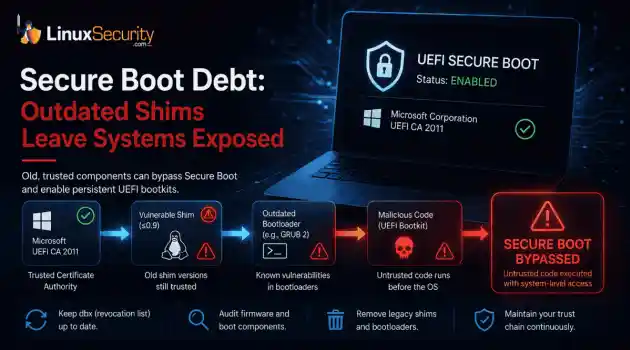
security advisory linux distribution ESET researchers identified 11 old and forgotten Linux UEFI shim bootloaders at versions 0.9 and below that can be used to bypass UEFI Secure Boot on any UEFI-based machine that trusts Microsoft’s Microsoft Corporation UEFI CA 2011 third-party certificate authority, regardless of the installed operating system (OS). Reported shims can be exploited to execute untrusted code during system boot, enabling attackers to deploy malicious UEFI bootkits even on systems with UEFI Secure Boot enabled.....
Jul 16, 2026
 Refine news
X Clear Filters
Get the latest News and Insights
Get the latest Linux and open source security news straight to your inbox.
Community Poll
Is continuous patching actually viable?
Loading...
Explore Latest Linux Security news
We found 385 articles for you...
83
 data protectionIT securityransomware
Hunters International Ransomware: A Cross-Platform Cybersecurity Challenge
In an alarming development for the cybersecurity community, the ransomware group Hunters International, suspected to be a rebrand of the notorious Hive ransomware , has been linked to extensive attacks on Windows, Linux, FreeBSD, SunOS, and ESXi systems. This discovery underscores the urgent need for robust defenses across all platforms. . This ransomware variant encrypts files and exfiltrates data, compounding the threat with potential data breaches. With advanced evasion techniques and a cross-platform reach, Hunters International exemplifies how modern ransomware is evolving into a more sophisticated and widespread menace. Let's take a closer look at what makes this cross-platform threat so dangerous, the growing importance of data protection, and the future of cross-platform attacks. Understanding This Cross-Platform Threat Hunters International poses a severe threat across multiple operating systems, and its main differentiator is its cross-platform capability. Hunters International ransomware can compromise not only Windows computers, as is typically targeted, but also Linux , FreeBSD, SunOS, and ESXi environments - effectively rendering no corner of an organization's IT infrastructure safe. This means no admin should assume their systems are free from danger. Linux admins face heightened risk, as this opens them up to more severe attacks than traditional threats against Windows. To respond to this threat, Linux administrators must ensure their security defenses can meet it head-on. This means having more than a strong antivirus and anti-malware solution. Comprehensive endpoint protection that recognizes and responds to threats across platforms must also be in place. Intrusion detection systems must also be configured to detect unusual behaviors within individual machines and across an entire network. At the same time, regular updates and patches can close any potential holes before attackers exploit them. The Double-Edged Sword: Exfiltration & Extortion HuntersInternational stands out among other ransomware groups by employing two distinct strategies of exfiltration and extortion. Encrypting files can disrupt an organization's operations, while exfiltrating sensitive information adds another level of pressure that increases both the chances that victims pay the ransom in exchange for accessing their files, but also raises stakes by potentially exposing customer records, intellectual property, or any other vital details that might otherwise remain concealed from view. A backup strategy is a great start in minimizing damage in the event of a ransomware attack, but alone, it is not sufficient to safeguard critical data. Although having regular, secure backups is essential to recovery efforts, they do not prevent data leakage. Data loss prevention (DLP) techniques must also be implemented to monitor and protect sensitive information at rest and in transit. Network monitoring tools should also be tuned to detect abnormal data movement patterns that might signal exfiltration attempts. Access control measures must also be implemented to limit user access to what users require to effectively complete their jobs. Navigating Advanced Evasion Techniques Hunters International doesn't rely on brute force to achieve its objectives - the ransomware implements sophisticated evasion techniques that complicate detection and response efforts, such as automatically mounting unmounted disk partitions to gain more data to encrypt and exfiltrate. In addition, this ransomware features an optional command-line interface (CLI) option to delay execution, making real-time detection systems' task of quickly detecting malicious activities more difficult. We Linux admins must beef up our monitoring abilities to counter these advanced tactics, watching for unusual behaviors such as unexpected mount operations. Security Information and Event Management (SIEM) systems are particularly helpful in analyzing log data from multiple sources to detect anomalies that mightsignal ransomware attacks. Admins should also inform their teams about these advanced evasion techniques so they can recognize and address them swiftly when they appear. The Rise of Ransomware-as-a-Service (RaaS) Hunters International's activities provide insight into broader trends surrounding ransomware attacks. One such trend is the emergence of ransomware-as-a-service (RaaS). This model allows even relatively inexperienced attackers to launch sophisticated ransomware campaigns by renting tools from more experienced developers, meaning criminal groups remain an ongoing threat despite law enforcement's attempts to shut them down. RaaS platforms reduce entry barriers for cybercriminals, leading to an upsurge in ransomware attacks . This trend highlights the importance of adopting an active and comprehensive cybersecurity approach. Regular penetration tests , security audits, and threat hunting exercises will help detect vulnerabilities before attackers exploit them. The Growing Importance of Data Protection Ransomware operators are increasingly targeting organizations' data through data exfiltration tactics, using the threat of public release of stolen files as leverage against victims to get them to pay ransom. Organizations must place greater importance on protecting sensitive information. Encryption should be implemented not only when data is being stored but also while it is being transmitted between servers. Additionally, comprehensive governance policies should be established to determine who accesses sensitive information under what conditions. When a data breach occurs, an effective response plan is critical to mitigating its consequences and minimizing damage as soon as possible. Being ready to respond quickly and efficiently to ransomware attacks can significantly reduce their impact. Understanding the Future of Cross-Platform Attacks Hunters International ransomware's ability to target multiple operating systems represents a larger trend towards sophisticated malwaredesigned to impact multiple IT environments simultaneously. This is forcing organizations to adopt an all-encompassing cybersecurity policy, with protections in place not just against one operating system but all their platforms of choice. This holistic approach involves regular training and awareness programs for employees to ensure they understand risks, recognize threats, and can identify them quickly. Furthermore, it involves investing in security solutions offering comprehensive protection across different environments. Unified security management platforms allow centralized administration for IT infrastructure management, enabling consistent security policies to be enforced more efficiently while being more agile at responding to potential threats. Our Final Thoughts: Taking a Proactive Stance Against Ransomware Threats Hunters International's ransomware campaigns highlight the need for Linux admins and all IT security professionals to take a more aggressive stance against ransomware threats. This means safeguarding systems and data and keeping abreast of new cybersecurity trends and threats. By understanding modern ransomware operators' tactics, administrators can better protect organizations against potentially devastating attacks. The key takeaway is that cybersecurity is an ongoing journey. Threats will constantly evolve, and attackers will discover ways to bypass defenses. By adopting an attitude of continuous improvement and vigilance, we can ensure we always stay one step ahead of attackers and protect systems and data against ransomware attacks. . Explorers Global focuses on Windows and various platforms plagued by malware, highlighting the necessity for strong cybersecurity measures.. Ransomware Evolution, IT Security Challenges, Cross-Platform Threats, Data Protection Strategies. . Brittany Day
 Apr 07, 2025
•
Apr 07, 2025
• Hacks/Cracks
83
 malwaredetectionprevention
CRON#TRAP: Emulated Linux Threats and Detection Strategies
Security threats continue to emerge from every corner of the cyber universe, with malicious actors constantly innovating new techniques to breach systems and remain undetected. One such creative attack is an emerging campaign dubbed "CRON#TRAP," which uses emulated Linux environments to execute malicious commands stealthily. . In this article, I'll explore CRON#TRAP's intricacies, including its design, significance, and potential targets, and offer practical advice for detection and prevention. Understanding CRON#TRAP Understanding CRON#TRAP requires diving deep into its complex attack vector, where cybercriminals use custom-built QEMU (Quick Emulator) Linux boxes on compromised endpoints to mount attacks. This emulated Linux environment, often distributed via phishing emails , has a backdoor that enables attackers to remain hidden on victim machines for extended periods. An initial step in an attack usually begins with phishing emails containing links to download an unorthodoxly large ZIP file titled "OneAmerica Survey.zip," often over 285MB - an early warning signal for alert users. Once they extract the archive, users find a shortcut file ("OneAmerica Survey.lnk") and a data directory that houses the QEMU installation directory; however, its contents remain hidden unless users enable the "view hidden files" option in their file explorer. Lure Image (source: securonix) The shortcut file connects to the system's PowerShell process and executes a command that re-extracts ZIP file contents into the user's profile directory and starts the start.bat batch file. This batch file primarily performs two actions: it displays a fake "server error" message to conceal malicious activity. It also executes QEMU (disguised as fontdiag.exe) emulator for running Linux environments on computers running Microsoft Windows OSes. QEMU runs invisibly in the background using its "-nographic" parameter to ensure an emulated Linux instance operates without a graphical user interface, making its detectiondifficult. Within this "PivotBox," attackers can execute additional commands or stage further malware without directly engaging with the host system - bypassing traditional antivirus solutions. Linux instances contain special commands, like get-host-shell and get-host-user , that allow them to interact with their host machine by accessing stored user context information. These allow attackers to execute host system shells from within an emulated environment, thereby improving their chances of remaining undetected while conducting malicious activities. Examining the Significance of This Novel Technique Utilizing QEMU to install an emulated Linux environment on a victim's machine is an innovative malware deployment strategy. As this virtualization tool is widely used and not usually flagged by security systems, attackers can circumvent traditional antivirus detection mechanisms. By operating within an isolated Linux environment, attackers can execute commands and stage further attacks without leaving a significant footprint on the host system. This level of stealth and persistence can remain undetected for extended periods, enabling attackers to conduct extensive reconnaissance, data exfiltration, or other malicious activities without detection. Who Is at Risk? While the victims of CRON#TRAP remain unknown, telemetry data indicates that most sources originate in either North America or Europe, with North America potentially being targeted as the main area for attack. Organizations across various sectors, such as government, finance, healthcare, and critical infrastructure, could fall prey to such sophisticated attacks. Individuals within these organizations who handle sensitive information, such as executives, IT administrators, and employees with elevated privileges, are particularly at risk. Phishing as an initial attack vector only compounds this risk further as it targets human vulnerabilities through social engineering techniques. Strategies for Early Detection and Prevention CRON#TRAP detection and prevention require a multidimensional approach to safeguarding systems. In particular, to detect CRON#TRAP, it's vital to watch out for unusual files and processes - such as large and oddly named ZIP files appearing unexpectedly or shortcut files appearing in unusual places - which could signal potential CRON#TRAP attacks. System processes should be carefully evaluated for QEMU processes running, especially those using strange names like fontdiag.exe. Network traffic analysis is equally important. This includes scanning for known malicious command and control (C2) servers and using network monitoring tools to detect anomalous outbound connections that could indicate backdoor access points. PowerShell activities require careful examination through audit log analysis for any unusual command executions, especially those related to file extraction and batch file execution. Implementing Endpoint Detection and Response (EDR) solutions can detect suspicious activities on endpoints, including hidden processes being run as processes running in parallel. To prevent CRON#TRAP attacks, comprehensive email security measures must be in place. This may involve installing advanced filters to detect and block phishing attempts and training employees about these tactics to recognize suspicious emails. File integrity monitoring tools can be extremely useful in detecting changes to important files and directories, including any hidden ones that may appear suddenly. Implementing Multi-Factor Authentication (MFA) protects against unauthorized access even if credentials have been compromised. Regular updates are necessary to protect all software, including operating systems and virtualization tools like QEMU, from known vulnerabilities. Network segmentation can limit lateral movement within systems by applying the principle of least privilege to restrict user access only to essential functions. Regular security audits and vulnerability assessments should also be performed to detect anyweaknesses in the security framework, providing an active defense against CRON#TRAP attacks. Our Final Thoughts on This Novel Linux Security Threat The CRON#TRAP campaign draws attention to the ever-evolving nature of cyber threats, highlighting their need for robust security measures that adapt to them. By exploiting emulated Linux environments through QEMU, attackers can avoid traditional detection mechanisms while maintaining a stealthy presence on compromised systems. Organizations should remain vigilant and implement robust detection and prevention strategies against advanced threats to stay protected against such risks. . Delve into the CRON#TRAP cyber threat operation, utilizing simulated Linux platforms for surreptitious infiltrations, and discover effective countermeasures to defend against such incursions.. CRON#TRAP malware,QEMU detection,cyber threats prevention,emulated Linux environments,phishing attacks. . Brittany Day
Nov 06, 2024
•
Hacks/Cracks

83
 network securityLinux administrationransomware
Akira Ransomware Advisory: Strategies for Linux Admins to Mitigate Risks
Cisco Talos' recent discovery of a Rust variant of the Akira ransomware targeting ESXi servers demonstrates how quickly modern cyber threats evolve. Akira ransomware is one of the most formidable. According to their research, Its operators have continuously developed their tactics, techniques, and procedures (TTPs), solidifying their position as notorious adversaries. . Once double-extortion techniques were used exclusively, their focus shifted toward improving encryption. Key advancements were noted when Akira created a Rust variant targeting ESXi servers. To help you understand this evolving threat, I'll explain its mechanisms of operations, the various advantages Rust offers, and practical measures admins can implement to prevent attacks. Understanding Akira Ransomware For years, Akira ransomware was notorious for employing a double-extortion tactic—taking critical data before encryption to further increase pressure on victims to comply with ransom demands. But in early 2024, a noticeable change occurred: ransomware developers temporarily sidelined encryption methods in favor of data exfiltration strategies, enabling them to refine and strengthen their malware over time. Akira has demonstrated impressive momentum over its development lifecycle. First created using C++, Akira ransomware operators then experimented with Rust to iterate on its payload functions. This trend in malware development highlights how adversaries search for more efficient, reliable, and harder-to-detect programming languages and techniques. Moreover, recent iterations suggest encryption tactics were revisited but enhanced using lessons learned from earlier iterations. This approach targets victims more aggressively and highlights Akira's meticulous refinement of its attack chain. Technical Insights into Akira's Operations Affiliates of Akira ransomware have taken advantage of recently disclosed Common Vulnerabilities and Exposures (CVEs) to gain initial access and move laterally across networks. Notable amongthese CVEs are CVE-2024-40766 , an exploit in SonicWall SonicOS that allows remote code execution. Adaptive Security Appliance ( CVE-2023-20263 ) vulnerabilities and FortiClientEMS software vulnerabilities. These flaws have been exploited for initial access and privilege escalation. Once inside a network, operators use sophisticated techniques to remain undetected and hidden. PowerShell scripts may be deployed for credential harvesting and privilege escalation. Such scripts often use Veeam backup systems' credentials to harvest Kerberos authentication credentials and dump Kerberos credentials into other backups like Tarsus backups. They also delete system shadow copies using Windows Management Instrumentation (WMI), hindering file recovery efforts. One notable incident involved targeting a Latin American airline in June 2024 by hackers using CVE-2023-27532 vulnerabilities found within their Veeam backup servers to access and swiftly deploy Akira ransomware, followed by data exfiltration. Its modules are for moving through compromised networks via Remote Desktop Protocol (RDP), employing defense evasion techniques like binary padding and disabling security tools, and defense-evasion tactics like binary padding to bypass defense tools and defenses. Examining Rust's Performance and Security Advantages Akira's development of a Rust variant targeting ESXi servers marks a critical turning point in its evolution. Rust , known for its performance and security features, provides several advantages over conventional languages like C++ - such as reduced memory management errors, increased resilience, and more challenging detection by signature-based antimalware tools. This evolution represents ongoing efforts by Akira actors to increase sophistication and stealthiness within their operations. Returning to trusted encryption methods after language experimentation indicates that Akira prioritizes stability and efficiency. Rust variant 2024.1.30 displayed advanced capabilities for targeting specificfile types or directories on Linux ESXi hosts, further signaling Akira's strategy of targeted attacks against virtual machine environments ubiquitous across modern enterprises. Patch management has become necessary due to Akira affiliates' unfaltering desire to exploit vulnerabilities. Their adaptability and willingness to exploit unpatched or poorly protected systems underscore the necessity of upholding robust patching practices. Prevention & Mitigation Recommendations for Linux Network Administrators Network administrators must adopt an aggressive, multifaceted, and preventative strategy against Akira ransomware to mitigate risk effectively. This involves implementing several key strategies to minimize risks effectively. First and foremost, patch management should be prioritized. Admins should ensure that all systems and software have the latest security patches that address the vulnerabilities Akira exploits. Furthermore, network segmentation must be implemented to limit lateral movement within an environment, protecting critical systems while controlling ransomware spread. Credential management practices should be rigorous, with regular password changes, implementing multi-factor authentication (MFA) , and adhering to minimal privilege access. Furthermore, regular backups should be performed and stored offline or in isolated environments to enable recovery without succumbing to ransom demands. Monitoring and auditing system logs for suspicious activity is another critical safeguard, with admins using tools and processes to detect anomalies promptly. Advanced endpoint protection tools that use behavioral analysis rather than signature-based detection to help identify and block ransomware activities are also helpful. Finally, employee training should also be prioritized. Regular sessions should be held to educate employees on phishing and social engineering threats and safe browsing practices. Human awareness is one of the first lines of defense against ransomware attacks. Creating and updating a comprehensive incident response plan focused on ransomware is paramount to ensure organizational readiness against attacks on any scale. Our Final Thought on the Emergence of Akira Ransomware Akira ransomware's evolution over time demonstrates its adversaries' adaptability and persistence. By continuously adapting their TTPs, these malicious actors are well-positioned to exploit emerging vulnerabilities and bypass conventional security measures. Therefore, organizations must adopt a comprehensive, proactive approach to cybersecurity: staying ahead of threats requires technical measures, education, vigilance, and preparedness—especially as cyberspace becomes ever more complex. Understanding threats like Akira ransomware is crucial in protecting enterprise environments and critical data. . The Akira ransomware is adapting its methods; discover preventive strategies to enhance cybersecurity defenses against potential attacks.. Akira Ransomware, Network Security, Linux Protection, Cyber Threats, Rust Programming. . Brittany Day
Oct 22, 2024
•
Hacks/Cracks
77
 application securitymalwareLinux administration
Defending Oracle WebLogic from Hadooken Malware Threats
Cybercriminals have been relentlessly attacking the digital landscape, aiming to exploit vulnerabilities in well-known systems. One such exploit is the recently discovered Hadooken malware, which targets Oracle WebLogic applications. . To help you secure your server against this emerging threat, we will explore the intricacies of the Hadooken malware, understand its operational mechanics, and pinpoint the targets it aims to compromise. We'll then offer practical detection and mitigation advice for Linux administrators and organizations. An Introduction to Oracle WebLogic Server Oracle WebLogic Server is a leading enterprise-level Java EE application server widely utilized for building, deploying, and managing large-scale, distributed applications. Developed by Oracle, it boasts strong support for Java technologies, transaction management, and scalability. Due to its prevalence in critical sectors such as banking, e-commerce, and various business-critical systems, WebLogic is often a prime target for cyberattacks. Despite its robust architecture, WebLogic has been susceptible to attacks due to vulnerabilities such as deserialization flaws and improper access controls. Misconfigurations, like weak credentials or exposed admin consoles, can lead to severe consequences, including remote code execution (RCE), privilege escalation, and data breaches if not properly secured or patched. How Does Hadooken Malware Operate? Hadooken malware is a complex threat that targets WebLogic servers by exploiting weak credentials and other vulnerabilities. When executed, the malware introduces additional threats, including the Tsunami malware and a crypto-miner. Here's a breakdown of the Hadooken malware's operation: Source: AquaSec Blog Initial Access and Execution The attackers gain initial access by exploiting weak credentials on WebLogic servers. Once inside, they achieve remote code execution. The malicious script downloads two scripts, a shell script named ‘c’ and a Python scriptnamed ‘y’, which serve as secondary payload mechanisms. Payload Delivery The primary payload, Hadooken malware, gets downloaded into non-persistent temporary directories. The Python script iterates over several paths to secure the download and execution while subsequently deleting the original file to avoid detection. The shell script similarly downloads the Hadooken malware into the /tmp directory, executing and then deleting it to remain stealthy. Secondary Malware Hadooken executes to deploy both a crypto-miner and Tsunami malware. Once packed and unpacked, the crypto-miner is dropped into several paths: /usr/bin/crondr, /usr/bin/bprofr, and `/mnt/-java. The Tsunami malware is also deployed, randomly named, into the /tmp/ directory, although indications show it isn't immediately used in the attack. Persistence and Evasion Hadooken creates multiple cron jobs to maintain persistence, using random names and varying frequencies for execution scripts under different cron directories. The malware employs tactics to evade detection by renaming its crypto miner to familiar names like -bash and deleting logs after execution. Lateral Movement and Impact Hadooken attempts to iteratively access SSH keys, allowing it to move laterally across connected servers within an organization. The malware's impact is evident in its resource hijacking for crypto-mining and its potential to introduce ransomware such as RHOMBUS and NoEscape in prolonged campaigns. Detection and Mitigation: Best Practices for Linux Admins and Organizations Given the sophisticated nature of Hadooken malware and the severity of its impact, Linux administrators and organizations must adopt a comprehensive approach to detect, mitigate, and prevent such threats. Here are some actionable strategies to secure your server and your Linux environment against Hadooken malware: Infrastructure as Code (IaC) Scanning: Scan IaC templates such as Terraform, CloudFormation, or Kubernetes YAML files for potentialmisconfigurations before deployment. Cloud Security Posture Management (CSPM): Continuously scan cloud configurations for misconfigurations, compliance violations, and security risks across services like AWS, Azure, and GCP. Kubernetes Security and Configuration: Regularly scan Kubernetes clusters for compliance with security best practices. Ensure alignment with CIS Kubernetes benchmarks . Container Security: Perform thorough vulnerability scanning of container images and Docker files to identify and rectify misconfigurations and vulnerabilities. Runtime Security Monitoring: Implement runtime security tools to monitor cloud-native applications for anomalies and suspicious behaviors in real time. Our Final Thoughts on Protecting Against Hadooken Malware The Hadooken malware illustrates the evolving nature of cyber threats targeting enterprise-level applications like Oracle WebLogic. Linux administrators and organizations can significantly mitigate risk and safeguard critical systems by understanding its operation and adopting proactive and reactive security measures. Continuous vigilance, regular updates , strong authentication practices, and comprehensive security tools are paramount in maintaining a secure digital environment amidst these growing threats. . Fortify your system from Hadooken threats through effective detection, mitigation techniques, and essential guidelines for Linux administrators.. WebLogic Security, Malware Detection, Cyber Threats, Application Security, Linux Administration. . Brittany Day
Sep 16, 2024
•
Server Security
83
 security practicesmalwarecyber threat
Ebury Malware Analysis: Key Risks for 400K Linux Servers
As cybersecurity practitioners, we are no strangers to the constant threat of malicious actors and the importance of remaining vigilant to protect our systems. Security researchers have identified a massive botnet comprising over 400,000 compromised Linux servers, reinforcing the need to stay alert and implement robust security measures. Let's examine the significance of this discovery and what we can learn from it to protect against future attacks. . Why Is the Ebury Malware So Significant? What Can We Learn from This Threat? According to researchers, the botnet has been active since at least 2009, demonstrating the tenacity and persistence of the threat group behind the Ebury malware . The botnet has evolved significantly over the past decade, employing various techniques to propagate the malware and expand its reach. For example, the Ebury gang has leveraged access to hosting companies’ infrastructure to install Ebury on all hosted servers, intercepted and redirected SSH traffic inside data centers to capture credentials, and automatically steals crypto wallets when victims log in. Of particular concern is the botnet's use for illicit financial gain, such as stealing financial data from transactional websites and cryptojacking to mine cryptocurrency on infected systems. Research also reveals the latest update to the Ebury malware family, version 1.8, which includes new ways to hide information, a new domain generation algorithm (DGA), and better userland rootkits that Ebury uses to hide from system admins. Linux admins must recognize the implications of these findings and take proactive steps to prevent compromise from the evolving Ebury threat. Maintaining patched systems and robust credential policies is critical, along with monitoring for indicators of compromise and implementing security best practices such as firewall configurations and regular software updates . Perhaps most importantly, we must remain vigilant and continue educating ourselves and others about the evolvingthreat landscape, ensuring we stay up-to-date with the latest security trends and techniques. Our Final Thoughts on the Ebury Malware The recent discovery of a massive botnet comprised of over 400,000 compromised Linux servers highlights the ongoing need for strong cybersecurity measures and constant vigilance. It is essential to recognize the evolving threat landscape and take proactive steps to prevent compromise, stay informed about the latest security trends, and educate others about the importance of security best practices. Failure to take such measures could have severe long-term consequences that could put sensitive financial and other data at risk. . The Ebury malware poses a major risk to Linux security, exploiting its botnet capabilities and increasing Linux-targeted attacks, emphasizing the need for better defenses. Ebury Botnet, Linux Malware, Cyber Threats, Cryptojacking, Server Security. . Brittany Day
Jun 03, 2024
•
Hacks/Cracks
77
 Linux securitysecurity measuresmalware
Combatting Magnet Goblin Linux Malware Threats and Security Solutions
Financially motivated hacking groups are increasingly exploiting newly disclosed vulnerabilities to deploy custom malware on public-facing servers. The threat actors are known as Magnet Goblin, and they have been quick to leverage one-day flaws, vulnerabilities for which a patch has been released but not yet applied by the target, to carry out their attacks. . Why Are the Implications of This Threat? The challenges faced by security practitioners in fighting against these types of threats must be acknowledged. While exploits are not immediately available upon disclosing a flaw, some vulnerabilities are easy to figure out and leverage through reverse-engineering the patch. This raises questions about the effectiveness of relying solely on patching as a defense mechanism. Are there other strategies and mechanisms that can be implemented to mitigate the impact of these attacks in the absence of a patch? Magnet Goblin targets Ivanti Connect Secure, Apache ActiveMQ, ConnectWise ScreenConnect, Qlik Sense, and Magento. This information can be precious to Linux admins, infosec professionals, and sysadmins, as it reveals the potential targets that must be closely monitored and patched diligently. The NerbianRAT malware, circulating since May 2022, is one variant that Magnet Goblin has been using to compromise servers. It is described as "sloppily compiled yet effective," which begs the question: how can a poorly constructed malware variant remain effective for such an extended period? Is this a testament to the ingenuity of the threat actors, or is there a flaw in the defense mechanisms employed by the targeted systems? How Can I Secure My Systems Against These Attacks? The importance of quick patching to combat 1-day exploitation cannot be overemphasized. However, it is not enough to rely solely on patching to ensure optimal security. Network segmentation, endpoint protection, and multi-factor authentication are additional security measures that can help mitigate the impact of potentialbreaches. It is crucial for security practitioners to not only stay informed about the newest vulnerabilities and exploits but also to implement a comprehensive security posture that goes beyond patching. Our Final Thought on Linux Malware Protection. This article aims to shed light on Magnet Goblin's activities and their exploitation of one-day flaws to deliver custom Linux malware. It highlights the challenges faced by security practitioners in detecting and mitigating these threats and raises essential questions about the efficacy of patching as the sole solution. By critically analyzing the implications and offering suggestions for comprehensive security measures, we hope to empower readers to prioritize their defense strategies and adapt to the ever-changing landscape of cyber threats. . Profit-driven cybercriminals target zero-day vulnerabilities to spread Windows-based malware. Discover strategies to mitigate these risks.. Linux Malware, Custom Malware, Cybersecurity Strategies, One-Day Exploits. . Brittany Day
Mar 11, 2024
•
Server Security
83
 security advisoryupdatephishing
Israel: Phishing Alerts for F5 Updates - Data Wipers Target Linux Users
Alright, folks, let me fill you in. Fake security updates have been causing real-world havoc ! The Israel National Cyber Directorate (INCD) alerts about phishing emails pretending to be F5 BIG-IP security updates, and guess what? These emails unleash Windows and Linux data wipers. Troubling, right? . Israeli organizations have been under fire recently, with an uptick in data theft and data-wiping attacks since October. Fueling this storm, the INCD discovered a malicious data wiper, "BiBi Wiper," which puts your Linux and Windows devices in its crosshairs. But it doesn’t stop there! The phishing emails link to a so-called F5 BIG-IP update, which, when launched, unleashes data wipers. Crafty, eh? The Linux and Windows versions will communicate with a Telegram channel to provide information about the compromised device, including status updates. So, what are the implications of these attacks? The threat isn't merely local, so we must ask how such tactics might evolve and impact global cybersecurity. While vendors are naturally the first line to maintain custom updates, where does that leave the end-users, particularly in open-source and Linux communities? Long-term, how can awareness and robust security strategies mitigate these risks? At LinuxSecurity, we've long been preaching that awareness and a defense-in-depth approach to securing your Linux systems are critical in mitigating risk. Remember, mates, only trust updates from original vendors or your Linux distro(s) and only download files from email if they come from a trusted and confirmed source. Stay safe out there, you savvy tech folks! . Cyber threats escalate for Israeli enterprises as harmful phishing campaigns aim at both Linux and Windows platforms.. Data Wiper Threats, Phishing Attacks, Linux Security Updates, Cybersecurity Awareness, Threat Intelligence. . LinuxSecurity.com Team
Dec 21, 2023
•
Hacks/Cracks
214
 malwaredetectioncyber threat
NKAbuse Malware Insights: Blockchain's Role in Linux IoT Threats
Threat actors are using blockchain technology to hide the presence of malware on Linux IoT devices. The Nkabuse malware uses a new method of hiding itself from detection: it stores its code in the Bitcoin blockchain. Every time an infected device communicates with the Bitcoin network, it sends a portion of its code with each transaction. This method allows Nkabuse to stay hidden even if it is discovered by a security researcher or neutralized by a patch. . The implications of this technique are significant: because the code is stored in such an accessible place, it is easy for anyone who wants to access it—including law enforcement or other malicious actors—to find and use it. Malicious actors could use this type of malware to create an army of compromised machines that they could use for any number of malicious purposes, such as DDoS attacks or sending spam emails. So, how long until we see someone else copycat this technique, and what can we do about it? I found the article linked below very helpful in answering these questions, and I encourage you to check it out! . The rise of 'NKAbuse' malware poses a severe risk in blockchain environments, particularly targeting Linux-based IoT systems and exploiting smart contract weaknesses. NKAbuse Malware, Blockchain Technology, Linux IoT Security, Cyber Threats. . Brittany Day
Dec 17, 2023
•
IoT Security

Get the latest News and Insights
Get the latest Linux and open source security news straight to your inbox.
Community Poll
Is continuous patching actually viable?
Search Topics
Powered By

Linux Security - Your source for Top Linux News, Advisories, HOWTOs and Feature Releases
QUICK LINKS
subscribe to newsletters!
Like staying secure? So do we.
Sign up for updates, tips, and alerts!