Explore top 10 tips to secure your open-source projects now. Read More
×


Akira Ransomware Advisory: Strategies for Linux Admins to Mitigate Risks
 Oct 22, 2024
•
Oct 22, 2024
•
 Brittany Day
3 - 5 min read


Cisco Talos' recent discovery of a Rust variant of the Akira ransomware targeting ESXi servers demonstrates how quickly modern cyber threats evolve. Akira ransomware is one of the most formidable. According to their research, Its operators have continuously developed their tactics, techniques, and procedures (TTPs), solidifying their position as notorious adversaries.
Once double-extortion techniques were used exclusively, their focus shifted toward improving encryption. Key advancements were noted when Akira created a Rust variant targeting ESXi servers. To help you understand this evolving threat, I'll explain its mechanisms of operations, the various advantages Rust offers, and practical measures admins can implement to prevent attacks.
Understanding Akira Ransomware
For years, Akira ransomware was notorious for employing a double-extortion tactic—taking critical data before encryption to further increase pressure on victims to comply with ransom demands. But in early 2024, a noticeable change occurred: ransomware developers temporarily sidelined encryption methods in favor of data exfiltration strategies, enabling them to refine and strengthen their malware over time.
Akira has demonstrated impressive momentum over its development lifecycle. First created using C++, Akira ransomware operators then experimented with Rust to iterate on its payload functions. This trend in malware development highlights how adversaries search for more efficient, reliable, and harder-to-detect programming languages and techniques. Moreover, recent iterations suggest encryption tactics were revisited but enhanced using lessons learned from earlier iterations. This approach targets victims more aggressively and highlights Akira's meticulous refinement of its attack chain.
Technical Insights into Akira's Operations
Affiliates of Akira ransomware have taken advantage of recently disclosed Common Vulnerabilities and Exposures (CVEs) to gain initial access and move laterally across networks. Notable among these CVEs are CVE-2024-40766, an exploit in SonicWall SonicOS that allows remote code execution. Adaptive Security Appliance (CVE-2023-20263) vulnerabilities and FortiClientEMS software vulnerabilities. These flaws have been exploited for initial access and privilege escalation.
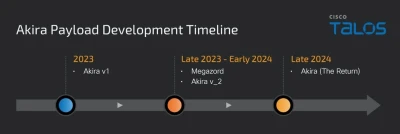 Once inside a network, operators use sophisticated techniques to remain undetected and hidden. PowerShell scripts may be deployed for credential harvesting and privilege escalation. Such scripts often use Veeam backup systems' credentials to harvest Kerberos authentication credentials and dump Kerberos credentials into other backups like Tarsus backups. They also delete system shadow copies using Windows Management Instrumentation (WMI), hindering file recovery efforts.
One notable incident involved targeting a Latin American airline in June 2024 by hackers using CVE-2023-27532 vulnerabilities found within their Veeam backup servers to access and swiftly deploy Akira ransomware, followed by data exfiltration. Its modules are for moving through compromised networks via Remote Desktop Protocol (RDP), employing defense evasion techniques like binary padding and disabling security tools, and defense-evasion tactics like binary padding to bypass defense tools and defenses.
Examining Rust's Performance and Security Advantages
Akira's development of a Rust variant targeting ESXi servers marks a critical turning point in its evolution. Rust, known for its performance and security features, provides several advantages over conventional languages like C++ - such as reduced memory management errors, increased resilience, and more challenging detection by signature-based antimalware tools. This evolution represents ongoing efforts by Akira actors to increase sophistication and stealthiness within their operations.
Returning to trusted encryption methods after language experimentation indicates that Akira prioritizes stability and efficiency. Rust variant 2024.1.30 displayed advanced capabilities for targeting specific file types or directories on Linux ESXi hosts, further signaling Akira's strategy of targeted attacks against virtual machine environments ubiquitous across modern enterprises.
Patch management has become necessary due to Akira affiliates' unfaltering desire to exploit vulnerabilities. Their adaptability and willingness to exploit unpatched or poorly protected systems underscore the necessity of upholding robust patching practices.
Prevention & Mitigation Recommendations for Linux Network Administrators
 Network administrators must adopt an aggressive, multifaceted, and preventative strategy against Akira ransomware to mitigate risk effectively. This involves implementing several key strategies to minimize risks effectively.
First and foremost, patch management should be prioritized. Admins should ensure that all systems and software have the latest security patches that address the vulnerabilities Akira exploits. Furthermore, network segmentation must be implemented to limit lateral movement within an environment, protecting critical systems while controlling ransomware spread.
Credential management practices should be rigorous, with regular password changes, implementing multi-factor authentication (MFA), and adhering to minimal privilege access. Furthermore, regular backups should be performed and stored offline or in isolated environments to enable recovery without succumbing to ransom demands.
Monitoring and auditing system logs for suspicious activity is another critical safeguard, with admins using tools and processes to detect anomalies promptly. Advanced endpoint protection tools that use behavioral analysis rather than signature-based detection to help identify and block ransomware activities are also helpful.
Finally, employee training should also be prioritized. Regular sessions should be held to educate employees on phishing and social engineering threats and safe browsing practices. Human awareness is one of the first lines of defense against ransomware attacks. Creating and updating a comprehensive incident response plan focused on ransomware is paramount to ensure organizational readiness against attacks on any scale.
Our Final Thought on the Emergence of Akira Ransomware
Akira ransomware's evolution over time demonstrates its adversaries' adaptability and persistence. By continuously adapting their TTPs, these malicious actors are well-positioned to exploit emerging vulnerabilities and bypass conventional security measures. Therefore, organizations must adopt a comprehensive, proactive approach to cybersecurity: staying ahead of threats requires technical measures, education, vigilance, and preparedness—especially as cyberspace becomes ever more complex. Understanding threats like Akira ransomware is crucial in protecting enterprise environments and critical data.
 PREVIOUS

 NEXT
NEXT


Powered By

Linux Security - Your source for Top Linux News, Advisories, HOWTOs and Feature Releases
QUICK LINKS
subscribe to newsletters!
Like staying secure? So do we.
Sign up for updates, tips, and alerts!