Explore top 10 tips to secure your open-source projects now. Read More
×



Server Security data privacy automation
data privacy automation Every system admin has lived through the same Monday morning ritual. A queue of forty tickets, half of them password resets, permission errors, or disk space warnings that any experienced technician could resolve in under two minutes. The other half require actual judgment. For years, automation promised that software would eventually sort the two apart on its own. That promise is now being tested in production Linux environments. . Early results are reshaping how IT teams think about tier-1...
 Jul 17, 2026

Privacydata collection automation
data collection automation You're running a web scraping project to collect pricing data from e-commerce sites. You set up a pool of datacenter proxies, launch your scripts, and within minutes — banned . CAPTCHAs everywhere. Your data pipeline stops before it really begins. . It's a frustrating scenario that plays out daily in ad verification, market research, and multi-account management. The website doesn't know you're doing legitimate research or monitoring. It just sees traffic coming from IP ranges it recognizes as...
Jul 17, 2026

Security Trends security advisory social engineering
security advisory social engineering Business Email Compromise used to be a numbers game — mass-blasted emails, broken English, an obvious "URGENT WIRE TRANSFER" subject line. That era is over. Generative AI has turned BEC into a tailored, low-noise operation that mimics writing style, voice, and even video presence. This piece looks at what's actually changed under the hood, what defenders are testing in response, and why so many organizations are still structurally unprepared for it. . The Infrastructure Problem Nobody Wants to...
Jul 17, 2026

Security Trends cybersecurity Linux documentation
cybersecurity Linux documentation Linux operating systems have gained prominence due to their stability, adaptability, and excellent security options. In the case of developing documentation, designing cybersecurity dashboards, or educational material, visuals are of vital importance when it comes to making things clear. The use of icons allows one to understand the message regarding alerts, authorization, encryption, authentication, or the state of the system just by looking at the visual cue without having to read long...
Jul 17, 2026
Security Vulnerabilities security advisory linux distribution
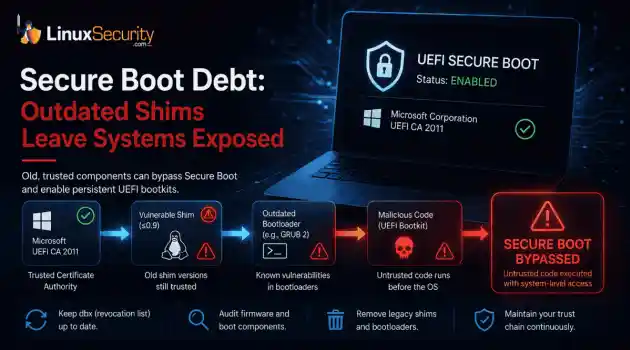
security advisory linux distribution ESET researchers identified 11 old and forgotten Linux UEFI shim bootloaders at versions 0.9 and below that can be used to bypass UEFI Secure Boot on any UEFI-based machine that trusts Microsoft’s Microsoft Corporation UEFI CA 2011 third-party certificate authority, regardless of the installed operating system (OS). Reported shims can be exploited to execute untrusted code during system boot, enabling attackers to deploy malicious UEFI bootkits even on systems with UEFI Secure Boot enabled.....
Jul 16, 2026
 Refine news
X Clear Filters
Get the latest News and Insights
Get the latest Linux and open source security news straight to your inbox.
Community Poll
Is continuous patching actually viable?
Loading...
Explore Latest Linux Security news
We found 77 articles for you...
77
 security advisorynetwork protectiondata encryption
Essential Linux Security Tips: Best Practices for a Resilient System
Linux is a powerful operating system that is greatly appreciated for being reliable, flexible, and open in nature. It runs servers, desktops, and even embedded devices around the world. But this huge popularity comes with big risks too, as Linux-based systems are not really safe from security hazards. Thus, implementing Linux security best practices effectively secures your infrastructure against security vulnerabilities, data breaches, and data loss. . The most effective way of implementing security is embedding it into a secure software product development life cycle . Of course, different phases of the SDLC—from planning to deployment and maintenance—may have their share of intervention. You may mitigate the risks associated with well-planned possible vulnerabilities or impose secure code on your application development to strengthen your application base. You may notice in a well-implemented SDLC that those places have embedded security to make early control of risks possible. This detailed white paper highlights imperative Linux security best practices to protect your open-source environment. Keep Your System Updated System updates are one of those core aspects of security that tends to get overlooked. Updates patch vulnerabilities currently being exploited by attackers. Delays in updating expose your system to risk unnecessarily, even when your configuration appears secure. Real-World Example: A vulnerability in the Linux kernel , CVE-2021-3156, provided privilege escalation in 2021. Exposure was mitigated for those users who managed to apply an update in good time, yet there are still unpatched systems out there ready to be exploited. How to Stay Updated: Apply critical patches using automated scripts like unattended-upgrades to ensure timely application of patches. Fetch the latest packages from a package manager such as apt, yum, or dnf. Go through changelogs of key pieces of software for possible security implications. Bear it in mind that sometimeseven tiny changes can have important security consequences. Use the Principle of Least Privilege Principle of Least Privilege restricts the potential damage that can be done by an account or process in case it gets hacked: minimize the amount of permissions granted to reduce the possibility of unauthorized access to sensitive information. Practical Steps: Allow no root logins for administration and use sudo instead. Set file permissions using the utilities chmod, chown, or setfacl. A sensitive configuration file, for example, may require only chmod 600. Minimize set user ID programs that grant processes privileges they don't really need to carry out their functions through the implementation of strict access control policies utilizing SELinux or AppArmor. Enhance Authentication The authentication procedure is the first entry point into your Linux boxes. Weak password policies, password reuse, or badly implemented mechanisms will let them in. Advanced Practices: Enforce password policy, for example, pam_pwquality, and it should contain a minimum length, enforcement of special characters in passwords, and password expiration. Two-factor authentication using Google Authenticator or Duo Security adds another layer of security. Switch to key-based authentication instead of passwords for remote logins. Keep your private key in a safe place. Firewalls and Network Security Firewall and intrusion detection systems are the first layer of defense that keeps bad people and scripts away from your systems. Linux has superb tools to tune up network security policies. Enhancing Network Security: Firewall: either use fine-grained control of iptables or the ease of use of ufw. Example: ufw deny 22 bans SSH on port 22. IDS: Install Snort or Suricata and detect bad traffic patterns. Use Wireshark and tcpdump to monitor network flows in real-time to detect abnormalities. Encrypt Data at Rest and in Transit Encryption is an absolutemust for locking up your sensitive data from unauthorized access both on the disk and over the networks for integrity and to ensure confidentiality. Encryption Tools: LUKS can be used to achieve full-disk encryption of the local storage. Encrypt/decrypt sensitive files with GPG . Enable HTTPS on your websites using the Let’s Encrypt tool among others to make sure that the ciphers used are safe in SSH connections. Real-World Use Case: Most financial institutions encrypt data at rest and in transit to meet the compliances of GDPR and PCI DSS. Hence, security and compliance because of encryption go hand in glove. Monitor Logs and System Activity System logs may stand useful in revealing unauthorized activities, misconfigurations, or intrusion attempts. Periodic log monitoring ensures early detection of threats before any exploit causes damage. Log Management: Centralize your logs at a single location for better management by making use of Rsyslog and Journald. Establish an alerting mechanism for malicious activities like repeated failed login attempts, privilege escalation, and so on. Automate your log analysis using Elk Stack, Splunk, and Logwatch to expedite identifying anomalies. Secure the Kernel The kernel itself forms the heart of the Linux Operating System; hence, the moment that is compromised, the security of the whole system is spoilt. Securing the Kernel : Keep the kernel updated to patch existing bugs. With kexec, one can remotely reboot to newer kernels without disrupting the currently running programs. Turn off unused kernel modules, reducing the attack surface area. For example, if one does not use USB devices, turn off all USB-related modules with the command modprobe -r. Utilize some kernel hardening with security features like Grsecurity or AppArmor. Regular Backups Data loss could be caused by a ransomware attack, hardware failure, or human error. Doing regular backups means one can recoverimmediately should anything happen. Types of Backups: Automate your backups with rsync, Borg, or Duplicity. Store your backups in an offsite location or in safe cloud environments, so when physical disasters strike, one is safe. Test the restoration processes every now and then to be sure that one will really be able to rely on their system backup. Leverage Open Source Security Tools Linux has a very lively community of free, open-source security tools that are capable of carrying out all kinds of tasks related to securing your system. The Must-Haves: Lynis: a tool for deep system auditing that lets one know of the weaknesses in security. Fail2Ban: guards against brute-force attacks, banning suspicious IP addresses. ClamAV: provides malware scanning for the detection and cleaning up of malicious files. Educate and Train Your Team Security awareness is a very important but often overlooked aspect of system security. Human mistakes are among the most common causes for breaches; thus, education is key. Some Tips for Training: Have periodic workshops or training classes on best practices for Linux security. Conduct training on fresh threats, such as new malware that targets Linux. Prepare a plan for incident response in which every member of your team will know how to act in case a security breach happens. Sandboxing and Isolation Techniques Sandboxing segregates applications; hence, if an attacker compromises one application, this will not affect the whole system. In the Case of Sandboxing, Use: Docker: For complete segregation of an application, including all dependencies for the application, use containerization. Firejail: In case of application-level sandboxing, minimum configuration. Virtual Machines: Run untrusted code on Virtual Machines for better segregation. Regular Security Audits Regular security audits point out vulnerabilities and ascertain whether they achieve organizational orregulatory standards. Steps to Audit: Run vulnerability scans using OpenVAS or Nessus. Perform penetration testing to see how systems defend themselves during an attack. Find configuration files maintaining a set of various misconfigurations that may expose your system to predators. Conclusion: Building a Secure Linux Ecosystem Securing your Linux environment involves active participation in its security—a multilayered approach. That means best practices related to Linux security will be included in the software product development life cycle, and hence, it would be a continuum rather than an afterthought. From the least privilege principle to encryption, log monitoring, and Linux security-awareness training, these ensure a robust guard against existing cyber threats for a Linux ecosystem. Not only will a secure Linux environment make it a matter of data security, but it is also about system reliability, compliance, and peace of mind for your team and stakeholders. . Implement essential Linux security protocols to safeguard your machine against unauthorized access and ensure the preservation of data integrity and regulatory compliance.. Linux security best practices, secure Linux environment, open-source security tools, effective security strategies. . Dave Wreski
 Jan 12, 2025
•
Jan 12, 2025
• Server Security
81
 data encryptioninternet safetyvpn
Top Free VPNs for Linux: Enhance Privacy and Bypass Restrictions
Linux is famous for its strong security. Yet, adding a Virtual Private Network (VPN) boosts privacy even more. A VPN encrypts connections and protects data. This is essential for accessing restricted content, avoiding censorship, or keeping activities private and secure. With privacy concerns growing, choosing the right VPN for your Linux system is key to staying safe online. Let's review the best free VPNs for Linux by comparing their compatibility, features, and limits. Importance of Using a VPN on Linux Privacy and Security Benefits Encryption: A VPN creates a secure tunnel between your device and its server, keeping data safe from hackers, ISPs, and prying eyes. It’s crucial for Linux users who work with servers or sensitive data. Protection from Threats: Linux faces fewer malware attacks than Windows or macOS but isn't safe. Threats like phishing and data theft are real. Using public Wi-Fi makes you vulnerable. A VPN encrypts your data and hides your online identity, reducing these risks. Stopping Data Collection: Data is valuable. Websites often track users for ads. Linux users might use ad blockers or privacy browsers. A VPN adds extra protection by hiding your IP and location, preventing targeted ads and tracking. Secure Work: For Linux users in development or tech, secure file sharing and remote work are key. A VPN protects files and data, crucial for corporate or personal information. Geographical Restrictions Accessing Region-Locked Content: Streaming services like Netflix and Hulu limit access to content based on location. For example, a show might be available in the U.S. but blocked in Europe or Asia. Here, a VPN acts as a digital key. It lets you appear in another country, unlocking more content. Meanwhile, tech-savvy Linux users often adopt VPNs. They navigate the online world while keeping their connections secure. Bypassing Censorship: In some areas, governments heavily censor the internet. They might block access toYouTube, WhatsApp, or Wikipedia. Countries like China, Russia, and Iran impose strict internet rules. A VPN allows users to bypass this censorship. It routes traffic through servers in less restrictive countries. This ensures access to important information and supports free expression. Accessing Work and Educational Resources Abroad: Many professionals and students need resources tied to specific regions. This includes corporate servers, academic journals, or online courses. A VPN can mask your location, granting access to these vital resources. Criteria for Selecting a VPN for Linux Choosing a VPN for Linux needs careful thought. While there are a ton of options for Windows, Android, and iOS, which you can easily find on websites like vpnHunt.com , there are not a ton of options available for Linux. Furthermore, not all VPNs suit Linux users. They often face unique issues, like limited app support or compatibility problems. Here, we outline key factors to help you decide. Compatibility First, ensure the VPN works with Linux. Many VPNs focus on Windows and macOS, but few fully support Linux. Linux Clients: The best choice is a VPN with a Linux app. It simplifies setup and offers better integration. However, not all free VPNs have this. Others may require manual setup, which can be tough for beginners. Support for Distros: A good VPN should work with many Linux distros , like Ubuntu and Fedora . Some providers offer guides for setting up VPNs on different distros, which helps less experienced users. Advanced users might prefer tweaking configurations. Command-Line vs. GUI: Many Linux users prefer terminal commands. Some VPNs offer command-line clients to this group, but others might find a GUI easier. Security and Privacy Security and privacy are crucial, especially for Linux users. Not all VPNs offer the same protection. Encryption Protocols: Look for VPNs using strong protocols like OpenVPN or WireGuard. These ensure datasafety. Logging Policies: Check the provider's logging policy. Avoid those that track or sell data. A no-logs policy is essential for privacy. Kill Switch and DNS Protection: A kill switch stops internet access if the VPN fails. DNS protection keeps browsing private. Both are vital for security-focused users. Advanced Features: Multi-hop and obfuscation features are extra benefits. They offer more security and privacy. Performance A VPN should not slow down your internet too much. Speed and Reliability: Free VPNs may have speed limits. Proton VPN is an exception, offering good speeds for free. Server Availability: More servers mean better performance. You can connect to closer servers, which speeds up your connection. Bandwidth and Data Limits: Be wary of data limits in free VPNs. Proton VPN offers unlimited data for free. TunnelBear, on the other hand, is much more limited. Usability Usability is key, especially for beginners. Installation and Setup: Some VPNs are easy to install. Others might need a manual setup. Ensure the provider offers support. User Interface: A GUI makes things easier for beginners. Some VPNs offer both command-line and GUI options . Customer Support: Free VPNs often have limited support. However, some provide basic support. Good support is crucial for troubleshooting. Customization Options: Advanced users appreciate customizable settings. Look for VPNs that allow such tweaks. Top Free VPN Options Proton VPN Compatibility: Offers a Linux client and setup guides, ideal for Linux users. Features: No data limits. Strong security with AES-256 and ChaCha20 encryption and a no-logs policy. Limitations: Free users can only access servers in a few countries. Speeds may drop during congestion. Follow this guide to learn how to install Proton VPN on linux and set it up. TunnelBear Compatibility: No Linux app, but manual setup isavailable. Features: Easy to use on Windows and macOS. Good speeds for browsing and streaming. Limitations: 2000 MB monthly cap on the free plan. Setup can be tricky for beginners. For those who aren’t familiar with the setup can follow this guide and start using TunnelBear on linux. Hotspot Shield Compatibility: Works with Fedora OS, Debian, Ubuntu, and CentOS operating systems . It is not available for free but comes with a 45-day money-back guarantee. Features: Strong encryption for secure browsing. Good speeds on the free plan. Limitations: Limited customization for Linux users. You can find all the support and installation guides on the official Hotspot Shield website. Comparison and Recommendations VPN Compatibility Features Limitations Best For Proton VPN Native Linux client No data limits, strong security Limited free servers Unlimited data, advanced users TunnelBear Manual configuration only User-friendly, decent speed 2000 MB monthly data cap Beginners, light browsing Hotspot Shield OpenVPN configuration only Strong encryption, good speed Limited Customization Moderate users, secure streaming Conclusion Enhance your online experience with a VPN on Linux—your ally in privacy and security. These virtual shields grant you access to content from around the globe. Free services like Proton VPN, TunnelBear, and Hotspot Shield lay the groundwork but come with limitations. Though free VPNs are a great starting point,they often tether you with data limits and lackluster features. For those seeking faster speeds, robust security, and dedicated support, a paid plan is worth considering. The best VPN adapts to your needs while safeguarding your privacy, ensuring your online world remains secure and accessible. . . Explore the top free VPN services for Linux users, providing secure browsing and access to restricted content with features tailored for online privacy. Linux VPN, Free VPN for Linux, Enhance Privacy Linux, VPN Options Linux. . MaK Ulac
Jan 06, 2025
•
Privacy

212
 backup solutionsdisaster recoverybusiness continuity
Enhancing Linux Security Through Cloud Encryption and Backup Solutions
Cloud computing is a vital part of today's Internet-based world. It drives innovation and provides scalable solutions. Cloud technologies such as disaster recovery solutions, encryption, and backup strategies are crucial in protecting sensitive data and ensuring business continuity amidst today's advanced and evolving Linux security threats. . In this article, we'll examine cloud-based technologies transforming Linux security, their advantages, and the central role of AI and automation in modern cloud security. The Power of Linux Cloud Backup Solutions Cloud computing has revolutionized the way businesses approach data backup . The cost of onsite storage for data backup is high, and cloud storage allows organizations to store data remotely and access it from anywhere. Cloud services provide automated backup solutions, reducing human error and creating a seamless process for backing up critical data. Cloud technology allows businesses to ensure that their data is always backed up, even in the case of a cyberattack or hardware failure. Cloud Technologies for Data Encryption It's no secret that data encryption is a foundational element of modern cybersecurity. To protect sensitive data, admins and organizations must use advanced encryption tools to protect information in transit and at rest. Cloud providers offer encryption services that allow users to encrypt their data before uploading it to the cloud. If an unauthorized server hack occurs, the data is then rendered unreadable. Combining advanced algorithms with constantly updated platforms strengthens encryption and ensures compliance with international standards. Ensuring Business Continuity with Cloud-Based Disaster Recover Cloud computing has changed the way organizations tackle disaster recovery and business continuity . It was once time-consuming for companies to maintain offsite backup and recovery systems. Cloud disaster recovery solves this issue by restoring operations more quickly and efficiently afteran event such as a cyberattack or natural disaster. Cloud technology allows businesses to mirror critical data and systems on cloud servers in real-time, allowing operations to start immediately with minimal downtime. Cloud disaster recovery can be scaled up to accommodate large enterprises and small businesses. This enables them to use enterprise-class software without investing heavily in infrastructure. Cloud-based systems are recoverable from disasters, reduce the impact on day-to-day operations, and ensure business continuity. The Role of Artificial Intelligence & Automation in Cloud Security Cloud-based security strategies are becoming increasingly reliant on Artificial Intelligence and automation. These AI technologies can analyze large volumes of data in real-time, providing definite insights about anomalies and possible threats before any damage has been done. Integrating AI and cloud security platforms can yield proactive defense mechanisms that detect and mitigate threats automatically. Cloud-based security strategies increasingly rely on Artificial Intelligence and automation, often as critical components of CSPM. These AI technologies can analyze large volumes of data in real-time, providing definite insights about anomalies and possible threats before any damage has been done. Integrating AI and cloud security platforms can yield proactive defense mechanisms that detect and mitigate threats automatically within a CSPM framework. Automation is a natural step in cloud security, as mundane tasks such as monitoring, patching, and updating systems are frequently repeated. Automated solutions allow IT teams to focus on more strategic tasks and less time-consuming routine maintenance. AI powers cloud systems to respond to threats much faster than human teams. This reduces response times and the damage cyberattacks can cause. For a cybersecurity system to be agile and adaptive, especially within CSPM solutions, it needs to be able to change the environment quickly with AI and automation. Automation is a natural step in cloud security, as mundane tasks such as monitoring, patching, and updating systems are frequently repeated. Automated solutions allow IT teams to focus on more strategic tasks and less time-consuming routine maintenance. AI powers cloud systems to respond to threats much faster than human teams. This reduces response times and the damage cyberattacks can do. For a cybersecurity system to be agile and adaptive, it needs to be able to change the environment quickly with AI and automation. Cloud-based Security Strategies: Benefits & Key Features Cloud-based security solutions offer several advantages. Scalable, pay-as-you-go cloud services can replace expensive IT infrastructure on premises. Improved cybersecurity is also a significant advantage that should not be overlooked. Cloud providers are investing heavily in the security of their platforms. They use advanced security protocols, often exceeding businesses' capabilities and abilities. Cloud systems are flexible and allow organizations to adjust their security frameworks according to their changing needs. Cloud-based security strategies also enable better compliance with industry standards. Cloud service providers often offer compliance features that allow businesses to comply with industry standards, such as the General Data Protection Regulation or the Health Insurance Portability and Accountability Act. Our Final Thoughts on the Advantages of Cloud-Based Linux Security Strategies Cloud technologies are among the most recent and diverse innovations in Linux cybersecurity. They offer a framework that can be used to improve data backup, encryption, and disaster recovery. Cloud technologies allow businesses to scale up and provide flexibility and enhanced security. This enables them to maintain operations even when cyber threats are present. AI and automation improve cloud security by proactively mitigating risks and responding quickly to emerging threats. . The rise of cloudtechnologies has transformed Linux security, with encryption, backup solutions, and disaster recovery becoming critical areas of focus. Cloud Security, Data Encryption, Disaster Recovery Solutions, AI Automation. . Anthony Pell
Oct 09, 2024
•
Cloud Security
81
 security measuresdata encryptionlinux
Boost Linux Protection: Free VPNs for Improved Privacy and Anonymity
Linux is one of the widely used operating systems and is rapidly growing in popularity. Its robust security is a major benefit to users and organizations. Although experts acknowledge Linux as a safer alternative to Windows, the OS can be further fortified by employing a free VPN. . Using a free VPN for Linux is an excellent option for users who value privacy and online security but are also looking for cost-efficient solutions. A VPN converts an open Internet connection into an encrypted network, shielding users’ IP addresses and preserving their anonymity online. It’s important to note that free VPNs may have limitations compared to paid VPNs, such as not offering the same level of reliability, security, or customer support services. Regardless, using a free VPN for Linux can still be advantageous for several reasons, including: Enhancing online privacy and security. Encrypting your sensitive data. Disguising your actual location. Avoiding firewalls. Selecting a free VPN with strong security features like kill switches and DNS leak prevention is crucial to ensure maximum protection. Have questions about choosing a free VPN that is right for you or your business? Connect with us on X @lnxsec - we're here to help! Stay safe out there, friends! . Employing an accessible VPN on a Linux system boosts online anonymity and safeguards your data, emphasizing budget-friendly options for individuals.. Free VPN for Linux, Linux privacy solutions, Data encryption methods. . LinuxSecurity.com Team
Dec 29, 2023
•
Privacy
209
 remote code executiondata encryptionsecure connections
Understanding Risks of Remote Code Execution in Python Packages from PyPI
Researchers have discovered that many Python packages on the Pypi repository are vulnerable to remote code execution attacks. . Many of these vulnerabilities exist due to poor design, including failure to use secure connections, insufficient permission levels on files, and lack of encryption for sensitive data. Many packages include outdated versions of libraries with known vulnerabilities. The Python community must improve their approach to security by following best practices, such as using secure connections and encrypting sensitive data. I found the article linked below very helpful in understanding this troubling trend and how to mitigate my risk as a Python user. Check it out! . Analyzing security gaps in PyPI packages highlights the need for secure communication and strong encryption, crucial for developers to avoid risks from vulnerabilities. Python Packages, Repository Security, Remote Code Exploits, Code Safety, Package Management. . Brittany Day
Dec 12, 2023
•
Security Trends
67
 data encryptionencryption standardNIST
Rijndael Selected As Primary Encryption Standard Over Contenders
Rijndael becomes the new data encryption standard beating out Schneier, IBM, and others. This DejaNews thread talks about the announcement of the winner of the new encryption standard. The Rijndael home page also provides some interesting . . . . Rijndael becomes the new data encryption standard beating out Schneier, IBM, and others. This DejaNews thread talks about the announcement of the winner of the new encryption standard. The Rijndael home page also provides some interesting information. The link for this article located at NIST / Other is no longer available. . The Advanced Encryption Standard (AES) has been officially adopted by the United States, edging out competitors such as Blowfish and RSA.. Rijndael Encryption, Data Encryption Standard, Cryptographic Algorithms. . LinuxSecurity.com Team
Nov 03, 2023
•
Cryptography
67
network securitydata encryptionopenvpnChoosing Between WireGuard and OpenVPN For Maximum Online Protection
WireGuard and OpenVPN keep you safe online, but which is best? . In our modern day, protecting ourselves online is crucial. With so many third parties and malicious actors trying to get their hands on our data, it’s paramount to do what we can to stay safe. Using a VPN is a great way to do this; WireGuard and OpenVPN are solid options. But how do these two protocols work, and which is best for you? Virtual private networks (VPNs) are now widely popular around the world. Using this technology, an individual can both mask their IP address and encrypt their online data. This is done using something called a remote server. When you send your online traffic through this server, it is fully encrypted and therefore indecipherable to anyone who wishes to view it. (For an in-depth look at what a VPN is and why you should be using one , we’ve got you covered.) . Delve into the capabilities of WireGuard and OpenVPN to protect your internet activities from external dangers.. WireGuard, OpenVPN, VPN Comparison, Network Protection, Data Security. . LinuxSecurity.com Team
Oct 09, 2022
•
Cryptography
67
 data protectioncybersecuritypersonal data
2020 The Year Marked By Data Encryption Trends and Privacy
Each year has its defining moments and trends. Learn why 2020 will be the "Year of Encryption": . 1969 will forever be known as the year humans walked on the moon . Gary Ross Dahl rocked the world again in 1975 with the introduction of the Pet Rock . AndMTV celebrated the moon landingand popular culture – and changed the music world – when it launched in 1981. The world remembers 1989 as the year the Berlin Wall fell , opening the door to a unified Germany. It’s hard to forget 2008, the year the financial crisis hit. And 2015 was the year of the millennial, when this groupsurpassed baby boomers as the biggest U.S. generation. Each year has its defining moments and trends. And 2020 will be the Year of Encryption. Here’s why: Encryption is a key technology in protecting sensitive information such as social security numbers, government IDs and financial data. It is also an important part of personal data privacy – a key consumer and compliance concern. Given the importance of encryption it is also a subject of debate at the U.S. state and federal level and elsewhere in the world. The link for this article located at Security Boulevard is no longer available. . The year 2020 marked a significant shift for encryption, highlighting its role in protecting sensitive data amid increasing cyber threats and privacy regulations. Data Protection, Encryption Trends, Cybersecurity Practices, Personal Data Privacy. . LinuxSecurity.com Team
Jan 09, 2020
•
Cryptography

Get the latest News and Insights
Get the latest Linux and open source security news straight to your inbox.
Community Poll
Is continuous patching actually viable?
Search Topics
Powered By

Linux Security - Your source for Top Linux News, Advisories, HOWTOs and Feature Releases
QUICK LINKS
subscribe to newsletters!
Like staying secure? So do we.
Sign up for updates, tips, and alerts!