Explore top 10 tips to secure your open-source projects now. Read More
×



Server Security data privacy automation
data privacy automation Every system admin has lived through the same Monday morning ritual. A queue of forty tickets, half of them password resets, permission errors, or disk space warnings that any experienced technician could resolve in under two minutes. The other half require actual judgment. For years, automation promised that software would eventually sort the two apart on its own. That promise is now being tested in production Linux environments. . Early results are reshaping how IT teams think about tier-1...
 Jul 17, 2026

Privacydata collection automation
data collection automation You're running a web scraping project to collect pricing data from e-commerce sites. You set up a pool of datacenter proxies, launch your scripts, and within minutes — banned . CAPTCHAs everywhere. Your data pipeline stops before it really begins. . It's a frustrating scenario that plays out daily in ad verification, market research, and multi-account management. The website doesn't know you're doing legitimate research or monitoring. It just sees traffic coming from IP ranges it recognizes as...
Jul 17, 2026

Security Trends security advisory social engineering
security advisory social engineering Business Email Compromise used to be a numbers game — mass-blasted emails, broken English, an obvious "URGENT WIRE TRANSFER" subject line. That era is over. Generative AI has turned BEC into a tailored, low-noise operation that mimics writing style, voice, and even video presence. This piece looks at what's actually changed under the hood, what defenders are testing in response, and why so many organizations are still structurally unprepared for it. . The Infrastructure Problem Nobody Wants to...
Jul 17, 2026
Security Trends cybersecurity Linux documentation
cybersecurity Linux documentation Linux operating systems have gained prominence due to their stability, adaptability, and excellent security options. In the case of developing documentation, designing cybersecurity dashboards, or educational material, visuals are of vital importance when it comes to making things clear. The use of icons allows one to understand the message regarding alerts, authorization, encryption, authentication, or the state of the system just by looking at the visual cue without having to read long...
Jul 17, 2026
Security Vulnerabilities security advisory linux distribution
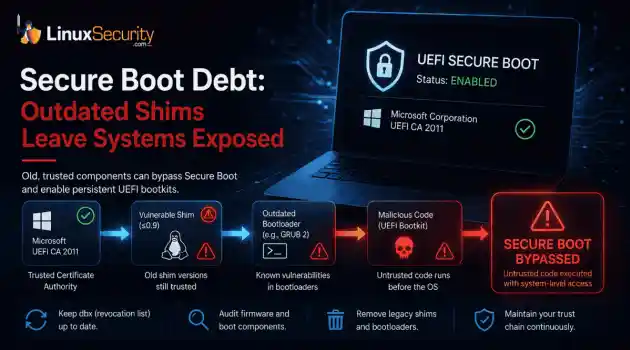
security advisory linux distribution ESET researchers identified 11 old and forgotten Linux UEFI shim bootloaders at versions 0.9 and below that can be used to bypass UEFI Secure Boot on any UEFI-based machine that trusts Microsoft’s Microsoft Corporation UEFI CA 2011 third-party certificate authority, regardless of the installed operating system (OS). Reported shims can be exploited to execute untrusted code during system boot, enabling attackers to deploy malicious UEFI bootkits even on systems with UEFI Secure Boot enabled.....
Jul 16, 2026
 Refine news
X Clear Filters
Get the latest News and Insights
Get the latest Linux and open source security news straight to your inbox.
Community Poll
Is continuous patching actually viable?
Loading...
Explore Latest Linux Security news
We found 151 articles for you...
77
 patch managementsecurity protocolsemail security
Zero Trust for Email: Implementing Advanced Protections on Linux
Email threats have long outgrown spamming and obvious phishing. Attackers now exploit trust itself. They impersonate internal users, hijack legitimate threads, and abuse misconfigured configurations. Defenses like perimeter filtering or static rules are not adequate any longer. A Zero Trust model redefines the issue by eliminating implicit trust at all phases of email processing. This shift is especially important in modern Linux mail environments where services are often modular, network-exposed, and heavily dependent on correct configuration across multiple components. . Redefining Trust at the Protocol Level On Linux mail servers, Zero Trust starts with the rigid implementation of authentication protocols. Correctly configured SPF, DKIM, and DMARC make sure that any incoming message is authenticated against policy at the domain level before being accepted. However, implementation alone is not enough. The policy needs to be set to enforcement mode as opposed to passive monitoring, and logs should be checked on a regular basis to detect anomalies. In practical deployments, this means moving DMARC policies toward “quarantine” or “reject” rather than “none.” This ensures that spoofed messages are actively blocked instead of only observed. Outbound validation is equally important. Preventing unauthorized messages from leaving your infrastructure protects both your reputation and your users. This two-fold verification makes a closed circle where trust has to be created on both sides. This includes restricting SMTP submission to authenticated sessions only and preventing unauthenticated relaying, which is a common misconfiguration in exposed mail servers. Hardening the Mail Stack A Zero Trust approach requires a hardened foundation. Mail transfer agents such as Postfix and mail delivery agents like Dovecot should be configured with minimal exposure. Turn off unneeded services, use TLS in all connections and limit access with firewall rules and network segmentation.Additional hardening should include: Disabling legacy authentication mechanisms Enforcing modern TLS versions Restricting administrative interfaces to trusted internal networks or VPN-only access The principles presented in the Linux hardening guide will reinforce this further by minimizing the attack surface and implementing stringent access controls. Combined with regular patching and long-term Linux support, systems are resilient to known vulnerabilities and new threats. Applying system-level hardening practices such as least privilege access, secure file permissions for mail configurations, etc., prevents the underlying operating system from becoming the weakest link in the mail security chain. Zero Trust Email Architecture Design Considerations A Zero Trust email system on Linux should be designed as a layered architecture rather than a single server handling all responsibilities. Separating roles such as mail transfer, authentication, filtering, and storage reduces blast radius and improves fault isolation. For example, Postfix can handle SMTP routing while a separate filtering layer processes content before delivery to Dovecot. This segmentation ensures that even if one component is compromised, the entire mail flow is not immediately exposed. Continuous Verification Over Static Rules Zero Trust is not a one-time configuration; it is an ongoing process of validation. Email content should be scanned dynamically using multiple layers, including: Heuristic analysis Reputation checks Sandboxing for suspicious attachments These layers are often chained together in mail pipelines so that each message is evaluated at multiple stages rather than relying on a single pass filter. Open-source security tools are essential in this regard. Adaptive filtering can be installed in Linux environments with solutions like: SpamAssassin ClamAV Rspamd These tools must be regularly tuned according to the threat intelligence instead of the defaultsettings. Static defenses fade away, whereas systems that are constantly updated remain effective. For example, rule sets should be updated based on live threat feeds, and scoring thresholds should be adjusted to reduce false negatives in high-risk environments. Identity and Access Controls Matter Compromised credentials remain a leading cause of email-based attacks. This risk is mitigated by enforcing strong authentication systems like multi-factor authentication on all mail users. In Linux, email services can be integrated with a centralized identity management system to enable a stricter access policy. Integration with PAM-based authentication or centralized directory services allows consistent enforcement of authentication policies across all mail-related services. Service accounts and administrative access should also be under least privilege principles. Restricting the number of people configuring or accessing the mail system curtails the possibility of misuse or escalation. Administrative SSH access and mail configuration privileges should be separated, ensuring that operational accounts cannot directly modify mail routing or authentication rules. Monitoring, Logging, and Response A Zero Trust model requires visibility. Full logging of SMTP transactions, authentication attempts, and system modifications can help quickly identify anomalies. Logs need to be proactively analyzed and not stored. Centralized log aggregation using syslog pipelines or SIEM-style tooling improves correlation between authentication events, mail delivery patterns, and system changes. Automated alert systems are capable of detecting abnormal patterns, including outbound mail spikes or failed logins. Organizations can swiftly transition to containment when a clear incident response plan combines with detection. When integrated properly, these systems can automatically throttle or block suspicious accounts based on behavioral thresholds, reducing response time during active attacks. Organizations operatinginternet-facing mail infrastructure should also consider DDoS protection solutions that can detect and mitigate large-scale traffic floods targeting SMTP gateways, authentication services, and other externally exposed communication systems before availability is disrupted. Endnote Organizations implementing a Zero Trust approach to email will be in a more favorable position to protect their systems as attackers continue to improve their methods. They do not respond to the threat when it manifests, but create a space where trust is constantly tested and never presumed. . Implement Zero Trust in Linux email systems by reinforcing security through authentication protocols and layered architecture.. Linux Email Security, Zero Trust Model, Threat Mitigation, Email Protocols, Security Architecture. . MaK Ulac
 Apr 17, 2026
•
Apr 17, 2026
• Server Security
212
 incident responseenterprise securityemail security
Open Source vs Commercial Email Security: Operational Choices and Risks
Email still looks like plumbing until it becomes the incident timeline, which is why the enterprise email security decision tends to surface only after something slips through and everyone is suddenly counting minutes. By then, the question is no longer about preference or tooling taste; it is about whether the system bends under pressure or holds. . In practice, enterprise email security posture shows up in workload and staffing math, in how much rule tuning you can sustain, how fast false positives pile up, and whether patch cadence quietly slips when priorities shift. The real tradeoff is not freedom versus convenience, but resilience versus operational burden, which is what makes build vs buy email security an ownership decision before it is a technical one. The rest of this piece looks at how those models behave day to day, where they absorb pressure cleanly, and where they tend to fail when detection and response are stressed at the same time. Why the Email Security Gateway Becomes the Risk Boundary Email attacks stopped looking like spam a long time ago, and most enterprise incidents now start with something that clears basic filters and lands cleanly in a real inbox. Business email compromise, credential theft, and ransomware delivery all ride legitimate-looking traffic , which means the pressure shifts from volume blocking to precision detection under constant load. Most of the pressure lands on the email security gateway because that’s where teams feel drift first. Misses show up as longer time-to-detect, noisier alerts, and response workflows that depend on partial logs instead of a clean signal. When attackers adapt, this is the layer that either absorbs it quietly or starts leaking risk into every downstream control. Attacker behavior keeps forcing posture upgrades because small misses at this layer compound quickly once credentials are harvested or lateral movement starts. What Your Gateway Decision Controls How quickly malicious patterns are detected and contained,which directly affects time-to-detect The balance between false positives and false negatives, and how much rule tuning that balance requires The shape of response workflows once something is flagged, including who sees what and when The depth and consistency of audit logs are needed for investigations and compliance How much operational drag shows up during patch cycles and policy changes Whether visibility holds up during sustained attack pressure or degrades quietly The Core Decision: Build vs Buy Is Really an Operational Choice Most debates about email security start with tools, but the friction usually shows up later in staffing calendars and incident queues. Once the gateway is in place, someone owns rule tuning, patch cadence, alert volume, and the long tail of edge cases that never make it into clean demos. That’s where the build vs buy email security question stops being philosophical and turns into a question of operational ownership. For Linux teams, this usually means the same people who own Postfix relays and mail routing also end up owning tuning debt, log fidelity, and incident traceability. In enterprise email security, building means the architecture and its daily behavior live with your team, while buying means you offload baseline defenses and their upkeep to someone else. Neither choice removes responsibility during an incident, but they shift who carries the ongoing load and how much slack exists when response timelines compress. That distinction is what drives build vs buy email security decisions long after the initial deployment is forgotten. Decision Variables That Actually Matter Staffing depth and whether coverage survives vacations, attrition, and on-call fatigue Tolerance for continuous maintenance, including tuning drift and uneven patch cycles Incident response expectations and how quickly teams need full visibility Integration demands with existing logging, SIEM, and compliance workflows Time-to-implement, especially when riskis already elevated Open Source Email Security: Build Your Own Gateway Stack Teams usually arrive at open source email security after deciding they want direct control over how mail is inspected and handled, even if that means owning the rough edges. The model shows up less as a single product and more as an assembled system, where behavior is shaped by configuration choices, tuning discipline, and the amount of operational attention the stack gets week to week, especially when email deliverability stays reliable , which is treated as a hard requirement alongside detection. Over time, that approach becomes an open source email gateway in practice, not by name. What an Open Source Email Gateway Stack Typically Includes At a minimum, the stack is a set of cooperating services running on Linux, each responsible for a narrow slice of the email security gateway pipeline. Components like ClamAV and SpamAssassin handle malware scanning and scoring, while Rspamd often becomes the policy brain that ties signals together. DMARC, DKIM, and SPF tooling sit alongside to enforce authentication and reporting, because identity failures tend to surface only after damage is already done. A mail transfer agent, such as Postfix, to handle message flow Content scanning and scoring engines like ClamAV, SpamAssassin, or Rspamd Authentication and policy components, including OpenDMARC and OpenDKIM How The Stack Is Wired Together Messages enter through the MTA, get scanned and scored, pass authentication checks, and are then routed based on combined policy outcomes. Each stage emits logs and metrics that teams stitch together for visibility, which is where most of the real work accumulates. Nothing here is opaque, but nothing is free of tuning debt either. Inbound mail is accepted and queued by the MTA Scoring, authentication, and policy decisions are applied in sequence Final routing, delivery, and logging for investigation and audit Where Open Source Wins: Control,Transparency, and Deep Integration Open source tends to show its value the moment something novel slips past baseline detection and the clock starts ticking. When teams can see the full scoring path and adjust logic without waiting on a vendor cycle, enterprise email security posture tightens in ways that are hard to replicate with fixed controls. I’ve seen cases where a targeted phish was blocked the same day because someone could write a rule, test it, and push it without negotiating access or priorities. Why that control matters Full visibility into scoring and decision paths, which removes guesswork during investigations Rapid custom rule creation when attackers reuse infrastructure or language patterns No vendor lock-in when detection logic needs to change faster than contracts allow Direct integration with SIEM pipelines for correlation and faster triage Hooks into ticketing systems and internal dashboards that match how teams already work Where Open Source Email Security Can Degrade Over Time Open source email security usually fails quietly, not because the detection logic is weak, but because the work never really stops. Once an open source email gateway is in production, posture depends on whether the same level of attention exists six months later, during patch windows, staffing changes, and uneven alert volume. When that consistency slips, enterprise email security degrades in ways that are easy to miss until exposure shows up downstream. Integration engineering What happens when upstream mail flow changes or a new business unit gets added is more glue work. Connectors drift, logging paths break, and visibility becomes uneven across the org. I’ve seen teams assume coverage exists simply because nothing is alerting. Rule tuning Scoring models age fast. Without regular tuning, false positives climb, alert fatigue sets in, and teams start trusting the system less than they should. The first thing you notice is time-to-detect stretching becausealerts are no longer taken seriously. Patch management Every component has its own cadence. Miss one update and you end up running mixed versions with subtle behavior changes. On Linux, that drift shows up as version mismatches across hosts, service restarts during maintenance windows, and subtle changes in scoring behavior that only become obvious after users complain. Over time, patch gaps turn into blind spots that no dashboard flags clearly. Threat intelligence curation Signals do not arrive pre-assembled. Someone has to source them, validate them, and decide how aggressively to apply them. When staffing thins or on-call burns out, intel coverage becomes inconsistent, and attackers notice before defenders do. Commercial Email Security: Integrated Defense as a Service Commercial email security usually enters the picture when teams want to stabilize posture without expanding headcount or carrying every operational edge case themselves. The model shifts day-to-day maintenance out of the inbox team and into a managed service, which changes how enterprise email security behaves under sustained load. Most of the complexity is abstracted away, whether or not teams think about it that way. What a commercial email security suite typically includes In practice, a commercial email security suite runs as a cloud service where filtering, policy, and inspection collapse into a single pipeline. Filtering, anti-malware, and anti-phishing sit alongside DLP, encryption, and archiving because policy enforcement tends to sprawl quickly once compliance enters the picture. Threat intelligence and monitoring are built into the service, rather than assembled piecemeal. Message filtering and malware inspection at scale Phishing detection tied to global telemetry Policy controls for DLP, encryption, and retention What the vendor manages vs what you still own The vendor typically runs the infrastructure, maintains signatures and models, and operates a SOC that feeds updates intothe platform. Customers still own policy decisions, escalation paths, and incident response once something is flagged. That boundary is where most expectations get set, correctly or not, during deployment. Where Commercial Email Security Holds Under Pressure Commercial platforms tend to hold their shape when pressure rises, mostly because the maintenance never pauses. Updates land continuously, threat intelligence shifts globally, and policy changes propagate without waiting for internal patch windows, which keeps enterprise email security posture from degrading in slow, invisible ways. That consistency matters when response teams are already stretched, and protecting your digital presence depends on controls holding steady between incidents, not just during them. Why That Consistency Shows Up Operationally Global policy enforcement that applies uniformly across regions and business units. SOC-led updates driven by aggregated threat intelligence, not local sightings. Low-level maintenance is offloaded so internal teams can focus on response, not upkeep. Rapid rollout of new controls, often in minutes rather than change cycles. Time-of-click URL inspection that adapts after delivery, not just at receipt. SLAs and support paths that stabilize response expectations when incidents escalate. Where Commercial Breaks: Cost, Control, and Integration Limits Commercial platforms tend to hide their friction until scale and customization demands increase. What starts as a clean deployment can slowly constrain enterprise email security when teams want to validate detections, tune edge cases, or explain decisions during an investigation. Those limits show up at the email security gateway when posture depends on controls you cannot fully see or shape. Cost Subscription pricing scales with users, features, and retention, which means steady growth turns into recurring pressure. Budget conversations start influencing detection choices, even if no one says it out loud. Overtime, cost becomes part of the risk equation. Control Detection logic is largely opaque. Teams get adjustment knobs, not the engine itself, which makes it harder to validate why something passed or failed. That lack of transparency complicates forensics and weakens confidence during incidents. Integration Logs and alerts arrive on the vendor’s terms. Feeding internal dashboards or SIEMs often requires API work, normalization, and ongoing care. If your visibility pipeline starts on Linux, you still end up normalizing vendor logs to match the rest of your telemetry, or your SIEM correlation never lines up cleanly. When integration lags, visibility fragments even if detection itself is strong. Stress Test: How Each Model Fails Under Pressure Failure modes only become obvious when volume spikes or attackers shift tactics midstream. That’s where enterprise email security posture stops being theoretical and starts reflecting who can react cleanly under stress. Open Source Under Fire What happens when a novel phish hits is speed versus staffing. Open source email security can adapt fast, but only if the right people are present and paying attention. When they are not, coverage degrades unevenly, and gaps persist longer than expected. Commercial Under Fire Commercial email security handles broad campaigns well because detection updates propagate globally. Hyper-targeted attacks are harder, especially when they sit just inside allowed behavior and don’t trigger global signals. The baseline holds, but edges can slip through. Recovery With open source, the internal team owns response end-to-end, including forensics and remediation. With commercial platforms, vendor support helps stabilize the incident, but visibility depth and investigative control vary by service. The Strategic Middle Ground: Buy the Baseline, Build the Edge Many mature teams stop treating this as a binary choice. The pattern that holds is a dependable baseline paired with selective customization,which spreads risk without multiplying operational load. That approach aligns build vs buy email security with how work actually gets done. Commercial controls handle baseline defense, global intelligence, and steady maintenance. Open components come into play at the edges, where niche detection, deep forensics, or internal workflows matter most. I’ve seen teams reserve custom rules for the threats that actually hurt them, not for everything that might. Enterprise Email Security FAQs Email security questions usually surface after something breaks or during a buying cycle, so these answers focus on operational meaning rather than textbook definitions. What is enterprise email security? Enterprise email security is the set of controls that detect, block, log, and respond to malicious or risky email activity at an organizational scale. It covers prevention, visibility, and response, not just filtering. Posture depends on how well those controls hold up under workload and attack pressure. Is open source email security safe for enterprises? Open source email security can be safe and effective when teams have the staffing and discipline to maintain it. The risk is not the code, but gaps in tuning, patch cadence, and monitoring when attention slips. Safety tracks consistency, not intent. What does a modern email security gateway protect against? A modern email security gateway protects against phishing, credential theft, malware delivery, and policy violations that move through email workflows. It also controls logging and enforcement, which directly affects time-to-detect and response quality. The gateway is where most failures either stop or spread. What should enterprises look for in a commercial email security suite? Teams usually look for consistent detection, fast updates, and coverage that does not depend on internal patch cycles. Integration depth, logging access, and response visibility matter as much as detection rates. Support expectations should be clear before an incidentforces the issue. What does “build vs buy email security” mean in practice? Build vs buy email security describes who owns daily operations, tuning, and long-term maintenance. Building keeps control internally but increases workload. Buying offloads baseline defense, while teams retain responsibility for response and oversight. Conclusion: What the Right Choice Looks Like for Enterprise Email Security The pattern that emerges is consistent across environments. Open source can deliver best-in-class results when teams have the depth to sustain tuning, patch cadence, and monitoring without gaps. Commercial platforms anchor enterprise email security with predictable coverage and fewer maintenance failures, which is why they become the default baseline in most organizations. What ultimately matters is posture, not preference. Enterprise email security holds when operations are steady, visibility is intact, and response does not degrade under pressure. The right choice follows resources and staffing reality, not ideology, and stays defensible long after deployment fades from memory. . Explore the nuances of email security in enterprises, contrasting open source and commercial solutions for optimal safety guidance.. Email Security Solutions, Operational Burden, Open Source Email, Commercial Email Security, Incident Response Management. . MaK Ulac
Jan 04, 2026
•
Cloud Security

212
 open-sourceLinux administrationemail security
Cloud Security: Addressing Email Issues in Postfix Environments
Perimeter-based email security assumes mail reliably passes a single inspection point. That’s how most Linux mail stacks were designed to operate: one choke point in front of the MTA, one place to enforce policy, one place to log what happened. In cloud environments, that stops being true fast. Some mail hits the gateway, some go directly to the tenant, and internal messages often bypass it entirely. . The incidents that matter most don’t trigger gateway logic anyway. Business email compromise and impersonation arrive clean. No payload, no link, nothing for a secure email gateway to score. I’ve seen authentication pass at the gateway while the mailbox activity downstream was already doing damage. Gateways still exist in most stacks, but they no longer describe where control actually lives. Email security now depends more on authentication, visibility into mail behavior, and how quickly you can act once something slips through. For Linux admins running Postfix-based relays, hybrid MTAs, or mail security infrastructure around cloud tenants, this is the core failure mode of perimeter-based email security in the cloud era. Cloud Mail Flow Breaks the Gateway Assumption Cloud email security changes where the mail actually enters the system. In Microsoft 365 and Google Workspace, mail flow is distributed by design, and that makes consistent inspection harder to guarantee. A secure email gateway can still play a role, but it’s no longer the single control point it used to be. That’s why cloud email security increasingly depends on visibility and enforcement inside the tenant, not just at the perimeter. Hybrid environments make this inconsistent. Some domains still route through a gateway, others deliver directly to the tenant, and internal messages often never touch the perimeter at all. I’ve seen investigations stall because gateway logs looked clean while the message in question never passed through that layer. If you’re on the hook for mail traceability, those gaps show upimmediately. MX rewiring is the usual workaround. Force mail back through the gateway and recreate a choke point. In practice, it adds latency, creates fragile dependencies, and introduces a single failure that can take mail down. I’ve had to unwind those designs during outages when queues backed up, and the gateway itself became the incident. Linux admins know how quickly “mail just works” becomes “mail is the outage” once your routing assumptions break. This is where perimeter-based email security breaks down. The gateway still exists, but cloud email security no longer treats it as authoritative. If your controls assume every message crosses that edge, cloud delivery keeps proving otherwise. Identity-Based Threats Beat Content Filters Even when mail does pass through the email security gateway, the attacks that cause the most damage don’t give it much to work with. Business email compromise and vendor impersonation arrive intact. No attachment. No link. Nothing malformed. From the gateway side, these messages usually look normal. Authentication passes. Headers line up. Delivery completes without delay. I’ve pulled logs where the only notable event was successful acceptance, while the mailbox activity that followed caused the actual incident. If you’ve ever stared at clean Postfix logs while users insist something is wrong, the feeling is familiar. Here’s what these messages tend to look like during review: SPF, DKIM, and DMARC all pass No URLs rewritten or detonated No attachment hashes to score Sender domain already trusted or previously seen The message stays inside an existing thread Spear phishing fits the same pattern. The content is shaped to match prior conversation history and expected tone. From a filtering perspective, it’s valid mail behaving like valid mail. Tightening content rules enough to catch this usually breaks routine business traffic first, which becomes your problem the moment you’re supporting mail delivery and securityat the same time. This is where perimeter-based email security stops being decisive. The email security gateway evaluates the message at delivery. Identity-based abuse plays out after that point, using trust and context that already exist inside the mailbox. By the time the action matters, the perimeter decision has already been made, and it wasn’t wrong. Why SEGs Fail Operationally: Visibility, Control, and Integration Gaps Most secure email gateways don’t break. They keep accepting mail and logging decisions. The trouble starts when you need more than “accepted” or “blocked.” For Linux admins, that’s when you need enough telemetry to prove what happened, tune it, and feed it into everything else you already operate. During incident review, the gateway usually has one event. Message received. Checks passed. Delivered. After that, it’s quiet. Replies, forwards, and internal handoffs all happen elsewhere. I’ve had cases where the gateway data ended before the user even saw the message. What I end up staring at: One inbound message at the SEG A mailbox full of follow-up activity No clean way to line the two up Tuning is similar. Gateways surface outcomes, not much detail behind them. When a rule misfires, the choice is usually to loosen it or shut it off. I’ve left detections weaker than I wanted because there wasn’t enough visibility to tune them without breaking normal traffic. Linux admins expect systems to be debuggable. Most SEGs are not. Once alerts leave the gateway, context drops again. In the SIEM, it’s a verdict and some headers. Thread history is gone. Identity context is missing. When that feeds into SOAR, automation usually stops at tagging or enrichment. There isn’t enough signal to do anything else safely. That’s the operational failure. The secure email gateway does what it says it will, but it doesn’t stay useful once mail moves past the perimeter. For email security operations, that gap shows up fast. The New Model: ALayered Email Security Stack (Not a Single Gateway) What replaces the gateway isn’t another box sitting in front of MX. Control shifts to places that still see the message after it’s delivered. This is the same pattern Linux admins have already lived through in other domains: one appliance stops scaling, and the stack becomes modular, observable, and integrated. Authentication is where that starts. SPF, DKIM, and DMARC are where policy drift shows up first. Domain alignment breaks, forwarding chains change, and third-party senders get added without notice. Those signals show up there before they show up anywhere else. That’s why teams need to circle back to fundamentals and ask what DKIM is in this context, because that’s where the trust story starts to break when a sender is legit. Filtering and malware scanning stay in the path: Commodity spam Bulk phishing Drive-by malware That layer does what it’s always done. After delivery, the indicators change: Replies that don’t line up with prior sender behavior Threads that change intent midstream Messages that trigger action without triggering any filters That activity doesn’t belong to the gateway. It shows up when you look across mailboxes and threads instead of individual messages. In most of the incidents I’ve worked, nothing stood out until the mail was viewed in that wider context. Orchestration is what keeps this from turning into manual correlation. Mail logs, authentication results, identity events, and mailbox activity need to be visible together. Without that, every investigation starts by rebuilding context that already exists somewhere else. That’s the shape of an email security stack in practice. The secure email gateway is still part of it, but it’s no longer the place where decisions stop. Open source email security fits this model because the underlying data stays available, which makes defense in depth possible without relying on opaque verdicts. Open-SourceBuilding Blocks Linux Admins Are Actually Using What makes open source workable here isn’t ideology. It’s that the components stay inspectable once mail is delivered and the gateway stops being useful. If you already run Linux infrastructure, you already have the operational tooling for this model: logs, pipelines, automation, and the ability to debug what your stack is doing. Authentication and mail hardening OpenDKIM and OpenDMARC sit closest to the mail flow. This is where alignment problems show up first. Forwarding chains break. Third-party senders drift. Domains get added without anyone updating the policy. I spend more time looking at reports and trends here than tweaking policy itself, because that’s where you see changes before they turn into incidents. Filtering and scanning Rspamd and ClamAV handle volume. Spam, bulk phishing, basic malware. This layer isn’t interesting, but it’s necessary. When it’s missing or misbehaving, everything else gets noisy fast. When it’s working, you mostly forget about it. Threat hunting and analytics CATAPULT Spider and similar log-driven setups are where BEC starts to stand out. Not from content, but from metadata. Message timing, reply chains, sender reuse, and mailbox overlap. The incidents I’ve worked that involved impersonation didn’t surface until someone correlated across messages instead of staring at a single email. Human layer Gophish shows up here as a signal, not education. Who reports what, how fast, and what gets ignored. That data ends up being useful during review, especially when you’re trying to figure out how long a thread was active before anyone noticed. Orchestration and case management TheHive and Shuffle are where mail stops being a pile of disconnected events. Headers, auth results, mailbox logs, enrichment, and response actions land in one place. Without this, investigations turn into tabs and screenshots. With it, you at least start from a shared context. These aren’t“best in class” picks or a reference architecture. They’re the pieces that stay visible and composable once you stop relying on a single secure email gateway. That’s why open source email security keeps showing up in real email security stacks. How to Move Beyond Perimeter-Based Email Security Without Breaking Mail This usually doesn’t start with removing anything. The gateway stays. What changes is where problems start showing up. For Linux admins, the goal is simple: keep mail reliable, make incidents traceable, and reduce the time it takes to understand what happened. Authentication data starts getting looked at more closely. SPF, DKIM, and DMARC are already wired in. Alignment breaks, forwarding chains change, and third-party senders drift. Those changes tend to show up there before anyone opens a ticket about mail delivery. Filtering and scanning stay in the path. Spam and basic malware still get handled at ingress. Messages continue to arrive clean from the gateway’s point of view. After delivery, the activity looks different. Replies move laterally. Threads change intent. Actions get taken without anything standing out in the inbound logs. When incidents get reviewed, the gateway event is usually the least interesting part. Response work shifts accordingly. Investigations stop starting with headers alone. Mail events, authentication results, identity logs, and mailbox activity end up getting pulled together just to reconstruct what already happened. Some of that gets automated over time. Some of it stays manual. That’s how the dependency changes without breaking mail flow. Perimeter-based email security remains in place, but it no longer describes where most of the work happens. Open source email security fits this pattern because the data stays accessible when you need to follow it past delivery. What Open Source Solves (and What It Doesn’t) Open source shows up in email security because it exposes what’s happening and doesn’t disappear once mail isdelivered. That matters in security operations, especially if you’re already responsible for Linux systems where auditability is a baseline expectation. What it does well: Transparency : Logs, decisions, and data paths are visible. When something breaks, there’s something to look at besides a verdict. Local control : You decide where data lives and how long it sticks around. That’s useful when incidents stretch across days or weeks. Faster adaptation : Rules, parsers, and integrations change without waiting for a vendor release cycle. Integration flexibility : Mail data, auth results, and case systems can be wired together without fighting proprietary formats. Tradeoffs that don’t go away: Operational ownership : You run it. You debug it. You keep it alive. Maintenance : Updates, compatibility, and drift are your problem. Consistency : Different tools behave differently. Normalizing data takes work. Open source email security doesn’t remove effort from security operations. It moves that effort into places you can actually see and control. Conclusion: Stop Defending a Boundary That Doesn’t Exist Cloud mail flow and identity-based attacks have made gateway-only security insufficient. Mail doesn’t reliably cross a single edge, and the most damaging messages don’t look broken when they do. Perimeter-based email security still has a role, but it’s a baseline layer now, not the architecture. It blocks volume. It doesn’t describe where incidents play out. What’s replacing it is an observable email security stack. Authentication, filtering, hunting, and response stay connected after delivery. Linux admins are building these stacks with open tools because the data stays accessible and the integrations don’t stop at the gateway. . Learn how Linux admins can adapt to the challenges of cloud email security and enhance their perimeter strategies effectively.. cloud email security, Linux admin tools, Postfix email gateway,identity-based attacks, open source security. . MaK Ulac
Jan 04, 2026
•
Cloud Security
77
security advisoryemail securitylinuxEnhancing Linux Email Security: Identify Malicious Attachments Effectively
Suspicious emails rarely confess in the body. The clues live in headers, MIME parts, and tiny inconsistencies between what a message claims and what it actually delivers. If your team can read those signals quickly—and connect them to the attachment—you’ll cut off credential theft, loaders, and ransomware without slowing operations. . Why Attachments Remain a Top Risk for Linux Teams Linux mail servers and gateways are resilient, but attachments are still the quickest path into a user’s workflow. Attackers lean on invoices, shipping notices, HR forms, and “faxed” PDFs. They spoof trusted domains, forward through legitimate relays, or abuse look-alike domains to sneak past simple checks. The trick is to combine transport truth (the header) with payload truth (the MIME description and the file’s behavior), so you’re not relying on antivirus alone. Public guidance on phishing patterns underscores how multiple small cues add up to a confident verdict, which is why security agencies emphasize verifying the source and treating unexpected attachments as high risk—see CISA’s guidance on recognizing and reporting phishing for context. Read the Header First: Route, Auth, and Timing Start with the Received chain to confirm the path and timing. Out-of-region relays, sudden drops from well-known ESPs to unknown hosts, or timestamp gaps are early flags. Next, look at Authentication-Results. SPF, DKIM, and DMARC should align with what you expect for the sender; failures during a period of look-alike domain activity demand caution. If DKIM passes but SPF fails on a forward, it might just be a benign relay. If DMARC fails outright and there’s an attachment, your risk jumps. When your analysts need a refresher on how to turn these fields into decisions, Linux log analysis helps connect header facts with the events you store in syslog and your SIEM. Let MIME Tell You the Truth About the Attachment Headers include MIME declarations that reveal filenames, claimed types, encodings,and sizes. Double extensions (like invoice.pdf.exe), mismatches (a file named .pdf declared as application/octet-stream), or base64 archives posing as documents are common tells. The core rules for MIME structure are stable and worth bookmarking in the MIME message format standard that defines message body formats. Once teams get used to reading MIME parts, they start spotting problems without opening the file at all. Mail client quirks stop mattering. A Linux Email Security Workflow You Can Repeat Collect the original message with full headers intact. Parse the route and auth story, then compare the MIME description to the filename and the size the sender claims in the body. If there’s an inconsistency, isolate the message and stage the file for offline checks. For admins who want a deeper foundation beyond one message, secure my e-mail provides server-side steps that complement analyst triage on the workstation. On endpoints, prefer opening unknown documents in a disposable VM or sandboxed viewer. If the file needs to be inspected for business reasons—say, AP needs to verify an invoice—strip active content and extract only what’s required for validation. That keeps users moving without accepting macro risk. Automate the Boring Parts of Attachment Analysis Manual review doesn’t scale, especially for queues full of receipts and statements. After the header points to a risky or unknown sender, you still need to normalize filenames, confirm the real type, and extract only the fields your workflow requires. When the payload lands as a PDF and you need something repeatable, pull it apart with Python-driven attachment parsing . Treat it like any other triage step: extract the text you actually need, pull the metadata, and log it without dragging raw files across systems. It confirms whether that “two-page invoice” is really two pages, records hashes and size, and gives analysts the fields they rely on without opening the document in a risky viewer. Most shops script this workanyway, folding whatever they extract into the ticket so later reviewers can see exactly what the analyst saw. Case Study: Finance Queue, Forged Vendor, Macro Risk Avoided A US manufacturing firm’s AP mailbox receives a vendor “banking update” with a spreadsheet. The header shows DMARC failure and a Received chain that includes a relay the vendor has never used. The MIME part lists .xlsm with a benign description. Analysts isolate the message, then parse a PDF copy of the form with a small Python job. The extracted text reveals misspelled vendor details and a payment account that doesn’t match the records. Because the decision is driven by header facts and MIME truth—plus extraction that avoids running macros—the team blocks the sender, calls the vendor to confirm fraud, and adds a transport rule that diverts macro-enabled spreadsheets from new domains into quarantine. The same rule prevents several follow-ups that week. Turn Header and MIME Signals Into Enforceable Policy Triage only matters if it shapes what your systems do next. Map header patterns to transport rules: divert messages with DMARC failures and attachments to quarantine; score look-alike domains higher; hold base64 archives that claim to be documents. On the host, log what your analysts read during triage so you can recreate the exact decision later. Many irreplaceable details—boundary markers, part ordering, transfer encoding—live in the raw message. Keep them. When you adjust filters and mail flow, align them with forensic lessons. Linux malware scanner coverage walks through practical tooling that pairs well with header-driven rules: scan detached in a sandbox, tag known-bad patterns, and keep signatures current. Over time, the combination of message policy and endpoint checks reduces noisy alerts and makes truly novel samples stand out. Train for Better Samples, Not Just Better Clicks Awareness programs help, but what analysts need most is clean sample capture. Give users a single “report” actionthat forwards the original message with headers preserved rather than screenshots or copy-pasted text. A short refresher on recognizing cues, aligned with CISA’s guidance on recognizing and reporting phishing , increases the odds that the first report includes the critical details. That saves analysts from chasing truncated messages or rebuilding routes from fragments. Practical Notes on Scale and Safety When attachments are routine for your business—claims, orders, lab results—focus on normalization. Extract only what’s necessary for approval steps, record hashes and size, and avoid moving raw files between systems. If a document needs to move beyond security, send a sanitized copy instead. For MIME-declared types that are risky by design (macro-enabled spreadsheets, HTML attachments, scriptable archives), treat them as untrusted even if upstream checks look clean. The point isn’t to block everything; it’s to ensure your approvals don’t depend on opening active content from unauthenticated sources. Conclusion: Linux Email Security Is a Repeatable Habit A reliable workflow for Linux email security starts with headers, is confirmed by MIME, and is reinforced by narrow, automated extraction. Read the Received path and auth lines first, compare what the message claims about the attachment with what you know about your environment, and only then decide whether to quarantine, parse, or pass. A bit of automation goes a long way. You catch more bad files, you keep better evidence for later reviews, and you stop burning time reopening tickets because someone left out a header. . Effective strategies for detecting and mitigating risks from malicious email attachments in Linux environments.. Linux Security, Email Threats, Malware Email Analysis, Attachment Security. . MaK Ulac
Dec 05, 2025
•
Server Security
77
 email serviceemail securityAPI
SMTP & API Email Solutions for Enhanced Security and Deliverability
Let’s say you have some dev experience, so running your own email servers on Linux with Exim or Postfix may seem like a good idea. But, mark my words, it’ll soon turn into a headache where you’ll need to battle email deliverability and server security, and everything in between. . If you plan to send emails for commercial purposes, not test out your dev skills, it’s best to choose a reliable SMTP and API solution. As there’s plenty to choose from, this write-up cuts through the noise and helps you make an informed choice, focusing on deliverability, safety, and overall email infrastructure. Why is running your own email server so hard? Here are the biggest challenges you’ll run into when managing email on your own. Deliverability Getting emails into people’s inboxes at scale is tricky. Top mailbox providers have highly sophisticated spam filters , topped with more than a handful of protocols you need to follow. For context, if you, for instance, send from a new, unknown server (at least in the eyes of mailbox providers), you’re treated as guilty until proven innocent. To get off the hook, you need to deal with the DNS records and authentication on your own. It is also a good practice to use a reliable email spam checker to test your content and technical setup before sending, as this helps identify potential issues that could trigger those sophisticated filters. Otherwise, you get the records pre-parsed and ready to be added to your domain. Security The truth is that it’s on you to be on the constant lookout for the latest security patches, manage SSL certificates, and keep an eye out for any kind of weird activity. The worst scenarios include exposing your data or getting your server hijacked as someone else’s spam bot. Expertise Creating and, more importantly, maintaining an email server is a complex task, typically involving multiple development teams. For instance, you need to manage email queues effectively, handle bounces, and develop a systemthat can run reliably at a specific cadence and scale. Doing all of this the proper way creates an operational overhead that may pull you away from your core business. Compliance It’s absolutely nece ssary to handle a maze of regulations like GDPR , CAN-SPAM, or HIPAA (for businesses that deal with medical data). Commercial email platforms and providers have the certification compliance baked in, saving you a mountain of paperwork and time. Top SMTP & API Email Solutions Let’s take a closer look at some of the leading providers and what sets them apart. Mailtrap As a platform for dev and product teams, Mailtrap seems to be carving out an email niche of its own. It’s hyper-focused on deliverability, offering the given teams all the tools they need for fast email delivery and high inbox placement. Mailtrap has separate streams for bulk and marketing emails. In turn, their architecture prevents marketing or otherwise promotional emails from slowing down or hurting your domain reputation for app (transactional) emails. Also, the platform is well-documented, offering comprehensive SDK and API docs for major programming languages (integration examples included). To top it all off, Mailtrap provides detailed analytics (including deliverability stats across major mailbox providers), yet it’s easy to navigate and drill down to the data you’re looking for. It offers email marketing as well, but unlike Mailchimp, Mailtrap isn’t trying to be the Jack of all trades. Instead, it’s focused on the core goal - getting your emails delivered reliably and at scale. Key features: Separate sending streams for transactional and bulk emails Industry-best analytics and reporting Full GDPR and ISO 27001 compliance certification Safe and fast scaling 24/7 expert support on higher plans Advantages: High email deliverability rates Streamlined integrations and setup Strong focus on developer experience Considerations: The email automationfeature is still under development Pricing: Mailtrap has a free tier of up to 3,500 emails a month, and paid plans start at $15/month. With paid plans, you get higher email volume and number of contacts, access to a dedicated IP and automatic warmup, and more. SendGrid SendGrid needs little introduction since it’s among the most established players in the industry. Overall, they are a good fit for companies of any size, and the platform processes billions of emails a month. But there’s a caveat to the above. If you’re a new business and have less experience with email platforms, you may look for a service that offers better support for lower-tier plans. Also, SendGrid’s analytics is comprehensive, though navigation can feel overwhelming due to the number of submenus. Nonetheless, the platform has extensive documentation for API and SMTP, and the same goes for various integration options. Strengths: Mature infrastructure, great uptime, and a strong templating engine. Considerations: The interface is quite complex, particularly if you don’t have experience with email platforms. The pricing can become steep if you scale rapidly, and there’s limited support on lower-tier plans. Postmark Postmark has a strong focus on transactional emails, but the service also allows you to send bulk emails. And besides Mailtrap, they are one of the handful of platforms that offer separate sending streams. Therefore, it’s well-suited for developers and those looking for secure and very fast email delivery. But yes, setting it all up, particularly within third-party app settings, requires skill and expertise, though the silver lining is that it’s all well documented with comprehensive tutorials. Strengths: Great email delivery speed, good deliverability rates, and a clean API. It offers detailed bounce handling and strict spam policies. Considerations: Compared to the competitors, Postmark is a bit costlier and has somewhat limited email marketing capabilities. Plus,their feature set is limited by design, so it might not fit all use cases. Amazon SES If you already use Amazon Web Services (AWS), SES is a logical choice. But with that, I also assume you have a strong dev team to set up and monitor SES. The service itself is highly scalable and reliable; however, you get limited analytics and out-of-the-box integrations. Strengths: At the start, very competitive pricing, though you need to pay attention as you scale since you’ll also pay for data transfer. And, as said, the platform is very reliable and scalable. Considerations: For SES, the major hurdle is the technical complexity required to set up and maintain the system. Also, email template management is limited. Mailgun Mailgun is a dev-centric platform with a strong focus on transactional emails and API, but it also allows you to send marketing messages. As such, Mailgun could be a good choice for SaaS businesses that are just starting out, but look for a pretty reliable and relatively inexpensive solution. But again, you’ll probably need dev help to set it up, especially if you want to use their API. Strengths: Well-documented APIs, advanced email validation, and options for flexible email routing. In addition, Mailgun has detailed email logging, and it integrates well with different dev frameworks. Considerations: The platform interface could be more user-friendly for non-dev users. Security and Compliance Considerations Now, I’d like to draw your attention back to the critical aspects when evaluating an email service provider . To stress, your primary focus should be security and compliance, including: Authentication protocols : It’s important to find a provider that automatically configures your SPF, DKIM, and DMARC records.. You need them to protect against spoofing and secure email authentication. Data protection: The email service needs to provide proper protection and encryption for data in transit and at rest. And it’s really helpful to haverelevant compliance certifications such as SOC 2, ISO, GDPR, HIPAA, etc. Infrastructure security: Make sure to check the provider’s track record of security or deliverability incidents. Ideally, you could also snoop around for incident response procedures and infrastructure monitoring capabilities. Access controls: The service should provide you with role-based access controls, typically something like viewer, admin, or owner. The same goes for secure API key rotation/management and audit logging. Make the Right Choice Running your own server can quickly become a liability — from security risks to compliance headaches. Shifting to a specialized email service provider isn’t just about convenience; it ensures reliable deliverability, stronger safeguards, and the freedom to focus on your core business. With trusted platforms like the ones covered here, you can choose a solution that balances performance, security, and scale, giving your organization confidence in every message sent. . Explore top SMTP and API email solutions that ensure security, compliance, and high deliverability for your email operations.. Email Service Provider, Email Deliverability, SMTP Solutions, Email Compliance. . MaK Ulac
Sep 30, 2025
•
Server Security
210
 critical updatesystem integritysecurity issues
Exim 4.98 Critical Update Addresses SMTP Issues and Enhances Security
Exim is one of Unix-like systems' most widely used mail transfer agents. It's essential for email delivery and handling and is a significant part of the Internet email infrastructure. . Its widespread adoption requires constant scrutiny and rapid responses to security flaws. Exim 4.98 was recently released, addressing a critical SMTP vulnerability and implementing necessary DKIM handling and SMTP security updates. This release reflects a solid effort to improve server integrity and reliability. To help maintain server performance and network integrity, I'll explain the recently found and fixed vulnerabilities in Exim, their impact, and how to determine if your version is vulnerable. I'll also walk you through the updates and fixes introduced in 4.98 and how to upgrade to secure your email server and Linux system. What Vulnerabilities Have Been Identified in Exim? Exim's older versions contained over 30 security vulnerabilities, which could have profound implications. Moreover, attackers could exploit SMTP smuggling to inject malicious commands into email content. This could have resulted in unauthorized access to the system or disruption of service. These vulnerabilities highlight the need for constant updates and monitoring systems that run on this MTA. Linux admins should be most concerned about how these vulnerabilities could impact their system and overall security. A breach can compromise sensitive data and damage the integrity of the services hosted by affected systems. What Versions Are Vulnerable & What Is the Impact of These Vulnerabilities? Exim versions before 4.98 were affected by the vulnerabilities that have been addressed. Linux administrators must check their current Exim version to identify any vulnerabilities. You can check this using the command exim-bV . Exim is vulnerable and outdated if the displayed version is lower than 4.98. The impact on systems that use compromised versions of Exim includes potential SMTP smuggling, attackers manipulatingemails to bypass security measures, and issues related to correctly handling DKIM-signed emails. These vulnerabilities can lead to systems being used as spammers or botnets , affecting server performance and network integrity. What Are the Main Fixes & Updates Introduced in 4.98? Exim 4.98 addresses the previously mentioned problems and makes significant improvements . The following is a list of critical fixes: SMTP Smuggling Prevention: Exim 4.98 will refuse certain inputs unless a server operates more securely. This change is intended to cut off possible exploit paths. Enhanced DKIM Handling: Recipient servers falsely flag fewer emails as risky by adding support for listing results within the dkim_status condition in ACL. Robust Error Handling: Instead of simply logging errors, Exim now responds with temporary rejections and wiping spool files if specific failures occur - a proactive management approach. TLS Resumption Fixes: These adjustments ensure secure emails are sent quickly and reliably, avoiding previous issues with load balancers. How Can I Upgrade to Exim 4.98? Upgrading to Exim's latest version is simple but essential for administrators. Exim is available in most Linux distributions through the standard package management system. To upgrade Exim, follow these steps: Backup Configuration Files: Before upgrading, always backup the current configuration files. Update Package Lists: Run sudo apt update or the appropriate command to refresh the list of packages. Upgrade Exim: Use sudo apt upgrade exim4 if you are using a RedHat-based distribution. Restart: Use sudo service Exim4 restart to restart the Exim Service after upgrading. This will ensure that all configurations and updates are in effect. Verify Upgrade: Recheck the version to confirm the upgrade. Linux admins must prioritize this update to protect their systems from attacks and performance issues. Regular monitoring of such updates and rapidresponse can help protect email infrastructures against potential threats and ensure a stable and secure service environment. Our Final Thoughts on the Significance of This Release Cyber threats are evolving, and so should our defenses. Exim 4.98 gives administrators the tools and improvements they need to combat critical vulnerabilities effectively. Prioritizing security improvements in critical infrastructures such as email servers is essential. This update is an excellent step in maintaining the robustness of today's digital communications networks. . Postfix 3.7 improves essential mail server protections, boosting safety and efficiency for users.. Exim Email Server, SMTP Vulnerability Fix, Email Security Improvements, Linux Email Systems. . Anthony Pell
Jul 24, 2024
•
Security Vulnerabilities
76
 security enhancementemail securityemail protection
20 Years of KAM Ruleset Impact on Email Security and Spam Detection
Cyber risk is increasing for individuals and organizations, making flexible and robust solutions for identifying spam and malware increasingly critical. Apache SpamAssassin is an anti-spam framework we stand behind and have been using in Guardian Digital EnGarde Cloud Email Security for decades as a component of our email security solution to help detect fraudulent and malicious mail. . The KAM ruleset for SpamAssassin is a set of rules developed by the McGrail Foundation . It has been in active use and development since May 2004 and significantly improves the performance and efficacy of a stock installation of Apache SpamAssassin. The foundation is celebrating the 20th anniversary of the KAM ruleset, underlining its long-standing support of the project. In celebration of this exciting accomplishment, we sat down with Founder and ruleset author Kevin McGrail to discuss the significance of the KAM ruleset, how it has evolved over the past two decades, and future plans for the ruleset. In addition to this exclusive coverage, you’ll learn how using the ruleset can improve the security of your email to protect against known and emerging threats. . The KAM ruleset stands as a crucial framework enhancing email security, addressing the dynamic nature of cyber threats through advanced algorithms and machine learning.. Email Security Solutions, Spam Detection Techniques, Apache SpamAssassin. . Brittany Day
May 13, 2024
•
Organizations/Events
79
 security advisoryemail securityprivacy tool
Tails 6.1: Tor Browser Upgrade and Email Security Enhancements
Tails 6.1 has been released as the latest version of the renowned Linux distribution focused on privacy and anonymity. This critical analysis will delve into the release's key updates and improvements, discuss the implications for security practitioners, and explore potential long-term consequences. . What's New in Tails 6.1? One of the notable updates in Tails 6.1 is the upgrade of the Tor Browser to version 13.0.13. This ensures that users have the latest secure browsing technology, enabling them to maintain their privacy and anonymity online. This update is crucial for security practitioners who rely on Tails for safe and anonymous browsing. Another significant update in Tails 6.1 is the upgrade of Thunderbird to version 115.9.0. This upgrade enhances users' email security and reliability. Security practitioners who handle sensitive information and rely on Tails for secure email communication will find this update intriguing. The Tails team has also addressed several issues in this release, improving the system's stability and usability. For example, a problem with Onion Circuits, the network visualization tool, has been resolved, ensuring smoother operation. The frequently occurring "Welcome to Tails!" error on the Welcome Screen has also been fixed. These fixes contribute to a better user experience, reducing frustration and improving productivity for security practitioners relying on Tails. One intriguing aspect of Tails 6.1 is its mitigation of the RFDS Intel CPU vulnerabilities. This security measure addresses hardware vulnerabilities, protecting users' systems against potential threats that exploit these flaws. This mitigation highlights the importance of keeping systems up to date with the latest security patches. Our Final Thoughts on the Tails 6.1 Release With increasing surveillance and threats to online privacy, Tails, and similar Linux distributions play a crucial role in safeguarding sensitive information. The latest release of Tails brings critical updatesand improvements in security and user experience. Want to upgrade to Tails 6.1 or give the distro a try? You can download Tails 6.1 here. . Discover Tails 6.1 featuring the latest Tor Browser along with bolstered security measures tailored for privacy-centric Linux enthusiasts.. Tails Security, Tor Browser Upgrade, Privacy Linux, Email Security Update, CPU Vulnerabilities Mitigation. . Brittany Day
Mar 27, 2024
•
Security Projects

Get the latest News and Insights
Get the latest Linux and open source security news straight to your inbox.
Community Poll
Is continuous patching actually viable?
Search Topics
Powered By

Linux Security - Your source for Top Linux News, Advisories, HOWTOs and Feature Releases
QUICK LINKS
subscribe to newsletters!
Like staying secure? So do we.
Sign up for updates, tips, and alerts!