Explore top 10 tips to secure your open-source projects now. Read More
×



Server Security data privacy automation
data privacy automation Every system admin has lived through the same Monday morning ritual. A queue of forty tickets, half of them password resets, permission errors, or disk space warnings that any experienced technician could resolve in under two minutes. The other half require actual judgment. For years, automation promised that software would eventually sort the two apart on its own. That promise is now being tested in production Linux environments. . Early results are reshaping how IT teams think about tier-1...
 Jul 17, 2026

Privacydata collection automation
data collection automation You're running a web scraping project to collect pricing data from e-commerce sites. You set up a pool of datacenter proxies, launch your scripts, and within minutes — banned . CAPTCHAs everywhere. Your data pipeline stops before it really begins. . It's a frustrating scenario that plays out daily in ad verification, market research, and multi-account management. The website doesn't know you're doing legitimate research or monitoring. It just sees traffic coming from IP ranges it recognizes as...
Jul 17, 2026

Security Trends security advisory social engineering
security advisory social engineering Business Email Compromise used to be a numbers game — mass-blasted emails, broken English, an obvious "URGENT WIRE TRANSFER" subject line. That era is over. Generative AI has turned BEC into a tailored, low-noise operation that mimics writing style, voice, and even video presence. This piece looks at what's actually changed under the hood, what defenders are testing in response, and why so many organizations are still structurally unprepared for it. . The Infrastructure Problem Nobody Wants to...
Jul 17, 2026

Security Trends cybersecurity Linux documentation
cybersecurity Linux documentation Linux operating systems have gained prominence due to their stability, adaptability, and excellent security options. In the case of developing documentation, designing cybersecurity dashboards, or educational material, visuals are of vital importance when it comes to making things clear. The use of icons allows one to understand the message regarding alerts, authorization, encryption, authentication, or the state of the system just by looking at the visual cue without having to read long...
Jul 17, 2026
Security Vulnerabilities security advisory linux distribution
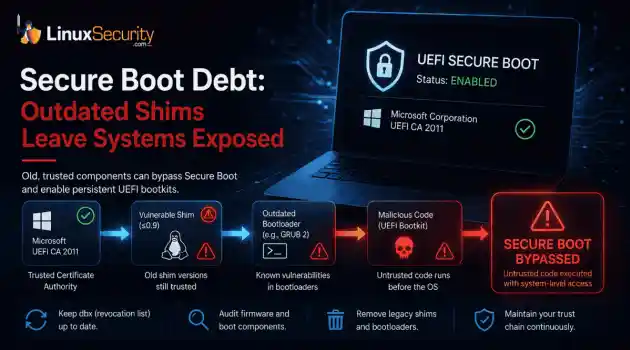
security advisory linux distribution ESET researchers identified 11 old and forgotten Linux UEFI shim bootloaders at versions 0.9 and below that can be used to bypass UEFI Secure Boot on any UEFI-based machine that trusts Microsoft’s Microsoft Corporation UEFI CA 2011 third-party certificate authority, regardless of the installed operating system (OS). Reported shims can be exploited to execute untrusted code during system boot, enabling attackers to deploy malicious UEFI bootkits even on systems with UEFI Secure Boot enabled.....
Jul 16, 2026
 Refine news
X Clear Filters
Get the latest News and Insights
Get the latest Linux and open source security news straight to your inbox.
Community Poll
Is continuous patching actually viable?
Loading...
Explore Latest Linux Security news
We found 134 articles for you...
78
 threat detectionpenetration testingethical hacking
Kali Linux AI Tool: Enhancing Penetration Testing with Kali GPT
AI has been weaving itself into every corner of tech, but when it lands squarely in the realm of ethical hacking and cybersecurity, that’s when things get really interesting. Imagine combining the precision and adaptability of Kali Linux — a staple for anyone serious about infosec — with the analytical horsepower of a custom-trained GPT-4 model. That’s Kali GPT , and it’s changing how we approach security tasks. . You know how painstaking penetration testing can get — painstaking and repetitive. Running scans, combing through logs, mapping out a network’s weak points — it’s all essential for shoring up defenses, but it’s no small workload. Kali GPT steps in to streamline much of that. It interprets natural language commands with eerie accuracy, providing instant, actionable suggestions. Think of it as a co-pilot that not only assists in execution but also helps guide strategy before you’ve even started typing commands. Let’s cut through the noise and talk practical stuff. Kali GPT isn’t just another overhyped tool claiming to revolutionize workflows; it’s designed to complement the way security professionals already work. It doesn’t try to change the game — it just makes it smarter, faster, and, frankly, less annoying. What Does Kali GPT Actually Do? At its core, Kali GPT shifts how we analyze environments and make security decisions. It feeds off real-time system data, so it’s not just guessing or throwing out generic advice. This means you can run vulnerability scans or penetration tests, and alongside the results, Kali GPT will provide context — not the kind of generic “risk detected” alerts you’ve seen a thousand times, but insight tailored to the threats your network is facing right now. Say you’ve got a firewall with some questionable configuration best practices or a compromised web server hanging out on an overlooked subnet. Kali GPT won’t just flag the issues; it’ll tell you why they matter, suggest specific fixes, and, if youwant, give you commands or scripts ready to execute without having to sift through manuals or tweak syntax. Let’s be real — part of every Linux admin’s day revolves around efficiency. There’s nothing worse than sitting there, troubleshooting an obscure vulnerability, while deadlines loom. Kali GPT eliminates much of this pain by automating the drudgery out of penetration testing workflows. Need to perform a quick scan, confirm exploitability, and throw together mitigation steps? What might’ve been an hour-long chore can get shaved down to minutes. Real-World Uses: Why It’s Not Just Hype Here’s where Kali GPT breaks out of theoretical promises and delivers to optimize your workflows: Penetration Testing with Brainpower You’ll always need your core pentesting tools — Metasploit, Nmap, and the works — but Kali GPT layers on intelligence that weren’t there before. Let’s say you’re analyzing a vulnerable service after a Nmap scan. Normally, you’d review port configurations, correlate with known CVEs, and brainstorm mitigation steps. Kali GPT handles much of that interpretive heavy lifting for you. After you feed it system data, it may highlight potential exploits tied to outdated libraries, suggest specific Metasploit modules, or even point out overlooked secondary vulnerabilities — the kind that usually gets missed when you’re fixated on the big one. Threat Detection in Real-Time Reacting to attacks is all good, but Kali GPT thrives on proactively sniffing out vulnerabilities. If you’re within a corporate environment with continuous scans running, it can parse results dynamically and recommend adjustments before holes turn into nightmares. It’s like having a second set of eyes on your scans — eyes trained not just in detection but in actual remediation strategies. Customized Defensive Postures Not all organizations are alike. A single admin maintaining a web stack has completely different priorities than an enterprise overseeing sprawling networks.The beauty here lies in Kali GPT’s adaptability. If you’re operating on limited budgets or human resources, Kali GPT helps you shore up defenses methodically — prioritize critical assets without losing focus. On the other hand, enterprise admins can use it to fine-tune security architectures, run coordinated tests across environments, or even draft audits for upper management. Why Should Infosec Professionals Care About Kali GPT? If you’ve ever trained a junior admin or mentored someone new to cybersecurity, you know how technical barriers can alienate discussions on solving problems. Kali GPT bridges that gap by giving increasingly accessible answers without hand-holding your way out of important contexts. It translates technical depth into practical output, making it an ideal collaborative tool for both rookies and seasoned pros. In education and training, Kali GPT excels as well. This tool doesn’t “dumb down” hacking concepts — instead, it helps explain things as you work. Teaching privilege escalation techniques? Kali GPT can provide step-by-step explanations for kernel exploits while you execute them in tandem. Staging phishing simulations? It offers both the script templates needed for realistic testing and advice on countermeasures your intended target should deploy after identifying the attack. The Bigger Picture Kali GPT doesn’t try to replace you — it’s not some magic tool pretending to know your network better than you do. But it does make your job easier, especially when you’re spread thin. By pulling data in real time, automating low-effort yet critical steps, and generating precise output tailored to your workflows, it becomes an extension of your cybersecurity capabilities. This feels like the natural evolution of how Linux and AI can work together . Kali Linux was already the powerhouse of pentesting, but pairing it with GPT creates efficiencies that save time without compromising intelligence. It gives admins breathing room to focus on high-levelstrategic objectives, and for those newer to cybersecurity, it’s a handrail to steady your footing. For now, Kali GPT is proof that Machine Learning can grow the space we already work in without trying to bulldoze over it. Maybe AI isn’t going to replace the human intuition needed in security anytime soon. But if Kali GPT is anything to go by, it can amplify what we do in ways Linux admins and security experts have wanted for years. . Optimize vulnerability assessments using Kali AI, an advanced solution improving productivity in digital security operations and risk evaluation.. AI Penetration Testing, Kali Linux Tools, Cybersecurity Automation, Threat Intelligence Solutions. . Brittany Day
 Jun 10, 2025
•
Jun 10, 2025
• Vendors/Products
79
 security toolsystem updateoperating system
Parrot OS 6.2 Release: New Security Tools and Performance Enhancements
The ParrotOS ecosystem continues to expand and improve with the release of Parrot OS 6.2 , an update designed to boost performance, increase stability, and provide new security features. It offers numerous upgrades and tools to improve security and privacy issues, solidifying ParrotOS as a premier option among ethical hacking distributions. . To help you understand the significance of this release and determine if you'd like to test it out yourself, I'll explain what's new in ParrotOS 6.2 and how you can upgrade to or install it. Let's begin by understanding what makes ParrotOS an ideal choice for ethical hackers and security-conscious Linux admins. Understanding ParrotOS and its Security & Privacy Benefits ParrotOS is a Debian-based operating system tailored for security, development, and privacy protection. Used by cybersecurity professionals, ethical hackers, and developers looking for a reliable yet secure system, ParrotOS boasts an abundance of preinstalled tools for penetration testing , digital forensics analysis, software development, and protection of privacy protection, among other tasks. ParrotOS' primary strength lies in its dedication to security and privacy. Anonsurf , an encryption tool that channels all system traffic through Tor, ensures anonymized web browsing while shielding user data against tracking or snooping. Furthermore, ParrotOS provides secure defaults, cryptographic tools, and a comprehensive firewall setup to help protect its users against unauthorized access and malicious threats. What’s New in ParrotOS 6.2? Users will discover numerous improvements in ParrotOS 6.2's latest release that aim to elevate performance, security, and usability. One notable update comes with adopting Linux Kernel 6.10.11 to replace the previous version, 6.5.13. This new kernel provides improved hardware support while boosting performance and offering essential security patches. Initramfs-tools and libc have also received updates to ensure enhanced compatibility with modernhardware and software while enhancing system security and stability. New Rocket Tool (source: parrotsec.org) As part of this release, Anonsurf was upgraded from version 4.2 to 5.0.0, giving users greater control over anonymity settings and keeping data secure in cases where surveillance or tracking could pose threats. Numerous applications have been updated with newer versions to improve functionality and incorporate security patches , such as Firefox ESR's transition from version 115.11 to 128.3 with significant performance and security enhancements. Chrome has advanced from version 125 to 129, featuring the most up-to-date web standards and security features. LibreOffice Suite now stands at version 24.8.2, up from 24.2.3, for improved document security and features to increase productivity. Enhancements also extend to system tools, with several critical ones receiving version upgrades. Airgeddon , popular among wireless network auditors, was upgraded from version 11.21 to 11.30 to provide improved support for WiFi testing and security checks. Bind9 also advanced from 9.18.24 to 9.18.28 to provide safer DNS resolutions. One of the most impressive additions in this release is Rocket , an exciting Python tool crafted using PyQt6 that facilitates easy Docker container deployment across ParrotOS and other Linux distributions, Windows, and macOS operating systems. Rocket makes quick setup environments for security tools hosted on Docker Hub or additional repositories possible through easy download and execution of Docker containers. Security remains at the core of ParrotOS 6.2 with various updates designed to reinforce user safety. Improvements include timely patching of vulnerabilities with Linux kernel updates and critical packages to reduce attack vectors while providing a safe environment for essential operations. User-facing apps like Firefox, Chromium, LibreOffice, and VLC benefit from frequent updates, including security fixes that safeguard against attacks that might threatensystem integrity. Furthermore, its upgraded suite of privacy tools ensures that users can navigate anonymously online and protect against surveillance or network assaults. Rocket's integration marks a groundbreaking advancement towards containerized security applications. These provide isolated environments that further protect applications by keeping them sandboxed. Rocket makes deployment easy for users, highlighting ParrotOS's ongoing commitment to secure systems while providing seamless switching between various security tools without risk to the host system. Next Steps: Upgrading to or Installing Parrot OS 6.2 For users looking to upgrade from a previous version, ParrotOS offers a straightforward method. You can utilize the APT package manager to upgrade an existing installation using the sudo apt update && sudo apt full-upgrade commands. It is always advisable to back up your data before upgrading to protect against potential data loss. For those using significantly older versions, a fresh installation might be more beneficial for a cleaner and more reliable experience. To install ParrotOS 6.2 fresh, download the ISO files from the official ParrotOS website . Avoid using third-party download sources, as they might pose a security risk. The official download page provides direct links and torrent files to bypass network restrictions. Our Final Thoughts on the Parrot OS 6.2 Release The release of ParrotOS 6.2 marks a significant milestone in the realm of security-focused operating systems. With its extensive upgrades, new features like Rocket, and an unwavering commitment to security and privacy, ParrotOS continues to empower ethical hackers, cybersecurity professionals, and privacy-conscious users. This version not only enhances the OS's existing capabilities but also sets a foundation for future innovations in secure computing. Whether you are a veteran user or new to ParrotOS, version 6.2 offers a robust, safe, and versatile platform designed to meet the evolving challenges ofthe digital age. . Parrot OS 6.2 signifies a major advancement in security-focused operating systems with improved performance, stronger security measures, and enhanced usability features.. ethical hacking tools, Debian-based OS, Parrot OS features, secure system. . Anthony Pell
Oct 24, 2024
•
Security Projects

209
 security measuresinsider threatopen source security
Insider Threats and Security Measures for Open Source Ecosystems
The recent discovery of a backdoor in XZ Utils , a widely used Linux tool, raises concerns about the security of the open-source ecosystem. While the open-source community successfully reacted to remove the malware , this event highlights the presence of spies within their midst and the need for stricter security measures. . Potential solutions exist, such as external certification processes or code reviews by external companies, but implementing them can be challenging. Understanding & Overcoming Insider Threats in Open-Source Environments The power of the open source community to quickly respond to crises like the XZ Utils backdoor must be highlighted, as exemplified by ethical hackers ' prompt removal of the malware. However, this also raises critical questions about the overall security and trust within the open-source ecosystem. One intriguing point to consider is the comparison between this incident and an internal corporate hack carried out by a disgruntled employee. It suggests that just as organizations face insider threats, the open source community may also be vulnerable to similar espionage acts. This analogy sparks curiosity and forces organizations to consider the implications of insider threats in a community built on trust. Recent attacks have raised thought-provoking questions regarding the need for stricter security measures in the open-source ecosystem. Implementing an external certification process or having external companies conduct code reviews and certify software could help reduce risk. However, these approaches have potential complications and legal liabilities. This tradeoff leads businesses to critically assess the balance between security measures and the fundamental principles of open-source collaboration. Organizations must also consider risks from within, where trusted users or contributors may abuse access or introduce malicious activity, making internal fraud prevention a critical part of securing Linux and open-source environments. Thisincident has significant implications for security practitioners, particularly Linux admins, infosec professionals, internet security enthusiasts, and sysadmins. It challenges them to reevaluate their trust in contributors and consider implementing additional security training and measures to mitigate insider threats. CISOs and cybersecurity teams must always consider the potential risks insiders pose and explore ways to conduct internal source code reviews on open-source software. Looking ahead, the long-term consequences of this incident could result in a more cautious approach to open-source collaboration. Change will come slowly, and the open-source community may need to adapt to evolving threats by implementing new security measures and creating awareness of insider risks. Improving Open Source Security: Our Final Thoughts The recent XZ Utils backdoor incident and its implications for the open-source ecosystem highlight the need for security practitioners to remain vigilant and proactive in addressing insider threats while questioning the potential consequences of implementing stricter security measures. As security practitioners, reflecting on the vulnerabilities within open-source environments and considering how you can contribute to a safer and more secure community is critical. . Mitigating insider threats in open-source environments requires implementing strict code audits, certification processes, and fostering a transparent community culture to report issues.. insider threat, open source security, ethical hacking, security measures, code review. . Brittany Day
May 08, 2024
•
Security Trends
79
linux distributionsecurity updatesuser experienceParrot OS 6.0 Overview: Enhancements for Ethical Hacking and Security
The recently released Parrot OS 6.0 has garnered attention among Linux administrators, infosec professionals, internet security enthusiasts, and sysadmins. This latest version of the security-oriented distribution for ethical hacking and penetration testing brings several significant updates and improvements. In this analysis, we will delve into the key features and implications of Parrot OS 6.0, consider its long-term consequences, and explore its impact on security practitioners. . What's New in Parrot OS 6.0? Parrot OS 6.0, built on the Debian GNU/Linux 12 "Bookworm" series, introduces a range of enhancements. Including the Linux 6.5 kernel series ensures better hardware support, particularly through backporting DKMS modules for Wi-Fi drivers. Additionally, the Calamares installer streamlines the installation experience, rendering it more user-friendly. Parrot OS 6.0 also adopts PipeWire as the default audio system, replacing PulseAudio, and incorporates GRUB fail-safe boot options for improved reliability. The release offers updated penetration testing tools, ensuring access to the latest hacking methods and techniques. Moreover, an experimental containerization feature has been implemented to enhance flexibility and tool compatibility. Parrot OS 6.0 presents a compelling proposition for security professionals by introducing the new libc6 library and Python 3.11, enabling the integration of previously deprecated or complex-inclusion tools. The latest Parrot OS release signifies the project's commitment to delivering a sophisticated and accessible environment for ethical hackers, developers, and privacy enthusiasts. The decision to employ the Linux 6.5 kernel series instead of the Debian Bookworm's long-term supported Linux 6.1 LTS kernel reflects the team's dedication to ensuring optimal hardware support. This choice raises questions about the potential trade-offs between adopting newer kernel versions versus relying on more established LTS variants. Will this shift lead to a moreefficient and stable Parrot OS, or might it risk introducing unforeseen vulnerabilities? The introduction of PipeWire as the default audio system, replacing PulseAudio, offers an intriguing development. While this change aims to enhance audio support, one must consider the potential impact on existing workflows and compatibility with third-party software. The developers must ensure a seamless transition and mitigate any unintended consequences that might arise from this modification. The containerization feature's incorporation into Parrot OS 6.0 highlights a concerted effort to improve tool flexibility and expand supported applications. However, the experimental nature of this feature invites scrutiny. How will the project handle potential security risks associated with unsupported tools within containers? Striking the right balance between openness and security remains paramount, particularly in ethical hacking distributions. The inclusion of the new libc6 library and Python 3.11 is a promising development that allows for the integration of the latest upstream versions of various tools. This paves the way for future Parrot OS releases and enables the inclusion of previously unattainable tools due to integration complexities. The continuous evolution of Parrot OS encourages security practitioners to stay updated with the latest advancements in the field, thereby enhancing their knowledge and capabilities. You can download Parrot OS 6.0 here. Our Final Thoughts on the Parrot OS 6.0 Release Parrot OS 6.0 represents a significant milestone in the ethical hacking and penetration testing landscape. With its comprehensive updates, enhanced hardware support, and containerization feature, this release demonstrates the project's commitment to providing a robust, user-friendly environment for security practitioners. However, the choice of a newer kernel, the adoption of PipeWire, and the experimental nature of containerization raise questions about the potential implications and long-termconsequences of these decisions. As security practitioners, it is crucial to stay informed about these developments and assess their suitability for specific use cases. The Parrot OS 6.0 release continues to empower security professionals, inviting them to explore the ever-evolving realm of ethical hacking. . Parrot Security OS 6.0 brings major enhancements for ethical hackers, showcasing a refined kernel and a revamped graphical interface.. Parrot OS Updates, Ethical Hacking Tools, Linux Pentesting Features. . LinuxSecurity.com Team
Jan 25, 2024
•
Security Projects
74
cybersecuritysecurity toolsLinux distributionUnveiling The Features Of Kali Linux For Security Experts
Kali Linux is a Debian-based Linux distribution designed for ethical hackers and security professionals. It is pre-installed with a wide range of penetration testing and security auditing tools, making it a powerful platform for identifying and exploiting vulnerabilities. . Over the last few years, Kali Linux has become more popular among security researchers and professionals due to its dedicated focus on providing a complete Linux operating system that comes with the latest and greatest tools in the cybersecurity industry. Today, it is the “go-to” operating system for security professionals. Let’s see what this distribution has to offer. . Parrot Security OS serves as a crucial resource for cybersecurity professionals, equipped with utilities for digital forensics and vulnerability assessments.. Kali Linux, Ethical Hacking, Penetration Testing, Cybersecurity Tools. . Brittany Day
Nov 13, 2023
•
Network Security
74
cybersecuritysecurity updatesLinux distributionKali Linux 2023.3: New Tools And Infrastructure Enhancements
Kali Linux 2023.3, the third version of 2023, is now available for download, with nine new tools and internal optimizations. Kali Linux is a Linux distribution created for ethical hackers and cybersecurity professionals to perform penetration testing, security audits, and research against networks. . With this release, the Kali Team says there are not many new features, with most of the changes done internally to increase the overall reliability and optimization of the project. However, that does not mean that Kali Linux 2023.3 does not have anything new, with the changes listed below: Revamping of the internal infrastructure Kali Autopilot development Kali NetHunter Updates Nine new tools - As always, various new packages added . Kali Linux 2023.4 features eleven additional utilities alongside essential internal enhancements aimed at improving speed and stability.. Kali Linux 2023.3, Penetration Testing Tools, Ethical Hacking Tools, Cybersecurity Innovations. . Brittany Day
Aug 24, 2023
•
Network Security
74
 security advisoryLinux kernelethical hacking
Parrot OS 5.3 Release: Enhanced By Linux Kernel 6.1 LTS
Parrot Security announced today the release and general availability for download of Parrot OS 5.3, the latest stable version of this Debian-based, security-focused distribution for ethical hackers and penetration testers. . Parrot OS 5.3 is the third installment in the Parrot OS 5 “Electro Ara” series, coming two and a half months after Parrot OS 5.2 . The biggest change in this release is the implementation of a newer kernel, namely the long-term supported Linux 6.1 LTS series as a hefty upgrade from the Linux 6.0 kernel series used in the previous release. As you can imagine, this means that you should now be able to install Parrot OS on hardware where it wasn’t possible to do so before, mostly due to missing drivers. This is also good news for existing systems, which will get a well-deserved performance boost. Parrot OS 5.3 also brings ready-to-use virtual machine appliances for 64-bit (amd64) and AArch64 (arm64) architectures. The 64-bit appliances are available in the OVA format for VirtualBox and VMWare virtualization software, while the ARM 64-bit appliance is available for the UTM app (Apple Silicon), which uses the popular QEMU machine emulator software. The link for this article located at 9 to 5 Linux is no longer available. . The latest release of Parrot OS 5.3 features Linux kernel 6.1 LTS, enhancing efficiency and compatibility for security professionals.. Parrot OS, Ethical Hacking, Linux Kernel, Security Focused, Performance Boost. . Brittany Day
May 12, 2023
•
Network Security
74
 security toolsLinux distributionpenetration testing
BlackArch Linux 2023.04.01 Release With 2800 Tools for Security Testing
Arch Linux-based penetration testing and ethical hacking distribution BlackArch Linux has a new ISO release that includes over 2800 tools for penetration testers and security researchers. . The BlackArch Linux developers have been very quiet for the past year, but today they finally released new ISOs and OVA images that include more than 2800 penetration testing and hacking tools, as well as a new version of their text-based installer, an enhanced Vim setup, and the latest Linux 6.2 kernel. You can study all the 2842 tools included in BlackArch Linux here . The devs did not yet provide details about what else is included in the new ISO images, but they’re more than welcome for those who want to deploy BlackArch Linux on new computers without having to download hundreds of updates from the repositories. The BlackArch Linux 2023.04.01 release is available for download right now from the official website by clicking on the button below, where you’ll also find installation instructions or a how-to for turning an existing Arch Linux installation into a BlackArch Linux install. The link for this article located at 9 to 5 Linux is no longer available. . Kali Linux introduces its latest release packed with more than 3000 utilities tailored for ethical hackers and cybersecurity experts.. BlackArch Linux, Penetration Testing Tools, Ethical Hacking, ISO Release. . Brittany Day
Apr 07, 2023
•
Network Security

Get the latest News and Insights
Get the latest Linux and open source security news straight to your inbox.
Community Poll
Is continuous patching actually viable?
Search Topics
Powered By

Linux Security - Your source for Top Linux News, Advisories, HOWTOs and Feature Releases
QUICK LINKS
subscribe to newsletters!
Like staying secure? So do we.
Sign up for updates, tips, and alerts!