


Security Vulnerabilities  malware linux
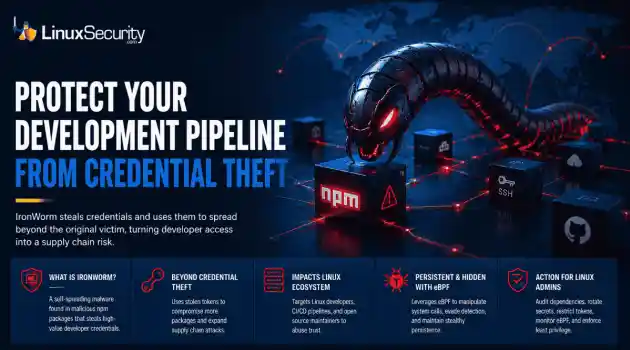
malware linux IronWorm steals credentials and uses them to spread beyond the original victim, turning developer access into a supply chain risk. . A new campaign targeting npm has evolved past simple credential theft. Researchers identified IronWorm, a self-spreading threat. It harvests high-value Linux development secrets—SSH keys, cloud tokens, package publishing credentials. One compromised workstation becomes a launchpad for downstream supply chain attacks. This is not a get-in-and-get-out operation....
 Jun 08, 2026

Network Securitysystem security Linux network
system security Linux network The romanticized image of the digital nomad – a laptop on a sun-drenched balcony – rarely accounts for the actual friction of maintaining a professional development environment on the move. . The friction is amplified with Linux. We are looking for a setup that respects our kernel configurations, handles volatile network handovers, and maintains a strict security posture without the hand-holding of a consumer-grade OS – so, put simply, more than just a laptop and a sunny deck. The hardware is...
May 26, 2026

Server Securityopen-source Linux administration
open-source Linux administration Cron has existed in Unix and Linux environments for decades, handling backups, cleanup scripts, patching jobs, log rotation, monitoring tasks, and other maintenance work that administrators do not want to run manually. Most Linux servers rely on it constantly, which is exactly why attackers continue abusing it for persistence after a system has already been compromised. . Persistence through cron is not complicated. Attackers do not need a rootkit or advanced malware framework to maintain...
May 25, 2026

Vendors/Productssecurity breach linux
security breach linux A major internal repository breach at GitHub has exposed a critical and overlooked blind spot in Linux supply chain security. Kernel exploits, exposed SSH services, weak firewall rules, and vulnerable daemons dominated the Linux threat model for years, and in many environments, they still matter. But recent supply-chain incidents involving GitHub ecosystems, npm packages, and malicious developer tooling point somewhere else entirely: the developer workstation. . The breach matters because...
May 21, 2026

Security Trends access control multi-tenant
access control multi-tenant Linux administrators often face an ugly choice in the cloud: prioritize convenience and cost-efficiency by sharing infrastructure, or sacrifice those benefits for the sake of total isolation. Most modern Linux workloads don't live on their own private servers anymore. They live in shared environments like Kubernetes clusters, where multiple teams and services run side-by-side. It sounds efficient, and it usually is. . But cloud isolation isn't as ironclad as it looks on the diagram. If you...
May 21, 2026
 Refine news
X Clear Filters
Get the latest News and Insights
Get the latest Linux and open source security news straight to your inbox.
Community Poll
What got you started with Linux?
Loading...

Explore Latest Linux Security news
We found -4 articles for you...
210
 security advisoryrisk managementvulnerability assessment
Understanding the 80/20 Rule in Linux Vulnerability Management
Linux administrators deal with steady pressure from patching, configuration changes, and the slow accumulation of technical debt. Environments rarely break because of one vulnerability. . Problems build in layers until the wrong weakness becomes reachable. When you look at real incidents, though, the pattern isn’t random. A small group of issues shows up repeatedly, while most of the CVEs published each week never factor into actual compromises. This imbalance is where the 80/20 rule becomes visible in Linux security. Why Most Linux Vulnerabilities Never Become Real Risks Most Linux vulnerabilities never become real risks because attackers rely on specific weaknesses that give them consistent results. The bulk of published advisories involve software paths, features, or configurations that never appear in common deployments. The issues that matter tend to fall into the same categories across investigations. This is also why teams use a mix of scanners and vulnerability management tools to separate noise from conditions that influence real attack paths. Tools alone do not solve the problem, but they help show which vulnerabilities sit in the parts of the environment attackers actually reach. Kernel Exploitation Paths in Linux Kernel issues show up in investigations more often than people expect. You usually see the same pattern. Someone gets a limited foothold, then looks for an elevation path that works across a wide range of systems. Dirty COW , Dirty Pipe, the overlayfs bugs. They weren’t just interesting vulnerabilities. They were dependable. Once a working exploit appeared, it stayed in use because the kernel versions out in the world don’t move as fast as advisories do. Most teams patch the applications first and the kernel later. Attackers know that, so they lean on whatever gives them root without guesswork. Commonly Exposed Linux Services Attackers Target When you look at scans against the public internet, the same services rise to the top on Linux systems.SSH, Apache, Nginx, Redis, Docker APIs. None of these is obscure, and none requires an unusual setup. They sit at the edge of a lot of deployments, so attackers spend most of their time checking versions, testing weak authentication, and looking for misconfigurations. Many intrusions start this way. Not with an exotic bug, but with a service that had been running quietly for months without anyone checking how it was configured or who could reach it. Linux Misconfigurations That Create Entry Points Misconfigurations show up in real compromises even when software is fully patched. It always comes back to something small. An SSH setting left too permissive. A test account that never made it out of production. A sudo rule written during a deadline and never corrected. NFS exports that expose more than intended. Files or directories that should have been locked down but were not. These aren’t edge cases. They travel with Linux because they come from how environments evolve, not from the packages themselves. Attackers use them because they work, not because they are clever. Supply Chain Weaknesses in Linux Ecosystems The 2024 XZ Utils backdoo r demonstrated how a compromise in an upstream component can reach Linux distributions before detection. Past events such as the Linux Mint ISO compromise or malicious PyPI modules arriving on Linux systems show similar patterns. Small upstream shifts can move quickly into production environments through trusted package channels. These examples outline why only a small percentage of vulnerabilities shape the majority of meaningful Linux incidents. Where Traditional Vulnerability Management Falls Short for Linux Traditional vulnerability management falls short for Linux because most tools were built to catalog weaknesses, not interpret how Linux systems are deployed, updated, and accessed. The assumptions built into those tools do not hold up when environments shift frequently. Excessive CVE Volume Across Linux Systems Linux distributions maintainlarge package ecosystems, which leads to frequent CVE publication. Many of these advisories involve features not enabled in common deployments or vulnerabilities that require specific, unlikely conditions. Scanners surface these items without context, which expands the list without improving understanding. Why Context Matters More in Linux Vulnerability Triage Context determines whether a vulnerability can be used. A flaw in an Apache module only matters if the module is enabled. A library CVE matters only if the application uses the code path. A kernel vulnerability matters only when a working exploit exists. Traditional scoring systems do not measure context, so they group unrelated issues together. How Exploit Timing Accelerates Linux Risk Exploit code for Linux vulnerabilities often appears quickly. Dirty Pipe had public exploit code shortly after disclosure. The OpenSSH regreSSHion flaw (CVE-2024-6387) triggered widespread scanning within hours. This timing compresses the window defenders have to respond and creates a risk that traditional patch cycles cannot match. The Impact of Linux Architecture Drift on Vulnerability Programs Linux environments change constantly. Containers freeze libraries while hosts evolve. Kubernetes schedules workloads across nodes with different patch levels. Cloud instances appear and disappear. These changes undermine static lists of vulnerabilities because the underlying systems shift faster than reports can capture. Because of this, Linux teams often rely on a mix of scanning, behavioral detection, configuration auditing, and targeted monitoring rather than long lists of raw CVEs. How to Identify High-Risk Vulnerabilities in Linux Environments You identify high-risk Linux vulnerabilities by looking at the conditions attackers consistently use. Once you narrow the focus to observable behavior rather than advisory counts, the same traits appear across most incidents. Indicators of Actively Exploited Linux Vulnerabilities Actively exploitedvulnerabilities matter immediately because attackers have demonstrated a reliable path to compromise. Kernel privilege escalation flaws , OpenSSH vulnerabilities, and common web server bugs move quickly from disclosure to exploitation. Once exploit code is accessible, the vulnerability becomes a predictable attack tool. Why Public Exposure Increases Linux Exploitability Public exposure shapes risk more than severity ratings. Internet-facing Linux systems receive constant scanning for SSH, HTTP, Redis, and container APIs. Telemetry from internet scanning projects shows that brute-force attempts and version enumeration occur continuously across these services. If a vulnerability exists on a reachable system, its real-world impact increases significantly. High-Value Linux Systems That Amplify Risk Certain Linux systems influence the environment more than others. LDAP servers, Kubernetes control planes, bastion hosts, and CI/CD runners carry privileges that extend beyond their footprint. A vulnerability or misconfiguration on any of these systems can allow attackers to pivot across the environment. These systems shape incident outcomes more than general-purpose workloads. Identity and Configuration Flaws in Linux Environments Identity and configuration issues appear often in real intrusions. Misconfigured PAM rules, permissive sudo policies, weak SSH settings, and exposed Docker sockets give attackers mobility after initial access. These weaknesses persist across distributions because they emerge from operational decisions, not from software defects. Risks Posed by Unsupported or Outdated Linux Systems Unsupported Linux distributions accumulate vulnerabilities without patches. Older appliances running outdated kernels remain common targets because public exploit kits cover many of these versions. These systems introduce predictable risk because every new vulnerability becomes permanent once support ends. Once these signals are visible, prioritization becomes more accurate than any staticseverity score. Tools That Help Prioritize Linux Vulnerabilities More Accurately Tools that help Linux teams prioritize vulnerabilities effectively are the ones that highlight exposure, behavior, and configuration rather than produce long inventories. These tools improve decision-making because they reflect how Linux systems operate in production. Attack Surface Discovery Tools for Linux Hosts Attack surface discovery identifies Linux systems that fall outside normal monitoring. Shadow VMs, abandoned cloud instances, outdated containers, and untracked development systems create paths attackers can use if left exposed. These systems rarely appear in traditional scans because the inventory is incomplete. Threat Intelligence Sources Focused on Linux Exploits Linux-focused threat intelligence highlights changes in attacker behavior, such as scanning waves, exploit releases, and malware families targeting Linux services. This information narrows attention to vulnerabilities with measurable activity rather than theoretical risk. Risk-Based Tools That Apply Linux Context to Prioritization Risk-based tools combine exploitability, asset importance, configuration state, and exposure. This blend aligns well with Linux workloads because it removes noise from vulnerabilities that cannot be reached from any meaningful attack path. Linux Configuration and Hardening Assessment Tools Configuration assessment catches weaknesses that scanning cannot see. SSH policies, kernel parameters, file permissions, container isolation , and Kubernetes roles influence real exposure. These settings explain many intrusions where no CVE played a direct role. Automation Platforms That Improve Linux System Consistency Automation reduces drift. Automated patching, image rebuilding, and configuration enforcement limit the time attackers have to exploit misconfigurations or outdated software. Environments that automate foundational tasks experience fewer recurring issues. Linux-Native Security Tools ThatReveal Real Risk Tools such as Lynis, Falco, OpenVAS, Greenbone, Wazuh, Tripwire, OSQuery, Sysdig, and eBPF-based detectors provide event-level visibility and configuration detail. They surface activity that matches known intrusion patterns and highlight conditions scanners miss. These tools support the 80/20 approach by exposing the parts of the environment that shape real-world incidents. What the 80/20 Rule Means for Linux Security Teams The 80/20 rule matters for Linux teams because a small subset of vulnerabilities and misconfigurations drives most real compromises. Once teams recognize this imbalance, they can prioritize based on observable behavior instead of exhaustive lists. This shift reduces noise and aligns work with the weaknesses attackers consistently use. Linux environments have always contained more vulnerabilities than any team can address fully. The difference comes from knowing which issues shape outcomes and which remain theoretical. . Understand how the 80/20 rule applies to Linux risk management and vulnerability prioritization for security teams.. Linux risk management,vulnerability prioritization,exploit detection,threat intelligence,configuration assessment. . MaK Ulac
 Nov 26, 2025
•
Nov 26, 2025
• Security Vulnerabilities

Get the latest News and Insights
Get the latest Linux and open source security news straight to your inbox.
Community Poll
What got you started with Linux?
Search Topics
Powered By

Linux Security - Your source for Top Linux News, Advisories, HOWTOs and Feature Releases
QUICK LINKS
subscribe to newsletters!
Like staying secure? So do we.
Sign up for updates, tips, and alerts!
Discover faster search, smarter navigation, and deeper Linux security insights. Read More