Overly broad permissions can turn one compromised account into a much larger security problem. Learn how to reduce unnecessary access, review privileges, and apply least privilege across modern Linux systems. Review Linux Privileges×


IronWorm Supply Chain Threat from Linux Credential Theft
 Jun 08, 2026
•
Jun 08, 2026
•
 MaK Ulac
3 - 5 min read

Topics Covered
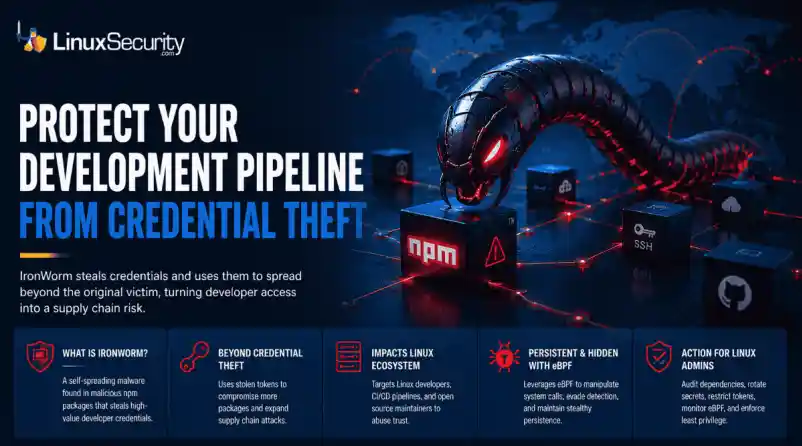
IronWorm steals credentials and uses them to spread beyond the original victim, turning developer access into a supply chain risk.
A new campaign targeting npm has evolved past simple credential theft. Researchers identified IronWorm, a self-spreading threat. It harvests high-value Linux development secrets—SSH keys, cloud tokens, package publishing credentials. One compromised workstation becomes a launchpad for downstream supply chain attacks.
This is not a get-in-and-get-out operation. IronWorm maintains persistence, expands through the software you maintain, and leverages your reputation to push malicious code to every user who pulls your next update. The threat model shifted. Your workstation is no longer just an endpoint. It is the most significant vulnerability in your production supply chain.
What Is IronWorm?
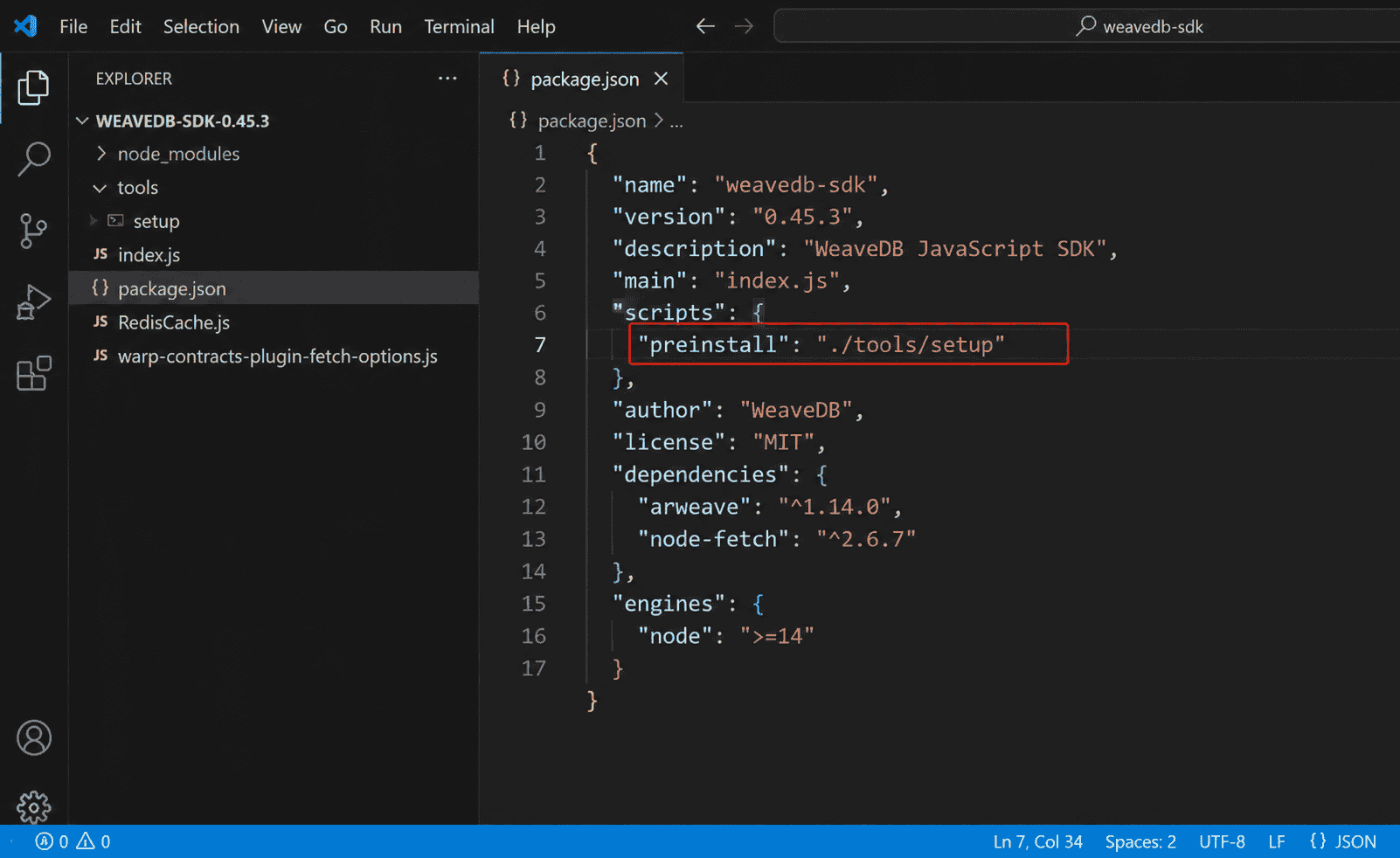
IronWorm acts like a digital parasite. It hides inside software developers' trust. Researchers found the malware inside dozens of malicious npm packages on the public registry.
It operates with a singular focus: collecting secrets. It ignores browser history. It ignores personal files. It hunts for digital keys that allow an attacker to move beyond a single machine and into the broader software ecosystem.
Why The IronWorm Malware Attack Is Different
Most malware follows a predictable, finite lifecycle. It infects a system. It scrapes what it can. It exists. IronWorm breaks that model. It is designed for expansion. A developer pulls a tainted dependency. The malware scrapes tokens. It uses those stolen tokens to compromise additional packages. It creates new victims through the very infrastructure you use to build software. This is not just credential theft. It is an automated supply chain assault. It uses your own reputation to lure the next target.
How IronWorm Impacts Linux Users
Most security reports stop at the npm layer. That is a mistake. For the Linux ecosystem, the threat is existential.
Linux Developers Are Prime Targets
Linux workstations are rarely just office computers. They are development hubs. Attackers know this. They are not looking for standard user credentials. They are looking for SSH keys, cloud secrets, and Git tokens. They want the bridge between a local machine and a production environment.
Linux Build Servers and CI/CD Pipelines
Linux systems act as the engine room for software delivery. They run GitHub Actions, GitLab CI, or Jenkins. If IronWorm compromises a machine used to manage build runners, the attacker gains more than a workstation. They gain the ability to tamper with software before it reaches a user.
Open Source Maintainers Face Elevated Risk
If you maintain public-facing packages, you are a primary target. IronWorm is specifically designed to hijack npm publishing tokens used to push updates. If an attacker gains those credentials, they push malicious code under your name. Trust is the hardest thing to build in open source. IronWorm is engineered to break it.
The eBPF Rootkit Connection
Beyond credential theft, IronWorm introduces a technical layer of persistence. Researchers found that the malware leverages eBPF. This is a powerful Linux kernel technology typically used for networking, observability, and security tools.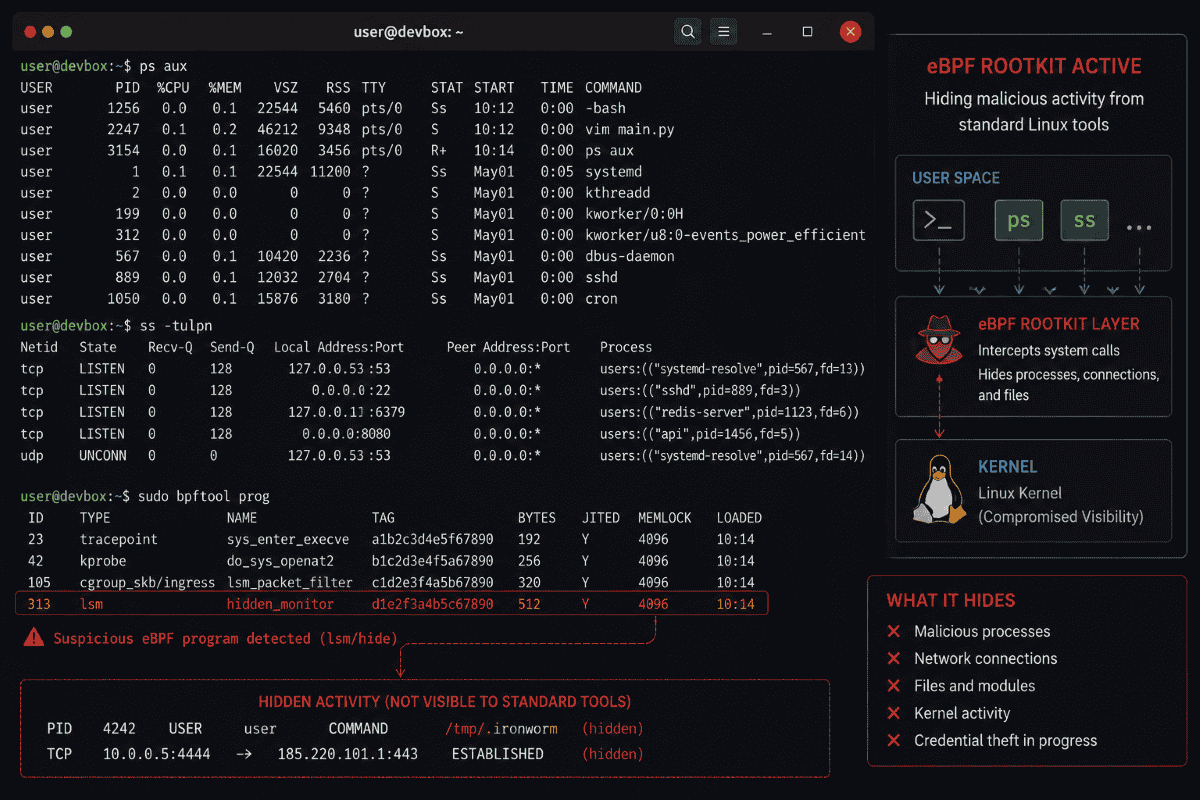
Administrators use eBPF to monitor system health and detect intrusions. Attackers realized the same power that allows a security tool to inspect the kernel also allows malware to remain hidden. By utilizing eBPF, IronWorm manipulates system calls. It bypasses traditional monitoring. It stays stealthy while it harvests the next set of credentials.
Why Supply Chain Attacks Keep Getting Worse
IronWorm is not an isolated anomaly. It is part of a broader trend in which attackers target trusted software distribution channels rather than individual users. The 2024 XZ Utils backdoor demonstrated how a compromise in a widely trusted open-source project can ripple through Linux distributions and enterprise environments. IronWorm follows a similar trust-abuse strategy, but instead of inserting malicious code directly into a project, it focuses on stealing developer credentials that can be used to compromise additional software packages and development pipelines.
Whether the attack begins with a compromised maintainer, a malicious dependency, or stolen publishing credentials, the goal remains the same: abuse trust to reach as many downstream systems as possible.
What Linux Administrators Should Do Now
If you manage Linux development environments, close the gap between developer workstations and production infrastructure. That's where a lot of these attacks gain traction.
- Audit Dependencies: Review package manifests and dependency trees for anything unauthorized, unexpected, or recently introduced without a clear reason.
- Restrict Tokens: Move away from long-lived master keys where possible. Use scoped, short-lived publishing credentials instead.
- Rotate Secrets: Assume every SSH key, API token, cloud credential, and other secret stored on an affected machine has been exposed. Rotate them.
- Isolate CI/CD: Build runners should not keep persistent secrets on disk. An infected process only needs a moment to scrape them.
- Monitor eBPF Activity: Configure detection and monitoring tools to alert on unexpected or unauthorized eBPF program loading.
- Enforce Least Privilege: Limit what a user session can access. Developer accounts rarely need direct access to production systems or high-value credentials.
For defenders, the interesting part isn't the Linux infection itself. It's the focus on credentials. Once an attacker has access to developer tokens, keys, and deployment accounts, the scope of the incident can change quickly. A compromised workstation is manageable. A compromised development pipeline is a different problem.
Related Reading
 PREVIOUS

 NEXT
NEXT

Powered By

Linux Security - Your source for Top Linux News, Advisories, HOWTOs and Feature Releases
QUICK LINKS
subscribe to newsletters!
Like staying secure? So do we.
Sign up for updates, tips, and alerts!