Overly broad permissions can turn one compromised account into a much larger security problem. Learn how to reduce unnecessary access, review privileges, and apply least privilege across modern Linux systems. Review Linux Privileges×


Actively Exploited Chromium V8 Zero-Day: What Linux Admins Need to Know
 Jun 10, 2026
•
Jun 10, 2026
•
 MaK Ulac
5 - 9 min read

Topics Covered
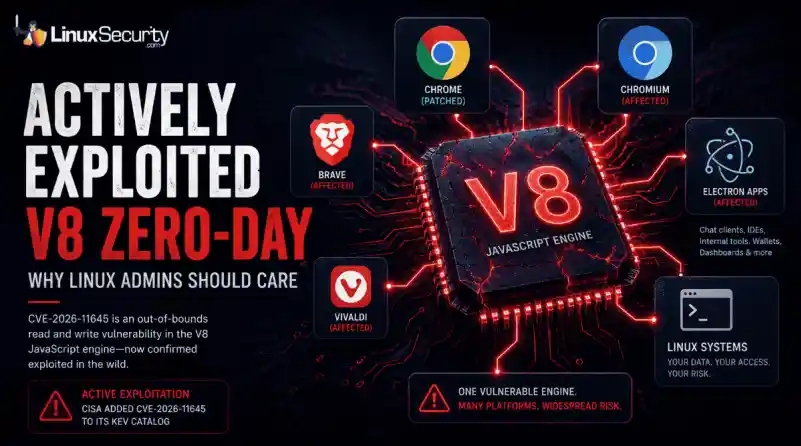
CISA added CVE-2026-11645 to its Known Exploited Vulnerabilities catalog after Google confirmed active exploitation of the flaw. The bug sits in V8, the JavaScript engine behind Chrome and Chromium.
That's where this gets more interesting. Most coverage will focus on Chrome because that's where the patch landed. But the affected component is V8.
- Chromium relies on it.
- Electron relies on it.
- Plenty of desktop software Linux users interact with every day relies on it too, often without much thought given to what is running underneath the interface.
V8 has become part of the plumbing. When a vulnerability shows up there, the conversation shifts from a browser update to a dependency problem. Different vendors patch at different speeds. Some applications ship their own Chromium runtimes. Others inherit updates from distribution maintainers. Same vulnerable code. Different timelines.
This is the fifth Chrome zero-day reported as exploited in the wild this year. That doesn't automatically mean browser security is getting worse. It does reinforce where attackers continue to spend their time. Browser engines process untrusted content constantly. A successful exploit can provide an initial foothold without touching SSH, bypassing MFA, or finding weak sudo rules on a target system.
What Is CVE-2026-11645?
CVE-2026-11645 is an out-of-bounds read and write vulnerability in V8. Google released patches after confirming exploitation in the wild, while technical details remain limited.
NVD describes the flaw as allowing a remote attacker to execute arbitrary code inside the browser sandbox through a crafted HTML page in Chrome versions before 149.0.7827.103.
Why Memory Bugs Matter
Out-of-bounds memory bugs are familiar territory. Software reaches beyond the memory region it was supposed to access, and things start breaking in ways developers never intended.
- Sometimes that means a crash.
- Sometimes memory corruption.
- Sometimes the conditions are needed to build the next stage of an exploit chain.
The location matters as much as the bug class. V8 sits directly in the path of content delivered from websites and web applications. Every page load pushes data through code designed for performance, compatibility, and speed. Large codebases carrying that much complexity tend to attract researchers and attackers for the same reason.
Google has not released exploit details, target information, or attribution. That's normal when patches are still rolling out. What defenders know right now is enough. The flaw exists in V8, exploitation has been observed, and one of the most widely deployed open-source components on the internet is carrying the issue.
Why the V8 Engine Matters Beyond Chrome
V8 is not just a Chrome component. It is the open-source JavaScript and WebAssembly engine used by Chromium, and Chromium sits underneath a long list of browsers and desktop applications. Chrome is the visible patch notice. The dependency graph is bigger than that.
Where V8 Lives in Your Environment:

- Chromium-based browsers: Brave, Vivaldi, and Microsoft Edge.
- Electron applications: Desktop software that may not look like a browser at all—chat clients, editors, dashboards, wallets, internal tools, and build systems.
That creates a practical problem for Linux admins. Updating Chrome does not automatically update every Chromium runtime sitting on a workstation. A Flatpak package may move on one schedule. A Snap package on another. A vendor-supplied AppImage may not get touched by normal package management at all. Quiet exposure.
Open source makes this both better and harder. The code is visible, patched, reviewed, and reused at scale. It also means one vulnerable component can travel through a lot of projects before anyone in operations sees a clean inventory line for it. You can patch what you know. The embedded copy is where teams get burned.
Active Exploitation Confirmed
Google said an exploit for CVE-2026-11645 exists in the wild. CISA then added the flaw to KEV, a catalog used by defenders to prioritize vulnerabilities with evidence of real-world exploitation. That is enough to move this out of routine maintenance and into active triage.
Confirmed exploitation is not the same as mass exploitation. Public reporting has not tied CVE-2026-11645 to a named threat actor, spyware vendor, or broad campaign. No clean attribution. No victim profile. No full exploit chain.
That uncertainty should not slow patching. Early zero-day reporting is usually incomplete because vendors are trying to close the window before exploit details spread. Attackers already have enough to work with. Defenders do not need a full teardown before pushing patches.
The safe read is simple. A V8 flaw was exploited before public patch adoption caught up. That is exactly the window attackers like, especially when the target component is reachable through normal web activity.
Why Browser Engines Remain Prime Targets
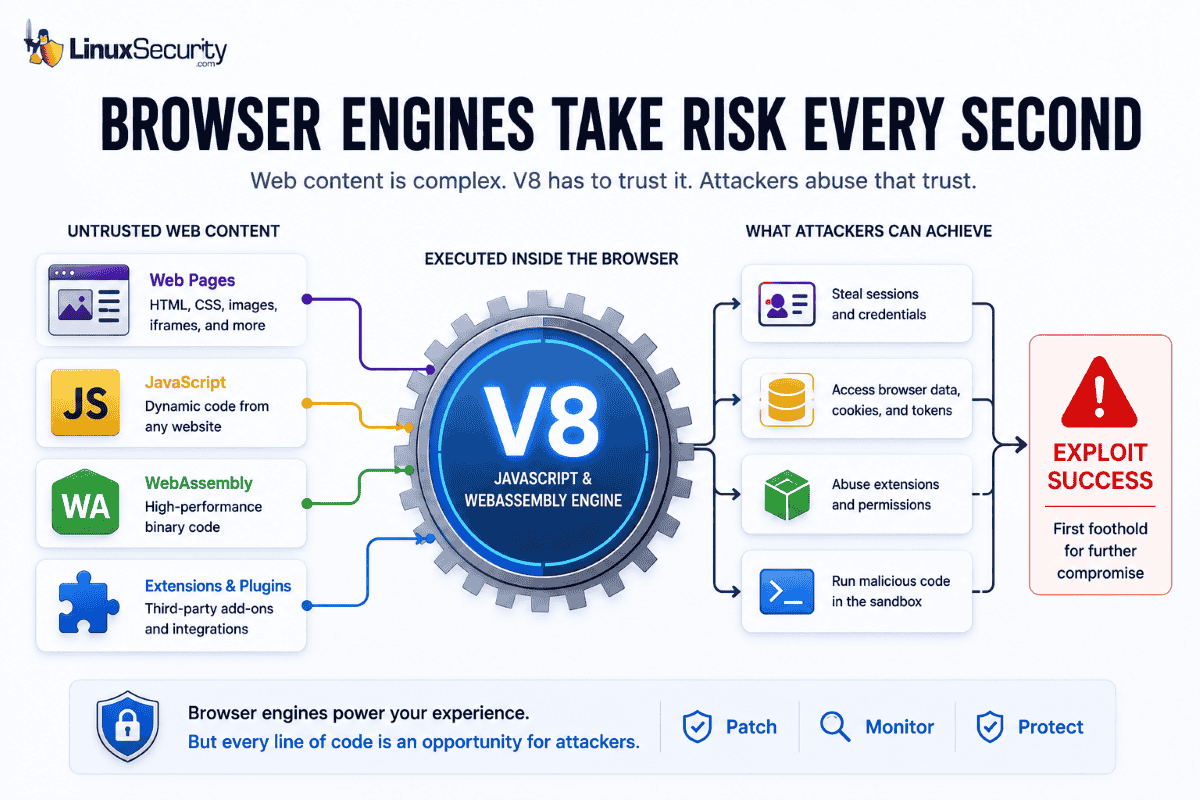
Browser engines take hostile input for a living. JavaScript, WebAssembly, media codecs, PDFs, images, extensions, authentication flows, cloud dashboards. All of it moves through code that has to be fast and forgiving while still holding a security boundary.
V8 sits close to the hardest part of that problem. JIT compilation, garbage collection, object handling, optimization paths, and memory management all need to work under pressure.
Patch Blind Spots
Chrome may update fast, but bundled Chromium runtimes often do not. Check Electron apps, AppImages, Flatpaks, Snaps, and vendor tools that ship their own browser engine.
A browser exploit does not need to deliver root access on the first move. A renderer foothold can expose session data, browser storage, tokens, extension behavior, or enough local context to support the next stage. Then the chain keeps moving.
This is why browser bugs keep showing up in serious intrusion work. They start from normal user behavior: open a page, follow a link, load an ad, or visit a compromised site. No exposed service required.
The Growing Pattern of Chrome Zero-Days in 2026
CVE-2026-11645 is reported as the fifth Chrome zero-day exploited in the wild during 2026. Earlier exploited Chrome flaws this year included CVE-2026-2441, CVE-2026-3909, CVE-2026-3910, and CVE-2026-5281. The count is useful, but the pattern matters more.
Attackers keep coming back to browsers because browsers sit where the credentials are:
- Cloud sessions
- Admin consoles
- Developer portals
- Password managers
- Internal apps
- SSO tokens
A clean browser foothold can become the first step toward something larger. Linux systems are not outside that model. The post-exploitation path may look different than Windows, but the target value is still there: Developer keys, SSH configs, Git credentials, browser cookies, Kubernetes contexts, cloud CLI tokens. Plenty to steal before anyone talks about root.
The mistake is treating browser patching like low-grade desktop hygiene. It belongs in endpoint defense, beside kernel patches, sudo rules, exposed daemons, and privilege escalation bugs. Different surface. Same incident queue.
What Linux Users Should Do Now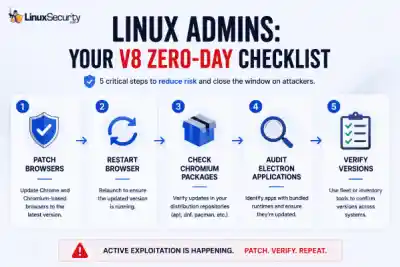
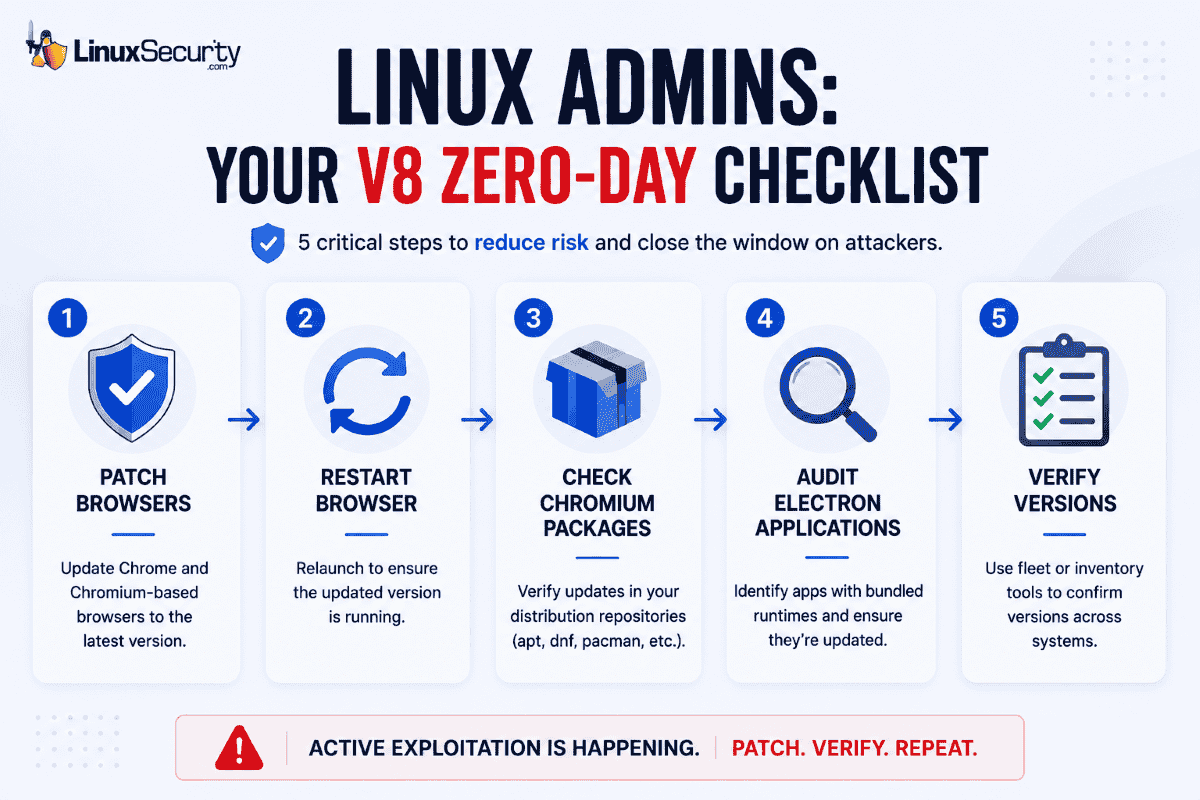
- Patch Chrome and Chromium-based browsers first. Then verify the version actually changed. Reports list Chrome versions before 149.0.7827.103 as affected, with Linux update guidance pointing to patched Chrome builds in the 149.0.7827 line. A browser that downloaded an update but never restarted is still running old code.
- Check Chromium packages from the distribution next. Ubuntu, Debian, Fedora, RHEL, Arch, and downstream repositories do not always ship fixes at the same pace. That is not unusual. It does mean admins should verify package status instead of assuming the update has already landed.
- Look for Electron applications and bundled runtimes. This is where the open-source dependency issue gets operational. Slack-style clients, IDEs, database tools, internal dashboards, chat apps, and packaged desktop utilities may carry Chromium components outside normal browser inventory.
- Managed fleets need version reporting, not user confirmation. Pull browser versions from endpoint management, package databases, EDR inventory, or configuration management. Force relaunches where needed. Long-running sessions are boring until they are not.
Why This Matters for Open-Source Security
The story is not just that Google patched Chrome. The larger issue is that attackers are exploiting a flaw in V8, a shared open-source component used across browsers, desktop applications, and development tooling. That is a different risk shape.
Open-source reuse is how modern software gets built. It saves time, improves quality, and gives maintainers a common base to patch. It also concentrates exposure. One bug in the wrong component can touch products that do not share branding, vendors, package managers, or release cycles.
V8 is one of those components. Most users never think about it, but they run it constantly—through browsers, through Electron, and through tools that wrap web interfaces inside desktop shells. The dependency is quiet until a zero-day makes it loud.
For Linux admins, this pushes asset management down a layer. Knowing that Chrome is installed is not enough. Teams need to know where Chromium and V8 are embedded, which apps bundle their own runtime, and which packages depend on distribution maintainers for fixes. Not elegant work. Necessary work.
Conclusion
CVE-2026-11645 is an actively exploited V8 vulnerability, but the bigger lesson sits underneath the patch notice. Attackers targeted a browser engine. Defenders are left tracking a dependency that runs across browsers, Electron applications, developer tools, and countless Chromium-based projects.
Patch the obvious browsers. Check Chromium packages. Find Electron apps and bundled runtimes. Then treat V8 the way security teams already treat OpenSSL, glibc, sudo, and the Linux kernel when active exploitation is confirmed. The software stack may look different. The risk model doesn't.
Want more Linux security news, vulnerability analysis, and patch guidance delivered straight to your inbox? Subscribe to the LinuxSecurity Newsletter to stay ahead of emerging threats and critical updates.
Related Reading
 PREVIOUS

 NEXT
NEXT


Powered By

Linux Security - Your source for Top Linux News, Advisories, HOWTOs and Feature Releases
QUICK LINKS
subscribe to newsletters!
Like staying secure? So do we.
Sign up for updates, tips, and alerts!