Explore top 10 tips to secure your open-source projects now. Read More
×


Red Hat npm Package Compromise Highlights a Growing Supply Chain Problem
 Jun 02, 2026
•
Jun 02, 2026
•
 MaK Ulac
4 - 7 min read

Topics Covered
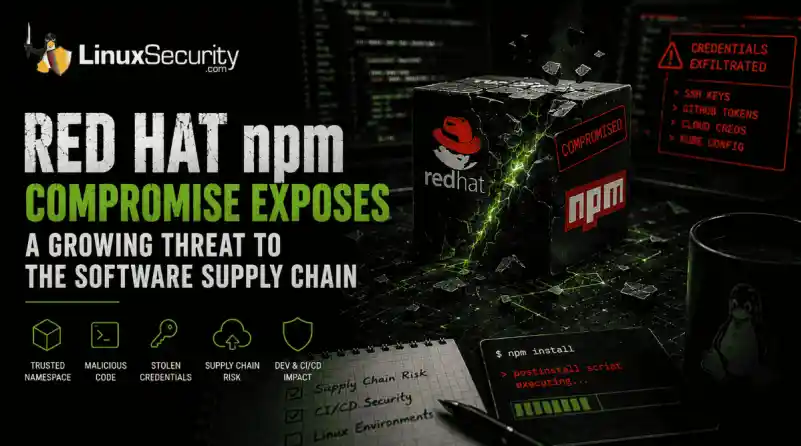
Researchers investigating a campaign now tracked as Miasma found that more than 30 packages in Red Hat's @redhat-cloud-services npm namespace had been altered to deliver credential-stealing malware.
The packages weren't being used to deploy ransomware or sabotage systems. From what has been reported so far, the objective appears to have been much simpler: collect credentials from developer environments and use that access elsewhere.
GitHub tokens, cloud credentials, SSH keys, and other secrets were reportedly among the targets. That's not particularly surprising. Development environments tend to end up with access to far more systems than anyone originally planned for, especially once build automation, cloud services, and deployment tooling start getting layered on top of each other. The question usually isn't whether useful credentials exist. It's how many are sitting there and what they can reach. By the time someone starts inventorying what a CI runner can reach, the answer is often more than expected.
Red Hat says it has not identified customer or partner impact, and the investigation is still underway. The compromise is notable less because of the malware itself and more because of where it showed up. A package repository sits in a place most organizations have already decided to trust. Once that trust relationship gets involved, the discussion usually shifts away from malware and toward access, validation, and how much confidence teams should place in automated software distribution.
A Trusted Namespace Becomes an Attack Vector
According to researchers, the compromised packages were distributed through Red Hat's @redhat-cloud-services namespace on npm. That detail matters because software teams often make decisions about risk based on reputation. Packages maintained by a well-known vendor naturally receive more trust than those published by an unknown developer.
Compromising a trusted namespace gives malicious code a much better chance of reaching developer workstations, build servers, and automated deployment environments without raising immediate suspicion. The goal is not necessarily widespread infection. Access to a handful of well-positioned systems can be enough.
Investigators believe the campaign affected dozens of package versions across multiple projects. Those packages were primarily frontend libraries rather than customer-facing Red Hat products, but frontend dependencies are routinely pulled into enterprise development workflows. Once a malicious package enters a build process, the attack surface expands quickly.
How Miasma Targets Linux-Based Environments
Unlike traditional malware campaigns that focus on persistence or disruption, Miasma appears to have been built around credential collection. The malware searched infected Linux systems for the files and environment variables that DevOps teams rely on daily:
- SSH keys: Stored in ~/.ssh.
- Registry credentials: Found in files like ~/.npmrc and ~/.docker/config.json.
- Cloud credentials: Stored locally or exposed through metadata services.
- Kubernetes configuration files, such as ~/.kube/config.
- CI/CD secrets: Injected directly into runners through environment variables.
For an attacker, these files represent immediate opportunities for lateral movement. A GitHub token may provide access to private repositories. A Kubernetes credential can expose cluster resources. Cloud access keys may unlock storage buckets, deployment pipelines, or administrative functions. Each credential becomes another step deeper into an environment that already trusts the user or service associated with it.
That strategy also generates less noise than many conventional attacks. Security teams often have detections for privilege escalation attempts, malware execution, and suspicious binaries. Legitimate credentials present a different challenge. Activity performed with valid authentication frequently blends into normal operations, especially inside busy development environments where automation is already performing thousands of actions every day.
CI/CD Pipelines: The Prime Target for Linux Operators
One of the most concerning aspects of this incident involves how the packages were published. Researchers believe the attackers abused GitHub Actions trusted publishing workflows using OIDC rather than stealing a traditional npm authentication token.
This highlights a shift in supply chain risk. Security controls designed to eliminate long-lived credentials are becoming the new target. An attacker who gains access to a publishing workflow effectively inherits the permissions of that workflow. Since those workflows are already authorized to push updates to official namespaces, the attacker doesn't need to break into the publishing process. The publishing process becomes the attack path.
Trusted publishing has become increasingly popular because it removes long-lived credentials from deployment workflows. Instead of storing permanent tokens, systems establish trust relationships between source repositories, build pipelines, and package registries.
- The benefit: The model is generally more secure.
- The risk: Those trust relationships become valuable targets.
An attacker who gains access to a publishing workflow may not need the credentials at all; the workflow already possesses the permissions required to publish software. In effect, the trust relationship becomes the credential.
Why Linux Teams Should Care
Modern software development doesn't just run on Linux. Most of the infrastructure responsible for building, packaging, signing, and deploying software relies on Linux systems.
DevOps teams
Build runners serve as the bridge between source code and production. If those runners operate with excessive permissions, a single dependency update can expose an entire CI/CD pipeline.
Linux administrators
The servers responsible for compiling, packaging, and deploying software often contain some of the most valuable credentials in the environment. They deserve the same attention as production systems.
Kubernetes operators
Compromised build pipelines can provide a path into clusters through service account tokens or deployment automation. An attacker doesn't need direct access to the cluster if the pipeline already has it.
Security teams
Traditional perimeter defenses provide little protection when trusted systems begin performing malicious actions using valid credentials.
What Linux Organizations Should Review Now
Rather than waiting for the next supply chain notification, organizations should use incidents like Miasma as an opportunity to examine their own Linux-based development infrastructure:
- Audit build runner permissions: Use a least-privilege lens to review what your runners can access (cloud accounts, SSH keys, registries).
- Focus on runner isolation: Use container isolation, workload separation, and credential scoping to limit how far an attacker can move after gaining a foothold.
- Apply Linux-native security controls: Use SELinux or AppArmor to restrict process access, seccomp filtering to reduce dangerous system calls, and read-only filesystem configurations to impede unauthorized modifications.
- Monitor package changes: Many supply chain attacks begin long before code reaches production; dependency monitoring should be as critical as production workload monitoring.
- Reconsider trust: Trust remains necessary, but it should never replace verification.
The Real Lesson
The Red Hat compromise wasn't significant because attackers found a new way to steal credentials. Those techniques have existed for years.
What makes this incident noteworthy is that the attack leveraged systems and workflows organizations already trusted. Package repositories, CI/CD pipelines, publishing workflows, and automated deployment systems have become attractive targets because compromising them allows attackers to inherit existing trust relationships rather than create new ones.
The Linux supply chain is deeper and more interconnected than many organizations realize. Protecting it requires acknowledging that the most dangerous threats may not arrive through an exposed service or an unpatched vulnerability. They may arrive through the same trusted mechanisms used to deliver software every day.
Related Reading
 PREVIOUS

 NEXT
NEXT
Powered By

Linux Security - Your source for Top Linux News, Advisories, HOWTOs and Feature Releases
QUICK LINKS
subscribe to newsletters!
Like staying secure? So do we.
Sign up for updates, tips, and alerts!