


Security Vulnerabilities  malware linux
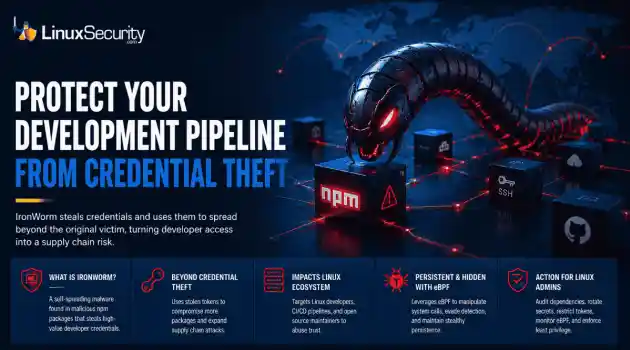
malware linux IronWorm steals credentials and uses them to spread beyond the original victim, turning developer access into a supply chain risk. . A new campaign targeting npm has evolved past simple credential theft. Researchers identified IronWorm, a self-spreading threat. It harvests high-value Linux development secrets—SSH keys, cloud tokens, package publishing credentials. One compromised workstation becomes a launchpad for downstream supply chain attacks. This is not a get-in-and-get-out operation....
 Jun 08, 2026

Network Securitysystem security Linux network
system security Linux network The romanticized image of the digital nomad – a laptop on a sun-drenched balcony – rarely accounts for the actual friction of maintaining a professional development environment on the move. . The friction is amplified with Linux. We are looking for a setup that respects our kernel configurations, handles volatile network handovers, and maintains a strict security posture without the hand-holding of a consumer-grade OS – so, put simply, more than just a laptop and a sunny deck. The hardware is...
May 26, 2026

Server Securityopen-source Linux administration
open-source Linux administration Cron has existed in Unix and Linux environments for decades, handling backups, cleanup scripts, patching jobs, log rotation, monitoring tasks, and other maintenance work that administrators do not want to run manually. Most Linux servers rely on it constantly, which is exactly why attackers continue abusing it for persistence after a system has already been compromised. . Persistence through cron is not complicated. Attackers do not need a rootkit or advanced malware framework to maintain...
May 25, 2026

Vendors/Productssecurity breach linux
security breach linux A major internal repository breach at GitHub has exposed a critical and overlooked blind spot in Linux supply chain security. Kernel exploits, exposed SSH services, weak firewall rules, and vulnerable daemons dominated the Linux threat model for years, and in many environments, they still matter. But recent supply-chain incidents involving GitHub ecosystems, npm packages, and malicious developer tooling point somewhere else entirely: the developer workstation. . The breach matters because...
May 21, 2026

Security Trends access control multi-tenant
access control multi-tenant Linux administrators often face an ugly choice in the cloud: prioritize convenience and cost-efficiency by sharing infrastructure, or sacrifice those benefits for the sake of total isolation. Most modern Linux workloads don't live on their own private servers anymore. They live in shared environments like Kubernetes clusters, where multiple teams and services run side-by-side. It sounds efficient, and it usually is. . But cloud isolation isn't as ironclad as it looks on the diagram. If you...
May 21, 2026
 Refine news
X Clear Filters
Get the latest News and Insights
Get the latest Linux and open source security news straight to your inbox.
Community Poll
What got you started with Linux?
Loading...
Explore Latest Linux Security news
We found -3 articles for you...
82
 law enforcementFBIcomputer security
Examining The Disconnect In FBI's Computer Security Hiring Practices
The carefully coiffed men wearing suspiciously shiny shoes are at every major computer security convention. They are there to remind hackers that law enforcement is always interested in their activities. They are also there to encourage security experts to become . . . . The carefully coiffed men wearing suspiciously shiny shoes are at every major computer security convention. They are there to remind hackers that law enforcement is always interested in their activities. They are also there to encourage security experts to become special agents. But after responding to the agency's appeals for computer security experts, aspiring G-men hackers sadly say that their names will never appear on the FBI's Most Wanted Job Applicants list. Although their technical abilities should allow them to qualify easily as agents, their ethics, age and/or physical fitness levels excluded them. Mike Sweeny, fueled by renewed patriotism after Sept. 11, wanted to offer his 20-plus years of experience in computer security to the FBI. But he was disheartened by job requirements that required him to have a college degree, be under 37 years old, morally irreproachable ... and physically fit. The link for this article located at Wired is no longer available. . The carefully coiffed men wearing suspiciously shiny shoes are at every major computer security conv. carefully, coiffed, wearing, suspiciously, shiny, shoes, every, major, computer, security. . Anthony Pell
 Sep 04, 2002
•
Sep 04, 2002
• Government
82
security concernscybersecurity policyDoD policyAnalyzing the Effect of DoD Policy on Cybersecurity Workforce Trends
Some computer security professionals are already feeling the pinch from a new Defense Department policy discouraging contractors from hiring non-citizens. The Pentagon says it's about loyalty; visa holders call it classic xenophobia. . . .. Some computer security professionals are already feeling the pinch from a new Defense Department policy discouraging contractors from hiring non-citizens. The Pentagon says it's about loyalty; visa holders call it classic xenophobia. When the Washington Post reported last month that the U.S. Department of Defense was crafting a new personnel policy, industry went on red alert. The new policy stated that IT companies with defense contracts would no longer be allowed to employ non-U.S. citizens on unclassified projects. As the news broke, everyone from H1-B subcontractors to tech industry leaders worried that this would lead to thousands of layoffs and underqualified, poorly trained replacement hires. Many security companies who contract with the DoD feel the policy is dangerous. Losing qualified developers, regardless of their national origins, would undermine the process of creating secure code, which requires experienced teams where everyone is intimately familiar with the project. But security companies -- many of them small contracting firms -- have been reluctant to criticize the DoD openly for fear of biting the hand that feeds them. Their concerns have been voiced by professional organizations like the Information Technology Association of America (ITAA). The link for this article located at SecurityFocus is no longer available. . Worries grow among cybersecurity experts regarding the Department of Defense’s revamped contractor recruitment strategy affecting employee relations.. Defense Department, Cybersecurity Policy, Non-Citizen Workforce, IT Contracts, Hiring Practices. . Anthony Pell
Apr 11, 2002
•
Government


Get the latest News and Insights
Get the latest Linux and open source security news straight to your inbox.
Community Poll
What got you started with Linux?
Search Topics
Powered By

Linux Security - Your source for Top Linux News, Advisories, HOWTOs and Feature Releases
QUICK LINKS
subscribe to newsletters!
Like staying secure? So do we.
Sign up for updates, tips, and alerts!
Discover faster search, smarter navigation, and deeper Linux security insights. Read More