


Security Vulnerabilities  malware linux
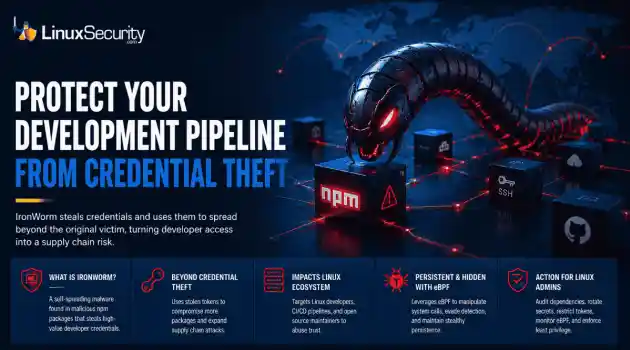
malware linux IronWorm steals credentials and uses them to spread beyond the original victim, turning developer access into a supply chain risk. . A new campaign targeting npm has evolved past simple credential theft. Researchers identified IronWorm, a self-spreading threat. It harvests high-value Linux development secrets—SSH keys, cloud tokens, package publishing credentials. One compromised workstation becomes a launchpad for downstream supply chain attacks. This is not a get-in-and-get-out operation....
 Jun 08, 2026

Network Securitysystem security Linux network
system security Linux network The romanticized image of the digital nomad – a laptop on a sun-drenched balcony – rarely accounts for the actual friction of maintaining a professional development environment on the move. . The friction is amplified with Linux. We are looking for a setup that respects our kernel configurations, handles volatile network handovers, and maintains a strict security posture without the hand-holding of a consumer-grade OS – so, put simply, more than just a laptop and a sunny deck. The hardware is...
May 26, 2026

Server Securityopen-source Linux administration
open-source Linux administration Cron has existed in Unix and Linux environments for decades, handling backups, cleanup scripts, patching jobs, log rotation, monitoring tasks, and other maintenance work that administrators do not want to run manually. Most Linux servers rely on it constantly, which is exactly why attackers continue abusing it for persistence after a system has already been compromised. . Persistence through cron is not complicated. Attackers do not need a rootkit or advanced malware framework to maintain...
May 25, 2026

Vendors/Productssecurity breach linux
security breach linux A major internal repository breach at GitHub has exposed a critical and overlooked blind spot in Linux supply chain security. Kernel exploits, exposed SSH services, weak firewall rules, and vulnerable daemons dominated the Linux threat model for years, and in many environments, they still matter. But recent supply-chain incidents involving GitHub ecosystems, npm packages, and malicious developer tooling point somewhere else entirely: the developer workstation. . The breach matters because...
May 21, 2026

Security Trends access control multi-tenant
access control multi-tenant Linux administrators often face an ugly choice in the cloud: prioritize convenience and cost-efficiency by sharing infrastructure, or sacrifice those benefits for the sake of total isolation. Most modern Linux workloads don't live on their own private servers anymore. They live in shared environments like Kubernetes clusters, where multiple teams and services run side-by-side. It sounds efficient, and it usually is. . But cloud isolation isn't as ironclad as it looks on the diagram. If you...
May 21, 2026
 Refine news
X Clear Filters
Get the latest News and Insights
Get the latest Linux and open source security news straight to your inbox.
Community Poll
What got you started with Linux?
Loading...
Explore Latest Linux Security news
We found -3 articles for you...
82
 national securityintelligence failuregovernment policies
Impact of Bush Administration's Secrecy on Intelligence Processes
There's a "total meltdown" in America's intelligence services -- and the Bush administration's penchant for secrecy is one of the major reasons why, current and former top U.S. spooks charged Tuesday. George W. Bush's White House has pushed like few . . . . There's a "total meltdown" in America's intelligence services -- and the Bush administration's penchant for secrecy is one of the major reasons why, current and former top U.S. spooks charged Tuesday. George W. Bush's White House has pushed like few before it to put government information out of the public's grasp. Moves to classify documents are up 400 percent from a decade ago, to more than 23 million such actions in 2002, according to the Information Security Oversight Office, a division of the National Archives. But despite their cloak-and-dagger reputation, several of the country's leading spies, past and present, aren't happy about the rush to make things secret. To counter far-reaching, stealthy terrorist cabals, the country needs more openness, not less, they said Wednesday at Geo-Intel 2003, a first-of-its-kind conference here on the use of satellites in war, intelligence and homeland security. "Our secrecy system is all about protecting secrecy officers, and has nothing to do with protecting secrets. It's a self-licking ice-cream cone," said Rich Haver, until recently Donald Rumsfeld's special assistant for intelligence, now with Northrop Grumman. "We're compartmentalizing the shit out of things. It's causing a total meltdown of our intelligence processes." The link for this article located at Wired is no longer available. . Ex-intelligence officials and operatives from the U.S. disclose significant problems within the intelligence community linked to the opaque strategies of the Bush administration.. Intelligence Failures, Government Openness, CIA Operations, Information Classification. . Anthony Pell
 Oct 17, 2003
•
Oct 17, 2003
• Government
82
national securitycritical infrastructuregovernment controlBush's Executive Order Enhances Government Classification Powers
President Bush has signed an executive order that explicitly gives the government the power to classify information about critical infrastructures such as the Internet. Bush late Tuesday changed the definition of what the government may classify as confidential, secret and . . . . President Bush has signed an executive order that explicitly gives the government the power to classify information about critical infrastructures such as the Internet. Bush late Tuesday changed the definition of what the government may classify as confidential, secret and top-secret to include details about "infrastructures" and weapons of mass destruction. The new executive order also makes clear that information related to "defense against transnational terrorism" is classifiable. In his executive order, which replaces a 1995 directive signed by President Bill Clinton, Bush said that information that already had been declassified and released to the public could be reclassified by a federal agency. Clinton's order said that "information may not be reclassified after it has been declassified and released to the public." The link for this article located at news.com is no longer available. . President Bush has signed an executive order that explicitly gives the government the power to class. president, signed, executive, order, explicitly, gives, government, power, class. . Anthony Pell
Mar 27, 2003
•
Government


Get the latest News and Insights
Get the latest Linux and open source security news straight to your inbox.
Community Poll
What got you started with Linux?
Search Topics
Powered By

Linux Security - Your source for Top Linux News, Advisories, HOWTOs and Feature Releases
QUICK LINKS
subscribe to newsletters!
Like staying secure? So do we.
Sign up for updates, tips, and alerts!
Discover faster search, smarter navigation, and deeper Linux security insights. Read More