Explore top 10 tips to secure your open-source projects now. Read More
×



Server Security data privacy automation
data privacy automation Every system admin has lived through the same Monday morning ritual. A queue of forty tickets, half of them password resets, permission errors, or disk space warnings that any experienced technician could resolve in under two minutes. The other half require actual judgment. For years, automation promised that software would eventually sort the two apart on its own. That promise is now being tested in production Linux environments. . Early results are reshaping how IT teams think about tier-1...
 Jul 17, 2026

Privacydata collection automation
data collection automation You're running a web scraping project to collect pricing data from e-commerce sites. You set up a pool of datacenter proxies, launch your scripts, and within minutes — banned . CAPTCHAs everywhere. Your data pipeline stops before it really begins. . It's a frustrating scenario that plays out daily in ad verification, market research, and multi-account management. The website doesn't know you're doing legitimate research or monitoring. It just sees traffic coming from IP ranges it recognizes as...
Jul 17, 2026

Security Trends security advisory social engineering
security advisory social engineering Business Email Compromise used to be a numbers game — mass-blasted emails, broken English, an obvious "URGENT WIRE TRANSFER" subject line. That era is over. Generative AI has turned BEC into a tailored, low-noise operation that mimics writing style, voice, and even video presence. This piece looks at what's actually changed under the hood, what defenders are testing in response, and why so many organizations are still structurally unprepared for it. . The Infrastructure Problem Nobody Wants to...
Jul 17, 2026

Security Trends cybersecurity Linux documentation
cybersecurity Linux documentation Linux operating systems have gained prominence due to their stability, adaptability, and excellent security options. In the case of developing documentation, designing cybersecurity dashboards, or educational material, visuals are of vital importance when it comes to making things clear. The use of icons allows one to understand the message regarding alerts, authorization, encryption, authentication, or the state of the system just by looking at the visual cue without having to read long...
Jul 17, 2026
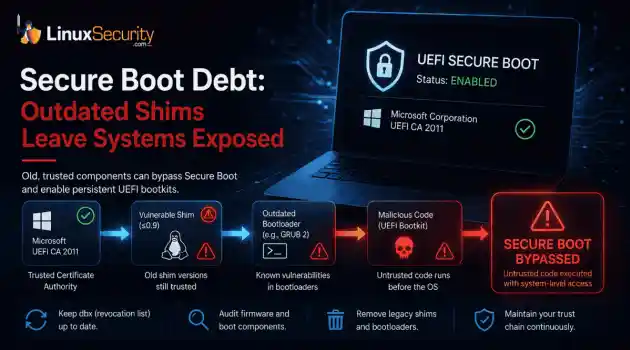
Security Vulnerabilities security advisory linux distribution
security advisory linux distribution ESET researchers identified 11 old and forgotten Linux UEFI shim bootloaders at versions 0.9 and below that can be used to bypass UEFI Secure Boot on any UEFI-based machine that trusts Microsoft’s Microsoft Corporation UEFI CA 2011 third-party certificate authority, regardless of the installed operating system (OS). Reported shims can be exploited to execute untrusted code during system boot, enabling attackers to deploy malicious UEFI bootkits even on systems with UEFI Secure Boot enabled.....
Jul 16, 2026
 Refine news
X Clear Filters
Get the latest News and Insights
Get the latest Linux and open source security news straight to your inbox.
Community Poll
Is continuous patching actually viable?
Trending News
Loading...
Explore Latest Linux Security news
We found 27 articles for you...
77
 antivirusintrusion preventionsecurity strategies
Comprehensive Guide to Securing Linux Servers Against Threats
Linux servers form a vital backbone of today's Internet, with approximately 81% of all hosted websites running on them. With Windows' complete dominance in the personal computing space, Linux's resilience to minute threats has made it a staple among server admins. However, this doesn't prevent a ttackers from actively targeting Linux servers and pentest distros . . Learning to safeguard and future-proof your servers and utilize pentest distros to boost security is crucial to network integrity as a Linux administrator. Let’s explore practical measures you can take to secure your networks and servers against vulnerabilities and attacks. Understanding Linux Server Vulnerabilities While Linux is dominant in resilience against malware and viruses, servers are still a vector for attack, especially in mixed-OS environments. An infected Linux server in such networks weakens barriers against malware propagation to other devices. It is indeed a vivid scenario pointing out the need for proactive security. According to CISA, corporate servers are among the favorite targets of cyberattacks. In this respect, implementing an effective antivirus solution for Linux servers is considered one of the critical steps toward assuring sensitive data protection and compliance with regulations. The Key Role of Antivirus in Linux Server Protection Antivirus has become an indispensable component in the security of Linux servers. It has changed how such servers are set up and ensures they are protected against threats. An effective antivirus strategy is instrumental, as Linux servers present a broad attack surface. First and foremost, antivirus software protects against user mistakes. Even the most conscientious user may commit errors by accidentally downloading or misconfiguring. In this respect, antivirus software serves as an added layer of protection, guaranteeing that such mistakes do not lead to a breach in the integrity of the server. Servers usually contain sensitive data, whichautomatically makes them targets for attackers. Deploying antivirus solutions is necessary to protect and comply with data protection regulations. By deploying antivirus defense mechanisms, an organization can reduce the risk of a data breach, loss of sensitive data, and damage to one's brand reputation. Ultimately, the prevalence of Linux servers on the Internet is increasingly making them an easy target for focused attacks. That means the entry points through which bad guys can get in are widening, which calls for a capable antivirus solution. Cyber threats keep evolving, making an effective antivirus strategy critical to every comprehensive security posture. Beyond Antivirus: All-Encompassing Security Strategies for Linux While antivirus software is foundational , there needs to be multiple layers to complete any Linux-based server security strategy. Following are several strategies that can add value to a server's security profile: Implementing Host-Based Intrusion Prevention Systems (HIPS) HIPS stands for Host Intrusion Prevention System , or advanced protection for Linux servers. It is designed to monitor system activities for malicious behaviors. HIPS detects unauthorized changes in system files and configuration, blocking real-time attacks. By monitoring endpoint devices continuously, HIPS gives administrators the capability for real-time threat response, drastically reducing the risk of any successful intrusion. Fail2ban for Extra Security Fail2ban is an efficient way to prevent brute-force login attempts. It reads the log file, searches for failed login attempts, and immediately blocks suspect IP addresses. Advanced users will want to configure Fail2ban because it offers advanced options for handling debug messages, among other features. This tool significantly improves your server's security posture against unauthorized access, helping to lock down the server from brute-force attacks and other potential threats that could leverage weak login credentials. Integrationof Behavioral Analysis Tools for Threat Detection Behavioral analysis tools can aid in identifying anomalies indicative of security breaches. In such systems, machine learning algorithms establish regular baselines for server operations. Because these systems flag deviations from established norms, administrators are warned of a potential threat before it escalates. By implementing behavioral analytics, proactive threat detection enables teams to quickly respond to suspicious activity and protect the integrity of servers and sensitive data. The Importance of Regular System Updates Regular updates are essential because they keep the server environment secure. Any outdated software opens up vulnerabilities if exploited by cybercriminals. Regular updates reduce these risks since all known vulnerabilities get patched. However, managing how such updates are announced or made known to others is vital in avoiding the unintentional disclosure of one's system weaknesses. Setting up regular, systematic updates will enable an organization to strengthen its security further and provide protection against newly arising threats. Proactive Measures to Mitigate Future Threats Cybersecurity threats are continuously changing; hence, new perils are coming. In such a scenario, frequent security audits become essential for the administrator to adapt. Various vulnerabilities like Injection flaws, Broken Authentication, and XSS attacks can be identified or picked out with the help of advanced tools like Burp Suite and SQLmap . These can comprehensively analyze server security assessments that could enable one organization to deal with vulnerabilities before they can be exploited proactively. Developing an Effective Audit Schedule Regular auditing is crucial to a sound security posture. It includes determining critical assets that need protection, such as sensitive data and essential applications that house them. Frequent vulnerability assessments involve organizations implementing automated tools thatfind vulnerabilities by rapidly scanning and providing actionable remediation steps. Moreover, your team must be fully aware of the response procedures tested. This will ensure that once potential vulnerabilities within an organization have been identified, there is a proper, workable plan to handle them efficiently and as quickly as possible. Our Final Thoughts on Improving Linux Server Security Administrators should consider integrating antivirus solutions with general security and, more importantly, proactive measures to offer increased protection for an organization's critical infrastructures from an ever-growing array of threats. Check out this LinuxSecurity article on the best forensic and pentesting distros to learn more about pentesting for admins and ethical hackers. Remember that security is not one activity to reach a destination but an ongoing process of safeguarding your server environment. . Learning to safeguard and future-proof your servers and utilize pentest distros to boost security is. linux, servers, vital, backbone, today's, internet, approximately, hosted, websit. . Dave Wreski
 Oct 02, 2024
•
Oct 02, 2024
• Server Security
72
 security advisoryintrusion preventionnetwork attack
IPFire 2.27 Core Update 168: Security Update With Improved IPS
Peter Müller has announced the release and general availability of IPFire 2.27 Core Update 168 as the latest stable version of this hardened open-source Linux firewall distribution targeted at routers and firewalls. . IPFire 2.27 Core Update 168 is here one and a half months after the Core Update 167 release to further improve the Intrusion Prevention System (IPS) of the Linux firewall distro by allowing users to individually enable the monitoring mode for each ruleset provider, making parsing and restructuring of changed or updated rulesets faster, as well as support for the downloader to automatically check if a ruleset was updated or not on its providers’ server. IPFire 2.27 Core Update 168 is also here to further improve the overall security of the Linux firewall distribution to prevent network spoofing attacks by dropping any packets that IPFire received on a different interface than it would have been routed back to, implement a defense-in-depth measure to prevent any unprivileged attacker from reading potentially sensitive configuration on an IPFire installation by tightening various file permissions, and updating to OpenSSH 9.0p1, which introduces quantum-resistant cryptography. The link for this article located at 9 to 5 Linux is no longer available. . IPFire 2.27 Core Update 168 boosts system integrity by introducing advanced IPS and enhanced defenses against online threats.. IPFire Update, Intrusion Prevention, Linux Firewall, Network Security, OpenSSH Update. . Brittany Day
Jun 14, 2022
•
Firewalls

72
 security advisoryintrusion preventionperformance enhancement
IPFire 2.27 Update 161: Enhancements in Firewall and exFAT Support
IPFire 2.27 Core Update 161 has been released as a new maintenance update to the hardened open-source GNU/Linux distro that primarily performs as a router and a firewall. The release brings exFAT support to IPFire and boosts the intrusion prevention system's performance. . IPFire 2.27 Core Update 161 introduces several new features, performance improvements, and some other important changes. For example, it brings support for the exFAT file system, support for the FriendlyARM NanoPI R2S open-source mini router, as well as Fast Flux Detection in the web proxy to proactively detect Fast Flux setups. Among the performance improvements included in this update, there’s a large increase of throughput for the Intrusion Prevention System (IPS), allowing it to decide if the traffic from a certain IP connection needs to be seen or not and tell the kernel to bypass it. The link for this article located at 9 to 5 Linux is no longer available. . IPFire 2.27 Core Update 161 brings enhanced features and performance upgrades aimed at fortifying firewall capabilities.. IPFire Update, exFAT Features, Firewall Improvements. . Brittany Day
Dec 01, 2021
•
Firewalls
72
 security advisoryintrusion preventionfirewall
IPFire 2.25 Core Update 143: Enhanced Intrusion Prevention Features
Are you familiar with IPFire - the Linux firewall distribution? The distro has now improved its intrusion prevention system. . Michael Tremer announced today the general availability of Core Update 143 of the IPFire 2.25 open-source Linux firewall distribution. The monthly Core Updates for the IPFire 2.25 Linux firewall distribution continue with version 143, which ships with an updated toolchain based on GNU C Library 2.31, GCC (GNU Compiler Collection) 9.3.0, and GNU Binutils 2.34. IPFire 2.25 Core Update 143 also optimizes the build system to take advantage of large amounts of memory on computers to use less I/O resources by no longer writing large temporary files to disk. The link for this article located at 9 to 5 Linux is no longer available. . Version 2.25 of the IPFire distribution has released Core Update 143, bolstering its intrusion detection features to improve overall security.. IPFire, Linux Firewall, Intrusion Prevention, Core Update, Open Source. . Brittany Day
Apr 23, 2020
•
Firewalls
67
 security advisorynetwork securityintrusion prevention
IPFire 2.25: Enhanced Kernel Protection Against Rootkits
Have you heard about IPFire's new method of cryptographic kernel rootkit protection? IPFire is an open-source software that protects the network from external attacks and prevents intrusion. . In the latest release of test v2.25 – Core update 142, IPFire has introduced a new method to sign the Linux kernel module cryptographically. As a result of this, the attacker cannot execute an illegal action using a deployed third-party module into the IPFire kernel. This new approach of kernel rootkit protection can completely restrict the activities of hidden rootkits on the system. Any modification to the kernel code now requires validation using a cryptographic signature to check its authenticity and integrity. The link for this article located at Fossbytes is no longer available. . The latest update to IPFire incorporates digital signatures for kernel modules, bolstering defenses against rootkits and strengthening overall Linux security.. IPFire Kernel Security, Rootkit Defense, Cryptographic Techniques, Open Source Firewalls. . LinuxSecurity.com Team
Mar 18, 2020
•
Cryptography
78
 network monitoringintrusion preventioncloud security
Juniper Acquires Altor Networks: Enhancing Virtual Security Solutions
Juniper Networks announced today it has bought virtual security vendor Altor Networks for $95 million. The acquisition builds on an existing relationship between the two companies, and Juniper actually invested in the company earlier this year. . Founded in 2007, Altor specializes in intrusion prevention, firewall and monitoring for virtual environments. With the purchase, Juniper seeks to deliver integrated, scalable security architecture protecting physical and virtual systems. "Juniper is excited to acquire one of the industry's leading virtualization security vendors and the extremely talented team that built it," said Mark Bauhaus, executive vice president and general manager of Service Layer Technologies at Juniper Networks, in a statement. "This acquisition will extend our leadership in data center and cloud security and will enable customers to deploy a consistent set of security services across their physical and virtual infrastructure, while delivering lowest total cost of ownership." The link for this article located at eWeek is no longer available. . Founded in 2007, Altor specializes in intrusion prevention, firewall and monitoring for virtual envi. networks, juniper, announced, today, bought, virtual, security, vendor, altor, millio. . LinuxSecurity.com Team
Dec 07, 2010
•
Vendors/Products
79
access controlintrusion preventiondata center19 Methods To Protect Your Data Center From Physical Intrusions
If a picture's worth 1,000 words, these illustration and diagrams have a lot to say about security. A dozen interesting and illuminating looks at data center security, image spam, forts and castles, and much more from CSO's archives.. 19 ways to physically secure your data center Mantraps, access control systems, bollards and surveillance. Your guide to securing the data center against physical threats and intrusions. The link for this article located at CSO Online is no longer available. . Implement stringent data center security by enforcing perimeter control, access systems, and continuous monitoring to mitigate unauthorized entry and threats. Data Center Security, Intrusion Prevention, Physical Protection. . LinuxSecurity.com Team
Oct 28, 2010
•
Security Projects
78
threat analysisintrusion preventionsecurity toolsSourcefire Razorback Open Source Detection Tool for Enhanced Security
The makers of the popular open-source Snort intrusion detection platform today unveiled a new open-source platform -- a detection framework that unites existing security tools, including IDS/IPSes.. The new Razorback platform developed by Sourcefire is basically a tool for tying together the various layers of detection within an organization, including antivirus, IDS/IPS, Web and email gateways, and firewalls, to use in concert to catch and examine potential threats and create mitigations on the fly. Its creators say it's not the same thing as a security information management tool, however, because it does more than capture events: "SIM collects events in a vacuum: It takes an AV event and says this host is infected by a virus ... It doesn't know anything about that piece of malware on the box," says Matt Watchinski, senior director of Sourcefire's vulnerability research team. Razorback, however, uses the various tools to provide more context about a potential attack, he says. It handles detection in near real-time and can convert newly found intelligence on an attack into a detection mechanism for it. It's basically a framework that overlays the existing security infrastructure and lets the various tools work more in concert, according to Sourcefire. The link for this article located at Dark Reading is no longer available. . The new Razorback platform developed by Sourcefire is basically a tool for tying together the variou. makers, popular, open-source, snort, intrusion, detection, platform, today, unveiled, open-s. . LinuxSecurity.com Team
Jul 28, 2010
•
Vendors/Products

Get the latest News and Insights
Get the latest Linux and open source security news straight to your inbox.
Community Poll
Is continuous patching actually viable?
Trending News
Search Topics
Powered By

Linux Security - Your source for Top Linux News, Advisories, HOWTOs and Feature Releases
QUICK LINKS
subscribe to newsletters!
Like staying secure? So do we.
Sign up for updates, tips, and alerts!