Explore top 10 tips to secure your open-source projects now. Read More
×



Server Security data privacy automation
data privacy automation Every system admin has lived through the same Monday morning ritual. A queue of forty tickets, half of them password resets, permission errors, or disk space warnings that any experienced technician could resolve in under two minutes. The other half require actual judgment. For years, automation promised that software would eventually sort the two apart on its own. That promise is now being tested in production Linux environments. . Early results are reshaping how IT teams think about tier-1...
 Jul 17, 2026

Privacydata collection automation
data collection automation You're running a web scraping project to collect pricing data from e-commerce sites. You set up a pool of datacenter proxies, launch your scripts, and within minutes — banned . CAPTCHAs everywhere. Your data pipeline stops before it really begins. . It's a frustrating scenario that plays out daily in ad verification, market research, and multi-account management. The website doesn't know you're doing legitimate research or monitoring. It just sees traffic coming from IP ranges it recognizes as...
Jul 17, 2026

Security Trends security advisory social engineering
security advisory social engineering Business Email Compromise used to be a numbers game — mass-blasted emails, broken English, an obvious "URGENT WIRE TRANSFER" subject line. That era is over. Generative AI has turned BEC into a tailored, low-noise operation that mimics writing style, voice, and even video presence. This piece looks at what's actually changed under the hood, what defenders are testing in response, and why so many organizations are still structurally unprepared for it. . The Infrastructure Problem Nobody Wants to...
Jul 17, 2026

Security Trends cybersecurity Linux documentation
cybersecurity Linux documentation Linux operating systems have gained prominence due to their stability, adaptability, and excellent security options. In the case of developing documentation, designing cybersecurity dashboards, or educational material, visuals are of vital importance when it comes to making things clear. The use of icons allows one to understand the message regarding alerts, authorization, encryption, authentication, or the state of the system just by looking at the visual cue without having to read long...
Jul 17, 2026
Security Vulnerabilities security advisory linux distribution
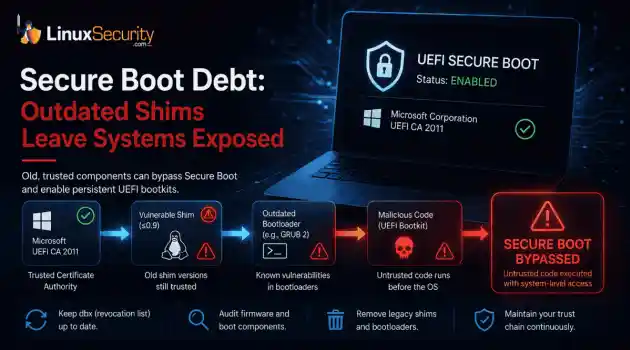
security advisory linux distribution ESET researchers identified 11 old and forgotten Linux UEFI shim bootloaders at versions 0.9 and below that can be used to bypass UEFI Secure Boot on any UEFI-based machine that trusts Microsoft’s Microsoft Corporation UEFI CA 2011 third-party certificate authority, regardless of the installed operating system (OS). Reported shims can be exploited to execute untrusted code during system boot, enabling attackers to deploy malicious UEFI bootkits even on systems with UEFI Secure Boot enabled.....
Jul 16, 2026
 Refine news
X Clear Filters
Get the latest News and Insights
Get the latest Linux and open source security news straight to your inbox.
Community Poll
Is continuous patching actually viable?
Trending News
Loading...
Explore Latest Linux Security news
We found 36 articles for you...
210
 security researchopen-sourcekernel
GhostLock Exposes an Uncomfortable Truth About Open Source Security
When researchers announced GhostLock, many people focused on the exploit. What stood out to me wasn't just what the vulnerability could do, but how long it had remained hidden. The flaw had lived in the Linux kernel for roughly 15 years before it was publicly identified by researchers. That means the flaw survived hundreds of kernel releases and years of upstream development before it was publicly documented. It raises an uncomfortable question about one of open source's oldest assumptions. One of the enduring arguments in favor of open source is that transparency improves security. If anyone can inspect the code, vulnerabilities should be easier to discover and fix. GhostLock doesn't disprove that idea, but it does force us to ask how well it scales when the Linux kernel contains tens of millions of lines of code. . Why the GhostLock Linux Kernel Vulnerability Is Different The Linux kernel vulnerability CVE-2026-43499 , or "GhostLock," was identified by Nebula Security Research in their ionstack analysis . Because the flaw originated in upstream code, it potentially affected numerous Linux distributions that incorporated the vulnerable kernel code until it was patched in the upstream Linux kernel in April 2026 . GhostLock stood out for several reasons: Legacy Impact: The bug existed since kernel 2.6.39, illustrating that even mature, stable code can harbor deep-seated flaws for years. High-Stakes Exploitation: Researchers demonstrated local privilege escalation to root and a container escape, making the vulnerability particularly significant for cloud and containerized environments. Professional Interest: The vulnerability was identified through Google’s kernelCTF program, earning a $92,337 bounty. The payout also reflects how difficult kernel memory-safety bugs have become to identify, even for experienced researchers. The real question isn't whether Linux is secure. It is whether the traditional "many eyes" argument still reflects how securityactually works in a codebase of this magnitude. When "Many Eyes" Meets Modern Reality One of the best-known ideas in open source security is the "many eyes" principle , often associated with Eric S. Raymond's Linus's Law : "Given enough eyeballs, all bugs are shallow." The idea is straightforward. Because the source code is publicly available, developers, researchers, and users can inspect it, increasing the likelihood that vulnerabilities will be identified and fixed more quickly than they might be in closed-source software. In practice, however, transparency makes review possible; it does not guarantee that every line of code will actually be examined by someone with the time, expertise, or reason to look at it. That distinction becomes increasingly important in a project as large and complex as the Linux kernel, where millions of lines of code are maintained by thousands of contributors across hundreds of subsystems. Several practical realities shape how security review works today: The Scale Problem: The Linux kernel receives thousands of changes during every development cycle. No single human can review the entire codebase. Subsystem Silos: Most reviewers specialize in one subsystem. If a vulnerability exists in an obscure or legacy corner of the kernel, it may sit outside the field of view of those most qualified to audit it. The "Old Code" Reality: Legacy code often changes less frequently than actively developed subsystems. That stability is valuable, but it can also mean certain execution paths receive less ongoing scrutiny than newer code undergoing active development. How Linux Kernel Security Research Has Changed GhostLock wasn't discovered because someone finally decided to manually audit that specific line of code. It was discovered because the methodology of Linux security research has fundamentally changed. Historically, kernel security depended largely on expert review and targeted testing. Today, that work is increasingly complemented bycoverage-guided fuzzing, sanitizers, and large-scale automated testing. Tools like syzkaller/syzbot and KASAN act as force multipliers, systematically probing kernel state transitions that would be impossible for a human to track mentally. Automated testing now routinely finds combinations of events that humans would never naturally think to test. Programs like kernelCTF have further professionalized this research, bringing top-tier talent to bear on the kernel’s deepest subsystems. GhostLock is a testament to the fact that modern security is no longer just about "eyes"—it’s about the sophistication of the tooling and the bounty programs that reward deep, specialized research. The Reboot Gap For administrators, GhostLock is a stark reminder of the "reboot gap." Most organizations have well-defined maintenance windows for web servers, databases, and application software. Kernel updates are different because they frequently require reboots, coordinated maintenance windows, or live-patching infrastructure that many organizations simply don't have. It's not uncommon for organizations to schedule kernel updates quarterly while patching user-space software weekly. GhostLock shows why that gap deserves another look. In a containerized world, many assume the host is "just plumbing." A container escape vulnerability proves that the host kernel is the single point of failure for everything running on top of it. Local privilege escalation vulnerabilities become especially important in these environments because the kernel remains the shared trust boundary. When a vulnerability allows for container escape, the kernel is effectively an application-level concern and must be treated with the same urgency as a critical web server flaw. Security Priorities Have Changed GhostLock also highlights how Linux kernel security priorities have shifted over the last decade. Memory safety is now one of the community's primary areas of investment. Maintainers continue to strengthen the kernel through hardeningfeatures, sanitizers, memory-safety improvements, Rust for new kernel components, and continuous automated testing. Rather than suggesting the ecosystem is stagnant, GhostLock illustrates why those investments have become increasingly important as the kernel continues to grow in size and complexity. GhostLock also demonstrates one of open source's greatest strengths. Once the vulnerability was publicly identified, researchers could independently analyze the root cause, distributions could verify the fix, and administrators had complete visibility into the patch itself. That level of transparency is difficult to match in proprietary software, where the source code and development process are generally not available for independent review. What GhostLock Says About the Future of Open Source Security If GhostLock could stay under the radar for 15 years, it makes you wonder: how many other bugs are still waiting to be found? We don't know for sure. But GhostLock also proves that the ecosystem for finding those bugs is much tougher today than it was ten years ago. Between continuous fuzzing, memory sanitizers, coordinated disclosure, and mature bug bounty programs, we are finding whole classes of vulnerabilities that would have been totally invisible in the past. GhostLock doesn't prove that open source security has failed; it proves that transparency alone isn't enough. The Linux kernel has outgrown the point where it can rely solely on volunteer code review to find every critical flaw. Today's security depends just as much on dedicated security teams, automated testing, and bounty programs that reward that deep, specialized research. This reminds us that those strengths still matter, but the scale of modern projects requires more than just visibility. Today's Linux kernel is secured not only by developers reviewing code, but also by continuous automated testing, specialized security researchers, and organizations willing to invest in uncovering vulnerabilities that traditional review alone maynever find. . GhostLock reveals the limitations of open source security, emphasizing the need for advanced tools and methodologies in Linux kernel maintenance.. Linux Kernel GhostLock, Open Source Security Flaws, Automated Security Testing. . MaK Ulac
 Jul 14, 2026
•
Jul 14, 2026
• Security Vulnerabilities
210
 security advisorykernelAlpine Linux
Linux Kernel Security 2025: Curly COMrades Exploits and Risks Exposure
Linux security entered new territory in 2025. Espionage groups that once focused on Windows began treating Linux as equal ground. The Russia-aligned Curly COMrades, tracked by Bitdefender and CERT Georgia, led that move with a string of well-coordinated campaigns. . Their activity exposed how hybrid infrastructures blur the lines between cloud, endpoint, and Linux kernel security. This piece looks at what changed, how these tactics evolved, and what they mean for defenders managing mixed environments. Inside the Latest Linux Kernel Security Exploits Bitdefender’s 2025 reports confirmed that Curly COMrades’ real breakthrough wasn’t a new Linux kernel security vulnerability but a cross-platform persistence model. The group used Microsoft Hyper-V to deploy lightweight Alpine Linux virtual machines inside compromised Windows environments. These guest VMs acted as hidden execution spaces — isolated from endpoint agents and native Windows telemetry. Within those Linux instances, the actors ran proxy tunnels, data handlers, and components of the MucorAgent (CurlyShell) framework. Each element served persistence and exfiltration without tripping host-based controls. It’s a misuse of Linux as an operational blind spot rather than a kernel exploit chain — an evasion layer disguised as normal virtualization. The distinction matters. Linux kernel security still plays a role, but here it’s about how the kernel’s legitimate processes can host persistence safely under Windows oversight. The risk now lies in treating virtual guests as secondary systems instead of integrated parts of the attack surface. Key 2025 Techniques Targeting Linux Security Vulnerabilities Curly COMrades’ tradecraft, as detailed in Bitdefender’s November 2025 analysis and validated by CERT Georgia, shows how Linux elements extend Windows intrusions. The technique used minimal Linux VMs and containers to sustain covert operations and maintain continuity through reboots or system resets. Observedbehaviors included NTDS/LSASS credential access on Windows, proxy tunneling from Linux guests, and C2 relay through hypervisor-managed interfaces. The operation didn’t exploit Linux security vulnerabilities directly — it exploited visibility gaps. Attackers treated Linux as an embedded subsystem, shifting persistence into virtual layers that defenders rarely inspect. To counter this, telemetry correlation across hypervisors, endpoints, and Linux kernel security processes becomes essential. Hybrid intrusion detection has to treat the guest OS as part of the primary network, not an afterthought. When Windows Intrusions Leverage Linux Infrastructure LinuxSecurity’s 2025 research shows how modern intrusions blur the line between Windows and Linux infrastructure. Attackers now deploy lightweight Linux VMs or containers within Windows environments to run covert tasks, maintain access, or stage outbound traffic. It’s a quiet way to stay resident without triggering host-based detection. Observed tactics include: Using guest Linux systems for persistence during Windows intrusions. Exploiting visibility gaps in existing Linux security detection frameworks. Masking outbound activity so it mimics legitimate host network traffic. Evading endpoint agents that monitor only Linux kernel security events. These methods expose how multi-platform operations exploit monitoring gaps rather than new exploits. Maintaining layered defense and continuous Linux security auditing is essential, especially in virtualized or containerized environments. For practical baselines, see Microsoft’s Hyper-V Linux best practices . Linux Hardening Gaps Exposed by Curly COMrades Bitdefender’s findings revealed how small Linux hardening lapses can make virtualization a persistent haven. Attackers exploited weak logging, poor baseline enforcement, and default service configurations — not kernel exploits. Common weak points included: .so library preloading used for stealthstartup tasks. systemd overrides or cron injection to relaunch payloads. Minimal monitoring of virtualization binaries , which hid VM manipulation. Each technique replicated the persistence logic of Windows intrusions, but through Linux-native paths. Tightening Linux hardening and maintaining visibility over virtualized assets is critical. Alignment with MITRE ATT&CK v17 provides a framework for mapping and validating these controls. Practical Linux Hardening for 2025 Threats Hardening Linux in 2025 depends on consistent visibility across systems that evolve faster than traditional controls. Layered defenses built on effective strategies to optimize Linux security keep workloads aligned and limit the spread of undetected activity. Auditd should log key virtualization events while privileges for hypervisors and containers remain tightly restricted. SELinux and AppArmor policies need continuous validation. Baseline trusted command-line utilities, and correlate EDR data with network inspection to close gaps that attackers use for persistence. Sustained Linux hardening narrows exposure to modern Linux security vulnerabilities, reducing the chance of cross-platform footholds that survive patch cycles. What Curly COMrades Means for Future Linux Kernel Security The Curly COMrades campaign reinforced how Linux kernel security now defines the baseline for hybrid defense. Adversaries have learned to live off the land inside Linux environments, using legitimate tools and processes to persist quietly. It’s not brute force anymore — it’s familiarity with how admins actually manage their systems. Future resilience depends on unified visibility across platforms. Linux security telemetry has to connect cleanly with Windows event data to reveal shared behavior patterns before they escalate. Organizations that postpone kernel-level audits risk facing the same cross-environment tactics that made 2025’s intrusions so effective. Strengthening Linux Security ThroughContinuous Hardening The Curly COMrades campaign raised the bar for Linux security in 2025, showing how fast familiar tools can be turned against enterprise systems. Real defense now depends on keeping Linux environments hardened continuously, not revisited quarterly. Proactive patch validation, routine kernel audits, and shared intelligence between teams form the core of that approach. Each reinforces the other, closing the small operational gaps attackers rely on. Sustained Linux hardening isn’t just upkeep — it’s what keeps infrastructure resilient when threat patterns shift overnight. LinuxSecurity.com will continue tracking verified research and publishing practical coverage to help teams strengthen visibility, improve response, and adapt faster to emerging threats across modern Linux ecosystems. . Examine the rise of Curly COMrades targeting Linux kernel in 2025, exploiting hybrid environments and cross-platform risks.. Linux Kernel Security, Curly COMrades, 2025 Security Threats, Exfiltration Techniques. . MaK Ulac
Nov 05, 2025
•
Security Vulnerabilities

210
security advisoryprivilege escalationUbuntuUbuntu: Kernel Advisory CVE-2024-0193 Medium Privilege Escalation Impact
The OverlayFS bug in Ubuntu last year slipped through normal testing. Nothing exotic, a permissions issue in the filesystem layer that let local users climb the privilege ladder. Classic Linux security problem. The patch landed quickly, but some production boxes stayed behind for weeks. Always the same story. . Privilege escalation on Linux isn’t a single jump. It’s a crawl. A local user finds a weak spot, gains elevated rights, plants persistence, and starts poking at whatever services share the host. On mail servers, that means the queue, spool, and user directories are suddenly fair game. Once kernel space is compromised, process boundaries don’t mean much. The timeline’s already closed, but the pattern isn’t. Ubuntu patched it mid-2023, and admins rolled out updates later depending on how tightly they manage patch windows. The lag exposed what everyone already knew — kernel trust remains the weakest point in many Linux environments. This one bug just made it obvious again. What the Ubuntu Linux Kernel Vulnerability Reveals The Linux kernel vulnerability tracked as CVE-2024-0193 hit several Ubuntu OEM and LTS builds early in 2024. Most affected systems ran 6.1-series kernels common in 22.04 deployments and HWE stacks. Canonical patched it fast, but there was still a window where local users with the right capabilities could turn a small kernel slip into full system control. The bug sat inside the nftables component of netfilter. A use-after-free in the PIPAPO handling code, tied to how catchall elements were removed. The code freed memory that later operations still touched, leaving dangling pointers behind. In practice, that meant kernel memory corruption without an immediate crash. Clean logs, but corrupted state underneath. Attackers with CAP_NET_ADMIN privileges — or namespace access that simulates it — could abuse this to rewrite kernel structures and escalate straight to root. No need for a fancy payload. Just controlled memory reuse and a bit of timing.Once the kernel is compromised, everything else on the box is an afterthought. From a Linux security perspective, it’s another reminder that isolation at the application layer doesn’t matter when the kernel fails. Containers, mail processes, and monitoring agents all rely on that same trust boundary. One kernel bug, and every userland control unravels with it. Why Linux Security Matters for Email Server Security Every mail system depends on the kernel’s honesty. When that breaks, filters, logs, and containers lose meaning. The recent write-up on kernel privilege escalation in Linux security spells it out. Once the kernel’s memory integrity fails, attackers don’t need to touch Postfix or Exim to take control. They start lower, and everything above follows. Here’s what that looks like in real environments: Logging becomes fiction. Audit trails and syslog entries can be intercepted or rewritten, leaving SOC dashboards calm while queues get drained or relays hijacked. Filters shift silently. An attacker with kernel access can hook system calls, changing how SpamAssassin or Amavis handles messages without altering a single config file. Persistence sticks deep. Implants load before the user space and survive across reboots, so a “clean” restart just reactivates the compromise. Isolation collapses. Containers and VMs share the same kernel. Once that layer’s owned, escaping into neighboring mail nodes is routine. That’s why Linux security isn’t separate from email server security. They’re the same surface. SOC teams watching mail flow have to monitor the OS underneath as well: kernel module checks, boot integrity validation, live memory baselines. If the base lies, the logs lie, and the rest of your tooling is just reading a story someone else wrote. Linux Hardening Strategies for Secure Email Infrastructure Hardening is the part nobody brags about, but it keeps mail systems alive. Miss a patch or leave a loose privilege in place, and you’llbe chasing ghosts later. The Ubuntu notice on USN-7289-1 showed how one small kernel miss can break isolation across the entire stack. Real Linux hardening is what keeps email server security grounded in the OS instead of hoping filters and firewalls will cover it. It comes down to four things: patching on time, locking down the boot chain, keeping privileges tight, and auditing everything that moves. Skip one, and Linux security becomes a patchwork. Patch Management and Kernel Version Visibility When a Linux kernel vulnerability like CVE-2024-0193 lands, the first problem isn’t the patch itself. It’s knowing which systems are still running the old kernel. Too many admins assume updates applied cleanly when they didn’t. You need a live inventory of kernel versions across all mail hosts. Scripts that pull version info after every reboot help. Tie those reports back into your SOC dashboards so outdated nodes stand out right away. Keep distro kernels aligned with upstream patches and track active CVEs, not just package numbers. Kernel visibility isn’t paperwork; it’s proof that your patching works. Kernel Lockdown and Secure Boot Lockdown starts before the OS loads. Secure Boot checks that the kernel image is signed and untampered. Lockdown mode takes over once the system’s running, blocking unsigned modules and write access to kernel memory. Both stop attackers from planting implants that load before the user space. Guidance around kernel lockdown and self-protection on LinuxSecurity goes into the low-level pieces if you need a walkthrough. At the hardware layer, protect BIOS and UEFI. Keep bootloaders signed, set firmware passwords, and cut console access down to whoever actually needs it. This is where Linux hardening becomes physical security, not just software policy. Attack Surface Reduction for Linux Security The easiest way to fix a hole is to remove it. For stronger Linux security, drop kernel modules that have no business on a mail host. Disable USB,wireless, and debug interfaces. Trim background services until you’re left with what actually supports mail delivery and monitoring. Keep privileges lean. Mail daemons shouldn’t have CAP_NET_RAW or unrestricted access to /proc. Use separate service accounts and audit sudo rules for scope creep. Small changes like that cut entire exploit paths without touching the application stack. That’s what steady Linux hardening looks like day to day. Monitoring and Auditing Email Server Security Trust nothing without checking it. Run auditd and file integrity tools to catch new kernel modules or binaries that change unexpectedly. Feed those results into your main dashboards so kernel noise and mail flow data live in the same view. Use SELinux or AppArmor to fence off mail processes. Add EDR rules for privilege jumps or socket floods that hint at kernel-level trouble. For email server security, this is the only reliable way to know when something breaks under the surface. If the kernel is lying, the rest of your logs will lie with it. Real-World Example – Ubuntu Linux Kernel Vulnerability Breakdown The recent Linux kernel vulnerability tied to Ubuntu’s 6.8.0-60-generic build showed what happens when kernel patching drifts just a little out of sync. The upstream fix landed, but some package builds lagged behind in staging. That mismatch left a few systems still running kernels without the corrected memory-handling logic. It wasn’t widespread, but it was enough to remind admins that kernel patching is never “set and forget.” Ubuntu terminal showing a pending linux-image-6.8.0-60-generic update during the kernel vulnerability patching process. In this case, the bug involved a use-after-free condition in kernel memory — the same type explained in LinuxSecurity’s overview of UAF flaws . The issue appeared when internal objects were freed and later accessed again by kernel code still holding a reference. That dangling pointer opened the door to memory corruption. Exploit pathsfollowed a pattern we’ve seen before. Gain a low-privilege foothold, typically through a local service account. Trigger the buggy code path to free and reuse the targeted memory segment. Overwrite the freed space with crafted data to redirect kernel execution. Escalate privileges to full root and disable controls like AppArmor or SELinux. From there, attackers could install persistence hooks, read or modify mail queues, and use the host for lateral movement. Classic kernel exploitation flow. Straightforward but effective — and a good reminder that Linux security starts with timely patching, not response after compromise. FAQ: Linux Hardening and Email Server Security Commonly asked questions about Linux hardening and email server security: Q1: Are only Ubuntu systems affected by the CVE-2024-0193 linux kernel vulnerability in the netfilter nftables code? No. Ubuntu just happened to surface this round, but kernel-level flaws travel fast across distributions. If a bug exists upstream, any distro that ships that kernel branch inherits it until patched. That’s why Linux hardening practices apply everywhere, not just in one ecosystem. Q2: Do containers protect against Linux kernel vulnerability exploits? Not really. Containers share the host kernel. Once the kernel is compromised, container boundaries mean nothing. Namespaces and cgroups provide separation, not isolation. A kernel exploit bypasses them entirely. Q3: What are the most critical Linux hardening actions for email servers? Patch regularly, confirm the active kernel after reboot, and strip unnecessary modules. Apply Secure Boot and lockdown features, enforce least privilege for mail daemons, and monitor kernel activity with auditd or file integrity tools. Hardening isn’t one setting — it’s a maintenance cycle that never ends. Q4: Does Linux security defend against phishing and malware? Not directly. It doesn’t block malicious emails or stop users from clicking links. But a hardened OS keepsattackers from turning a small foothold into full control. In email server security, that’s the difference between cleaning up a spam run and rebuilding the whole system. Takeaway: Strengthening Linux Security for Reliable Email Protection The Ubuntu patch miss showed how thin the margin really is. A single delay in kernel rollout turned into a local privilege path that anyone with shell access could walk. That’s the real lesson: Linux security isn’t about zero-days or advanced payloads. It’s about staying current and watching for the gaps that build up quietly between updates. Strong Linux hardening keeps those cracks from widening. Patch tracking, kernel lockdown, least privilege, and continuous auditing aren’t optional extras; they’re how you make sure the ground your mail stack stands on doesn’t shift underneath it. For SOC teams, visibility at the OS layer has to sit beside mail analytics and spam telemetry. The kernel is now part of the threat surface. When it’s stable and monitored, email server security holds its line. When it’s not, the rest of your defenses just follow it down. . Recent Ubuntu kernel bug revealed serious risks in Linux security, showing the importance of timely patching and hardening strategies.. Linux Kernel Security, Ubuntu Patch Management, Privilege Escalation Risks. . MaK Ulac
Nov 01, 2025
•
Security Vulnerabilities
210
 security advisoryprivilege escalationUbuntu
Ubuntu: Kernel Important Privilege Escalation and DoS Risk USN-7289-1
Ubuntu has issued patches for multiple Linux kernel vulnerabilities now under active review by the security community. The flaws sit inside core components — GPU, network, and Netlink subsystems — where routine processes handle device communication and system traffic. . When those controls break, even limited accounts can gain higher privileges or crash critical services. That opens paths to privilege escalation and denial-of-service attacks across Linux servers, desktops, and container environments. For teams managing Linux fleets, kernel flaws like these don’t stay quiet. Once exploit code circulates, patch speed decides who gets hit first. Once a working exploit appears, attackers fold it into existing toolkits fast, and systems lagging behind on updates become the soft targets. Technical Breakdown of Recent Linux Kernel Vulnerabilities Ubuntu’s latest security notice (USN-7289-1) highlights several Linux kernel vulnerabilities now patched across supported releases. The bugs sit deep in the system — GPU, network, and Netlink code — the parts that keep devices talking to the kernel. When those paths fail, privilege boundaries blur fast. Each flaw works a little differently, but the outcome looks the same: possible privilege escalation or kernel crashes that ripple across Linux servers, desktops, and containers. CVE Details and Kernel Privilege Escalation Risks CVE-2024-26700 — a memory handling bug inside the GPU driver. Bad data can corrupt memory during device operations. CVE-2025-38727 — an issue in the Netlink interface that links the kernel and the user space. With crafted messages, a local user could climb to kernel-level privileges. CVE-2023-52593 — a network driver mishandling that can crash the system under certain traffic patterns, leading to denial-of-service. CVE-2024-26896 — a kernel memory exposure flaw that can leak data or destabilize running processes. Together, they map out another round of Linux kernel vulnerabilitieswhere small coding gaps lead to outsized impact — local users or containers gaining system-wide reach. Affected Linux Kernel Components and Distributions The weaknesses hit GPU and network drivers in newer kernel builds, and the Netlink subsystem that handles inter-process communication. HKCERT’s bulletin confirms these same issues stretch beyond Ubuntu, affecting multiple Linux distributions that share upstream kernel code. That overlap means patching on one distribution doesn’t always close the hole everywhere else. Teams should check which kernel branch they’re actually running before assuming the update covers it. How Attackers Could Exploit These Kernel Vulnerabilities These aren’t remote exploits. They need local access — a valid user, or a process inside a container. But once triggered, they give leverage. Attackers can escalate privileges, crash hosts, or use the kernel foothold to move laterally inside a network. In enterprise setups, a single unpatched node can be enough. Kernel privilege escalation removes most of the usual guardrails, turning a contained compromise into a full system takeover. Impact and Context: Why These Linux Kernel Vulnerabilities Matter Linux kernel vulnerabilities like these sit at the core of modern infrastructure. Once active in production, they affect everything built on top — servers, containers, and cloud workloads that depend on the same kernel base. Ubuntu’s latest security update closes several privilege escalation paths before attackers can use them in real-world environments. Enterprise Risk and Exposure in Linux Environments Unpatched systems are the main concern. A kernel privilege escalation bug gives local users a route to full control, and in shared or containerized environments, that access can spill across instances. The Ubuntu kernel update shows how narrow the patch window can be. Miss it, and a single node can turn into an entry point for persistence or lateral movement. Ongoing Kernel Security Trendsand Patch Cadence Challenges Linux security has long wrestled with the same tradeoff: rapid kernel development versus consistent patch rollout. Driver-level flaws keep surfacing because the code base is huge and deeply reused. Upstream maintainers often ship fixes fast, but enterprise deployment lags. That’s where real exposure builds — not in discovery, but in delay. The Ubuntu 7289-3 notice underscores this cycle. Patches arrive quickly, yet older kernels stay in rotation, giving attackers a small but critical window before updates land everywhere. Cross-Distribution Impact and Shared Kernel Codebase Although this round of flaws was disclosed through an Ubuntu security update, they exist upstream in the Linux kernel itself. Debian, Fedora, and RHEL derivatives inherit the same code and will need matching fixes. Shared architecture simplifies maintenance but also links their risk. Once a vulnerability appears at the kernel layer, it becomes a cross-distro issue until every branch applies the patch. Mitigation and Response for Linux Kernel Vulnerabilities Apply Ubuntu’s latest kernel updates as soon as possible. Reboot each system to complete the patch cycle and clear any loaded modules tied to older builds. Leaving a vulnerable kernel running, even after an update, keeps the same privilege escalation risk in memory. Container hosts need their own step. Rebuild and redeploy images that include affected kernel versions so patched layers replace the old base. Many overlook this stage — the host gets fixed, but the container still carries the flaw. Reduce exposure by tightening local permissions. Limit unprivileged access to device drivers and shared system paths that interact directly with the kernel. Watch for warning signs that show privilege misuse — repeated sudo errors, kernel audit logs with unexpected module loads, or spikes in system calls from non-administrative accounts. Those patterns often appear before a crash or escalation attempt. Linux security staysstrongest when updates move fast and are routine. Each kernel release closes one gap, but discipline in patch management keeps the next one from turning into an incident. Broader Takeaway: Keeping Pace with Kernel-Level Risks Linux kernel vulnerabilities don’t stop at version numbers. Even mature kernels keep revealing driver-level flaws that open quiet privilege escalation paths. The pattern doesn’t change much — small mistakes at the kernel layer still carry the biggest consequences when left unpatched. Effective patch management is what holds Linux security together. Building kernel updates into standard vulnerability response cycles turns it from a scramble into routine maintenance, cutting the time attackers have to move. For a wider look at how these kernel risks keep evolving across distributions, see the latest coverage of 2025 kernel vulnerabilities . It reinforces the same point: resilience comes from pace, not panic. . When those controls break, even limited accounts can gain higher privileges or crash critical servic. ubuntu, issued, patches, linux, kernel, vulnerabilities, under, active, review. . MaK Ulac
Oct 21, 2025
•
Security Vulnerabilities
210
 security advisorydenial of servicecritical
Ubuntu: Kernel Critical Updates Network DoS Vulnerabilities 2025:0011-1
Canonical has released a coordinated set of Ubuntu kernel advisories, including USN-7789-2, USN-7792-3, USN-7809-1, USN-7810-1, and USN-7811-1. Each update addresses critical flaws affecting several kernel builds. The patches span cloud environments like AWS, Azure, and GKE, as well as hardware targets such as Tegra IGX and Raspberry Pi. . The timing and scope of these advisories point to a shared underlying issue. Instead of a handful of isolated bugs, this is a single security event spread across the Linux ecosystem. The same vulnerabilities appear in multiple builds, reflecting how quickly kernel-level flaws can propagate when systems share core components. This incident shows a deeper reality about Linux security. Shared code brings speed, flexibility, and transparency, but it also means one weakness can reach every environment built on that foundation. We’ll examine the technical layers underlying these advisories and explore the connections that bind them beneath the surface. Technical Summary: The Kernel Weak Points Behind the Advisories The five Ubuntu kernel advisories address a cluster of related vulnerabilities found across several kernel builds. Each one targets a different deployment tier, but the flaws trace back to the same core code paths in the networking and virtualization layers. Canonical released all five updates within hours of each other, signaling a coordinated Linux security response rather than routine patch maintenance. Affected Kernel Variants Azure and AWS kernels: Optimized for virtualized cloud workloads. These rely heavily on vSockets and network drivers, both affected by the same underlying flaws. GKE kernels: Used in container orchestration environments where namespace isolation and network filtering are central to workload separation. Tegra IGX and Raspberry Pi builds: Deployed in edge and embedded systems. These variants often face longer patch windows, which increases the likelihood of lingering exposure even after fixes arepublished. Vulnerabilities and CVEs The shared CVEs — 2025-38617, 2025-38477, and 2025-38618 — indicate issues in packet processing and communication between the kernel and user space. While Canonical’s advisories describe them broadly as memory handling and validation errors, their overlap suggests a common failure in the network I/O stack . Each one represents a slightly different path to system instability or denial-of-service conditions under crafted traffic or abnormal packet flow. Subsystems Affected Packet sockets and network traffic control: Vulnerable to memory corruption and potential denial-of-service triggers when handling malformed packets . VMware vSockets driver: Susceptible to local exploitation through inter-VM messaging, which could allow unintended access or service disruption. Architecture-specific builds (ARM, x86, PowerPC): All display similar unsafe memory handling behaviors, showing that the flaw lies in shared kernel logic rather than hardware-specific drivers. Our Analysis These advisories share more than CVE numbers; they share code lineage. The same vulnerable functions appear across kernel variants built for entirely different environments. That overlap demonstrates how modern Linux systems, from cloud to embedded, remain interconnected through the same upstream kernel components. Canonical’s synchronized patch release reflects how seriously the exposure was treated. Achieving parity across mainline, cloud, and edge builds requires a coordinated pipeline — one that can propagate fixes without breaking compatibility. Few vendors can deliver that level of consistency under time pressure. Network and virtualization subsystems continue to be the most complex areas to secure within the Linux kernel. They evolve constantly to support scale and performance, and that churn leaves space for subtle bugs to reappear. This latest Linux kernel patch wave shows that even mature, well-audited components can still surface as risk points inLinux security when shared across so many environments. Understanding where these weaknesses appear helps explain why the same subsystems keep resurfacing in Linux system security updates and kernel hardening efforts. Why These Subsystems Matter in Linux Security Networking and virtualization code sits at the intersection of exposure and control. These are the kernel’s front doors — the places where untrusted data first crosses into privileged space. Every packet, socket call, or virtual interface request passes through layers that manage both communication and containment. That’s what makes them such reliable targets for attackers and such difficult components to secure. When vulnerabilities appear here, the effects cut deep. A single memory handling error can compromise kernel stability, disrupt network flow, or weaken the boundaries that isolate workloads. In cloud or containerized deployments, this can translate into cross-tenant interference or complete service interruption. What ties these issues together isn’t just the CVEs themselves but the shared code they stem from. The same core functions that route traffic in a data center also run inside small-footprint edge devices. The same virtualization stack used in enterprise hypervisors powers lighter embedded workloads. That shared codebase brings efficiency, but it also means that one overlooked bug can echo across architectures and environments. What This Cluster Says About Linux Security Kernel vulnerabilities rarely stay in one place. The same source trees that power every Ubuntu variant connect servers, containers, and edge devices through shared code. When that code fails, the impact spreads fast. It’s the thread that ties these advisories together — a reminder that Linux security isn’t isolated by version or hardware. In real deployments, that interconnection cuts both ways. In a Kubernetes cluster, one unpatched node can quietly reintroduce a fixed flaw across workloads. In cloud infrastructure, an outdatedimage might expose tenant data even if newer builds are fully hardened. It doesn’t take many gaps to open a path. The challenge here runs deeper than missing updates. Linux security depends on consistency, but consistency can also create fragility. Shared components simplify development and maintenance, yet they turn the kernel into a single, global surface for exploitation. That tradeoff is built into the ecosystem itself — the same efficiency that makes Linux adaptable also means a single issue can travel from a data center to an IoT gateway without much resistance. The Interdependence Factor When one module breaks, every environment that reuses it inherits the risk. The modular design that keeps the kernel flexible also makes it demanding to maintain. Each subsystem evolves on its own timeline, but once deployed, it becomes part of a much larger chain of dependencies . For defenders, speed and visibility matter as much as the fix itself. Knowing where that shared code resides — which kernels, which branches, and which workloads — determines how far the exposure extends and how quickly it can be closed. Securing Systems After the Ubuntu Kernel Fixes Canonical has advised all users to apply the latest kernel updates without delay. The process is direct: sudo apt update && sudo apt full-upgrade Once updates are installed, systems need to be rebooted so the patched kernel can load. That final step is what closes the loop; without it, the old kernel remains active and the vulnerabilities stay exposed. Cloud administrators should confirm that images used for automated deployments — whether on AWS, Azure, or GCP — have been rebuilt or replaced with patched versions. In multi-environment setups, patch timing matters. A single outdated image in a deployment pipeline can silently reintroduce the same flaw to hundreds of instances. Patching across environments must happen in sync. The vulnerabilities addressed here are shared, not unique to any one build. A staggered orincomplete rollout leaves openings that threat actors can exploit in predictable ways. Long-term protection depends on more than manual updates. Integrating kernel patch automation, vulnerability scanning, and configuration checks into CI/CD pipelines keeps exposure windows short and repeatable. Teams that treat kernel maintenance as part of continuous integration, not post-incident recovery, are the ones that maintain real Linux security resilience. Operational Takeaways from the Kernel Advisory Cluster This series of Ubuntu kernel patches shows how shared code can quickly turn into shared risk. When the same CVEs appear across multiple builds, one kernel issue can reach everything from cloud workloads to edge devices. For administrators, the priority is consistency. Kernel updates need to be tracked and verified across all deployments — not just production servers. That means checking base images, containers, and any automation pipelines that might reintroduce outdated kernels. Speed matters, but so does completeness. A single lagging node or stale image can reopen exposure after a patch cycle. Verification steps and automated scans close those gaps before they spread. Most of these vulnerabilities sit in the networking and virtualization layers, which continue to produce the highest-impact kernel flaws. Systems that depend heavily on those components should plan for shorter patch intervals, tighter kernel hardening practices, and closer monitoring. Based on Ubuntu Security Notices USN-7789-2 , USN-7792-3 , USN-7809-1 , USN-7810-1 , and USN-7811-1 , October 2025. . Critical issues in Ubuntu's kernel show vulnerabilities across multiple environments. Patches are essential.. Ubuntu kernel patches, technical advisory, security response, cloud vulnerabilities, system resilience. . MaK Ulac
Oct 08, 2025
•
Security Vulnerabilities
79
security advisoryimportantkernelLinux 6.17 AVC Introduction: Revolutionizing CPU Security Management
Linux isn’t exactly famous for keeping things simple, especially when it comes to security. Any admin managing CPU mitigations knows how messy it can get. You’re installing patches for speculative execution vulnerabilities, tweaking system performance, and second-guessing whether disabling something could open the floodgates for another attack. It’s a delicate balancing act, and frankly, it’s exhausting. That’s where Attack Vector Controls (or AVC ) comes in—a much-needed feature landing in Linux 6.17 that aims to make the process more manageable. . AVC isn't just another fancy option tucked away in the kernel settings . It’s an entirely new way to think about CPU security mitigations, grouping them into categories based on actual threat scenarios. No more micromanaging individual mitigations. Instead, you decide what’s relevant to your environment: Are you running systems with trusted users? Virtual machines spun up by random guest accounts? High-performance computing workloads? AVC lets you focus on those scenarios and apply (or disable) mitigations accordingly. Let's take a closer look at ACV and the significance of its integration in the kernel for improved security and administrative workflows. Understanding The Nuts and Bolts of AVC Let’s break it down. Attack Vector Controls organizes CPU mitigations by attack vector classes. These aren’t arbitrary groupings—they’re based on the real-world vulnerabilities admins typically face, like user-to-kernel attacks, thread-to-thread abuse, or VM-related exploits. Here are the key classes: User-to-Kernel Attacks: Think privilege escalation vulnerabilities, where an unprivileged user tries to wriggle their way into the kernel's security sandbox. User-to-User Attacks: Cross-process exploits involving malicious user code targeting adjacent processes (e.g., stealing sensitive data from neighboring applications). Guest-to-Host Attacks: Crucial for anyone running virtualized workloads. Attackers are exploitingthe hypervisor to compromise the host system. Guest-to-Guest Attacks: For multi-tenant environments, this addresses VM isolation vulnerabilities where one guest slips into another’s memory space. Cross-Thread Attacks: Similar concerns arise in multithreaded environments, but targeting host system multithreading rather than VMs. Now, rather than turning mitigations on or off individually based on each vulnerability, you configure security policies based on these categories. It’s a smart shift that makes fine-tuning security much less labor-intensive. Why Does This Matter? If this feels like a breath of fresh air, you’re not alone. CPU mitigations have historically forced admins to make decisions that were both complicated and incredibly specific. Take speculative execution vulnerabilities like Spectre and Meltdown : some mitigations cripple performance, others are irrelevant to your setup, and keeping track of what’s active and why often feels like playing whack-a-mole. AVC changes the conversation entirely. Instead of worrying about whether or not retpoline needs to be enabled, you can simply ask: Does my system need defense against user-to-kernel attacks? And if so, you’re covered. It’s also a game-changer for mixed environments. For example, let’s say you operate a cluster of VMs running workloads from both trusted and untrusted clients. Historically, you’d have to decide whether to disable mitigations to boost performance for trusted VMs, and that decision could expose others to guest-to-host vulnerabilities. With AVC, you’ll be able to set security classes to defend against these kinds of vector-specific risks without overshooting. Performance Meets Precision Another noteworthy benefit here is how AVC optimizes security without blindly taxing system resources. Security mitigations tend to come with inherent trade-offs—sometimes they’re vital, but oftentimes they’re just weighing your system down unnecessarily. High-performance computing (HPC)workloads especially come to mind. If you’re tuning for speed above all else, you now have the flexibility to disable security mitigations that don’t directly apply to your workload’s threat landscape. For instance, imagine an isolated HPC cluster crunching datasets with no external access points. In this scenario, user-to-user and guest-to-host mitigations might simply be irrelevant, and disabling them could directly improve system performance. AVC allows admins to move beyond blanket “on or off” toggles and make thoughtful mitigation choices that align with real-world conditions. Vendor-Neutral Control Now, before you assume this is just another AMD-specific trick, rest assured—it’s not. While AMD engineers spearheaded the development, AVC is built to support Intel processors, too. That’s a big deal for admins managing fleets of heterogeneous systems. Whether you’ve got Ryzen chips on your development servers or Xeons powering production environments, AVC’s role-based approach ensures consistent behavior across architectures. This cross-compatibility eliminates headaches around vendor-specific tweaks. Admins can focus on actual security requirements without worrying about mismatches between mitigations for AMD vs. Intel CPUs. The Path Forward Some groundwork for AVC already landed back in Linux 6.15, but Linux 6.17 is where the action really starts. The remaining implementation patches—including functionality to actually enable those mitigation selections—are set to be finalized within the 6.17 kernel merge window, likely toward the latter half of 2023. If you’re eager to follow its rollout in closer detail, you’ll want to dig into the kernel’s TIP branches ( specifically x86/bugs ) where these patches are actively tracked. Don’t expect wide adoption in production environments immediately—kernel-level changes tend to cascade slowly through distributions—but the framework itself is robust enough to start planning around. Our Final Thoughts on ThisExciting Development Attack Vector Controls in Linux 6.17 is more than just an incremental improvement—it's an entirely new way of thinking about security in the modern admin’s toolkit. As cyber threats grow increasingly diverse, grouping mitigations by attack vector classes is simply the logical step forward in reducing complexity without compromising protection. It’s not a complete solution—no singular security innovation really is—but it’s a seriously promising tool for anyone looking to streamline their workflows and fine-tune their security posture. Admins should take the time to familiarize themselves with the feature, even if Linux 6.17 isn't hitting their systems anytime soon. This isn’t just about making things simpler; it’s about enabling smarter decision-making across diverse environments, with the flexibility to prioritize performance where it matters and lock systems down when necessary. Security isn’t one-size-fits-all, and AVC finally seems to understand that. . The introduction of AVC in Linux 6.17 streamlines CPU defenses, enhancing the overall security framework and assisting administrators in tackling complex security challenges.. CPU Mitigation, Linux Kernel, Attack Vector Controls. . Brittany Day
Jul 14, 2025
•
Security Projects
79
 security enhancementkernelsoftware management
Linux Kernel: Enhancing Security with Rust – Debate Insights
As the Linux community grapples with integrating Rust into the Linux kernel , a heated debate has unfolded, highlighting the balance between innovation and stability. At its core, the discussion examines whether Rust, a language lauded for its robust memory safety features, should coexist with the traditionally C-based Linux kernel. . Proponents, like Hector Martin, argue that Rust’s integration would significantly enhance security by preventing common vulnerabilities such as buffer overflows . Meanwhile, some veteran maintainers are skeptical, expressing concerns about increased complexity and the disruption of established development workflows. For us Linux security administrators, this debate is more than just an academic exercise; it has direct and tangible implications for the security and manageability of future kernel releases. Linus Torvalds himself has emphasized that while modernization is essential, it must be approached with technical rigor and through established processes, not social media pressure. Let's examine this recent debate and its practical implications for the future of Linux kernel security. The Promise of Rust Rust is a relatively new programming language that has quickly gained a following due to its dedication to memory safety and concurrent programming. Rust's design automatically prevents common vulnerabilities like buffer overflows and use-after-free errors that often arise in C and C++ due to manual memory management; by enforcing safety checks at compile time, Rust may help prevent whole classes of vulnerabilities that have plagued system software, including the Linux kernel. Advocates of Rust often highlight this potential increase in security as one of its primary selling points. Hector Martin, lead developer of Asahi Linux, emphasizes that integrating Rust into the kernel could form an effective defense against many security issues. By taking advantage of Rust's safety features, Martin believes the Linux kernel could substantially decreasesecurity vulnerabilities and create a more reliable operating environment - particularly beneficial when considering device drivers, which have often been sources of kernel bugs and security flaws. Concerns and Resistance Rust integration into the Linux kernel may bring significant potential benefits; however, some veteran maintainers have expressed reservations. They fear that adding another language, such as Rust, may add more complexity when maintaining it. Additionally, some prominent Linux kernel developers, such as Christoph Hellwig, have raised concerns that supporting Rust alongside C may complicate development processes , creating steeper learning curves for contributors and maintainers alike. Furthermore, this complexity has real ramifications on managing and long-term sustainability of kernel development projects. Given its complexity and global ubiquity, developers and maintainers are understandably wary when considering changes to the kernel's infrastructure. Any significant alteration could have far-reaching ramifications affecting everything from code readability and maintainability to speed and efficiency of kernel operation. Understanding Linus Torvalds’ Perspective Linus Torvalds, the creator of Linux, has made an important statement regarding this debate by stressing his emphasis on technical rigor and established processes. Torvalds is known for his no-nonsense approach to kernel development. Changes must benefit all system operation aspects before going through proper channels for approval. He criticized Hector Martin's use of social media in pushing Rust integration, believing such discussions should occur only within development communities. Despite its imperfections, Torvalds believes the current development process has proven effective. He holds that any proposal - such as Rust integration - must pass the same rigorous review and testing processes used to maintain kernel reliability and performance. His focus here lies on technical contributions and professionalcommunication to ensure changes are driven solely by merit and necessity rather than social media influence. Practical Implications for Security Administrators For Linux security administrators, this debate is immensely relevant. The potential introduction of Rust into the kernel could change how we approach securing our systems. On the one hand, Rust’s memory safety features could lead to more secure and stable kernel releases, reducing the number of vulnerabilities and the frequency of security patches . This could streamline maintaining secure systems, allowing admins to focus on more proactive security measures rather than constantly fighting emergent issues. On the other hand, the integration of Rust could introduce new challenges. Administrators would need to familiarize themselves with the intricacies of Rust and understand how it interacts with the existing C-based kernel. This knowledge would be necessary for troubleshooting and debugging, as well as assessing the security implications of new code and updates. Transition periods are often fraught with learning curves and adjustments, and the integration of Rust would likely be no different. Preparing for the Future Given the potential for Rust integration, Linux security admins should start preparing now. It is crucial to keep up-to-date with developments in this area, enabling us to anticipate changes and adapt our security strategies accordingly. We administrators should also consider investing in training for ourselves and our teams. Familiarity with Rust will be an asset, allowing us to understand and fully leverage its security benefits. Additionally, this knowledge will facilitate collaboration with developers working on integrating Rust into the kernel, ensuring that security considerations are thoroughly addressed in the process. Our Final Thoughts on This Recent Linux Security Debate Rust's integration into the Linux kernel represents an ongoing conversation about innovation, security, and stability in softwaredevelopment. While Rust's memory safety features may offer potential benefits, legitimate concerns regarding complexity and disruption must also be carefully assessed before being applied in critical systems. Linus Torvalds's emphasis on technical rigor and established processes serves as a reminder that significant changes to critical systems must be based on careful consideration and merit alone. We'd love to hear your perspective on this debate on X @lnxsec ! . Proponents, like Hector Martin, argue that Rust’s integration would significantly enhance security. linux, community, grapples, integrating, kernel, heated, debate. . Brittany Day
Feb 21, 2025
•
Security Projects
210
 security advisorydenial of servicecritical
Ubuntu 16.04 & 18.04 Critical Kernel Advisory: Azure Systems Impacted
Canonical has fixed several recently identified critical Linux kernel vulnerabilities in July 2024. These vulnerabilities primarily affect Microsoft Azure cloud systems in Ubuntu 16.04 (Extended Security maintenance) and Ubuntu 1804 ESM. . If exploited, these vulnerabilities could result in downtime or unauthorized access to sensitive information, among other serious security risks for affected systems. In this article, I'll explore these Ubuntu vulnerabilities and their impact, how to identify which Ubuntu version you are running, and how to update your systems to protect against these flaws. I'll also discuss strategies for mitigating risk. Understanding These Vulnerabilities Canonical's updates address multiple vulnerabilities in the Linux kernel for Azure environments. Here are the critical vulnerabilities that were patched: CVE-2021-33631 (CVSS v3 Severity Score: 7.8 High): Description: The ext4 file system implementation was found to validate the data state on miswrite operations. Impact: An attacker could exploit this vulnerability by crafting a malicious ext4 file system image. Upon mounting, it could crash the system, resulting in a denial of service. CVE-2023-6270 (CVSS v3 Severity Score: 7.0 High): Description: A race condition in the ATA over Ethernet (AoE) driver was discovered, leading to a use-after-free vulnerability. Impact: This could be exploited to cause a denial of service or execute arbitrary code. CVE-2024-2201 : Description: Researchers found insufficiencies in mitigations for the initial Branch History Injection vulnerability ( CVE-2022-0001 ) in Intel processors. Impact: This could allow local attackers to expose sensitive information. CVE-2024-23307 (CVSS v3 Severity Score: 7.8 High): Description: A race condition in the software RAID driver leads to an integer overflow vulnerability. Impact: Privileged attackers could use this to cause a denial of service. CVE-2024-24861 (CVSS v3 Severity Score: 6.3 Medium): Description: A race condition in the Xceive XC4000 silicon tuner device driver led to an integer overflow vulnerability. Impact: This could potentially allow an attacker to cause a denial of service. Other patched vulnerabilities affect several subsystems, including the block layer subsystem, hardware random number generator core, GPU drivers, AFS file system, memory management, and Netfilter. Which Ubuntu Versions Are Impacted & What Is the Impact on Affected Systems? These vulnerabilities primarily impact Ubuntu 16.04 ESM and Ubuntu 18.04 ESM. Admins running these versions should immediately patch their systems to mitigate the risks associated with the identified vulnerabilities. The potential consequences of these vulnerabilities are severe: Denial of service (DoS) due to system crashes or resource exhaustion. Exposure of sensitive information through the exploitation of information disclosure vulnerabilities. Execution of arbitrary code could compromise the integrity and security of the system. How Can I Check My Ubuntu Version? System administrators can check their Ubuntu version to determine if they are at risk by executing: lsb_release -a Alternatively, they can use: cat /etc/lsb-release Both commands will provide detailed information about the Ubuntu distribution and release. How Can I Update My System? Follow the steps outlined below to update your Ubuntu system and apply the necessary patches. Update Package List: sudo apt update Upgrade Installed Packages: sudo apt upgrade Reboot System: sudo reboot Consistent updates ensure your system maintains optimal security by applying the latest patches. EOL Ubuntu Versions: Risks and Mitigation Strategies The risks of using End-of Life (EOL) Ubuntu versions such as Ubuntu 16.04 or 18.04, without Extended Security Maintenance are significant. These systems are not updated with security patches, makingthem vulnerable to known exploits. Practical mitigation strategies admins should implement to reduce risk include: Extended Security Maintenance (ESM): ESM is a type of security maintenance that can help reduce the risk of running EOL versions of Ubunto by providing extended support and security protection. Subscribe to Ubuntu Pro: This will provide ESM support and extend security updates past the five-year standard period. Extended Lifecycle Support: This cost-effective option for ESM offers security patches for Ubuntu 16.04 or 18.04 for five additional years after the end of life. Live Kernel Patching: Live patching solutions allow for live kernel patching. Security updates can be applied without requiring a restart. Monitor CVE Trackers Regularly: CVE trackers are a great way to stay current on the latest Linux vulnerabilities and patches. These best practices can help Linux administrators mitigate risk and maintain a robust security posture, even when Ubuntu versions are no longer supported. Our Final Thoughts on Mitigating These Threats Addressing these Linux kernel flaws in Ubuntu is essential, especially within Microsoft Azure Cloud environments. Administrators can protect their infrastructure from potential threats by taking proactive measures such as using ELS and ESM, patching the kernel, and subscribing to LinuxSecurity newsletters to stay informed of the latest threats to their systems. . Compromised weaknesses in essential operating systems may result in service interruptions or illicit retrieval of confidential data.. Linux Kernel Update, Ubuntu Security, Azure Vulnerabilities, Kernel Patching. . Brittany Day
Jul 31, 2024
•
Security Vulnerabilities

Get the latest News and Insights
Get the latest Linux and open source security news straight to your inbox.
Community Poll
Is continuous patching actually viable?
Trending News
Search Topics
Powered By

Linux Security - Your source for Top Linux News, Advisories, HOWTOs and Feature Releases
QUICK LINKS
subscribe to newsletters!
Like staying secure? So do we.
Sign up for updates, tips, and alerts!