Explore top 10 tips to secure your open-source projects now. Read More
×



Server Security data privacy automation
data privacy automation Every system admin has lived through the same Monday morning ritual. A queue of forty tickets, half of them password resets, permission errors, or disk space warnings that any experienced technician could resolve in under two minutes. The other half require actual judgment. For years, automation promised that software would eventually sort the two apart on its own. That promise is now being tested in production Linux environments. . Early results are reshaping how IT teams think about tier-1...
 Jul 17, 2026

Privacydata collection automation
data collection automation You're running a web scraping project to collect pricing data from e-commerce sites. You set up a pool of datacenter proxies, launch your scripts, and within minutes — banned . CAPTCHAs everywhere. Your data pipeline stops before it really begins. . It's a frustrating scenario that plays out daily in ad verification, market research, and multi-account management. The website doesn't know you're doing legitimate research or monitoring. It just sees traffic coming from IP ranges it recognizes as...
Jul 17, 2026

Security Trends security advisory social engineering
security advisory social engineering Business Email Compromise used to be a numbers game — mass-blasted emails, broken English, an obvious "URGENT WIRE TRANSFER" subject line. That era is over. Generative AI has turned BEC into a tailored, low-noise operation that mimics writing style, voice, and even video presence. This piece looks at what's actually changed under the hood, what defenders are testing in response, and why so many organizations are still structurally unprepared for it. . The Infrastructure Problem Nobody Wants to...
Jul 17, 2026

Security Trends cybersecurity Linux documentation
cybersecurity Linux documentation Linux operating systems have gained prominence due to their stability, adaptability, and excellent security options. In the case of developing documentation, designing cybersecurity dashboards, or educational material, visuals are of vital importance when it comes to making things clear. The use of icons allows one to understand the message regarding alerts, authorization, encryption, authentication, or the state of the system just by looking at the visual cue without having to read long...
Jul 17, 2026
Security Vulnerabilities security advisory linux distribution
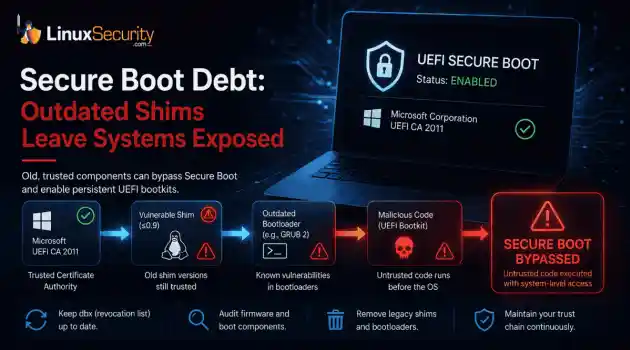
security advisory linux distribution ESET researchers identified 11 old and forgotten Linux UEFI shim bootloaders at versions 0.9 and below that can be used to bypass UEFI Secure Boot on any UEFI-based machine that trusts Microsoft’s Microsoft Corporation UEFI CA 2011 third-party certificate authority, regardless of the installed operating system (OS). Reported shims can be exploited to execute untrusted code during system boot, enabling attackers to deploy malicious UEFI bootkits even on systems with UEFI Secure Boot enabled.....
Jul 16, 2026
 Refine news
X Clear Filters
Get the latest News and Insights
Get the latest Linux and open source security news straight to your inbox.
Community Poll
Is continuous patching actually viable?
Trending News
Loading...
Explore Latest Linux Security news
We found 3 articles for you...
72
 security advisoryfirewall managementlinux firewall
Why IPv6 Influences Linux Firewall Behavior and Exposure Risks
Most Linux systems are already dual-stack, whether anyone planned for it or not. IPv4 and IPv6 both sit in the kernel, both accept traffic, and both get evaluated independently before a packet ever reaches a service. That’s normal Linux behavior, not a special case, and it’s where a lot of firewall confusion quietly starts. . UFW tends to be where people notice it. The rules look right, access appears restricted, yet something still connects. Nothing is “broken” in the usual sense. The firewall is enforcing policy exactly as expressed, just across two protocol paths that don’t share state or assumptions. This isn’t about misconfiguration or missing hardening steps. It’s about how Linux networking is designed and how that design surfaces through firewall interfaces. Once IPv6 is in play, outcomes can diverge from intent without any rule changes, which is why these issues keep showing up in server builds, audits, and post-incident reviews. The goal here is to map that behavior, not fix it. To ground IPv6 in Linux reality so it stops leaking into hardening guides, server playbooks, and troubleshooting threads as a mysterious edge case when it’s been part of the operating system the whole time. Why Linux Treats Dual-Stack Networking as the Baseline Linux didn’t add IPv6 as an overlay on IPv4. It implemented it as a parallel protocol family with its own routing tables, sockets, and packet filtering paths. From the kernel’s perspective, evaluating IPv4 and IPv6 traffic separately isn’t a complication. It’s the cleanest way to support two different network stacks at the same time. Firewall tools sit on top of that design . When a policy is expressed through an interface like UFW, it reads as a single intent, but it gets translated into two independent enforcement paths. That translation is faithful to the kernel model, even if it doesn’t line up with how operators tend to reason about firewalls as a single control plane. This matters because IPv4-era assumptionsshape most firewall expectations. Reviews, audits, and troubleshooting often implicitly assume a single decision point and a single outcome. On Linux, that assumption doesn’t hold once IPv6 is present, and it usually is. Firewall decisions on Linux are made per-protocol, not per-intent. The result isn’t exposure by mistake. It’s exposure by omission of the whole model. When IPv6 isn’t part of the mental picture, firewall behavior can look inconsistent even when every rule is doing exactly what it was asked to do. Understanding dual-stack as the baseline explains why these surprises recur and why they tend to surface only after systems are already in use. Why Firewall Intent Splits at the Kernel Boundary Linux did not evolve IPv6 as an extension of IPv4. It implemented it as a separate protocol family with its own routing logic, socket handling, and lifecycle inside the kernel. That decision predates most modern firewall tooling and reflects a design choice to keep protocol handling explicit rather than merged behind a compatibility layer. Because of that, dual-stack operation is not a mode Linux switches into. It is the steady state. As soon as a system has an IPv6 address, the kernel treats IPv6 traffic as first-class, regardless of whether operators plan policy for it. Firewalls inherit this structure instead of redefining it. This matters because firewall intent is expressed at a higher level than packet evaluation. Tools like UFW are designed to describe access in human terms, not to collapse protocol families into a single enforcement path. The abstraction improves readability, but it does not change how the kernel reasons about traffic once it arrives. How the Linux Kernel Separates IPv4 and IPv6 Traffic Evaluation Linux classifies traffic by protocol family before the firewall policy is applied. Whether a packet is IPv4 or IPv6 determines which part of the networking stack will handle it and which firewall rules are even in scope. From there, evaluation splits cleanly: IPv4 traffic follows the IPv4 networking path and its associated filter chains IPv6 traffic follows a separate path with its own state and decision history No shared context exists between the two during enforcement From the kernel’s perspective, there is no concept of “the same rule” being applied twice. There are two rule sets derived from the same policy description, enforced independently. If their outcomes differ, Linux neither reconciles them nor surfaces a warning. Each protocol path is considered complete on its own. When those outcomes diverge, Linux provides no signal that anything unusual occurred, because each protocol path is considered valid in isolation. This separation is why firewall behavior can appear inconsistent even without any configuration changes. The inconsistency isn’t in the rules. It’s an assumption that enforcement ever happened in one place to begin with. Why Linux Firewalls Allow IPv6 Traffic When IPv4 Is Blocked Most Linux firewall reviews are tested only over IPv4. Connectivity checks, scans, and spot tests are run over v4, and the results are taken as representative of the system’s exposure. If IPv4 is blocked, the service may still be reachable over IPv6, unless IPv6 is also blocked or appropriately filtered. That assumption doesn’t hold in dual-stack environments. IPv6 traffic is evaluated independently, so blocking access over IPv4 says nothing about whether the same service is reachable over IPv6. From the operator’s perspective, the firewall appears to contradict itself. From the system’s perspective, nothing unusual happened. This matters because the failure mode is invisible during routine checks. Systems pass internal review, changes get signed off, and the firewall is considered done. The gap only shows up when traffic arrives over IPv6, often from outside the environments or tools teams typically test from. For administrators and analysts, this is why IPv6-related firewall exposure rarely feels like a configurationmistake. It shows up as a mismatch between what was reviewed and what the system actually permits, rooted in Linux’s dual-stack design rather than a bad rule. Where This Behavior Surfaces in Linux Firewall Interfaces When IPv6 exposure becomes visible, attention almost always turns to the firewall interface. UFW is where policy is read, reviewed, and reasoned about, so it becomes the focal point for investigation. What people usually encounter: Firewall status and rules that align with the intended posture No obvious indication that IPv6 traffic is being evaluated separately Services remaining reachable despite “correct” rules Conflicting signals between firewall output and real-world access This is usually the point where teams fall back on UFW log analysis to reconcile what the firewall reports with what the network is actually doing. UFW isn’t misrepresenting policy. It’s showing intent, not execution history. The interface can’t explain which protocol path a given connection used; it can only list the rules that exist. That’s why IPv6 confusion tends to surface here even though the underlying behavior lives deeper in the Linux networking stack. Common Linux Service Exposure Patterns in Dual-Stack Systems Dual-stack behavior becomes visible through services, not through the firewall itself. Exposure shows up where applications bind, listen, and advertise availability across protocol families, often in ways that don’t line up cleanly. The patterns are familiar once you’ve seen a few environments: Public-facing services that appear restricted during IPv4 testing but remain reachable over IPv6 Management interfaces that were never intended to be externally accessible, yet respond on a v6 address Services that bind differently across protocol versions due to defaults, libraries, or legacy config These aren’t edge cases. They’re a product of how Linux services inherit network context and how firewall intent gets applied unevenlyacross real workloads. This is why dual-stack exposure shows up most often on hosts running multiple services, especially in UFW in server environments where access models are already more complex. What matters here isn’t the specific service. It’s the pattern. Exposure emerges at the intersection of Linux networking defaults and service behavior, long before anyone thinks to question the firewall. Why These Issues Are Difficult to Diagnose on Linux Once unexpected access is detected, diagnosis tends to stall. Not because the tools are bad, but because the signals don’t line up in a way that clearly points back to the cause. What operators usually see: Logs showing traffic being blocked Rules that appear to match the intended posture Connections are still succeeding from operators. Symptoms appearing at the application or network layer At that point, attribution breaks down . The firewall looks correct. The service looks exposed. Each layer reports something different, and none of them explain how those observations fit together. This is where people start searching for explanations around when UFW rules don’t behave as expected, even though the behavior itself is consistent. The difficulty isn’t a lack of data. It’s that Linux distributes responsibility for network behavior across layers that don’t share context. By the time traffic reaches a log or a service, the decision that allowed it has already happened somewhere else. That’s why confusion is normal here, and why dual-stack issues tend to consume more time than their eventual explanation would suggest. How Dual-Stack Behavior Complicates Linux Firewall Operations Dual-stack behavior doesn’t stay confined to firewall reviews. Once IPv6 is in play, it quietly complicates everything built on top of the firewall layer, even when no one is actively thinking about it. Policy design becomes harder because intent has to survive translation across two protocol families. Validation becomesnoisier because test results depend on which path the traffic took. Change management slows down because every adjustment carries uncertainty that isn’t visible at the rule level. None of this breaks operations outright, but it raises the cost of certainty. This is why teams start gravitating toward more structured approaches like advanced UFW rule patterns , not because UFW lacks features, but because dual-stack environments punish ambiguity. The firewall hasn’t changed. The operational surface around it has. The critical point is scope. Dual-stack behavior isn’t a separate firewall problem. It’s a multiplier that increases cognitive load across hardening, auditing, and troubleshooting without announcing itself as the cause. Recognizing When IPv6 Is the Root Cause on Linux IPv6 rarely shows up as a clear signal. It usually surfaces as an inconsistency. Behavior changes depending on where traffic originates, which host is being tested, or which network path is involved, without any corresponding change in firewall state. The pattern tends to look like this: Issues only appear on hosts with publicly reachable IPv6 addresses The same services behave normally in IPv4-only environments Symptoms disappear when dual-stack networking is removed and return when it’s restored What makes this hard to spot is that none of these conditions directly involves the firewall. Rules remain unchanged. Logs don’t obviously contradict policy. The only variable that moves is the protocol path the traffic takes. In practice, IPv6 is introduced late in investigations. It’s rarely treated as a configured feature, and more often as an environmental constant no one accounted for. Once that connection is made, the behavior stops looking intermittent and starts looking predictable, even if it’s still undesirable. Takeaway: Why Dual-Stack Linux Requires a Different Firewall Mental Model IPv6 doesn’t make Linux firewalls less correct. It makes their behavior harder to reasonabout if you’re still thinking in single-path terms. The rules can be valid, enforcement can be accurate, and outcomes can still surprise you because traffic is being evaluated in places you weren’t actively considering. UFW sits at the point where this becomes visible. It doesn’t introduce dual-stack behavior or smooth it over. It exposes Linux networking realities through a policy-focused interface that was never meant to explain packet flow in detail. That gap is where confusion tends to collect. The recurring issues in dual-stack environments aren’t solved by adding more rules or tightening syntax. They come from mismatched mental models. Linux firewall behavior reflects how the kernel processes traffic, not how operators prefer to reason about access control. Once IPv6 is part of the picture, that distinction matters. If this feels less like a configuration problem and more like a framing problem, that’s the point. Understanding Linux firewall behavior at the system level is what keeps IPv6 from bleeding into hardening guides, server builds, and troubleshooting efforts, turning it into a constant source of noise rather than a known, bounded condition. . Explore how IPv6 influences firewall behavior on Linux, uncovering challenges and solutions for dual-stack environments.. IPv6 configuration, dual-stack networking, Linux firewall behavior, UFW management, firewall troubleshooting. . MaK Ulac
 Dec 19, 2025
•
Dec 19, 2025
• Firewalls
72
 security enhancementLinux securityopen-source
NethSecurity 8.1 Release: Overview and User-Driven Enhancements
NethSecurity is a Linux firewall that has been gaining traction in the open-source Linux space. Its proactive approach to network management and security has set it apart. . In this article, I'll examine the newly announced NethSecurity 8.1 release , highlighting user-driven improvements and the project's commitment to seamless updates without downtime. What Is NethSecurity? NethSecurity is a powerful spinoff of the NethServer Project . It has replaced the UTM Firewall module that was removed from NethServer 8 with NethSecurity. NethSecurity, a powerful protection suite that offers a complete set of features for Linux administrators, is designed to simplify network security. The user-friendly interface makes it easy for admins to implement robust network defenses. This open-source Linux Firewall is built using a new technology stack, representing a significant leap from its predecessor. NethSecurity is known for its simple setup. It allows you to have a firewall up and running in just minutes. NethSecurity is easy to use and continues to support users who need a dedicated firewall portal, solidifying its position as the go-to solution within the open-source community. NethSecurity 8.1: What's New? The 8.1 milestone release introduces several enhancements and new features that will elevate the security landscape in Linux for administrators. This strategy, which releases new images after an OpenWrt upgrade or after introducing essential features and bug fixes, ensures users have access to security and performance updates. These updates don't require a restart, so there is no service interruption. The release includes extensive bug fixes and stability enhancements. It addresses issues ranging from NVME space usage to cosmetic UI improvements: User-Driven Enhancements to Improve Usability: This release's updates have been infused with user feedback, making admins' jobs easier. Connection Manager: A new interface for tracking connections has been added.This allows admins to manage network connections more precisely. This feature is handy for monitoring and troubleshooting any network anomalies. Admin User management: Admin user management can be accessed directly from the UI, streamlining user administration tasks and enhancing security. DPI Signatures: The update includes DPI signatures for community and enterprise subscribers, providing the latest detection capabilities for deep-packet inspection. Repository Access Proxy and Subscription Authentication: This extends NethSecurity’s commitment to security, allowing access to the subscription repository after system_key validation. It ensures that only authenticated users can download updates. These updates demonstrate NethSecurity’s commitment to continuous improvement and responsiveness to user feedback. They also solidify the firewall's position as an essential tool for network security management. How Can I Download NethSecurity 8.1? Linux admins who want to upgrade or adopt NethSecurity 8.1 can easily do it. The project offers two ways to update the latest version. A package update through the UI is suitable for updating specific packages without changing the dashboard version. A full-image update refreshes your entire system and reflects the version number on the dashboard. Admins can visit the NethSecurity forum for detailed instructions on installing the latest version. Users can participate in discussions, report problems, share their experiences, and suggest new features, actively shaping the future of NethSecurity. Our Final Thoughts on the NethSecurity 8.1 Release NethSecurity's release of version 8.1 is a significant milestone for the project, as it demonstrates a user-centric and robust approach to open-source network security. The NethSecurity's 8.1 release is a blend of user-driven improvements, critical updates, and a commitment to a hassle-free upgrade process. The roadmap teases future features such as Firewall Objects andReporting, pointing to a bright future for NethSecurity and its community. NethSecurity is a leader in the rapidly evolving landscape of network protection. Its commitment to innovation, community involvement, and delivering premier solutions sets it apart. Linux administrators worldwide would be wise to use NethSecurity as a cornerstone in their network defense strategy. . Discover the latest updates in NethSecurity 8.1, focusing on its essential features and enhancements shaped by user feedback tailored for Linux systems.. NethSecurity 8.1,Linux Firewall,Network Protection,Open-Source Software. . Dave Wreski
Jul 11, 2024
•
Firewalls

72
 linux applicationsnetworkinginstallation guide
Installing RouterOS 2.9 on Compaq Proliant 400: Key Features and Setup
Would you like to have a Linux-based router capable of doing tasks such as stateful firewall inspection, virtual private networking, and traffic shaping, in addition to packet routing? Tired of having to do administration from the command line but want to be able to administer your box from a Windows-based client PC? MikroTik's RouterOS may what you need. You can boot RouterOS via diskette, CD, or over the network via PXE or Etherboot-enabled network interface card. You can find a full list of RouterOS technical specifications at the homepage. . I installed the 13MB ISO CD image RouterOS v2.9.23 on a old Compaq Proliant 400 (450MHz, 128MB RAM, 20GB hard disk). The software's minimum configuration is a 100MHz Pentium, 64MB RAM, and 64MB storage. When I booted the PC, I found a list of available packages for RouterOS, including the packages to use DHCP and PPTP servers, Web proxy, and much more. You can select individual packages, all available packages, or the minimum required packages. To see the full range of what RouterOS was capable of, I selected all. After a last warning about the data on the disk being erased, the software is installed. The link for this article located at Linux.com is no longer available. . I revived an old Compaq Proliant 400 by installing RouterOS v2.9.23, a rewarding journey of setup that deepened my networking knowledge and skills. RouterOS Installation, MikroTik Router Features, Linux Firewall Applications. . Brittany Day
May 23, 2006
•
Firewalls
72
network protectionopen sourcelinux firewallChoosing Between Floppyfw And Coyote Linux Firewalls For Home Use
When you look in your closet, do you see a pile of obsolete hardware that you just cannot bring yourself to throw out, despite the pleas of your family? If you want to share your home Internet connection and save a little money at the same time, dust off that old hardware and set up a Linux-based firewall. All you need is a 486 or better processor, two network adapters (only one if you're on dial-up), a switch or hub, diskette drive, and 12MB of RAM. In this article, we'll take a look at floppyfw and Coyote Linux, two free, open source projects that have shrunk Linux down to diskette size to implement a firewall. . Both floppyfw and Coyote Linux provide adequate protection for home or small office use. So which is right for you? Floppfw takes a minimalist approach that requires you to understand iptables in order to customize it. Its lack of remote administration could be seen as an advantage for both resource-constrained and security-conscious users. Running SSH or a Web server takes up memory and processor resources that could be used to support more users. It is also one less source of potential vulnerabilities. Those familiar with Linux and command-line administration will feel right at home with floppyfw.. When evaluating network security options such as Floppyfw and Coyote Linux, both provide solid defense for home or small business settings. The key question is: which one to choose?. Floppyfw, Coyote Linux, Linux Firewall, Network Protection, Home Office Security. . Benjamin D. Thomas
Mar 14, 2005
•
Firewalls
72
network securityapplication protectionlinux firewallAhorro Corporación Enhances Security with Linux and StoneGate Integration
As part of the 'shake up' in its security system, Ahorro Corporación decided to change the platform for its applications and choose to invest in Linux. This meant that the firewall would also have to run with Linux. The StoneGate firewall . . . . As part of the 'shake up' in its security system, Ahorro Corporación decided to change the platform for its applications and choose to invest in Linux. This meant that the firewall would also have to run with Linux. The StoneGate firewall and VPN came with its own hardened Linux operating system, which made it totally compatible with Ahorro's new platform while allowing the whole solution to run on any standard hardware. Having met this initial criteria, StoneGate was interesting to Ahorro for a number of other reasons including the high availability which was included as standard and that it offered flexible facilities to define policies The link for this article located at Dr. Dobbs is no longer available. . Ahorro Corporación upgraded its defenses using Linux, incorporating the StoneGate firewall for enhanced application protection.. Linux Firewall, StoneGate Security, Application Protection. . Anthony Pell
Oct 28, 2003
•
Firewalls
72
security practicesnetworkinglinux firewallKernel 2.2 or 2.4 Selection For Linux Firewall on Old PCs
An old PC can be the ideal platform to realize a network firewall based on Linux. The system configuration needs a bit of attention but it's not a difficult task to fulfill. The only doubt concerns which kernel version better suits . . . . An old PC can be the ideal platform to realize a network firewall based on Linux. The system configuration needs a bit of attention but it's not a difficult task to fulfill. The only doubt concerns which kernel version better suits our needs. The 2.2 version is said to be less memory consuming, but has a less solid filesystem and lacks other recent features. What's the right choice then? The link for this article located at PortaZero.info is no longer available. . Transform an outdated computer into a robust Linux-based firewall by selecting an optimal kernel version that enhances efficiency and configurability for your network needs.. Linux Firewall, Kernel Selection, Networking Options, System Optimization, Security Practices. . Anthony Pell
Sep 26, 2002
•
Firewalls
72
network managementlinux firewallfirewall solutionRick Johnson Discusses PMFirewall for Linux Firewalling Solutions
"A few months ago when I was asked to design a firewalling strategy for a local consulting company, I proposed that I would use Linux to create a low cost firewalling solution. Everyone loved the idea from the . . .. "A few months ago when I was asked to design a firewalling strategy for a local consulting company, I proposed that I would use Linux to create a low cost firewalling solution. Everyone loved the idea from the Techs who understood the power of linux, to the business men who saw the bottom dollar to the clients who loved to hear that buzzword "Linux". So, I set out and studied all I could about IPCHAINS and firewalling in the 2.2x Kernel. After writing some custom firewalling rules over and over again, I came across PMFirewall. PMFirewall is a script that asks you what services you need and which ones you want blocked out; it then uses your selections to create an ipchains ruleset. This was the perfect firewalling solution because it was easy to adapt the firewall rules to different networks. PMFirewall is a script that creates a ruleset for IPCHAINS for dual nic machines. The following is an email interview I conducted with Rick Johnson, the creator of PMFirewall." The link for this article located at LinuxLock.org -- Â Â is no longer available. . In his latest lecture, Rick Johnson elaborates on leveraging Linux alongside PMFirewall to enhance firewall management techniques during client engagements.. Linux Firewall, PMFirewall Script, Network Management, Firewalling Solutions. . Anthony Pell
Mar 31, 2000
•
Firewalls
72
network securitylinux firewallipchainsSetting Up a Linux Firewall with ipchains and Router Project
This Linux Journal article describes the process of configuring a PC to become a firewall. It includes information on using the Linux Router Project, ipchains, and securing your PC to be used with a cable modem or DSL . . .. This Linux Journal article describes the process of configuring a PC to become a firewall. It includes information on using the Linux Router Project, ipchains, and securing your PC to be used with a cable modem or DSL connection. The link for this article located at Linux Journal is no longer available. . Discover how to set up your computer as a security barrier utilizing the Linux Router Project together with iptables to bolster protection.. Linux Firewall Configuration, ipchains Guide, Network Security Setup. . Anthony Pell
Feb 24, 2000
•
Firewalls

Get the latest News and Insights
Get the latest Linux and open source security news straight to your inbox.
Community Poll
Is continuous patching actually viable?
Trending News
Search Topics
Powered By

Linux Security - Your source for Top Linux News, Advisories, HOWTOs and Feature Releases
QUICK LINKS
subscribe to newsletters!
Like staying secure? So do we.
Sign up for updates, tips, and alerts!