Audit Linux privileges now to limit compromise, escalation, and system-wide damage. Review Linux Privileges×


Why IPv6 Influences Linux Firewall Behavior and Exposure Risks
 Dec 19, 2025
•
Dec 19, 2025
•
 MaK Ulac
6 - 11 min read


Most Linux systems are already dual-stack, whether anyone planned for it or not. IPv4 and IPv6 both sit in the kernel, both accept traffic, and both get evaluated independently before a packet ever reaches a service. That’s normal Linux behavior, not a special case, and it’s where a lot of firewall confusion quietly starts.
UFW tends to be where people notice it. The rules look right, access appears restricted, yet something still connects. Nothing is “broken” in the usual sense. The firewall is enforcing policy exactly as expressed, just across two protocol paths that don’t share state or assumptions.
This isn’t about misconfiguration or missing hardening steps. It’s about how Linux networking is designed and how that design surfaces through firewall interfaces. Once IPv6 is in play, outcomes can diverge from intent without any rule changes, which is why these issues keep showing up in server builds, audits, and post-incident reviews.
The goal here is to map that behavior, not fix it. To ground IPv6 in Linux reality so it stops leaking into hardening guides, server playbooks, and troubleshooting threads as a mysterious edge case when it’s been part of the operating system the whole time.
Why Linux Treats Dual-Stack Networking as the Baseline
Linux didn’t add IPv6 as an overlay on IPv4. It implemented it as a parallel protocol family with its own routing tables, sockets, and packet filtering paths. From the kernel’s perspective, evaluating IPv4 and IPv6 traffic separately isn’t a complication. It’s the cleanest way to support two different network stacks at the same time.
Firewall tools sit on top of that design. When a policy is expressed through an interface like UFW, it reads as a single intent, but it gets translated into two independent enforcement paths. That translation is faithful to the kernel model, even if it doesn’t line up with how operators tend to reason about firewalls as a single control plane.
This matters because IPv4-era assumptions shape most firewall expectations. Reviews, audits, and troubleshooting often implicitly assume a single decision point and a single outcome. On Linux, that assumption doesn’t hold once IPv6 is present, and it usually is. Firewall decisions on Linux are made per-protocol, not per-intent.
The result isn’t exposure by mistake. It’s exposure by omission of the whole model. When IPv6 isn’t part of the mental picture, firewall behavior can look inconsistent even when every rule is doing exactly what it was asked to do. Understanding dual-stack as the baseline explains why these surprises recur and why they tend to surface only after systems are already in use.
Why Firewall Intent Splits at the Kernel Boundary
Linux did not evolve IPv6 as an extension of IPv4. It implemented it as a separate protocol family with its own routing logic, socket handling, and lifecycle inside the kernel. That decision predates most modern firewall tooling and reflects a design choice to keep protocol handling explicit rather than merged behind a compatibility layer.
Because of that, dual-stack operation is not a mode Linux switches into. It is the steady state. As soon as a system has an IPv6 address, the kernel treats IPv6 traffic as first-class, regardless of whether operators plan policy for it. Firewalls inherit this structure instead of redefining it.
This matters because firewall intent is expressed at a higher level than packet evaluation. Tools like UFW are designed to describe access in human terms, not to collapse protocol families into a single enforcement path. The abstraction improves readability, but it does not change how the kernel reasons about traffic once it arrives.
How the Linux Kernel Separates IPv4 and IPv6 Traffic Evaluation
Linux classifies traffic by protocol family before the firewall policy is applied. Whether a packet is IPv4 or IPv6 determines which part of the networking stack will handle it and which firewall rules are even in scope.
From there, evaluation splits cleanly:
- IPv4 traffic follows the IPv4 networking path and its associated filter chains
- IPv6 traffic follows a separate path with its own state and decision history
- No shared context exists between the two during enforcement
From the kernel’s perspective, there is no concept of “the same rule” being applied twice. There are two rule sets derived from the same policy description, enforced independently. If their outcomes differ, Linux neither reconciles them nor surfaces a warning. Each protocol path is considered complete on its own. When those outcomes diverge, Linux provides no signal that anything unusual occurred, because each protocol path is considered valid in isolation.
This separation is why firewall behavior can appear inconsistent even without any configuration changes. The inconsistency isn’t in the rules. It’s an assumption that enforcement ever happened in one place to begin with.
Why Linux Firewalls Allow IPv6 Traffic When IPv4 Is Blocked
Most Linux firewall reviews are tested only over IPv4. Connectivity checks, scans, and spot tests are run over v4, and the results are taken as representative of the system’s exposure. If IPv4 is blocked, the service may still be reachable over IPv6, unless IPv6 is also blocked or appropriately filtered. 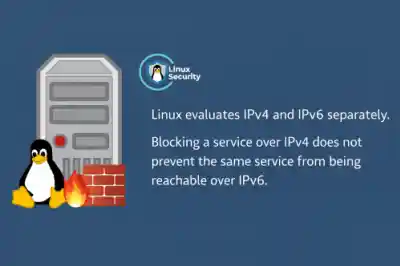
That assumption doesn’t hold in dual-stack environments. IPv6 traffic is evaluated independently, so blocking access over IPv4 says nothing about whether the same service is reachable over IPv6. From the operator’s perspective, the firewall appears to contradict itself. From the system’s perspective, nothing unusual happened.
This matters because the failure mode is invisible during routine checks. Systems pass internal review, changes get signed off, and the firewall is considered done. The gap only shows up when traffic arrives over IPv6, often from outside the environments or tools teams typically test from.
For administrators and analysts, this is why IPv6-related firewall exposure rarely feels like a configuration mistake. It shows up as a mismatch between what was reviewed and what the system actually permits, rooted in Linux’s dual-stack design rather than a bad rule.
Where This Behavior Surfaces in Linux Firewall Interfaces
When IPv6 exposure becomes visible, attention almost always turns to the firewall interface. UFW is where policy is read, reviewed, and reasoned about, so it becomes the focal point for investigation.
What people usually encounter:
- Firewall status and rules that align with the intended posture
- No obvious indication that IPv6 traffic is being evaluated separately
- Services remaining reachable despite “correct” rules
- Conflicting signals between firewall output and real-world access
This is usually the point where teams fall back on UFW log analysis to reconcile what the firewall reports with what the network is actually doing.
UFW isn’t misrepresenting policy. It’s showing intent, not execution history. The interface can’t explain which protocol path a given connection used; it can only list the rules that exist. That’s why IPv6 confusion tends to surface here even though the underlying behavior lives deeper in the Linux networking stack.
Common Linux Service Exposure Patterns in Dual-Stack Systems
Dual-stack behavior becomes visible through services, not through the firewall itself. Exposure shows up where applications bind, listen, and advertise availability across protocol families, often in ways that don’t line up cleanly.
The patterns are familiar once you’ve seen a few environments:
- Public-facing services that appear restricted during IPv4 testing but remain reachable over IPv6
- Management interfaces that were never intended to be externally accessible, yet respond on a v6 address
- Services that bind differently across protocol versions due to defaults, libraries, or legacy config
These aren’t edge cases. They’re a product of how Linux services inherit network context and how firewall intent gets applied unevenly across real workloads. This is why dual-stack exposure shows up most often on hosts running multiple services, especially in UFW in server environments where access models are already more complex.
What matters here isn’t the specific service. It’s the pattern. Exposure emerges at the intersection of Linux networking defaults and service behavior, long before anyone thinks to question the firewall.
Why These Issues Are Difficult to Diagnose on Linux
Once unexpected access is detected, diagnosis tends to stall. Not because the tools are bad, but because the signals don’t line up in a way that clearly points back to the cause.
What operators usually see:
- Logs showing traffic being blocked
- Rules that appear to match the intended posture
- Connections are still succeeding from operators.
- Symptoms appearing at the application or network layer
At that point, attribution breaks down. The firewall looks correct. The service looks exposed. Each layer reports something different, and none of them explain how those observations fit together. This is where people start searching for explanations around when UFW rules don’t behave as expected, even though the behavior itself is consistent.
The difficulty isn’t a lack of data. It’s that Linux distributes responsibility for network behavior across layers that don’t share context. By the time traffic reaches a log or a service, the decision that allowed it has already happened somewhere else. That’s why confusion is normal here, and why dual-stack issues tend to consume more time than their eventual explanation would suggest.
How Dual-Stack Behavior Complicates Linux Firewall Operations
Dual-stack behavior doesn’t stay confined to firewall reviews. Once IPv6 is in play, it quietly complicates everything built on top of the firewall layer, even when no one is actively thinking about it. 
Policy design becomes harder because intent has to survive translation across two protocol families. Validation becomes noisier because test results depend on which path the traffic took. Change management slows down because every adjustment carries uncertainty that isn’t visible at the rule level. None of this breaks operations outright, but it raises the cost of certainty.
This is why teams start gravitating toward more structured approaches like advanced UFW rule patterns, not because UFW lacks features, but because dual-stack environments punish ambiguity. The firewall hasn’t changed. The operational surface around it has.
The critical point is scope. Dual-stack behavior isn’t a separate firewall problem. It’s a multiplier that increases cognitive load across hardening, auditing, and troubleshooting without announcing itself as the cause.
Recognizing When IPv6 Is the Root Cause on Linux
IPv6 rarely shows up as a clear signal. It usually surfaces as an inconsistency. Behavior changes depending on where traffic originates, which host is being tested, or which network path is involved, without any corresponding change in firewall state.
The pattern tends to look like this:
- Issues only appear on hosts with publicly reachable IPv6 addresses
- The same services behave normally in IPv4-only environments
- Symptoms disappear when dual-stack networking is removed and return when it’s restored
What makes this hard to spot is that none of these conditions directly involves the firewall. Rules remain unchanged. Logs don’t obviously contradict policy. The only variable that moves is the protocol path the traffic takes.
In practice, IPv6 is introduced late in investigations. It’s rarely treated as a configured feature, and more often as an environmental constant no one accounted for. Once that connection is made, the behavior stops looking intermittent and starts looking predictable, even if it’s still undesirable.
Takeaway: Why Dual-Stack Linux Requires a Different Firewall Mental Model
IPv6 doesn’t make Linux firewalls less correct. It makes their behavior harder to reason about if you’re still thinking in single-path terms. The rules can be valid, enforcement can be accurate, and outcomes can still surprise you because traffic is being evaluated in places you weren’t actively considering.
UFW sits at the point where this becomes visible. It doesn’t introduce dual-stack behavior or smooth it over. It exposes Linux networking realities through a policy-focused interface that was never meant to explain packet flow in detail. That gap is where confusion tends to collect.
The recurring issues in dual-stack environments aren’t solved by adding more rules or tightening syntax. They come from mismatched mental models. Linux firewall behavior reflects how the kernel processes traffic, not how operators prefer to reason about access control. Once IPv6 is part of the picture, that distinction matters.
If this feels less like a configuration problem and more like a framing problem, that’s the point. Understanding Linux firewall behavior at the system level is what keeps IPv6 from bleeding into hardening guides, server builds, and troubleshooting efforts, turning it into a constant source of noise rather than a known, bounded condition.
 PREVIOUS

 NEXT
NEXT

Powered By

Linux Security - Your source for Top Linux News, Advisories, HOWTOs and Feature Releases
QUICK LINKS
subscribe to newsletters!
Like staying secure? So do we.
Sign up for updates, tips, and alerts!