Explore top 10 tips to secure your open-source projects now. Read More
×



Server Security data privacy automation
data privacy automation Every system admin has lived through the same Monday morning ritual. A queue of forty tickets, half of them password resets, permission errors, or disk space warnings that any experienced technician could resolve in under two minutes. The other half require actual judgment. For years, automation promised that software would eventually sort the two apart on its own. That promise is now being tested in production Linux environments. . Early results are reshaping how IT teams think about tier-1...
 Jul 17, 2026

Privacydata collection automation
data collection automation You're running a web scraping project to collect pricing data from e-commerce sites. You set up a pool of datacenter proxies, launch your scripts, and within minutes — banned . CAPTCHAs everywhere. Your data pipeline stops before it really begins. . It's a frustrating scenario that plays out daily in ad verification, market research, and multi-account management. The website doesn't know you're doing legitimate research or monitoring. It just sees traffic coming from IP ranges it recognizes as...
Jul 17, 2026

Security Trends security advisory social engineering
security advisory social engineering Business Email Compromise used to be a numbers game — mass-blasted emails, broken English, an obvious "URGENT WIRE TRANSFER" subject line. That era is over. Generative AI has turned BEC into a tailored, low-noise operation that mimics writing style, voice, and even video presence. This piece looks at what's actually changed under the hood, what defenders are testing in response, and why so many organizations are still structurally unprepared for it. . The Infrastructure Problem Nobody Wants to...
Jul 17, 2026
Security Trends cybersecurity Linux documentation
cybersecurity Linux documentation Linux operating systems have gained prominence due to their stability, adaptability, and excellent security options. In the case of developing documentation, designing cybersecurity dashboards, or educational material, visuals are of vital importance when it comes to making things clear. The use of icons allows one to understand the message regarding alerts, authorization, encryption, authentication, or the state of the system just by looking at the visual cue without having to read long...
Jul 17, 2026
Security Vulnerabilities security advisory linux distribution
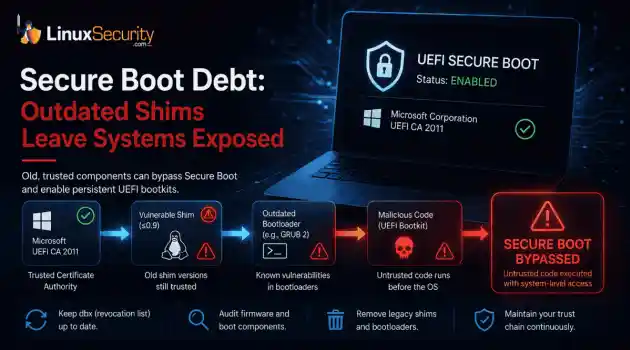
security advisory linux distribution ESET researchers identified 11 old and forgotten Linux UEFI shim bootloaders at versions 0.9 and below that can be used to bypass UEFI Secure Boot on any UEFI-based machine that trusts Microsoft’s Microsoft Corporation UEFI CA 2011 third-party certificate authority, regardless of the installed operating system (OS). Reported shims can be exploited to execute untrusted code during system boot, enabling attackers to deploy malicious UEFI bootkits even on systems with UEFI Secure Boot enabled.....
Jul 16, 2026
 Refine news
X Clear Filters
Get the latest News and Insights
Get the latest Linux and open source security news straight to your inbox.
Community Poll
Is continuous patching actually viable?
Loading...
Explore Latest Linux Security news
We found 19 articles for you...
77
 security advisoryemail securitylinux
Enhancing Linux Email Security: Identify Malicious Attachments Effectively
Suspicious emails rarely confess in the body. The clues live in headers, MIME parts, and tiny inconsistencies between what a message claims and what it actually delivers. If your team can read those signals quickly—and connect them to the attachment—you’ll cut off credential theft, loaders, and ransomware without slowing operations. . Why Attachments Remain a Top Risk for Linux Teams Linux mail servers and gateways are resilient, but attachments are still the quickest path into a user’s workflow. Attackers lean on invoices, shipping notices, HR forms, and “faxed” PDFs. They spoof trusted domains, forward through legitimate relays, or abuse look-alike domains to sneak past simple checks. The trick is to combine transport truth (the header) with payload truth (the MIME description and the file’s behavior), so you’re not relying on antivirus alone. Public guidance on phishing patterns underscores how multiple small cues add up to a confident verdict, which is why security agencies emphasize verifying the source and treating unexpected attachments as high risk—see CISA’s guidance on recognizing and reporting phishing for context. Read the Header First: Route, Auth, and Timing Start with the Received chain to confirm the path and timing. Out-of-region relays, sudden drops from well-known ESPs to unknown hosts, or timestamp gaps are early flags. Next, look at Authentication-Results. SPF, DKIM, and DMARC should align with what you expect for the sender; failures during a period of look-alike domain activity demand caution. If DKIM passes but SPF fails on a forward, it might just be a benign relay. If DMARC fails outright and there’s an attachment, your risk jumps. When your analysts need a refresher on how to turn these fields into decisions, Linux log analysis helps connect header facts with the events you store in syslog and your SIEM. Let MIME Tell You the Truth About the Attachment Headers include MIME declarations that reveal filenames, claimed types, encodings,and sizes. Double extensions (like invoice.pdf.exe), mismatches (a file named .pdf declared as application/octet-stream), or base64 archives posing as documents are common tells. The core rules for MIME structure are stable and worth bookmarking in the MIME message format standard that defines message body formats. Once teams get used to reading MIME parts, they start spotting problems without opening the file at all. Mail client quirks stop mattering. A Linux Email Security Workflow You Can Repeat Collect the original message with full headers intact. Parse the route and auth story, then compare the MIME description to the filename and the size the sender claims in the body. If there’s an inconsistency, isolate the message and stage the file for offline checks. For admins who want a deeper foundation beyond one message, secure my e-mail provides server-side steps that complement analyst triage on the workstation. On endpoints, prefer opening unknown documents in a disposable VM or sandboxed viewer. If the file needs to be inspected for business reasons—say, AP needs to verify an invoice—strip active content and extract only what’s required for validation. That keeps users moving without accepting macro risk. Automate the Boring Parts of Attachment Analysis Manual review doesn’t scale, especially for queues full of receipts and statements. After the header points to a risky or unknown sender, you still need to normalize filenames, confirm the real type, and extract only the fields your workflow requires. When the payload lands as a PDF and you need something repeatable, pull it apart with Python-driven attachment parsing . Treat it like any other triage step: extract the text you actually need, pull the metadata, and log it without dragging raw files across systems. It confirms whether that “two-page invoice” is really two pages, records hashes and size, and gives analysts the fields they rely on without opening the document in a risky viewer. Most shops script this workanyway, folding whatever they extract into the ticket so later reviewers can see exactly what the analyst saw. Case Study: Finance Queue, Forged Vendor, Macro Risk Avoided A US manufacturing firm’s AP mailbox receives a vendor “banking update” with a spreadsheet. The header shows DMARC failure and a Received chain that includes a relay the vendor has never used. The MIME part lists .xlsm with a benign description. Analysts isolate the message, then parse a PDF copy of the form with a small Python job. The extracted text reveals misspelled vendor details and a payment account that doesn’t match the records. Because the decision is driven by header facts and MIME truth—plus extraction that avoids running macros—the team blocks the sender, calls the vendor to confirm fraud, and adds a transport rule that diverts macro-enabled spreadsheets from new domains into quarantine. The same rule prevents several follow-ups that week. Turn Header and MIME Signals Into Enforceable Policy Triage only matters if it shapes what your systems do next. Map header patterns to transport rules: divert messages with DMARC failures and attachments to quarantine; score look-alike domains higher; hold base64 archives that claim to be documents. On the host, log what your analysts read during triage so you can recreate the exact decision later. Many irreplaceable details—boundary markers, part ordering, transfer encoding—live in the raw message. Keep them. When you adjust filters and mail flow, align them with forensic lessons. Linux malware scanner coverage walks through practical tooling that pairs well with header-driven rules: scan detached in a sandbox, tag known-bad patterns, and keep signatures current. Over time, the combination of message policy and endpoint checks reduces noisy alerts and makes truly novel samples stand out. Train for Better Samples, Not Just Better Clicks Awareness programs help, but what analysts need most is clean sample capture. Give users a single “report” actionthat forwards the original message with headers preserved rather than screenshots or copy-pasted text. A short refresher on recognizing cues, aligned with CISA’s guidance on recognizing and reporting phishing , increases the odds that the first report includes the critical details. That saves analysts from chasing truncated messages or rebuilding routes from fragments. Practical Notes on Scale and Safety When attachments are routine for your business—claims, orders, lab results—focus on normalization. Extract only what’s necessary for approval steps, record hashes and size, and avoid moving raw files between systems. If a document needs to move beyond security, send a sanitized copy instead. For MIME-declared types that are risky by design (macro-enabled spreadsheets, HTML attachments, scriptable archives), treat them as untrusted even if upstream checks look clean. The point isn’t to block everything; it’s to ensure your approvals don’t depend on opening active content from unauthenticated sources. Conclusion: Linux Email Security Is a Repeatable Habit A reliable workflow for Linux email security starts with headers, is confirmed by MIME, and is reinforced by narrow, automated extraction. Read the Received path and auth lines first, compare what the message claims about the attachment with what you know about your environment, and only then decide whether to quarantine, parse, or pass. A bit of automation goes a long way. You catch more bad files, you keep better evidence for later reviews, and you stop burning time reopening tickets because someone left out a header. . Effective strategies for detecting and mitigating risks from malicious email attachments in Linux environments.. Linux Security, Email Threats, Malware Email Analysis, Attachment Security. . MaK Ulac
 Dec 05, 2025
•
Dec 05, 2025
• Server Security
78
 open sourcesecurity toolsmalware detection
Evaluate Kaspersky KVRT: Necessary Antivirus Tool for Linux Admins
Despite Linux's reputation as the most secure operating system (OS) by design , no OS is fully immune to online risks like malware and viruses. While Linux is still targeted far less frequently than Windows, attacks on Linux are becoming increasingly prevalent as Linux's user base and the number of critical systems it powers worldwide continue to grow. . In response to this trend, Kaspersky has released a free virus removal tool for Linux , Kaspersky Virus Removal Tool (KVRT). But is such a tool necessary for Linux admins? Let's examine the benefits of KVRT, its necessity, and the best practices you can implement to protect against threats to your Linux environment. What Is the Purpose of Kaspersky Virus Removal Tool (KVRT)? Kaspersky Virus Removal Tool (KVRT) is a free virus removal tool tailored specifically for Linux-based operating systems. It is intended to address growing security concerns regarding malware targeting these environments. KVRT detects and removes malware, adware, and other threats. It conducts comprehensive scans of system memory, startup objects, boot sectors, and all files, including archived ones. Linux is generally considered secure; however, its increased adoption across various sectors has made it a cybercriminal target. KVRT adds another layer of protection for users without other security measures, but users must understand that KVRT should not replace regular updates and other protective measures. Rather, users should incorporate KVRT into a comprehensive cybersecurity plan to maintain robust protection. To use KVRT on Linux: Download the KVRT file from Kaspersky’s website and save it locally. Enable execute permission through the file manager or the terminal command chmod +x kvrt.run. Run the application either via the GUI or the command line. For full functionality, we recommend running it under a superuser account. Is KVRT Necessary for Linux Admins to Maintain Robust Linux Security? Virus removal tools likeKVRT should not be considered optional for Linux systems despite Linux's robust security. With its growing adoption across various sectors and increased cybercriminal activity targeting this platform, it has become an increasing target of cybercriminals who take advantage of vulnerabilities to exploit and infect systems with viruses and malware. While KVRT may enhance security on Linux systems, users should complement it with regular updates, strong passwords, and other protective tools to safeguard them from potential cyber threats. Open-source malware and virus scanners are another great option for detecting and removing viruses on Linux. Some of our favorites include: Lynis is an open-source cloud security audit scanner that protects devices against breaches and data leakage. Check Rootkit provides an easily navigable resource that helps safeguard devices against malware, botnets, and rootkits. Linux Malware Detect uses signatures created through network Intrusion Detection Systems to identify specific files with malware. ClamAV is the most frequently used anti-virus software for Linux on macOS, BSD, and Windows devices. It provides comprehensive threat protection. What Best Practices Should I Engage in to Prevent Virus Infections on Linux? In addition to using virus removal tools like KVRT and the open-source scanners we've discussed, tips for protecting Linux against potential malware and virus attacks include using strong passwords and restricting user access via VPN connections while keeping devices updated. In addition, admins must pay attention to log information from log information management services to rapidly identify potential threats. Explore the LinuxSecurity Feature article How to Check if Your Linux System is Infected with a Virus for more details on these best practices and how to implement them . Our Final Thoughts on the Necessity of Linux Virus Removal Tools Linux has long been considered one of the safest operating systems bydesign; however, increased attacks against its systems highlight an ever-evolving landscape of cybersecurity threats. As Linux usage and system deployment increase worldwide, the Kaspersky Virus Removal Tool for Linux addresses security risks related to malware targeting these systems. KVRT adds another layer of security by detecting and eliminating malware; however, it should not be seen as a replacement solution for secure administration practices. Linux administrators should pair KVRT with regular system updates, strong password practices, and the implementation of other protective measures detailed in this article to secure their Linux environments effectively. Incorporating open-source scanners such as Lynis, Check Rootkit Detect, Linux Malware Detect, or ClamAV into a comprehensive cybersecurity strategy may further boost Linux system protection from potential cyber threats. . Explore Kaspersky's Linux Virus Removal Tool to grasp malware threats and enhance security practices. Utilize this tool to effectively find and remove threats.. Kaspersky Virus Removal Tool, Linux Security Tools, Cybersecurity Best Practices, Malware Detection Linux, Open Source Security. . Brittany Day
Jun 04, 2024
•
Vendors/Products

77
security toolvulnerability scannermalware detectionExplore The Best Linux Scanners For Security Assessment In 2023
Are you searching for Linux vulnerability scanners that can recognize, characterize, and categorize to scan Linux servers? If so, this article will provide details on the most comprehensive Linux vulnerability scanners that can be used to scan Linux servers for malware and vulnerabilities. . Vulnerabilities are detected and disclosed as part of any vulnerability assessment. These vulnerabilities can be exploited to carry out malicious activities like cracking the system, website, and LANs. Now you might be wondering what a vulnerability scanner is. Automated security auditing plays a vital part in your IT security by scanning your network. Linux vulnerability scanners can also scan your website for several security risks. Scanners also generate a list of where you must patch, and describe the vulnerabilities found. They also need to take a step to remediate them. The link for this article located at Cyber Security News is no longer available. . Uncover the leading Linux vulnerability assessment tools to enhance the security evaluations and remediation strategies on your systems.. Linux Vulnerability Scanners, Security Auditing Tools, Malware Detection Solutions. . LinuxSecurity.com Team
May 08, 2023
•
Server Security
210
 malware detectioncybersecurity analysisadvanced threat
Bvp47 Linux Backdoor By Equation Group Survives Nearly A Decade Undetected
A new report dives deep into technical aspects of a Linux backdoor now tracked as Bvp47 that is linked to the Equation Group, the advanced persistent threat actor tied to the U.S. National Security Agency. . Bvp47 survived until today almost undetected, despite being submitted to the Virus Total antivirus database for the first time close to a decade ago, in late 2013. Until this morning, only one antivirus engine on Virus Total detected the Bvp47 sample. As the report spread in the infosec community, detection started to improve, being flagged by six engines at the moment of writing. . Bvp47 is a covert Linux backdoor attributed to government espionage efforts, evading discovery for nearly ten years.. Linux Backdoor, Equation Group, Advanced Threat, Malware Detection, Bvp47. . Brittany Day
Feb 25, 2022
•
Security Vulnerabilities
83
 malware detectionLinux utilitiesthreat research
Investigating Frequently Misapplied Linux Commands by Cyber Attackers
Uptycs' threat research team has observed several instances of Linux malware where attackers leverage the inbuilt commands and utilities for a wide range of malicious activities. This article explores Linux commands and utilities commonly used by attackers and how you can use Uptycs EDR detection capabilitiesto find if these have been used in your environment. . In Linux, several utilities and commands are configured by default. Once an adversary gains access to the system, they can leverage these commands and utilities to get their malware up and loaded quickly with full system privileges. And since these commands and utilities are used by users on a daily basis, it can be extremely difficult to detect malicious activities if they have been used for malicious purposes. Using the data sources from customer telemetry, MITRE mapping of the detection alerts, threat intelligence systems and our in-house osquery-based sandbox, we identified around 25 commands and utilities that are most commonly used by attackers. The link for this article located at Uptycs Blog is no longer available. . Linux systems are common targets for attackers, making it vital to understand commands used in attacks and how to detect them for better security with Uptycs EDR. Linux Malware Detection, Attack Command Utilities, Threat Research Insights. . LinuxSecurity.com Team
Jun 14, 2021
•
Hacks/Cracks
83
 data securitysecurity researchthreat detection
Undetected RotaJakiro Linux Malware Exfiltrates Sensitive Data
Researchers have discovered a dangerous strain of Linux malware Dubbed " RotaJakiro " that went undetected for three years, enabling its operators to harvest and exfiltrate sensitive data from infected systems. . A previously undocumented Linux malware with backdoor capabilities has managed to stay under the radar for about three years, allowing the threat actor behind to harvest and exfiltrate sensitive information from infected systems. Dubbed " RotaJakiro " by researchers from Qihoo 360 NETLAB, the backdoor targets Linux X64 machines, and is so named after the fact that "the family uses rotate encryption and behaves differently for root/non-root accounts when executing." The link for this article located at The Hacker News is no longer available. . Uncover the cunning Windows virus SneakyRodent that remained hidden for over three years, quietly siphoning off confidential information.. Linux Malware,RotaJakiro,Data Exfiltration,Data Security,Malware Threat. . LinuxSecurity.com Team
Apr 29, 2021
•
Hacks/Cracks
78
 Linux securitythreat detectionmalware detection
Microsoft's Azure Security Center Enhances Linux Fileless Attack Detection
A fileless attack tends to hit via a software vulnerability, inject a stinky payload into an otherwise fragrant system process and then lurk in memory. The malware also attempts to remove any trace of itself on disk, which makes disk-based detection tricky. . Hey, Linux fans! Microsoft has got your back over fileless threats. Assuming you've bought into the whole Azure Security Center thing. Hot on the heels of a similar release for Windows (if by "hot" you mean "nearly 18 months after")comes a previewaimed at detecting that breed of malware that inserts itself into memory before attempting to hide its tracks. A fileless attack tends to hit via a software vulnerability, inject a stinky payload into an otherwise fragrant system process and then lurk in memory. The malware also attempts to remove any trace of itself on disk, which makes disk-based detection tricky. The link for this article located at The Register UK is no longer available. . Linux administrators can utilize Azure services to identify fileless intrusions that utilize stealthy memory-based methods.. Fileless Attack Detection, Malware Threats, Linux Security, Azure Security Center, Software Vulnerability. . LinuxSecurity.com Team
Feb 26, 2020
•
Vendors/Products
79
 security strategiesattack mitigationmalware detection
Exploring Honeypots and Their Role in Cyber Deception Challenges
As a concept, honeypots can be a powerful tool for detecting malware. But in the emerging field of cyber deception, they're not up to the task of fooling attackers and getting our hands on their resources.. Cyber deception is a growing industry, offering defenders a chance to turn the table on attackers. But are the tools up to the task? Iran and a leading cloud provider The link for this article located at Dark Reading is no longer available. . Digital misdirection is a burgeoning domain, offering protection specialists avenues to outsmart intruders and enhance protective strategies.. Honeypots, Cyber Deception, Attack Mitigation, Security Strategies, Threat Detection. . LinuxSecurity.com Team
Aug 04, 2015
•
Security Projects

Get the latest News and Insights
Get the latest Linux and open source security news straight to your inbox.
Community Poll
Is continuous patching actually viable?
Search Topics
Powered By

Linux Security - Your source for Top Linux News, Advisories, HOWTOs and Feature Releases
QUICK LINKS
subscribe to newsletters!
Like staying secure? So do we.
Sign up for updates, tips, and alerts!