


Security Vulnerabilities  malware linux
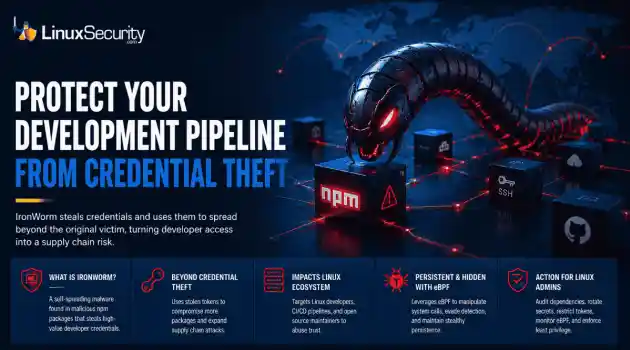
malware linux IronWorm steals credentials and uses them to spread beyond the original victim, turning developer access into a supply chain risk. . A new campaign targeting npm has evolved past simple credential theft. Researchers identified IronWorm, a self-spreading threat. It harvests high-value Linux development secrets—SSH keys, cloud tokens, package publishing credentials. One compromised workstation becomes a launchpad for downstream supply chain attacks. This is not a get-in-and-get-out operation....
 Jun 08, 2026

Network Securitysystem security Linux network
system security Linux network The romanticized image of the digital nomad – a laptop on a sun-drenched balcony – rarely accounts for the actual friction of maintaining a professional development environment on the move. . The friction is amplified with Linux. We are looking for a setup that respects our kernel configurations, handles volatile network handovers, and maintains a strict security posture without the hand-holding of a consumer-grade OS – so, put simply, more than just a laptop and a sunny deck. The hardware is...
May 26, 2026

Server Securityopen-source Linux administration
open-source Linux administration Cron has existed in Unix and Linux environments for decades, handling backups, cleanup scripts, patching jobs, log rotation, monitoring tasks, and other maintenance work that administrators do not want to run manually. Most Linux servers rely on it constantly, which is exactly why attackers continue abusing it for persistence after a system has already been compromised. . Persistence through cron is not complicated. Attackers do not need a rootkit or advanced malware framework to maintain...
May 25, 2026

Vendors/Productssecurity breach linux
security breach linux A major internal repository breach at GitHub has exposed a critical and overlooked blind spot in Linux supply chain security. Kernel exploits, exposed SSH services, weak firewall rules, and vulnerable daemons dominated the Linux threat model for years, and in many environments, they still matter. But recent supply-chain incidents involving GitHub ecosystems, npm packages, and malicious developer tooling point somewhere else entirely: the developer workstation. . The breach matters because...
May 21, 2026

Security Trends access control multi-tenant
access control multi-tenant Linux administrators often face an ugly choice in the cloud: prioritize convenience and cost-efficiency by sharing infrastructure, or sacrifice those benefits for the sake of total isolation. Most modern Linux workloads don't live on their own private servers anymore. They live in shared environments like Kubernetes clusters, where multiple teams and services run side-by-side. It sounds efficient, and it usually is. . But cloud isolation isn't as ironclad as it looks on the diagram. If you...
May 21, 2026
 Refine news
X Clear Filters
Get the latest News and Insights
Get the latest Linux and open source security news straight to your inbox.
Community Poll
What got you started with Linux?
Loading...
Explore Latest Linux Security news
We found -2 articles for you...
82
 internet securitymilitary communicationanonymous access
DARPA SAFER Program: Secure Access For Military Communications
Internet security experts at the U.S. Defense Advanced Research Projects Agency (DARPA) in Arlington, Va., are asking industry to develop ways to guarantee the military safe and anonymous access to the Internet amid hostile attempts to disrupt government cyber communications. . DARPA released a broad agency announcement Thursday (DARPA-BAA-10-69) for the Safer Warfighter Communications (SAFER) program to develop technology that gives the military services safe, resilient Internet communications -- particularly to frustrate third-party attempts to identify and locate end users or block Internet communications. DARPA wants industry to develop technology that also provides the quality of service to enable the government to use Internet services like instant messaging, e-mail, social networking, streaming video, voice over Internet protocol (VoIP), and video conferencing. The four-year SAFER program concerns any technologies that enable anonymous Internet communications to bypass techniques that suppress, localize, and/or corrupt information such as: Internet protocol (IP)-address filtering or "blocking," typically by blacklisting the IP addresses of Websites or other services -- possibly by the network operator -- to deny the user access; domain naming service (DNS) hijacking, redirecting a user to a different website or service from what the user intended, by supplying a false reply to the user's domain name resolution request; and content filtering that captures and analyzes the content of the user's network traffic through deep packet inspection to check whether the traffic contains predefined signatures or sensitive keywords. The DARPA SAFER program involves three technical areas of interest: ways to measure and evaluate the system; tools to overcome the suppression, localization, and corruption of Internet communications; and support to host the developed technology, provide configuration management, and use an existing server-side network test bed. Companies interested should respond to DARPA by 6 July 2010, and the solicitation's final closing is 24 Nov. 2010. DARPA's program manager for the SAFER initiative is Drew Dean, who can be reached by e-mail at
 May 22, 2010
•
May 22, 2010
• Government
82
military communicationpsychological operationselectronic warfareDOD Enhances Psychological Warfare Against Iraqi Military Leaders
The Defense Department is continuing, and perhaps has stepped up, its electronic psychological operations campaign directed at the upper echelons of the Iraqi military now that hostilities have begun. . .. The Defense Department is continuing, and perhaps has stepped up, its electronic psychological operations campaign directed at the upper echelons of the Iraqi military now that hostilities have begun . In a press conference March 20, Defense Secretary Donald Rumsfeld said that DOD officials are "in communication with still more people who are officials of the [Iraqi] military at various levels," warning them of the outcome of their actions should they take up arms against U.S. or allied forces. Defense officials confirmed in January that they had been sending e-mail messages to Iraqi military officials as part of a psychological operations campaign. For decades, military forces have dropped leaflets on enemy soldiers in an attempt to persuade them to surrender before engaging in combat. The new e-mail campaign, according to experts, is a technological extension of that. The link for this article located at FCW is no longer available. . The Defense Department is continuing, and perhaps has stepped up, its electronic psychological opera. defense, department, continuing, perhaps, stepped, electronic, psychological, opera. . Anthony Pell
Mar 24, 2003
•
Government

82
encryptionauthenticationwireless securityMilitary Pushes For Stronger Wireless Security In Communications
Military leaders agree that wireless communication is the wave of the future, but they also agree that it needs far greater security features to become deployable and reliable on the battlefield. . .. Military leaders agree that wireless communication is the wave of the future, but they also agree that it needs far greater security features to become deployable and reliable on the battlefield . Air Force Maj. Gen. John Bradley, deputy commander of U.S. Strategic Command's joint task force for computer network operations, said the Defense Department not only needs more secure wireless tools, it also needs them to be smaller with solid encryption and authentication features. The joint task force, created about 18 months ago, is responsible for defending DOD networks from attack, according to Bradley, who was speaking during a Nov. 19 panel at the AFCEA International's TechNet Asia-Pacific International 2002 Conference and Exposition in Honolulu. The link for this article located at FCW is no longer available. . Military leaders agree that wireless communication is the wave of the future, but they also agree th. agree, military, leaders, wireless, communication, future. . Anthony Pell
Nov 21, 2002
•
Government

Get the latest News and Insights
Get the latest Linux and open source security news straight to your inbox.
Community Poll
What got you started with Linux?
Search Topics
Powered By

Linux Security - Your source for Top Linux News, Advisories, HOWTOs and Feature Releases
QUICK LINKS
subscribe to newsletters!
Like staying secure? So do we.
Sign up for updates, tips, and alerts!
Discover faster search, smarter navigation, and deeper Linux security insights. Read More