


Security Vulnerabilities  malware linux
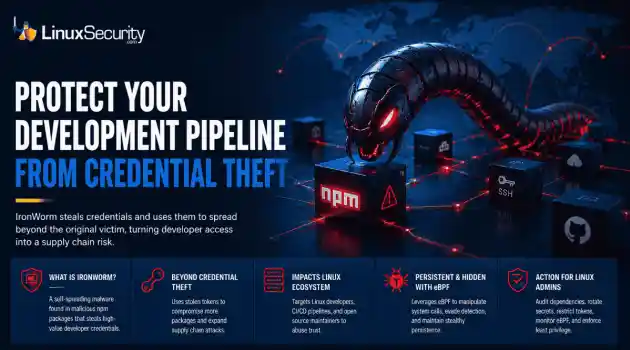
malware linux IronWorm steals credentials and uses them to spread beyond the original victim, turning developer access into a supply chain risk. . A new campaign targeting npm has evolved past simple credential theft. Researchers identified IronWorm, a self-spreading threat. It harvests high-value Linux development secrets—SSH keys, cloud tokens, package publishing credentials. One compromised workstation becomes a launchpad for downstream supply chain attacks. This is not a get-in-and-get-out operation....
 Jun 08, 2026

Network Securitysystem security Linux network
system security Linux network The romanticized image of the digital nomad – a laptop on a sun-drenched balcony – rarely accounts for the actual friction of maintaining a professional development environment on the move. . The friction is amplified with Linux. We are looking for a setup that respects our kernel configurations, handles volatile network handovers, and maintains a strict security posture without the hand-holding of a consumer-grade OS – so, put simply, more than just a laptop and a sunny deck. The hardware is...
May 26, 2026

Server Securityopen-source Linux administration
open-source Linux administration Cron has existed in Unix and Linux environments for decades, handling backups, cleanup scripts, patching jobs, log rotation, monitoring tasks, and other maintenance work that administrators do not want to run manually. Most Linux servers rely on it constantly, which is exactly why attackers continue abusing it for persistence after a system has already been compromised. . Persistence through cron is not complicated. Attackers do not need a rootkit or advanced malware framework to maintain...
May 25, 2026

Vendors/Productssecurity breach linux
security breach linux A major internal repository breach at GitHub has exposed a critical and overlooked blind spot in Linux supply chain security. Kernel exploits, exposed SSH services, weak firewall rules, and vulnerable daemons dominated the Linux threat model for years, and in many environments, they still matter. But recent supply-chain incidents involving GitHub ecosystems, npm packages, and malicious developer tooling point somewhere else entirely: the developer workstation. . The breach matters because...
May 21, 2026

Security Trends access control multi-tenant
access control multi-tenant Linux administrators often face an ugly choice in the cloud: prioritize convenience and cost-efficiency by sharing infrastructure, or sacrifice those benefits for the sake of total isolation. Most modern Linux workloads don't live on their own private servers anymore. They live in shared environments like Kubernetes clusters, where multiple teams and services run side-by-side. It sounds efficient, and it usually is. . But cloud isolation isn't as ironclad as it looks on the diagram. If you...
May 21, 2026
 Refine news
X Clear Filters
Get the latest News and Insights
Get the latest Linux and open source security news straight to your inbox.
Community Poll
What got you started with Linux?
Loading...
Explore Latest Linux Security news
We found -2 articles for you...
82
 network securityautomated attacksinformation assurance
U.S. Army Cyber Incident Response: Follow-Up Actions After Cyberwar
Shortly after a military surveillance plane collided with a Chinese fighter last April, a two-week ÒcyberwarÓ began, and U.S. Army Web sites took numerous hits. More than 50 Web pages were defaced by an automated attack launched by supporters or agents of the PeopleÕs Republic of China. The hackers placed anti-American sentiments in English and Chinese characters on some of the sites. . . .. Shortly after a military surveillance plane collided with a Chinese fighter last April, a two-week ÒcyberwarÓ began, and U.S. Army Web sites took numerous hits. More than 50 Web pages were defaced by an automated attack launched by supporters or agents of the PeopleÕs Republic of China. The hackers placed anti-American sentiments in English and Chinese characters on some of the sites. But most of the attacks could have been prevented if published fixes, identified in Information Assurance Vulnerability Alerts, were in place on the hacked machines, said Lt. Col. John Quigg, chief of the ArmyÕs network security improvement program in the serviceÕs chief information office. An IAVA is a digital list of computer vulnerabilities. They are reported monthly to the chairman of the Joint Chiefs of Staff, Quigg said. The alerts are also posted on Army networks and warn of basic security measures needed to ward off viruses, worms or hackers. The link for this article located at ComputerUser is no longer available. . Shortly after a military surveillance plane collided with a Chinese fighter last April, a two-week . shortly, military, surveillance, plane, collided, chinese, fighter, april, two-week. . Anthony Pell
 May 14, 2002
•
May 14, 2002
• Government
82
cyber defensecomputer attacksinformation warfareU.S. Military Cyber Defense and Emerging Offensive Tactics
Today, they defend the U.S. military's 2.5 million computers against hackers. But they are being trained to guard against computer attacks by other countries and to launch computer virus invasions that will bring chaos to a foe's communications networks, financial systems . . . . Today, they defend the U.S. military's 2.5 million computers against hackers. But they are being trained to guard against computer attacks by other countries and to launch computer virus invasions that will bring chaos to a foe's communications networks, financial systems and power grids. Military analysts say the United States is one of more than 20 countries girding for this new kind of conflict, known within the Defense Department as "IW" for information warfare. Last fall, the Pentagon disclosed that the U.S. Space Command is building offensive computer weapons to use against adversaries. Until then, the Pentagon had focused on defensive measures to protect U.S. military computers, satellites and communications links. The link for this article located at USA Today is no longer available. . Today, they defend the U.S. military's 2.5 million computers against hackers. But they are being tra. today, defend, military's, million, computers, against, hackers, being. . Anthony Pell
Jun 21, 2001
•
Government

82
cyber defensegovernment recruitmenthacker collaborationDefense Officials Urge Hackers To Join Cybersecurity Efforts
The largest-ever convention of computer hackers opened here on Friday with top-ranking U.S. military officials offering to hire the elite of the cybervandal world and put them to work defending against foreign government attacks. "I invite you to join the government, . . . . The largest-ever convention of computer hackers opened here on Friday with top-ranking U.S. military officials offering to hire the elite of the cybervandal world and put them to work defending against foreign government attacks. "I invite you to join the government, or private industry for that matter. But get on the defense side," Art Money, U.S. Assistant Secretary of Defense, and the Pentagon's Chief Information Officer with responsibility for command, control, communications and intelligence." The link for this article located at FoxNews is no longer available. . The largest-ever convention of computer hackers opened here on Friday with top-ranking U.S. military. largest-ever, convention, computer, hackers, opened, friday, top-ranking, military. . Anthony Pell
Aug 01, 2000
•
Government

Get the latest News and Insights
Get the latest Linux and open source security news straight to your inbox.
Community Poll
What got you started with Linux?
Search Topics
Powered By

Linux Security - Your source for Top Linux News, Advisories, HOWTOs and Feature Releases
QUICK LINKS
subscribe to newsletters!
Like staying secure? So do we.
Sign up for updates, tips, and alerts!
Discover faster search, smarter navigation, and deeper Linux security insights. Read More