


Security Vulnerabilities  malware linux
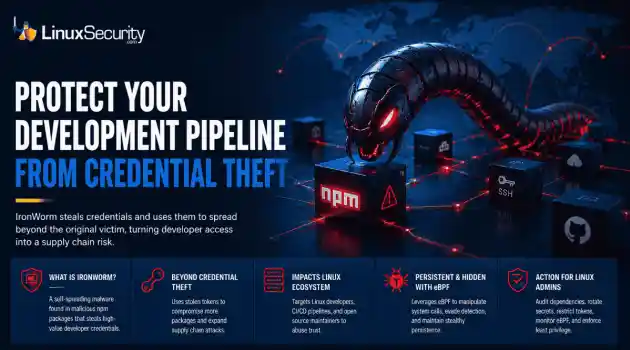
malware linux IronWorm steals credentials and uses them to spread beyond the original victim, turning developer access into a supply chain risk. . A new campaign targeting npm has evolved past simple credential theft. Researchers identified IronWorm, a self-spreading threat. It harvests high-value Linux development secrets—SSH keys, cloud tokens, package publishing credentials. One compromised workstation becomes a launchpad for downstream supply chain attacks. This is not a get-in-and-get-out operation....
 Jun 08, 2026

Network Securitysystem security Linux network
system security Linux network The romanticized image of the digital nomad – a laptop on a sun-drenched balcony – rarely accounts for the actual friction of maintaining a professional development environment on the move. . The friction is amplified with Linux. We are looking for a setup that respects our kernel configurations, handles volatile network handovers, and maintains a strict security posture without the hand-holding of a consumer-grade OS – so, put simply, more than just a laptop and a sunny deck. The hardware is...
May 26, 2026

Server Securityopen-source Linux administration
open-source Linux administration Cron has existed in Unix and Linux environments for decades, handling backups, cleanup scripts, patching jobs, log rotation, monitoring tasks, and other maintenance work that administrators do not want to run manually. Most Linux servers rely on it constantly, which is exactly why attackers continue abusing it for persistence after a system has already been compromised. . Persistence through cron is not complicated. Attackers do not need a rootkit or advanced malware framework to maintain...
May 25, 2026

Vendors/Productssecurity breach linux
security breach linux A major internal repository breach at GitHub has exposed a critical and overlooked blind spot in Linux supply chain security. Kernel exploits, exposed SSH services, weak firewall rules, and vulnerable daemons dominated the Linux threat model for years, and in many environments, they still matter. But recent supply-chain incidents involving GitHub ecosystems, npm packages, and malicious developer tooling point somewhere else entirely: the developer workstation. . The breach matters because...
May 21, 2026

Security Trends access control multi-tenant
access control multi-tenant Linux administrators often face an ugly choice in the cloud: prioritize convenience and cost-efficiency by sharing infrastructure, or sacrifice those benefits for the sake of total isolation. Most modern Linux workloads don't live on their own private servers anymore. They live in shared environments like Kubernetes clusters, where multiple teams and services run side-by-side. It sounds efficient, and it usually is. . But cloud isolation isn't as ironclad as it looks on the diagram. If you...
May 21, 2026
 Refine news
X Clear Filters
Get the latest News and Insights
Get the latest Linux and open source security news straight to your inbox.
Community Poll
What got you started with Linux?
Loading...
Explore Latest Linux Security news
We found -1 articles for you...
82
 threat assessmentcyberattackinformation warfare
Investigating How Cyberattacks Influence Contemporary Warfare Dynamics
Imagine Saddam Hussein sitting in one of his palaces, tapping on his laptop, maybe shopping at Uranium Online. Which actually exists, by the way. Tag line: "The nuclear fuel e-commerce solution." . . .. Imagine Saddam Hussein sitting in one of his palaces, tapping on his laptop, maybe shopping at Uranium Online. Which actually exists, by the way. Tag line: "The nuclear fuel e-commerce solution." All of a sudden, Saddam's computer explodes with e-mail. It's all spam, made in America -- thousands of offers. Consolidate your debt. Earn money working at home. Enlarge your breasts. It would be like Internet carpet bombing. He'd surrender within days. In reality, the U.S. military is developing cyberwarfare weapons. Details of the program are top secret. OK, it probably doesn't involve unleashing spammers on Iraq, but you never know. The link for this article located at USA Today is no longer available. . Imagine Saddam Hussein sitting in one of his palaces, tapping on his laptop, maybe shopping at Urani. imagine, saddam, hussein, sitting, palaces, tapping, laptop, maybe, shopping, urani. . Anthony Pell
 Feb 12, 2003
•
Feb 12, 2003
• Government
82
cyber defenseinformation warfaremilitary strategyThe Information Age Revolutionizing Military Strategies and Tactics
Just as World War I introduced new weaponry and modern combat to the twentieth century, the information age is now revolutionizing warfare for the twenty-first. Around the world, information technology increasingly pervades weapons systems, defense infrastructures, and national economies. As a . . . . Just as World War I introduced new weaponry and modern combat to the twentieth century, the information age is now revolutionizing warfare for the twenty-first. Around the world, information technology increasingly pervades weapons systems, defense infrastructures, and national economies. As a result, cyberspace has become a new international battlefield. Whereas military victories used to be won through physical confrontations of weapons and soldiers, the information warfare being waged today involves computer sabotage by hackers acting on behalf of private interests or governments. The recent escalation of tension between Israel and the Palestinians, for example, has had a prominent virtual dimension. From October 2000 to January 2001, attacks by both sides took down more than 250 Web sites, and the aggressions spread well beyond the boundaries of the Middle East to the computer networks of foreign companies and groups seen as partisan to the conflict. A decade after the end of the Cold War, the U.S. military stands as an uncontested superpower in both conventional and nuclear force. Ironically, its overwhelming military superiority and its leading edge in information technology have also made the United States the country most vulnerable to cyber-attack. Other nations know that they have fallen behind in military muscle, so they have begun to look to other methods for bolstering their war-fighting and defense capacities -- namely, "asymmetrical warfare," which the Pentagon characterizes as "countering an adversary's strengths by focusing on its weaknesses." The link for this article located at Lexis-Nexis is no longer available. . Explore how the rise of information technologies is reshaping militarystrategies and how cyber operations become the contemporary battlefield.. Information Warfare, Military Strategy, Cyber Tactics, Defense Systems. . Anthony Pell
May 02, 2001
•
Government

82
cyber attacknational defensecyber warfareU.S. Military Prepares For Cyber Attacks On Potential Adversaries
The U.S. military has a new mission: Be ready to launch a cyberattack against potential adversaries, some of whom are stockpiling cyberweapons. Such an attack would likely involve launching massive distributed denial-of-service assaults, unleashing crippling computer viruses or Trojans, and . . . . The U.S. military has a new mission: Be ready to launch a cyberattack against potential adversaries, some of whom are stockpiling cyberweapons. Such an attack would likely involve launching massive distributed denial-of-service assaults, unleashing crippling computer viruses or Trojans, and jamming the enemy's computer systems through electronic radio-frequency interference. An order from the National Command Authority - backed by President Clinton and Secretary of Defense William Cohen - recently instructed the military to gear up to wage cyberwar. The ability of the U.S. to conduct such warfare "doesn't exist today," according to a top Army official speaking at a conference in Arlington, Va., last week. "We see three emerging threats: ballistic missiles, cyberwarfare and space control," said Lt. Gen. Edward Anderson, deputy commander in chief at U.S. Space Command, which was recently assigned the task of creating a cyberattack strategy. "Cyberwarfare is what we might think of as attacks against digital ones and zeros." The link for this article located at CNN is no longer available. . The military's latest guideline emphasizes readiness against digital assaults from possible foes, amplifying the landscape of cyber combat.. Cyber Warfare, Military Strategy, Cyber Attack, Electronic Assault. . Anthony Pell
Nov 25, 2000
•
Government
82
national securitycybersecurity tacticscyber warfareUS Plans Cyber Warfare Tactics For Military Superiority
The US is planning to turn the internet into a battleground. Air Force Lieutenant General Michael Hayden, head of the super-secret National Security Agency (NSA), said that cyberspace had become an important strategic target. . The US is planning to turn the internet into a battleground. Air Force Lieutenant General Michael Hayden, head of the super-secret National Security Agency (NSA), said that cyberspace had become an important strategic target. The link for this article located at vnunet.com is no longer available. . The United States intends to reshape the digital realm into a theater of warfare, highlighting its tactical significance for military operations.. Cyber Warfare, Military Strategy, National Security Threats. . Anthony Pell
Oct 25, 2000
•
Government

Get the latest News and Insights
Get the latest Linux and open source security news straight to your inbox.
Community Poll
What got you started with Linux?
Search Topics
Powered By

Linux Security - Your source for Top Linux News, Advisories, HOWTOs and Feature Releases
QUICK LINKS
subscribe to newsletters!
Like staying secure? So do we.
Sign up for updates, tips, and alerts!
Discover faster search, smarter navigation, and deeper Linux security insights. Read More