Explore top 10 tips to secure your open-source projects now. Read More
×



Server Security data privacy automation
data privacy automation Every system admin has lived through the same Monday morning ritual. A queue of forty tickets, half of them password resets, permission errors, or disk space warnings that any experienced technician could resolve in under two minutes. The other half require actual judgment. For years, automation promised that software would eventually sort the two apart on its own. That promise is now being tested in production Linux environments. . Early results are reshaping how IT teams think about tier-1...
 Jul 17, 2026

Privacydata collection automation
data collection automation You're running a web scraping project to collect pricing data from e-commerce sites. You set up a pool of datacenter proxies, launch your scripts, and within minutes — banned . CAPTCHAs everywhere. Your data pipeline stops before it really begins. . It's a frustrating scenario that plays out daily in ad verification, market research, and multi-account management. The website doesn't know you're doing legitimate research or monitoring. It just sees traffic coming from IP ranges it recognizes as...
Jul 17, 2026

Security Trends security advisory social engineering
security advisory social engineering Business Email Compromise used to be a numbers game — mass-blasted emails, broken English, an obvious "URGENT WIRE TRANSFER" subject line. That era is over. Generative AI has turned BEC into a tailored, low-noise operation that mimics writing style, voice, and even video presence. This piece looks at what's actually changed under the hood, what defenders are testing in response, and why so many organizations are still structurally unprepared for it. . The Infrastructure Problem Nobody Wants to...
Jul 17, 2026

Security Trends cybersecurity Linux documentation
cybersecurity Linux documentation Linux operating systems have gained prominence due to their stability, adaptability, and excellent security options. In the case of developing documentation, designing cybersecurity dashboards, or educational material, visuals are of vital importance when it comes to making things clear. The use of icons allows one to understand the message regarding alerts, authorization, encryption, authentication, or the state of the system just by looking at the visual cue without having to read long...
Jul 17, 2026
Security Vulnerabilities security advisory linux distribution
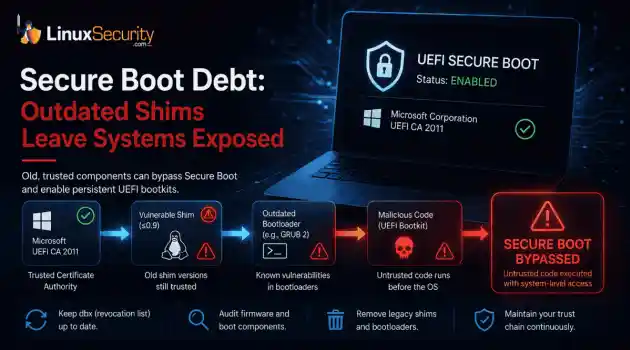
security advisory linux distribution ESET researchers identified 11 old and forgotten Linux UEFI shim bootloaders at versions 0.9 and below that can be used to bypass UEFI Secure Boot on any UEFI-based machine that trusts Microsoft’s Microsoft Corporation UEFI CA 2011 third-party certificate authority, regardless of the installed operating system (OS). Reported shims can be exploited to execute untrusted code during system boot, enabling attackers to deploy malicious UEFI bootkits even on systems with UEFI Secure Boot enabled.....
Jul 16, 2026
 Refine news
X Clear Filters
Get the latest News and Insights
Get the latest Linux and open source security news straight to your inbox.
Community Poll
Is continuous patching actually viable?
Trending News
Loading...
Explore Latest Linux Security news
We found 68 articles for you...
209
 security updatemobile securityoffensive security
What Kali Linux 2026.2 Says About Today's Linux Security Priorities
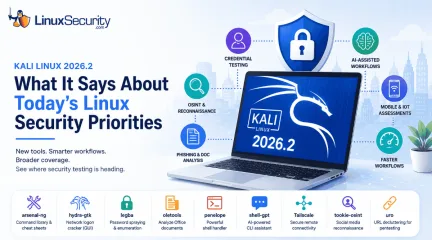
Offensive Security just dropped Kali Linux 2026.2 , and at first glance, it looks like a standard quarterly refresh. You’ve got the usual kernel bumps, desktop environment updates, and a handful of new utilities. But don't write this off as just another routine version update. If you look past the changelog, this release highlights several capabilities that continue to be important in offensive security. From AI-assisted workflows to credential testing and mobile assessments, Kali Linux 2026.2 reflects the techniques many security professionals are incorporating into modern Linux security testing. For Linux administrators and defenders, understanding what tools are being added to Kali can be just as valuable as using them; they reflect the techniques security teams—and attackers—consider most relevant for evaluating modern Linux environments. . Why Kali Releases Matter Even If You Don't Use Kali Most enterprise Linux systems will never run Kali Linux, but administrators still benefit from following its development. New tools often reflect the techniques penetration testers are actively using during real-world assessments. Reviewing each release helps defenders identify emerging testing priorities and evaluate whether their own monitoring, authentication controls, and hardening practices address those attack paths. What's New in Kali Linux 2026.2 The headline for 2026.2 is the inclusion of nine new security tools, but the platform improvements are what really move the needle for daily operations. The distribution is now running on the Linux kernel 6.19, with the desktop experience receiving a facelift through GNOME 50 and KDE Plasma 6.6. Tool Primary Purpose arsenal-ng Cybersecurity command reference and cheat sheets hydra-gtk GUI for Hydra credential testing legba Password spraying and authentication testing oletools Analyze Microsoft Office documents andmacros penelope Shell handler for post-exploitation shell-gpt AI-assisted command generation Tailscale Secure remote connectivity tookie-osint Social media reconnaissance uro URL normalization for web testing Taken together, the new tools cover credential auditing, OSINT, phishing analysis, AI-assisted workflows, remote connectivity, and shell management. They reinforce a broader reality: modern security assessments rarely focus on a single system. Today's engagements often combine identity testing, cloud infrastructure, web applications, mobile devices, and social engineering into a single assessment. Beyond the aesthetics, the team focused on friction reduction. VM deployments are significantly faster this time around, thanks to the removal of graphics firmware from pre-built images, and there’s a marked improvement in NetHunter’s stability. For those running security assessments in virtualized labs, these workflow optimizations save real time when you're spinning up or tearing down testing environments. Another notable addition is Tailscale, which gives security teams a straightforward way to create encrypted connections between testing systems. For organizations with distributed labs or remote team members, it can simplify access to assessment environments without exposing them directly to the internet. Credential Attacks Continue to Be a Priority Among the new tools are additions focused on credential testing, including legba and the re-added hydra-gtk . Their inclusion reflects how identity-based attacks—including password spraying, credential reuse, and authentication testing—continue to play a central role in modern security assessments. If an administrator uses the same password for a local Linux server and a corporate SSO account, that’s an open door. These tools act as a wake-up call: if you aren't enforcing MFA, disabling legacyauthentication, and proactively monitoring for password-spraying attempts, your infrastructure is likely the low-hanging fruit in a credential-stuffing campaign. AI Is Becoming Part of Everyday Security Operations The inclusion of shell-gpt might trigger a knee-jerk reaction about AI replacing security pros, but that’s missing the point. Tools like shell-gpt illustrate how AI is beginning to reduce repetitive command-line work. Rather than replacing expertise, they help security professionals generate commands, reference syntax, and automate routine tasks more efficiently. Offensive security is notoriously repetitive. Whether it's drafting boilerplate command syntax or normalizing log output, the friction of manual scripting slows down an assessment. These tools reduce repetitive command-line work and make common workflows easier to reproduce, allowing analysts to spend more time interpreting results than writing boilerplate commands. Mobile Devices Are Now Part of Enterprise Security Assessments The latest NetHunter improvements highlight a shift in scope. Many organizations that rely on Linux servers also manage Android devices, embedded Linux systems, and IoT endpoints. Expanding NetHunter reflects the reality that enterprise security assessments increasingly extend beyond traditional servers. Strong Linux server hardening is only one part of the equation. If attackers can gain network access through an insecure Android device or wireless infrastructure, they may still be able to pivot toward Linux systems. Kali 2026.2 provides the tools to assess these wireless "flanks" of the enterprise, ensuring that mobile and IoT devices are part of your broader security program. Security Testing Is Becoming Faster There’s a clear emphasis on speed in 2026.2, from the faster VM boot times to the smaller initrd. When you're building disposable lab environments, validating detections, or conducting repeated penetration tests, time is your most limited resource. Faster deployments meanassessments can happen more frequently, which makes security validation a natural part of daily operations rather than a painful, quarterly event. By removing unnecessary graphics firmware from pre-built virtual machine images, Kali reduces boot times for many VM-based testing environments while leaving bare-metal installations unchanged. Office Documents Still Matter in Linux Environments Kali 2026.2 also highlights the ongoing relevance of oletools . While Linux endpoints are less commonly associated with Office malware than Windows systems, Linux administrators frequently investigate phishing campaigns, analyze suspicious attachments, and protect mixed-platform environments. Tools like oletools help incident responders inspect Office documents for embedded macros and other malicious content before those files reach users or move deeper into an organization. What Linux Administrators Should Take Away From the Release One of the most useful aspects of following Kali releases isn't deciding whether to upgrade immediately. It's understanding where offensive security is investing its attention. The tools that enter Kali often mirror the techniques organizations are increasingly testing during security assessments, giving defenders an opportunity to evaluate whether their own controls keep pace. Use this table as a checklist for your own hardening efforts: Area Question to Ask Authentication Could your SSH service withstand password spraying? AI Workflows Have you established guidelines for using AI tools without exposing sensitive commands or data? Email Security Are Office documents scanned for malicious content before users open them? OSINT Is unnecessary organizational information publicly exposed? Mobile Security Are Android and IoT devices included in security assessments? Detection Can your monitoringidentify credential attacks and suspicious shell activity regardless of the specific tool used? Conclusion Kali Linux 2026.2 is more than a collection of new packages and version upgrades. Its newest tools and platform improvements reflect the techniques security professionals are using to evaluate modern Linux environments. Whether your organization performs formal penetration tests or simply wants to strengthen its defenses, the release highlights where security testing is placing increasing emphasis: identity, automation, mobile devices, and operational efficiency. Pay attention to the techniques these tools are designed to test; they reflect the attack paths that penetration testers evaluate today and the behaviors defenders should be prepared to detect. Want more Linux security news, vulnerability analysis, and software supply chain updates? Subscribe to the LinuxSecurity Newsletter and get the latest threats, advisories, and expert insights delivered directly to your inbox. . Kali Linux 2026.2 showcases new capabilities in offensive security, highlighting tools for credential testing, AI, and mobile assessments.. Linux Security Tools,Kali Linux 2026.2,Cybersecurity Tools,Credential Testing Techniques,AI in Security. . MaK Ulac
 Jun 30, 2026
•
Jun 30, 2026
• Security Trends
78
 system performancemobile securitypentesting
Kali Linux 2025.2: New Tools and Features for Effective Pentesting
The latest iteration of Kali Linux is here, and while it won’t shout for attention, it will make you lean in. Kali 2025.2 quietly reinforces its position as a trusted framework, delivering new tools, expanded device support, and strategies that aren’t just functional—they’re pragmatic. . If your daily grind involves pentesting , forensics, or platform customization, this release is calibrated to meet those needs without making your setup feel like an exercise in dexterity. Let’s parse through what’s new, what’s better, and what just makes sense. CARsenal: Car Hacking for the Present Forget about fumbling with tools that feel built for a prior decade. The rebranded CARsenal (formerly CAN Arsenal) has shifted gears—pun unintended—to integrate vehicle penetration testing and digital forensics into one cohesive experience. Refined UI: The interface genuinely gets out of the way. You don’t need to spend extra time deciphering navigation; more time is spent on tasks that actually matter—like interaction testing or forensic log extraction in modern vehicles. New Features That Expand Possibilities: The lineup includes hlcand , a modified slcand tailored for seamless ELM327 compatibility. If VIN decoding was previously hit-and-miss, the aptly named VIN Info makes it consistent and reliable. Not to be outdone, CaringCaribou packs practical modules—Dump, UDS simulation, and XCP communication—that forego flashiness for raw capability. Pentesters frequently find themselves constrained when attempting vehicle exploits without full VCAN setups. Here, ICSim steps in to emulate those environments, eliminating dependency on physical hardware during initial testing stages. On the technical front, kernel support for CAN-enabled devices expands meaningfully, empowering devices like Realme C15 and Redmi Note 11 with A10/A15 compatibility, alongside updates for flagship Samsung kernels. Combine all this, and you’re looking at a toolkit that doesn’t just playwell with the hardware—it actively reduces dependency on specialized infrastructure. How Has Kali NetHunter Expanded Its Reach in Kali Linux 2025.2? Kali NetHunter isn’t merely an add-on anymore—it’s a cornerstone for mobile penetration testing, and the updates this time around reflect its evolution toward universal applicability. New device inclusions like the Xiaomi Redmi Note 11 (A15) and Redmi 4/4X (A13) catch immediate attention, but it’s the deeper kernel development that steals the spotlight. The expansion to devices like Realme C15 (A10) and Samsung Galaxy S10 is boosted by meticulous upgrades to kernel handling across the board, ensuring not only compatibility but efficient utilization of system resources during tooling. What really piques my curiosity here is the teaser: Kali NetHunter KeX running on Android Radio. It’s one of those changes that feels less like an incremental step and more like a quiet preview of where the ecosystem is headed—potentially full-on Android Auto support. You can bet this will open new avenues for security testing, particularly in cars leaning heavily into connected systems. It hasn’t been officially rolled out yet, but researchers should start paying attention. ARM Improvements That Don’t Waste Your Time Let’s be clear: working with single-board computers (SBCs) in a professional capacity is a niche, but it’s hardly trivial. Kali Linux understands this, and rather than bloating the ARM experience, it sharpens the tools. Raspberry Pi consolidation should be a relief for most. Pi 5 now rides with a unified 64-bit image—no more hunting for that “specific kernel tweak buried in forums somewhere.” Its shiny 6.12-based kernel brings smoother overall performance and broader compatibility across widely adopted ARM peripherals. USB Armory MKII? Well, this one quietly shines. Kernel upgrades, bootloader refinements (2025.04), and PowerShell hitting 7.5.1 deliver measurable improvements to scripting workflows and systemhandling for heavier pentesting tasks. If your ARM use case involves lightweight forensics or operating on constrained environments, this matters. These upgrades aren't loud—they're effective. Support Systems That Actually Support There's an understated quality to Kali Documentation updates this time. It doesn’t reinvent the wheel; it just makes the wheel smarter. The addition of step-by-step solutions for PostgreSQL collation mismatches and USB persistence setups aren’t “nice-to-haves” for many—they’re critical. Equally important are the expanded install guides for NetHunter deployments on atypical devices like Xiaomi Mi A3 and OnePlus 5T, which remove ambiguity from inherently finicky processes. We’ve also got new global mirrors making downloads less of a traffic battle. India’s Albony Network and South Korea's QuietSky initiative show that Kali’s footprint isn’t just about practical network redundancy—it’s growing collaboratively. South Korea backing this with localized translations only makes this narrative stronger. Subtle Fixes and Under-the-Radar Enhancements Quality-of-life upgrades often don’t get the spotlight—but here’s where they matter: updated build scripts now deliver reliable custom images, reducing failure rates. The 6.12.25 kernel isn’t a leap; it’s just better at avoiding edge-case frustrations. And powering through ARM architecture tasks? PowerShell 7.5.1 works exactly as expected. These updates don’t scream excitement—they remove headaches, which is just honest progress. Our Final Thoughts: A Release That Understands You Kali Linux keeps evolving—not drastically, but intelligently. Version 2025.2 moves the ecosystem forward without forcing unnecessary changes, instead honing familiar tools and frameworks for better deployment across mobile, automotive, and ARM operations. For Linux admins and security professionals who measure tools by practicality rather than novelty, this release is worth exploring. It doesn’t demandattention—it earns it. How you apply it depends on your domain, but everything on offer here feels like it was curated for professionals who know what they’re doing—and those who always keep one eye on what’s next. Ready to give it a try? You can find instructions on installing or updating to Kali Linux 2025.2 on the official website. We'd love to hear what you think! Connect with us on X @lnxsec and share your review. . Kali Linux 2025.2 enhances pentesting and forensics with new tools and improved device support for effective cybersecurity.. latest, iteration, linux, while, won’t, shout, attention. . Brittany Day
Jun 16, 2025
•
Vendors/Products

209
 cyber defensemobile securityremote work
Mobile Security Threats from APT Groups in Remote Work Environment
State-backed APT groups are increasingly targeting mobile devices in this new remote work environment. This article explores how the industry is fighting back. . The cyber defence industry is finally turning its attentions toward mobile devices as Covid-19 shines a light on remote working trends and strains . Unfortunately, they’re already 10 years behind the world’s most elite Advanced Persistent Threat (APT) contingent. While this period of lockdown, working from home, and siloed digital infrastructures have undoubtedly caught the eye of the most sophisticated – often state-run – hacking operations, it would be a mistake to think that such a focus is only just taking off. . The digital security sector is prioritizing the protection of handheld devices amid increasing risks from government-sponsored APT factions in flexible work environments.. Mobile Device Security, Cyber Defense Industry, APT Threats, Remote Work Threats. . Brittany Day
Jun 24, 2020
•
Security Trends
81
 security researchmobile securityanonymous browsing
SecTor: Major Privacy Threat from Tor in Millions of Mobile Devices
There is a privacy threat lurking on perhaps hundreds of millions of devices, that could enable potential attackers to track and profile users, by using information leaked via the Tor network, even if the users never intentionally installed Tor in the first place. Learn more in an informative article: . In a session at the SecTor security conference in Toronto, Canada on October 10, researchers Adam Podgorski and Milind Bhargava fromDeloitte Canadaoutlined and demonstrated previously undisclosed research into how they were able to determine that personally identifiable information (PII) is being leaked by millions of mobile users every day over Tor. The irony of the issue is that Tor is a technology and a network that is intended to help provide and enable anonymity for users. With Tor, traffic travels through a number of different network hops to an eventual exit point in the hope of masking where the traffic originated from. Podgorski said that there are some users that choose to install a Tor browser on their mobile devices, but that’s not the problem. The problem is that Tor is being installed by mobile applications without user knowledge and potentially putting users at risk. The link for this article located at InfoSecurity is no longer available. . In a session at theSecTorsecurity conference in Toronto, Canada on October 10, researchers Adam Podg. there, privacy, threat, lurking, perhaps, hundreds, millions, devices, enable. . LinuxSecurity.com Team
Oct 11, 2019
•
Privacy
78
 mobile securitysecurity evaluationandroid protection
Android Antivirus Tests Show Limited Reliability of Google Play Protect
A new set of antivirus tests conducted by AV-TEST show that Android users should not rely on Google Play Protect as their exclusive mobile security product. . The research included a total of 19 security packages for Android that were evaluated for protection, usability, and features. Each application could score a maximum of 6 points for protection, another 6 points for usability, and 1 point for features. The link for this article located at Softpedia is no longer available. . The research included a total of 19 security packages for Android that were evaluated for protection. antivirus, tests, conducted, av-test, android, users, should, google. . LinuxSecurity.com Team
Apr 22, 2019
•
Vendors/Products
72
 data protectionmobile securityenterprise security
Reimagining Security With Modern Data Protection Strategies
It will take a dramatic reimagining of security to dedicate focus to the areas where company data actually resides. It starts with tearing down the firewall.. Firewalls only protect what work used to be, not what it is today: a distributed collection of employees connected by mobile devices, in turn connected to the cloud. The only way to secure all company data, then, is to extend enterprise-grade security to these employees. In today's landscape where firewalls falter, businesses need a multi-layered security approach, including AI systems, endpoint security, and zero-trust models. Cloud Security, Data Protection, Enterprise Security. . Anthony Pell
Jun 17, 2015
•
Firewalls
67
data protectionlaw enforcementmobile securityFBI Director Discusses Encryption Challenges Impacting Law Enforcement
FBI Director James Comey said Thursday that the recent movement toward default encryption of smartphones and other devices could . Speaking at an event at the Brookings Institute in Washington, D.C., Comey discussed the challenges that strong encryption present to law enforcement agencies, specifically when it comes to lawful interception of cell phone communications. The link for this article located at ThreatPost is no longer available. . Comey discusses the hurdles of encryption for police at Brookings Institute gathering.. Encryption Challenges, Law Enforcement, Smartphone Security. . LinuxSecurity.com Team
Oct 20, 2014
•
Cryptography
82
security measuresmobile securitycyber securityCalifornia Law Requires Anti-Theft Software on New Mobile Devices
Beginning next year, if you buy a cell phone in California that gets lost or stolen, you. The law, which takes effect next July, requires all phones sold in California to come pre-equipped with a software The link for this article located at Wired is no longer available. . California's new law mandates that all newly released smartphones must include anti-theft and anti-hacking software to combat increasing theft and data breach incidents. California Security Law, Mobile Theft Prevention, Cyber Policies. . Dave Wreski
Aug 29, 2014
•
Government

Get the latest News and Insights
Get the latest Linux and open source security news straight to your inbox.
Community Poll
Is continuous patching actually viable?
Trending News
Search Topics
Powered By

Linux Security - Your source for Top Linux News, Advisories, HOWTOs and Feature Releases
QUICK LINKS
subscribe to newsletters!
Like staying secure? So do we.
Sign up for updates, tips, and alerts!