Explore top 10 tips to secure your open-source projects now. Read More
×



Server Security data privacy automation
data privacy automation Every system admin has lived through the same Monday morning ritual. A queue of forty tickets, half of them password resets, permission errors, or disk space warnings that any experienced technician could resolve in under two minutes. The other half require actual judgment. For years, automation promised that software would eventually sort the two apart on its own. That promise is now being tested in production Linux environments. . Early results are reshaping how IT teams think about tier-1...
 Jul 17, 2026

Privacydata collection automation
data collection automation You're running a web scraping project to collect pricing data from e-commerce sites. You set up a pool of datacenter proxies, launch your scripts, and within minutes — banned . CAPTCHAs everywhere. Your data pipeline stops before it really begins. . It's a frustrating scenario that plays out daily in ad verification, market research, and multi-account management. The website doesn't know you're doing legitimate research or monitoring. It just sees traffic coming from IP ranges it recognizes as...
Jul 17, 2026

Security Trends security advisory social engineering
security advisory social engineering Business Email Compromise used to be a numbers game — mass-blasted emails, broken English, an obvious "URGENT WIRE TRANSFER" subject line. That era is over. Generative AI has turned BEC into a tailored, low-noise operation that mimics writing style, voice, and even video presence. This piece looks at what's actually changed under the hood, what defenders are testing in response, and why so many organizations are still structurally unprepared for it. . The Infrastructure Problem Nobody Wants to...
Jul 17, 2026

Security Trends cybersecurity Linux documentation
cybersecurity Linux documentation Linux operating systems have gained prominence due to their stability, adaptability, and excellent security options. In the case of developing documentation, designing cybersecurity dashboards, or educational material, visuals are of vital importance when it comes to making things clear. The use of icons allows one to understand the message regarding alerts, authorization, encryption, authentication, or the state of the system just by looking at the visual cue without having to read long...
Jul 17, 2026
Security Vulnerabilities security advisory linux distribution
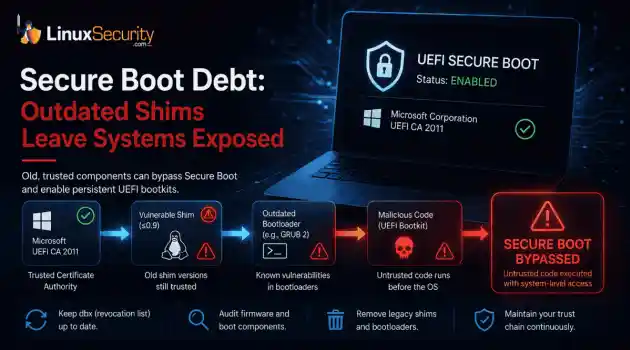
security advisory linux distribution ESET researchers identified 11 old and forgotten Linux UEFI shim bootloaders at versions 0.9 and below that can be used to bypass UEFI Secure Boot on any UEFI-based machine that trusts Microsoft’s Microsoft Corporation UEFI CA 2011 third-party certificate authority, regardless of the installed operating system (OS). Reported shims can be exploited to execute untrusted code during system boot, enabling attackers to deploy malicious UEFI bootkits even on systems with UEFI Secure Boot enabled.....
Jul 16, 2026
 Refine news
X Clear Filters
Get the latest News and Insights
Get the latest Linux and open source security news straight to your inbox.
Community Poll
Is continuous patching actually viable?
Trending News
Loading...
Explore Latest Linux Security news
We found 145 articles for you...
74
 network protectionsystem hardeningsecurity best practices
Securing SSH in Production: Keys, Hardening, and Real Attack Patterns
Spin up a fresh Linux VPS with default settings and check /var/log/auth.log ninety seconds later. There will already be failed login attempts — not dozens, hundreds, sometimes before the deployment script has even finished running. . Automated bots scan the entire IPv4 address space non-stop, and port 22 with password authentication open is exactly what they're looking for. Most cloud providers have seen enough of this that a new instance gets its first probe within a minute of going live. Security research tracking exposed Linux endpoints found that 89% of Linux endpoint attack behaviors in 2025 involved brute force or credential stuffing against SSH. Eighty-nine percent. In early 2026, the SSHStalker botnet — discovered by Flare Systems via SSH honeypot — had already racked up nearly 7,000 compromised systems by the end of January, mostly cloud servers, not through any sophisticated exploit but through weak or default credentials. Once inside, the malware dropped an SSH key, then immediately started scanning for more victims on port 22. A DShield sensor from around the same period documented the full cycle at under four seconds: first connection to complete botnet enrollment. The attacks aren't sophisticated. Default configurations keep making sophistication unnecessary. Start With Keys — Everything Else Comes After Disabling password authentication is the change with the most immediate impact. Do it first, before touching anything else. Once it's in place, the entire brute-force and credential-stuffing attack surface disappears — bots can hammer port 22 as long as they want, and without the private key they're simply not getting in. For new key pairs, Ed25519 is the right choice. Faster than RSA, smaller, stronger at comparable performance: ssh-keygen -t ed25519 -C "production-server" -f ~/.ssh/id_ed25519 Copy the public key to the server, then — and this step matters more than it sounds — open a second terminal and confirm the key-based login works from thatsecond session before touching anything in the config. Don't close the existing session until you've confirmed a fresh connection succeeds. Locking yourself out of a remote server mid-hardening is the most common way this process goes sideways, and it's entirely avoidable: # /etc/ssh/sshd_config PasswordAuthentication no KbdInteractiveAuthentication no PubkeyAuthentication yes In environments where key management is taken seriously — and it should be — rotating keys every six months is worth the friction. It sounds excessive until a former employee still has valid credentials six months after leaving, or a key gets exfiltrated as part of a broader compromise nobody caught at the time. The sshd_config Settings That Actually Move the Needle A handful of changes, none of them complicated, collectively close off real attack surface. None should require debate. Disable direct root login. There's no legitimate operational need for it — log in as a regular user and escalate with sudo when needed. And it adds a layer: an attacker who gets a key still needs to figure out which account has elevated access: PermitRootLogin no Explicit allowlists for SSH access so that any system accounts created after this point don't automatically inherit login capability: AllowUsers deploy monitoring-user Default values for authentication attempts and connection grace periods are far too generous for anything internet-facing: MaxAuthTries 3 LoginGraceTime 20 MaxStartups 10:30:60 LoginGraceTime 20 drops connections that haven't authenticated in 20 seconds flat. MaxStartups 10:30:60 starts throttling unauthenticated connections at 10 pending and drops them aggressively past 60 — this directly limits parallel brute-force attempts trying to flood the authentication pipeline. Add idle session timeouts too, since forgotten open sessions are their own category of risk: ClientAliveInterval 300 ClientAliveCountMax 0 On the port change. Moving SSH off port 22 won't stop a targetedattacker — a basic port scan finds it immediately. But it does eliminate the overwhelming majority of automated scanning traffic, since most botnets only ever target port 22. Logs get dramatically cleaner, and on production systems where log analysis is part of the daily workflow, that reduction in noise has genuine operational value. Worth doing, as long as nobody confuses it with a security control: Port 2222 SSH Certificates for Larger Deployments Key pairs are fine when you've got five servers. At fifty, the model breaks. You're distributing public keys to every host, rotating them manually, and inevitably inheriting authorized_keys files full of entries from people who left six months ago — nobody owns the cleanup, and stale access just sits there. The fix is treating SSH like PKI: a central Certificate Authority signs user keys, and every server trusts the CA instead of tracking individual keys. One revocation point. No per-host cleanup: # Generate the CA key pair — store this offline or in a hardware security module ssh-keygen -t ed25519 -f ~/.ssh/ssh_ca -C "production-ca" # Sign a user's public key with a 24-hour validity window ssh-keygen -s ~/.ssh/ssh_ca -I " username@prod " -n deploy -V +24h ~/.ssh/id_ed25519.pub On each server, trust the CA — not individual keys: # /etc/ssh/sshd_config TrustedUserCAKeys /etc/ssh/ssh_ca.pub Issue certificates with short lifetimes — 24 hours works well — and a stolen key becomes useless overnight without touching a single host. The stale access problem that haunts larger fleets mostly disappears on its own. Bastion Hosts Exposing SSH directly on every server multiplies attack surface with every machine you add. The cleaner model: a single hardened bastion host — the only machine with port 22 reachable externally — with all other servers restricted to accepting connections only from the bastion's IP at the firewall level. All hardening effort concentrates on one machine. Internal servers can dropeverything that doesn't come from the bastion. And SSH's ProxyJump makes the setup seamless: # ~/.ssh/config Host internal-server HostName 10.0.1.50 User deploy ProxyJump bastion.example.com SSH internal-server tunnels through the bastion automatically. Every lateral connection gets logged there. Combined with SSH certificates, you get one enforcement point for the entire fleet. Fail2Ban Key-only authentication largely kills the brute-force problem. Fail2ban still earns its place — misconfigured clients, edge cases, environments where password auth genuinely can't be fully disabled for one reason or another. A baseline configuration that bans IPs for 24 hours after three failed attempts: # /etc/fail2ban/jail.local [DEFAULT] bantime = 86400 findtime = 600 maxretry = 3 [sshd] enabled = true port = 2222 logpath = /var/log/auth.log maxretry = 3 Adjust the port value to match whatever is set in sshd_config. After any configuration changes, restart and verify: sudo systemctl restart fail2ban sudo fail2ban-client status sshd For privileged access workstations or jump servers where a stolen key alone would be an unacceptable outcome, stack TOTP on top. Twenty minutes of setup, and a compromised private key by itself stops working: # /etc/ssh/sshd_config AuthenticationMethods publickey,keyboard-interactive Reading the Logs Getting the configuration right is one half of this. Actually reading the logs is the other — and it gets underestimated consistently. SSH authentication logs are genuinely informative when you read them with intent rather than just watching for volume spikes. Repeated failures from a single source followed by a success: credential stuffing, worth investigating regardless of the account. Authentication from an IP that's never appeared before on an account with established connection history: worth a second look. More telling than either: a privileged account suddenly connecting from somewhere it never hasbefore. Or a service account that's never had an interactive session showing up with one. Audits extend monitoring past what SSH logs capture: auditctl -a always,exit -F arch=b64 -S execve -F euid=0 -k root_commands Every root command gets logged with a tag for easy filtering. Cross-reference with SSH auth events and you get a full timeline from initial login through command execution — which matters a lot during incident response when reconstruction is what you need. SSHStalker reinforced something worth keeping in mind: compromised hosts don't just become victims, they become attack infrastructure. A server generating high outbound connection volumes to port 22 on non-private IP ranges is almost certainly already part of a scanning relay. Behavioral monitoring that flags that specific pattern catches it faster than manual log review ever will. The DShield sensor data from early 2026: four seconds from first connection to fully enrolled botnet node on a default-credential system. Not a theoretical estimate — an actual observed result from a real internet-exposed VPS. The full hardening process here takes under an hour on a fresh server. Disable passwords, deploy a key, tighten the config, install fail2ban. The gap between a default SSH setup and a properly hardened one isn't a project. It's an afternoon. For the offensive perspective on SSH — how attackers enumerate configurations, harvest private keys from the filesystem, hijack agent sockets to move laterally without ever touching a key file, and use SSH tunneling to reach internal services, this SSH attack surface guide breaks down the techniques defenders need to understand. . Implement essential SSH security measures to prevent automated attacks through key management and system hardening strategies.. SSH Security, Hardening Practices, Key Management, Automated Attacks, Network Protection. . Andrew Kowal
 Jul 13, 2026
•
Jul 13, 2026
• Network Security
77
 security advisorynetwork protectiondata encryption
Essential Linux Security Tips: Best Practices for a Resilient System
Linux is a powerful operating system that is greatly appreciated for being reliable, flexible, and open in nature. It runs servers, desktops, and even embedded devices around the world. But this huge popularity comes with big risks too, as Linux-based systems are not really safe from security hazards. Thus, implementing Linux security best practices effectively secures your infrastructure against security vulnerabilities, data breaches, and data loss. . The most effective way of implementing security is embedding it into a secure software product development life cycle . Of course, different phases of the SDLC—from planning to deployment and maintenance—may have their share of intervention. You may mitigate the risks associated with well-planned possible vulnerabilities or impose secure code on your application development to strengthen your application base. You may notice in a well-implemented SDLC that those places have embedded security to make early control of risks possible. This detailed white paper highlights imperative Linux security best practices to protect your open-source environment. Keep Your System Updated System updates are one of those core aspects of security that tends to get overlooked. Updates patch vulnerabilities currently being exploited by attackers. Delays in updating expose your system to risk unnecessarily, even when your configuration appears secure. Real-World Example: A vulnerability in the Linux kernel , CVE-2021-3156, provided privilege escalation in 2021. Exposure was mitigated for those users who managed to apply an update in good time, yet there are still unpatched systems out there ready to be exploited. How to Stay Updated: Apply critical patches using automated scripts like unattended-upgrades to ensure timely application of patches. Fetch the latest packages from a package manager such as apt, yum, or dnf. Go through changelogs of key pieces of software for possible security implications. Bear it in mind that sometimeseven tiny changes can have important security consequences. Use the Principle of Least Privilege Principle of Least Privilege restricts the potential damage that can be done by an account or process in case it gets hacked: minimize the amount of permissions granted to reduce the possibility of unauthorized access to sensitive information. Practical Steps: Allow no root logins for administration and use sudo instead. Set file permissions using the utilities chmod, chown, or setfacl. A sensitive configuration file, for example, may require only chmod 600. Minimize set user ID programs that grant processes privileges they don't really need to carry out their functions through the implementation of strict access control policies utilizing SELinux or AppArmor. Enhance Authentication The authentication procedure is the first entry point into your Linux boxes. Weak password policies, password reuse, or badly implemented mechanisms will let them in. Advanced Practices: Enforce password policy, for example, pam_pwquality, and it should contain a minimum length, enforcement of special characters in passwords, and password expiration. Two-factor authentication using Google Authenticator or Duo Security adds another layer of security. Switch to key-based authentication instead of passwords for remote logins. Keep your private key in a safe place. Firewalls and Network Security Firewall and intrusion detection systems are the first layer of defense that keeps bad people and scripts away from your systems. Linux has superb tools to tune up network security policies. Enhancing Network Security: Firewall: either use fine-grained control of iptables or the ease of use of ufw. Example: ufw deny 22 bans SSH on port 22. IDS: Install Snort or Suricata and detect bad traffic patterns. Use Wireshark and tcpdump to monitor network flows in real-time to detect abnormalities. Encrypt Data at Rest and in Transit Encryption is an absolutemust for locking up your sensitive data from unauthorized access both on the disk and over the networks for integrity and to ensure confidentiality. Encryption Tools: LUKS can be used to achieve full-disk encryption of the local storage. Encrypt/decrypt sensitive files with GPG . Enable HTTPS on your websites using the Let’s Encrypt tool among others to make sure that the ciphers used are safe in SSH connections. Real-World Use Case: Most financial institutions encrypt data at rest and in transit to meet the compliances of GDPR and PCI DSS. Hence, security and compliance because of encryption go hand in glove. Monitor Logs and System Activity System logs may stand useful in revealing unauthorized activities, misconfigurations, or intrusion attempts. Periodic log monitoring ensures early detection of threats before any exploit causes damage. Log Management: Centralize your logs at a single location for better management by making use of Rsyslog and Journald. Establish an alerting mechanism for malicious activities like repeated failed login attempts, privilege escalation, and so on. Automate your log analysis using Elk Stack, Splunk, and Logwatch to expedite identifying anomalies. Secure the Kernel The kernel itself forms the heart of the Linux Operating System; hence, the moment that is compromised, the security of the whole system is spoilt. Securing the Kernel : Keep the kernel updated to patch existing bugs. With kexec, one can remotely reboot to newer kernels without disrupting the currently running programs. Turn off unused kernel modules, reducing the attack surface area. For example, if one does not use USB devices, turn off all USB-related modules with the command modprobe -r. Utilize some kernel hardening with security features like Grsecurity or AppArmor. Regular Backups Data loss could be caused by a ransomware attack, hardware failure, or human error. Doing regular backups means one can recoverimmediately should anything happen. Types of Backups: Automate your backups with rsync, Borg, or Duplicity. Store your backups in an offsite location or in safe cloud environments, so when physical disasters strike, one is safe. Test the restoration processes every now and then to be sure that one will really be able to rely on their system backup. Leverage Open Source Security Tools Linux has a very lively community of free, open-source security tools that are capable of carrying out all kinds of tasks related to securing your system. The Must-Haves: Lynis: a tool for deep system auditing that lets one know of the weaknesses in security. Fail2Ban: guards against brute-force attacks, banning suspicious IP addresses. ClamAV: provides malware scanning for the detection and cleaning up of malicious files. Educate and Train Your Team Security awareness is a very important but often overlooked aspect of system security. Human mistakes are among the most common causes for breaches; thus, education is key. Some Tips for Training: Have periodic workshops or training classes on best practices for Linux security. Conduct training on fresh threats, such as new malware that targets Linux. Prepare a plan for incident response in which every member of your team will know how to act in case a security breach happens. Sandboxing and Isolation Techniques Sandboxing segregates applications; hence, if an attacker compromises one application, this will not affect the whole system. In the Case of Sandboxing, Use: Docker: For complete segregation of an application, including all dependencies for the application, use containerization. Firejail: In case of application-level sandboxing, minimum configuration. Virtual Machines: Run untrusted code on Virtual Machines for better segregation. Regular Security Audits Regular security audits point out vulnerabilities and ascertain whether they achieve organizational orregulatory standards. Steps to Audit: Run vulnerability scans using OpenVAS or Nessus. Perform penetration testing to see how systems defend themselves during an attack. Find configuration files maintaining a set of various misconfigurations that may expose your system to predators. Conclusion: Building a Secure Linux Ecosystem Securing your Linux environment involves active participation in its security—a multilayered approach. That means best practices related to Linux security will be included in the software product development life cycle, and hence, it would be a continuum rather than an afterthought. From the least privilege principle to encryption, log monitoring, and Linux security-awareness training, these ensure a robust guard against existing cyber threats for a Linux ecosystem. Not only will a secure Linux environment make it a matter of data security, but it is also about system reliability, compliance, and peace of mind for your team and stakeholders. . Implement essential Linux security protocols to safeguard your machine against unauthorized access and ensure the preservation of data integrity and regulatory compliance.. Linux security best practices, secure Linux environment, open-source security tools, effective security strategies. . Dave Wreski
Jan 12, 2025
•
Server Security

81
 cyber threatsnetwork protectionmalware
Securing Streaming on Linux: DDoS, Malware, and Payment Protection
Streaming on Linux can be an exhilarating experience, but it also comes with its own set of cybersecurity challenges. The risks are real, from DDoS attacks that can halt your secure video streaming to malware hidden in plugins to the looming threat of phishing schemes and secure streaming. . On top of that, doxxing and network vulnerabilities can put your personal information at risk. Fortunately, there are straightforward ways to protect your streaming broadcast without sacrificing the excitement. With tools like SELinux, VPNs, and regular updates, you can fortify your setup and focus on what matters most—creating an engaging, secure video streaming environment for your audience. The Hidden Dangers for Streamers Feel invincible in your Linux environment? Think again. While your setup has better defenses than most, the landscape of cyber threats is as unforgiving as a final boss. Cybercriminals hunt high-value targets, and your streaming broadcast empire, with its mix of personal data, financial transactions, and high-profile gaming accounts, glows like a neon bullseye. DDoS ambushes, malware smuggled through innocuous-looking plugins, or clever phishing schemes disguised as sponsorship offers—all aim to dismantle your fortress, brick by digital brick. Streaming isn’t just gaming; it’s an interconnected web of hardware, software, and networks. Capture devices, microphones, overlays—they all widen the gates. And let’s be honest: no system is flawless. A single unpatched vulnerability in third-party tools is like leaving your vault door ajar with a sign that reads, "Loot here." Why Are Streamers Under Fire? Streaming is a paradox—a platform that elevates your presence while stripping away anonymity. Your wealth of digital assets, from donation revenue to subscriber data, paints a tempting picture for cyber intruders. A hacker might hijack your stream mid-action, redirecting your hard-earned audience. Worse yet, a viewer could face collateral damage, their privatedata siphoned through exploits aimed at your channel. Stream sniping adds another layer of frustration and risk . Imagine being in the heat of a competitive match, only to realize an opponent is watching your broadcast in real time to predict your every move. Not only does this disrupt your gameplay, but it also undermines your credibility and leaves your audience disillusioned. The stakes escalate in real time, where online harassment and doxxing can spiral from nuisances to nightmares. For streamers, the always-online nature of gaming multiplies risk—each live session, each unscripted moment, is a potential opening. Where Vulnerabilities Lurk Even the strongest chain has weak links; your streaming setup is no exception. Outdated software, misconfigured networks, or lax privacy settings can transform a hardened Linux base into Swiss cheese. Consider this: Unpatched system flaws become entry points for silent intrusions. Poorly secured Wi-Fi invites snoopers to the party. Plugins from dubious sources act as digital Trojan horses. Combat these pitfalls with relentless vigilance. Security audits aren’t a luxury—they’re your lifeline. Scrutinize everything: who has access, how your data is stored, and where backups reside. Fortifying Your Streaming Setup To protect your streaming broadcast kingdom, you need a layered defense. Begin with your Linux Foundation: Activate tools like SELinux or AppArmor to choke out unauthorized actions. Keep updates automatic, closing gaps before attackers can exploit them. Monitor traffic logs like a hawk—your first warning sign might be buried in the noise. Protect your secure video streaming with robust defenses. Convenience should not bring down security in any aspect when it comes to secure video streaming software. OBS Studio is a brilliant creation, but every plugin or every shortcut you put in starts becoming more of a liability. Using third-party extensions, unless absolutely necessary, is just part ofcreating unique logins and allowing 2FA functionality. You can avoid the biggest reasons behind information leaks and keep secure streaming practices intact. Securing Your Network: The First Line of Defense Your network isn’t just a conduit; it’s the fortress wall. A poorly secured connection is akin to leaving the drawbridge down for invaders. Reinforce your setup by: Employing WPA3 encryption on your Wi-Fi and rotating passwords like clockwork. Deploying a VPN to mask your IP address and disrupt attackers’ targeting mechanisms. Conducting secure video streaming audits can also help detect unauthorized devices before they become threats. Protecting Your Identity and Finances Cybersecurity extends beyond your stream—it’s personal. Your identity and revenue streams are prime targets, and safeguarding them requires equal parts of strategy and execution: Never reveal sensitive data during live sessions, not even accidentally. Use compartmentalized accounts for streaming-related finances. Rely on encrypted payment platforms and review transaction histories with eagle eyes. These measures ensure your livelihood isn’t siphoned away while you’re focused on that clutch moment in-game. Battling Doxxing and Toxic Viewers Doxxing is no longer an outlier—it’s an epidemic. Prevent exposure by limiting personal information on profiles and leveraging tools like VPNs. Toxic viewers? Moderate them into oblivion. Automated tools, trusted human moderators, and escalating penalties for violators maintain your control and preserve the sanctity of your digital stage. The Cybersecurity Streamer’s Toolkit For the ultimate edge, consider leveling up your security arsenal. Specialized Linux distributions like Kali or Parrot OS come pre-loaded with defensive capabilities, giving you a head start. Adopt the 3-2-1 backup strategy—three copies, two different formats, one offsite storage—because even the best defenses can’t guaranteeinvulnerability. Stay alert, stay informed, and most importantly, stay streaming. Your audience is there for the gameplay, the banter, and the thrill of the journey—not for a front-row seat to a cyber calamity. So suit up, streamer. The digital battlefield awaits, but now you’re armed to conquer it. . Fortify your streaming environment against online risks by implementing essential security measures and resources tailored for Linux users who game and share broadcasts.. Linux Security, Cyber Threats, Streaming Protection, Network Security, Identity Protection. . MaK Ulac
Dec 17, 2024
•
Privacy
72
 network protectionopen source toolsecurity application
Discover The 10 Best Free Linux Firewall Tools For Network Protection
For those who are serious about their network security, knowing which Linux firewall apps and solutions are available for free is crucial. . Setting up a firewall is key to securing your network perimeter. A firewall blocks sensitive ports and filters incoming and outgoing traffic to thwart malicious connections and ensure there is no unsolicited exchange of data. In the world of FOSS, there are plenty of firewall solutions to choose from. Here's a list of the best firewall solutions for fortressing your network on Linux. . Establishing a security barrier is crucial for protecting your network boundary. A firewall restricts access to critical ports and scrutinizes data flow.. Free Linux Firewall Tools, Network Security Solutions, Open Source Firewall Applications. . Brittany Day
Dec 14, 2022
•
Firewalls
77
 network protectionsecurity enhancementopen source tools
Enhancing Linux Server Security With Top Open-Source Tools for 2022
Learn about 10 great open-source tools to improve the security of your Linux servers heading into 2022. . Since I started learning about computers I have heard many experienced users saying Linux is impenetrable, Linux offers the best security, and such. It is partly true that Linux offers various security measures which mitigate attacks and stop hackers from breaching your system network. But you should also understand that just by deploying Linux on your server or PC you are not done yet, you have to configure all the necessary tools and apps. As the security features are not enabled by default, and if you are scared of network breaches and security leaks, then this should be the first thing you should be doing after installing the Linux OS. Remember your security system always depends on the tools you use, it’s the tools’ features that sniff out any malware in the system, prevent security breaches from happening, and find out vulnerabilities to deploy countermeasures. In short, the cybersecurity for a network or terminal is based on the tools, not on the default security measures of the OS. . Uncover powerful freely available solutions to enhance the protection of your Linux server during the year 2022.. Linux Server Security, Open Source Tools, Cybersecurity Solutions. . LinuxSecurity.com Team
Dec 22, 2021
•
Server Security
77
 security practicesaccess controlnetwork protection
Proven Methods to Enhance SSH Security on Linux Servers Today
Learn about a unique and effective method of securing SSH to help lock down your Linux servers. . The other day I was thinking of ways to secure SSH that were a bit outside the norm. Let's face it, we've all configured SSH in /etc/ssh/sshd_config and /etc/ssh/ssh_config. We've blocked root login, we've set SSH to a non-standard port, we've installed fail2ban, and we've enabled SSH key authentication. What more can we do? That's where my train of thought sort of went off the tracks to come up with a non-standard method of blocking unwanted SSH traffic. What I came up with isn't revolutionary, nor is it a guaranteed fix for everything that ails remote logins. . Enhance SSH security on Linux by using port knocking with advanced firewalls. This technique masks the SSH port, allowing access only to legitimate users.. SSH Security, Linux Servers, Remote Access Method, Security Practices, Network Protection. . LinuxSecurity.com Team
Oct 08, 2021
•
Server Security
77
 security practicesnetwork protectionmalware defense
Enhance Linux Server Security With Six Key Open-Source Tools
Don't want to compromise on the security of your Linux server? Install these six must-have open-source tools to set up an impenetrable network. . Tech geeks often tout Linux as the most secure operating system, especially compared to the mainstream proprietary ones like Windows and macOS. While that’s true for the most part, Linux doesn’t offer you a secure environment by default. Linux server's security largely depends on what methods you adhere to and the tools you have deployed on your system to help it withstand viruses, malware, and other malicious attacks. Nothing’s invincible; for this very reason, it is practical to secure your Linux server with the best open-source security tools in the market. . Fortify your Linux server thoroughly using seven crucial free tools aimed at improving cybersecurity measures.. Open Source Security Tools, Linux Server Security, Malware Protection, Network Defense, Security Practices. . LinuxSecurity.com Team
Jul 16, 2021
•
Server Security
74
 network securitynetwork protectionfirewall management
GeoIP Filtering With Nftables For Improved Linux Network Security
This LinuxSecurity.com article featured on the frontpage of Slashdot examines the concept of geo filtering and how it could add a valuable layer of security to your firewall , and explores how the Geolocation for nftables project is leveraging Open Source to provide intuitive, customizable geo filtering on Linux. . What if you could block connections to your network in real-time from countries around the world such as Russia, China and Brazil where the majority of cyberattacks originate? What if you could redirect connections to a single network based on their origin? As you can imagine, being able to control these things would reduce the number of attack vectors on your network, improving its security. You may be surprised that this is not only possible, but straightforward and easy, by implementing GeoIP filtering on your nftables firewall with Geolocation for nftables . . Geo filtering enhances Linux network security by restricting access based on location. Using nftables, admins can block foreign connections, enhancing safety.. GeoIP Filtering, Nftables Security, Network Defense. . Brittany Day
Feb 15, 2021
•
Network Security

Get the latest News and Insights
Get the latest Linux and open source security news straight to your inbox.
Community Poll
Is continuous patching actually viable?
Trending News
Search Topics
Powered By

Linux Security - Your source for Top Linux News, Advisories, HOWTOs and Feature Releases
QUICK LINKS
subscribe to newsletters!
Like staying secure? So do we.
Sign up for updates, tips, and alerts!