Explore top 10 tips to secure your open-source projects now. Read More
×


Security Vulnerabilities  security advisory authentication
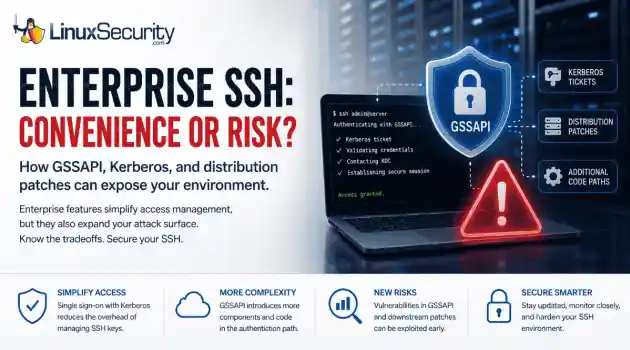
security advisory authentication We often view OpenSSH security updates through the lens of standard patch management. When a new CVE hits, we scramble to update, check our versions, and return to business as usual. But recent vulnerabilities tied to distribution-added OpenSSH GSSAPI patches are a reminder that the danger doesn't always lie in the core code; it often resides in the "convenience" features we layer on top. . These recent issues shouldn't just trigger an apt upgrade or dnf update; they should trigger a...
 Jul 06, 2026

Security Trends privilege escalation Linux security
privilege escalation Linux security Linux security teams are drowning. Patches, kernel updates, new CVEs every week. SSH exposed here, an old web service there, and a forgotten cron job running as root. On top of that, SIEM dashboards blink all day with alerts that all claim to be “high priority.” . It’s no surprise that people stop paying attention. The real problem isn’t a lack of data. It’s the opposite. Too much noise, not enough signal. Security teams see huge lists of vulnerabilities and thousands of alerts, but very...
Jul 06, 2026

Security Vulnerabilities security advisory critical
security advisory critical Before you close out the week, check what still needs to be patched. . The list is not small. Ubuntu and Red Hat pushed kernel updates. OpenVPN and OpenShift both received security fixes. Several everyday Linux components were patched too, including Vim, nginx, cifs-utils, LibVNCServer, nghttp2, and Perl. That is the kind of week administrators can easily write off as routine. It should not be. These are the updates that keep small openings from turning into real access. Why This Week Looks...
Jul 03, 2026
Security Trends malware security research
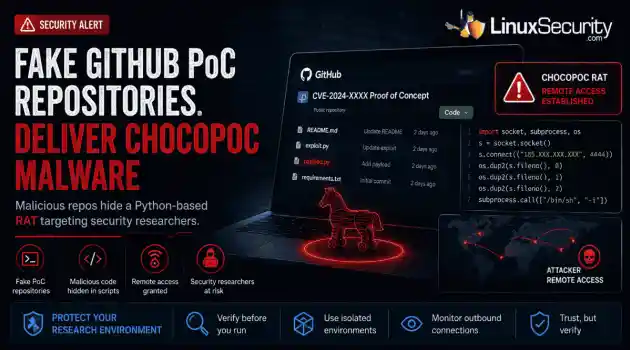
malware security research GitHub has become the latest delivery mechanism for malware aimed at security researchers. . YesWeHack and Sekoia identified a campaign that hid a Python-based remote access trojan (RAT) called ChocoPoC inside repositories presented as proof-of-concept exploits for recently disclosed vulnerabilities. Someone looking for a working exploit could clone the project, execute the code, and unknowingly launch a second payload that established remote access. Nothing about the campaign specifically...
Jul 02, 2026
Cloud Security incident response Linux administration
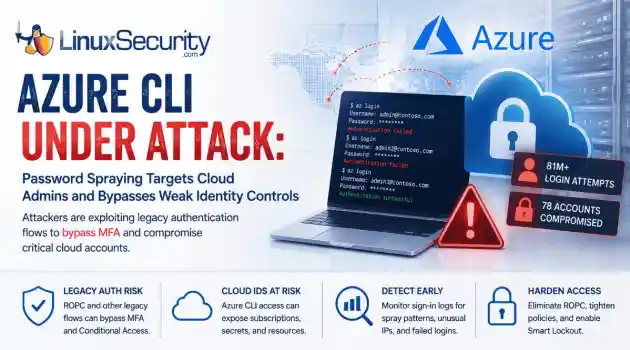
incident response Linux administration Over the span of just 14 days, threat actors unleashed more than 81 million login attempts against Microsoft’s Azure command-line interface (CLI). The campaign , which security researchers at Huntress identified as an ongoing, automated password-spraying effort, successfully compromised at least 78 Microsoft accounts across 64 organizations between June 12 and June 26, 2026. . While the scale is massive, the underlying strategy is surprisingly surgical. Attackers aren't exploiting a flaw in...
Jul 01, 2026
 Refine news
X Clear Filters
Get the latest News and Insights
Get the latest Linux and open source security news straight to your inbox.
Community Poll
Is application sandboxing truly safe?
Loading...
Explore Latest Linux Security news
We found 8 articles for you...
214
 security advisorySSH accessnetwork isolation
Eight Sleep Smart Beds: Privacy Threats and SSH Backdoors Explained
As we connect almost every element of our homes to the Internet of Things (IoT), security concerns have spread far beyond traditional computing devices to everyday items. From fridges that track groceries to security systems we manage via smartphone apps - IoT brings both convenience and potential risks. . Recent research on Eight Sleep's internet-connected mattresses reveals that Linux security admins using these smart beds may be exposed to unexpected privacy threats. Eight Sleep's firmware contains AWS credentials, which pose privacy and financial integrity threats to services linked with these cloud infrastructures. At the same time, remote SSH backdoors could allow malicious actors unauthorized access into smart beds--or any connected device on the same network, including Linux-based systems. Let's examine these recent IoT vulnerabilities and discuss practical security measures you can implement to safeguard your network and Linux infrastructure against them. Unpacking These IoT Vulnerabilities Eight Sleep's smart mattresses contain firmware with critical flaws, including exposed AWS credentials and remote SSH backdoors that pose significant threats to data privacy. Hackers could exploit these issues to access sensitive information, incur significant costs, or gain unauthorized entry into personal networks. AWS Credential Exposure One of the more concerning discoveries is the exposure of AWS credentials within a smart bed's firmware. AWS is a secure cloud service provider that requires careful credential management to protect users from unauthorized access or misuse. Should an attacker gain access, they could manipulate sleep data or incur significant costs through excessive API requests and resource consumption. Linux admins face more serious repercussions from exploits involving credentials that they entrust with financial transactions than just economic considerations. A compromised credential could enable attackers to install malicious scripts into cloud environmentsthat utilize those compromised credentials - potentially impacting any service that interfaces with them. While Linux systems are widely known for being secure and stable environments , weaknesses in embedded credentials allow attackers to exploit vulnerabilities more readily. Remote SSH Backdoors Eight Sleep smart beds contain another major security flaw: remote SSH backdoors intended to allow engineers to execute commands on mattresses remotely. However, these backdoors allow anyone - not only engineers - to gain entry and control of these devices. Linux admins will find remote SSH backdoors particularly concerning, given their inherent trust and control levels associated with SSH access . If an attacker can gain control over one such bed using these backdoors, they could use it as a springboard for other devices on the network, including home security cameras, laptops, or any other crucial connected infrastructure. Eight Sleep's smart beds do not offer user-accessible logs, making detecting and tracing unauthorized access more difficult. Without such logs, investigating after a breach has occurred or monitoring for unusual activity is nearly impossible. Network Traversal Risk Company Response Remote SSH backdoors also increase the risk of network traversal attacks, allowing malicious actors to move from device to device within a network, exploiting trust relationships between devices to increase their reach and spread malware infections more widely. In the case of Eight Sleep smart beds, infected devices could serve as staging grounds for more extensive network infiltration attempts. We Linux admins must recognize this risk, as even highly secured Linux systems could become vulnerable if an adjacent device - a smart bed - were vulnerable. This underscores the necessity of network segmentation and using best practices when isolating IoT devices from more critical infrastructure. Practical Advice for Mitigating Your Risk Linux admins must protect their networks andtheir devices from security risks, using best practices as part of an overall plan to minimize vulnerabilities that can threaten them. Although no single solution provides complete protection, combining various strategies will substantially lower risks posed by vulnerabilities. Securing Credentials AWS credentials have been accidentally exposed within the firmware of a smart bed, which highlights the importance of secure credential management. Credentials must never be hardcoded into devices' firmware or accessible through straightforward reverse engineering techniques. Environment variables or external credential management tools like AWS Secrets Manager are excellent ways to ensure credentials are stored safely and rotated regularly. Regular audits where embedded keys are searched and scrutinized can further help detect exposed credentials before they're exploited. Administrators should advocate for secure development practices and work with vendors to ensure their devices adhere to these standards. Monitoring and Isolation Given the risk posed by remote SSH backdoors, devices in your network must be regularly checked and monitored for any unauthorized access points. Intrusion detection systems (IDS) can assist in spotting unusual patterns indicative of such access. Their logs and alerts provide valuable insight into potential breaches while expediting quick responses. Network segmentation plays a pivotal role in mitigating risks from compromised IoT devices. By isolating such items as smart beds from more critical infrastructure, administrators can isolate breaches and stop attackers from exploiting vulnerable devices to access sensitive systems. Establishing separate VLANs for IoT devices ensures that even if an infiltrated smart bed is compromised, more important parts of the network remain secure. Proactive Network Monitoring Active network monitoring is vital to detecting and responding quickly to security incidents. Tools designed to analyze traffic for anomalies canquickly notify administrators when suspicious devices begin making unexpected connections or performing high data transfer rates. Centralized logging provides a consolidated view of network activity and can help correlate events across devices. Linux administrators can use monitoring solutions like Elasticsearch, Logstash, and Kibana (ELK stack) to collect, analyze, and visualize logs from multiple network devices. This holistic approach allows them to detect potential security incidents quickly. Regular Firmware Updates Maintaining security by updating devices with the latest firmware can be simple yet easily overlooked. Vendors often release updates to patch known vulnerabilities, and keeping smart devices updated helps reduce risks from known exploits. Linux administrators need to establish a regular schedule for checking and applying updates. If a vendor provides tools that automate this process, taking advantage of such opportunities could simplify the task while guaranteeing that security updates are applied promptly. Our Final Thought on Combating These Eight Sleep Smart Bed Security Flaws Eight Sleep's smart beds are a vivid example of the security risks posed by IoT devices that proliferate in our homes and workplaces, prompting us Linux admins to adhere to security best practices even for seemingly harmless devices. Securing credentials, monitoring for unauthorized access, isolating vulnerable devices, and updating firmware are essential to defend networks against potential intrusions. By effectively understanding and mitigating IoT risks, Linux admins can continue to protect their systems while safeguarding the networks they manage - not simply responding to threats but creating resilient infrastructure. . With the rise of smart sleep technologies like Eight Sleep, Linux system admins must assess cybersecurity risks and device vulnerabilities to protect user data. Smart Beds, IoT Security, Linux Admins, AWS Credentials, Network Monitoring. . Brittany Day
 Feb 25, 2025
•
Feb 25, 2025
• IoT Security
83
 cyber threatssecurity practicesnetwork monitoring
Salt Typhoon Threat: Credential Management and Network Defense Strategies
Recent reports have revealed a sophisticated intrusion campaign conducted by Salt Typhoon, targeting major U.S. telecommunications providers. To safeguard against this emerging threat, Linux admins must understand Salt Typhoon's malicious methods: using stolen credentials, living-off-the-land techniques, and consistently changing network configurations to avoid detection while expanding access. . These tactics stress the importance of rigorous credential management practices, such as disabling unnecessary utilities and conducting regular configuration audits to protect networks against Salt Typhoon. Let's examine Salt Typhoon's attack methods in greater depth and discuss practical detection and prevention measures you can implement to safeguard your Linux environment. Credential Use and Expansion The Salt Typhoon group's recent increase in cyber intrusion activity has been a cause of alarm among the cybersecurity community and U.S. telecommunications providers. This threat actor excels at using valid stolen credentials to gain entry to key network infrastructure, further expanding their reach by gathering more credentials from network configurations. Doing so helps solidify their hold on networks once an initial breach occurs, making extrication increasingly difficult. To prevent credential management abuse and to mitigate this particular threat, it is vitally important that security admins engage in reliable credential management practices. This includes creating and using strong, unique passwords across users and systems, as well as updating them regularly and adding multi-factor authentication whenever feasible to add another layer of protection. Furthermore, consistent and proactive monitoring for unauthorized access attempts is imperative. Monitoring access logs and setting alerts can quickly identify and isolate potential breaches before they escalate further. Living-off-the-Land (LOTL) Techniques Salt Typhoon stands out by using living-off-the-land (LOTL) techniques toexploit existing legitimate tools and utilities within compromised networks, such as command line utilities, network management tools, or scripting environments already present on these systems. By doing this, they can minimize their footprint while remaining undetected by traditional detection mechanisms, allowing them to conduct malicious activities without raising immediate red flags. Administrators can counter these tactics by regularly reviewing and updating their network configurations, with an eye toward disabling unnecessary tools or services that could be exploited. Understanding which tools should run on each network device and then disabling or removing those that are unnecessary is key. Regular audits of system configurations and real-time monitoring will assist administrators in detecting and preventing LOTL techniques used in campaigns like Salt Typhoon. Infrastructure Pivoting and Persistence One of the hallmarks of the Salt Typhoon campaign is its persistent movement through compromised infrastructure. Once inside a network, an attacker meticulously modifies configurations and creates multiple access points to maintain control for extended periods. This technique allows the attackers to operate undetected, continuously siphoning data or planning new exploits. Implementing stringent network segmentation measures is key to mitigating persistent threats. like Salt Typhoon. breaking up a large network into separate and isolated segments, security teams can limit an attacker's lateral movement. Conducting thorough configuration audits regularly is also necessary. These audits should identify any unauthorized changes that might signal an attacker's presence on your network. Monitoring devices for sudden configuration changes can detect malicious activities quickly and respond swiftly to these activities. Recommendations for Detection and Prevention Protecting network infrastructure against sophisticated threat actors like Salt Typhoon requires an aggressive and comprehensiveapproach. Our recommendations for detection and prevention include robust configuration management, enhanced monitoring, and in-depth traffic analysis, as these are designed to detect early signs of compromise and stop attackers from reaching their goals. Robust Configuration Management and Auditing Security teams should undertake network device configuration audits regularly. They should check for unapproved changes such as AAA (Authentication, Authorization, and Accounting) configurations, loopback IP addresses, or newly created local accounts that could serve as targets for attackers looking to penetrate networks further. Adopting the principle of least privilege is also an integral security practice. Only users who need access to critical network devices should have it, minimizing opportunities for compromised accounts to be exploited by threat actors. Strong password policies and widespread multifactor authentication measures will significantly increase threat actors' difficulty in gaining and maintaining access. Enhanced Monitoring and Logging Effective detection relies on closely monitoring the syslog and AAA logs for any unusual activities or configuration changes that could indicate potential attacks and log changes. Modifying bash_history, auth.log, lastlog, wtmp, or btmp could indicate an attacker's attempt to cover up their tracks. Integrity logging across all network devices is vitally important. Automated systems can detect log tampering or gaps in logging data - often signs of malicious activity - while regularly checking for non-empty or unusually large.bash_history files may reveal evidence of illicit scripts being run. Network Traffic Analysis Establishing visibility of network traffic is essential to identifying and mitigating network threats. Utilizing tools like NetFlow for traffic analysis, port scanning, and monitoring for unusual volumetric changes are all helpful in pinpointing suspicious network activities. Profiling network devices to detect any changes,such as new ports opening, closing, or traffic patterns, could give early indications of breaches in security systems. Implementing stringent Access Control Lists (ACLs) is crucial to restricting unauthorized access and movement within a network, with regular monitoring for violations helping identify security gaps and address them quickly. Network segmentation helps contain threats more effectively by compartmentalizing potentially compromised sections into separate segments. Patching known vulnerabilities is also key to maintaining an effective security posture against threats like Salt Typhoon. Our Final Thoughts on Mitigating Salt Typhoon's Threat to Your Linux Environment Salt Typhoon's tactics demonstrate the necessity of adopting an integrated network security approach. From advanced credential management and disabling unneeded tools to network segmentation and ongoing configuration audits, Linux security administrators possess several strategies to prevent sophisticated intrusions from taking hold. By prioritizing such actions and cultivating a culture dedicated to security, network defenders can gain the upper hand against even persistent and skilled threat actors. Ultimately, vigilance, continuous improvement, and proactive mitigation are key in protecting critical network infrastructures from stealthy cyber threats like Salt Typhoon. . To combat threats like Salt Typhoon effectively, organizations should implement strong credential management, robust activity monitoring, and proper network segmentation to enhance security.. Cyber Intrusion Detection, Credential Management Techniques, Network Security Practices, Salt Typhoon Threat, LOtl Mitigation Techniques. . Brittany Day
Feb 24, 2025
•
Hacks/Cracks

210
 security advisoryLinux kernelnetwork segmentation
CISA: 2024-53104 critical: Linux kernel UVC driver exploit
Recently, the Cybersecurity and Infrastructure Security Agency (CISA) issued a dire warning regarding an out-of-bounds write vulnerability in the Linux kernel tracked as CVE-2024-53104 . This issue exists within UVC drivers and has already been targeted in attacks . We admins must understand the nature of this threat, assess risks to our systems, and take adequate precautionary measures to guard against potential exploitation. . CISA recognizes the urgency of requiring government agencies to patch this flaw within three weeks, and Linux administrators should also act swiftly by applying patches from kernel versions 2.6.26 onward. Let's take a closer look at this severe Linux kernel flaw, its security implications, and measures you can take to fortify your systems against exploits. Understanding This Severe Kernel Vulnerability At the heart of this issue lies an out-of-bounds write vulnerability traced back to the uvc_parse_format function within the UVC driver . The vulnerability stems from improper parsing of UVC_VS_UNDEFINED frames, potentially leading to buffer size miscalculations and subsequent out-of-bounds writes. This vulnerability enables attackers to cause unexpected behaviors and potentially escalate privileges on the affected devices to compromise sensitive data, take over affected devices, and launch further attacks against your systems. Identifying Systems at Risk Identifying whether your systems are at risk involves a few critical steps. First, check the kernel version running on your systems. If it is 2.6.26 or later, your systems could be vulnerable, especially if you use USB Video Class (UVC) devices. The issue is especially pertinent for devices and servers with USB video devices enabled, which could act as potential vectors for exploitation. Steps to Mitigate the Risk of an Exploit Our immediate response to a vulnerability of this magnitude should be patching affected systems. Updating your systems with the latest security patches provided by yourLinux distribution maintainers can effectively mitigate this threat. CISA's mandate for U.S. federal agencies to patch this flaw within a three-week timeline emphasizes this action's critical nature and urgency. But patching alone can't be the end of your mitigation strategy. It’s essential to adopt a multi-layered approach to ensure long-term security. One practical step is reviewing and possibly revising the policy around USB device usage within your organization. If USB video devices are not essential to your operations, consider disabling or limiting their access to reduce potential entry points for attackers. Monitoring and Incident Response In addition to these measures, deploying robust monitoring tools to track device behavior and network traffic is crucial. Anomalies in network traffic or unusual device behaviors often act as early indicators of attempted exploitation. Implementing these tools will allow you to detect and respond to threats faster, potentially before significant damage is done. Preparing for incidents through regular drills and updating your incident response plans can significantly enhance your organization's resilience. Knowing exactly how to act when a vulnerability is identified and having a clear, practiced response plan can considerably reduce the chaos and confusion in the event of an attack. Tracking Advisories and Staying Informed Security is a continuous process that requires staying informed about the latest threats and best practices. Regularly checking for updates and advisories from your Linux distribution is essential. These advisories often provide critical information tailored to your specific Linux environment and contain essential patches or workaround strategies to deal with vulnerabilities. Another essential resource is the CISA’s Known Exploited Vulnerabilities catalog . This catalog is regularly updated with vulnerabilities actively exploited across industries, offering invaluable insight into the current threat landscape. Stayingplugged into these resources can distinguish between proactive defense and reactive damage control. Revising USB Device Policies This vulnerability specifically targets USB Video Class (UVC) drivers, making revisiting your USB device policies prudent. In environments where USB devices are not essential, disabling them can be a straightforward method to close off a potential attack vector. Consider implementing stringent controls and monitoring measures when USB devices are necessary. For instance, only allow USB devices that are essential for business operations and are from trusted sources. Conduct regular audits of connected USB devices to ensure no unauthorized devices are present. Enhanced monitoring of USB ports and connected devices can create an added security layer, helping detect and respond to unauthorized access attempts immediately. Network Segmentation Network segmentation is another layer of security that helps mitigate potential exploitations. By dividing your network into smaller segments, you limit an attacker’s ability to move laterally through your environment if they manage to compromise one device. Each segment should be designed with controls that restrict data flow based on necessity, minimizing the risk exposure if one segment is compromised. In implementing segmentation, ensure critical systems and sensitive data are isolated from less secure segments and employ firewalls and access controls to regulate the traffic between segments. This approach not only helps in containing breaches but also makes the detection and response process more efficient. Enhancing Employee Awareness Employees are an invaluable first line of defense against cyber threats. To inform staff of the dangers associated with USB devices and best practices for safe computing, regular training sessions should focus on recognizing phishing attempts , updating software as necessary, and the risks posed by connecting unknown USB devices. Establishing a security-conscious culture withinyour organization ensures that everyone from the IT team to the general staff is aware and vigilant against possible exploits, decreasing the chance of successful attacks. Our Final Thoughts on Mitigating This Severe Linux Kernel Flaw CVE-2024-53104 represents a serious security threat, underscoring the need for proactive and multilayered security strategies. By understanding its nature, identifying potentially at-risk systems, and creating comprehensive mitigation strategies to combat emerging threats to our networks, we can defend our Linux environments against emerging risks. Patching systems promptly, revising USB device policies, employing robust monitoring tools, staying informed through advisories and CISA resources, network segmentation, employee awareness training, and improving network segmentation are essential steps in strengthening your digital security posture to protect against current and future threats. . CISA mandates patching a serious Linux kernel flaw within three weeks for timely protection against exploits.. recently, cybersecurity, infrastructure, security, agency, (cisa) issued, warning. . Brittany Day
Feb 13, 2025
•
Security Vulnerabilities
74
 intrusion detectionbest practicessystem updates
Best Practices: Securing Linux from Bots, DDoS, and Threats
Linux systems have long been an indispensable asset to businesses and individuals alike. From running servers and cloud infrastructure to powering personal computers, Linux provides companies and individuals with unparalleled stability, flexibility, and security - making it the ideal platform for future development. . One of Linux's key advantages lies in its open-source nature. Since the code behind Linux has been made publicly accessible, developers and security professionals worldwide can use it to constantly audit, optimize, and reinforce systems for their specific needs - helping them stay ahead of everything from productivity to security issues. Linux is an attractive and secure solution, but that doesn't make it foolproof. Though its open-source nature makes Linux appealing, its vulnerability has allowed attackers to study its source code and devise exploits targeted explicitly against it. Understanding Linux Threats: How Malicious Bots Target Your System One of the most pressing threats to Linux systems today is malicious bots, which automate attacks such as brute-force login attempts, data scraping, and DDoS . Because cybercriminals have access to the same information ethical bodies do, there has been a constant race between security professionals and malicious actors ever since Linux grew popular, as both work to patch or exploit vulnerabilities as fast as possible. Because of these risks, it’s up to businesses and individuals using Linux to take a proactive approach to security, implementing all of the best practices to protect their Linux environments and ensure they can’t be successfully targeted. So, what are the best practices? Effective DDoS Prevention Strategies for Linux Systems When bots disrupt traffic, one of the best DDoS prevention strategies is combining advanced technology like AI with real-time threat analysis, creating a robust protection environment that can fight both simple and complex DDoS attacks. Looking at more straightforward attacks,security can be achieved by implementing multi-layered authentication or utilizing content delivery networks. CDNs work well to distribute traffic across multiple servers and absorb unexpected traffic spikes. But in 2025, things have become a little more complicated. Nowadays, it’s become necessary to utilize advanced software processes – processes that can analyze 5 trillion signals a day to detect and block known malicious bots and emerging threats. In the cybersecurity industry, speed is everything, and the right software will ensure you have the speed and accuracy to protect your Linux system. Boost Your Linux Security with Network Segmentation Techniques One of the big problems with cyber criminals is that they utilize lateral movement to infiltrate your network. By this, we mean if there are no barriers or segmentation between different parts of a Linux system, cybercriminals can easily access one part of the network and then most laterally or horizontally escalate their privileges. This allows them to exploit a single vulnerability to reach other critical systems across your entire network. By implementing network segmentation , however, you will mitigate this risk by dividing your network into smaller, isolated sections – or subnets. Each subnet can have its security policies and access controls, ensuring that even if a bot compromises one part of the network, reaching other areas without additional authentication is impossible. In addition to this, you should also be implementing firewalls to control inbound and outbound traffic. A well-configured firewall, for instance, can block unwanted visitors in the first place, limiting access to critical system resources and mitigating these initial attempts to exploit vulnerabilities. Stay Secure: The Importance of Regular Linux System Updates Lastly, the best practice we recommend for businesses and individuals is regularly updating their Linux systems . Even in 2025, simply keeping your Linux systems up to date is one of the mosteffective ways to protect them from malicious bots – particularly unpatched software that bots can easily leverage to compromise a network. Regularly applying security patches and updates from trusted sources ensures that your system remains strong, reliable, and consistently resistant to threats, which can ultimately minimize the risk of malicious bots exploiting any outdated components. Even without a fully-fledged IT team, this is doable. For instance, plenty of companies out there offer automated Linux patch management, helping to prevent delays in updates and ensuring they happen behind the scenes, eliminating the risk of human error and updates being missed. Implement Intrusion Detection Systems (IDS) Intrusion Detection Systems (IDSs) can help Linux administrators increase security by monitoring network traffic and system activity to detect any sign of malicious behavior or policy violations. Popular tools among Linux users for IDS use include Snort and OSSEC - two open-source network intrusion prevention systems using rule-driven language analysis of traffic while OSSEC offers a comprehensive host-based solution that integrates log analysis, integrity checking and alerting functionality - these allow administrators to quickly detect suspicious activities before any damage caused by malware infections occurs. Conduct Security Audits and Penetration Testing Conducting periodic security audits and penetration testing ensures a secure Linux environment. Security audits entail carefully reviewing your system's security posture to assess policy compliance while identifying weaknesses. Linux users can use tools like Lynis and Tiger to monitor security issues on their system, such as user accounts, software patch levels, and file permissions. Lynis is a security auditing tool, while Tiger performs in-depth system checks, including file permissions. Tiger is another Unix security checker that scans your system and provides detailed reports. Penetration testing helps identifyvulnerabilities before attackers exploit them, giving security teams time to discover them before attacks occur. Metasploit Framework and Nmap are invaluable for penetration testing on Linux systems. Metasploit provides a complete environment for writing and executing exploit code, while Nmap aids network discovery and security auditing. With these practices and tools in their arsenal, Linux users can proactively identify and mitigate security risks to safeguard themselves against potential malware attacks. Keep Learning about Best Practices for Securing Linux Systems Applying this – and the other best practices we discussed – will put you in the best position to earn all of the benefits of Linux systems without any of the negatives. We’re not saying you won’t still get targeted. Thousands of businesses and individuals are targeted every day. But through being proactive and applying these practices, you’ll be well placed to deal with the threats and keep your Linux systems operating smoothly and sufficiently. . Safeguarding Linux systems from invasive bots requires adopting best practices like regular software updates, firewalls, strong passwords, and two-factor authentication. Linux Security Practices, Malicious Bots Defense, DDoS Prevention Methods, Network Segmentation Strategies, Security Audits Tools. . MaK Ulac
Jan 31, 2025
•
Network Security
83
 security advisoryintrusion detectionpatch management
Protecting Linux & VMware from Helldown Ransomware Threats
Recently, cybersecurity researchers discovered a Linux variant of the Helldown ransomware strain . This finding signals that threat actors have begun targeting VMware and Linux systems as attack vectors, indicating an increased focus on such platforms for attacks targeting Linux-based machines. . With ransomware attacks becoming increasingly sophisticated and prevalent across these systems and platforms, understanding their targets, impact, and workings is crucial in safeguarding against service disruption and data loss. I'll explain how this new Helldown variant works and who is at risk. I'll then offer practical advice for securing your systems against this emerging threat. Understanding How Helldown Ransomware Works Cyfirma first identified Helldown Ransomware Group (HHG) in August 2024. Helldown is known for exploiting vulnerabilities to gain entry to networks, using double extortion tactics where data is stolen and then threatened to be published unless a ransom payment is made. While the details and processes employed by the Helldown group remain largely unexplored, recent analysis indicates their methods include exploiting vulnerabilities found in network devices like firewalls and VPNs to gain initial entry. Once inside, they move laterally through networks using various persistence mechanisms. Targeted Victims & Impact of Helldown Ransomware Helldown targets small to mid-sized businesses, although larger organizations aren't immune. By attacking network and cybersecurity solution providers like Zyxel Europe, Helldown aims to cause maximum disruption among entities that provide services to multiple clients simultaneously. Most victims reside within the US or Europe. Helldown ransomware for Windows typically deletes shadow copies, terminates certain processes, and encrypts files, making them inaccessible without the decryption key. A ransom note then demands payment in exchange for retrieving your data. On Linux systems, however, Helldown encrypts files affecting criticalinfrastructures running VMware or Linux servers, causing downtime, financial losses, and data breaches in affected organizations. Practical Advice for Securing Linux and VMware Systems Against Helldown Ransomware Organizations seeking to protect themselves against Helldown ransomware must implement rigorous security practices tailored to Linux and VMware environments. Effective patch management is necessary. Operating systems, applications, and network devices like firewalls or VPNs must be regularly patched as soon as updates become available. Furthermore, vulnerabilities like those found in Zyxel firewalls must be quickly addressed to close off potential entryways into systems. Network segmentation is another essential practice. Organizations can limit attackers' lateral movement by breaking their networks into smaller segments and controlling traffic flow between them with stringent policies. If one segment is breached, attackers cannot quickly gain entry to others. Multi-factor authentication (MFA) adds another layer of protection when accessing critical systems and remote access points. MFA requires multiple forms of verification before gaining entry, further strengthening protection. Regular backups should be created and stored offline or in immutable storage to safeguard essential files against ransomware encrypting them. Testing backups frequently ensures their integrity and ability to restore systems effectively. Relying on advanced Endpoint Detection and Response (EDR) solutions can help monitor and mitigate unusual behaviors on endpoints. These solutions provide real-time malware detection, rapid incident responses, and containment against ransomware activity. User training is another vital ransomware protection measure. Inform employees about ransomware threats, phishing tactics, and safe online practices. Regular sessions will equip staff to recognize potential threats quickly and respond appropriately, thus decreasing the probability of successful phishing attacksthat lead to ransomware deployment. Implementing adequate access controls is also of utmost importance. User privileges should only extend as far as necessary for their role and always follow the principle of least privilege. This principle restricts access to sensitive data and systems, reducing potential damage should an account become compromised. An Intrusion Detection and Prevention System (IDPS) should be deployed to monitor network traffic for suspicious activities, block potential threats, and promptly alert security teams to any strange behaviors detected in their network. Lastly, periodic security audits and vulnerability assessments can help identify security weaknesses. An external review by cybersecurity specialists offers fresh perspectives on potential risks and areas for improvement. Our Final Thoughts on Protecting your Linux & VMware Environments Against This Emerging Threat The spread of Helldown ransomware targeting Linux and VMware systems underscores the ever-evolving landscape of cybersecurity threats. Organizations can better prepare and defend against Helldown and similar threats by understanding its mechanisms and preferred victims. Implementing layered security measures, including regular updates, user training programs, and advanced monitoring solutions, will significantly strengthen Linux and VMware environments' security against similar ransomware infections. By remaining informed and proactive, admins and cybersecurity professionals can minimize risks while maintaining system availability in an ever-changing cyber threat landscape. . Examining the ramifications of Helldown ransomware on Linux-integrated VMware environments and the strategies for ensuring robust protection against potential breaches.. Helldown Ransomware, Linux Security, VMware Threats, Endpoint Detection, Cybersecurity Measures. . Brittany Day
Nov 20, 2024
•
Hacks/Cracks
83
cyber threatsmalware protectiondata backupRansomHub: Ransomware Threat Mitigation for Linux Administrators
RansomHub, a Ransomware-as-a-Service (RaaS) platform, has emerged as a significant threat to organizations around the globe. Targeting Windows, Linux, and ESXi systems with malware written in Go and C++ programming languages, RansomHub quickly made waves in the cybercrime landscape. . This article explores RansomHub's threat profile and practical mitigation measures against this insidious ransomware. Overview of the RansomHub Threat First introduced on the underground forum Ramp by user "koley," RansomHub stands out due to its multi-OS targeting ability. By exploiting vulnerabilities across Windows, Linux, and ESXi systems, RansomHub has significantly broadened its attack surface and poses a substantial threat across various organizations. Furthermore, its high % commission rate of 90% attracts experienced affiliates who play an essential part in spreading and executing malicious payloads that exponentially increase infections. Since its creation, RansomHub has caused 45 victims across 18 countries, with IT sector employees being the primary targets. This indicates a trend of "big game hunting," where threat actors specifically target high-value targets to extract substantial ransom payments. RansomHub affiliates have leveraged cloud storage backups and misconfigured Amazon S3 instances to extort victims, showing an advanced and strategic approach toward ransomware deployment. Connections and Code Overlaps Code overlaps between RansomHub and other ransomware variants, such as ALPHV and Knight Ransomware, have been discovered, suggesting potential connections or shared resources among these criminal groups. RansomHub utilizes password-protected decryptors, making dynamic malware analysis difficult for security researchers to comprehend all its capabilities. RansomHub's ESXi version employs unique tactics that distinguish itself, such as creating the file /tmp/app.pid to stop multiple instances from running simultaneously. This strategy serves as an obstacle for security measuresdesigned to counter ransomware attacks, necessitating innovative mitigation strategies to combat threats effectively. What Are the Security Implications for Linux Admins? As a versatile ransomware capable of infiltrating Linux servers, RansomHub poses an immediate danger to administrators who manage Linux-based platforms. As RansomHub becomes more prevalent across different platforms, its targeting highlights the necessity of fortifying security measures against cyber threats. Linux administrators must recognize the importance of data integrity and system availability when protecting against RansomHub's effects. Given its ability to encrypt files, disrupt system operations, and potentially leak sensitive information, proactive security measures are vitally necessary to protect Linux environments against intrusions by malicious actors. Security Measures to Safeguard Against RansomHub Attacks Practical measures for securing Linux systems against RansomHub attacks include: Network Isolation and Segmentation: Segmenting networks to limit lateral movement may help thwart RansomHub from infiltrating interconnected systems and spreading ransomware, thus containing its spread and lessening its effect on critical infrastructure. Using EDR Services: Utilizing Endpoint Detection and Response (EDR) services with YARA/Sigma rules increases visibility and responsiveness to ransomware attacks on Linux systems, helping organizations proactively protect themselves against RansomHub infection. Implementing Least Privilege Access and Multi-Factor Authentication : Implementing least privilege access and multi-factor authentication on remote services strengthens Linux systems by mitigating risks related to unauthorized access and decreasing their attack surface against RansomHub ransomware attacks. Data Backup and Recovery: Regular data backup provides Linux administrators with a reliable means to mitigate ransomware attacks by protecting themselves against their damage through recoverystrategies that provide reliable protection. Robust backup solutions enable administrators to restore systems quickly after an attack and lessen its impact. Patch Management and Collaboration: Implementing up-to-date patch management practices on Linux systems protects them from known vulnerabilities that ransomware attacks could exploit. Working closely with solution providers on system audits and strategic assessments increases organizations' readiness to counter evolving threats like RansomHub more efficiently. Our Final Thoughts on Preventing RansomHub Attacks RansomHub's rise as a multi-OS ransomware threat with high commission rates highlights the urgency for organizations, particularly Linux administrators, to fortify their defenses against this sophisticated malware. By taking robust mitigation steps such as detection mechanisms, network segmentation, endpoint protection, access controls, backup strategies, and working collaboratively with security partners, organizations can increase resilience against RansomHub attacks while safeguarding critical assets against threats like RansomHub. . Implementing strict security measures against RansomHub for Linux systems is vital, including regular updates, firewalls, backup strategies, user education, and endpoint security.. RansomHub,Ransomware-as-a-Service,Linux security measures,data recovery. . Brittany Day
Jun 23, 2024
•
Hacks/Cracks
209
 user managementsecurity strategysystem updates
Essential Strategies for Enhancing Linux Security Practices
Implementing robust security measures in Linux-based systems is essential and doesn't need to be complex. In this article, we'll provide an overview of key concepts and basic strategies you can use to fortify your Linux environment against evolving threats. . Key Concepts & Basic Strategies for Robust Linux Security It is crucial to understand that Linux security is multifaceted and encompasses user management, network design, and consistent system updates. User management forms the foundation of Linux security. Controlling user access and privileges to minimize the risk of unauthorized access and potential breaches is of critical importance. Regular system updates are also essential in maintaining overall security and integrity. Updates provide patches for vulnerabilities that attackers could exploit. The implementation of network segmentation is also a key defense mechanism against breaches. Admins should divide networks into smaller segments to limit the spread of breaches and use firewalls like iptables or ufw to control traffic flow and block unauthorized access. It is important to consider the impact of network design on security and how segmentation and firewalls can be optimized to safeguard Linux systems. Our Final Thoughts: What Are the Implications of These Insights? The implications of these suggestions for security practitioners are significant. The continuous nature of securing Linux environments and the need for constant vigilance and adaptation must be emphasized. The dynamic landscape of cyber threats has heightened the importance of keeping abreast of vulnerabilities and security advisories . In summary, the practical advice provided in this article will help admins and organizations strengthen their Linux security posture. User management, network design, and regular system updates are crucial in fortifying Linux environments against evolving threats. We hope that this overview has contributed to your understanding of the impact of Linux security on your roleas a security practitioner and open-source community member! . Understand essential principles and techniques to boost Linux defenses and safeguard against emerging risks efficiently.. Linux Security Strategies, User Management in Linux, System Updates Importance. . Brittany Day
Feb 08, 2024
•
Security Trends
210
security advisorysystem hardeningOpenSSHTerrapin Attack Advisory: OpenSSH Risk and Mitigation Strategies
Researchers recently uncovered a sophisticated attack dubbed Terrapin that takes advantage of a weakness in the SSH protocol to gain access to servers. The attack targets a specific implementation issue in OpenSSH 7.2 through 8.8 that allows remote code execution. By sending carefully crafted data, attackers can overflow the stack buffer and execute commands, leading to complete server compromise. . This is especially concerning for Linux system administrators , as SSH is widely used to manage Linux servers and infrastructure remotely. The vulnerability allows attackers to bypass authentication and gain elevated privileges on the target system. While patches have been released, Terrapin serves as an urgent reminder that determined adversaries are probing for weaknesses in core internet infrastructure. Proactive vigilance and defense-in-depth strategies remain essential to secure critical systems and data. How Does the Terrapin Attack Work? The Terrapin attack showcases the ingenuity of threat actors and illustrates why continued vigilance is necessary even with tried and true protocols like SSH. The malware , named Terrapin by security researchers, abuses the SSH protocol in a novel way to infect Linux systems and maintain persistence. Specifically, it modifies the SSH server daemon's host keys which are used to authenticate SSH sessions. When an SSH client first connects to a server, the server provides its host key fingerprint. The client caches this key to validate future connections. Terrapin secretly replaces the server's legitimate host keys with ones it controls. The next time a user logs in, their SSH client sees the fake host key and warns about a possible man-in-the-middle attack. However, many admins train themselves to accept key changes reflexively. Terrapin relies on this conditioned response to sneak its malicious host key onto the client's system. Now any future SSH connections get silently redirected through a proxy controlled by the attackers. This not only allowsthe threat actors to intercept sensitive data but also gives them remote access to pivot further into the breached network. All while avoiding detection by blending in with expected SSH communication. The researchers note that Terrapin shows intelligence gathering and patience on the attacker's part. Instead of immediately exploiting a breach, they stealthily set the trap and then wait for the catch. This highlights the need for admins to stay alert to subtle signs of compromise even after an initial infection. What Are the Implications for Linux Admins? The Terrapin attack concerns Linux admins and system administrators for several reasons. While this vulnerability affects OpenSSH, one of the most widely used tools for remote administration, the implications extend beyond just SSH. This attack shows how a single vulnerability in a core protocol can lead to full system compromise. Once the attackers have an initial foothold from the SSH exploit, they can potentially access any other service or data on the server. Servers are often bastions of an organization's entire infrastructure, so a compromise of one server can spread network-wide. As a privilege escalation attack, Terrapin bypasses authentication and gives the attacker immediate root access. This allows attackers to control and hide within compromised servers fully. Even with audit logging and monitoring, malicious actions are harder to detect if initiated by root. The targeting of IoT and embedded Linux devices is also troubling. As more critical infrastructure relies on connected Linux devices, attacks against them become higher risk. Malicious control of power grids, manufacturing systems, medical devices, and more through Terrapin could lead to safety, privacy, and reliability issues. For Linux admins, Terrapin means a renewed focus on patching , and upgrades are essential. However, it also shows the importance of reducing attack surface area through tight system hardening, network segmentation, the principle of least privilege,and other defensive best practices. Proactive logging, monitoring, and auditing are also key to help detect anomalous behaviors indicative of intrusion. How Can I Prevent the Terrapin Attack? The Terrapin attack targets vulnerabilities in SSH client software on Linux systems. While patches are still pending for some distros, there are several ways Linux admins can defend against this threat: Upgrade SSH Client - Ensure you are running the latest SSH client version without known vulnerabilities. Fully patch or upgrade vulnerable systems. Limit SSH Access - Only allow SSH connections from specific IP addresses or networks that need it. Restrict access to SSH internally when possible. Disable Password Auth - Require public key authentication for SSH instead of passwords. This prevents brute force attacks. Install Intrusion Detection - Monitor SSH logs closely for signs of compromise. Deploy host and network monitoring to detect brute-force attacks in real-time. Segment Networks - Use internal firewall rules and VLANs to isolate critical systems. Don't allow lateral movement between subnets and environments. Enforce MFA - Require multi-factor authentication for all SSH access. This will stop stolen credentials from being easily abused. Raise Awareness - Educate users on social engineering and securely sharing credentials. Limit access to only those needing it. Staying vigilant and proactively securing SSH access will make it much harder for threats like Terrapin to exploit environments. However, continued patching, upgrades, and monitoring are critical for identifying and stopping new vulnerabilities. Monitoring for Compromise While patching and upgrading software is critical, it's also important to monitor systems for signs of compromise. Here are some tips: Review logs regularly - Look for unusual failed login attempts or activities during off hours. Unauthorized access attempts could indicatebrute-force hacking attempts. Inspect running processes - Use commands like ps and top to look for unknown or suspicious processes. Attackers often try to hide malware by naming it after legitimate system processes. Check network connections - Tools like netstat this can show open ports and connections. Backdoors and malicious software often communicate over the network. Monitor user accounts - Look for unauthorized new users or changes to existing users like added sudo rights. Attackers try to create backdoor accounts. Scan for malware - Run rootkit scanners like rkhunter and chkrootkit. They check for signs of known malware. Also, scan things like PHP files for hidden code injections. Verify file integrity - Use a file integrity checker like Tripwire or AIDE to alert on unauthorized file changes. Attackers often modify system binaries or add malicious files. Monitor security patches - Check that all security updates are applied promptly to ensure known vulnerabilities can't be exploited. Staying vigilant is key. Even if patches are applied, assume systems can still be compromised. Actively hunting for the signs of intrusion is critical, especially on internet-facing systems. Patching Vulnerabilities Keeping SSH software up-to-date is one of the most important things Linux admins can do to prevent Terrapin and other attacks. The Terrapin attack exploits a vulnerability in OpenSSH that was patched in version 8.8 in April 2022. However, many organizations are slow to patch and upgrade services like SSH once they are running smoothly in production environments. The tendency to continue running outdated software is understandable but very risky from a security perspective. New vulnerabilities in protocols like SSH are discovered frequently, and threat actors quickly weaponize them in attacks. Unpatched systems running old SSH versions are sitting ducks. Upgrading to the latest OpenSSH release should be a toppriority for any organization exposed to the internet and relying on SSH for remote access. Dedicate the resources to testing patches and upgrades in dev environments before promoting them to production. Establish policies and procedures to ensure SSH daemons and clients stay current going forward. The effort required for ongoing patching and upgrades is far less than that needed to detect, contain, and recover from a breach. Take software updates and patches seriously, especially for security-critical network services like SSH. Multi-Factor Authentication Multi-factor authentication (MFA) is an important security control to implement for SSH access. Instead of relying solely on a username and password for authentication, MFA requires users to provide an additional factor, such as a one-time code sent to their mobile device. Enabling MFA provides significant security benefits for SSH: Provides an additional layer of protection beyond just a password. If credentials are compromised in a breach, an attacker still cannot access SSH without the additional factor. Defends against brute force attacks. Even if an attacker determines a user's password through guessing, MFA will block access without the secondary authentication factor. Protects against password reuse risks. An exposed password on one system does not enable access to SSH if MFA is required. Adds user-friendly options like push notifications and biometrics for the second factor. Can detect suspicious login attempts and block illegitimate access. For Linux administrators already using SSH keys for authentication, MFA further strengthens security. Overall, implementing MFA is one of the most meaningful controls an organization can adopt to secure SSH access and defend against advanced attacks like Terrapin. The minimal extra effort for users to authenticate with a second factor provides major security dividends and peace of mind. Network Segmentation Minimizing lateral movement is critical for mitigating attacks likeTerrapin. Segmenting networks into zones using firewalls, VLANs, and access controls can limit the blast radius if an attacker breaches part of the infrastructure. Admins should segment based on trust levels, using strict rules to filter traffic between zones. Critical servers like domain controllers should be isolated from general-purpose systems. Test/dev environments should also be segregated from production to prevent test instances from being used to pivot into production systems. Zero-trust network architectures take segmentation further by denying traffic by default and restricting communication to only what is explicitly allowed on a policy basis. While complex to implement correctly, zero trust significantly raises the bar for attackers attempting lateral movement. With the highly connected nature of modern networks, no segmentation is foolproof. But intelligent network segregation remains an important defense-in-depth measure against attacks like Terrapin that rely on pivoting through systems after gaining an initial foothold. Insider Threats The Terrapin attack highlights the risks that come from malicious insiders who have privileged access to systems. Even with strong perimeter defenses, a rogue admin on the inside can carry out damaging attacks. Some ways to mitigate insider threats: Implement separation of duties and least privilege access. Don't give any single person too much power. Use monitoring and auditing to detect anomalous behavior from privileged accounts. Look for unusual login times, commands run, and files accessed. Enforce multi-factor authentication for admin logins. This raises the bar for stealing credentials. Log and alert on suspicious admin activities like disabling security tools, excessive data exfiltration, or tampering with logs. Conduct background checks during the hiring process for sensitive roles. Screen for potential red flags. Implement behavioral analytics to spot risky user behavior patterns.Model normal vs abnormal activities. Provide anonymous reporting channels for employees to flag concerning insider actions. Foster an ethical workplace culture with clear policies, expectations, and accountability. Insider threats are hard to eliminate entirely, but taking proactive steps can help reduce the risk and damage they can inflict. Ongoing vigilance is required, along with being alert to warning signs. The Importance of Ongoing Cyber Vigilance The Terrapin attack demonstrates the ever-evolving nature of cyber threats and the need for continuous security monitoring and vigilance. Even if all known vulnerabilities are patched, new attack methods can emerge anytime. Organizations should have robust security awareness training to alert employees to potential risks. Monitoring systems and access logs can help detect anomalies that may indicate compromise. But technology alone is not enough. A vigilant security culture requires engagement from every employee, not just IT staff. With distributed workforces connecting remotely, risks multiply. Everyone has a role to play in spotting and reporting possible intrusions. Cyber hygiene, like strong, unique passwords and multi-factor authentication, is a daily habit. As defenders, we must be proactive, not reactive. The threats won't wait for us to catch up. Only persistent preparation and vigilance give us a fighting chance against sophisticated adversaries. Complacency is the enemy. We must continually adapt and improve defenses in anticipation of what comes next. Be sure to subscribe to our weekly newsletters to stay up-to-date on the latest advisories, information, and insights impacting the security of your Linux systems. Stay safe out there! . Linux system admins should stay vigilant against the Terrapin attack targeting SSH protocol flaws to infiltrate systems.. OpenSSH Vulnerability, SSH Exploit, Linux Threats, Cybersecurity Defense. . Brittany Day
Jan 02, 2024
•
Security Vulnerabilities

Get the latest News and Insights
Get the latest Linux and open source security news straight to your inbox.
Community Poll
Is application sandboxing truly safe?
Search Topics
Powered By

Linux Security - Your source for Top Linux News, Advisories, HOWTOs and Feature Releases
QUICK LINKS
subscribe to newsletters!
Like staying secure? So do we.
Sign up for updates, tips, and alerts!