Explore top 10 tips to secure your open-source projects now. Read More
×



Server Security data privacy automation
data privacy automation Every system admin has lived through the same Monday morning ritual. A queue of forty tickets, half of them password resets, permission errors, or disk space warnings that any experienced technician could resolve in under two minutes. The other half require actual judgment. For years, automation promised that software would eventually sort the two apart on its own. That promise is now being tested in production Linux environments. . Early results are reshaping how IT teams think about tier-1...
 Jul 17, 2026

Privacydata collection automation
data collection automation You're running a web scraping project to collect pricing data from e-commerce sites. You set up a pool of datacenter proxies, launch your scripts, and within minutes — banned . CAPTCHAs everywhere. Your data pipeline stops before it really begins. . It's a frustrating scenario that plays out daily in ad verification, market research, and multi-account management. The website doesn't know you're doing legitimate research or monitoring. It just sees traffic coming from IP ranges it recognizes as...
Jul 17, 2026

Security Trends security advisory social engineering
security advisory social engineering Business Email Compromise used to be a numbers game — mass-blasted emails, broken English, an obvious "URGENT WIRE TRANSFER" subject line. That era is over. Generative AI has turned BEC into a tailored, low-noise operation that mimics writing style, voice, and even video presence. This piece looks at what's actually changed under the hood, what defenders are testing in response, and why so many organizations are still structurally unprepared for it. . The Infrastructure Problem Nobody Wants to...
Jul 17, 2026

Security Trends cybersecurity Linux documentation
cybersecurity Linux documentation Linux operating systems have gained prominence due to their stability, adaptability, and excellent security options. In the case of developing documentation, designing cybersecurity dashboards, or educational material, visuals are of vital importance when it comes to making things clear. The use of icons allows one to understand the message regarding alerts, authorization, encryption, authentication, or the state of the system just by looking at the visual cue without having to read long...
Jul 17, 2026
Security Vulnerabilities security advisory linux distribution
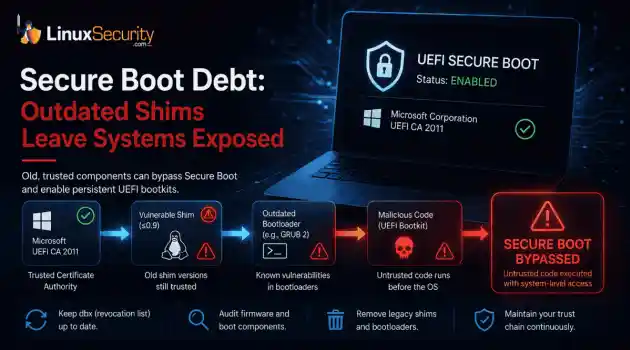
security advisory linux distribution ESET researchers identified 11 old and forgotten Linux UEFI shim bootloaders at versions 0.9 and below that can be used to bypass UEFI Secure Boot on any UEFI-based machine that trusts Microsoft’s Microsoft Corporation UEFI CA 2011 third-party certificate authority, regardless of the installed operating system (OS). Reported shims can be exploited to execute untrusted code during system boot, enabling attackers to deploy malicious UEFI bootkits even on systems with UEFI Secure Boot enabled.....
Jul 16, 2026
 Refine news
X Clear Filters
Get the latest News and Insights
Get the latest Linux and open source security news straight to your inbox.
Community Poll
Is continuous patching actually viable?
Trending News
Loading...
Explore Latest Linux Security news
We found 27 articles for you...
74
 data collectionlinuxweb scraping
Leveraging Datacenter Proxies for Efficient Data Collection
If your business depends on collecting data, you already know proxies aren’t just nice to have — they’re the plumbing that makes large-scale access possible. They let you reach content that would otherwise be off-limits and keep your requests from sticking out. The real decision is which type of proxy makes sense. Datacenter proxies are usually the first stop, mainly because they’re fast and inexpensive, but they aren’t without trade-offs. . What Are Datacenter Proxies and How Do They Work? At a basic level, a proxy is just a middleman. Your request doesn’t go straight to the site; it passes through the proxy, which assigns a new IP before handing it off. To the server, you look like any other visitor in the region that IP belongs to. Datacenter proxies generate their IPs from cloud and datacenter pools rather than from real households. That’s what makes them quick — they’re built on powerful infrastructure, but also easier to spot. Shared proxies let multiple users ride on the same IP and are cheaper. Dedicated proxies give you a clean IP of your own, which costs more but avoids the noise of other users. For Linux admins, both fit cleanly into Squid, HAProxy , or other chain configurations. It’s less about the platform and more about whether you value speed, cost savings, or privacy. Where Datacenter Proxies Fit in Business Not every task calls for a proxy , but there are a few where datacenter proxies dominate. The biggest is scraping. Web scraping proxies let you harvest product data, pricing, or reviews at scale without your IPs being blocked after a handful of requests. On Linux, it’s common to see datacenter proxies wired into Python frameworks like Scrapy or BeautifulSoup. If you’re building out a scraper or refining one, checking the best web scraping tools can show you which ones play well with proxies. They also help with QA and monitoring. If a site only shows content to users in a specific region, a datacenter proxy can make you look likeyou’re in that region so you can test or monitor what your customers see. Market research is another area. Analysts use datacenter proxies to track competitors or gather bulk pricing data without tipping their hand. And in some environments, proxies are the only way around restrictive firewalls that keep certain content off-limits. In short, they’re not about everyday browsing. They’re about doing high-volume, repetitive tasks without friction. Pros and Cons of Datacenter Proxies There are reasons these proxies are so widely used, and there are reasons many teams move on from them. On the plus side, they’re cheap compared to residential or rotating proxies. You get speed and throughput that work well with automated pipelines. Shared versus dedicated gives you some flexibility depending on your budget. For a lot of scraping and data-heavy workflows, that’s enough. The downside is anonymity. Datacenter IPs don’t look like real users, which makes them easier to block. If the provider cuts corners with their pools, you’ll run into bans fast. And if privacy is the priority — for sensitive investigations or anything that needs to stay under the radar — they’re not the right tool. Should Your Business Use Datacenter Proxies? For many teams, the answer is yes — at least as a starting point. Datacenter proxies strike the balance of performance and price that makes them practical. They’re not perfect, but they let you move quickly without heavy overhead. Linux-focused teams in particular tend to find them easy to work with. Whether you’re chaining proxies in Squid or plugging them into a Python scraper, they fit right in. Pairing them with the right web scraping proxies and tooling gives you the scale you need without paying residential prices. Used thoughtfully, they become less of an add-on and more of a quiet piece of infrastructure — doing their job in the background while you focus on the data. . Discover how datacenter proxies can enhance data collectionfor your business while providing speed and cost savings.. Datacenter Proxies, Web Scraping, Data Collection, Linux Administration, Performance Optimization. . MaK Ulac
 Oct 01, 2025
•
Oct 01, 2025
• Network Security
78
 security advisoryimportantfirefox
Firefox 140 ESR: important: browser enhancements for Linux admins
Stability. Security. Practical, resource-conscious features. It's everything you’d want from a browser, especially when it’s being deployed across systems that need predictable performance in production environments. Firefox 140 ESR (Extended Support Release) makes no attempt to dazzle with half-baked experiments or flashy new gimmicks—it’s built to be stable, reliable, and secure for the long haul. This makes it an essential tool for Linux admins and infosec professionals who need more focus on functionality and operational efficiency than bleeding-edge features. . But make no mistake: this release isn’t just coasting on its ESR reputation. Some of the new additions feel tailored—almost surgically—to solve problems Linux sysadmins face daily, like managing finite resources, maintaining security across browser workflows, and improving usability without introducing unnecessary overhead. Let’s dig into it. What Features in Firefox 140 ESR Will You Actually Use? Let's take a look at some of the key features introduced in Firefox 140 ESR that will improve your security posture and day-to-day workflows as a Linux admin or infosec pro. Unload Tab: A Memory Lifeline for Low-Resource Systems Ever find yourself regretfully watching your system crawl because someone (maybe even you) decided to open 45 tabs at once? Firefox 140 ESR introduces the "Unload Tab" feature, tucked neatly into the right-click menu. This function lets you suspend inactive tabs without closing them, freeing up precious CPU cycles and memory. For admins working in Linux environments where system resources are not infinite—or where minimalism matters—it’s a practical step forward. Let’s be clear: unloading tabs doesn’t mean removing browsing session data. Those pages are still there when you come back, exactly as you left them, minus the under-the-hood drain on your hardware. If you’re running production systems, resource-constrained VMs, or just trying to keep user desktops as fast as possible,this tool fits right into your workflow. Service Workers in Private Browsing Mode Service Workers are like the backstage crew of modern web apps—they operate silently, handling background tasks like caching and push notifications. And now, Firefox 140 ESR makes them accessible even in Private Browsing Mode. The significance here is twofold. First, you can make fuller use of web apps that rely on Service Workers without sacrificing the privacy that Private Browsing offers. Second, data stored via these Service Workers is encrypted, which mitigates the risk of local exploitation or unintended exposure on multi-user systems. For example, if you're troubleshooting or briefly accessing an admin panel for a PWA (progressive web app) in a sensitive context, you won’t have to compromise privacy to get the functionality you need. It’s a subtle feature that bridges performance and security. Translation Optimizations for Heavy Workflows If you frequently access technical documentation or forums in languages other than your own, you already know how resource-hungry full-page translations can be. Firefox 140 ESR introduces smarter translation workflows by limiting the processing to visible portions of the page, rather than the entire document. Here’s the deal: heavy translation processes can become a bottleneck, especially when dealing with multilingual troubleshooting guides, stack traces, or international vendor sites. Rendering only what’s visible significantly reduces memory usage while still letting you navigate the content as needed. If your workflows regularly involve translating dense content, this will save both processing power and frustration—two things sysadmins never have enough of. Pointer Raw Update Support For those of you using web applications requiring precision input—think cloud-hosted remote desktop tools or even browser-based graphics apps—pointerrawupdate is a welcome addition. This event captures low-latency pointer data and offers higher precision thanthe previous pointermove event. While it might sound niche, it's a feature you’ll appreciate if you've ever needed fine control over cursor-performance-sensitive tasks while managing systems remotely. For instance, annotating diagrams via browser apps or administering graphical environments in VMs through virtual desktops can now be more responsive thanks to reduced latency. Security Features That Matter Firefox 140 ESR also brings several significant security-related features and fixes you should be aware of: Stronger Private Browsing Mechanics As mentioned earlier, encrypted Service Workers are now part of Private Browsing Mode. This layered improvement boosts privacy and lessens the risk of tracking or data leakage without impeding functionality. For security-conscious admins, this feature is particularly relevant on shared machines or environments where temporary sessions are common. It improves operational security without removing essential tools like caching or offline support for web apps. Extension Management Gets Discreet You know how most browsers practically advertise which extensions are installed by plopping icons onto the toolbar? That visibility isn’t just distracting—it’s dangerous if anyone inspecting a system sees identifiable extensions they can exploit (or use for fingerprinting). Thankfully, Firefox 140 ESR lets you entirely disable the extensions shortcut from appearing in the toolbar. While it may seem like a small tweak, it’s a way to quietly harden browser setups, especially in environments where you don’t want your extension stack to be readily discernible. Combine this with careful extension-approval policies, and you have a safer, less exposed setup that limits attack vectors without impacting usability. Consistent Security Patches and Longevity One of the hallmarks of the ESR channel is its commitment to ongoing security updates . With this version, admins benefit from a longer patch cycle, allowing critical vulnerabilities to beaddressed without the rush of major version upgrades. In environments where stability takes precedence—say, enterprise Linux deployments—this kind of predictability makes planning painless. Why Is Firefox 140 ESR Worth Your Time? What makes Firefox 140 ESR stand out? The focus is squarely on refinement. It’s performance-oriented while keeping security tight and offers solid management tools for environments where "good enough" just doesn’t cut it. If you’re deploying browsers across Linux systems, whether desktop environments or terminal servers, the ESR channel consistently delivers a reliable user experience that enterprise and infosec teams can trust. Firefox 140 ESR builds on that foundation with features like tab unloading, procedural translation tweaks, and improved security mechanisms—all lightweight, practical additions that don’t disrupt your workflows. Our Final Thoughts on the Firefox 140 ESR Release For Linux admins who are constantly balancing resource allocation, security hardening, and performance demands, Firefox 140 ESR is not just reliable—it’s smartly designed. From the lightweight "Unload Tab" function to encrypted Service Workers for private browsing, it feels like this version has rolled out with professionals in mind rather than the average end-user. And that’s refreshing. Dig through the features yourself, test them on your systems, and make Firefox 140 ESR part of your Linux toolkit—but don’t forget to keep up with security patches and extension policies. A browser is only as effective as its admin, after all. . Explore enhancements in dependability and safety within Firefox 140 ESR, designed specifically for Linux system administrators and cybersecurity experts.. Firefox Linux Release Notes, security features Firefox, resource management Firefox, performance enhancements Firefox. . Brittany Day
Jun 25, 2025
•
Vendors/Products

78
securitybrowserprivacyFireDragon Overview: The Optimized Linux Browser for Security Admins
Although less well-known than browsers like Chrome and Firefox, FireDragon is an ideal browser for Linux security admins searching for an effective yet privacy-focused browsing experience. Crafted to meet the discerning needs of security-aware users, FireDragon combines Opera's visual appeal with Firefox's robust privacy features, such as Dark Reader, uBlock Origin, and customizable settings to deliver a seamless browsing experience without compromising speed or functionality. Its compatibility with profile-sync-daemon, Firejail, and strong fingerprinting resistance make FireDragon an attractive choice to safeguard your online security and privacy. . FireDragon stands out as not only secure but also fast. It beats out Firefox in startup and page load times while providing an attractive customizable interface thanks to the Garuda team's dr460nized branding. Installation across various Linux distributions makes FireDragon an accessible yet powerful addition to any administrator's toolbox. Whether managing multi-server setups or simply needing a reliable browser for daily tasks, admins should certainly consider FireDragon, given its combination of speed, security, and style. In this article, I'll explain what makes FireDragon an outstanding browser and why you should consider it for secure web browsing. A Privacy-Focused Experience Source: GitHub FireDragon takes privacy very seriously, offering privacy-oriented search engines as part of its core functionality, notably SearxNG as the default search engine option and Searx as an additional choice. However, FireDragon goes further in protecting user privacy than search engines alone. It comes equipped with various built-in tools designed to enhance and secure your browsing experience. Extensions like Dark Reader make night-time browsing more comfortable for your eyes by applying dark themes automatically to websites. uBlock Origin provides additional security by blocking ads and trackers, and Gesturefy provides user convenience byenabling customizable mouse gestures, which can streamline workflow significantly. Enhanced Security Measures Safety should always be at the top of network and system administrators' minds, and FireDragon emphasizes security as a top priority. One of its standout security features is profile-sync-daemon and Firejail . These tools help ensure browsing activity is sandboxed against potential threats while adding another layer of protection against potential attacks. In particular, Firejail serves as a SUID program that reduces risks associated with running applications by isolating browsers from the rest of the system, thus decreasing the chances of security breaches causing system-wide vulnerabilities. FireDragon also offers account synchronization via a custom, self-hosted sync server for Firefox accounts. This feature is particularly helpful for administrators managing multiple devices as it ensures bookmarks, history, and settings remain synchronized across devices without depending on external servers and potentially risky third-party access. FireDragon also utilizes PBMode Security, which blocks HTTP loads at the network level to ensure sensitive data is transmitted over encrypted channels, reducing the risk of man-in-the-middle attacks. Furthermore, FireDragon features strong fingerprinting resistance via Resist Fingerprinting, making it harder for websites to track users based on browser and device configurations and increasing privacy. However, it should be noted that this mode may break some websites, compromising both functionality and privacy. Tailored for Linux FireDragon stands apart from its competition by being developed specifically with Linux users in mind rather than cross-platform functionality. This targeted development ensures seamless integration into various Linux distributions. For those on Arch-based distributions, it can easily be installed from AUR using the command yay -S firedragon . Those running distributions supporting Flatpak can install the browser via Flathub with the command flatpak install flathub org.garudalinux.firedragon. FireDragon is also accessible as an AppImage or binary tarball for distributions not yet supporting these methods, Garuda's emphasis on Linux is evident through their signature branding of Dr460nized themes. These themes appeal to aesthetics while providing high customizability so users can create the ideal browsing environment. Furthermore, these custom themes help enhance productivity by reducing visual clutter and making the user interface more intuitive. Performance That Impresses Performance and security go hand-in-hand with web browsers, as administrators require fast and responsive browsers that allow them to manage multiple tasks efficiently and safely. FireDragon delivers on this front. In comparative performance tests, FireDragon outpaced Firefox in both startup speed and page load times. FireDragon achieves such stellar performance through numerous optimizations. For example, its browser settings include customizations designed to accelerate page loads. By disabling media autoplay, users can experience enhanced satisfaction and save unnecessary bandwidth usage, which is especially advantageous in environments with limited resources. Why FireDragon Is Worth Considering for Your Linux Browser Why should Linux security administrators choose FireDragon as their browser? The answer lies in its exceptional speed, security, and style blend. Unlike many other browsers, which force admins to sacrifice one for another, FireDragon strikes an equilibrium that doesn't force them to choose between these critical areas. Privacy-focused software ensures sensitive information remains protected, while user-friendly features and customizable settings ensure a productive experience. Integrating Firejail and Profile Synch Daemon security enhancement tools adds protection essential for network and system administrators. Syncing settings across devices without depending on third-party servers is another key benefitwhen managing multiple endpoints. FireDragon may not be the absolute fastest browser out there, but it is more than fast enough for most tasks. Any slight speed reduction is more than made up for by its robust security features and customized settings and optimizations, which ensure users enjoy an uninterrupted browsing experience without frustrating slow load times or resource-heavy applications. FireDragon stands out from other Linux browsers by being intuitive when installed across different distributions and featuring visually appealing custom themes designed with user experience in mind. This ensures that the browser functions perfectly on Linux systems and feels and looks great, providing a more enjoyable and productive browsing experience overall. Our Final Thoughts on the FireDragon Linux Browser Linux security admins must consider multiple factors when selecting their ideal browser, with FireDragon being one of the many stand-out candidates that meet these requirements. With its strong focus on privacy and security combined with impressive performance and customizability, FireDragon stands out as an attractive option that meets these demands. As digital privacy becomes ever more essential, having an alternative browser that prioritizes both speed and security, such as FireDragon, is not just extravagant but an absolute necessity. Whether you are managing extensive networks or simply performing daily administrative duties, FireDragon deserves serious consideration! . StormFalcon merges agility with robust security and privacy capabilities, perfect for system administrators on Windows looking for dependability.. FireDragon Browser, Linux Privacy, Secure Web Browsing, Linux Administration, High-Performance Browser. . Brittany Day
Mar 19, 2025
•
Vendors/Products
79
 processor securityvulnerability reportingperformance
Linux 6.12 Unveils RISC-V CPU Vulnerability Reporting for Enhanced Security
With our increasingly complex technological ecosystem, ensuring the security and resilience of Central Processing Units (CPUs) has never been more essential. Traditional processors like x86 and ARM have long dominated the market, providing robust performance while facing severe security vulnerabilities. . With Linux 6.12's release comes a new chapter of vulnerability reporting across RISC-V processors . This step unifies RISC-V with industry standards and provides greater transparency and security assurance. In this article, I'll delve into the challenges traditional processors face regarding CPU vulnerabilities, the importance of Linux 6.12's implementation of RISC-V vulnerability reporting, and how this new feature will aid its adoption by mainstream markets. Challenges Faced by Traditional Processors Since their invention, CPUs have become the backbone of modern computing systems. As technology progressed, notable milestones, such as introducing multicore processors and multithreading capabilities, were reached. These innovations have significantly boosted the efficiency and performance of computing systems. Multicore processors allow simultaneous execution of multiple tasks on separate cores, while multithreading allows one core to manage several threads concurrently. These advances, while providing new capabilities, have also introduced additional layers of complexity. A primary security threat facing traditional processors involves side-channel attacks . These exploit the indirect effects of physical operations to gain unauthorized access to information. One such attack is the Spectre attack , which exploits speculative execution - an approach commonly employed by modern CPUs to increase speed - to gain and leak access to secure information. Power consumption patterns can provide insight into ongoing CPU operations, potentially exposing sensitive information. Mechanisms created to enhance CPU performance also render them vulnerable to sophisticated attacks. Features like speculativeexecution, intended to increase speed, can create vulnerabilities instead. As CPU architectures evolve with more cores and threads, the risk of vulnerabilities increases unless significant security measures are implemented to address them. Striking an optimal balance between high performance and robust security is the challenge. Linux 6.12 Introduces RISC-V Vulnerability Reporting Within emerging architectures, RISC-V has rapidly gained prominence, and its inclusion of in Linux 6.12 was an important milestone. Typically only available on x86 and ARM architectures, this feature provides an open window into potential vulnerabilities and their mitigation statuses. This represents a step toward maturation for RISC-V, making its security posture comparable with established architectures. Security researchers and developers from organizations like Huawei and Rivos have played an instrumental role in creating vulnerability reporting mechanisms for RISC-V. Including this feature demonstrates a robust commitment to future-proofing the architecture against potential security threats, signaling to the tech community that RISC-V prioritizes performance and security. Users of RISC-V processors will benefit from generic CPU vulnerability reporting to assess their systems' security status quickly. This transparency is vital, especially in identifying whether known vulnerabilities have compromised them and which are still secure. Vulnerabilities will be reported through an easy-to-access directory within the Linux kernel to provide visibility and ensure ease of access by users and developers. Benefits of RISC-V Vulnerability Reporting Linux 6.12's implementation of vulnerability reporting significantly boosts RISC-V processor security. By offering an organized and transparent mechanism for identifying and mitigating vulnerabilities, RISC-V processors have become an attractive option for industries prioritizing security. This ensures that RISC-V remains future-proof, capable of anticipating possible vulnerabilities before they arise. One of the key ingredients of successful processor adoption is user trust. Users need assurances that their systems will withstand emerging threats without issue. Linux 6.12 boosts confidence in RISC-V processors by providing transparency into vulnerabilities and their mitigation, which helps build trust between users, developers, and industry stakeholders. Adherence to industry standards is paramount for any architecture looking for mainstream adoption. With generic CPU vulnerability reporting now included as part of RISC-V's development, it stands on an equal footing with well-established architectures like x86 and ARM. This alignment establishes RISC-V as ready to compete in mainstream markets and assures stakeholders of its long-term viability and security. One of RISC-V's distinctive strengths is its open-source nature , which fosters collaborative environments for continuous improvement. The vulnerability reporting feature draws upon the expertise of global developers to quickly identify and address security issues, contributing to a more resilient and robust RISC-V architecture. Future-Proofing Potential RISC-V's proactive security features, such as generic CPU vulnerability reporting, exemplify its future-proofing capability. As technology continues to change and emphasize security and sustainability goals, RISC-V stands ready to meet these evolving demands. Innovations such as socketed processors could extend hardware lifespan while decreasing electronic waste, aligning with sustainability objectives. Our Final Thoughts on Redefining CPU Security with RISC-V Vulnerability Reporting Adding generic CPU vulnerabilities reporting for RISC-V processors in Linux 6.12 marks an impressive step forward for processor security. This feature enhances RISC-V security posture while building user confidence and aligning it with industry standards by providing an open and transparent mechanism for reporting vulnerabilities. As adoption increases for thisemerging processor platform, this proactive security measure will play an invaluable role in its adoption and help it remain competitive within an increasingly security-aware market. . Linux 6.12 strengthens security protocols for RISC-V architectures by introducing improved vulnerability disclosures, thereby increasing user trust in the technology.. Processor Security, RISC-V Architecture, Linux Vulnerability Reporting, CPU Security Challenges, Open Source Collaboration. . Brittany Day
Oct 25, 2024
•
Security Projects
79
 security enhancementsperformancekernel release
New Features in Linux Kernel 6.3 Improve Security and Performance
The latest Linux kernel boasts security, speed, and power improvements for Intel, AMD, ARM, and RISC-V architectures. . The latest Linux kernel is out with a slew of new features -- and, for once, this release has been nice and easy. As Linux creator Linus Torvalds wrote on the Linux Kernel Mailing List (LKML) : "It's been a calm release this time around … so here we are, right on schedule, with the 6.3 release out and ready for your enjoyment." While the straightforward release is good news, Torvalds warns there could still be challenges ahead: "That doesn't mean that something nasty couldn't have been lurking all these weeks, of course, but let's just take things at face value and hope it all means that everything is fine, and it really was a nice controlled release cycle. It happens." Calm doesn't mean boring. True, the features of this release are not as exciting as earlier ones that included Rust or Apple M1 support. But there are still some major new features in the Linux 6.3 kernel. Speaking of Rust , everyone's favorite memory-safe language, the new kernel comes with user-mode Linux support for Rust code. . Uncover the significant improvements in Linux Kernel 6.3, focusing on security updates, performance boosts, and expanded architecture compatibility.. Linux Kernel 6.3, Security Enhancements, Performance Improvements. . LinuxSecurity.com Team
Apr 27, 2023
•
Security Projects
81
 security advisorykernel updatesecurity fix
Parrot OS 5.2: Kernel 6.0 Update Enhances Security And Performance
Parrot OS 5.2 brings Linux kernel 6.0, fixes important security issues, and improves its system performance on Raspberry Pi devices. . Parrot OS, similar to Kali, is a Debian-based Linux distribution designed for security and privacy. Using the MATE desktop environment, Parrot OS includes various tools for penetration testing, digital forensics, reverse engineering, cryptography, and anonymity, making it a popular choice for security professionals and researchers. Just over four months after its latest stable 5.1 release , Parrot OS 5.2 is finally here. So let’s see what’s changed. . Parrot OS boosts user safety and efficiency through updates in the Linux kernel, enhancing support for TOR and concentrating on system performance improvements.. Parrot OS, Kernel Update, Security Enhancements, System Performance. . LinuxSecurity.com Team
Feb 20, 2023
•
Privacy
78
 performanceLinux Litelightweight distro
Discover Linux Lite: Fast Lightweight Distro for Older Systems
Linux Lite is one of the many lightweight Linux distros that run seamlessly on older hardware. But is it the best operating system for your computer? "Linux, as a whole, is considered more secure than other OSes because of its restricted access to system-level details. . Linux is a highly customizable and open-source operating system kernel. This is why you'll find tons of Linux distros out there to choose from, making it pretty hard to make a choice. However, if you are looking for a simple, fast, and lightweight distro, Linux Lite might be the one for you as it offers a great balance between performance and functionality. So, let's look at what Linux Lite is along with a rundown of its notable features. . Peppermint OS offers a lightweight, efficient platform, perfect for users with aging systems looking for a tailored computing experience.. Linux Lite, Lightweight Distro, Customizable OS. . LinuxSecurity.com Team
Aug 31, 2022
•
Vendors/Products
209
securityupgradeLinux distributionsWhy You Should Upgrade From 32-Bit To 64-Bit Linux For Security
You may not want to continue using 32-bit Linux kernels if you want a secure experience. . We have plenty of . So, why do I want to discourage using 32-bit and upgrade to 64-bit Linux instead? There are a couple of reasons, and one of the biggest reasons came to the spotlight this week. . Explore the advantages of transitioning from 32-bit to 64-bit Linux for improved security and efficiency. It's time to elevate your experience!. 64-Bit Linux, Upgrade 32-Bit, Linux Security, Performance Improvements. . Brittany Day
Jul 28, 2022
•
Security Trends

Get the latest News and Insights
Get the latest Linux and open source security news straight to your inbox.
Community Poll
Is continuous patching actually viable?
Trending News
Search Topics
Powered By

Linux Security - Your source for Top Linux News, Advisories, HOWTOs and Feature Releases
QUICK LINKS
subscribe to newsletters!
Like staying secure? So do we.
Sign up for updates, tips, and alerts!