Explore top 10 tips to secure your open-source projects now. Read More
×



Server Security data privacy automation
data privacy automation Every system admin has lived through the same Monday morning ritual. A queue of forty tickets, half of them password resets, permission errors, or disk space warnings that any experienced technician could resolve in under two minutes. The other half require actual judgment. For years, automation promised that software would eventually sort the two apart on its own. That promise is now being tested in production Linux environments. . Early results are reshaping how IT teams think about tier-1...
 Jul 17, 2026

Privacydata collection automation
data collection automation You're running a web scraping project to collect pricing data from e-commerce sites. You set up a pool of datacenter proxies, launch your scripts, and within minutes — banned . CAPTCHAs everywhere. Your data pipeline stops before it really begins. . It's a frustrating scenario that plays out daily in ad verification, market research, and multi-account management. The website doesn't know you're doing legitimate research or monitoring. It just sees traffic coming from IP ranges it recognizes as...
Jul 17, 2026

Security Trends security advisory social engineering
security advisory social engineering Business Email Compromise used to be a numbers game — mass-blasted emails, broken English, an obvious "URGENT WIRE TRANSFER" subject line. That era is over. Generative AI has turned BEC into a tailored, low-noise operation that mimics writing style, voice, and even video presence. This piece looks at what's actually changed under the hood, what defenders are testing in response, and why so many organizations are still structurally unprepared for it. . The Infrastructure Problem Nobody Wants to...
Jul 17, 2026

Security Trends cybersecurity Linux documentation
cybersecurity Linux documentation Linux operating systems have gained prominence due to their stability, adaptability, and excellent security options. In the case of developing documentation, designing cybersecurity dashboards, or educational material, visuals are of vital importance when it comes to making things clear. The use of icons allows one to understand the message regarding alerts, authorization, encryption, authentication, or the state of the system just by looking at the visual cue without having to read long...
Jul 17, 2026
Security Vulnerabilities security advisory linux distribution
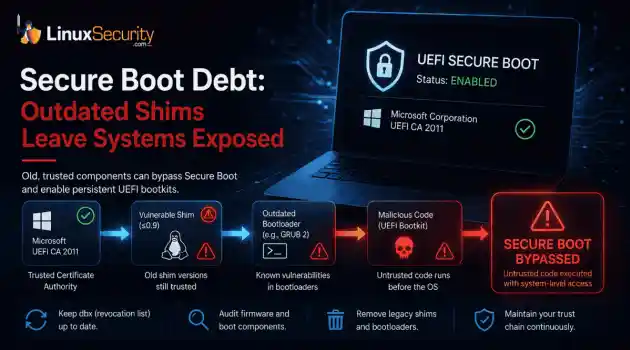
security advisory linux distribution ESET researchers identified 11 old and forgotten Linux UEFI shim bootloaders at versions 0.9 and below that can be used to bypass UEFI Secure Boot on any UEFI-based machine that trusts Microsoft’s Microsoft Corporation UEFI CA 2011 third-party certificate authority, regardless of the installed operating system (OS). Reported shims can be exploited to execute untrusted code during system boot, enabling attackers to deploy malicious UEFI bootkits even on systems with UEFI Secure Boot enabled.....
Jul 16, 2026
 Refine news
X Clear Filters
Get the latest News and Insights
Get the latest Linux and open source security news straight to your inbox.
Community Poll
Is continuous patching actually viable?
Trending News
Loading...
Explore Latest Linux Security news
We found 9 articles for you...
210
 open-sourcelinuxsecurity monitoring
AI Coding, Rust, and the Linux Security Tradeoffs We Have to Manage
I keep seeing Rust show up in places it never could have five years ago. Kernel-adjacent tools. Security agents. Parsers that used to be a pile of careful C and comments warning you not to touch anything. It’s not because developers suddenly got more patient or because everyone decided memory safety was fun. The cost equation changed, and AI coding is a big part of why. . Linux security has lived with memory corruption for a long time because there wasn’t a realistic alternative. C was fast, portable, well understood, and already everywhere. If you wanted something to run close to the kernel, parse untrusted input at scale, or ship across distributions, you wrote it in C and accepted the risk. We built mitigations around that reality. ASLR, stack canaries, fuzzing, and crash monitoring. It worked well enough to keep systems running, not well enough to make the problem go away. What’s different now is not that Rust suddenly became more correct, but that AI-assisted coding lowered the friction that kept it out of security-critical paths. Writing Rust is cheaper in time and attention than it used to be. Porting small but risky components is no longer a multi-quarter project. That shift matters for Linux security because it changes where memory safety actually shows up, and where it doesn’t. This isn’t a story about safer code by default. It’s about how risk moves when Rust adoption accelerates, what new blind spots show up alongside the old ones, and how that affects policy, monitoring, and review. By the end, you should be able to look at AI coding in your environment and decide whether it meaningfully reduces risk for you, or just changes the shape of what you have to watch. Why Rust Was Always the Right Answer but Rarely the Chosen One If you look back at most serious Linux incidents over the last couple of decades, memory corruption shows up early in the chain. Sometimes it’s the initial foothold. Sometimes it’s the privilege escalation . Use-after-free, bufferoverflows, integer wraparounds that turn into writes where they shouldn’t be. You start to see the trend once you’ve read enough advisories and postmortems. Rust is significant because it addresses that entire class of failures at the language level. The ownership model, the borrow checker, and the default refusal to let memory be shared or freed unsafely. Those guarantees line up almost perfectly with the problems that dominate Linux security exploit paths. Not in theory. In the actual bugs that keep getting recycled under different CVE numbers. The problem was never the promise. It was the cost. Writing Rust took longer, especially for teams that had spent years thinking in C. Review was harder because fewer people could confidently say what “good” looked like. Onboarding a new engineer meant weeks of friction before they were productive. When you’re shipping kernel modules, agents, or low-level parsers, that friction matters more than ideal properties. Security teams didn’t push back very hard because we don’t usually own language choices. We inherit them. We review what ships, we monitor what runs, and we clean up what breaks. When product teams said C was the only practical option, that was usually true. So Rust stayed in the category of “clearly better, operationally unrealistic.” That’s why adoption stalled for so long. Rust wasn’t blocked by technical limits. It was blocked by timelines, staffing, and the very real cost of slowing delivery. Risk stayed high not because safer tools didn’t exist, but because they didn’t fit how Linux systems were actually built and maintained. What AI Coding Actually Changes About Rust Adoption The shift didn’t come from a breakthrough in the language itself. It came from lowering the amount of time a human has to spend fighting the language before getting something useful on the screen. That’s where AI coding shows up in practice. Developers still need to understand what they’re building, but they no longer have tointernalize every rule up front. AI tools smooth over the early friction. They suggest ownership patterns, fix borrow checker errors, and scaffold structures that would have taken a lot of trial and error before. For teams that bounced off Rust once and never came back, that matters. Here’s what I see changing on real projects: Small C components that handled untrusted input are getting rewritten in Rust instead of endlessly patched. New security tooling is being started in Rust by default, not as an experiment. Bindings and glue code that used to block adoption are easier to generate and iterate on. Engineers who aren’t Rust specialists can still produce working, reviewable code. First versions ship sooner, even if they’re not perfect. This isn’t about eliminating mistakes. It’s about making a first pass viable. AI-assisted Rust code still needs review, and it still contains bugs, but the barrier to entry is low enough that teams are actually crossing it. As an admin, that means Rust will start showing up in production paths faster than your policies and assumptions might expect. How This Shifts Risk in Real Linux Environments When Rust actually replaces unsafe C in a code path, the risk profile changes in a way that’s hard to argue with. Whole categories of memory corruption just stop being reachable. Fewer crashes show up in logs. Some exploit techniques quietly stop working. That part is real, and it’s measurable. The shift gets messier once you look at how this lands in production. Most environments don’t flip from C to Rust cleanly. They end up with mixed codebases, FFI boundaries , and small pockets of unsafe code that still matter a lot. Those seams become the new points of failure, and they’re easier to miss if reviewers relax too early. AI-generated Rust adds another layer. The code may be memory-safe and still wrong. Logic bugs, trust failures, and bad assumptions don’t trigger the borrow checker. They compile cleanly and run fine untilsomeone figures out how to abuse them. If you’re used to crashes as an early warning sign, that signal gets weaker. What I see instead is a gradual shift in exploit style. Less emphasis on smashing memory. More emphasis on abusing state, inputs, and trust boundaries. From a Linux security perspective, that means fewer obvious failure modes and more subtle ones that only show up under specific conditions. The risk doesn’t disappear. It moves. Monitoring, review, and threat models need to move with it, or you end up feeling safer while missing a different class of problems entirely. Policy Implications for Security and Platform Teams Once Rust starts showing up more often, the first thing that breaks is the policy that assumes language equals risk level. A lot of standards quietly treat memory-safe languages as “lower risk” and move on. That shortcut doesn’t hold up once AI coding is involved. Rust needs different rules, not lighter ones. Unsafe blocks are still code you have to reason about. FFI boundaries still cross into C. AI-assisted generation means parts of the codebase may not have a clear human author who fully understands every decision. If policy doesn’t account for that, review becomes symbolic instead of real. These are the adjustments I see teams needing to make: Stop treating Rust as automatically safe and start treating it as conditionally safer. Require disclosure when AI coding is used on security-critical components. Define review expectations for unsafe blocks and generated code, not just handwritten logic. Update dependency policies to account for fast-growing Rust crate trees. Log and justify exceptions instead of letting them blend into the baseline. Hold vendors to the same audit standards, regardless of language. The practical change is subtle but important. Policy shifts from trusting the toolchain to enforcing understanding. That’s the difference between reducing risk and just feeling better about it. Monitoring and DetectionDon’t Get Easier, They Get Different One of the first things teams notice after introducing more Rust is that some of the old signals quiet down. Fewer segfaults. Fewer obvious memory crashes. Less noise from components that used to fail hard under bad input. That can feel like progress, and it is, but it also removes a class of early warning you may have relied on without realizing it. From a Linux security standpoint, the fundamentals don’t change. Audit logs still matter. Syscall patterns still matter. Process behavior over time still tells you more than the language a binary was written in. What changes is where the anomalies show up. Rust binaries under attack often fail cleanly or keep running while doing the wrong thing, which means you’re watching behavior instead of crashes. Tooling has to keep up with that reality. Static analysis that only understands C and C++ starts missing things. Dependency scanners need to handle Rust crates with the same rigor as system libraries. Runtime monitoring has to stay focused on what the process is doing, not whether it’s “supposed to be safe.” The practical adjustment is in tuning and expectation. Alerts based on crash frequency may lose value. Behavior-based detection becomes more important. In Linux security, that’s not a downgrade, but it does mean you can’t relax just because the logs look quieter than they used to. Where AI Coding Makes Things Worse If You’re Not Careful The biggest failure mode I see is overconfidence. Rust compiles, tests pass, and everyone relaxes a little. When AI coding is involved, that confidence can show up even faster, because the code looks structured and intentional even when nobody fully understands it. Loss of understanding is the real risk here. If a critical path was generated, lightly edited, and then shipped, reviewers may approve it based on surface correctness. Unsafe patterns get repeated because they “worked last time.” Small helper crates multiply because generating one is cheap.Over time, the system becomes harder to reason about, not easier. These are the patterns that tend to show up together: AI-generated Rust that no one feels responsible for long-term. Unsafe blocks copied across projects without re-evaluating context. Dependency trees that grow faster than review capacity. Subtle logic bugs that survive because nothing crashes. Blurred authorship that complicates accountability during incidents. Review fatigue caused by code that looks correct at a glance. None of this is unique to Rust, but the combination of AI assistance and a “safe by default” language makes it easier to miss. The fix isn’t banning tools. It’s keeping review discipline tight even when the code feels cleaner than what you’re used to. What I’d Change Right Now as a Linux Admin or Security Lead I wouldn’t treat this as a future problem. Rust is already landing in places that matter, and AI coding accelerates that, whether you endorse it or not. The response doesn’t need to be dramatic, but it does need to be deliberate. The first change is in how risk is modeled. Memory-safe code paths should be called out explicitly, not assumed. When something is written in Rust, I want to know where unsafe blocks exist, where C boundaries are crossed, and what assumptions the code is making about inputs and state. That’s information you can track. Visibility into AI coding matters for the same reason. Not to police developers, but to understand where human review needs to slow down. Generated code isn’t bad, but it should be treated like work from a fast junior engineer. Useful, productive, and always in need of oversight. From there, the investments are practical. Rust-aware static analysis and dependency tooling. Reviewer training focused on recognizing bad Rust, not just good intentions. Metrics around unsafe usage and dependency growth that show up in the same dashboards as everything else. The change isn’t about adopting a new language or tool. It’sabout adjusting decisions and oversight to match how software is actually being produced now. If you do that, AI coding can reduce risk in real Linux environments. If you don’t, it just changes how the failures arrive. . Explore the impact of AI-assisted Rust coding on Linux security practices and managing new risks.. Rust Adoption, AI Coding, Linux Security Policy, Memory Safety, Security Monitoring. . Brittany Day
 Feb 03, 2026
•
Feb 03, 2026
• Security Vulnerabilities
210
 security advisorylinuxautomation
TARmageddon: async-tar Vulnerability Exposes Linux Archive Extraction Risks
A path traversal flaw in the Rust async-tar library has people looking harder at archive extraction security on Linux. Researchers are calling it TARmageddon, which fits. It’s not a kernel panic or a zero-day bomb, but it’s the kind of quiet bug that ends up everywhere — build servers, CI pipelines, container images. . The problem’s simple. async-tar doesn’t properly sanitize file paths when unpacking a tar file. A crafted .tar file can slip files outside the intended directory and overwrite system data. No one’s shown a clean remote code execution (RCE) path yet, but that doesn’t matter much if your build process just wrote an attacker’s file to /etc/cron.d. CVE-2025-62518 is the provisional tag floating around. Whether or not it sticks, the point stands — these small libraries sit deep in automation stacks, and one unsafe assumption can cascade across thousands of systems. This isn’t news to most admins. Linux archive security has always been more about habits than patches. But TARmageddon is a good reminder of how easy it is to trust an archive you shouldn’t. How the async-tar Vulnerability Works on Linux Here’s what’s known about how it happens and where it shows up. Vulnerability Overview The Rust async-tar library handles archive extraction asynchronously. That’s great for speed but less so for safety. When unpacking a tar file, it doesn’t fully sanitize directory paths. A malicious archive can slip entries like ../../etc/passwd into the stream, and the library will write them outside the target directory. It’s a classic path traversal vulnerability. In most tests, that means files get overwritten like configs, scripts, whatever the process has write access to. No confirmed Linux remote code execution yet, but overwrite is usually step one in the chain. The bug shows up in projects that call async-tar directly or through build tooling that depends on it. For the technically inclined, the library’s behavior is documented in the async-tar library documentation . Affected Components and Environments You’ll see exposure mainly in Rust-based tools and CI/CD jobs using async-tar or its forks like tokio-tar. Anything unpacking untrusted tar files— containers, build pipelines, or automated deployment tasks can be hit. Maintainers working with tokio-tar have already pushed a fix, outlined in the astral-tokio-tar security advisory . A safer alternative for new projects is tar-rs, which includes proper path sanitization by default. This isn’t the first time archive libraries have failed this way. A nearly identical bug appeared in npm’s tar-fs module, as noted in the Debian security update for node-tar-fs path traversal . Different language, same blind spot, assuming file paths can be trusted. Technical Reference There’s no officially assigned CVE yet. Some reports reference CVE-2025-62518, but that listing hasn’t been verified. The CVE-2025-62518 vulnerability details page summarizes what’s been discussed publicly so far. Researchers found the issue during static analysis of unmaintained Rust crates, a reminder that dependency drift is its own risk. Once a library drops maintenance, small bugs like this one can hide for years. Why Tar File Extraction Security Matters on Linux Every admin unpacks a tar file without a second thought. It’s part of the muscle memory of Linux work. But that routine is exactly where this kind of mistake hides. Archive Extraction Risks in Linux Systems Tar archives run everything under the hood — packaging, backups, container layers, you name it. When that system breaks, it’s not flashy. It’s quiet. A build fails—a config change. Something odd starts running where it shouldn’t. A bad archive doesn’t need fancy malware. If it overwrites a script or drops a new file into a live directory, it’s already won. One poisoned tar file in a CI cache can move through a fleet before anyone notices. That’s why this bug lands squarely in Linux supply chainsecurity. Every automated build that extracts archives inherits the trust model of the tool doing the unpacking. Most of the time, that means CI/CD security is assumed rather than verified. Path Traversal Exploits and Real-World Parallels We’ve seen this movie before. The Python tarfile bug, CVE-2007-4559, sat unnoticed for years while developers kept shipping vulnerable code. npm’s tar and tar-fs had similar holes. Even core tools like GNU tar have cracked — see the Ubuntu GNU tar denial-of-service vulnerability . The async-tar issue just keeps the trend going. Same pattern, different stack. It’s not that engineers don’t know better. It’s that archive handling feels like solved work — until a path traversal vulnerability shows it isn’t. These flaws all fall under a familiar bucket in the NVD vulnerability classification framework : improper input validation. The oldest bug there is trust. Broader Linux Security Implications Automation makes life easier and attacks faster. Build jobs, containers, and deployment scripts unpack archives nonstop, sometimes with root rights, sometimes without a second thought. A single untrusted archive in that flow can rewrite a config, poison a container image, or slip into production. It’s not a headline-worthy hack. It’s just lazy archive extraction, security meeting real-world consequences. That’s the uncomfortable part of Linux hardening — we’re often defending against ourselves. Mitigation and Response: Securing Tar Extraction on Linux If async-tar exposed one thing, it’s that archive handling still needs guardrails. Here’s what actually helps when closing path traversal vulnerabilities in day-to-day Linux work. 1. Replace Vulnerable Libraries If you’re using async-tar or tokio-tar, stop. Switch to tar-rs , which includes proper path sanitization and is still maintained. It’s a drop-in option for most Rust tools, but more importantly, it’s alive. Run dependency scans often. Old or abandoned cratesare how these bugs stay hidden for years. cargo-audit and RustSec checks catch most of them. 2. Avoid Root Extraction Don’t run tar commands as root unless you enjoy rebuilding servers. Run extraction through a limited service account or inside a container with tight file permissions. Even a small tar file can overwrite critical configs if it runs with full privileges. 3. Sandbox Archive Operations Isolation beats cleanup every time. Use systemd-run --user --pty to launch a temporary environment, or go further with bubblewrap . Point the writable directory somewhere safe — /tmp/build or /work — and keep everything else read-only. It takes an extra command, but it cuts off most sandbox escape routes before they start. 4. Validate Before Extraction Never trust what you haven’t looked at. List archive contents first: tar -tvf archive.tar tar -tvf archive.tar Then extract safely: tar --one-top-level --restrict -xf archive.tar tar --one-top-level --restrict -xf archive.tar Those flags limit where files land and prevent accidental writes outside the target directory. 5. Automate Checks in CI/CD Don’t rely on memory. Add scripts that flag unsafe tar usage or call out unmaintained dependencies. Verify every archive source — mirrors, third-party packages, automated downloads. Most CI/CD pipelines already parse manifests; add validation before unpacking anything. Follow vendor updates when they land, like the Fedora advisory for astral-tokio-tar fix (FEDORA-2025-5e50082948) . The safest Linux hardening stance treats every archive as untrusted. Combine sandboxing, path sanitization, and strict tar command flags. That alone blocks most remote code execution attempts born from sloppy archive extraction. It’s not elegant, but it works, and that’s what counts. Conclusion: Reinforcing Linux Archive Extraction Security If TARmageddon showed anything, it’s that even familiar tools can become attack surfaces when the basics are ignored.async-tar wasn’t malicious, just unguarded — and that’s often worse. A single unchecked path can undo every other layer of defense on a system that looks hardened from the outside. The real takeaway is simple: treat every .tar file as untrusted input. Most remote code execution stories don’t start with zero-days; they start with shortcuts — missing flags, root extractions, and unreviewed scripts. Mitigation isn’t just about patching or replacing a crate. It’s about verifying every tar command, automating checks, and keeping privileges narrow enough that one bad archive can’t reach anything that matters. Sandboxing and privilege separation still win over theoretical fixes every time. Admins and DevOps teams should take this moment to audit the quiet stuff — build jobs, cron tasks, Dockerfiles — anything that extracts or handles archives. Move those processes into safer lanes with bubblewrap or systemd-run , and assume that tomorrow’s package might not be clean. Long-term, this is about supply chain security. Verifying not just what code runs, but how it arrives. It’s a small shift in mindset, but it’s the one that keeps your environment boring — and boring, in security, is the goal. For reference, LinuxSecurity.com has tracked similar issues before, like the Python tarfile vulnerability affecting 350,000 projects . The patterns haven’t changed much — only the toolchains have. . Explore the TARmageddon vulnerability in async-tar impacting archive extraction on Linux with vital security tips.. async-tar security, Rust vulnerabilities, archive extraction security, path traversal exploits, container security. . MaK Ulac
Oct 24, 2025
•
Security Vulnerabilities

78
 security advisoryUbuntusudo
Ubuntu 25.10 introduces Rust-based sudo for improved security features
Ubuntu 25.10 is switching up something we admins use practically every day—sudo. Yep, that trusty command-line companion we run for everything from installing packages to tweaking system settings is getting a replacement. Well, it's not exactly a replacement; it's more like a rewrite. Canonical’s moving from the decades-old C-based version to a Rust-based implementation , and honestly, it’s not just some background tweak you’ll never notice. There’s more going on here than you’d expect, and it’s a shift you’ll probably want to keep on your radar. . Now, Rust might seem like just another buzzword if you’ve been ignoring all the noise about how safe and modern it is, but the switch from C to Rust with sudo isn’t just about trendy programming languages or security posturing. It’s about rethinking a tool that’s basically glued into every admin's workflow, and there are real-world implications for stability and safety here. Maybe you’re already thinking, “Okay, do I need to worry about compatibility or some weird quirks popping up?” It's a legitimate question, and we’ll dive into that. But for now, let’s just say this move is worth your attention, even if you’re skeptical of change—or just already tired of typing "sudo" for the thousandth time today. Why Switch to Rust? First things first: you’re probably wondering why Canonical suddenly decided to rewrite a tool that has been rock-solid (for the most part) for decades. The short answer: security. Rust, unlike C, is built with memory safety baked into its DNA . If you’ve ever stayed up late patching a vulnerability caused by things like buffer overflows or use-after-free bugs, you’ll appreciate what this means. Rust doesn’t let those mistakes happen in the first place—it’s like having a safety net you don’t even notice is there until something tries to go horribly wrong. This change isn’t about jumping on the “modern programming language” bandwagon. It’s a deliberate move to reducesecurity headaches across the board. Rust is smart. It scans for nasties at compile time—so by the time code is running on your system, the odds of low-level bugs being exploitable drop dramatically. And frankly, tools like sudo—which basically hold the keys to the kingdom for elevating permissions—can’t afford to be anything less than airtight. Will Anything Actually Change for You? Here’s the good news: if you already know how to use sudo, there’s nothing new to learn. The syntax? Exactly the same. Whether you’re enabling admin rights with a quick sudo apt update or doing something gnarly like a one-liner shell escape, the core functionality doesn’t change. This isn’t some massive shakeup that’ll force you to rewrite all your scripts or rethink your workflows. But, and this is important— sudo-rs isn’t aimed at being a 1:1 replacement. It’s taking a “less is more” approach. Some obscure features from the original sudo have been culled. Don’t panic just yet; Canonical’s keeping the legacy C-based sudo available in the archives for anyone who’s dependent on some niche functionality. If you’ve got custom systems using funky sudo configurations, you’ll want to test things out before you jump in headfirst. Security Features Admins Will Appreciate Let’s talk about the stuff sudo-rs brings to the table that might make life a little easier—or at least harder for attackers. First off, there’s the reduced attack surface. Rust’s memory safety features mean vectors like memory misuse, overflows, and dangling pointers are essentially squashed. For a tool that deals directly with privilege escalation, that’s huge. You don’t want something that lets attackers slip through cracks—it should slam the door in their faces. Then there’s improved NOEXEC support. This will help lock down shell escapes to prevent privilege escalation shenanigans. If you’ve dealt with attackers trying to spawn shells from tools they weren’t supposed to, this feature isyour friend. For anyone deploying AppArmor profiles, sudo-rs integrates like a champ. It’s better aligned with modern application confinement frameworks, which makes it ideal for locking down environments while keeping a closer lid on privileges. And here’s a nice touch for organizations that are slow to upgrade kernels—sudo-rs supports pre-Linux 5.9 kernels. That’s welcome news for those of us still clinging to older LTS versions like Ubuntu 20.04 for stability reasons. Things to Watch for I’ve got to be upfront: no transition is perfect. While sudo-rs looks solid on paper, there are still a few things that might trip folks up: Missing Features: Some less obvious functionality from the old sudo didn’t make the cut in sudo-rs. Stuff like sudoreplay (great for auditing command logs) or SELinux support isn’t here yet—and those could be deal-breakers for certain enterprise setups. If you rely on those, hold tight for updates. Testing Phase: Canonical’s made it clear they want feedback. This is where you come in. Testing sudo-rs in staging environments could help surface problems before the tool becomes mandatory in Ubuntu 26.04 LTS. Throw it on some non-critical systems and see how it behaves with your workflows. Frankly, this is one of those situations where the transition might seem invisible—but under the right circumstances, small incompatibilities could jump out when you least expect them (looking at you, 3 a.m. outages). The time to find those snags is before sudo-rs becomes the default. The Bigger Picture: Rust in Linux System Utilities As much as this is a technical shift, there’s something symbolic about Canonical putting its weight behind Rust. It’s not just sudo—it’s the beginning of broader Rust adoption in Linux systems programming. Admins, if you haven’t brushed up on Rust, this might be your nudge to at least learn the basics. You don’t need to become an expert overnight, but knowing your way around tools written in Rust(or debugging them when things go sideways) is going to be increasingly relevant. I wouldn’t be surprised if we started seeing other distros follow suit. Debian, Fedora, and the like could easily pick up on the trend for critical components. This isn’t limited to sudo—it’s possible that utilities across the stack will shift toward Rust where it makes sense. What Canonical’s Got Right Switching to sudo-rs might sound like a big scary deal, but Canonical’s doing a couple of things that make it less daunting for admins: Legacy Support: They’re not forcing anyone into the new version cold turkey. If sudo-rs isn’t a perfect fit for your environment yet, the old C-based sudo isn’t disappearing. Feedback Window: By targeting Ubuntu 26.04 LTS for sudo-rs adoption, Canonical is giving us plenty of time to test and tweak. LTS versions are long-term commitments; they’re not rushing this transition. Here’s the kicker, though: most admins probably won’t notice anything dramatically different during their day-to-day operations. This redesign is happening quietly—you won’t see blinking neon signs shouting, “Now in Rust!” It’s designed to be unobtrusive, which, when it comes to a tool like sudo, is exactly what you want. Stability over flashiness. Our Final Thoughts on This Exciting Transition The move to Rust-based sudo isn’t some headline-grabbing gimmick. It’s about hardening one of the most critical pieces of our systems against modern threats while keeping things as seamless as possible for humans like you and me. Take this chance to test sudo-rs—I’d suggest tossing it onto a few staging boxes running varied workloads. The sooner you uncover quirks or compatibility surprises, the smoother your eventual transition will be. And hey, maybe this signals the start of something bigger. Rust creeping deeper into the Linux ecosystem isn’t just a technical curiosity—it’s a shift that could reshape system programming standards for years tocome. As always, the best approach is to get your hands dirty and see where things land. . The shift to a Rust-based sudo in Ubuntu 25.10 marks a move towards modern coding practices, enhancing security and reliability while executing superuser commands. Rust sudo administration security Ubuntu. . Brittany Day
Jun 04, 2025
•
Vendors/Products
78
security advisoryUbuntucoreutilsUbuntu 25.10: Transition to Rust-based Coreutils for Enhanced Security
Canonical has shaken up the Ubuntu ecosystem, announcing a major step forward —or sideways, depending on your view—by replacing the venerable GNU Coreutils with Rust-based uutils , starting with Ubuntu 25.10. This isn't just a tweak to the operating system’s innards. It's a foundational shift with implications that stretch across compatibility, security, and administration. If you’re neck-deep in managing Ubuntu systems, you need to pay attention. Changes like these can ripple through your workflows, and the worst thing you can do is be caught off guard. So, let’s dig in. . Rust is the foundation for this new approach. If you’ve been following the growing enthusiasm around Rust over the last few years, you’ve surely heard about its promises: its type system and how it prevents entire categories of bugs, its built-in security features that address memory safety, and its practical approach to modernizing codebases. Canonical is betting big on these attributes, pushing the Ubuntu project closer to a future where its core utilities are safer, faster, and potentially more maintainable. But this isn’t just about overhauling the inner workings of Ubuntu for the sake of technical symmetry. It’s about how something as basic as ls , cp , or find can fundamentally shift the operating system’s security and stability—or, depending on how this plays out, create headaches for admins who rely on GNU Coreutils behaving exactly as they have for decades. System administrators and developers don’t deal with these foundational tools in abstract terms. They’re baked into your scripts, they’re predictable, they’re trusted. When one of them fails to perform as expected, your day gets a lot worse, fast. Let's take a closer look at the mechanics of this transition, the growing appeal of Rust, the controversy surrounding this transition, and how you can successfully navigate this change. The Mechanics of the Transition Here’s how Canonical is handling this: starting with Ubuntu25.10, the replacement Coreutils will be rolled out as Rust-based versions via a system utility called oxidizr . Think of oxidizr as a kind of bridge, or maybe a valve—it lets you test the waters without diving straight into them. With oxidizr installed, you’ll have the ability to replace GNU Coreutils on your system with the Rust-based versions while keeping the originals safely backed up . If it works, great. If it doesn’t, no harm done; you roll back. The process sounds slick enough—and it needs to be. Canonical has openly stated that they’re pushing the boundaries with this experiment. Administrators will be warned repeatedly to tread cautiously. Oxidizr, at least initially, is labeled as experimental software. “Experimental” isn’t a word that inspires confidence when managing production infrastructure, but that’s exactly why oxidizr allows you to flip the switch back. Canonical has built escape hatches into this rollout because they know there will be edge cases, unexpected behaviors, and outright bugs. Why Rust, and Why Now? The timing of this move is no accident. Over the last few years, Rust has gained traction in both developer and security circles for its ability to write safer, more predictable code. It’s not just trendy—it solves legitimate problems. Many security exploits stem from issues like buffer overflows and use-after-free vulnerabilities, things that Rust’s design actively prevents. By integrating Rust into one of the most popular Linux distributions, Canonical is leaning heavily into this security philosophy. There’s also the question of maintainability. GNU Coreutils works, and it has worked for decades, but its complexities sometimes discourage new contributors from jumping in. Rust offers something that feels more modern, approachable, and inherently safer to newcomers. Canonical hopes this will result in a steady flow of contributors who might not otherwise get involved with legacy C code. And an influx of new minds can only help, especiallywhen security vulnerabilities need patching quickly. For administrators, this shift has a few parallels with adopting Rust-based utilities like sudo-rs , which Canonical is also set to introduce. These tools aren’t completely rewriting the rules of command-line behavior. Instead, they aim for the same functionality—with better safeguards. Over time, you’ll likely see fewer reports of vulnerabilities linked to the utilities embedded into Ubuntu. That’s a big win for everyone, assuming it pans out as expected. What Security Looks Like in Practice Security isn’t just something that gets better in theory. It has to work in the weeds. One of Rust’s standout features is its resistance to memory-related vulnerabilities, which account for a huge chunk of reported security issues in software. These are the kinds of bugs you don’t see coming until something breaks open, whether it’s a buffer overflow or an invalid memory write. With Rust-based utilities, the goal is to make such vulnerabilities disappear outright. But replacing Coreutils means handling functionality in some key edge cases—places where these utilities aren’t just running in isolation but interacting with other layers of the operating system. Compatibility is one concern Canonical isn’t glossing over. Early testing has pointed to missing or incomplete support for features like SELinux labels. These aren’t exotic use cases. If you’re relying on SELinux to enforce critical security policies, you can’t tolerate gaps in support. Canonical’s response, so far, has been to acknowledge these shortcomings and push fixes upstream. For admins, the takeaway is simple: test everything. Early adopters are bound to find workflows where the Rust-based utilities fall short, fall over, or behave differently from their GNU counterparts. That’s your opportunity to report the issue, but it’s also your opportunity to know when you should stick with GNU for the time being. The oxidizr utility provides that fallback mechanism,but relying on it too heavily might mean you’re sailing into waters that aren’t ready yet. Controversy and Conversations A shift of this magnitude doesn’t come quietly. Among admins and developers, the move has sparked debate—some practical, some philosophical. On one side are those with plenty of enthusiasm for Rust. It’s not hard to find praise for Canonical’s willingness to modernize and take risks. Rust-based utilities might not match GNU’s maturity yet, but the long-term security benefits aren’t easy to ignore. For those who spend their days patching bugs and locking down vulnerabilities, this looks like a step in the right direction. On the other side, concerns abound. Some are skeptical about replacing utilities with decades of real-world testing behind them. Stability doesn’t come easy in tools like these, and introducing new code always carries risk. Compatibility concerns are being raised left and right. Scripts, monitoring tools, and automated deployments often assume the behavior of GNU Coreutils. Any deviation—however slight—can gum up the works. There’s also the broader philosophical concern of replacing GNU components, which are tied deeply to the history of Linux itself. Some critics argue that this shift represents a break with traditional Unix philosophies, trading reliability and compatibility for the promise of security. Others worry that Rust-based utilities, while safer from certain classes of bugs, might introduce new issues administrators haven’t yet learned to anticipate. Our Final Thoughts: Navigating the Future as an Ubuntu User Canonical hasn’t left users high and dry with this transition. Their experimental approach signals that they’re aware of the stakes. Oxidizr, for all its warnings and disclaimers, gives admins the tools to experiment without committing. What’s clear is that this isn’t just a technical change—it’s a cultural one. Canonical is asking Ubuntu users, contributors, and administrators to rethink theirexpectations of core utilities. They’re asking the community to trust that the benefits of a safer code will outweigh the pains of adaptation. And they’re betting that Rust’s best features—its memory safety, its performance, its ability to attract contributors—will carry this transition forward. For system administrators, the lesson is straightforward: don’t get caught flat-footed. You need to test these utilities, even if you’re planning to stick with GNU for now. Understand where the differences lie, what edge cases might trip up your workflows, and what scripts or tools might need to be tweaked. Stay close to the community discussion. Canonical has been transparent so far, and the feedback they receive will shape how quickly uutils and oxidizr mature. This change isn’t coming as a surprise—we’ve got time to prepare for it. But make no mistake: Ubuntu 25.10 will mark a turning point, and all signs point to this being just the beginning. Rust is carving out its place in the Linux world. Whether you’re excited or apprehensive, it’s happening. Stay ready. . Examine how Ubuntu's transition to Rust-driven Coreutils is transforming security, improving features, and shaping future administration.. Rust utilities, Ubuntu Coreutils, Canonical shift, system administration. . Brittany Day
May 08, 2025
•
Vendors/Products
79
 open source projectchromiumlanguage features
Rust's Impact on Chromium and Servo in Open Source Projects
Rust is the language we are all expecting to save us and it has just scored two more goals. The Chromium project has decided to support it and Mozilla, the original home of Rust, has a revitalized Servo project. . Rust making inroads into Linux is amazing in itself as Linus Torvalds has been a C fanatic for a very long time. As a result the only language to use for the Linux kernel was C, but now Rust is making its way in. Such modest, but important, gains are the sort of thing that sees a language thrust from the hands of the enthusiastic early adopters to the mainstream. Now we have news that Rust has joined another "big" project - Chromium - the open source part of Chrome and Edge. . Go is achieving significant advancements in Windows and proprietary software initiatives, improving Firefox and invigorating the development of WebAssembly.. Rust Programming, Open Source Development, Chromium Support. . LinuxSecurity.com Team
Jan 19, 2023
•
Security Projects
79
security enhancementopen sourceperformance improvementRust in Linux Kernel: Enhancing Security and Performance
The release candidate for the latest version of the Linux kernel was announced last month, and one of the highlights in the release notes for Linux 6.1 is the inclusion of the initial infrastructure for adding Rust as a language. . Rust has been growing steadily in popularity through the years, and though according to the 2022 Stack Overflow Developer Survey 9 percent of developers use it, it has spent seven years in the top spot for “most loved” language. In this year’s survey almost 87% of developers said they love Rust, which is about 10 percentage points higher than the second-most loved language, Elixir. According to Joel Marcey, director of advocacy and operations for the Rust Foundation, one of the benefits of Rust over C is that it provides security without sacrificing the performance and speed that C provides, the current language for the Linux kernel. One of the key points of the language that people love is that it is memory safe. . The increasing adoption of Go and its integration into cloud computing is set to bring improved scalability and efficiency advantages.. Rust Programming, Linux Kernel Adaptation, Security Benefits, Performance Features. . LinuxSecurity.com Team
Nov 27, 2022
•
Security Projects
83
malwareransomwarelinuxRansomExx2: Latest Ransomware Written in Rust Aims at Linux Systems
IBM Security X-Force Threat Researchers have discovered a new variant of the RansomExx ransomware that has been rewritten in the Rust programming language, joining a growing trend of ransomware developers switching to the language. . Malware written in Rust often benefits from lower AV detection rates (compared to those written in more common languages) and this may have been the primary reason to use the language. For example, the sample analyzed in this report was not detected as malicious in the VirusTotal platform for at least 2 weeks after its initial submission. As of the time of writing, the new sample is still only detected by 14 out of the 60+ AV providers represented in the platform. RansomExx is operated by the DefrayX threat actor group (Hive0091), which is also known for the PyXie malware, Vatet loader, and Defray ransomware strains. The newly discovered ransomware version is named RansomExx2 according to strings found within the ransomware and is designed to run on the Linux operating system. The group has historically released both Linux and Windows versions of their ransomware, so it is likely that a Windows version is also in the works. . Uncover a new variant of RansomExx written in Rust, showcasing minimal detection rates and compatibility with Linux systems.. RansomExx, Rust Malware, Linux Ransomware. . LinuxSecurity.com Team
Nov 27, 2022
•
Hacks/Cracks
209
linuxprogrammingsoftware transitionRust Drivers Herald A New Dawn In Linux Programming Landscape
Rust is eating into our systems. The first Rusted drivers are being welded into Linux, while Microsoft's Azure CTO Mark Russinovich said C/C++ – until now, the systems languages of choice – should be dropped in favor of Rust henceforth. . This is not universally applauded. No change in ecosystem ever is, and language wars have been a part of the tech landscape ever since there was more than one. This time, it's different: the stakes are far higher. C++ first appeared in commercial form in 1985, the year the Nintendo Entertainment System hit the US. A generation of systems programmers have gone from hip young codeslingers to senior management, and they can say truthfully that the fundamental underpinning of IT has been successfully built in the older way. Everything Rust can do, the current C++ can do too; it's even insulting to suggest that programmers need the extra help. . Rust is reshaping the systems programming landscape with its focus on memory safety and concurrency, presenting a safer alternative to C/C++.. Rust Programming, Linux Systems, Drivers Development, Software Transition. . Brittany Day
Sep 30, 2022
•
Security Trends

Get the latest News and Insights
Get the latest Linux and open source security news straight to your inbox.
Community Poll
Is continuous patching actually viable?
Trending News
Search Topics
Powered By

Linux Security - Your source for Top Linux News, Advisories, HOWTOs and Feature Releases
QUICK LINKS
subscribe to newsletters!
Like staying secure? So do we.
Sign up for updates, tips, and alerts!