Explore top 10 tips to secure your open-source projects now. Read More
×



Server Security data privacy automation
data privacy automation Every system admin has lived through the same Monday morning ritual. A queue of forty tickets, half of them password resets, permission errors, or disk space warnings that any experienced technician could resolve in under two minutes. The other half require actual judgment. For years, automation promised that software would eventually sort the two apart on its own. That promise is now being tested in production Linux environments. . Early results are reshaping how IT teams think about tier-1...
 Jul 17, 2026

Privacydata collection automation
data collection automation You're running a web scraping project to collect pricing data from e-commerce sites. You set up a pool of datacenter proxies, launch your scripts, and within minutes — banned . CAPTCHAs everywhere. Your data pipeline stops before it really begins. . It's a frustrating scenario that plays out daily in ad verification, market research, and multi-account management. The website doesn't know you're doing legitimate research or monitoring. It just sees traffic coming from IP ranges it recognizes as...
Jul 17, 2026

Security Trends security advisory social engineering
security advisory social engineering Business Email Compromise used to be a numbers game — mass-blasted emails, broken English, an obvious "URGENT WIRE TRANSFER" subject line. That era is over. Generative AI has turned BEC into a tailored, low-noise operation that mimics writing style, voice, and even video presence. This piece looks at what's actually changed under the hood, what defenders are testing in response, and why so many organizations are still structurally unprepared for it. . The Infrastructure Problem Nobody Wants to...
Jul 17, 2026

Security Trends cybersecurity Linux documentation
cybersecurity Linux documentation Linux operating systems have gained prominence due to their stability, adaptability, and excellent security options. In the case of developing documentation, designing cybersecurity dashboards, or educational material, visuals are of vital importance when it comes to making things clear. The use of icons allows one to understand the message regarding alerts, authorization, encryption, authentication, or the state of the system just by looking at the visual cue without having to read long...
Jul 17, 2026
Security Vulnerabilities security advisory linux distribution
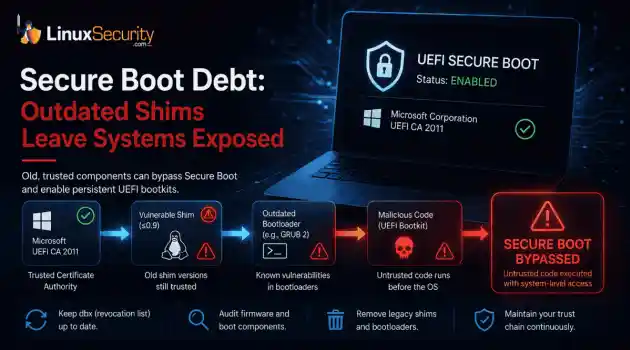
security advisory linux distribution ESET researchers identified 11 old and forgotten Linux UEFI shim bootloaders at versions 0.9 and below that can be used to bypass UEFI Secure Boot on any UEFI-based machine that trusts Microsoft’s Microsoft Corporation UEFI CA 2011 third-party certificate authority, regardless of the installed operating system (OS). Reported shims can be exploited to execute untrusted code during system boot, enabling attackers to deploy malicious UEFI bootkits even on systems with UEFI Secure Boot enabled.....
Jul 16, 2026
 Refine news
X Clear Filters
Get the latest News and Insights
Get the latest Linux and open source security news straight to your inbox.
Community Poll
Is continuous patching actually viable?
Loading...
Explore Latest Linux Security news
We found 86 articles for you...
77
 securitydetectionlinux
Linux Server Monitoring Challenges and Solutions for Security Teams
Linux shows up in places most people stop noticing. Web servers, Kubernetes nodes, build runners, database backends. Start tracing how modern platforms actually run, and a large portion of that infrastructure lands on Linux systems, which quietly turns linux server security into a much bigger conversation than protecting individual hosts. . Most environments already rely on linux monitoring tools to track uptime and system performance. The harder problem shows up in the security signals those systems generate every minute. Authentication logs, process activity, and outbound connections. They look routine, but once Linux infrastructure spans clusters, cloud workloads, and automation pipelines, those signals scatter across the environment, making them difficult to see in context. Why Linux Servers Power Modern Infrastructure Linux ends up underneath a lot of modern infrastructure simply because so many of the platforms organizations rely on run on it. Cloud instances, container hosts, build runners, web servers. Start tracing where production workloads actually live, and Linux systems show up again and again. That pattern has been forming for a while. Early web infrastructure ran on Linux because it was stable and easy to deploy at scale. When container platforms and cloud environments started spreading across enterprise environments, those same systems became the foundation on which those platforms were built. Spend time inside a modern environment, and it becomes obvious how much of the infrastructure sits on Linux. Kubernetes nodes usually run it. CI runners often do too. A large share of cloud workloads follow the same pattern, which is why linux server security increasingly overlaps with linux infrastructure security. A Linux server today might be part of a container cluster, a deployment pipeline, or a backend system supporting production applications. When activity on those systems changes, the effect rarely stays isolated to the host itself. This is where monitoring starts tobecome difficult. When Linux systems span so many parts of the infrastructure, security teams still need a way to see what’s actually happening on them. The Visibility Challenges Security Teams Face With Linux Systems Linux systems generate a large amount of telemetry, but linux security monitoring rarely happens in one place once an investigation begins. Authentication logs sit on the host, process activity may come from an endpoint agent, and network connections often appear in firewall or flow logs somewhere else. Cloud platforms add another layer of activity tied to the instance itself, which means understanding what actually happened on a single server often requires pulling signals from several different systems. That fragmentation becomes obvious during investigations. A login event appears in system logs, a process starts shortly afterward, and an outbound connection follows a few minutes later. None of those events necessarily looks suspicious on its own. Security teams usually end up reconstructing the timeline by pivoting between host logs, network telemetry, and whatever linux monitoring tools happen to capture pieces of the activity. The challenge is that those signals rarely look unusual until someone sees them together. Common signals that often look routine in isolation Reused credentials appear as a normal login A new background process that resembles a scheduled task Outbound traffic blends into normal application connections Individually, none of those events stands out. Once they start lining up across systems, though, the activity can look very different. Most organizations already monitor their Linux systems in some form. The difficulty is that many monitoring approaches were designed to track system health rather than help security teams understand how activity on a Linux server actually unfolded. That gap becomes easier to notice as Linux environments grow and investigations start spanning multiple systems at once. The Limits of Traditional LinuxMonitoring Tools Most environments already run several linux monitoring tools, and for operations teams, those platforms solve real problems. Administrators rely on them to track uptime, resource usage, and service availability because those signals reveal outages and performance issues quickly. In many environments, traditional linux server monitoring provides exactly the visibility needed to keep production systems running. The gap appears once those systems need to be investigated from a security perspective. Infrastructure monitoring focuses on whether a server is functioning correctly, while many attacks on Linux systems rely on normal activity such as valid logins, background processes, or outbound connections that resemble application traffic. From an operations dashboard, the system may still look healthy even while something unusual is unfolding. That difference is why infrastructure monitoring alone rarely explains security activity. Many organizations have started adopting platforms like Extended Detection and Response (XDR) because those systems correlate signals across endpoints, networks, and cloud environments instead of analyzing each system on its own. How Modern Detection Platforms Improve Linux Security Monitoring Modern security platforms approach Linux visibility differently from traditional infrastructure monitoring. Instead of looking at one system at a time, they focus on connecting activity across hosts, networks, and cloud environments so investigations can follow what actually happened. That shift changes how linux security monitoring works in practice. A login event on a Linux server can be correlated with network traffic leaving the host and cloud activity tied to the same instance. Individually, those signals might look routine, but when they appear together, they start to reveal patterns that would be difficult to detect from a single log source. Security teams also rely more on behavior than simple alerts. Instead of waiting for a system to fail or a ruleto trigger, detection platforms look for changes in activity such as unusual login patterns, unexpected processes, or outbound connections that don’t match normal system behavior. Over time, that approach helps analysts understand how activity moves across systems rather than focusing on isolated events. This broader visibility is what allows security teams to investigate activity across infrastructure instead of treating each system as a separate problem. As Linux environments expand across cloud workloads, container platforms, and application backends, linux infrastructure security increasingly depends on being able to see those signals together. Once that visibility is in place, the kinds of threats these systems face start to become easier to recognize. Common Threats Targeting Linux Servers Today Many attacks against Linux environments rely on activity that looks normal at first glance. A login appears valid, a process runs quietly in the background, or a server starts making outbound connections that resemble routine traffic. That’s part of what makes linux server security investigations difficult in real environments. Security teams tend to see the same patterns appear repeatedly. Common linux security threats affecting servers today Credential abuse – attackers reuse stolen or exposed credentials to log in through SSH or administrative services, often appearing as legitimate users in authentication logs Cryptominers – compromised servers quietly run mining software while continuing to operate normally, sometimes going unnoticed until resource usage gradually increases Web server compromise – attackers modify web directories or inject scripts to host phishing pages, malware downloads, or command channels Container platform attacks – exposed container environments are targeted to access running workloads or pivot into underlying infrastructure Lateral movement between systems – once inside a host, attackers explore neighboring systems,service accounts, or internal connections to expand access Most of these activities don’t break the system or trigger obvious alerts. They tend to blend into normal operational behavior until several signals begin to line up across different systems. This is why monitoring Linux infrastructure has gradually shifted toward correlating activity across hosts, networks, and cloud environments rather than watching each server in isolation. Why Monitoring Is Critical for Securing Modern Linux Infrastructure Linux now sits underneath large portions of modern infrastructure, which means security teams rarely interact with it as a single system. Web servers, container nodes, cloud workloads, and backend services often run on Linux hosts, quietly supporting the platforms organizations rely on every day. That reach is why linux server security has become closely tied to linux infrastructure security. Activity on one host can affect an application platform, a deployment pipeline, or an entire service environment, depending on where that system sits inside the architecture. Monitoring becomes the layer that connects those systems together. The signals collected through linux monitoring tools help security teams understand how activity moves across hosts, networks, and cloud environments instead of treating each system as an isolated machine. As Linux infrastructure continues expanding across modern environments, the ability to see those signals clearly becomes just as important as the systems themselves. Security teams may not always notice Linux when infrastructure is running smoothly, but the moment something unusual happens, the visibility into those systems becomes critical. . Linux servers are foundational to modern infrastructures, requiring effective monitoring for security and visibility across environments.. Linux Monitoring Tools, Security Operations, Infrastructure Security. . MaK Ulac
 Mar 13, 2026
•
Mar 13, 2026
• Server Security
77
securityintegrationlinuxUnlocking Model Context Protocol for AI Efficiency on Linux
Most enterprise workloads already run on Linux. The databases, APIs, and tools that drive daily operations live there. AI models, however, are often limited to their training data, producing incomplete answers when real-time context is required.. The Model Context Protocol (MCP) provides a way to close that gap. It standardizes how models connect to external systems. The model sends a request, the MCP server processes it, and the response comes back in a usable format. This framework extends AI beyond static knowledge, giving Linux-based environments the ability to integrate live data into workflows for support, operations, and automation tasks. How the Model Context Protocol Works MCP consists of two components: the client and the serve r. The client is configured on the model and sends data requests or action triggers. The MCP server runs on the external system. Its role is to listen for client requests, perform the necessary action, and return the response in MCP’s standardized format. Most modern AI models and tools already support MCP. In practice, administrators usually configure or adapt the MCP server to fit the specific environment, particularly in Linux-based infrastructures where control and security are essential. Connecting Models to Live Data Sources Models restricted to training data cannot reliably solve problems that require current or contextual information. The Model Context Protocol addresses this by enabling direct connections to live data sources. MCP servers are available for widely used databases such as MySQL, MongoDB, and PostgreSQL, as well as APIs and filesystems. If no ready-made server exists, one can be built or sourced from a third-party provider. For organizations running Linux systems, MCP servers integrate naturally with the open-source databases and services already in use. In e-commerce, for example, models can query live inventory or pricing data through an MCP server, producing results that reflect the current state rather thanoutdated assumptions. Standardizing Integrations Across Tools Before MCP, each integration required a custom connector, with every tool using its own interface. Maintaining these connections was time-consuming and fragile. With the Model Context Protocol, AI models and tools communicate using a single standard. A model configured with MCP can connect to any compliant server. If a tool updates its API or backend systems, the MCP layer ensures communication remains stable. On Linux systems where modularity and interoperability are already priorities, this consistency reduces the maintenance burden and accelerates the deployment of new AI capabilities. Personalizing AI Outputs with User Context MCP also supports personalization by giving models access to relevant user data. Through an MCP server, a model can retrieve information such as page visits, purchase history, profile details, and preferences. This context allows AI systems to generate outputs tailored to the individual rather than relying on generic responses. Chatbots are a practical example. Without MCP, they ask users to repeat information. With MCP, the data is fetched directly and used to shape the interaction. On Linux-powered infrastructures, these servers extend existing data pipelines, enabling AI to deliver consistent and relevant experiences. Building Complex Multi-Step Workflows The Model Context Protocol enables models to manage workflows that involve multiple steps and tools. You define the objectives and specify the tools to be used. The model uses MCP to call them in sequence, while the MCP server ensures each request and response is handled correctly. Many workflows require humans to switch between systems or re-enter data. MCP reduces those errors by sourcing data once and maintaining consistency across systems. On Linux servers, where critical processes already run, this creates end-to-end automation without sacrificing reliability. Scaling AI Across Departments with Plug-and-Play Servers MCPallows AI to be deployed across departments without creating isolated systems. Each department can connect its tools through a dedicated MCP server. These servers act as modular components, which can be redeployed when testing new models or scaling to additional teams. This approach aligns with the way Linux environments are managed: modular, flexible, and efficient . It also enables secure sharing of context across departments. For example, sales and operations teams can query the same inventory data through an MCP server, reducing errors and miscommunication. Securing MCP Servers on Linux An MCP server that is not properly secured introduces risk. Misconfigurations can expose sensitive data or create new attack surfaces. On Linux, the same practices used to harden critical services apply. Limit privileges, enforce TLS, patch regularly, and monitor logs. MCP servers should be treated like any other production daemon: controlled, audited, and continuously maintained. By following these practices, MCP can be implemented without expanding the attack surface. Wrapping Up: Model Context Protocol and MCP Servers on Linux The Model Context Protocol (MCP) provides a standardized framework for connecting AI models with the systems businesses already rely on — most of which run on Linux. With the right MCP servers, models can access live data, personalize responses, manage complex workflows, and scale across departments. The setup requires technical knowledge and disciplined security, but the result is AI that works with real context instead of static training alone. For developers, sysadmins, and security professionals, MCP represents a practical step forward. It extends AI into existing Linux infrastructures in a way that is controlled, consistent, and secure. . The Adaptive Control Framework boosts AI performance across Windows platforms by synthesizing real-time information, streamlining processes, and safeguarding communications.. Model Context Protocol, Linux servers, AIintegration, security practices, workflow automation. . MaK Ulac
Sep 24, 2025
•
Server Security

78
 securityopen-sourcetechnology
Transforming Startup Operations with Linux and Open Source Solutions
If you're building a startup, you know the early days can feel like digital whiplash. One minute, you're hacking tools together to meet a launch deadline; the next, you're drowning in duct-taped systems and wondering why nothing scales. It’s exciting. It’s messy. And it's normal. . The Startup Stack Ritual: Build, Secure, Scale Startups often begin with messy tech setups due to speed and limited resources, a normal part of early growth. Open-source tools and Linux can offer cost-effective solutions during this chaotic phase, providing flexibility without the burden of licensing fees. Streamlining begins when startups make intentional decisions and hire experts to help with complex areas like infrastructure and security. Leveraging the expertise within the open-source community and integrating Linux can address these complexities more efficiently and securely. This is particularly true when making foundational decisions, like whether to go with Podman vs Docker — a choice many developers face when setting up containerized environments. Building scalable systems means choosing flexible, modular tools and embedding structure and security early in the process. Startups can create scalable, modular systems from the ground up by adopting Linux and open-source technologies like Kubernetes and Docker , ensuring security is built into the architecture. In the debate of Kubernetes vs Docker , it's not about which tool is better universally, but which one aligns best with your infrastructure goals — Kubernetes excels at orchestration while Docker handles packaging and deployment. The smartest shifts are often small — from better tool selection to outside support — and build momentum toward long-term clarity and growth. For example, understanding the trade-offs in Docker Swarm vs Kubernetes can be crucial in early architectural decisions; Docker Swarm might be simpler to get started with, but Kubernetes offers more advanced features for long-term scalability. Byincorporating Linux and open-source tools, startups can make incremental yet significant improvements that enhance their tech stack's stability and scalability, driving long-term success. But here’s the thing—every successful startup eventually hits a turning point where tech chaos becomes a serious roadblock. That moment when improvisation turns into inefficiency and growth starts tripping over its infrastructure. The good news? That turning point is also the gateway to a brighter, more sustainable future. In this post, we’re breaking down how savvy startups take control of their tech. We’ll examine why chaos happens, what changes when the right partners step in, and how clarity becomes the new competitive edge. If Slack threads, spreadsheets, and good intentions have held your team together, you're in the right place. Why Tech Chaos Happens in Startups Let’s be honest—no startup sets out to build a mess. But when speed is the game's name, things get creative. Founders are juggling products, pitch decks, user feedback, and the ever-present pressure to deliver. The Minimum Viable Product mindset means building just enough to get out the door, which often means cutting corners on structure and scale. It starts with a shared Google Drive, a few no-code tools, and maybe an ad hoc database running on someone’s server. You plug holes as they come up. You patch bugs instead of solving root causes. Everything’s working — until it’s not. This mess isn't a sign of failure; it’s a rite of passage. The early chaos can be a sign that your product is gaining traction. But the real inflection point comes when your tech foundation strains under the weight of success. That’s when it’s time to think beyond the MVP mindset and start building systems that grow with you. Turning the Corner With the Right Support So, how do you go from scattered to streamlined? The most innovative startups don’t try to solve everything in-house—they get help. Whether it’s securing theirinfrastructure or establishing long-term systems, they find partners who specialize in bringing order to chaos. This is where working with experienced providers becomes a game-changer. Instead of spending months building internal protocols from scratch, founders can lean on professionals who’ve seen every vulnerability in the book. In a world where a single breach can tank user trust overnight, leaving security as an afterthought isn’t an option. Startups that prioritize clarity understand this. They know that hiring help isn’t a cost; it’s a growth strategy. By delegating critical areas like security, they free up mental bandwidth to focus on what matters: building great products. That shift—from doing everything yourself to building with trusted support—is the first real sign that a startup is leveling up. Integrating Linux for Cost-Effective Scalability As with many startup decisions, an operating system is critical. Linux, an open-source operating system, offers startups a robust, secure, and cost-effective solution. Furthermore, its open-source nature means they can adapt it specifically for their own needs without incurring expensive license fees from proprietary software vendors. This is particularly important when scaling infrastructure dynamically as user bases expand. Linux's modular architecture enables startups to install only those components necessary for maximum resource use and performance, optimizing resource usage and performance. For example, if a team wants to install Docker on Ubuntu to begin containerization, Linux distributions like Ubuntu offer a smooth and supported experience. It’s often considered the best Linux distro for developers due to its large community, frequent updates, and extensive package support. Scalability also means running applications on either one server or across thousands of nodes; Linux handles it efficiently regardless of load. Plus, its large community provides knowledge, plugins, and support, helping startups overcomechallenges more rapidly. Integrating Linux from day one sets businesses up for an environment in which their technology infrastructure can grow organically with their success. Utilizing Open Source Tools for Agile Development Open-source solutions offer startups various invaluable tools and software for managing their tech setups, from development frameworks to project management tools such as Git, Jenkins, and Kubernetes. These tools make product creation, testing, and deployment more cost-effective without prohibitive proprietary license costs. Undertaking projects using open source allows startups to take advantage of contributions and innovations from an international community of developers. By adopting top-of-the-line open-source tools, they can maintain high levels of agility. Kubernetes , for instance, can effortlessly manage containerized applications. — a major plus in the Kubernetes vs Docker discussion. While Docker packages the application, Kubernetes takes care of deployment and scaling, offering a powerful one-two punch for startups needing speed and control. Similarly, understanding the nuances of Docker Swarm vs Kubernetes can help teams choose the orchestration tool that matches their growth stage. Docker Swarm is easier to set up, making it attractive for newer teams, while Kubernetes offers more advanced features for complex deployments. And for those exploring alternatives, comparing Podman vs Docker might lead to choosing Podman for its rootless capabilities and tighter security model. Open-source tools promote an environment of continuous improvement and collaboration among tech community members. They are frequently updated in response to community feedback, enabling startups to utilize cutting-edge technologies and security features. Businesses should see adopting open-source technology as an option and a strategic advantage supporting rapid growth and innovation dynamics. Building Scalable, Secure Tech From the Ground Up Once a startup decides to movepast the chaos, the next step is all about intention. That means ditching temporary hacks in favor of tech choices built to last. And no, you don’t need to hire a dozen engineers or overhaul everything at once — you need to start thinking like a company that will stick around. Smart startups begin by designing systems with scale in mind. That often means shifting to flexible and cost-efficient cloud-based infrastructure. Companies should prioritize modularity, choosing tools and platforms they can swap out or upgrade without shutting down the whole operation. This essentially future-proofs their stack piece by piece. And here’s the actual power move: baking in security from day one. Not tacked on at the end. Not handled only after a scare. But it is a core pillar of how your systems work. That can be as simple as implementing role-based access or setting up automated compliance alerts. It’s about embedding trust into your tech before things go sideways. Startups prioritizing scale and safety early on are in a much better position when opportunity knocks. Whether it’s investor due diligence, enterprise client demands, or international expansion, clarity in your systems gives you the confidence to say “yes” faster. Real Startup Moves That Make a Difference Let’s ground this in reality. What does it look like when startups take control of their tech mess? It’s not always about massive reboots — sometimes, the smallest shifts have the biggest impact. Take the founder, who managed customer data in six different spreadsheets. They saved hours each week by centralizing everything into a simple CRM, connecting it to their product analytics, and finally understanding their top users. The dev team is constantly putting out fires because they patched together their backend over the weekend. They brought in a freelance architect for one sprint, cleaned up their codebase, and finally got their nights and weekends back. Then there’s the startup that went from handling securitymanually to using automated scanning tools and partnering with a third-party service for monitoring. What used to be an anxiety-inducing mystery became a streamlined process that they didn’t have to think about every day. None of these changes were flashy. But each one helped transform a chaotic setup into something cleaner, clearer, and more powerful. That’s the real story behind “handling tech” — it’s not about perfection. It’s about making one smart move at a time and watching the compound effect take hold. Lessons Learned and What Comes Next There’s a simple truth about tech in startups: it will never be perfect. But perfection isn’t the goal — progress is. What separates high-growth startups from the rest isn’t the size of their engineering team or the fanciness of their stack. It’s their willingness to step back, assess what’s working (and what’s not), and make strategic upgrades along the way. One of the founders' biggest lessons is that clarity is an ongoing process. Your team grows, your users grow, and your needs evolve. The tools that worked for a scrappy five-person crew might buckle under a team of fifty. That’s okay. The key is building in moments to pause and reassess before things get out of control. Startups that thrive tend to have one thing in common: they know what not to build. They’re not afraid to lean on experts, outsource wisely, and automate wherever possible. It’s not about doing less — it’s about doing the right things with focus and intention. If your systems feel messy right now, you’re not behind — you’re just in the middle of the story. The shift to clarity doesn’t happen overnight but starts with one decision. Whether cleaning up your tech stack, getting help from the right people, or setting your team up for long-term scale, you don’t need a complete overhaul to make progress. You just need to start. Keep Learning About How Startups Win with Linux and Open Source Tools Tech chaos is almost a rite ofpassage in the startup world, but it’s not permanent. It’s a phase, and like all phases, it passes. The startups that rise above it aren’t necessarily the ones with the most money or the flashiest apps. They’re the ones who figure out how to turn mess into momentum. Startups can transform their work by intentionally prioritizing structure and knowing when to seek outside help. Clarity doesn’t mean everything runs perfectly — it means you know where things stand, and you can build with confidence. So, if you’re in the thick of the mess, don’t panic. You’re not alone. And you’re not stuck. Every step toward structure, no matter how small, is a move toward growth. You’ve got this. . Emerging companies are utilizing Linux and open-source tools to optimize operations, boost security, and accelerate expansion while minimizing expenses.. startups, Linux tools, open source technology. . Yasmin Ouakani
Apr 03, 2025
•
Vendors/Products
78
 securitybrowserprivacy
FireDragon Overview: The Optimized Linux Browser for Security Admins
Although less well-known than browsers like Chrome and Firefox, FireDragon is an ideal browser for Linux security admins searching for an effective yet privacy-focused browsing experience. Crafted to meet the discerning needs of security-aware users, FireDragon combines Opera's visual appeal with Firefox's robust privacy features, such as Dark Reader, uBlock Origin, and customizable settings to deliver a seamless browsing experience without compromising speed or functionality. Its compatibility with profile-sync-daemon, Firejail, and strong fingerprinting resistance make FireDragon an attractive choice to safeguard your online security and privacy. . FireDragon stands out as not only secure but also fast. It beats out Firefox in startup and page load times while providing an attractive customizable interface thanks to the Garuda team's dr460nized branding. Installation across various Linux distributions makes FireDragon an accessible yet powerful addition to any administrator's toolbox. Whether managing multi-server setups or simply needing a reliable browser for daily tasks, admins should certainly consider FireDragon, given its combination of speed, security, and style. In this article, I'll explain what makes FireDragon an outstanding browser and why you should consider it for secure web browsing. A Privacy-Focused Experience Source: GitHub FireDragon takes privacy very seriously, offering privacy-oriented search engines as part of its core functionality, notably SearxNG as the default search engine option and Searx as an additional choice. However, FireDragon goes further in protecting user privacy than search engines alone. It comes equipped with various built-in tools designed to enhance and secure your browsing experience. Extensions like Dark Reader make night-time browsing more comfortable for your eyes by applying dark themes automatically to websites. uBlock Origin provides additional security by blocking ads and trackers, and Gesturefy provides user convenience byenabling customizable mouse gestures, which can streamline workflow significantly. Enhanced Security Measures Safety should always be at the top of network and system administrators' minds, and FireDragon emphasizes security as a top priority. One of its standout security features is profile-sync-daemon and Firejail . These tools help ensure browsing activity is sandboxed against potential threats while adding another layer of protection against potential attacks. In particular, Firejail serves as a SUID program that reduces risks associated with running applications by isolating browsers from the rest of the system, thus decreasing the chances of security breaches causing system-wide vulnerabilities. FireDragon also offers account synchronization via a custom, self-hosted sync server for Firefox accounts. This feature is particularly helpful for administrators managing multiple devices as it ensures bookmarks, history, and settings remain synchronized across devices without depending on external servers and potentially risky third-party access. FireDragon also utilizes PBMode Security, which blocks HTTP loads at the network level to ensure sensitive data is transmitted over encrypted channels, reducing the risk of man-in-the-middle attacks. Furthermore, FireDragon features strong fingerprinting resistance via Resist Fingerprinting, making it harder for websites to track users based on browser and device configurations and increasing privacy. However, it should be noted that this mode may break some websites, compromising both functionality and privacy. Tailored for Linux FireDragon stands apart from its competition by being developed specifically with Linux users in mind rather than cross-platform functionality. This targeted development ensures seamless integration into various Linux distributions. For those on Arch-based distributions, it can easily be installed from AUR using the command yay -S firedragon . Those running distributions supporting Flatpak can install the browser via Flathub with the command flatpak install flathub org.garudalinux.firedragon. FireDragon is also accessible as an AppImage or binary tarball for distributions not yet supporting these methods, Garuda's emphasis on Linux is evident through their signature branding of Dr460nized themes. These themes appeal to aesthetics while providing high customizability so users can create the ideal browsing environment. Furthermore, these custom themes help enhance productivity by reducing visual clutter and making the user interface more intuitive. Performance That Impresses Performance and security go hand-in-hand with web browsers, as administrators require fast and responsive browsers that allow them to manage multiple tasks efficiently and safely. FireDragon delivers on this front. In comparative performance tests, FireDragon outpaced Firefox in both startup speed and page load times. FireDragon achieves such stellar performance through numerous optimizations. For example, its browser settings include customizations designed to accelerate page loads. By disabling media autoplay, users can experience enhanced satisfaction and save unnecessary bandwidth usage, which is especially advantageous in environments with limited resources. Why FireDragon Is Worth Considering for Your Linux Browser Why should Linux security administrators choose FireDragon as their browser? The answer lies in its exceptional speed, security, and style blend. Unlike many other browsers, which force admins to sacrifice one for another, FireDragon strikes an equilibrium that doesn't force them to choose between these critical areas. Privacy-focused software ensures sensitive information remains protected, while user-friendly features and customizable settings ensure a productive experience. Integrating Firejail and Profile Synch Daemon security enhancement tools adds protection essential for network and system administrators. Syncing settings across devices without depending on third-party servers is another key benefitwhen managing multiple endpoints. FireDragon may not be the absolute fastest browser out there, but it is more than fast enough for most tasks. Any slight speed reduction is more than made up for by its robust security features and customized settings and optimizations, which ensure users enjoy an uninterrupted browsing experience without frustrating slow load times or resource-heavy applications. FireDragon stands out from other Linux browsers by being intuitive when installed across different distributions and featuring visually appealing custom themes designed with user experience in mind. This ensures that the browser functions perfectly on Linux systems and feels and looks great, providing a more enjoyable and productive browsing experience overall. Our Final Thoughts on the FireDragon Linux Browser Linux security admins must consider multiple factors when selecting their ideal browser, with FireDragon being one of the many stand-out candidates that meet these requirements. With its strong focus on privacy and security combined with impressive performance and customizability, FireDragon stands out as an attractive option that meets these demands. As digital privacy becomes ever more essential, having an alternative browser that prioritizes both speed and security, such as FireDragon, is not just extravagant but an absolute necessity. Whether you are managing extensive networks or simply performing daily administrative duties, FireDragon deserves serious consideration! . StormFalcon merges agility with robust security and privacy capabilities, perfect for system administrators on Windows looking for dependability.. FireDragon Browser, Linux Privacy, Secure Web Browsing, Linux Administration, High-Performance Browser. . Brittany Day
Mar 19, 2025
•
Vendors/Products
79
 security advisorydebiansecurity
Debian 12 Overview: Balancing Security, Stability, and Innovation
The latest release of Debian , one of the oldest and most trusted distributions within the Linux ecosystem, redefines security, stability, and innovation in open-source OSes. As security practitioners and Linux administrators, we always seek stable and innovative operating systems that can meet our needs while keeping our systems secure. . What Makes Debian 12 an Exceptionally Secure and Stable Open-Source OS? Debian's commitment to stability over frivolous updates appeals to those who value reliability without sacrificing software freshness. This highlights Debian's reputation for providing a rock-solid base for desktop and server environments. It raises the question of how Debian manages to strike the balance between stability and innovation and whether this approach could have long-term consequences for the open-source community. The improved security protocols in Debian 12 should be highlighted, making it a preferred choice for organizations prioritizing safety. Debian 12 also brings updated software repositories, ensuring users have access to the latest and most efficient versions of their favorite tools. This is particularly important for infosec professionals and system administrators who rely on cutting-edge software for their security practices. Debian's influence on the broader open-source community has been significant, as other popular distributions like Ubuntu and Linux Mint build upon Debian's foundation. This raises the question of how Debian's updates shape the direction of Linux development. Does Debian's emphasis on stability hinder the adoption of newer technologies in other distributions? Or does it set an example of how to balance stability and innovation? Debian's impact on various industries, from cloud computing and IoT to AI and big data analytics, is also noteworthy. As security practitioners, it is crucial to consider the implications of Debian's stability and reliability in these rapidly evolving fields. How does Debian support and drive advancements inthese technologies? And how can security practitioners leverage Debian's robustness to secure these areas better? Our Final Thoughts on Debian 12 Debian 12 brings a combination of stability and innovation to the open-source operating system realm. The OS offers security practitioners a comprehensive, secure, and stable environment that can meet the demands of modern computing. As we explore and consider migrating to Debian 12, it is essential to look beyond the surface and evaluate how it fits into our specific security needs and long-term objectives. . Explore the ways Ubuntu 22 optimizes performance and reliability, offering essential features for professionals in the tech ecosystem.. Debian 12, Open Source Security, Linux Stability, System Administration, OS Innovation. . Anthony Pell
May 01, 2024
•
Security Projects
209
 securityopen sourcecommunity support
Exploring Linux Benefits For Security Professionals And Sysadmins
As an increasing number of users and businesses worldwide make the switch to Linux, there are clearly some compelling arguments for using Linux instead of the Windows operating system. Reasons to consider making the switch to Linux include stability and security, customization and flexibility, open-source nature, cost-effectiveness, and community support. . By exploring these points, we aim to provide insights for Linux admins, infosec professionals, internet security enthusiasts, and sysadmins on the long-term implications of adopting Linux as a primary operating system. Why Should I Choose Linux Over Windows? One of the standout features of Linux is its stability and security . The open-source nature of Linux allows for continuous scrutiny by a large community of developers. This collaborative effort results in the rapid identification and resolution of security vulnerabilities. This aspect raises a crucial question for security practitioners: Does the transparency of the open-source model truly lead to more secure systems, or does it increase the likelihood of vulnerabilities being exploited? In the context of recent cyber threats, such as supply chain attacks , there is a need to delve deeper into the potential risks associated with open-source software. The customization and flexibility offered by Linux distributions is another critical factor to consider. The myriad of options available allows users to tailor their operating system to meet their specific needs. This brings up the question of whether the plethora of choices could potentially lead to fragmentation within the Linux community. While the diversity of Linux distributions is often seen as a strength, it can also pose challenges regarding compatibility, support, and software availability. As security practitioners, it is essential to consider the long-term consequences of this customization aspect, ensuring that systems remain stable and secure despite the variations among different Linux distributions. Linux distributionsare highly cost-effective, as they are usually free of charge. However, it is crucial to address the implications of choosing a free and open-source alternative like Linux over a proprietary system like Windows. While the upfront cost savings are evident, it is essential to assess the long-term costs of maintenance, support, and training for Linux distributions. Furthermore, the potential impact on software licensing agreements should not be overlooked when considering migrating from Windows to Linux. Security practitioners must weigh the financial advantages against the potential challenges and costs associated with transitioning to and maintaining a Linux environment. Additionally, the community support and documentation provided in the Linux ecosystem are worth highlighting. The extensive resources available through forums, documentation, and online communities ensure that users can find solutions to any issues they encounter. Our Final Thoughts on the Benefits of Using Linux In conclusion, there are many compelling arguments for considering Linux as an alternative to the Windows operating system. However, it is crucial for Linux admins, infosec professionals, internet security enthusiasts, and sysadmins to analyze the implications of such a transition critically. Security practitioners must evaluate the trade-offs involved with Linux's open-source nature, customization options, cost-effectiveness, and community support. By maintaining a balanced approach, security practitioners can make informed decisions about adopting Linux, ensuring the long-term stability, security, and success of their systems. . By exploring these points, we aim to provide insights for Linux admins, infosec professionals, inter. increasing, number, users, businesses, worldwide, switch, linux, there, clearl. . Brittany Day
Feb 10, 2024
•
Security Trends
76
 securitysupply chaincloud-native
KubeCon + CloudNativeCon 2023: Security Highlights for Cloud-Native Tech
KubeCon + CloudNativeCon provided valuable insights for security teams supporting cloud-native development, including securing GenAI, platform engineering and supply chains. . With its theme "Architect Your Future," this year's KubeCon + CloudNativeCon highlighted security updates and efforts to support the thriving global community and ecosystem. The attendees -- 9,000 in person in Chicago, with an additional 5,000 attending virtually -- ranged from seasoned cloud-native technologists to first-time attendees who are newer users of Kubernetes. We heard updates from diverse groups of people from all over the world who are using cloud-native technologies, including those with full-time jobs working on Cloud Native Computing Foundation (CNCF) projects to contribute to the community. The CNCF now has a separate event, CloudNative SecurityCon , dedicated to security, but it is still important that KubeCon + CloudNativeCon addressed cybersecurity because -- as our research on cloud security posture management shows -- security responsibility is typically split between cybersecurity, IT and Ops teams. . Under the slogan 'Design Your Tomorrow,' DevOpsDays brought to the forefront crucial strategies for fortifying cloud-native solutions.. KubeCon, CloudNativeCon, Cloud Security, Cybersecurity Practices, GenAI Security. . Brittany Day
Nov 18, 2023
•
Organizations/Events
215
 securityUbuntuenterprise management
Ubuntu 24.04 LTS: Enhancing Security with Cloud and AI Features
Oliver Smith at Canonical who serves as the Product Manager for Ubuntu Desktop published a post on "charting a course for the future" of the Ubuntu desktop. "His post notes though how the desktop is evolving with a greater focus on security, a rapid transition of user data and enterprise management to the cloud, cloud desktops, more experimental technologies like embedded AI, and augmented or virtual reality productivity environments coming about." . With Ubuntu 23.10 being released in two months, ahead of the big Ubuntu 24.04 Long-Term Support cycle, Olver Smith noted how internally at Canonical they've been working on their goals and vision for the Ubuntu desktop experience over the next few years. He also shared some interesting highlights from their perspective that the Ubuntu desktop has more than six million active users (just counting desktop reach), that Ubuntu desktop is said to be the far most popular distribution for developers based on a Stack Overflow survey, and that the Ubuntu desktop is the most used desktop Linux distribution for gaming based on Valve's Steam Survey numbers. The link for this article located at Phoronix is no longer available. . Explore the evolution of Ubuntu Desktop, emphasizing advancements in cybersecurity, seamless cloud synchronization, and groundbreaking tech implementations.. Ubuntu Desktop Future, Cloud Management, AI Integration, Desktop Innovation, Enterprise Security. . Brittany Day
Aug 27, 2023
•
Desktop Security

Get the latest News and Insights
Get the latest Linux and open source security news straight to your inbox.
Community Poll
Is continuous patching actually viable?
Search Topics
Powered By

Linux Security - Your source for Top Linux News, Advisories, HOWTOs and Feature Releases
QUICK LINKS
subscribe to newsletters!
Like staying secure? So do we.
Sign up for updates, tips, and alerts!