Explore top 10 tips to secure your open-source projects now. Read More
×



Server Security data privacy automation
data privacy automation Every system admin has lived through the same Monday morning ritual. A queue of forty tickets, half of them password resets, permission errors, or disk space warnings that any experienced technician could resolve in under two minutes. The other half require actual judgment. For years, automation promised that software would eventually sort the two apart on its own. That promise is now being tested in production Linux environments. . Early results are reshaping how IT teams think about tier-1...
 Jul 17, 2026

Privacydata collection automation
data collection automation You're running a web scraping project to collect pricing data from e-commerce sites. You set up a pool of datacenter proxies, launch your scripts, and within minutes — banned . CAPTCHAs everywhere. Your data pipeline stops before it really begins. . It's a frustrating scenario that plays out daily in ad verification, market research, and multi-account management. The website doesn't know you're doing legitimate research or monitoring. It just sees traffic coming from IP ranges it recognizes as...
Jul 17, 2026

Security Trends security advisory social engineering
security advisory social engineering Business Email Compromise used to be a numbers game — mass-blasted emails, broken English, an obvious "URGENT WIRE TRANSFER" subject line. That era is over. Generative AI has turned BEC into a tailored, low-noise operation that mimics writing style, voice, and even video presence. This piece looks at what's actually changed under the hood, what defenders are testing in response, and why so many organizations are still structurally unprepared for it. . The Infrastructure Problem Nobody Wants to...
Jul 17, 2026

Security Trends cybersecurity Linux documentation
cybersecurity Linux documentation Linux operating systems have gained prominence due to their stability, adaptability, and excellent security options. In the case of developing documentation, designing cybersecurity dashboards, or educational material, visuals are of vital importance when it comes to making things clear. The use of icons allows one to understand the message regarding alerts, authorization, encryption, authentication, or the state of the system just by looking at the visual cue without having to read long...
Jul 17, 2026
Security Vulnerabilities security advisory linux distribution
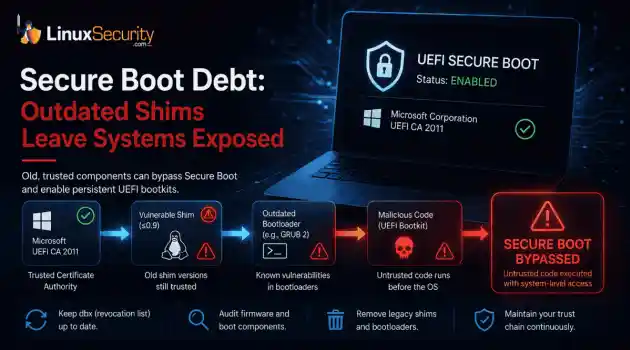
security advisory linux distribution ESET researchers identified 11 old and forgotten Linux UEFI shim bootloaders at versions 0.9 and below that can be used to bypass UEFI Secure Boot on any UEFI-based machine that trusts Microsoft’s Microsoft Corporation UEFI CA 2011 third-party certificate authority, regardless of the installed operating system (OS). Reported shims can be exploited to execute untrusted code during system boot, enabling attackers to deploy malicious UEFI bootkits even on systems with UEFI Secure Boot enabled.....
Jul 16, 2026
 Refine news
X Clear Filters
Get the latest News and Insights
Get the latest Linux and open source security news straight to your inbox.
Community Poll
Is continuous patching actually viable?
Loading...
Explore Latest Linux Security news
We found 120 articles for you...
78
 fedoradebianubuntu
In-depth Security Comparisons: Debian, Fedora, and Ubuntu Distributions
As a Linux security admin, choosing the right distribution is a crucial decision that will immensely impact your administration workflow. Debian, Fedora, and Ubuntu are three popular Linux distros that offer unique security features and characteristics. Fedora is like a cutting-edge scientist, constantly innovating with built-in tools like SELinux and delivering rapid security updates. . On the other hand, Debian is the reliable guardian, known for its stability and extensive testing, albeit with slightly slower adoption of new technologies. Then there’s Ubuntu, the user-friendly diplomat, offering a balance between usability and security with features like AppArmor and timely, albeit less frequent, updates compared to Fedora. In this article, I'll dive into the nitty-gritty of these distributions' security landscapes. I'll explore how each handles default configurations, manages updates, and what kind of community support you can expect. I’ll also highlight some pain points — because no distribution is without flaws — and provide practical insights to help you decide which distro best fits your security needs. Whether you're an SELinux wizard, a Debian stability fan, or an AppArmor enthusiast, understanding these differences can make a notable difference in your day-to-day operations. An In-Depth Security Analysis of Debian Debian is a rock-solid choice for many Linux admins, primarily due to its stability and well-maintained security features. One thing that makes Debian stand out is its predictable and stable release cycle. Each stable release gets around five years of security updates, so you can count on your systems staying secure over time without any surprises. The Debian Security Team is on the ball, too. They issue security advisories and updates promptly, and their dedicated security repository ( security.debian.org ) ensures you can get these patches easily and quickly. Also, Debian's default installation is pretty lean and secure right off the bat. It avoids runningunnecessary services, which helps keep the attack surface small. And if you're looking to beef up security further, Debian supports AppArmor , which lets you confine applications to tight security policies. Debian’s participation in the Reproducible Builds project is a big plus, assuring that the binaries you're running are genuine and haven't been tampered with. Another thing I appreciate about Debian is its strong security community. These folks are passionate and extremely collaborative, consistently working on identifying and fixing vulnerabilities. And let's not forget the Debian Security Tracker, which keeps everything transparent—you can check the status of vulnerabilities and the rollout of patches anytime. However, no system is perfect. One gripe some admins have with Debian is its SELinux support. While it supports AppArmor, SELinux , which offers more granular control, isn’t as polished or user-friendly. This might be a sticking point if you come from a Fedora or CentOS background. Also, while Debian does a good job with security patches, it’s conservative. This means you might not get some updates as fast as you would on a rolling-release distro like Arch Linux. Kernel hardening is another area that could use a bit more love. Debian’s default kernel is secure but not as aggressively hardened as in some security-focused distributions like Qubes OS or Kali Linux . If you want those features, you’ll likely dive into manual configurations. Lastly, the commitment to stability sometimes means you're dealing with older versions of packages. This can be a double-edged sword; while you get well-tested software, you might miss out on newer security features found in the latest versions. Debian’s security framework offers an outstanding balance of stability and security, making it a dependable choice for many scenarios, especially on servers. But as with any distribution, knowing its strengths and weaknesses will help you maximize it for your specific use case. Fedora'sProactive Security Approach: Strengths & Challenges Fedora Linux stands out in the Linux ecosystem due to its solid focus on security. As a Linux admin, you'll appreciate that Fedora integrates cutting-edge technologies with a strong emphasis on keeping systems secure. One of its hallmark features is SELinux, which is baked right into the system to enforce strict access controls—imagine sleeping at night knowing that even if a service gets compromised, it's locked down tighter than Fort Knox! Plus, the Fedora team is on the ball with security patches and updates, pushing them out with a sense of urgency that keeps you ahead of potential threats. It’s also handy that Fedora comes with essential security tools, like firewalld , making it easy to hit the ground running. And let’s not underestimate the power of community; Fedora’s security community is teeming with experts whose contributions often improve not only Fedora but the entire Linux landscape. When setting up a new system, you’ll notice that Fedora promotes security best practices from the start, with default settings prioritizing the highest level of safety. On the flip side, some users find SELinux a bit of a beast to tame. Its complexity can be intimidating, especially for those just dipping their toes into Fedora's waters, sometimes leading them to disable it, precisely what you don't want. Also, given how up-to-the-minute everything is, all these frequent updates can be a bit resource-hungry, which might make you think twice if you're managing systems that aren't exactly brimming with hardware prowess. In essence, Fedora’s proactive security stance and robust community support make it a solid choice for any security-savvy admin. Still, it’s wise to brush up on your SELinux skills to make the most of Fedora's offerings. Ubuntu's Comprehensive Security Features: Benefits & Areas for Improvement Ubuntu is well-regarded for its strong security measures, making it a go-to Linux distribution for many users seekingrobust cybersecurity features. One of the main characteristics that stands out is its design philosophy, which prioritizes ease of use and accessibility, helping even those with a minimal technical background configure secure systems. Ubuntu provides regular security updates and patches faster than many other distributions. This proactive approach enables administrators to address vulnerabilities rapidly, reducing exposure to potential threats. Another unique aspect of Ubuntu is its default installation, which is configured with security in mind. By default, it includes a firewall called UFW (Uncomplicated Firewall) , making it easier to implement basic firewall settings without delving into complex configurations. Moreover, Ubuntu integrates with AppArmor, a security module that restricts the capabilities of programs to fortify your system against potential threats. The security community supporting Ubuntu is active and dedicated, frequently sharing best practices and guidelines for improving system security. Resources like Ubuntu Security Notices and Launchpad are vital for staying informed on recent threats and security patches. Ubuntu’s Security Team ensures that security vulnerabilities are closely monitored and promptly addressed. Despite these strong points, there are areas where Ubuntu could enhance its security offerings. For example, while AppArmor provides good protection, some users feel that the SELinux support isn’t as comprehensive as it could be, limiting users accustomed to the more granular policy controls found in SELinux. Although UFW simplifies firewall management, it does not offer the same depth of features as more advanced firewall solutions. Ubuntu's user-friendly security features, reliable update mechanisms, and supportive community make it a solid choice for many. However, there is always room for improvement, especially in broadening the capabilities of built-in security tools to match those in more specialized security distributions. Our FinalThoughts: Choosing the Right Linux Distribution for Optimal Security Choosing the right Linux distribution can significantly impact your security posture. Debian's focus on stability and extensive testing procedures makes it an excellent choice for those prioritizing a time-tested, reliable environment. Fedora's rapid update cycle and cutting-edge security features, such as SELinux, cater to those who need the latest advancements and are willing to manage a more dynamic system. With its balanced approach, Ubuntu provides an accessible yet secure platform, leveraging features like AppArmor to offer protection with ease of use. Your choice should reflect your specific security needs and operational priorities. Whether you prefer Debian's stability, Fedora's innovation, or Ubuntu's balanced approach, understanding what each distribution offers can help you make the right decision. With this knowledge, you can tailor your security strategy to match the unique characteristics of your chosen distro, ensuring robust protection for your systems. . Evaluate Linux distributions like Debian, Fedora, and Ubuntu by considering their unique security strengths and weaknesses to find the best fit for your needs. Debian Security, Fedora Features, Ubuntu Administration. . Brittany Day
 Mar 26, 2025
•
Mar 26, 2025
• Vendors/Products
210
 security analysislinux securitydata leakage
Exploring GhostRace Attack: Critical Threats Affecting Major CPUs
A new data leakage attack called GhostRace ( CVE-2024-2193 ) was recently discovered. It affects major CPU manufacturers and widely used software. This critical analysis will investigate the implications of this attack and discuss its significance for Linux admins, infosec professionals, and Internet security enthusiasts. . What Is the GhostRace Attack? IBM and VU Amsterdam University researchers have identified a new type of attack called GhostRace. This attack exploits speculative race conditions (SRCs) to leak sensitive information from a system's memory. Speculative execution, a technique commonly employed in CPU attacks, is combined with race conditions to bypass synchronization primitives implemented in operating systems, enabling the leakage of critical information. Race conditions exist when there is insufficient synchronization with a shared resource, allowing multiple threads to access it simultaneously. The GhostRace attack presents a significant threat to security practitioners and organizations relying on major CPU manufacturers. This attack highlights the vulnerability of software utilizing conditional branches without any serializing instructions. The fact that all major hardware vendors, including Intel, AMD, Arm, and IBM, are impacted indicates the breadth of the issue. Researchers have used the term "Speculative Concurrent Use-After-Free (SCUAF)" attack to describe the GhostRace attack technique. This points to the creative ways attackers exploit vulnerabilities, emphasizing the need for vigilant security practices and continuous monitoring. The GhostRace attack also uses Inter-Process Interrupt (IPI) Storming, a new technique researchers employ to interrupt the victim process and perform the SCUAF attack. This raises questions about the effectiveness of current measures to prevent such interruptions and highlights the importance of implementing robust defense mechanisms at the hardware and software levels. The extensive research conducted by the IBM and VU Amsterdamteams includes identifying potentially exploitable gadgets in the Linux kernel . This information is invaluable for Linux admins and developers when assessing their systems' vulnerability. However, the lack of immediate action by Linux developers due to performance concerns may concern security practitioners. What Are the Implications and Long-Term Consequences of This Threat? The GhostRace attack severely impacts security practitioners and organizations relying on CPU manufacturers and software vendors. It exposes the vulnerabilities in synchronization primitives and speculative execution techniques, which may have long-term consequences for designing and implementing future CPUs and operating systems. Security professionals must be proactive in their approach to mitigating this threat. They should actively monitor for any advisories or updates from CPU and software vendors, such as AMD and Xen, to address the GhostRace vulnerability. Also, Linux admins should consider implementing the IPI rate-limiting feature to enhance their security. Our Final Thoughts on the GhostRace Attack The GhostRace attack unveils a new type of data leakage attack that compromises the security of major CPU manufacturers and widely used software. We emphasize the importance of staying informed about emerging vulnerabilities and taking proactive measures to secure systems against such threats. By addressing the issues raised by GhostRace, it is possible to fortify security practices and protect critical data from malicious actors. . Spectral Chase vulnerability affects top providers. Examine its consequences for Unix administrators and cybersecurity experts.. GhostRace Attack, CPU Security Threats, Data Leakage Techniques, Speculative Execution. . Brittany Day
Mar 15, 2024
•
Security Vulnerabilities

67
 cyber threatsransomwarefile encryption
Exploring Qilin Ransomware Attacks on VMware ESXi Hypervisor Systems
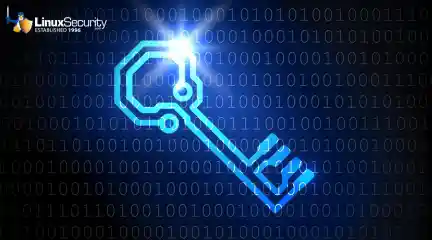
The Linux version of Qilin, a new ransomware strain that debuted in January, has been spotted in the wild. It's also one of the first ransomware families to target VMware ESXi. . Qilin targets users and organizations that run ESXi hypervisors. The malware encrypts files on connected USB devices with AES-256 encryption and a randomly generated RSA public key. It also creates an HTML file in each folder containing encrypted files containing instructions on paying the ransom and where to get decryption keys. The malware doesn't appear very sophisticated and is likely not targeting any specific industry or organization; it's just another opportunistic infection for any user connecting a USB device infected with Qilin to their machine. I found the article linked below very helpful in understanding the specifics of this attack, and I wanted to share it with you! . Qilin specializes in supporting users and organizations leveraging ESXi virtualization technologies, safeguarding information with the robustness of AES-256 encryption.. Qilin Ransomware, ESXi Hypervisor Security, AES-256 Encryption, Cyber Threats, Linux Malware. . LinuxSecurity.com Team
Dec 04, 2023
•
Cryptography
74
 network securityopen sourceLinux tools
Top Forensic And Pentesting Distros For Enhanced Network Security
Choosing a forensic Linux distro makes it simple and easy to find weaknesses in your network. A Linux distro for forensics will also help you to ward off unwanted attention from bad actors and to spot potential security weaknesses in your IT infrastructure to enable adequate measures to harden the network periphery. . The good news is that the most popular and best tools for the job are open source . And the even better news is that there are several projects that create specialized Live distros that bundle these tools and will help you identify the weaknesses in your network. We’ve analyzed various of the best pentesting Linux distros and pentest distros for you to help you find the best Linux for pentesting. We looked at the distro’s hardware requirements, how lightweight it was, whether it was available for 32-bit and 64-bit systems, and the documentation. Other than the existing documentation, we assessed the quality of third-party documentation, like books, video tutorials, and online forums. We also considered the simplicity of the user interface, the range of security and analysis tools they offered, and whether the internet traffic is routed through the Tor network. . Explore the top Linux distributions of 2023 for forensic analysis and penetration testing, featuring enhanced tools and performance for cybersecurity experts. forensic Linux, pentesting tools, open source distros, network weaknesses, security analysis. . Brittany Day
Apr 18, 2023
•
Network Security
83
 malwareransomwarecyber threat
REvil Ransomware: Analyzing Innovation and Affiliate Model for Success
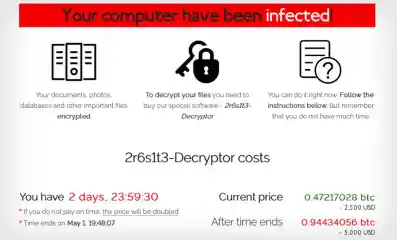
Experts say that an affiliate-driven approach and regular malware refinements are key to REvil's ransomware success formula. . Just as cloud services have taken the business world by storm, the same can be said for ransomware, including one of today's most notorious strains: REvil. Also known as Sodinokibi and Sodin, REvil is a ransomware-as-a-service offering, which means a core group develops and maintains the ransomware code and makes it available to affiliates via a portal. Those affiliates and the core group of operators share in any profits that result from victims paying a ransom. Recent victims that have made payments include meat processor JBS , which paid $11 million in bitcoins. On Friday, remote management software provider Kaseya was the latest victim to come to light, as REvil's ransomware disrupted operations for its 36,000 customers worldwide, leading U.S. President Joe Biden to order the launch of a full-scale federal investigation . . Similar to how e-commerce has revolutionized retail, emerging threats such as DarkSide represent significant risks, constantly evolving to exploit vulnerabilities.. Ransomware Prevention, Malware Variants, Cyber Security, Ransomware Analysis. . LinuxSecurity.com Team
Jul 05, 2021
•
Hacks/Cracks
78
 security testingLinux distributionsecurity analysis
Kali Linux 2020.4 Review on Raspberry Pi 4 for Security Testing
The latest Kali Linux images for the Raspberry Pi 4 include both 32-bit and 64-bit versions. J.A. Watson gives them a try in this hands-on demonstration. . Over the past few weeks, I have tried out Ubuntu , Manjaro , openSUSE and the latest Raspberry Pi OS release on the Raspberry Pi 4. I am going to complete this series with a look at Kali Linux, one of my favorite specialist Linux distributions. Kali is specifically made for security analysis and penetration testing, and is preloaded and configured for that purpose. The combination of the inexpensive and portable Raspberry Pi hardware and the Kali Linux distribution has seemed extremely promising to me for several years now, but so far it hasn't really fulfilled my expectations. Hopefully the more powerful Raspberry Pi 4 and the more mature Kali Linux 2020.4 will remedy that. . Kali Linux's compatibility with the Raspberry Pi 4 enhances accessibility, offering both 32-bit and 64-bit versions for various user needs and hardware capabilities. Kali Linux Raspberry Pi, Penetration Testing Software, Security Analysis Tools. . LinuxSecurity.com Team
Dec 24, 2020
•
Vendors/Products
67
 security analysisdigital certificatecryptographic system
GPG Collision Attack Calls For SHA-1 Phase-Out To Prevent Forgery
New research has heightened an already urgent call to abandon SHA-1, a cryptographic algorithm still used in many popular online services. A new, powerful GPG collision attack on the system which could enable attackers to fake digital certificates has been discovered. . In a paper called SHA-1 is a Shambles , researchers Gaëtan Leurent and Thomas Peyrin have demonstrated a new, powerful attack on the system that could enable attackers to fake digital certificates for as little as $45,000. Leurent, from INRIA in France, and Peyrin, from the Nanyan Technological University in Singapore, demonstrated their attack by creating a fake digital certificate using the GNU Privacy Guard (GPG or GnuPG) system. The link for this article located at Naked Security is no longer available. . Recent analyses underscore the urgent need to eliminate SHA-1, given that GPG collision exploits allow for the creation of fraudulent digital certificates.. GPG Attack, SHA-1 Security Risks, Cryptographic Analysis, Digital Certificate Issues. . LinuxSecurity.com Team
Jan 13, 2020
•
Cryptography
67
 encryptioncryptographysecurity analysis
Exploring the Economic Effects of AES on Cryptographic Security Solutions
"NIST hascompleted a study-- it was published last year, but I just saw it recently -- calculating the costs and benefits of the Advanced Encryption Standard." Learn Bruce Schneier's opinion on AES in an interesting article: . The report contains lots of facts and figures relevant to crypto policy debates, including the chaotic nature of crypto markets in the mid-1990s, the number of approved devices and libraries of various kinds since then, other standards that invoke AES, and so on. There's a lot to argue with about the methodology and the assumptions. I don't know if I buy that the benefits of AES to the economy are in the billions of dollars, mostly because we in the cryptographic community would have come up with alternative algorithms to triple-DES that would have been accepted and used. Still, I like seeing this kind of analysis about security infrastructure. Security is an enabling technology; it doesn't do anything by itself, but instead allows all sorts of things to be done. And I certainly agree that the benefits of a standardized encryption algorithm that we all trust and use outweigh the cost by orders of magnitude. The link for this article located at Schneier on Security is no longer available. . Evaluating the merits and drawbacks of RSA reveals its significance within the cybersecurity framework and financial sector.. AES Benefits Analysis,Crypto Security Infrastructure,Encryption Analysis. . LinuxSecurity.com Team
Oct 22, 2019
•
Cryptography

Get the latest News and Insights
Get the latest Linux and open source security news straight to your inbox.
Community Poll
Is continuous patching actually viable?
Search Topics
Powered By

Linux Security - Your source for Top Linux News, Advisories, HOWTOs and Feature Releases
QUICK LINKS
subscribe to newsletters!
Like staying secure? So do we.
Sign up for updates, tips, and alerts!